Tag Archives: i ching

Psychological Hang-Ups of Diviners and Querents

When a person sits in front of a diviner, a number of preconceptions have often already been set off in their mind, and sometimes even in the mind of the diviner.

We must always remember that, nowadays, many people don’t visit an astrologer or card reader by chance, nor (usually) as their first go-to choice. Often, they have made a deliberate choice to step outside of the norm, for better or for worse, meaning that they have found the norm to be lacking in its ability to provide certainty. For many, therefore, the underlying presupposition seems to be: “I accept to take part in something that operates outside of consensus reality as long as it gives me the certainty I can’t find any other way.”

As diviners, we instinctively know it, and we may feel pressured to play into this presupposition or swim directly against it, thus falling into the opposite error.

Some diviners may feel they need to provide the querent with the unreasonable all-knowledge that only God can gift them with, only to end up providing uncertain information with unreasonable confidence. Others may push in the direction of vague self-help: We may not know if Mr. Right is behind the corner for our love-starved querent, but her divine feminine or other buzzword can still derive important lessons and “aha moments” from reflecting on the whole situation.
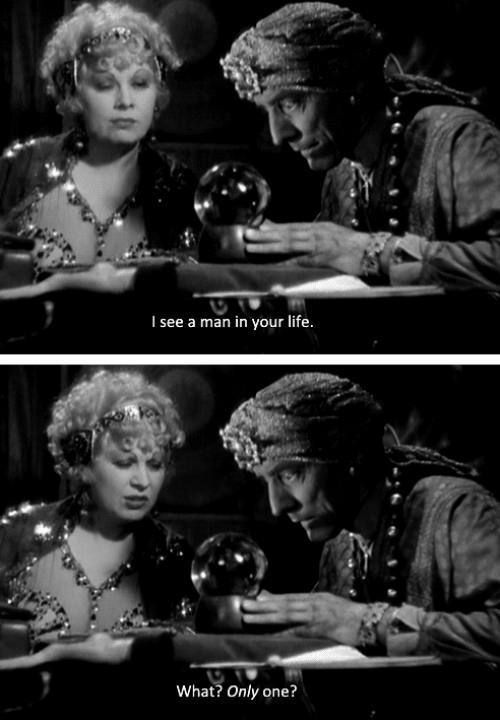
Mae West said it best. Picture by Sophie Charlotte on Pinterest

There are many dimensions to divination, some of which are indeed very deep. However, as far as our relationship with querents is concerned, we are simply an added means of intelligence-gathering, which, like all tools at our disposal, may fail for a variety of reasons, not the least of which is the diviner’s limited knowledge (our knowledge is always limited).

“But I came here to have undebiable, clearcut answers,” one might argue. To which I anwer: Tough titties! If you want undeniable clearcut answers shake a magic eightball. Divination is, quite literally, a divine language, and is not always so cleacut, either in itself or due to our limitations, or sometimes simply because the situation isn’t clearcut in itself. This is especially the case for issues involving human emotions.

As a rule, honesty is the best policy. I believe in voicing my procress to the querent, and the querent has a right to as clear an answer as I am capable of giving them, but we should never feel pressured to give them more certainty than we can truly see in the oracle.

It is perfectly acceptable to talk to the querent about our doubts or about the possible interpretations we are seeing in the oracle. For instance, it is ok to say “it seems like x, but y is also a possibility, while z seems less likely and w is out of the question.” It is also acceptable to say “these cards seem to point to such and such being the case, but I’m uncertain, as this other interpretation might also be right”. More often than not, the querent will say that both interpretations apply, and when this is not the case they can help us disambiguate the oracle.

Ultimately, the fact that divination has no legitimate place in our society implies as a consequence that, because our society believes itself to be held together by reasonable rules and processes, then divination must be either complete poppycock for delusional idiots or it must be capable of unreasonable fits of prowess in other to justify its existence in spite of its current ostracism.

This in turn creates expectations and hang-ups on both ends of the divination process that need to be analyzed and clarified to avoid them subconsciously ruling our practice. Doing so can make divination much more valuable and much more enjoyable.

MQS
On The Way To Follow

Previous / Back to Index / Next

From the Microcosmicon, 35:

Master Feiyu scolded his pupil, Qiang, for consulting the I Ching by tossing coins instead of using the meditative yarrow stalks.

Mortified, Qiang, who’d been deriving great benefit from the oracle, set about manipulating the sticks. He asked if he’d been wrong in using coins. He got Hexagram 7, The Army. Not understanding the answer, he abandoned the divination.

Later he asked again, but tossed his coins instead. Again he got Hexagram 7, which he still didn’t understand.
What Qiang did understand was that there was nothing wrong in his choice of method, but plenty in his choice of master.

MQS

What Makes Readings Go South

A recent comment by a visitor of this website has inspired me to write an article about what makes divination go south, whether it’s card reading or something else. I have already shared one or two readings I got wrong, but in the future I would like to share more of my hardships as well as my successes, for two reasons: 1. it gives a fairer representation of how divination works and 2. it doesn’t discourage those who are studying the material I provide (I often get messages from people despairing they will ever be good diviners)

The reality is that divination is a human activity, and like all human activities it can go wrong. In a world where lawyers, scientists and doctors can be wrong (and not seldom), it’s unclear why we would expect fortune-tellers to be infallible.

There can be a variety of factors that make a reading go south. Here’s a bunch, in no particular order.

The querent is too emotionally volatile

Usually, the querent’s attitude doesn’t matter that much. However, it has been my experience that when a querent is in a state of utter and extreme desperation or emotional volatility, they will skew the reading in one direction or the other. This is rare, but it does happen on occasion. Once a friend who was looking for a job and was absolutely desperate asked for a reading and he pulled ALL spades. He still got a job around a month later. The cards were just reflecting his emotional turmoil.

Emotional involvement is also usually not good when reading the cards for ourselves. My personal experience is that if I read for myself about a topic I don’t care too much about, the reading will be largely accurate, while if I read about something I care very much about, the cards will show me either what I hope or what I fear.

Note though that there are divination tools that work better when the querent is very emotionally involved. This is the case, for instance, for Horary Astrology, where there are no counters to manipulate and therefore a relatively strong emotional push is required for question and answer to align.

The reader isn’t grounded enough

This is more common. Divination is not an assembly line type of occupation. We are dealing with a world that is, in a very real sense, divine and that eschews the mechanic and repetitive.

The diviner needs to be relatively at peace with themselves before performing a divination. I say ‘relatively’ because we don’t need to always be at our best (otherwise we’d never be able to divine). Certainly we need to be capable of detaching at least momentarily from our deepest worries and hopes. Fits of ecstasy and cheap mysticism are also to be avoided, as the best attitude is one of sober helpfulness toward the other.

There are some partial exceptions for ‘inspired divination’, such as mediumistic spiritism, but I don’t cover these topics on this website as I avoid these practices like the plague (I had a distant relative who was an excellent natural psychic and ruined her life in her attempt at constantly staying in the required state of passive receptivity).

The reader simply doesn’t always interpret the medium right

This is obvious, and I’ve talked about it at length, but it bears repeating. Divination is a language with no native speakers. We must learn it as if it were a foreign language. or, if you are romantic about the universe and think divination is our original language, then we must relearn it, but the end result doesn’t change. Like with all secondary languages, we are bound to make mistakes.

The best we can do about it is strive to correct our mistakes and be upfront with our querents that we are not offering miracles but just help in widening their view of their own life, of where it’s coming and where it’s directed.

Drawing wrong conclusions from right premises

This is another important pitfall, and it is a particular variety of ‘not reading the medium right’. As diviners we must understand that certain things can be changed and certain things can’t. Most divination tools are very upfront about it. If they say the thing you want cannot be achieved, then it cannot be achieved (unless we are interpreting the medium wrong, see above). If it says the thing you want will fall in your lap, then it will fall in your lap. Period. But if the medium says what you want is hard, it doesn’t mean it’s impossible, just as when it says it’s easy it doesn’t mean you’ll achieve it.

As diviners, sometimes, we feel we must give our querents more certainty than we are entitled to give them based on our divination tools. If the querent wants to become a writer and the cards show that writing comes easy to them, it doesn’t mean they will become a writer if they don’t put in the effort. Usually, in such cases, the lack of effort does come up in the cards as a warning, so that the prediction will sound like: you are very talented, but unless you actually spend time honing your craft, you won’t amount to much. This, too, is a valid prediciton.

All in all, we must be careful to distinguish what the medium says from what we want to tell the querent.

MQS

The Many Ways of Reading the I Ching

The I Ching (usually translated as Classic of Changes) is primarily known to the West as an oracular book in which people look up answers to their questions after casting a Hexagram. In reality, the I Ching (or Yi Jing, following the newer transliteration) permeates traditional Chinese culture much more thoroughly and its symbols are found in many methods of divination. Here are the most common ones (the list is not meant to be exclusive and it is limited by my ignorance, no doubt).

Zhou Yi (Reading Commentaries)

Zhou Yi means ‘the changes of the Zhou [dynasty]’ and refers to the oracular text we and Legge, Wilhelm, Jung, Philip K. Dick, Aleister Crowley, Ursula Le Guin etc. knew. This is what we usually mean when we cast an I Ching reading in the West (and also in much of the Eastern world).

We flip coins or manipulate yarrow stalks or pick up small handfuls of rice, depending on the method, in order to obtain a symbol made up of six lines that may change or remain stable (solid). The changing lines are then flipped to their opposite (yin to yang and yang to yin) and a new Hexagram is derived, so that we can interpret the initial Hexagram as the beginning of a matter and the final Hexagram as the likely conclusion or result.

We then look up the Hexagram(s) we got, as well as the text pertaining to any changing line, and we patch together an interpretation. This method of consulting the I Ching, which is traditionally called Zhou Yi, is very old and seems to have been the preferred method of interpretation of the Confucian or Neoconfucian school, the semi-official school of the intellectual bureaucracy of Imperial China.

And this school is exactly the one that the Western missionaries came into contact with first and foremost when they arrived in China and started studying Chinese culture. Although compared to other methods of Hexagram interpretation it may seem the most straightforward, it is complicated by the arcane and hermetic nature of the text, which is notoriously difficult even in Chinese, let alone to translate.

Yet I must say that, in my experimentations with the I Ching, the text method has revealed a subtle, beautiful simplicity. Often the answer is very clear and elegant, just clouded by one’s preconceptions.

Mei Hua Yi Shu (Plum Blossom Numerology Method)

Far wackier, but also far more interesting than the text and commentaries method, Plum Blossom Divination seems to have been devised by a Medieval scholar, Shao Yung. This method does not consist in looking up interpretations in an old book (and this probably accounts for the fact that it has fallen out of favor among most Neoconfucians). Instead, it applies certain rules of interpretation to the Trigrams.

The Eight Trigrams are the building blocks of the sixty-four Hexagrams of the I Ching text. They are also found in Feng Shui, traditional medicine and other forms of divination (e.g., Qi Men Dun Jia or Da Liu Ren) as well as in Chinese alchemy, philosophy and magic. They are, in a word, among the most important symbols in traditional Chinese culture. Everything can be categorized under one of the Trigrams.

Plum Blossom Numerology is essentially a form of Trigram divination that interprets the meanings of the eight Trigrams rather than considering the Hexagrams as a whole with their own commentaries. In Plum Blossom, we usually get a Hexagram made up of two Trigrams and we look at how the Trigrams interact based on certain fixed rules such as the five phases theory. In this method of divination we usually accept only Hexagrams with one mandatory changing line (and no more than that), so that the Trigram without the changing line represents the subject, and the one that does change is the object.

What is most interesting about Mei Hua Yi Shu is how we derive the Trigrams. This is done by way of augury. For instance, if you hear a short metallic sound and want to know if this has a particular meaning or announces a particular event, you search your mind for the Trigram that symbolizes short metallic sounds (this would be Qian). To derive the second Trigram, as well as the changing line, you generally take the time of day into account, similarly to horary astrology.

In essence, Plum Blossom allows one to interpret the world around them based on the signals the world sends them in that moment. It is both a very simple method and a very complicated one, because it requires a certain disposition and flexibility of mind that most people only achieve through much training.

Wen Wang Gua

This is, as far as I know, the most complex way of interpreting Hexagrams. To cover it would require much more than a short section in a short article. Wen Wang Gua (usually translated as King Wen’s Oracle) is a form of Chinese horary astrology that applies many of the rules of Chinese metaphysics (Chinese astrology, the Five phases, the Six Animals, etc.) to the interpretations of a Hexagram (usually cast using coins).

It is a favorite among fortune-tellers, and if we were to apply the (faulty) distinction between divination and fortune-telling that is en vogue in the West, we would say that the Zhou Yi, i.e., the commentaries, are divination, while Wen Wang Gua is fortune-telling. This because Wen Wang Gua can often predict situations very specifically, even down to the day or month something will happen.

In reality, the more I delve into Wen Wang Gua, the more I realize that it is as philosophically deep as it is captivating and accurate from a divinatory standpoint. The Hexagram one casts symbolizes the spatial, earth-related aspect of a matter, while the application of astrological rules to said Hexagram allows one to see the connection of the earthly element to the celestial element.

This is the form of I Ching divination I am devoting most of my study, and I will in time present my (very faulty and very partial) understanding of it, not because I consider myself the most qualified, but because I hope to awaken some interest for it in more people who may be more gifted than me and can comprehend its mysteries.

MQS