Tag Archives: how to read the vera sibilla

Vera Sibilla Cards That Indicate Change

Change is a vague concept. Much of contemporary occultism is predicated on the equation of change and stability, so that essentially everything is change. Still, even if we subscribe to this notion, our everyday life is made up of things that change relatively as opposed to things that remain relatively stable. It may be true that my body is a Swiss cheese of chaotic particles constantly being swapped with new ones, but from the standpoint of our daily experience, my body is a relative constant.

Therefore, divination does deal with what changes and what stays the same. Here I talk about cards that indicate change. As usual, the list is not meant to be exhaustive.

Ace of Hearts Reversed – The Conversation

When upright, the Ace of Hearts, aside from being the card of words, represents a relatively stable situation (as indicated symbolically by the table in the image). When reversed, the Ace of Hearts represents change, transformation, revolution. This may be good or bad, depending on the cards that follow.

Two of Hearts Reversed – The House

Again, when upright this card indicates a house, a very stable thing. When reversed, it shows instability. This time the connotation is quite negative, as it can indicate a couple breaking up, a family falling out, and similar situations depending on the other cards. This is rarely a positive card when reversed.

Five of Hearts – Happiness

As I discussed in the article for this card, the Five of Hearts is the card of commitment to someone or something. Traditionally it is the card of engagement, a transition phase between being single and being married. As such, the Happiness card symbolizes a positive, happy transition (when upright). It often rids us of problems and shows fidelity and the ability to honor commitments.

Ten of Hearts Reversed – Perseverance

When upright, the Ten of Hearts represents things that persevere, go on, stabilize. When reversed it shows situations going legs up, becoming shaky or stormy. It is a wildly negative card of volatile emotions and deep instability.

Three of Clubs Upright or Reversed – The Journey

When upright, the Journey card is indicative of travel, that is, change of place. However, it also indicates physical movement, or even mental movement, such as changing one’s mind. It is a card of transition, seen in a neutral to slightly positive sense (but always take the other cards into account). When reversed, the Journey card becomes intensely positive, representing the interruption of negative trends, freedom from addiction or vicious cycles in general. It represents situations starting to evolve in a positive direction, unless followed by very negative cards.

Five of Clubs Upright or Reversed – Fortune

Representing the power of fate in our life, the Five of Clubs is emblematic of strokes of luck, situations taking a different (usually positive) turn, things getting into motion in a positive way. When reversed, the card is slowed down and weakened, and it acquires the meaning of long-term transformations.

Ten of Clubs Reversed – Levity

Much like the Fortune card, the Ten of Clubs reversed represents strokes of luck shaking up the routine, offering us opportunities and chances. Its power, however, is much smaller.

Five of Diamonds – Melancholy

The Melancholy card is rather static in itself, especially when hemmed in by cards indicating a negative situation. However, it can also show situations which were once positive and are starting to show some cracks or situations that are negative but which won’t be negative forever. Therefore, in spite of its mild negativity, often the card implies future change.

Eight of Diamonds – The Handmaid

A symbol of social and personal ascent thanks to its symbolism of the stairs, the Handmaid indicates positive evolution, transition from one phase to the next, entering new segments of one’s life. This is especially true when it shows between cards indicating different situations, or when it shows up at the beginning of a spread. In general it represents positive change.

Two of Spades – The Old Lady

It may seem strange to find the static Old Lady card on this list. However, when we think about it, the Two of Spades is about things that are old and are reaching their natural conclusion. When followed by cards indicating a different situation, therefore, the Old Lady can act as a card of transition (for instance, showing that a contract is expiring.)

Four of Spades Reversed – Sickness

The Sickness card reversed is usually a card of deep stasis and blockage. There is, however, one exception: when it is preceded by negative cards and followed by positive cards. In this case, it indicates the end of the negative situation (tha situation is blocked in favor of what followed.) Of course, when the situation is reversed, i.e., with positive cards before and negative ones after, it shows a change for the worse.

Five of Spades – Death

The most archetypal card of change, the Death card usually indicates a sharp and often difficult cut in one’s life. The result is not necessarily bad, as the outcome depends on what follows. However, since it is a Spade card, it is always difficult and comes at a great price.

Six of Spades Reversed – Sighs

When upright, the Sighs card signifies sighing for something, pining and waiting. It is very static. When reversed, one of its (many) meanings is of showing the end of sighing. This doesn’t necessarily mean you get what you’ve been sighing for. Often, it shows giving up on something and moving on, letting go of it.

Seven of Spades – Tragedy

In spite of its name, the Seven of Spades can indicate a sharp turn for the better if followed by positive cards (if followed by negative ones then, yes, it can indicate being struck by tragedy). What it does imply is that the situation followed by the other cards strikes us from the outside, without us planning it, and usually in a very sudden way.

Nine of Spades Reversed – The Prison

This card acts in very much the same way as the Sickness card reversed. Attention must be paid to the cards preceding and following it.

MQS

Vera Sibilla Cards That Indicate Positive Feelings

In the Vera Sibilla, every card can indicate some type of feelings. I have singled out some of those that indicate positive feelings. As usual, the list is not meant to be exclusive.

Ace of Hearts (A♥️) – Conversation

This card is broadly connected with words and self-expression. However, when discussing someone’s feelings, they indicate someone who is capable of expressing their feelings to someone else and reaching some kind of communion with them. In general, it shows an attitude of openness toward others.

Two of Hearts (2♥️) – The House

Usually the Two is the card of the house and of places in general. However it is also connected with harmony between two people, and it shows a constructive attitude, especially, though not exclusively, in a love reading.

Four of Hearts (4♥️) – Love

The Love card is, wouldn’t you know, the card of love, but also of strong feelings of affection in all personal relationship. It is connected with the motions of our heart, and as such it shows emotions above and beyond reason. The caveat here is that this card is not stable, and it requires other more grounded cards to promise lasting happiness.

Five of Hearts (5♥️) – Happiness

The Happiness card indicates everything connected with joy and good intentions. Being the card of the bethrodal, it also shows a certain degree of commitment to someone, and is therefore also a symbol of fidelity.

Seven of Hearts (7♥️) – The Scholar

The Scholar is a rational card, one of planning and long term prospects. When not damaged by the presence of difficult cards it shows the desire to create something lasting, as well as a helpful attitude.

Eight of Hearts (8♥️) – Hope

Hope is the positive feeling par exccellence. It represents optimism, honesty, someone who takes the high road, is elevated, spiritual, reliable. The exception is when the Hope card is not supported by stronger cards, as in this case it tends to show flirts, due to its connection with ease and lack of trouble.

Nine of Hearts (9♥️) – Faithfulness

Contrary to popular belief, the Nine of Hearts (not the Four) is the best card when it comes to feelings. Not only does it show love, but unlike the Love card, it also represent a strong bond and commitment that goes beyond those feelings and is pursued systematically. It is the card of the diehard supporter, of the best friend, of the lifelong love commitment.

The Heart Court Cards

Court cards tend to be neutral. However, the Heart court cards, when upright, indicate a person who is in love or who has a positive attitude toward the question or the querent.

Four of Clubs (4♣️) – The Friend

Similar to the Nine of Hearts, the Friend can indicate friendship (when it doesn’t show a literal -female- friend). The difference is that the concept of friendship of the Four of Clubs is not as strong and it is often connected with practical matters. When reversed, the Friend card can indicate a helpful attitude that takes the form of tips, recommendations, etc.

Six of Clubs (6♣️) – The Surprise

The Surprise card is connected broadly with things that come to us easily. As such, it indicates people who are similar, have similar interests and find it easy to grow together and pursue similar activities. Relationships tend to flourish with this card.

Seven of Clubs (7♣️) – The Realization

In general, this card speaks of ambitions in a positive sense, so it can show people having common goals and projects.

Eight of Clubs(8♣️)  – The Reunion

The reconciliation card of the deck, the Eight of Clubs is indicative of a willingness to compromise and to find common ground. Furthermore, it shows someone who is social and moves toward others with positive intents in mind.

Nine of Clubs (9♣️) – Merriment

In keeping with the energy of the suit, the Nine of Clubs indicate positive bonds, though not necessarily deep. It is a card of fun and of playing, drinking and having a good time together.

Ace of Diamonds (A♦️) – The Room

The Room has, among its meanings, that of intimacy. As such it represents someone who seeks closeness and contact. However it is not a card of love, as it is in the suit of Diamonds, not that of Hearts.

Seven of Diamonds (7♦️) – The Child

As the card of children, the Seven of Diamonds shows someone to be open, good-hearted and inoffensive, unless with cards that bring out the worst qualities of children (immaturity, etc.). It represents also someone who wants to start new things and is unprejudiced and innocent.

Eight of Diamonds (8♦️) – The Handmaid

This is the card of someone who is serviceable, dependable and hardworking. It is also a card of politeness and the desire of peace. It can show someone of a noble character who is helpful, friendly and improving himself to be better with others.

Two of Spades (2♠️) – The Old Lady

As pretty much the only card of this suit that is not outright negative, the Old Lady can indicate feelings of affection toward others, though these feelings tend to be tenuous and not very dynamic. It can also indicate someone who uses the wisdom and experience they gained in life to be of service to others in a detached, serene way

MQS

When Mothers Smother (Reading example)

When we read for people and they only give us a broad question, I think it’s important to remain open to the twists of fate the cards are showing us, as well as to have an open dialogue with the querent  Sometimes querents lie, but more often they are either confused or fail to focus on the ‘real’ question. In the following case, the querent’s question wasn’t wrong, but it hid more than it showed. The querent is a woman of around 25. She asked me about her career without specifying anything.

A career reading using the Vera Sibilla

The querent is anagraphically covered by the Queen of Clubs, the young maiden, so we can initially assign this card to her. She is reversed, showing trouble.

The first line of the pyramid indicates the influence of a (probably older) woman. She is surrounded by the House and Love, but on the same line we find the Seven of Spades reversed. This is one of the worst cards in the deck, so whenever we see it we must tread carefully.

I asked the querent if an older female relative, possibly her mother, is involved in the issue, and at this point the querent tells me she works with her parents in the family business.

The Seven of Spades reversed represents tyranny and oppression, so I ask her if her mother is somewhat authoritarian, and she confirms. Note though that the mother is surrounded by two positive cards, hence the ‘somewhat’ in the statement. Furtermore, look at the angles of the spread: Good feelings, oppression, but not too much (Butterfly). I am aware that smothering mothers are how some serial killers get started, but this mother, while not positive, could be worse. She smothers the querent out of (real) love. She is oppressive, but not a sociopath.

Be it as it may, the querent clearly suffers from this situation (she is reversed) and therefore hopes to move away (Hope + Journey), as the Hope card can indicate the hopes of the querent or of the person preceding it, which in this case is again the querent. Probably the querent wants to find her sense of self and freedom. This would be understandable even under normal circumstances, let alone in this case. I asked her if she wanted to leave and again she confirmed.

But, woe and alas, look how the spread ends! Money is tight (Money + Sickness) so whatever job she is looking for is going to probably make her start at the very bottom. Thus we end with the Ten of Clubs, the Butterfly. This card indicates all those things that are fleeting and not rooted in the querent’s destiny. Thus her hopes are just fleeting, at least in the foreseeable future, due to the rotten (Sickness) money situation.

MQS

On Readings Without Question

The following is an attempt at reorganizing some old notes I have taken on the subject of divinations without a specific question, adding to them some new insights,

Divination Without Questions Is Possible (With Exceptions)

There is a relatively well-known tarot reader who says that a reading without a question is basically two people talking over a bunch of colored cardboards.

This is not true. It was customary, among old-time fortune-tellers, to have the querent sit in front of them and never have them speak anything that wasn’t their name at the beginning of the consultation. I know for a fact that this is a tradition in the Italian countryside, and I believe it is the case all over the world as soon as one leaves the hipster pseudointellectual tarot community bubble and seeks the real deal.

Let’s leave aside the fact that, technically speaking, there is always a question. Even if the querent sits with their arms crossed in front of you waiting to be astounded, the implicit question is “What’s going on in my life, now and in the near future?”

Times change, and sensibilities change with the times. Many querents nowadays wish to take a more active part in the reading. Furthermore, readings without a question are obviously more difficult, and the modern diviner who doesn’t have time to waste is certainly happy to get more cooperation. I know I do. But this doesn’t mean that a reading without a question isn’t possible.

There are exceptions to this, of course. Some oracles do require a question. Horary Astrology, for instance, usually needs one, and the more specific and focused it is, the better. True, some old authorities give rules for judging “Universal Questions“, but these universal questions were asked back when many people didn’t know their birth time and often had to travel for days to see the astrologer for probably the one and only time in their life, so instead they asked the astrologer to tell them about their future in general in more than one sector of life.

Confronted with the impossibility of looking at the person’s birth chart, the astrologer erected a horary chart for the time the consultation took place, a moment that was probably significant, since the querent had gone to great trouble to visit him. Today, the astrologer is one Zoom call away, so this hardly justifies vague Horary questions.

The peculiarity that makes Horary more sensitive than other oracles is that there is no manipulation of physical counters involved: you don’t reshuffle the planets whenever the querent’s whim settles on a new fancy. Therefore, the question put to the heavens must be meaningful and at least relatively important to the person asking it. In a way, this limitation of Horary is due to Astrology’s nobility, seeking as it does answers from the heavens themselves.

Cartomancy is not noble. It spreaded like wildfire among the lower classes exactly because you didn’t need to have studied trigonometry in order to deal out a spread. Cartomancy is therefore as sturdy as the beasts of burden that the lower classes used in the fields. Like all beasts of burden, of course, cartomancy too has its limits: you can ask random questions (“Tell me about my life. Now tell me about my sweatheart. Now tell me about my job. Now about my neighbor”) but if you abuse it, it collapses to the ground exhausted.

But the fact remains that cartomancy (and tarot reading is a form of cartomancy) is a trusty, resistant beast.

Vague Questions Don’t Necessarily Yield Vague Answers

Another common myth is that if one asks a general question the reader is entitled to give them a general answer. Even worse, some readers say that, in the absence of a question, they can read “the general energies surrounding your life.” The problem is that there is no such thing as a (meaningful) general answer. “Tell me about myself.” Well, you seem to be a featherless biped with one heart, two lungs, etc.

The thing is that when the cards have been shuffled and dealt, they always tell a specific story. Sometimes this story is not what the querent secretly wishes us to talk about, but that’s not our fault–we are merely reading what’s there. Furthermore, we as readers may sometimes not be able to decipher the story in the cards, but it’s there. We may, as a result of our confusion, try to string together the cards in a looser way than usual (“There seems to be a woman next to you whom you love dearly and is going through a rough patch in life. It could be health-related, but I may be wrong. Can you help me with this?”). The cards, however, are always specific, never vague.

As a matter of fact, our life is never vague. It is always made up of details. These details may be mundane, but they are specific. In our life there is never “the general energy of the moment”. You don’t go the supermarket and find the general energy of the moment on sale. There is no such thing.

There is the coffee I’m brewing, the floor I’m sweeping, the feeling of dread I’ve been struggling with for some months, the mom I just talked to on the phone, etc. And the mom I talked to is my mom, not a general mom floating in the world of Platonic ideas. No energy. No universals. Universals are always embodied in our limited existence. I don’t talk to “momness in itself”. I talk to my mom. Therefore, the fact that our querent asks us a general question cannot embolden us to give a general answer, though it CAN justify us in being more cautious and loose in the interpretation.

Again, if we don’t have a specific question, it may be harder to interpret the cards, especially because certain cards together may appear to be open to more than one interpretation if we don’t have enough context.

And here we come to an important point. Some diviners think they need to be able to awe the querent with incredible details without missing a beat and think they should never ask them for clarification. I say that the querent exists in order to be tortured until every last bit of useful information that I need in order to interpret his damn spread has been wrung out of his writhing body, because at the end of the day it’s him who wants to know about his future, not I.

This authoritarianism is all the more justified in case of a general question. I am not going to talk for ten minutes straight without catching my breath only to be told “no that’s not me.” I’d much rather proceed cautiously and ask the querent for clarification step by step (and, if nothing makes sense, start anew).

BUT, the point remains that when we lay out the cards, the cards are going to talk about specific situations in the querent’s past, present or future. They are not going to give us “the general energy”.

MQS

Vera Sibilla Cards That Indicate Groups

There is a number of cards in the Vera Sibilla that can indicate groups or at least hint at them. Each card stresses a different aspect of the experience of groups, and must be read within the context of the whole spread. As usual, this list is not meant to be exhaustive. Context is key.

Ace of Hearts (Conversation)

The Conversation card represents the act of talking, and therefore (except the querent is a lunatic) it implies someone else. It can broadly refer to the ability to express one’s thoughts or even one’s qualities with others, and is a deeply interpersonal card. It also refers to a usually tight-knit group of people, often people living together or family members,

Two of Hearts (House)

The House card does not directly refer to people, but it does refer to a close environment where people either live (a literal house) or are found (any kind of building). For instance, next to negative cards, or if reversed, it can show that the querent isn’t happy in their house, usually due to interpersonal conflict with family members or other people who spend time in that place.

Five of Hearts (Happiness)

The Happiness card can refer to relatives and blood relations or, in general, one’s “clan”. It can be another significator for the querent’s family, but it refers to relatives in a usually broader sense. However, it can also indicate groups of people held together by common interests, a clan of sorts, such as a political party. This is quite rare though. When reversed, it shows trouble with relatives.

Ten of Hearts (Perseverance)

Traditionally this card can refer to the querent’s town or motherland. Occasionally it can show how they are seen or if they are talked about in their town. This is somewhat rare.

Ace of Clubs (Marriage)

The Ace of Clubs represents all official acts binding two or more people together. It is the card of pacts, agreements, marriage, contract, partnerships. It can represent a business where people cooperate in the creation of something (a product).

Four of Clubs (Friend)

The Friend card can refer to a literal (female) friend or relative, but it can also represent a circle of friends, and the idea of a supportive environment where the querent is taken care of in a spirit of friendship or cooperation.

Eight of Clubs (Reunion)

Traditionally this is the card of reconciliation, of meetings, etc. However, it represents also a coming together, and this coming together doesn’t need to involve only two people. It can also more generally represent the querent’s interpersonal skills. When reversed, these skills are not present or are put to the test by difficult people. This is also the “more than one” card of the Sibilla (e.g., more than one job, more than one child, etc.)

Nine of Clubs (Cheerfulness)

This card can indicate one’s wider circle of acquaintances, but in general also friends or groups of people, often not tied by very deep bonds of affections. When reversed, or when near negative cards, it can refer to bullying by other people or serious problems in a particular environment due to being hated. Traditionally it also represented people from the countryside, but this is an older reading.

Ace of Diamonds (Room)

Like the House card, the Room doesn’t refer to people directly, but it can represent them indirectly by pointing to the environment they spend time in, usually an office, a shop or similar.

Nine of Diamonds (The Fools)

This card is the opposite of the Cheerfulness card, and is the only (upright) card that directly points to interpersonal problems, problematic groups, enmity and instability in a group setting and similar situations. It can represent hooligans, gangs, rioters or, more simply, a disunited family.

Three of Spades Reversed (Widower)

In general, the Widower reversed is the card of trauma, of serious loss and of bad behavior. However, it can also point to ritual settings that involve more than one person. The ritual setting needn’t be negative (it can be a christening, for instance). However, with negative cards it can signify dangerous groups, especially sects.

MQS

Spirituality and the Sibilla (Example Reading)

As promised in a previous post, I’m discussing a (rather old) reading on spiritual issues. It is common to believe that the Tarot is better suited to talk about spiritual issues and oracles such as the Sibilla or Lenormand are more useful for practical, everyday events. This is not true. The Tarot can be just as practical, and the Sibilla (and, I assume, other oracles) can be just as clear about spiritual issues. The thing that makes people think otherwise is that they are used to that kind of tarot reading where the psychic spends the whole time pulling pseudodeep psychobabble out of their butt by looking at the pictures on the cards. That’s not a tarot reading, that’s a therapy session (for the reader, not for the querent).

Spirituality is part of real life, and as such all oracles can talk about it, but always in real-life terms. Here the querent was a man and had asked me generically about his spiritual life.

A spiritual reading with the Vera Sibilla cards

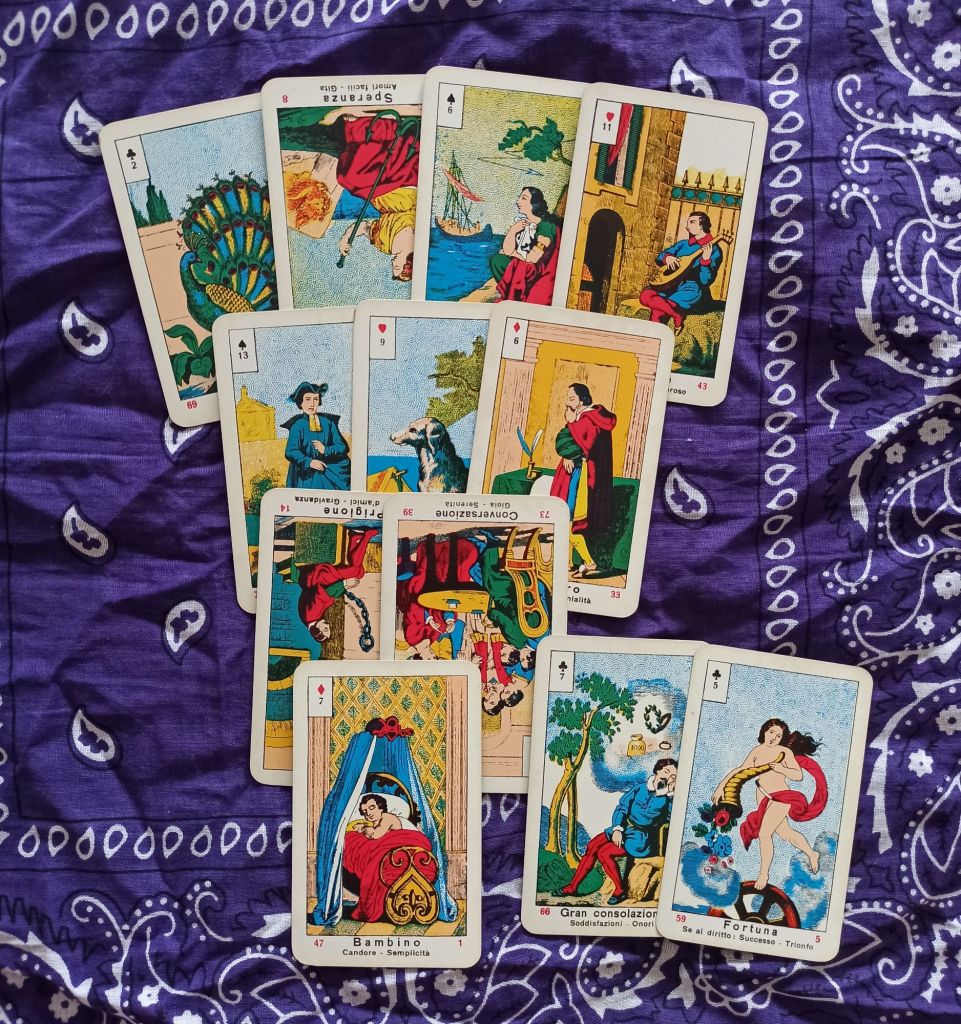
The first thing I was able to detect was the presence of the Priest in the second row. The Priest is usually not a real priest, and rather indicates a figure of authority. We also have, it seems, the significator card for the querent, represented by the Boyfriend, or Jack of Hearts, in the first line. The Priest is accompanied by the Dog/Faithfulness. This is a very good card, even outside of a love reading. It shows that, whoever the Priest is, he (or she) is good, trustworthy and has the querent’s best interest at heart. Furthermore, they are true believers.

The Thought card perplexed me a little, so I skipped over it (though you can see that the Thought card is just under the querent, so it turned out that it was the querent’s thinking process setting into motion). However, I did ask the querent if he was in contact with some kind of spiritual authority and he confirmed it, though he said it wasn’t a traditional priest or minister. This doesn’t matter: all kind of spiritual authorities can be signified by the Priest card.

The querent’s line, the first, has the card of God in it. This is the Peacock (when reversed, it represents the Devil and demons, as well as pride and haughtiness). The Peacock indicates totality, wholeness, miracles, etc. when upright. But it is followed by the Hope card reversed. Hope is the card of faith, but it is reversed, thus showing unbelief.

Yet it is not a clear atheism. Look at the Six of Spades, the Sighs card, right between the querent and the combination of lack of faith in God: the querent is sighing about his lack of faith. He is uncertain and tormented. I remember judging that he was probably a wobbly agnostic, and upon asking he confirmed that he had doubts (I didn’t ask him “are you a wobbly agnostic?” of course. We need to be kind to the querent).

It turned out, the querent had long banished spirituality from his life, had gone for an engineering degree, had been active in the skeptic community online, etc. However, some personal experiences had made him doubt his position.

Look at the last three cards of the pyramid. The Prison reversed shows unburdening, unshackling, freedom, etc. (when not followed by negative cards). Then we have the Conversation card. When reversed, it shows change. Finally, the Child, which shows a new beginning. I don’t know about you, but liberation + change + new beginning sounds like a spiritual conversion.

Furthermore, look at the angles of the pyramid plus the center: the Peacock (God), the querent, the new beginning (Child) and the Faithfulness card. This is a very positive indication.

Still, just to make sure, I asked the querent to draw two cards, and these were the Gratification and Fortune, confirming the good outcome.

As far as I know, the querent has since chosen his spiritual path.

MQS

Vera Sibilla Cards That Indicate Gain

Following up on my previous post about Sibilla cards that show loss, today we discuss the opposite idea, i.e., that of gain. As usual, the list is not meant to be exclusive, and gain is not the only meaning of the following cards.

Six of Hearts (Money)

As the main significator card for money, the 6♥ often shows the querent’s (or another person’s) liquid assets. By itself it doesn’t necessarily show increase of money, but it can indicate that a situation will bring money, and so increase can be implied in the context.

Eight of Hearts (Hope)

The 8♥ can indicate investments, but more in general it shows a favorable situation, so if gain is looked for, it will probably come.

Ace of Clubs Reversed (Marriage)

When reversed, the Ace of Clubs can indicate wealth. However, it is a neutral card, so if followed by negative cards it can point to loss of wealth. By itself it speaks not only of money but of property in general.

Two of Clubs (the Peacock)

Being the talisman card of the deck, the 2♣ represents prosperity. It shows freedom from want and positive situations all around (the Peacock’s wheel is the counterpart to the World card’s garland in the tarot).

Five of Clubs (Fortune)

Both upright and reversed, the Fortune card shows positive situations and movement in the querent’s life, especially as it pertains to finances, so gain is implied. When reversed, the positivity is diminished or delayed.

Six of Clubs (Surprise)

Even in its design the card represents obtaining money. It can shows the querent’s income in general, but more specifically it indicates money coming in, usually without much effort on the querent’s part (it is a surprise, after all).

Seven of Clubs (Realization)

Although this card is geared more toward the querent’s patrimony or realization in the world, it can imply prosperous finances and its power is greater than that of the preceding card. When the 5♣, 6♣ and 7♣ fall together they represents major wealth.

Ten of Clubs Reversed (Levity)

When reversed, the Ten of Clubs indicates the ability to manage one’s finances wisely and to save. It can also represent lucky opportunities to make money, and by itself it can show a small sum of money coming in.

Ace of Diamonds (Room)

This one is a card of material prosperity. When upright, it can represent a well-balanced checkbook or positive upcoming news concerning one’s finances. Reversed it can show the same, but with bad cards it points to mismanagement.

Three of Diamonds (Gift)

It can be a literal gift, of course, but often it represents the act of receiving or being offered something. This can be very comforting for someone waiting for a loan to be approved. It is also a card of luxury, so gain is implied in some way.

Eight of Diamonds (Handmaid)

This one is the card of money coming and going. When upright, it usually shows money coming in, positive financial evolution and ascent. Like the Gift card, the 8♦ can represent the idea of receiving.

King of Diamonds (Merchant)

In the main this is the card of work and career. However, it is still a merchant, so it can be indicative of business, banking and money changing hands.

MQS

Vera Sibilla Cards That Indicate Loss

I’m going to write a few articles on the similarities and differences between cards in the Sibilla deck based on certain topics or concepts. Because I’m a positive person, let’s start with the concept of loss.

This list is not meant to be exclusive (for instance, most bad cards next to the Money card can show loss of money). Context is key, and each spread must be studied as its own thing. Furthermore, loss is not the only meaning of the cards I talk about here.

Five of Hearts Reversed (Happiness)

The 5♥R generally indicates failing to meet aims and failing to live up to promises and commitments. These ideas can easily be what leads to loss, whether material or in the field of relationship (though it also has a strong connection with cheating in the latter field).

Six of Hearts Reversed (Money)

This one doesn’t require much in terms of explanation. The Money card, when reversed, can indicate money troubles.

Eight of Hearts Reversed (Hope)

When upright, the 8♥ is connected with investments (things where there is a hope placed on future returns). When it is reversed, it often shows bad investments causing losses. It also indicates relationships that go up in smoke.

Ten of Hearts Reversed (Perseverance)

Traditionally, the 10♥R is really bad for commerce, as it shows loss of contracts and even of merchandise. More broadly, though, this card bodes ill for anything where you wish for smooth sailing.

Six of Clubs Reversed (Surprise)

When upright, the 6♣ represents a positive discrepancy between effort and returns: you get more than you hoped for based on your efforts. The 6♣R is the opposite: you put much effort into something but get little in return. It also shows excess confidence and ambition causing losses.

Five of Diamonds Upright or Reversed (Melancholy)

In general, this card represents unsatisfactory situations, but next to the card of something we hope to get it shows either we don’t get it or we are unsatisfied with it. When reversed it speaks more clearly of loss and debts.

Eight of Diamonds Reversed (Handmaid)

The 8♦R often speaks of the need of spending money or money going out in general. By itself not a tragic card, but its meaning can be exaggerated by the presence of other difficult cards. It also indicates lack of skill in balancing a checkbook.

Ten of Diamonds (Thief)

Obviously, a thief takes something from us, so we lose that something. The 10♦ represents all situations where we lose someone or something, and if other cards of dubious moral import add their meaning, foul play may be suspected.

Ace of Spades (Sorrow)

The A♠ is a strong card, which can modify most readings for the worse. It represents feelings of bereavement and loss, not necessarily material in nature. If it is material, it is likely to be a big loss, as it will shake the querent to the core, like a letter containing tidings of death (which is what the card represents). When reversed its meaning is lessened.

Three of Spades (Widower)

This is the ‘loss’ card. It represents the notion of ‘without’ and it brings loss to the fore as a concept. The loss doesn’t need to be material, so the 3♠ can show loss of friends or social support. As the title implies, it can show widowhood. When reversed the loss is more traumatic.

Five of Spades (Death)

The 5♠ is similar to the Widower in its depiction of loss, but the loss is sharper and is more likely to radically change (usually for the worse) the querent’s life.

Seven of Spades (Tragedy)

The 7♠ represents disruption, the surfacing of unaccounted or unexpected factors bringing the loss of what we hoped to achieve. As with most really bad cards, the Seven of Spades can add its meaning to other cards to bring most projects to their knees.

Eight of Spades (Desperation and Jealously)

The 8♠ is specifically connected with a crisis in material affairs (though of course it can bring problems to relationships as well). It is not uncommon to find it when the question is about investments or debts, showing a critical situation where the querent must tread carefully to avoid making mistakes they’ll deeply regret.

MQS

Can I Trust Him? Well, Can He Trust You? Vera Sibilla Reading With a Twist

Querents are not always paragons of virtue. There are usually two sides to most stories. I generally distrust people whose past is littered with psychos, crazy ex and narcissists. While someone CAN be that unlucky, the general trend seems to me to be more that people who have trouble in every relationship tend to be the cause of the trouble. “My love life is always a mess!” Of course it is, Rhonda, you are always in it!

As I said, there are usually two sides to each story, but as diviners we rarely hear the other one, so what we are stuck with is the querent’s own version, their word that the universe is constantly conspiring against them and a divination system usually saying exactly the opposite. And we are stuck in the middle of the perfect storm, carefully trying to thread the fine line between politeness and truth.

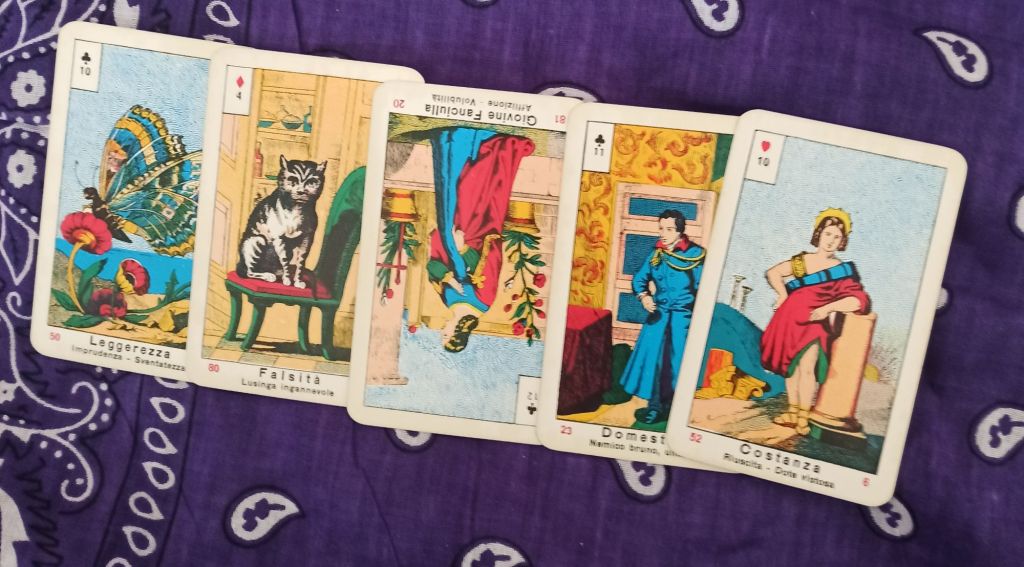
We were at a friend’s house and she had invited over another friend. The latter asked me the question: “I’m always unlucky in love. I’ve started dating this new guy, can I trust him?” Our friend made an odd face I could not decipher as we did the spread. These were the cards:

Is he reliable?

As I already discussed, sometimes the cards describe the development of a situation as if it were a book. At other times, they recreate a scene that can almost be observed with the characters calling attention to what they symbolize. This is one of those situations.

Right off the bat we notice that both querents are present. They are within the age range of the Queen of Clubs and Jack of Clubs. However, the mere fact that they are represented by these cards in a love question shows that this is not the romance of the century and will probably end, sooner or later. The cards, though, tell us something else.

Look at the Queen of Clubs! She is reversed and occupying the center of the spread. Usually, when the Young Maiden (Giovane Fanciulla) is reversed, she is afflicted by something, as opposed to other significators which, when reversed, tend to show problematic behavior.

This is unless the Maiden is reversed and near cards that show problematic behavior. This is exactly the case here. She is together with the Four of Diamonds, the Falsehood card (which, notice, is on her side of the spread, not on the guy’s side) and the Ten of Clubs, the Levity or Carefreeness card.

On the other hand, we have the Ten of Hearts, i.e., the Perseverance card, on the side of the boyfriend. Although the Perseverance card is not one of major feelings, it still shows him to be dependable. She, however, is depicted by the cards as being not only somewhat whiny, but also a little flighty (someone might say a little floozy, especially since she comes up reversed with the Ten of Hearts at the end of the spread)

In this situation, I tried to sugarcoat it to the querent by telling her that he is rather dependable, though this romance was probably not the one that would lead to marriage, and that he also had doubts about her, and that she should make sure not to send mixed signals.

Upon leaving, our friend pulled me aside and she told me that the girl has literally been the “butterfly” of the group, landing from man to man, being unreliable and not learning anything from experience. This is very well described by the reversed Queen of Clubs, who, in a negative context, can show a woman with a princess complex who thinks everyone else is at fault.

MQS

Should Diviners Give Advice? Yes, But…

I come from a rather traditionalist school of divination. One of the ways I learned was that my teacher often told me to do a spread on an aspect of her past I knew nothing about to see if I managed to discover what happened. Another way was when she told me to do a spread to see what would be the problem of the next person going to her for a reading. Interestingly, I have met other people, who have taught me other techniques, who used the same method.

As can be expected, there was little room for anything other than the literal interpretation of the cards. This has helped me a lot to remain  with my feet on the ground as I forged my path, which is very good, considering how littered with nonsense the esoteric landscape is.

On the other side of the spectrum you have a sizeable chunk of diviners today, though the situation now is slightly more balanced than it was just twenty years ago. These readers simply interpret the cards (or the planets, or whatever) as if they were benevolent tips from the universe about some inner issue that the person needs to work through to progress.

The problem I have with this approach, aside from the fact that it leads to unverifiable predicitions, is that it presupposes a superstitious view of the universe as some kind of benevolent nanny that teaches you how you ought to behave. These people, I should remind you, are the ones who often loathe Christianity as a bundle of silly dogmas and think they are the reasonable ones.

If there is one thing that my study of philosophy as well as my experience as fortune-teller has taught me is that there is no such thing as an ‘ought’. There’s what is and what isn’t, what was and what wasn’t, what will be and what won’t be, as well as what can be, or is more or less likely to be. For instance, there is no way you ‘ought’ to eat. You either eat well or you don’t. Eating well only becomes an ought when your current diet is checked against your desire to minimize health risks. It’s your desires that create oughts, not the universe.

I already discussed how I believe that divination tools are essentially something that gives us a bird-eye view of existence, affording us a glance at a number of considerations about our situation that we might not otherwise have. To use my old analogy, it is like being in a crowded city center and talking to a person on a walkie talkie, this person looking at your position from the top of a skyscraper and therefore seeing things you cannot see.

It goes without saying that I believe divination tools never give advice.* As maps, they simply tell you what is. Advice is contingent on what either someone wants to do or what they believe a superior authority wants them to do. My view of the superior authority is that it is too occupied exploring all its potential through us to pick and choose what’s best for us.

Does it therefore mean that a diviner should not give advice? I actually believe advice is a perfectly fine thing, as long as it is not delusional advice. I think a good divination session should always be of help to the querent in living their own life better. This is done by checking the querent’s wishes (sometimes implied, sometimes stated outright) against the wider situation as portrayed by the oracle, with its potentials, its risks, its possibilities and impossibilities, its certainties and its uncertainties.

In other words, advice must come from the diviner on the backdrop of the oracle, and not be projected onto the oracle, which just pictures reality as it is, not as it should be (because there is no way reality should be, from an objective standpoint). Sure, sometimes I tell my querents “the cards are advising you to do X”, but this is short for “I am advising you to do X based on what the cards are telling me about your situation.”

Sometimes the right bit of advice at the right time can help the querent make a turn for the better in life. These are the readings I love the most. Sometimes it can improve a situation. Sometimes, though, the advice is not enough to change an objectively difficult situation. The more heroic and nietzschean reaction to these slings and arrows that life throws at us is that of amor fati: in knowing what’s coming, one can learn to love it, thus overcoming it, making it part of oneself instead it being an alien destiny. But this is not always possible. Sometimes, all the querent can get from a difficult reading is peace of mind. And peace of mind is a great thing, all too often undervalued until it’s no longer there.

MQS

* In this, divination tools are very different from inspired divinations caused by spirits or deities, since these actually do have their own particular views and preferences.