Tag Archives: how to read the vera sibilla

Vera Sibilla Cards That Indicate Ambiguity

There is a number of cards in the Vera Sibilla that can indicate ambiguity and unreliability. As usual, context is key, but the following ones are the most common.

Four of Hearts Reversed – Love

As I discussed in my recent video about the Fours, traditionally the Four of Hearts is the card of homosexuality. And it can still mean that in particular situations, but more broadly, aside from the other main meaning of ‘lack of love’, it can also indicate an unhealthy approach to love (hence the XIX century association with homosexuality). An unhealthy approach to love can also involve secret perversions or cheating, so the Love card reversed can be an indicator of unreliability in love.

Five of Hearts Reversed – Happiness

Being a card that represents more than one person, being in the suit of Hearts and being reversed, the Happiness card can indicate betrayal. However, traditionally, this more commonly refers to relatives (since the upright card can stand for relatives in a neutral sense). It can show disharmony among relatives, and relatives you must guard against, especially with people cards next to it.

Seven of Hearts Reversed – The Scholar

Upright, the Scholar is a symbol of the positive use of the intellect in a creative or constructive way. Reversed, the card can symbolize nonsensical or useless abstraction from reality, impotence (in all senses) but also the negative use of the intellect. Hence, the card can indicate ulterior motives and a sneaky disposition of character.

Eight of Hearts Upright/Reversed – Hope

The Hope card has many spiritual and moral virtues, among them that of choosing the high road and doing what’s good. When the card is next to cards of ambiguity, or when reversed, it can stand for someone who is extremely fickle and even promiscuous in love.

Nine of Hearts Reversed – Faithfulness

Upright, the dog symbolizes fidelity, friendship, sincerity in the affections. Reversed it can, quite literally, indicate unfaithfulness. It is also the proverbial dog biting the hand that feeds it, showing ungratefulness, anarchy, rebellion.

Ten of Hearts Reversed – Perseverance

Upright, the Ten of Hearts can indicate a stable, reliable character. Like the dog card, it reversed this symbolism when reversed, showing situations that are not stable, but also people who are unreliable.

Two of Clubs Reversed – The Peacock

When upright, the card emanates the positive energy of the peacock symbolism, showing beauty, marvel, art, beauty, completion, immortality. Reversed, it takes on its more sinister characteristics: vanity, being full of oneself, being blinded by one’s ego, which can all of course make us unreliable.

Ten of Clubs – Levity

The butterfly symbol speaks for itself. It shows someone who is fickle, not thorough, changeable, too easygoing or carefree. Still, the unreliability indicated by this card, unless supported by cards of dubious moral character, can also be of the innocent kind, due to superficiality rather than to some grand secret plan.

Four of Diamonds – Falsehood

The cat card is obviously the opposite of the dog: it indicates everything that isn’t as it seems, and so is the card of lies and cover-ups. But don’t go crying foul too easily: this is also the card of everything that is wrong, and so it also covers such things as mistakes and oversights. Still, it is never good when coming up next to a significator.

Six of Diamonds Reversed – Thought

Somewhat similarly to the Scholar, the Thought card is connected with what goes on between one’s ears. When it is reversed, the card indicates negative thoughts, which must be understood broadly to signify negative thinking or the thought of doing something negative. As such, if a significator comes up with the Thought card reversed after it, look at the other cards to see if they are feeling down, are deluded or a plotting something.

Seven of Diamonds Upright/Reversed – The Child

The Child card is neutral and has many positive undertones, but it is also card of immaturity. If it comes up upright with cards that highlight this side of its symbolism, or even worse if it comes up reversed, then you may be dealing with people who are not mature enough to be trusted, in whatever sense that might be meaningful in the context.

Eight of Diamonds Reversed – The Handmaid

Upright, the Handmaid is a card of morality and education. But when it is reversed, it becomes a card of the shallow trashy character that you should not take seriously. It can stand for someone who will betray your confidence.

Ten of Diamonds – The Thief

Obviously, the Thief is the card of betrayal par excellence. It always shows something that sneaks into a situation to ruin it from the inside. A person card with the Thief card next to it should make you think twice about trusting them.

Six of Spades Reversed – Sighs

The Sighs card is complex in its meanings, especially when reversed. Its broadest meaning is that of “no sighs”, so it can be good. But this can also signify that someone is not losing any sleep over the evil they are concocting, and so it can be a symptom of an unscrupulous character. This submeaning of the card usually emerges when other cards of similar signification are next to it.

Nine of Spades Reversed – The Prison

As with the Sighs card, the Prison reversed can be positive, as it shows freedom, being unchained or unburdened, repentance, and similar concepts. But with cards of dubious moral character it can indicate that someone is unhinged, lacking restraint and giving into unscrupulous ambitions.

Ten of Spades Upright/Reversed – The Soldier

The Soldier is the card of the night, and of everything that happens at night, including shady dealings. Because of this, especially when reversed, it can sound the alarm on the fact that something is going on behind your back. A person card next to the Soldier reversed is rarely someone you can trust.

People Cards

The general rule is that a person card reversed is either suffering or is against the querent. Especially the Heart court cards must be treated with caution, as they can become traitors and cheaters. It goes without saying that the two Enemy cards already have this potential indication baked into their upright meaning.

A Warning

You may have noticed that a lot of cards in the Sibilla can indicate unreliability. Follow these indications strictly and you’ll go around accusing everyone and their mother of being a cheater and a fraud. Interpretation is never a matter of a single card: it is important to see if cards of similar import accumulate, how the court cards relate to them and if there aren’t more likely explanations.

MQS

How ‘Topic’ Cards Behave

In every deck there are what we might call topic cards, that is, cards that represent a specific field of life: family, work, money, health, love, the law, etc.

All or most of these cards also have general meanings that apply to various contexts. For instance, the Ace of Cups in the Bolognese Tarot is the home card (just like the Ace of Hearts in playing cards or the Two of Hearts in the Vera Sibilla), so it is the topic card for everything relating to family and house questions. But it can also indicate that someone belongs to the family, e.g., when it comes up next to a court card. It can also indicate the inner side of one’s experience of life, one’s inmost, intimate world, etc. So it can also show that something is close to us and touches us.

We need to distinguish between a card acting as a stand-in for a specific topic and the same card acting out a particular meaning. To keep with the Ace of Cups example, when it comes up in a question about work, it might show that the querent’s work life interferes with their family life or vice versa, or that they work from home, or that their work environment is family-like. In all these cases, the house card qualifies the other cards by adding details of its own.

But when the House card is simply a stand-in for the topic ‘home and family life’, the card says nothing about the topic itself. It doesn’t qualify the reading. It simply tells us, “this is the topic.” It is then the role of the other cards to describe the situation, qualifying it in a positive or negative way.

When we are doing a general reading with no question, or with all the cards down on the table, this is all well and good: we see if the person’s significator is next to any of the topic cards, showing that that topic is important, and then we read the cards surrounding the topic card relating them to the topic.

When the question has been specified, though, extra care must be taken trying to figure out if the topic cards that appear are qualifying the topic of the question or if they are coming up to ignore the question and talk about something else. This is not always easy.

Let’s say you asked about work, but the house card comes up. Why? Is it because the home is involved? Or is it because the cards have decided to bypass your question and discuss something else? Or is it both? (It CAN be both). One way to solve this issue is to see if there are topic cards relating to the question, or if at least the cards seem to be predominantly of a nature that seems more akin to the question asked (e.g., lots of Diamonds and Clubs in a work-related question).

The other way is to see if the cards next to the rogue topic card coalesce with it to form a coherent statement that has nothing to do with work, or if instead the topic card allows itself to be absorbed into the querent’s question.

The third way is simply to work with the querent. This is always a good idea. After all, our aim is to interpret the oracle correctly, not to impress people.

Cards that have the potential to be topic cards are always quite strong in a reading, so it is always good to observe them first. Often they form focal points in the interpretation of the spread. Sometimes some cards in some readings can even be ignored, but topic cards always seem to have something to say. We ignore them at our peril.

MQS

Was That On Purpose? (Example Reading)

This one’s a quickie. A friend of mine who tends to take things way more seriously than she should asked if the boyfriend had really misplaced the small gift they had bought for her mother or if he had hidden it out of spite (he doesn’t like her mother). Knowing the dude I was quite sure she was overreacting. Still we asked the Sibilla:

Vera Sibilla reading: was that on purpose?

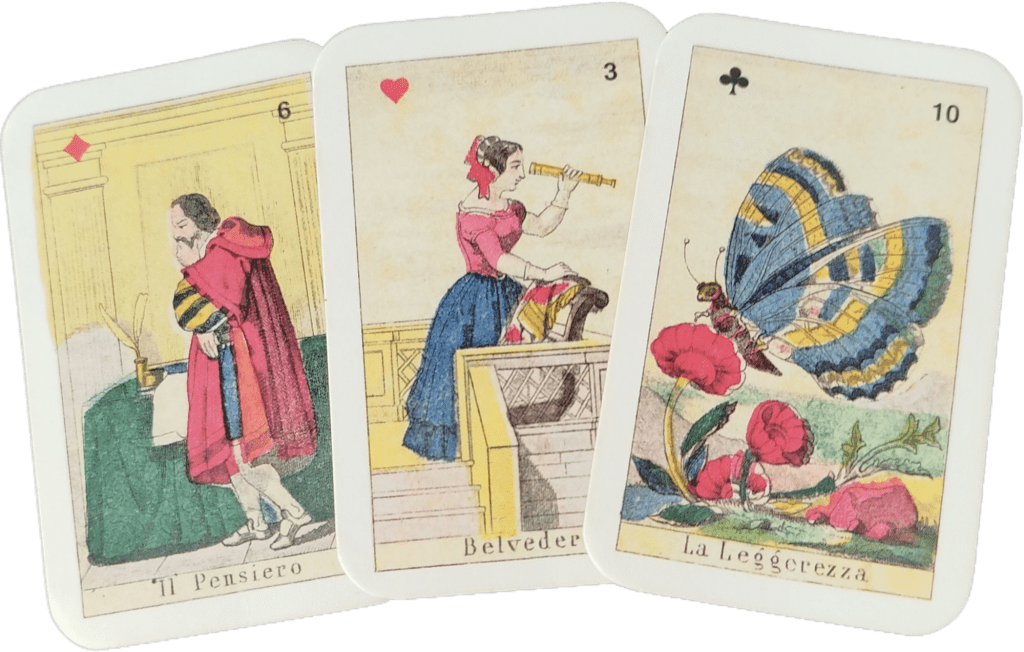
The Thought card is indicative of someone’s inner reality (their thoughts, plans, character, proclivities, etc). Since we asked about the boyfriend’s intention, the thought is his. The Belvedere card is usually associated with the arrival of something. However, it is also the card of sight. Next to the Ten of Clubs, which is a card of carefreeness, this seems to point to an oversight.

It turned out the gift had been left in the car, where it had lodged itself between the the two front seats. As silly as the reason for the reading is, it’s nice to have the cards confirm our suspicion.

MQS

How to Work With Wrong Readings

I had a nice exchange with a visitor, who asked how we can work with the readings we get wrong, so that we can improve our skill.

The first thing to take into account is that this is not always possible. We may say that we are accurate because 80-90% of our assertions end up being true, but that is calculated on those assertions for which we get feedback, and we don’t always get feedback.

Here, too, there is a lesson, I think: all we can do is be as good as we can be at the particular moment in which the reading takes place. If we think an interpretation is viable, there is no point in withholding it out of fear that we might get it wrong (unless the topic is sensitive and we choose to stretch the truth to avoid hurting the querent) because we might not get another chance to say it.

What happens after the reading is that some querents simply forget about it. Too many querents think that a reading needs to come true within a couple of weeks, when in fact it often takes months, so after the initial excitement (or dread) they simply move on, and they may only be reminded of it when it comes to pass, if at all.

Other readings are correct, but the querent thinks that’s just regular business, so they don’t bother to tell us, while other readings are wrong, and the querent either rubs that in our face as publicly as possible or they don’t talk about that anymore, thinking we are beneath them.

Then there’s the readings for which we do have feedback, which can be very positive (“everything was spot on, and you’re also kinda cute”), very negative (“it ended up being the exact opposite of what you said”), or mixed (“this and that came to pass, but this other thing not yet”).

Even the feedback we get needs to be taken with a grain of salt. Positive feedback can sometimes be a mix of wishful thinking and the desire to please, while negative feedback can sometimes be a mix of delusion (you said he wouldn’t call and he didn’t, but I know he loves me, so you’re wrong) and desire to hurt.

So, what do we do with the feedback we are given, if it is negative? The reasonable thing to do, in my opinion, is to check the spread (I usually take pictures and/or notes) and see where we might have screwed up.

Was there a point in the spread where the cards were a bit ambiguous and we forced the reading in the wrong direction? Was there a huge, smacking-your-forehead blunder? You simply cannot see what went wrong? Take notes on the reading. If you don’t think you can formulate a definitive theory on what went south, don’t. Leave things hanging. Add ‘maybe’ and ‘possibly’, and see if there are other readings you did on similar issues that can help you.

Even when going back to an older spread, we should never force it to say what the feedback said, if we just don’t see it: firstly, because, as I said, even feedback that exists must be treated with caution; secondly, because there is a tendency to want to read details into the reading that we would never have been able to guess beforehand, and that’s not divination.

Broadly speaking, the feedback we get, positive, negative or mixed, should be treated as raw data that needs to be studied carefully. That’s where a lot of growth can take place. Be especially thankful for mixed feedback, as usually it is the most honest kind: we rarely get 100% of the things right, either in our description of the past/present or in our predictions. As fallible humans, getting many things right many times should be enough to satisfy us, especially since we are doing something most people consider impossible.

MQS

Fixed Significators and Modern Issues

Some decks have variable significators, while others assign certain cards to always represent the querent and their partner. This can cause confusion when reading for people who would not have lived their life out in the open back when cartomancy emerged, such as gay or trans people. Following are some experimental notes on how to deal with such instances in the various decks I use.

I want to stress that these are based on my practical experience, not on that of someone else and not on some theory I am trying force onto the cards. My aim is to improve my accuracy as a diviner, not to pontificate on academic eventualities.

Vera Sibilla

The Sibilla doesn’t have fixed significators, meaning that the querent will, if at all, be represented by a court card that indicates their role in the situation and/or society at the moment of the reading, always compatibly with their sex.1

And this is already problematic nowadays. I haven’t read for too many trans people, but I have noticed that if the person has either transitioned, fully or in part, or has at least adapted considerably to the other sex, then they are represented by a court card of that sex (ftm as a male, mtf as a female).

To be blunt: Jane, cashier, who has been living as Jane despite being born as Jim, and lives out her concrete life as Jane, is described as a woman in the cards, although the cards may hint at the transition, if relevant in the context; Jim, cashier, who would like to become Jane and maybe one day will, is represented as a man, even if he’s started to play with makeup since watching Myra Breckinridge; Becky, professional TikTok cheese grater, special traits no personality, who thinks an androgynous look makes her stand out, still comes up as a woman even if she pretends to identify as a man on every day with an R in it.

This has nothing to do with politics or tolerance or “passing as the other sex” and everything to do with concrete life: divination mirrors life, but social media clout simply doesn’t transfer to the cards, and there’s nothing I can do about it, even if it may offend some. The good news is that indentification with a significator is just a divinatory device and lasts only for the fifteen minutes needed to conduct a reading, and then is over.

IMPORTANT: we are talking about trans people, not crossdressers. A crossdressing man is a man who cosplays as a woman for whatever reason, but remains a man and lives as a man, at least until that fake business trip to Atlanta that his wife knows nothing about.

Talking about gay people, the Sibilla is very straightforward. In the few readings I do for myself, I usually come up as the Boyfriend, my husband as the Gentleman, and some years ago I came up as the Helper and my husband as the Boyfriend.

As for “but what about…” particular cases about any of the identities that are created daily, the best I can offer is: I’ll cross that bridge when I get to it. I trust the cards to simply describe the situation as it is and I accept the risk of not being able to understand how complex it may be, either in reality or in someone’s perception.

Playing cards and Bolognese Tarot

In some systems of cartomancy with playing cards, significators are not fixed. The way I was taught, though, the male querent is the King of Clubs and the female querent the Queen of Clubs, and the other card is the person they love. Similarly, in the Bolognese tarot the male querent is the King of Wands and the female querent the Queen of Wands.

For trans people, I think what I said about the Sibilla still holds true. Again, all I can say is to keep your mind and your eyes open (on the cards, I mean. Looking if the querent has an adam’s apple doesn’t count.)

For gay people, I have generally found that a degree of flexibility is required on the diviner’s part. Some readers seem to believe that you can just dictate to the cards how to behave, including in the case of gay querents. If that works, then bully for you, but I have always found the cards to have a mind of their own, regardless of the conventions we try to establish for them, so all I can do is be flexible.

Some people think the querent is represented by the court card of their gender, the partner by the other main significator, regardless of their sex. This theory is predicated on the fact that the two main significators are meant to show those people, and the fact that they are of two different genders is accidental or a matter of historical bias.

This may sound convincing, but have I found it to be true in practice? Sometimes. Sometimes the partner will come up as the other Club/Wand figure and there is simply no way of interpreting it other than as the partner, even if the stuff under the dress doesn’t match. Sometimes the cards will represent the partner as a court card of another suit that matches them. Sometimes the cards will throw in both cards for good measure: hubby has come up as the Queen of Clubs + King of Hearts together on more than one occasion in the past. Talk about a big personality.

Tarot

This is like the Sibilla, and doesn’t require much discussion. The male querent is usually the Emperor or the Pope, the female querent is usually the Empress or the Popess. Two men in a relationship can be shown as Emperor and Pope.

MQS

  1. I am aware of the difference between the word ‘sex’ and the word ‘gender’, but I am going to use them quasi-interchangeably to avoid too many repetitions that hurt the ear. ↩︎

Three Decks For One Inheritance (Example Reading)

We did a little experiment with a friend. She wanted to know if the bureaucratic process to get the inheritance from the recently deceased grandfather would finally come to an end, since there had been several delays (leave it to the Italian bureaucracy). We started with the Sibilla.

Sibilla

A three card reading with the Vera Sibilla

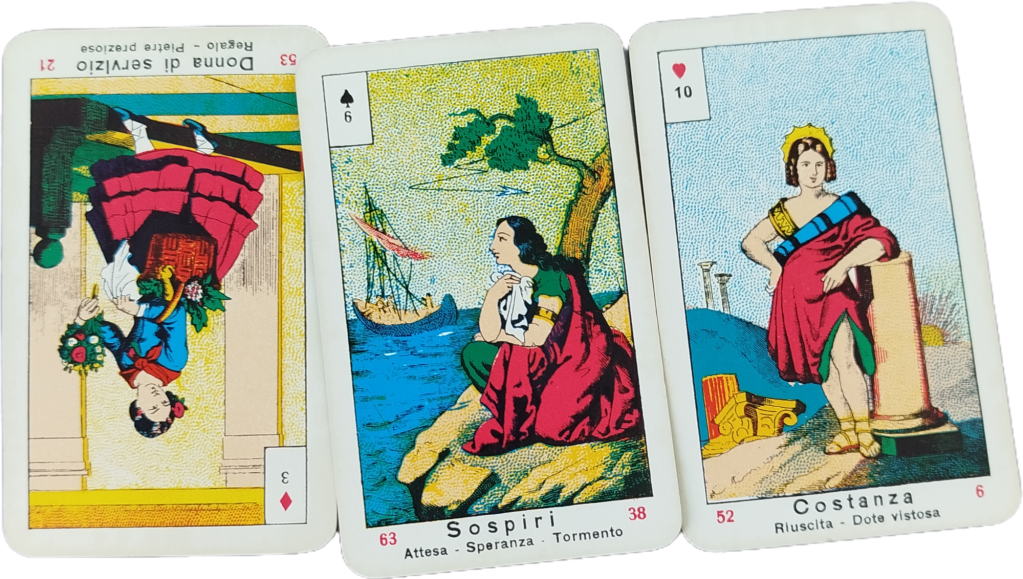
In this case, the Handmaid reversed indicates money going out (of the querent’s wallet). The Sighs card simply indicates that the person worries they’ll have to pay money. The Ten of Hearts here is not a positive influence, because it is a card that makes the uncertain certain (in the context of a trial, for instance, it might indicate the sentence being decided). So in this case the worries shown by the Sighs are confirmed.

I asked my friend if she was worried about having to pay some extra money, and she said that this was her and her dad’s worry, but that they had looked into inheritance law and thought they were safe and wouldn’t need to pay . Clearly the Sibilla begs to differ.

Playing cards

A three card reading with regular playing cards

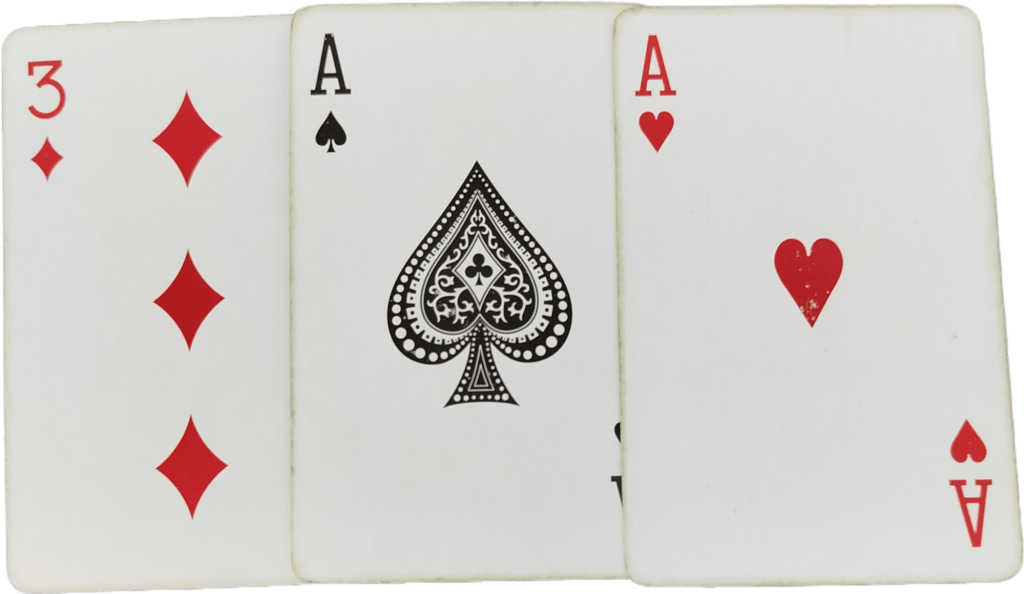
In this case we don’t have the querent’s state of mind (which the Sibilla talked about). However, we do have, once again, the loss of money, indicated by the Three of Diamonds being covered by the Ace of Spades. The Ace of Hearts shows us that the money going out is due to family issues, something which was absent from the Sibilla.

Skat cards

A three card reading with the Skat / Piquet deck

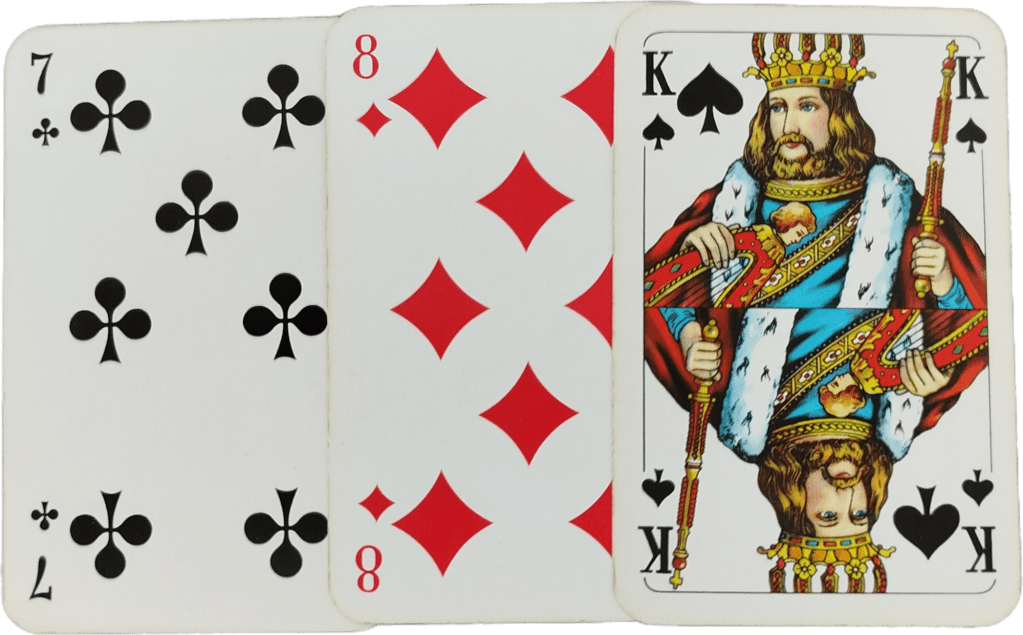
I decided to make an experiment with the Skat cards as well, just for kicks. The Eight of Diamonds is technically the card of work. However, if I understand the meanings correctly, it represents work because it shows the flow of money, money being exchanged. So it can represent, more broadly, the economy. With the Seven of Clubs, which indicates tears, the economy will take a hit. The King of Spades might be the office worker who will give the querent the news.

A week ago they received news that they needed to pay an extra 3000€ to unfreeze the granddad’s money. My friend doesn’t know if the office worker who worked on their case was a man (the King). Still I think the Skat cards were rather accurate.

MQS

Making Sense of Daily Readings

Daily readings are not my passion. Divination moves from the assumption that something is going to happen. But life is full of uneventful days, where time seems to stand still. Yet the oracle must necessarily tell us something, for the simple fact that we allow it to speak.

This is not to say that the cards (or other means) don’t mean anything, but often we need to tone down the interpretation to such a degree, or retrieve such inconsequential shades of meaning that, unless you are a god of divination, you aren’t going to be able to consistently predict much, and I am definitely not a god of divination.

On the other hand, daily readings can sometimes be easy to read into once the event has come to pass (see my recent example). Reading into the oracle always leaves us in danger of deluding ourselves. The question I always ask myself is: would I be able to see it if I didn’t know it? Often a vaguer prediction that is true to what we can see in the cards is preferable to a highly detailed account that simply regurgitates what we already know or what we have been fed.

Still, sometimes we can afford the luxury of reading-into after the fact, and daily readings can be one such instance, because at least we can learn something, if we are careful. In the example I posted about the pregnancy, the three cards, called at random to disclose a daily influence, could have meant a variety of different things, but news about a pregnancy is without a doubt one possible interpretation. Furthermore, sometimes if we know that something is bound to happen, we may gauge by the daily reading if it is likely to happen on a particular day, or if it is going to go well.

Another thing to consider is that limiting the timeframe is always somewhat arbitrary. Do you seriously think that if you ask the cards what is going to happen this week and in ten days something terrible or wonderful is bound to happen the cards are going to keep quiet about it? Just because you told them to keep it within the week?

Often, if you pull daily cards, a major event or major influence or vibe shift will start manifesting in the cards many days in advance. A romantic reunion happening next week may start manifesting with cards of love now, even if today or tomorrow aren’t especially romantic days.

What I personally prefer to do is occasionally pulling three cards for the day, while knowing that they may describe something happening further along the way. By occasionally I mean every two or three weeks, rarely every week. That way the cards are usually more meaningful than if I stress them every day on how the day is going to go. This doesn’t mean I’m going to be able to predict something, but the careful, tentative reading-into is going to be more certain and less based on wishful thinking.

MQS

Cards That Change Topic

In the latest reading I presented, an interesting phenomenon occurred. At some point during the reading, two cards came up that seemed very negative, but which actually had nothing to do with the reading in itself. Instead, they simply acted as some form of punctuation. This happens especially with simple methods like the one I used, called ‘alla zdoura’ (literally, ‘method of the housewife’, or ‘like the housewives do it’ in dialect), where we start with a very limited number of cards, usually one, two or three, and then we keep adding them without following a specific layout.

In this type of reading, if the cards need to signal that we are changing topics and moving on to a new one, they may use cards or combinations that show an ending (sometimes even just the Death card). Of course, I had a huge deal of luck in this reading, because it came up clear. It isn’t always like that. Often, these combinations look really bad, but if we look around we see that they feel out of place.

In playing cards, the same can happen when the Four of Spades and Five of Spades, or the Ace of Spades, or the Five of Diamonds come up. Usually, in these situations, it pays to zoom out of the reading and catch the general flow of it: it will become apparent, generally, whether these cards are part of the reading or if they act as punctuation. 

I am also experiencing a similar phenomenon while experimenting with the Bolognese tarot. For instance, in the first few lines of a thirteen- card spread, it may happen that the Angel and Death cards come up together, and then the cards seem to discuss other topics. In this case, the cards seem to be answering the question positively and quickly, only to introduce new discussions. At other times, the Queen of Coins comes up to say “and that’s the truth about it, period.” or the Justice card, to say “and that ok the way it is.” Of course, I need to experiment a little more, especially to see if apparently negative combinations can act in the same way.

MQS