While in Italy for the holidays, I retrieved my first notes from when I had started learning cartomancy from the person who taught me to read playing cards and the Sibilla. It’s just a couple of loose sheets on the basic meanings of the playing cards, the main combinations and two spreads (the row of cards, hardly a spread at all, and the cross).
This brought back so many memories of that period, but most of all it reminded me of how eminently practical divination used to be before its current glamorization. Of course, over time I learned a lot more from that lady than what is on that couple of now yellowed sheets, but the core of the system is there, and I believe she must have passed it on to me in no more than two sittings, if not just in one.
People who spend their time musing on the arcane meaning of the splotch of color on this or that card in the latest glossy and overly ornate oracle deck may laugh at how bare-bones that system is, but they would forget what significance divination had for the regular folks that used it to solve everyday matters.
Folk systems of fortune-telling, especially by cards, were designed to be quickly memorizable in their main lines, because they formed part of every housewife/househusband’s toolkit of remedies to the difficulties and uncertainties of life.
When an elderly person passed their meanings on to you, they did so not to introduce you to a different world detached from the real one, where you could dilly-dally with pleasant platitudes, but to send you into this life with another string to your bow. In principle, they revealed their system to you for the same reason that they taught you how to make preserves and liquors and how to best cultivate your garden.
Folk fortune-telling, in a word, was just another traditional remedy to the complexities of life. It did not involve stepping into a different plane of existence, because the everyday one was already enough, and it was looked on with the same pragmatic, solution-oriented gaze that was cast on all other problems people faced back in the day. “Don’t forget to add a small pinch of sugar to your tomato sauce. The Ace of Spades is a thorn in the heart.”
This is an attitude toward life that is hard to recapture nowadays. The idea of divination being useful has been so utterly eradicated from our mind that, when we approach it again, we do it as if it were an exotic, quaint, arcane world separate from our own. Our immediate reaction is therefore to keep it separate from our life, divorcing it from veriafiable prediction.
This stance is fatal, because it implies that our world is not inherently meaningful as it is; that meaning is found elsewhere and cannot be reconciled with our real life; that in order to find it, one must learn to look at one’s everyday struggles as illusions or as silly preoccupations not worthy of the attention of those in the know about the cosmic mechanism. All this ends up debasing both life and divination, because once life is debased, divination, which is the language of life’s drama, becomes a meaningless mirror only reflecting vague vapors.
(Note: this is a collection of the meanings attributed to the cards by some occultists in the past centuries. It does not reflect my own study or opinion of the cards. It is only meant as a quick comparative reference as I develop my own take.)
The Queen of Cups from the Builders of the Adytum (BOTA) tarot deck
Paul Foster Case (and Ann Davies)
The time period is the beginning of the last decanate of Libra to the end of the second decanate of Scorpio, October 13 to November 11, combining the rulerships of Mercury, Mars, Jupiter and Neptune. Well Dignified: through the influence of Mercury in Libra the Queen of Cups personifies a woman, mentally alert, yet somewhat superficial, who probably has a touch of the poetic in her nature. She is kindhearted though not likely to go to too much trouble for anyone. The Scorpio influence added gives her strong desires and makes her emotionally responsive and attractive to the opposite sex; very psychic, and if her hig he r nature is developed she depicts a very powerful spiritual force akin to the influence of the purified desire nature and the influence of Neshamah. Ill Dignified: a woman who is subtle, decidedly coquettish and may even be a deliberate heart-breaker. Usually gold-brown hair with blue eyes. (From the Oracle of Tarot course)
A. E. Waite
Beautiful, fair, dreamy–as one who sees visions in a cup. This is, however, only one of her aspects; she sees, but she also acts, and her activity feeds her dream. Divinatory Meanings: Good, fair woman; honest, devoted woman, who will do service to the Querent; loving intelligence, and hence the gift of vision; success, happiness, pleasure; also wisdom, virtue; a perfect spouse and a good mother. Reversed: The accounts vary; good woman; otherwise, distinguished woman but one not to be trusted; perverse woman; vice, dishonour, depravity. (From The Pictorial Key to the Tarot)
Aleister Crowley
The Queen of Cups represents the watery part of Water, its power of reception and reflection. In the Zodiac it rules from the 21St degree of Gemini to the 20th degree of Cancer Her image is of extreme purity and beauty, with infinite subtlety; to see the Truth of her is hardly possible, for she reflects the nature of the observer in great perfection.
She is represented as enthroned upon still water. In her hand she bears a shell-like cup, from which issues a crayfish, and she bears also the Lotus of Isis, of the Great Mother. She is robed in, and veiled by, endless curves of light, and the sea upon which she is enthroned conveys the almost unbroken images of the image which she represents.
The characteristics associated with this card are principally dreaminess, illusion and tranquillity. She is the perfect agent and patient, able to receive and transmit everything without herself being affected thereby. If ill-dignified, all these qualities are degraded. Everything that passes through her is refracted and distorted. But, speaking generally, her characteristics depend mostly upon the influences which affect her.
In the Yi King, the watery part of Water is represented by the 8th hexagram, Tui. The commentary is as colourless as the card; it consists of mild exhortations on the subject of pleasure. It may really be said that, normally, people of this type have no character at all of their own, unless it can be called a characteristic to be at the disposition of every impact or impression.
There is, however, a hint (line 6) that the chief pleasure of people of this type is to lead and attract others. Such are accordingly (often enough) exceedingly popular. (From The Book of Thoth)
AI-Generated illustration for the Queen of Cups
Golden Dawn’s Book T
A VERY beautiful fair woman like a crowned Queen, seated upon a throne, beneath which is flowing water wherein Lotuses are seen. Her general dress is similar to that of the Queen of Wands, but upon her crown, cuirass and buskins is seen an Ibis with opened wings, and beside her is the same bird, whereon her hand rests. She holds a cup, wherefrom a crayfish issues. Her face is dreamy. She holds a lotus in the hand upon the Ibis. She is imaginative, poetic, kind, yet not willing to take much trouble for another. Coquettish, good-natured and underneath a dreamy appearance. Imagination stronger than feeling. Very much affected by other influences, and therefore more dependent upon dignity than most symbols. She rules from 20 Degree Gemini to 20 Degree Cancer.
Etteilla
Blonde Woman Upright: As far as the medicine of the spirit is concerned, this card, when upright, means: Blonde Woman, Honest Woman, Virtue, Wisdom, Honesty Reversed: Distinguished woman, Vice, Dishonesty, Debauchery, Corruption, Scandal
(Note: this is a collection of the meanings attributed to the cards by some occultists in the past centuries. It does not reflect my own study or opinion of the cards. It is only meant as a quick comparative reference as I develop my own take.)
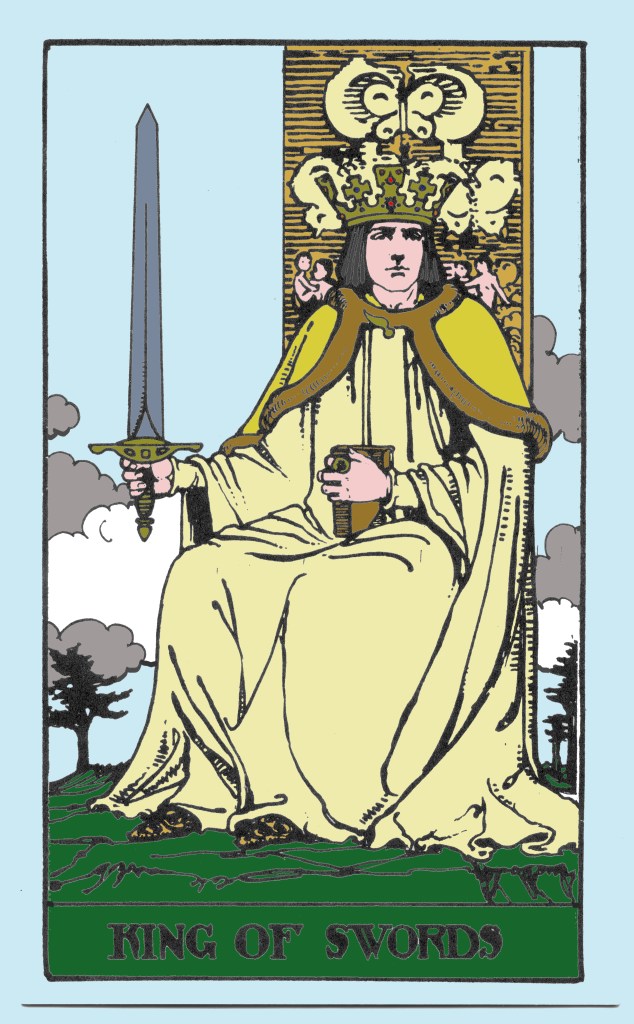
The King of Swords from the Builders of the Adytum (BOTA) tarot deck
Paul Foster Case (and Ann Davies)
The time period is from the beginning of the last decanate of Virgo to the end of the second decanate of Libra, September 13 to October 12, under the combined rulerships of Venus in Taurus, Venus in Libra, and Saturn-Uranus in Aquarius. Meanings: a man of strong and powerful imagination; hard worker and having authority; keen in understanding law and capable of excellent cooperation; somewhat distrustful and suspicious and therefor e hard to convince. He sometimes surprises his friends by sudden changes of attitude, although he is usually overcautious and analytical. In a divinatory lay-out: Well Dignified: he is friendly to the Querent and will cooperate with him. lll Dignified: he is inimical, harsh, malicious and plotting, obstinate and wholly unreliable. Dark hair and dark eyes. (From the Oracle of Tarot course)
A. E. Waite
He sits in judgment, holding the unsheathed sign of his suit. He recalls, of course, the conventional Symbol of justice in the Trumps Major, and he may represent this virtue, but he is rather the power of life and death, in virtue of his office. Divinatory Meanings: Whatsoever arises out of the idea of judgment and all its connexions-power, command, authority, militant intelligence, law, offices of the crown, and so forth. Reversed: Cruelty, perversity, barbarity, perfidy, evil intention. (From The Pictorial Key to the Tarot)
Aleister Crowley
(Note: Crowley and the Golden Dawn swapped around King and Knight. This is in part true of Waite as well.)
The Knight of Swords represents the fiery part of Air; he is the wind, the storm. He represents the violent power of motion applied to an apparently manageable element. He rules from the 21st degree of Taurus to the 20th degree of Gemini. He is a warrior helmed, and for his crest he bears a revolving wing. Mounted upon a maddened steed, he drives down the Heavens, the Spirit of the Tempest. In one hand is a sword, in the other a poniard. He represents the idea of attack.
The moral qualities of a person thus indicated are activity and skill, subtlety and cleverness. He is fierce, delicate and courageous, but altogether the prey of his idea, which comes to him as an inspiration without reflection.
If ill-dignified, the vigour in all these qualities being absent, he is incapable of decision or purpose. Any action that he takes is easily brushed aside by opposition. Inadequate violence spells futility. “Chimaera bombinans in vacuo”.
In the Yi King, the fiery part of Air is represented by the 32nd hexagram, Hang. This is the first occasion on which it has been simple to demonstrate the close technical parallelism which identifies Chinese thought and experience with that of the West. For the meaning is long continuance: “perseverance in well-doing, or continuously acting out the law of one’s being”, as Legge puts it in his note on the hexagram; and this seems incongruous with the Qabalistic idea of violent energy applied to the least stable of the elements. But the trigram of Air also indicates wood; and the hexagram may have Suggested the irresistible flow of the sap, and its effect in strengthening the tree. This conjecture is supported by the warning in line 6: “The topmost line, divided, shows its subject exciting himself to long continuance. There will be evil.”
Allowing this, the image of “the extended flame of mind”, as Zoroaster calls it, may well be subjoined to the former description. It is the True Will exploding the mind spontaneously. The influence of Taurus makes for steadiness, and that of the first decanate of Gemini for inspiration. So let us picture him, “integer vitae scelerisque purus”, a light-shaft of the Ideal absorbing the entire life in concentrated aspiration, passing from earthy Taurus to exalted Gemini. Here, too, is shewn (as in the Yi) the danger to the subject of this symbol; for the first decan is the card called “Interference”; or, in the old pack, “Shortened Force”. (From the Book of Thoth)
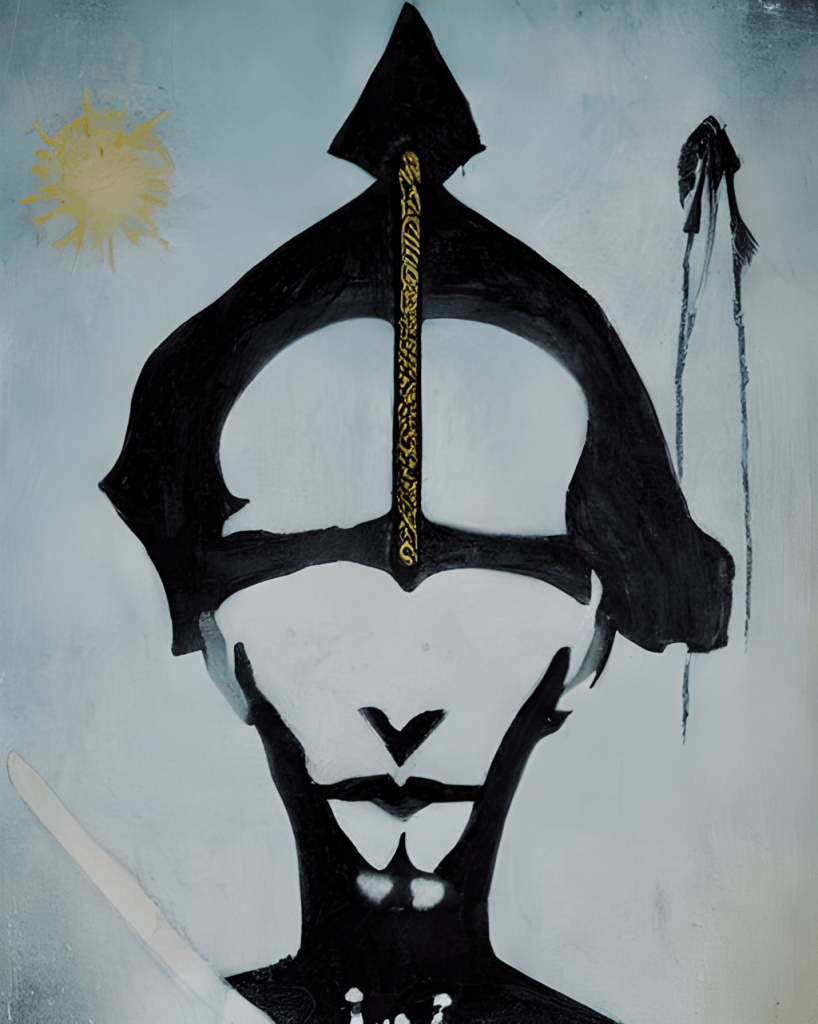
Oddly Bismarckian AI-generated Illustration for the King of Swords
Golden Dawn’s Book T
A WINGED Warrior with crowned Winged Helmet, mounted upon a brown steed. His general equipment is as that of the Knight of Wands, but he wears as a crest a winged six-pointed star, similar to those represented on the heads of Castor and Pollux the Dioscuri, the twins Gemini (a part of which constellation is included in his rule). He holds a drawn sword with the sigil of his scale upon its pommel. Beneath his horse’s feet are dark-driving stratus clouds. He is active, clever, subtle, fierce, delicate, courageous, skilful, but inclined to domineer. Also to overvalue small things, unless well dignified. If ill dignified, deceitful, tyrannical and crafty. Rules from 20 Degree Taurus to 20 Degree Gemini.
Etteilla
Man in Uniform Upright: This card, as far as the medicine of the spirit is concerned, means, in its natural position: Man in Uniform, Man of the Law, Judge, Councilor, Assessor, Senator, Business Man, Medical Practitioner, Lawyer, Prosecutor, Doctor, Physician. – Jurist, Law-making. – Litigant [= Party to litigation], Jurisconsult. Reversed: Malicious, Maliciousness, Perversity, Perfidy, Crime, Cruelty, Atrocity, Inhumanity.
The astounding thing about all oracular forms is that they reflect the real world in the same way a recording of a scene does. This reading is from five or six months back, and it was partially confirmed a couple of weeks later, but the final feedback came only very recently.
I friend of ours was dating a new man. She’d been out of the dating scene for a while due to focusing on other things in her life. But she noticed that the guy was acting weird, as if he was looking for any excuse to cause a fight that would end the (still budding) relationship. We asked the cards and this is what happened:
Relationship reading with the tarot (Tarocchi di Layla, by Elisa Scerrato)
The cards of the cut are the Fool and Justice. Justice usually represents a solid union, not one that has just started and where the partners don’t even live together. The instability caused by the fool was already an alarm bell.
Then we have a full scene playing out: the Tower breaks up the relationship between her (Empress) and him (Emperor), but there is an obscure (Moon) influence next to him. Another woman (Popess / High Priestess). This is not even a new girl he met. The Popess has the World card next to her, showing a solid family, and the Hanged Men indicates being bound to someone, a serious commitment. I told our friends that I didn’t think the relationship had much of a future, and that she should be careful that there wasn’t any other woman around the dude.
A couple of weeks later he left her abruptly via text message. A couple of days ago, we met with our friend and she confirmed the guy was married all along, although he has an on again, off again relationship with his wife and, due to his cultural background, he doesn’t see it as strange to date multiple women, even without them knowing.
Notice how the readings flows from one card to the next in true cinematic fanshion. This ability of divination to act as a mirror is partly why I don’t believe in asking the cards for advice. This would be like asking a map for advice on where to go. The map gives you a larger picture, but the advice doesn’t come from the map: it comes from checking your plans against the available options.
(Note: this is a collection of the meanings attributed to the cards by some occultists in the past centuries. It does not reflect my own study or opinion of the cards. It is only meant as a quick comparative reference as I develop my own take.)
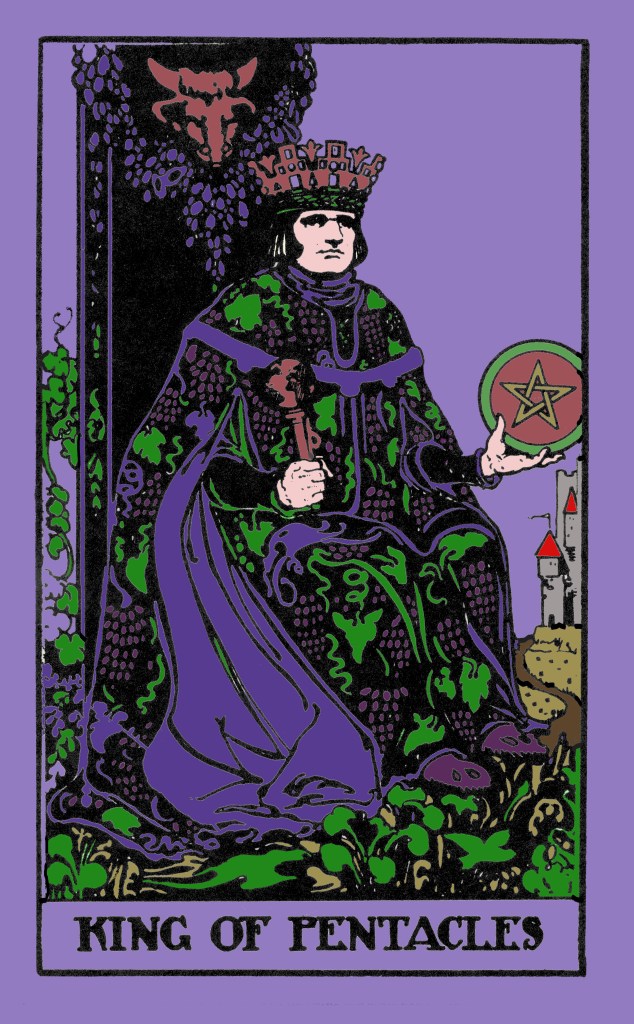
The King of Coins or King of Pentacles from the Builders of the Adytum (BOTA) tarot deck
Paul Foster Case (and Ann Davies)
The time period is from the beginning of the last decanate of Sagittarius to the end of the second d ecanate of Capricorn, De cember 12 to January 9. This period combines the rulerships of the Sun, Saturn and Venus . Well-Dignified: the ability to see the workings of Divine Law in the phenomena of the physical plane – thus rulership. In divination, a dark man, friendly to the Querent, practical, steady and reliable. He is good at the practical application of ideas and theories. Things tend to prosper and increase under his direction. He is slow to anger, but furious when aroused. Ill-Dignified: good theoretical insight into the workings of Divine Law, but inability to apply it to everyday experiences. In divination, a man selfish and materialistic. Such a man could have some power to solidify evil forces and express them but is nevertheless somewhat stupid. (From the Oracle of Tarot course)
A. E. Waite
The figure calls for no special description. The face is rather dark, suggesting also courage, but somewhat lethargic in tendency. The bull’s head should be noted as a recurrent symbol on the throne. The sign of this suit is represented throughout as engraved or blazoned with the pentagram, typifying the correspondence of the four elements in human nature and that by which they may be governed. In many old Tarot packs this suit stood for current coin, money, deniers. I have not invented the substitution of pentacles and I have no special cause to sustain in respect of the alternative. But the consensus of divinatory meanings is on the side of some change, because the cards do not happen to deal especially with questions of money. Divinatory Meanings: Valour, realizing intelligence, business and normal intellectual aptitude, sometimes mathematical gifts and attainments of this kind; success in these paths. Reversed: Vice, weakness, ugliness, perversity, corruption, peril. (From The Pictorial Key to the Tarot)
Aleister Crowley
(Note: Crowley and the Golden Dawn swapped around King and Knight. This is in part true of Waite as well.) The Knight of Disks represents the fiery part of Earth, and refers in particular to the phenomena of mountains, earthquakes, and gravitation; but it also represents the activity of Earth regarded as the producer of Life. He rules from the 21st degree of Leo to the 20th degree of Virgo, and is thus concerned greatly with agriculture. This warrior is short and sturdy in type. He is clothed in great solidity of plate armour; but his helmet, which is crested with the head of a stag, is thrown back, for at the moment his function is entirely confined to the production of food. For this reason he is armed with a flail. The disk which he bears, moreover, is very solid; it represents nutrition. These characteristics are borne out by his horse; a shire horse, solidly planted on all four feet, as was not the case with the other Knights. He rides through the fertile land; even the distant hills are cultivated fields.
Those whom he symbolizes tend to be dull, heavy and preoccupied with material things. They are laborious and patient, but would have little intellectual grasp even of matters which concern them most closely. Their success in these is due to instinct, to imitation of Nature. They lack initiative; their fire is the smouldering fire of the process of growth.
If ill-dignified, these people are hopelessly stupid, slavish, quite incapable of foresight even in their own affairs, or of taking an intelligent interest in anything outside them. They are churlish, surly, and jealous (in a dull sort of way) of what they instinctively realize is the superior state of others; but they have not the courage or intelligence to better themselves. Yet they are always irritably meddling about petty matters; they interfere with, and inevitably spoil, whatever comes their way.
In the Yi King, the fiery part of Earth is represented by the 62nd hexagram, Hsiao Kwo. This is as important as its complement, Kung Fu (see under Prince of Cups); it is a “big Khan”, the trigram of Luna with each line doubled. But it is also suggestive of the Geomantic figure Conjunctio, Mercury in Virgo, corresponding very closely indeed with the Fire of Earth attribution in the Qabalistic system.
To the Chinese sages, moreover, the shape of the figure gave the idea of a bird. The meaning is, accordingly, modified by human influence of the more frivolous and irresponsible kind, Shakespeare’s “little wanton harlotry”, the French cynic’s “Souvent femme vane”, and the fickle mob of Coriolanus; indeed, of History itself. But Mercury in Virgo symbolizes Intelligence (and even creative Idea) applied to Agriculture; and this (once more!) harmonizes perfectly with the Ten of Disks, which is ruled by this Planet and this Sign. This adds to the superabundant mass of proof that this whole system of symbolism is based upon Realities of Nature, as understood by the materialist School of Science-if such a school survives in some obscure and obsolescent University! Such coherence, such introverted exfoliation, cannot be the chance parallelism of the dreams of nebulous philosophies.
The character described by this card is therefore exceeding complex yet admirably well-knit; but its dangers are indicated by the symbols of Luna and the bird. In the happiest cases, the qualities thus indicated will be romance and imagination; but overweening ambition, the pursuit of Ignis Fatuus, superstition, and the tendency to waste time in idle dreaming, are perils all too frequently found in such sons of the soil. Thomas Hardy has painted many admirable portraits of the type. Ill-starred indeed and black with bile are those who have profaned the Sacred Fire, not enkindling Earth to new, more copious, more varied life, but peering in deceptive moonlight, turning their faces from their mother Earth. (From the Book of Thoth)
AI-generated King of Pentacles or King of Coins illustration
Golden Dawn’s Book T
A DARK Winged Warrior with winged and crowned helmet: mounted on a light brown horse. Equipment as the Knight of Wands. The winged head of a stag or antelope as a crest. Beneath the horse’s feet is fertile land with ripened corn. In one hand he bears a sceptre surmounted by a hexagram: in the other a Pentacle like that of the Zelator Adeptus Minor. Unless very well dignified he is heavy, dull, and material. Laborious, clever, and patient in material matters. If ill dignified, he is avaricious, grasping, dull, jealous; not very courageous, unless assisted by other symbols. Rules from above 20 Degree of Leo to 20 Degree of Virgo.
Etteilla
Dark man. Upright. This card, as far as the medicine of the spirit is concerned, means, in its natural position: Dark Man, Trader, Shopkeeper, Banker, Stockbroker, Calculator, Speculator. – Physics, Geometry, Mathematics, Science. – Teacher, Professor. Reversed. Vice, Defect, Weakness, Defective, Defective conformation, Deformed nature. – Abnormality, Ugliness, Deformity. – Corruption. – Stench.
I don’t often use the cards to track day-to-day happenings, but sometimes, if I’m feeling inspired, I will draw three cards to see what’s going to happen the next day. Of course, daily readings are much harder to make sense of because they require you to tone down the language of the cards. Still, if something out of the ordinary is set to happen, the cards will capture it quite clearly.
A couple of days ago, I was alone at home as my husband had driven to his mom for a couple of days to help her. I couldn’t go as I had a deadline and couldn’t waste time traveling. Still, he was set to come back the following day.
I felt compelled to draw three cards for the following days. You can see them in the picture: these were the King of Hearts, the Three of Clubs and the Three of Spades.
Daily reading with playing cards, confirmed by the tarot
The King of Hearts and the Three of Clubs together usually indicate a married man. My husband, of course, is a married man, if you can believe it. But the Three of Spades usually represents a removal or at least problems intervening between two people. I didn’t think too much about it, and that was a mistake, because if I had been reading those same cards for someone else I would have certainly predicted that their partner wouldn’t come home.
It was only on the next day that I remembered the cards. Out of curiosity, I asked the Tarot if my husband would come back that day.
The cards of the cut show the Popess and the Stars, in this case probably his mother taking care of him. We then have Judgement and the Juggler / Magician, which among other things could indicate work-related communication. The Charriot, showing the journey, is then slowed down by Temperance and brought to a halt by the Hanged Man. After that, the Pope / Hierophant (my husband) and the Emperor (me) unite again.
Later that day my husband said that he had unexpectedly received some work-related task that he needed to take care of from his laptop that evening and wouldn’t be able to drive back home. He came back the next day (yesterday).
(Note: this is a collection of the meanings attributed to the cards by some occultists in the past centuries. It does not reflect my own study or opinion of the cards. It is only meant as a quick comparative reference as I develop my own take.)
The King of Wands from the Builders of the Adytum (BOTA) Tarot
Paul Foster Case (and Ann Davies)
When well aspected the powers listed above are expressed by a personality represented by the King of Wands. However these same qualities when overly strong or intense can express as cruelty, oppression, ostentation and pride. Thus in Tarot divination, besides the basic principles expressed by Ab, the Father, and Yod, the Creative principle, the King of Wands has these specific meanings: Well Dignified: an ardent, impulsive, influential man; one possessed of authority and strongly marked by the quality of leadership; somewhat hasty in temper but just, generous and friendly. lll Dignified: the same general type but cruel, ill-natured, intolerant and probably unfriendly to the querent. (From the Oracle of Tarot course)
A. E. Waite
The physical and emotional nature to which this card is attributed is dark, ardent, lithe, animated, impassioned, noble. The King uplifts a flowering wand, and wears, like his three correspondences in the remaining suits, what is called a cap of maintenance beneath his crown. He connects with the symbol of the lion, which is emblazoned on the back of his throne. Divinatory Meanings: Dark man, friendly, countryman, generally married, honest and conscientious. The card always signifies honesty, and may mean news concerning an unexpected heritage to fall in before very long. Reversed: Good, but severe; austere, yet tolerant. (From The Pictorial Key to the Tarot)
Aleister Crowley
(Note: Crowley and the Golden Dawn swap around King and Knight. This is in part true of Waite as well.) The Knight of Wands represents the fiery part of Fire; he rules from the 21St degree of Scorpio to the 20th degree of Sagittarius. He is a warrior in complete armour. On his helmet for a crest he wears a black horse. In his hand he bears a flaming torch; a flame also in his mantle; and upon the flames does he ride. His steed is a black horse leaping.
The moral qualities appropriate to this figure are activity, generosity, fierceness, impetuosity, pride, impulsiveness, swiftness in unpredictable actions. If wrongly energized, he is evil-minded, cruel, bigoted and brutal. He is in either case ill-fitted to carry on his action; he has no means of modifying it according to circumstances. If he fails in his first effort, he has no resource.
In the Yi King, the fiery part of Fire is represented by the 51st hexagram, Kan. The signification there given is entirely in accordance with the doctrine of the Tarot, but great emphasis is laid on the startling, perilous, and revolutionary character of the events cognate. The Querent is advised to be apprehensive, yet cool, resolute and energetic: to beware of untimely action, but to go forward with tense confidence in his own ability.
All these correspondences of the Yi King are to be studied in that book (S.B.E. vol. XVI) and reference is here made to the text when important passages are too long to be conveniently quoted. (From the Book of Thoth)
Oddly interesting AI-generated King of Wands illustration
Golden Dawn’s Book T
A KINGLY Figure with a golden, winged crown, seated on a chariot. He has large white wings. One wheel of his chariot is shewn. He wears corslet and buskins of scale armour decorated with a winged lion’s head, which symbol also surmounts his crown. His chariot is drawn by a lion. His arms are bare, save for the shoulder-pieces of the corslet, and he bears a torch or fire-wand, somewhat similar to that of the Zelator Adeptus Minor. Beneath the chariot are flames, some waved, some salient. Swift, strong, hasty; rather violent, yet just and generous; noble and scorning meanness. If ill dignified — cruel, intolerant, prejudiced and ill natured.
Etteilla
Country man Upright. This card, as far as the medicine of the spirit is concerned, means, in its natural position: Country Man, Good and Stern Man, Well Intentioned Man, Honest Man. – Conscience, Probity. – Farmer, Worker, Cultivator. Reversed. Good and stern man – Indulgence, Severity, Forbearance, Condescension.
As I have a mind to start talking about Tarot in the very near future, I wanted to start by sharing the main meanings I apply to the major trumps. These are just basic guidelines, as the majors have almost no bounds, so this list is not exhaustive. The meanings I use are not especially weird, and they tend to be very practical.
The Fool Instability, Untrustworthiness, Freedom, Unpredictability, Lack of ties or bonds, Irresponsibility, Innocence, Lack of foresight, Lack of planning, Doing things on the spur of the emoment, Surprise, Irregularity, Chaos, Things and situations that are not well-defined or that are not clearly settled, Nothing, Nothingness, Mistake, Error, Oversight, Mental issues, Originality, Creativity, Deep feelings in love that could be a flash in the pan because they are unsupported by effort, Unpreparedness, Going on foot, Walking
The Juggler / Conman / Magician Beginning, Child, Son or daughter, New, Small, Initiative, Doing, Action, Work, Job, Play, Game, Playing, Studying, Youth, Competence, Ability, Adroitness, Project, Being aware, Doing by hand, Creativity, Charm, Fascinating, Tricks, A thief or con artist, Charlatan, Lie, Things done with good or evil intent (depending on the other cards) but not by mistake, Things that are planned, Immaturity, Tantrums, A charmer
The Popess / High Priestess A mature woman, A serious woman, precise, knowledgeable, reserved, A wife, A mother, An older sister, A female boss, A female doctor or professional, A woman with a degree, Conscience, Spirituality, Study, Knowledge, Deep understanding, Faith, Someone who knows what to say and what not to say, Silence, Reserve, Secret, with bad cards a superficial floozy, A gossip, Dogmatic, Strict, Ignorant, Inimical
The Empress A younger woman, Active, Creative, Communicative, Unmarried or, if married, still very much in love, Action, Abundance, Love, A younger sister, A young mother, A daughter, A coworker, An employee, A boss that works together with her employees rather than staying shut in her office, Well-being, Sex, Fascination, Beauty, Expansion, Amplification, Increase, Growth, With bad cards can be wastefulness, etc., Spring, The Earth element
The Emperor A younger man, Active, Creative, Dynamic, Unmarried, In love, Son, Young father, Brother (younger), Action, Law, Politics, Durability, Willpower, An active boss, With great directive ability, A coworker, An Employee, Managing, Organizing (in general, he is the male counterpart to the Empress), with negative cards can be tyrannical or a young man in difficulty, etc.
The Pope / Hierophant / High Priest Broadly the male counterpart to the Popess: Older man, Father, Boss, Older brother, Religion, An interpreter, A communicator, An intermediary, Wisdom, Faithfulness, A teacher, A guide, Responsible, Knowledgeable, Trustworthy, A ritual of some kind (religious, magical, etc.), A man with a degree, A man wearing a uniform or serving some official function, An agency
Love / The Lover / The Lovers Love, Attraction, Harmony, Desire, Preference, Being attracted to one thing, one person, one option, etc. A deal, A handshake, Compromise, Commitment, Getting along, Affinity, Vocation, Inspiration, The family, A group of people, A meeting, appointment, date, etc. The public, Sociability, The social aspect of life, A partnership, Something done with other people, Beauty, Esthetics, etc.
The Chariot Movement, Activity, Advancement toward a goal, Journey, Travel, Car, Means of transport, Going, Being determined, Going in one particular direction, Career, A public uniform, Audacity, Overcoming obstacles, Moving beyond difficulties, Attacking or tackling and, with positive cards, Winning, Victory, Recognition, Ambition, Self-discipline, Doing, Acting, Enterprise, Knowing where you want to go and going, Enthusiasm, Quickness, Velocity (for good or ill)
Justice Justice, Fairness, Equilibrium, Stability, Contract, Union, Marriage or living together as an established family, Legal and bureaucratic issues, Buying and selling, The law, Tests, Evaluations, Documents, Papers, The middle way, Half, Halving, Cutting in half, Evaluating the pros and cons, Developing contacts, Creating ties with others, with negative cards it can show separations, injustice, etc.
The Hermit One, Lonely, Unique, Old, Past, A long time, Slow, An older person (60+), Difficulties, Slowing down, Lack of communication, Secret, Moving behind the scenes, away from the public eye, Serious, A master or teacher, Weakening, becoming old, weak, extinguished, Spirituality, High culture, Study, Research, Not kidding around, No sense of humor, Being dependable, Taking very small steps, Deep reflection and thought, A premeditator, Cold places, Places of retreat, Solitude, Not wanting contact, Stinginess, Marginalized, With negative cards can show not being self-reliant, and by extension also being hooked on drugs or alcohol, Inability to communicate, Winter
The Wheel of Fortune Transition, Change, The regular flow of life, Luck, Opportunity, Success, Money, Gambling, Winning, A trip, Travel, Change of place, Situations that resurface at intervals, On and off, The unblocking of a stagnant situation for better or worse, Protection from above, Fatality, Changeability, Instability, Small animals, Changing route, Opening of avenues, Partial, Sometimes, Part-time, etc.
Strength / Fortitude Strength, Power, Influence, Intelligence, Being capable of steering the situation, Overcoming, Willpower, Stability, Strengthening, Manipulation, Savoir faire, Control, A situation that is strongly desired, Self-control, Discipline, Sport, Physical movement, Materialization, The signing of papers (materializing their effect), Knowing how to resist temptation, Intelligence, Rationality, Wild animals, with negative cards it can show impotence, anger, etc.
The Hanged Man Suffering, Blockage, Stillstand, Sacrifice, Confinement, Prison, Hospital, Not acting, Being still, A bond of some kind, with good cards it can show a positive bond (e.g., being committed to someone or something), Down, South, Below, Digging, Falling, Broken, Rotten, Suffering, Impotence, Inability
Death Death, Sharp change, Mortality, Ending, A short trip, Elimination, Unavoidability, Something that cannot be walked back, Point of no return, Destruction, Fatality, Danger, Discouragement, Gloomy thoughts, Sadness, Inability to accept change, Corruption, Alteration, Sharp instruments
Temperance Temperance, Moderation, Patience, Waiting, Tolerance, Adaptability, Giving and receiving, Avoiding extremes, Meeting halfway, Purity, Clean, Cleaning, Honesty, Angels, Spirituality, Protection, Gentleness, Respect, Consideration, Sincerity, Truthfulness, Male and female together, Mixing, Two in one, Duality, Education, Health, Healing, Conciliation, Inaction, Lack of activity, Indolence, Unemployment, Autumn
The Devil Evil, Antagonist, Opposition, Obstacle, Force, Energy, Great power, Magic, Strategy, Cunning, Being in chains, Strong chemistry, Fatal attraction, Great business, Big corporations, Stress, Enmity, Being very worried, Being forced to do something, Dictatorship, Subjugation, Vice, Sin, Addiction, Excess, Darkness, Dark, Blood, Illegality, Crime, Swindle, Jealousy, Possessiveness, Sexual attraction, Sex, Betrayal, Cheating
The Tower A place, A home, A building of some kind, Explosions, Explosive energies, Fire, Crumbling down, Ending, Closure, Departure from the old, Destruction, Crisis, Loss of name, Fragility, Things that suddenly don’t seem as strong as they used to be, Boldness, Anger, Sudden onrush,
The Star / The Stars Hope, Future, Serenity, Things clearing up, Truthfulness, Honesty, Purity, Art, Beauty, Gift, The Air element, Wind, Sky, Above, Over, Up, High-mindedness, Idealism, Promises, Guidance, Inspiration, Meditation, Harmony, Solution, Positive ending close at hand, Fulfillment of wishes, Pregnancy, Generosity, Shooting for the stars, Optimism, The soul, An investment, Influx of money, Getting back dividends or money you loaned, etc.
The Moon The night, Darkness, Silence, Not talking, Disappearing, Secret, Falsehood, Lies, Keeping in the dark, Water, Lake, Sea, Ocean, Dampness, Fantasy, Intuition, Mother, Mom, Maternity, Femininity, Clairvoyance, Influence on the world or on people, Worry, Preoccupation, Sadness, Disappointment, Depression, Gloominess, Refusal, Saying no, Negativity, Changeability, Inconsistency, The realm of shadows and of the dead, Mary mother of God and other lunar entities
The Sun The day, Light, Clarity, Visibility, Intelligence, Father, Fatherhood, Manly energy, Twins, Clarity, Truth, Discovering, Discovery, Finding, Clarifying, Explaining, Reaching the truth of the matter, Rationality, Logic, Experts, Knowledgeable people, News, Novelty, Renewal, Beginning, Gold, Money, Wealth, Success, Heat, Warmth, Love, Feelings, Happiness, Faithfulness, Sincerity, Glory, Visibility, Success, Self-confidence, Summer, Summery or hot places (beaches, etc.), Poetry, Literature, The realm of the living, Life, Jesus and other solar entities
Judgement / The Angel Information, News, Letters, Calls, Communication, Emails, Sociability, Social contacts, Contacts in general, Announcements, Inspiration, Feeling called, Leaving the old life behind, Coming out of the old, Renewal, Return, Reconciliation (but with negative cards definitive ending), Healing (but with negative cards it can signal death), A definitive turning point, Family members, Music, Hearing
The World Everything, All, Total, Full, Filled, Full-time, Fat, Obese, The Whole, Complete, Large, Big, God, Totality, The Soul of the World, Paradise, A situation that is complete in itself, such as a full family, a marriage or stable partnership (usually one that already exists), A company or firm, Glory, A wreath, A ring, Completion of a project, Completion of a journey (e.g., graduating, tying the knot, etc.), The querent’s country, A country in general (with some other cards a foreign country and foreign lands in general), A city or the querent’s city, The world out there, A perfect picture, A picture or image in general, The population, Masses, Crowds