Tag Archives: How to read the tarot

Tarot Encyclopedia – The Five of Pentacles or Coins

(Note: this is a collection of the meanings attributed to the cards by some occultists in the past centuries. It does not reflect my own study or opinion of the cards. It is only meant as a quick comparative reference as I develop my own take.)
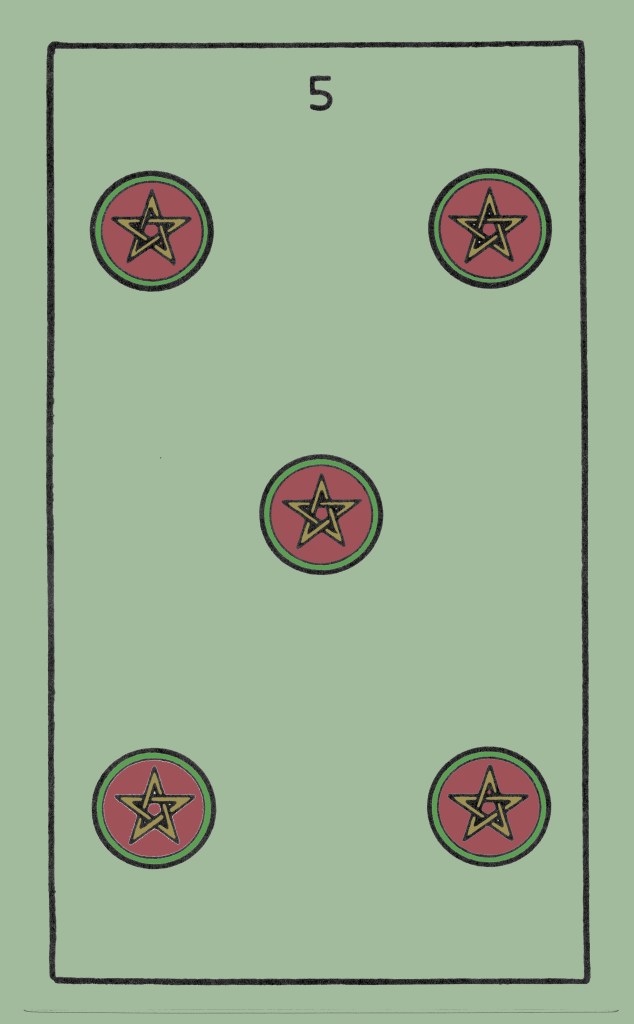
The Five of Pentacles from the Builders of the Adytum (BOTA) tarot deck

Paul Foster Case (and Ann Davies)

The time period is the first decanate of Taurus, under the rulership of Venus, April 20 to 29. Meanings:
Well-Dignified: labor, toil, the cultivation of the land; building, and plans concerning it; some anxiety over money.
lll-Dignified: toil unrewarded; loss of money; poverty; trouble for the Querent through lack of imagination and foresight.
Keyword: Uncertainty; material trouble.
(From the Oracle of Tarot course)

A. E. Waite

Two mendicants in a snow-storm pass a lighted casement. Divinatory Meanings: The card foretells material trouble above all, whether in the form illustrated–that is, destitution–or otherwise. For some cartomancists, it is a card of love and lovers-wife, husband, friend, mistress; also concordance, affinities. These alternatives cannot be harmonized. Reversed: Disorder, chaos, ruin, discord, profligacy.
(From The Pictorial Key to the Tarot)

Aleister Crowley

The Five of Disks is in equally evil case. The soft quiet of the Four has been completely overthrown; the card is called Worry. [See Skeat, Etymological Dictionary. The idea is of strangling, as dogs worry sheep. Note the identity with Sphinx.] The economic system has broken down; there is no more balance between the social orders. Disks being as they are, stolid and obstinate, as compared with the other weapons, for their revolution serves t9 stabilize them, there is no action, at least not in its own ambit, that can affect the issue.

[…]

The Number Five, Geburah, in the suit of Earth, shows the disruption of the Elements, just as in the other suits. This is emphasized by the rule of Mercury in Taurus, types of energy which are opposed. It needs a very powerful Mercury to upset Taurus; so the natural meaning is Intelligence applied to Labour.

The symbol represents five disks in the form of the inverted Pentagram, instability in the very foundations of Matter. The effect is that of an earthquake. They are, however, representative of the five Tatvas; these hold together, on a very low plane, an organism which would otherwise disrupt completely. The background is an angry, ugly red with yellow markings. The general effect is one of intense strain; yet the symbol implies long-continued inaction.
(From The Book of Thoth)
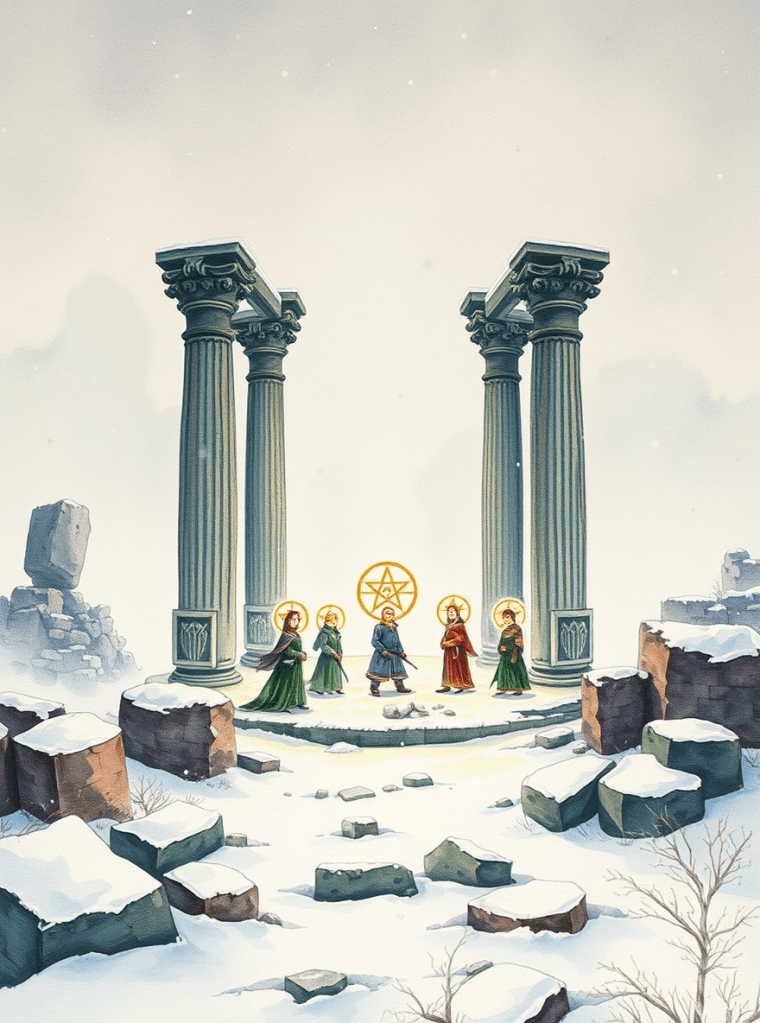
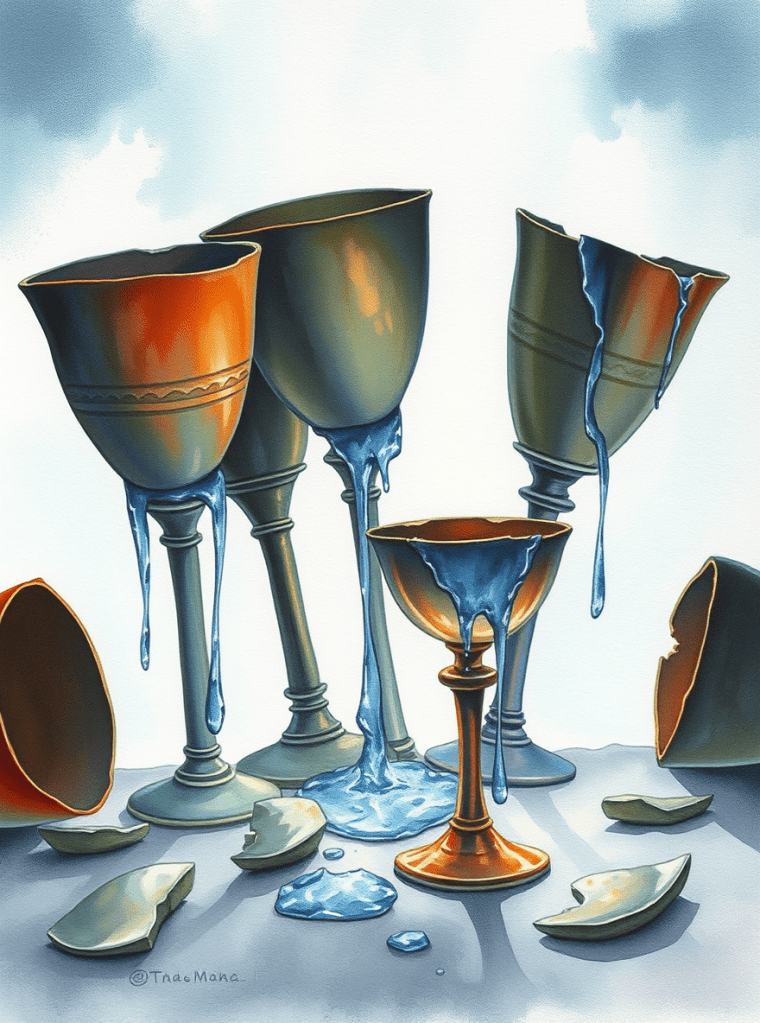
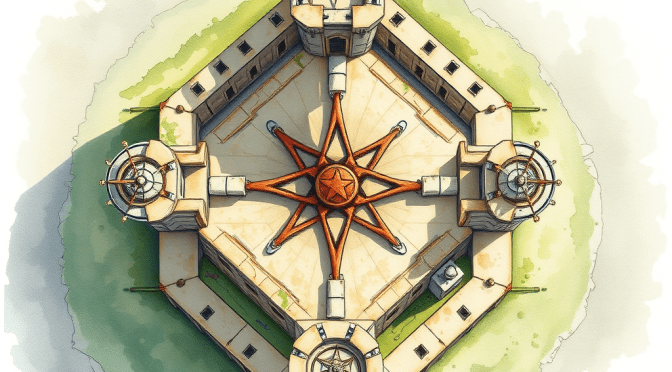
A peasantly mystical AI-generated illustration for the Five of Pentacles

Golden Dawn’s Book T

A WHITE Radiant Angelic Hand issuing from clouds, and holding a branch of the white rose tree, but from which the roses are falling, and leaving no buds behind.
Five Pentacles similar to the Ace. Above and below are Mercury and Taurus.

Loss of money or position. Trouble about material things. Labour, toil, land cultivation; building, knowledge and acuteness of earthly things, poverty, carefulness, kindness; sometimes money regained after severe toil and labour.
Unimaginative, harsh, stern, determined, obstinate.
Geburah of HB:H (Loss of profession, loss of money, monetary anxiety).
Herein the angels HB:MBHYH and HB:PNYAL rule.

Etteilla

Lover
Upright. This card, as far as the medicine of the spirit is concerned, means, in its natural position: Lover [man], Lover [woman], In love, Gallant man, Gallant woman, Husband, Wife, Groom, Bride, Friend, Friend. – Lover. – Loving, Lovingly, Adoring. – Harmony, Agreement, Convenience, Concordance, Good manners.
Reversed. Disorderly, Contrary to order. – Debauchery, Disorder, Turmoil, Confusion, Chaos. – Damage, Devastation, Ruin. – Dissipation, Consumption. – Unruliness, Libertinism. – Discord, Disharmony, Discordance.

MQS
Tarot Encyclopedia – The Five of Swords

(Note: this is a collection of the meanings attributed to the cards by some occultists in the past centuries. It does not reflect my own study or opinion of the cards. It is only meant as a quick comparative reference as I develop my own take.)

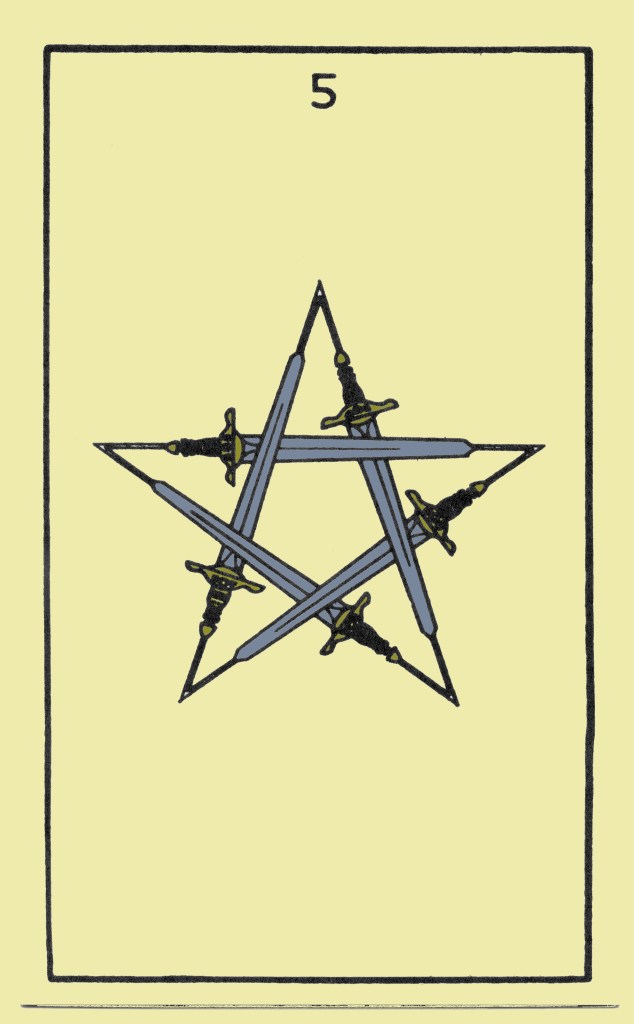
The Five of Swords from the Builders of the Adytum (BOTA) tarot deck

Paul Foster Case (and Ann Davies)

The time period is the first decanate of Aquarius, from January 20 to 29, under the rulers hip of Saturn and Uranus.
Well-Dignified: the decision is adve rse to the Querent in any matter of a material nature. In spiritual affairs this card portends apparent troubles which work out ultimately to good result. Thus this Key is one of trouble and anxiety, but rightly comprehended can be the turning point for positive good .
Ill-Dignified: the troubles are intensified and are probably due to the Querent’s own lack of understanding of the true nature of the situation. If the question is one of speculation, the Querent is likely to be disappointed due to his own desire to get something for nothing, to over-reach somebody else,
or to get rich quick.
Keyword: Defeat.
(From the Oracle of Tarot Course)

A. E. Waite

A disdainful man looks after two retreating and dejected figures. Their swords lie upon the ground. He carries two others on his left shoulder, and a third sword is in his right hand, point to earth. He is the master in possession of the field. Divinatory Meanings: Degradation, destruction, revocation, infamy, dishonour, loss, with the variants and analogues of these. Reversed: The same; burial and obsequies.
(From The Pictorial Key to the Tarot)

Aleister Crowley

The Five of Swords is similarly [to the other fives] troublesome; the card is called Defeat. There has been insufficient power to maintain the armed peace of the Four. The quarrel has actually broken out. This must mean defeat, for the original idea of the Sword was a manifestation of the result of the love between the Wand and the Cup. It is because the birth had to express itself in the duality of the Sword and the Disk that the nature of each appears so imperfect.

[…]

Geburah, as always, produces disruption; but as Venus here rules Aquarius, weakness rather than excess of strength seems the cause of disaster. The intellect has been enfeebled by sentiment. The defeat is due to pacifism. Treachery also may be implied.

The hilts of the swords form the inverted pentagram, always a symbol of somewhat sinister tendency. Here matters are even worse; none of the hilts resembles any of the others, and their blades are crooked or broken. They give the impression of drooping; only the lowest of the swords points upwards, and this is the least effective of the weapons. The rose of the previous card has been altogether disintegrated.

The historian is happy to observe two perfect illustrations of the mode of this card and the last in the birth of the Aeon of (1) Osiris, (2) Horus. He will note the decay of such Virtue as characterized Sparta and Rome, ending in the establishment of the Pax Romana. As Virtue declined, corruption disintegrated the Empire from within. Epicene cults, such as those of Dionysus (in its degraded form), of Attis, of Adonis, of Cybele, the false Demeter and the prostituted Isis, replaced the sterner rites of the true Solar-Phallic gods; until finally (the masters having lost the respect, and so the control, of the plebs, native and alien) the lowest of all the slave-cults, dressed up in the fables of the vilest of the parasitic races, swept over the known world, and drenched it in foul darkness for five hundred years. He will delight to draw close parallels with the cognate phenomena displayed before the present generation.
(From The Book of Thoth)

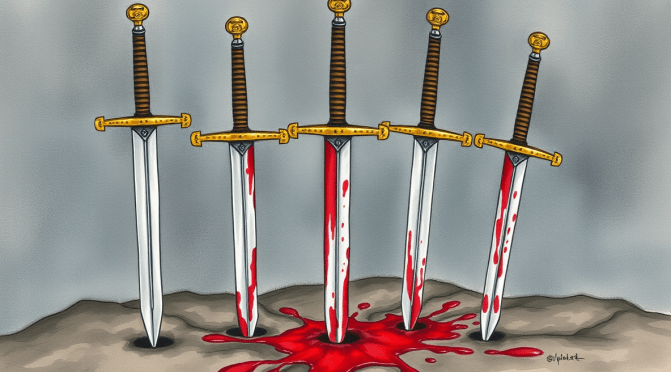
AI-generated illustration for the Five of Swords

Golden Dawn’s Book T

TWO Rayed Angelic Hands each holding two swords nearly upright, but falling apart of each other, right and left of the card. A third hand holds a sword upright in the centre as though it had disunited them. The petals of the rose, which in the four had been reinstated in the centre, are torn asunder and falling. Above and below are Venus and Aquarius for Decan.

Contest finished and decided against the person; failure, defeat, anxiety, trouble, poverty, avarice, grieving after gain, laborious, unresting; loss and vileness of nature; malicious, slanderous, lying, spiteful and tale-bearing. A busybody and separator of friends, hating to see peace and love between others. Cruel, yet cowardly, thankless and unreliable. Clever and quick in thought and speech.
Feelings of pity easily roused, but unenduring.

Geburah of HB:V (Defeat, loss, malice, spite, slander, evil-speaking).
Herein the Angels HB:ANYAL and HB:Cha’aMYH bear rule.

Etteilla

Loss
Upright. This card, as far as the medicine of the spirit is concerned, means, in its natural position: Loss, Alteration, Discredit, Degradation, Perdition, Decay, Destruction, Deterioration, Deterioration, Diminution, Depression, Diminution, Damage, Failure, Prejudice, Blemish, Torts, Avarice, Decline of business, Failure, Disadvantage, Devastation, Dilapidation, Dissipation, Injury, Disgrace, Reversal, Reversal of fortune, Ruin. – Defeat – Debauchery, Disgrace, Dishonor, Infamy, Ignominy, Affront, Ugliness, Difformity, Humiliation. – Theft, Thievery, Rape, Plagiarism, Abduction, Filthy, Horrible. – Infamy, Corruption, Profligacy, Seduction, Libertinism.
Reversed. Mourning, Abasement, Affliction, Sadness, Grief, Pain of spirit, Funeral pump, Burial, Funeral, Inhumation, Burial.

MQS

Tarot Encyclopedia – The Five of Cups

(Note: this is a collection of the meanings attributed to the cards by some occultists in the past centuries. It does not reflect my own study or opinion of the cards. It is only meant as a quick comparative reference as I develop my own take.)

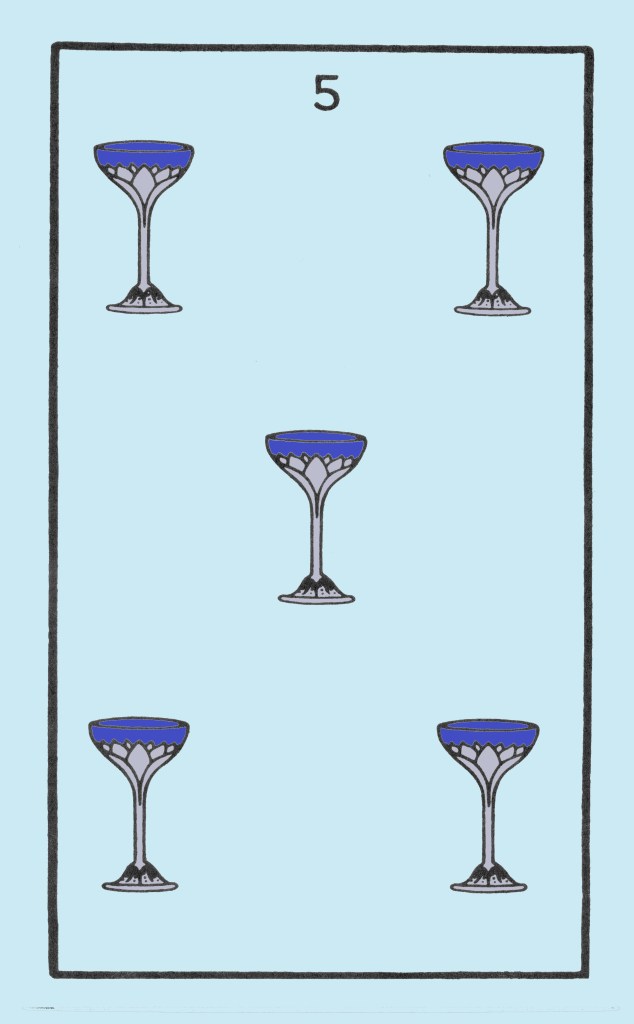
The Five of Cups from the Builders of the Adytum (BOTA) tarot deck

Paul Foster Case (and Ann Davies)

The Five of Cups is the first decanate of Scorpio, ruled by Mars, time period October 22 to October 31.
Well-Dignified: strength, power to do; ability to introduce needed changes and let go of relationships, prejudices and false ideas that are hindering spiritual progress.
lll-Dignified: loss in pleasure, vain regret, disappointment, sorrow and loss of those things which have been much desired; treachery, deceit; unexpected troubles and anxieties; disappointments in love, broken engagements, broken friendships.
(Note: These sorrows and disappointments, as indicated by the Five of Cups, lll Dignified, are often the necessary destruction before the beginning of a new and greater expansion and growth in the life of the Querent, depending on his basic understanding and evolutionary level.)
Keyword: Defeated desire.
(From the Oracle of Tarot course)

A. E. Waite

A dark, cloaked figure, looking sideways at three prone cups two others stand upright behind him; a bridge is in the background, leading to a small keep or holding. Divanatory Meanings: It is a card of loss, but something remains over; three have been taken, but two are left; it is a card of inheritance, patrimony, transmission, but not corresponding to expectations; with some interpreters it is a card of marriage, but not without bitterness or frustration. Reversed: News, alliances, affinity, consanguinity, ancestry, return, false projects.
(From The Pictorial Key to the Tarot)

Aleister Crowley

 […] the Five of Cups is called Disappointment, as is only natural, because Fire delights in superabundant energy, whereas the water of Pleasure is naturally placid, and any disturbance of ease can only be regarded as misfortune.

This card is ruled by Geburah in the suit of Water. Geburah being fiery, there is a natural antipathy. Hence arises the idea of disturbance, just when least expected, in a time of ease.

The attribution is also to Mars in Scorpio, which is his own house; and Mars is the manifestation on the lowest plane of Geburah, while Scorpio, in its worst aspect, suggests the putrefying power of Water. Yet the powerful male influences do not show actual decay, only the beginning of destruction; hence, the anticipated pleasure is frustrated. The Lotuses have their petals torn by fiery winds; the sea is arid and stagnant, a dead sea, like a “chott” in North Africa. No water flows into the cups.

Moreover, these cups are arranged in the form of an inverted pentagram, symbolizing the triumph of matter over spirit.

Mars in Scorpio, moreover, is the attribution of the Geomantic figure Rubeus. This is of such evil omen that certain schools of Geomancy destroy the Map, and postpone the question for two hours or more, when Rubeus appears in the Ascendant. Its meaning is to be studied in the “Handbook of Geomancy” (Equinox Vol. I, No.2).
(From The Book of Thoth)

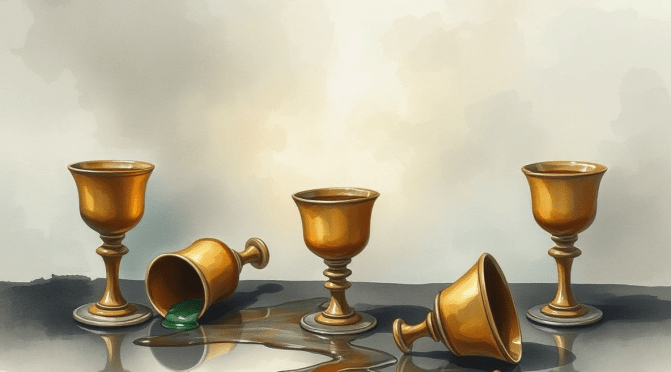
AI-generated illustration for the Five of Cups

Golden Dawn’s Book T

A WHITE Radiating Angelic Hand, holding lotuses or water-lilies, of which the flowers are falling right and left. Leaves only, and no buds, surmount them. These lotus stems ascend between the cups in the manner of a fountain, but no water flows therefrom; neither is there water in any of the cups, which are somewhat of the shape of the magical instrument of the Zelator Adeptus Minor. Above and below are the symbols of Mars and Scorpio for the Decan.

Death, or end of pleasure: disappointment, sorrow and loss in those things from which pleasure is expected. Sadness, treachery, deceit; ill-will, detraction; charity and kindness ill requited; all kinds of anxieties and troubles from unsuspected and unexpected sources.
Geburah of HB:H (Disappointment in love, marriage broken off, unkindness of a
friend; loss of friendship).
Herein rule HB:LVVYH and HB:PHLYH.

Etteilla

Legacy
Upright. This card, in its natural position, means, as far as the medicine of the spirit is concerned: Inheritance, Succession, Bequest, Gift, Donation, Endowment, Estate, Transmission, Will. – Tradition, Resolution [=Decision]. – Kabbalah.
Reversed. Consanguinity, Blood, Family, Avi, Ancestors, Father, Mother, Brother, Sister, Uncle, Aunt, Cousin, Cousin. – Filiation, Extraction, Race, Lineage, Alliance. – Affinity, Attachment, Relationship, Ties.

MQS

Parrots and Betrayed Deals (13 Card Spread Reading Example)

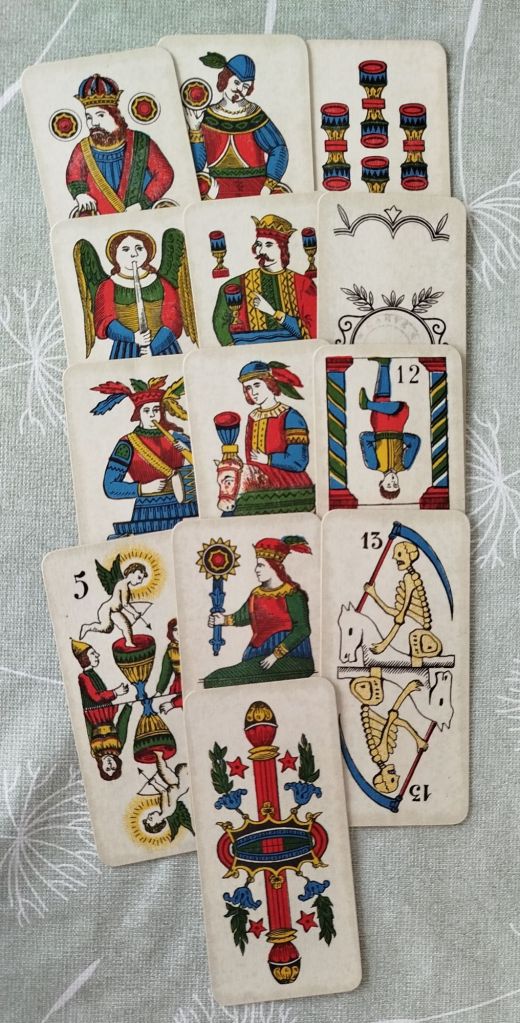
As I mentioned here, I got a new parrot from a local breeder and I had an interesting reading concerning it. The reading was done using the Bologna Tarot in its 45-card variant. We had already gotten some pictures of some of the available birds, and we had settled on a gray cockatiel, because it looked like the one I had as a kid. As the day approached, I asked the cards if everything would go alright. This is the spread I got:

Is the bird handover going to go smoothly?

Although I’ve already talked about the 13 card spread, when used with the Bolognese tarot there are some peculiar aspects to it (it is, after all, one of the “official” traditional spreads to be used with this deck). Traditionally, when a yes-or-no question is asked, the following rules apply:

  1. If the Death card shows up in the spread, it’s a yes (as sure as we all die)
  2. If the Angel (Judgement) card shows up, it’s a good chance
  3. If both show up, it’s a sure thing
  4. If the Angel and the Devil show up, it represents great satisfaction within the context (the Devil is in itself a negative card, but it is redeemed by the presence of the Angel)

Well, in my (still limited) experience with this tarot deck, I have found that it’s best not to rely too much on mechanical rules: the cards must always be interpreted, and exceptions allowed for. Still, it is encouraging to see both the Angel and the Death card as answer. Let’s interpret the cards row by row, as they came up very clear and orderly (it is not always like this, unfortunately):

King of Coins – Page of Coins – Seven of Cups: there have been talks (Page) with a man concerning business (King). The Seven of Cups is generically positive here.
Angel – King of Cups – Ace of Coins: There is help (Angel) from a man of the house (King) concerning money (Ace). My husband paid in part for the parrot and the cage and food.
Fool – Knight of Cups – Hanged Man: This is the most interesting row in the spread. It shows something that brings chaos or confusion (Fool) and that betrays or upends (Hanged Man) the agreement (Knight of Cups)
Love – Queen of Coins – Death: True (Queen of Coins) Love (Love) is confirmed (Death)
Ace of Wands: Success, positive ending

So in general what we can say from the spread is that the breeder is trustworthy, my husband helps me and I will be very satisfied, but still the deal will somehow be changed in an unexpected/confused way.

What ended up happening: we got there and the breeder introduced us to the various chicks that were ready for adoption, including the one we had settled on. But as we were playing with them, a white cockatiel chick quickly flew onto my shirt looking for cuddles. Obviously, it was love at first sight (see the true love in the spread), and we got that one instead.

I believe this change of plans is shown in the spread by combination of Knight of Cups (agreement, conciliation) followed by the Hanged Man (betrayal, upending). Our initial agreement was upended (or “betrayed” in a metaphorical sense), but still everything ended on a positive note.

NOTE: look how “dry” this reading is. Traditionally, tarot was not interpreted by musing on how the pictures looked, but by applying clear and specific meanings.

MQS

Bolognese Tarot – The 45-Card Method Meanings

In another post, I detailed the main meanings of the 50-card method, which is the one my teacher uses. Here I am going to talk about the other main method for using the Bolognese tarot using 45 cards. I have this from a contact of mine, who gave me permission to explore it and talk about it. The two methods are equally powerful: the absence of 5 cards does not reduce the ability to predict, because the meanings, though similar to the 50-card method, are distributed slightly differently across the cards. Supposedly, the 45-card method is slightly older.

Note that 1) there are some books (in Italian) that discuss the 45-card method, but each gives its own version, and the method I know is also partially different. This is normal: every village and city has its own folk tradition, especially in a country as culturally decentralized as Italy 2) again, the meanings are eminently practical 3) as with the 50-card method, I arranged the majors in the usual order, even though it is different from the Bolognese order of the trumps

Major Trumps

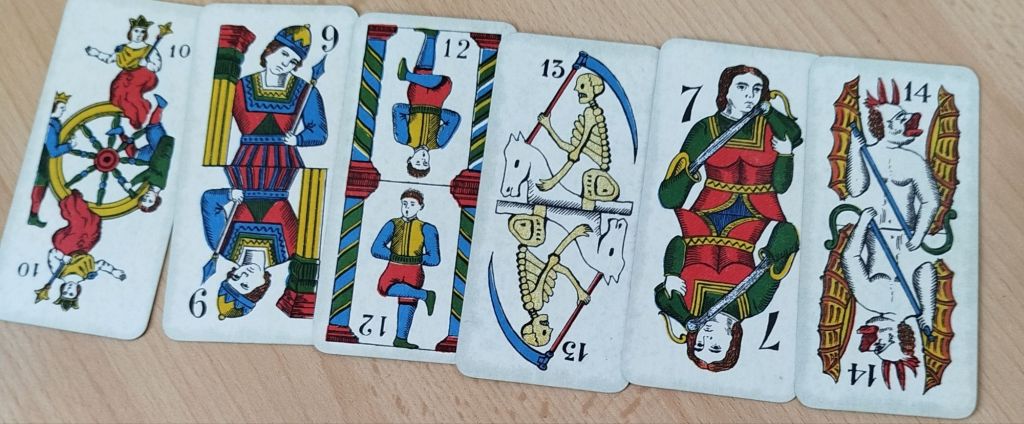
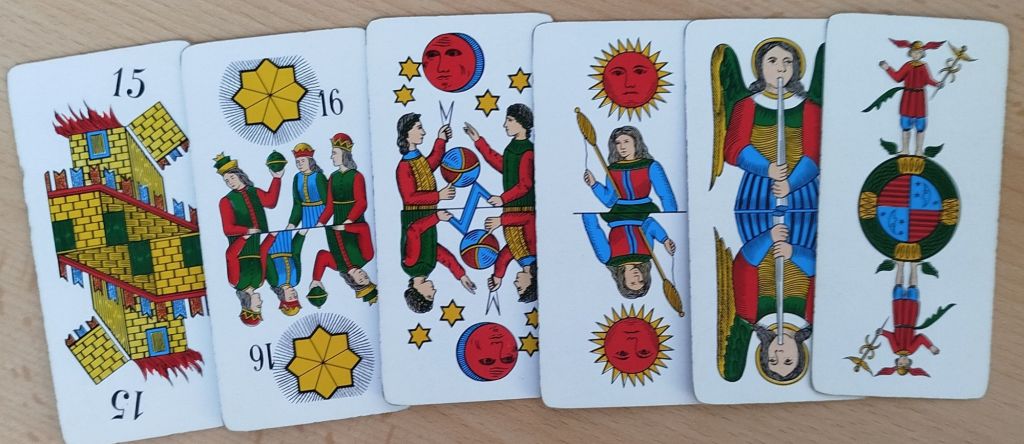
Bolognese Tarot, Major Trumps

The Fool. Strangeness, Instability, Creativity
The Juggler. A Child, A pet, Immaturity, Something New
Love. Love, Feelings, Affection, Passion, Harmony
Chariot. The bed card, Sickness, Static Situations (because the horses seem to rest)
Justice. Justice, The Law, Fairness, Equilibrium
The Hermit. Obstacle, Blockage, Small ailments

Bolognese Tarot, Major Trumps

The Wheel. Fortune, Chance
Strength. Energy, Power, Fortitude, Good Health, Active stance
The Hanged Man. Betrayal,1 Upending
Death. Loss, Mortification, Change, Yes to a yes-or-no question
Temperance. Time, Patience, Waiting
Devil. Being bedeviled, Anger, Jealousy

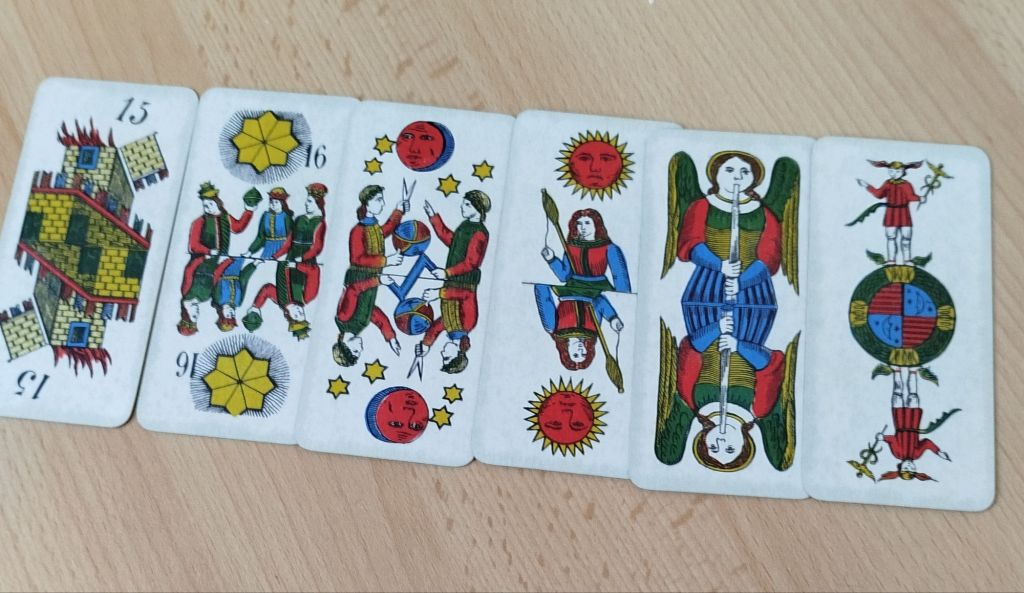
Bolognese Tarot, Major Trumps

The Tower. Prison, Hospital, Sacrifice, Being impeded or limited
The Star. “Stuff”, Objects, Material things, Your work life, Business
The Moon. By Night, Darkness, Sadness, Falsehood, Negativity
The Sun. By Day, Light, Happiness, Positivity
The Angel. Help, Friendship, Peace, Protection, Solution
The World. Travel, Journey (literal or metaphorical), Around the world

The Suit of Cups

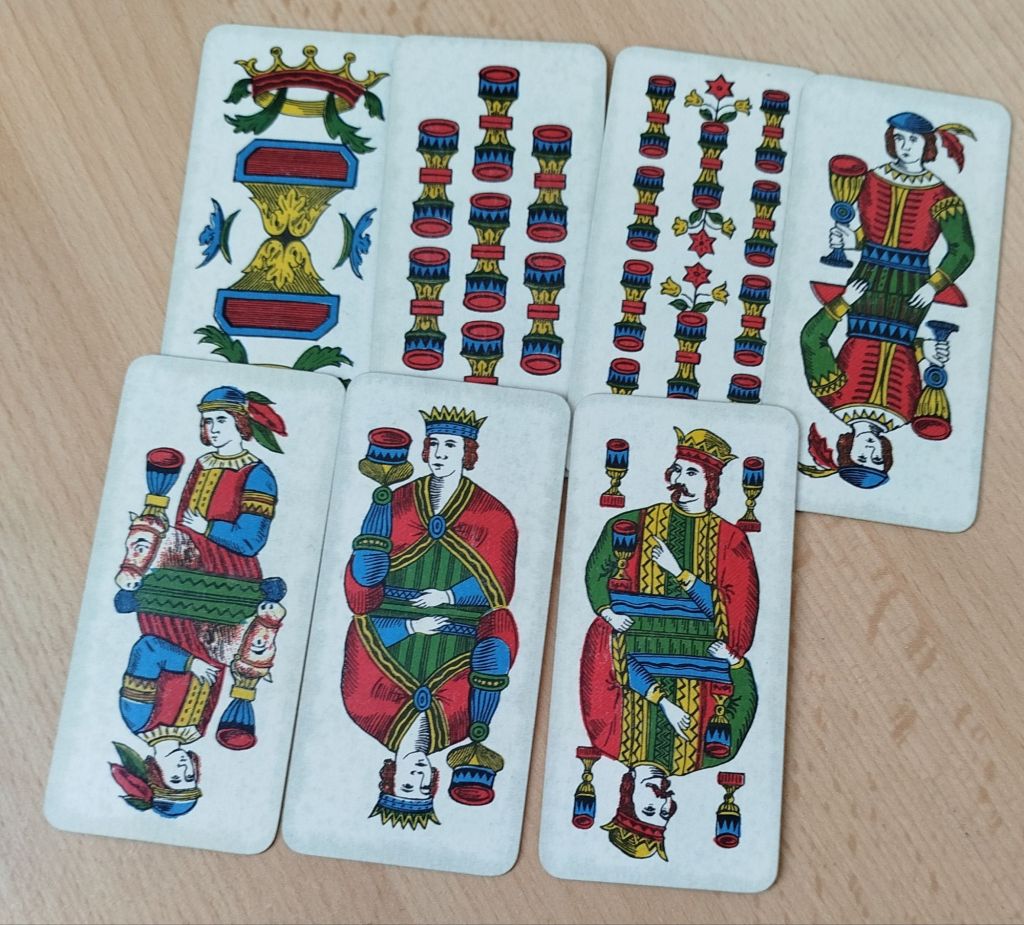
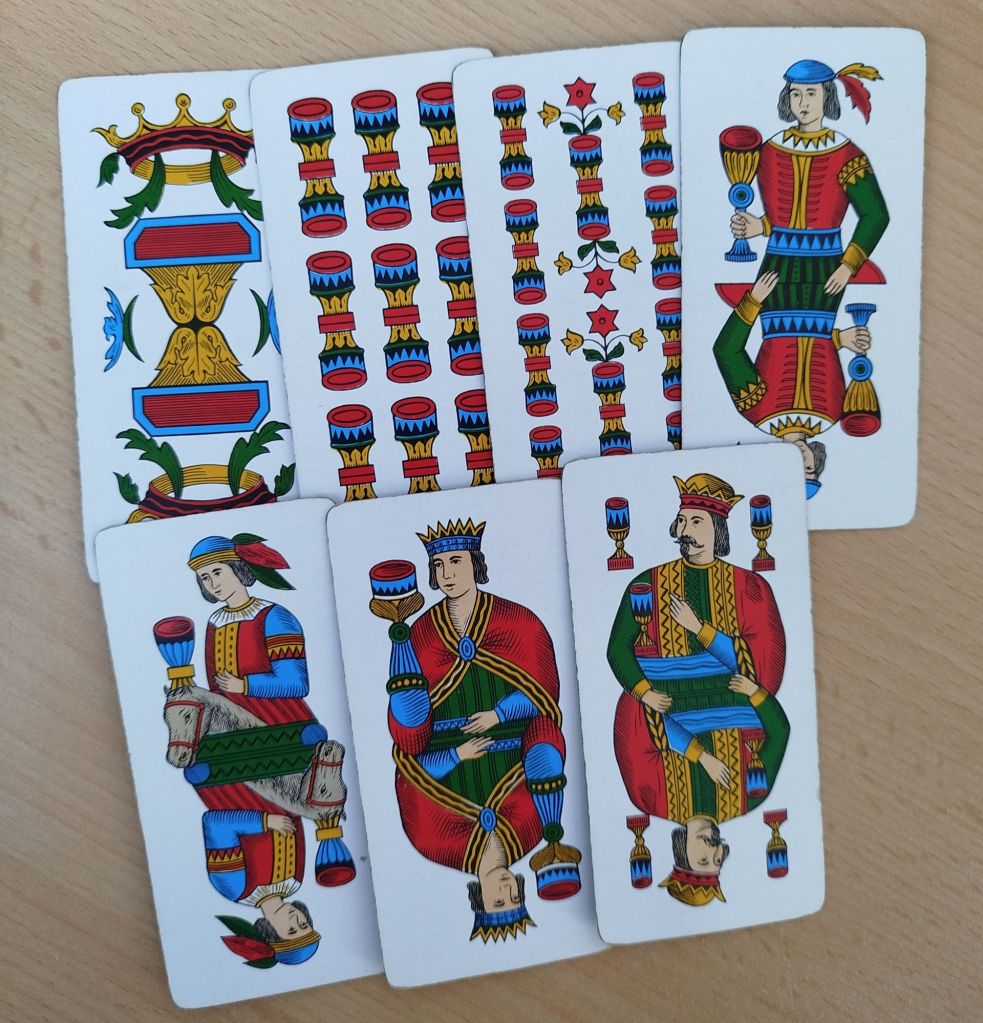
Bolognese Tarot, Suit of Cups

Ace. The Home, The House, The Family
Seven. The City, The Surroundings, Also the family, Protection
Ten. Blooming, Flourishing, Celebrating, Fun, Happiness
Page. A young woman, sometimes a female rival, Comfort, Help
Knight. Adjustment, Agreement, Positive development
Queen. A mother, A woman in your family, A motherly figure
King. A father, A man in your family, A fatherly figure

Suit of Wands

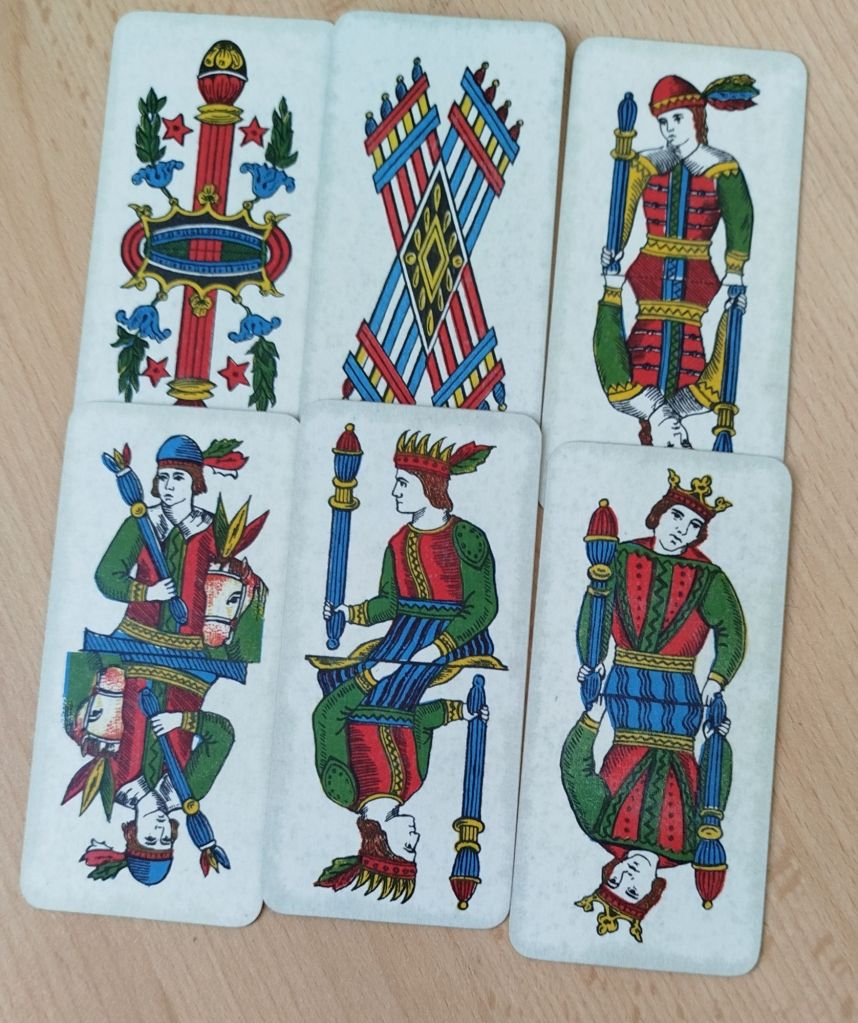
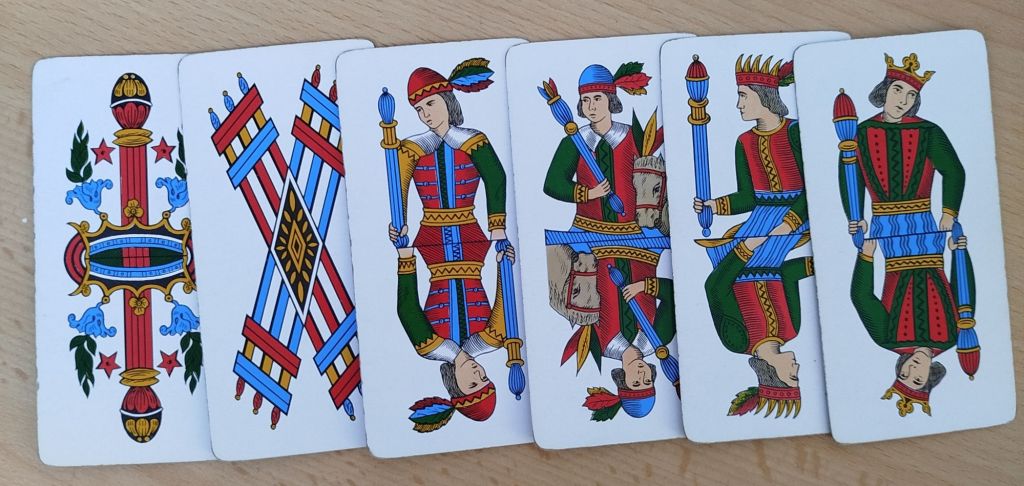
Bolognese Tarot, Suit of Wands

Ace. Victory, Union, Sex, Ability to succeed
Eight. A road, A path, Taking Steps
Page. The thoughts of the female querent
Knight. The thoughts of the male querent
Queen. The female querent, An important woman
King. The male querent, An important man

Bolognese Tarot, Suit of Coins

Ace. Big Money, Abundance, Satisfaction, The table
Seven. Tears, Sadness, Melancholy
Ten. Small money card, Small satisfactions, Tranquillity
Page. Discussions, Talks, Communications
Knight. News (especially good news, but news in general), Sometimes a young man
Queen. The Truth, Truthfulness, Wisdom, Knowledge, A blonde woman
King. An important man, A doctor, A graduate, A professional, “Important” in general

Bolognese Tarot, Suit of Swords

Ace. Something knocking at the door, About to happen, Contract, Relationship, Being bound, Hands tied
Eight. Suffering, A thorn in the heart
The Moor.2 A priest, A person in uniform, A surprise, Unexpectedness
Page. Letter, Message, Post, Contacts
Knight. Fighting, Ill-disposition, Cutting, Problems
Queen. A dark-haired woman, A problematic woman, Affliction in general
King. A dark-haired man, A young man, A problematic man, Immaturity in general

MQS

  1. See my note on this card in the 50-card method ↩︎
  2. This method only uses one of the four moors, and the person who gave me this method counted it as a sword card, probably due to the spear ↩︎

Bolognese Tarot – The 50 Card Method Meanings

Following my introductory article about the Bolognese Tarot, I want to introduce some quick meanings for the cards. No current method of reading the Bolognese Tarot employs all 62 cards. Instead, two main variants exist: the 45-card method and the 50-card method. I learned the 50-card method from my current teacher (whose book on the Bolognese tarot I reviewed some time ago). I have the 45-card method from another source, and I’ll talk about it separately.

My teacher’s hypothesis as to why traditional fortune-tellers seem to only use a reduced deck is that the cards were all employed in some older method, but the oral transmition of the tradition caused some meanings to go lost. I incline more toward the idea that the fortune-tellers of Bologna simply wanted a slimmer deck that could be used in large spreads (we will see in a future article that most spreads using this tarot deck employ many cards, some even the whole deck).

What follows is a quick summary of the main meanings. Note that: 1) the meanings are quick, concrete and to the point. Yet, in divination, it is possible to use the cards to write whole sentences 2) The major trumps are arranged according to our current system, but in reality the Bolognese tarot follows a different numbering tradition1

Major Trumps

Major Trumps of the Bolognese Tarot: The Fool, The Juggler, Love, The Charriot, Justice, The Hermit

The Fool. Foolishness, Originality, Confusion
The Juggler. A child, naive, uncertain, unreliable. A beginning
Love. Love, Good feelings, Joy
The Chariot. Moving toward something, but also the bed card (because in the picture the chariot seems to be static, with the horses resting)
Justice. Justice, Fairness, the law
The Hermit. Blockage, Obstacle, Small health issues

Major Trumps of the Bolognese Tarot: The Wheel, Strength, The Hanged Man, Death, Temperance, The Devil

The Wheel. Upright (king with crown ascending): Good luck, positive development; Reversed (page without crown ascending): Instability, need for effort
Strength. Strength, Power, Energy, Effort, Health
The Hanged Man. Betrayal,2 Cheating, Feeling betrayed or cheated, Sudden reversal
Death. A sharp ending, The confirmation of something3
Temperance. Time, the passage of time, the need to wait, stability over time
The Devil. Wrath, Anger, Being bedeviled, Passion, Jealousy, Magic

Major Trumps of the Bolognese Tarot: The Tower, The Star, The Moon, The Sun, The Angel (Judgement), The World

The Tower. A large building (usually, but not always, with a negative connotation), A prison, A hosipital. Obstruction, being imprisoned or limited (imagine being trapped in a burning building)
The Star. Objects, Gifts, Merchandise, Commerce, Work4, A positive card
The Moon. By night, Darkness, Sadness, Negativity, Secret
The Sun. By day, Light, Happiness, Positivity, Clarity
The Angel. Goodness, Friendship, Peace, Solution, Spirituality
The World. Around the world, From afar, Journey, Movement

The Moors

The three Moors used in divination with the Bolognese Tarot (the fourth one, similar to the third, is discarded)

Moor with three Arrows. Intrigue, Danger, Something that is difficult and requires to be disentangled or clarified
Moor with a Turban. A doctor, someone wearing a uniform, sickness, melancholy. A priest
Moor with one Spear. Surprise, something unexpected for good or ill, Bump on the road

The Suit of Cups

The Suit of Cups in the Bolognese Tarot

Ace. The Home, the Family
Nine. Close to home, Something on its way to us or something/someone close
Ten. Flourishing, Blooming, Feasting, Partying, Blood, Wine
Page. A young(er) woman, a small opportunity or consolation
Knight. Solution, Agreement, Reconciliation, Making peace or making your peace
Queen. A woman close to us or who loves us, archatypally a mother
King. A man close to us or who loves us, archetypally a father

The Suit of Wands

The Suit of Wands in the Bolognese Tarot

Ace. Sex, Pleasure, Triumph, Personal success
Six. A road, a path (literal or figurative), an opening
Page. The female querent’s thoughts
Knight. The male querent’s thoughts
Queen. The female querent
King. The male querent

The Suit of Coins

The Suit of Coins in the Bolognese Tarot

Ace. A document or letter, test results, contracts, etc. The table (sitting at the table, etc.)
Six. Tears, sadness
Nine. Money, assets
Ten. Well-being, lots of money
Page. Words, talks, communications
Knight. News (usually good)
Queen. The truth, wisdom, knowledge, trustworthy. Sometimes a woman embodying these traits
King. An important man, a gentleman, a lawyer or doctor, wise, with a degree

The Suit of Swords

The Suit of Swords in the Bolognese tarot

Ace. The door knockers, something about to happen.5 Also something binding, a union, a prison sentence, a contract (notice they look like rings or handcuffs)
Six. Within a three (three hours, three days, three weeks, three months)
Nine. Destiny. It highlights the other cards.
Ten. A gate, end of the road, something closing down, Suffering
Page. A letter, a message, interpersonal relationships
Knights. Cuts, Stitches, Arguments, Attacks, Fractures (real or metaphorical)
Queen. A strict woman. Affliction.
King. A younger or strict man. Childishness

MQS

  1. In reality, our current order of the major trump also differs from all other ways of numbering them in the first centuries of the tarot’s existence. ↩︎
  2. In all ancient documents concerning the tarot, the Hanged Man was called “the traitor”, because being hanged by the feet was a the punishment for traitors (see Mussolini in Italy). In the old Medieval trumps, the Hanged Man represented the person who had betrayed God ↩︎
  3. “Sicuro come la morte”, i.e., “As sure as the fact that we all die”. it is the ‘yes’ card in the Thirteen card spread. ↩︎
  4. Usually the iconography of the card is interpreted as the three Magi bringing their gifts to Jesus, but some Bolognese fortune-tellers see three merchants striking a deal ↩︎
  5. Interestingly, in many system of fortune-telling by cards practiced in Italy, there is always a card called “the door knockers”. In the system of cartomancy by playing cards I was taught, this card is the Two of Hearts ↩︎

Tarot Encyclopedia – The Four of Pentacles Or Coins

(Note: this is a collection of the meanings attributed to the cards by some occultists in the past centuries. It does not reflect my own study or opinion of the cards. It is only meant as a quick comparative reference as I develop my own take.)

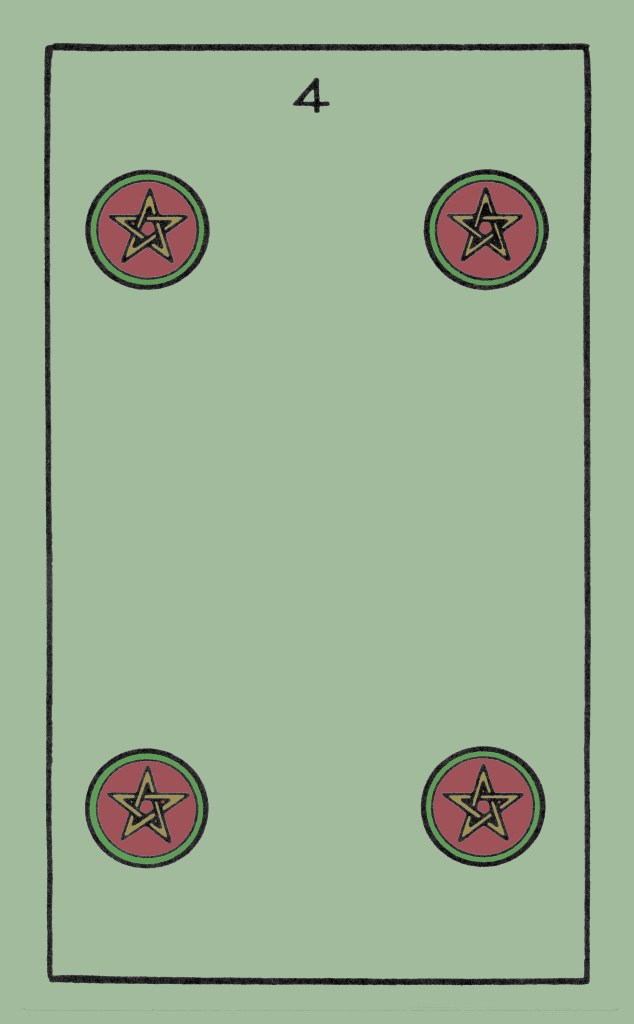
The Four of Pentacles from the Builders of the Adytum (BOTA) Tarot deck

Paul Foster Case (and Ann Davies)

The time period is the third decanate of Capricorn, under the rulership of Mercury, January 10 to 19.
Well-Dignified: opportunities for public service; an acute, sharp, penetrating, tactful temperament; economy in the arrangement of material affairs; activity in money matters.
Ill-Dignified: dangers to reputation; troubles through changes not carefully considered; desire for money, but unwisdom in its management; the Querent will meet with sharp criticism.
Keyword: Management.
(From the Oracle of Tarot course)

A. E. Waite

A crowned figure, having a pentacle over his crown, clasps another with hands and arms; two pentacles are under his feet. He holds to that which he has. Divinatory Meanings: The surety of possessions, cleaving to that which one has, gift, legacy, inheritance. Reversed: Suspense, delay, opposition.
(From The Pictorial Key to the Tarot)

Aleister Crowley

As to the Disks, the heaviness of the symbol rather outweighs any considerations of its weakness. The card is called Power. It is the power which dominates and stabilizes everything, but manages its affairs more by negotiation, by pacific methods, than by any assertion of itself. It is Law, the Constitution, with no aggressive element.

[…]

The Four, Chesed, shows the establishment of the Universe in three dimensions, that is, below the Abyss. The generating idea is exhibited in its full material sense. The card is ruled by the Sun in Capricornus, the Sign in which he is reborn. The disks are very large and solid; the suggestion of the card is that of a fortress. This represents Law and Order, maintained by constant authority and vigilance. The disks themselves are square; revolution is very opposite to the card; and they contain the signs of the Four Elements. For all that, they revolve; defence is valid only when violently active. So far as it appears stationary, it is the “dead centre” of the engineer; and Capricornus is the point at which the Sun “turns again Northward”. The background is of deep azure, flecked yellow, suggesting a moat; but beyond this is a pattern of green and indigo to represent the guarded fields whose security is assured by the fortress.

In the Yi King, Sol in Capricornus is represented by the Second Hexagram, Khwan, which is the Female Principle. Compare the English word Queen, Anglo-Saxon Cwen, old Mercian Kwoen. Cognate are Icelandic Kvan, Gothic Kwens, woman. The Indo-Germanic type is g (w)eni and the Sanskrit root GwEN. Note also Cwm, coombe, and agnate words, meaning an enclosed valley, usually with water running from it. Womb—possibly a softened form?

Compare also the innumerable words, derived from the root Gas, Which imply an enclosed and fortified space. Case, castle, chest, cyst, chaste, incest and so on.

The primary radicle in all this class of words is the guttural. Observe the Hebrew attributions: Gimel, the moon; Cheth, Cancer, the house of the moon; Kaph, the Wheel; Qoph, the Moon, XVIII, Guttur, the throat. Sounds so made suggest the other throat; one is the channel of respiration and nutrition, the other of reproduction and elimination.
(From The Book of Thoth)

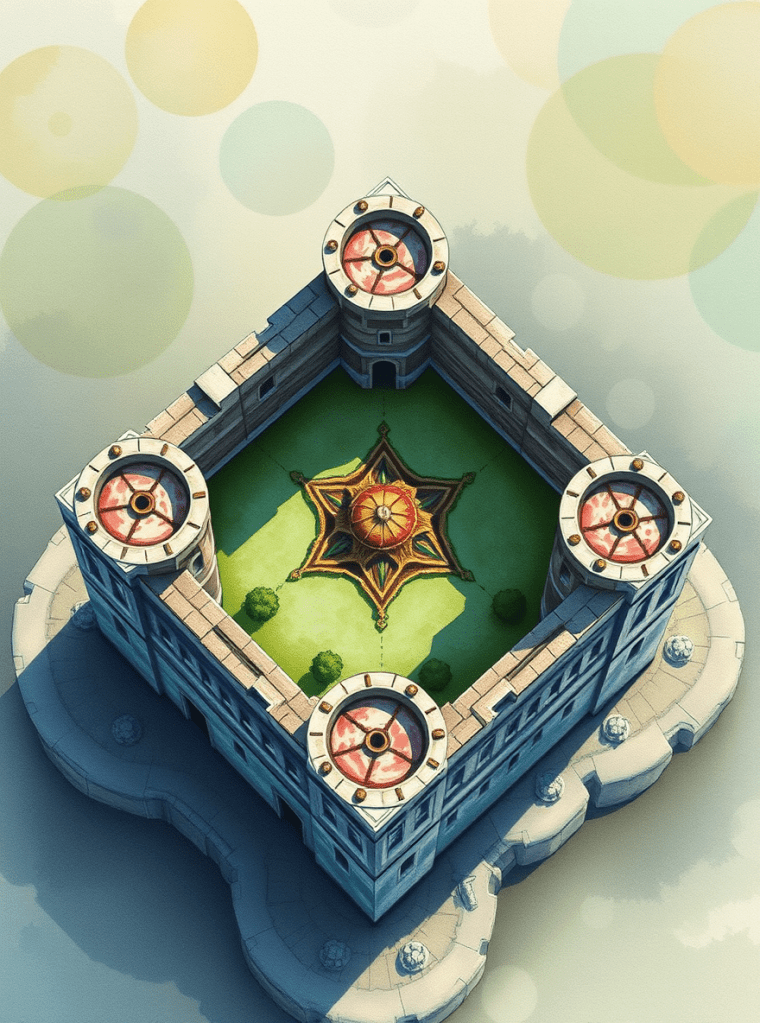
A Crowley-esque AI-generated illustration for the Four of Pentacles

Golden Dawn’s Book T

A HAND holding a branch of a rose tree, but without flowers or buds, save that in the centre is one fully blown white rose. Pentacles are disposed as on the points of a square; a rose in its centre. Symbols Sun and Capricorn above and below to represent the Decan.
Assured material gain: success, rank, dominion, earthy power, completed but leading to nothing beyond. Prejudicial, covetous, suspicious, careful and orderly, but discontented. Little enterprise or originality. According to dignity as usual.
Chesed of HB:H (Gain of money or influence: a present).
Herein do HB:KVQYH and HB:MNDAL bear rule

Etteilla

Benefit
Upright. This blade, as far as the medicine of the spirit is concerned, means, in its natural position: Present, Gift, Generosity, Beneficence, Liberality, Strenna, Grace, Offering, Giving, Gratification, Service. – White color, Lunar medicine, Stone to white.
Reversed. Enclosure, Circuit, Circumvolution, Circumscription, Circumference, Circle, Circulation. – Intercept, Obstruction, Engorgement, Hoarding, Cloister, Monastery, Convent. – Stop, Fixed, Determined, Definite, Extremity, Boundaries, Limits, Terms, End, Barrier, Dividing wall, Wall, Hedge, Wall. – Obstacles, Bars, Impediment, Suspension, Delay, Opposition.

MQS

Tarot Encyclopedia – The Four of Swords

(Note: this is a collection of the meanings attributed to the cards by some occultists in the past centuries. It does not reflect my own study or opinion of the cards. It is only meant as a quick comparative reference as I develop my own take.)

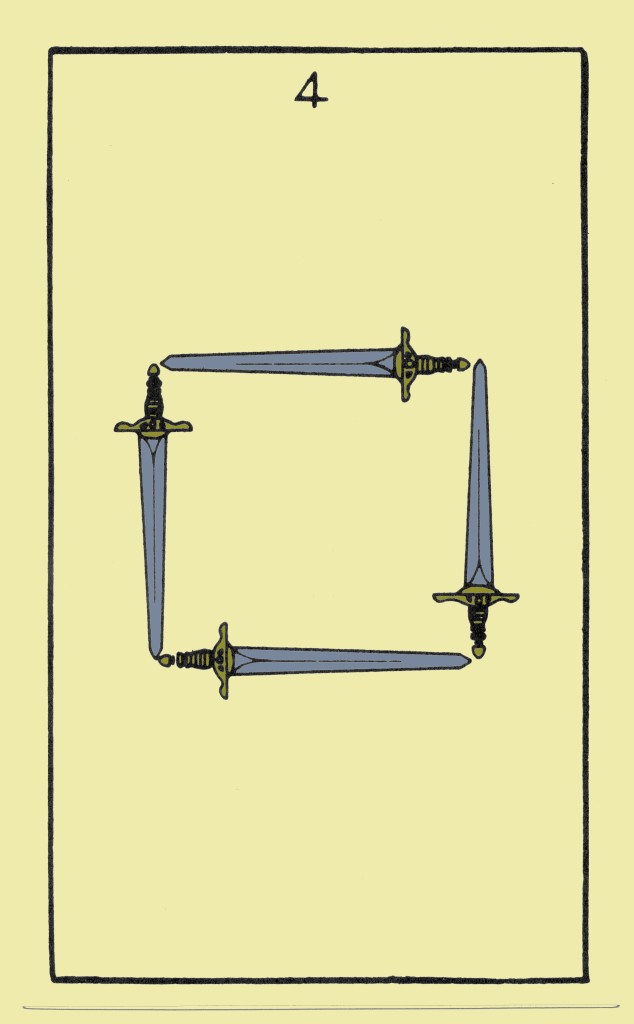
The Four of Swords from the Builders of the Adytum (BOTA) tarot deck

Paul Foster Case (and Ann Davies)

The time period is the last decanate of Libra, October 13 to October 23, under the rulership of Mercury.
Well-Dignified: rest from sorrow, yet after and through it; relief from anxiety; rest after illness; quietness; change for the better; success in legal affairs; association with others in Mercurial pursuits; strong mental attraction to a person of the opposite sex; activity in writing or short journeys.
Ill-Dignified: inharmony with partners; unsettled conditions in legal
affairs; disorder and loss through ill-considered writings or needless
short journeys; vexations through petty strife and sarcastic speech.
Keyword: Rest.
(From the Oracle of Tarot Course)

A. E. Waite

The effigy of a knight in the attitude of prayer, at full length upon his tomb. Divinatory Meanings: Vigilance, retreat, solitude, hermit’s repose, exile, tomb and coffin. It is these last that have suggested the design. Reversed: Wise administration, circumspection, economy, avarice, precaution, testament.
(From The Pictorial Key to the Tarot)

Aleister Crowley

The Four of Swords is called Truce. This seems rather on the lines of “the strong man armed, keeping his house in peace”. The masculine nature of air makes it dominant. The card is almost a picture of the formation of the military clan system of society.

[…]

The number Four, Chesed, is here manifested in the realm of the Intellect. Chesed refers to Jupiter who rules in Libra in this decanate. The sum of these symbols is therefore without opposition; hence the card proclaims the idea of authority in the intellectual world. It is the establishment of dogma, and law concerning it. It represents a refuge from mental chaos, chosen in an arbitrary manner. It argues for convention.

The hilts of the four Swords are at the corner of a St. Andrew’s cross. Their shape suggests fixation and rigidity. Their points are sheathed—in a rather large rose of forty-nine petals representing social harmony. Here, too, is compromise.

Minds too indolent or too cowardly to think out their own problems hail joyfully this policy of appeasement. As always, the Four is the term; as in this case there is no true justification for repose, its disturbance by the Five holds no promise of advance; its static shams go pell-mell into the melting-pot; the issue is mere mess, usually signalized by foetid stench. But it has to be done!
(From The Book of Thoth)

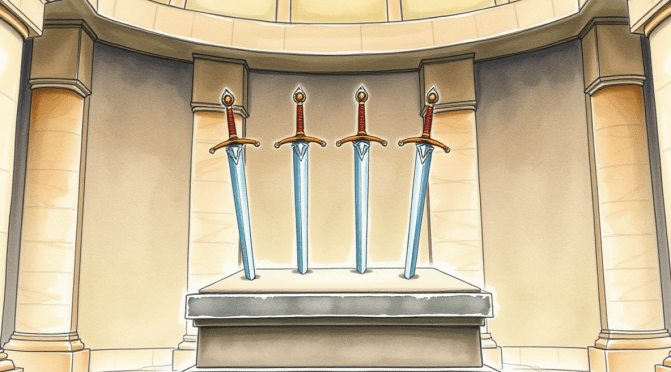
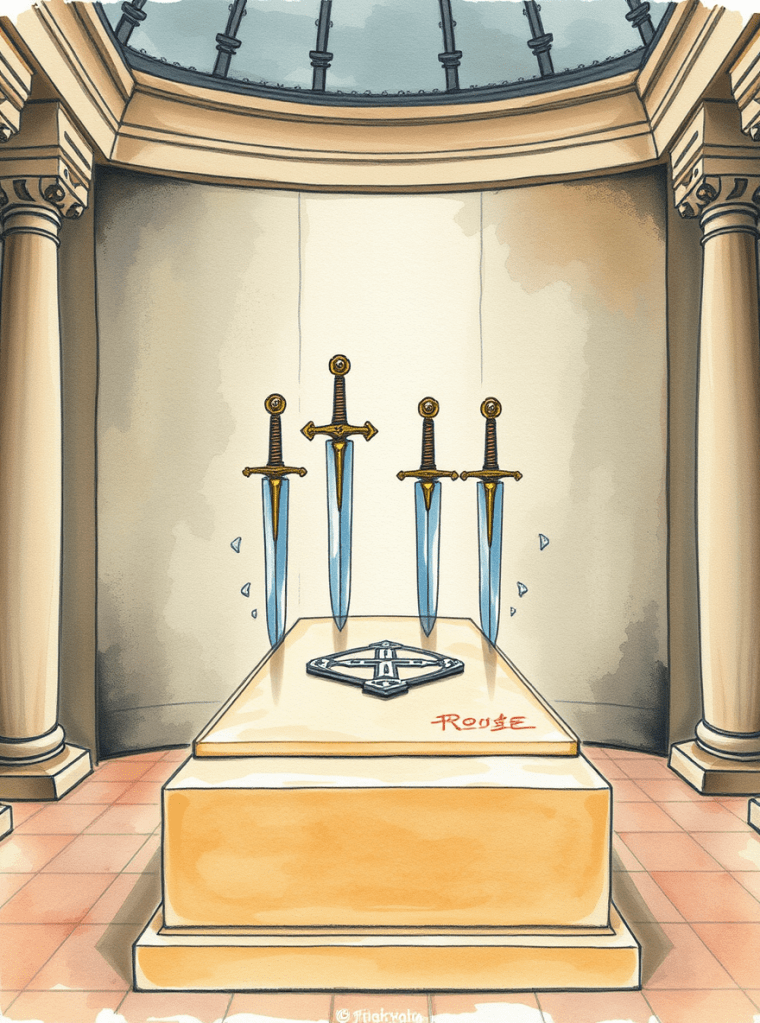
AI-generated illustration for the Four of Swords

Golden Dawn’s Book T

TWO White Radiating Angelic Hands, each holding two swords; which four cross in the centre. The rose of five petals with white radiations is reinstated on the point of their intersection. Above and below, on the points of two small daggers, are Jupiter and Libra, representing the Decanate.

Rest from sorrow; yet after and through it. Peace from and after war. Relaxation of anxiety. Quietness, rest, ease and plenty, yet after struggle. Goods of this life; abundance; modified by dignity as is usual.
Chesed of HB:V (Convalescence, recovery from sickness; change for the better).
Herein do HB:LAVYH and HB:KLYAL bear rule.

Etteilla

Solitude
Upright. This card means, as far as the medicine of the spirit is concerned and in its natural position: Solitude, Desert, Retired place, Hermitage. – Exile, Banishment, Proscription. – Uninhabited, Isolated, Abandoned, Neglected. – Tomb, Burial Ground, Coffin.
Reversed. Economy, Wise Conduct, Wise Administration. – Welfare, Management, Household management, Savings, Avarice. – Order, Arrangement, Relationship, Convenience, Concordance, Agreement, Harmony, Music, Disposition. – Will. – Reservation, Restriction, Exception. – Circumspection, Circumscription, Retention, Wisdom, Sympathy, Regard, Precaution.

MQS

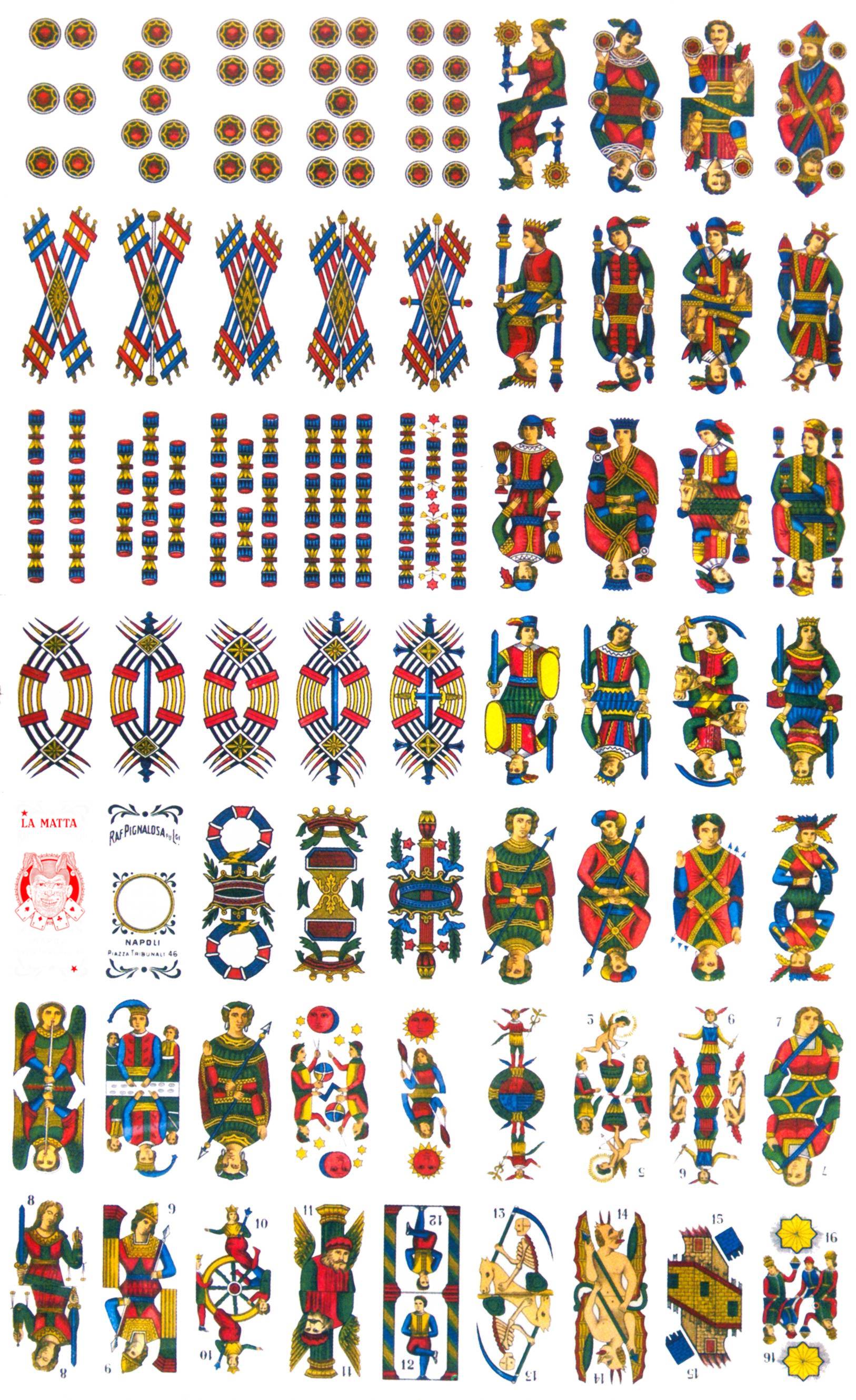
Bolognese Tarot – Introduction to an Old Fortune-Telling Tradition (Part I)

As I’ve mentioned on this blog, I’ve been studying the divination tradition of the Bolognese Tarot (Tarocchino Bolognese, literally the Small Tarot of Bologna) for some months now. I’ve been doing it under the direction of a traditional practitioner of this art, whom I’ve befriended and with whom a wonderful exchange of ideas has started.

The full deck. Image from the website Labirinto Ermetico

I plan on introducing this form of divination in its main lines for a couple of reasons: 1) it is little known outside of Italy and it deserves some love 2) Its reading techniques are markedly different from the current approach and allow for a very concrete, down-to-earth approach 3) I want to discuss some spreads done with it in the future, and I can’t do it without introducing it first 4) it is the oldest tarot-related divination tradition that we know of, and it is therefore cool from a historical standpoint.1

The Ugly Duckling and Its Quirks

Like the almost totality of very old decks, with a couple of exceptions (the Visconti deck is one) the Bolognese tarot is distinctively unappealing from an esthetic standpoint, largely because, like other popular pre-RWS decks, it was meant to be used by poor people as a playing deck at the local inn.

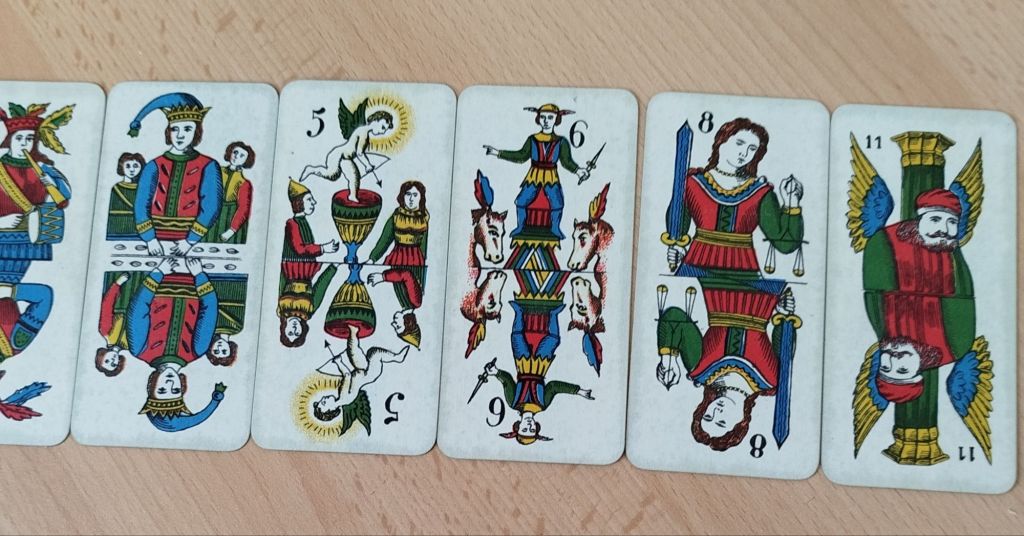
A selection of cards from the Bolognese Tarot. As may be noted, they are symmetrical, like playing cards, though the earliest packs had full images.

The reason it is called ‘tarocchino’ (small tarot) has to do with its reduced size, probably to enhance its handlability. However, it is not just the size of the cards that is reduced, but also the number of the cards that comprise the deck: all pip cards from Two to Five are removed, leaving only the Ace of each suit plus the cards from Six to Ten and the court cards.

Furthermore, the Pope (Hierophant), Popess (High Priestess) Empress and Emperor are absent from the deck for political reasons, as Bologna was directly under the control of the Church. Instead, the deck includes four ‘Moors‘ (the Moors were Muslim colonizers that had conquered parts of Italy.)

Three of the ‘Moors’. The Fourth one is a copy of the third on the right.

Finally, the Bolognese Tarot has another peculiarity, in that the Major Trumps are out of order compared to our regular system. This may sound surprising to some, but our current ordering of the trumps is a relatively recent development and has nothing mystical about it (the oldest preserved document with the order of the trumps gives a rather different sequence).

An Old Tradition

The Bolognese Tarot tradition was almost entirely confined to the city of Bologna and the surrounding areas, and was at risk of dying out, until both the card game and the divination tradition were transmitted to a larger public thanks to the power of the Internet.

Interestingly, to this tradition is connected the most ancient set of meanings handed down by old sources. The following list dates back to the pre-Napoleonic period and gives the meanings of a reduced pack of thirty five cards. I’m copying it here for its historical interest, but it does not correspond to the system I have been taught:

  1. The Juggler (Magician): Married Man
  2. The Lovers: Love
  3. The Chariot: Journey
  4. Temperance: Time
  5. Strength: Violence
  6. The Hermit: Old (Person)
  7. The Hanged Man: Treason
  8. Death (called ‘Thirteen’): Death
  9. The Devil: Wrath
  10. The Star: A Gift
  11. The Moon: Night
  12. The Sun: Day
  13. The Angel (Judgement): Marriage or Agreement
  14. The World: Long travel
  15. The Fool: Madness
  16. King of Wands: A Bachelor
  17. Queen of Wands: A Prostitute
  18. Knight of Wands: Something Knocking at the Door
  19. Page of Wands: Thoughts of the Female Querent
  20. Ace of Wands: Sexual Escapades
  21. King of Cups: An Old Man
  22. Queen of Cups: Married Woman
  23. Knight of Cups: Reconciliation
  24. Page of Cups: The Female Querent
  25. Ten of Cups: The Roof of the House
  26. Ace of Cups: The House
  27. King of Swords: An Evil Tongue
  28. Ten of Swords: Tears
  29. Ace of Swords: A Letter
  30. King of Coins: The Male Querent
  31. Queen of Coins: The Truth
  32. Knight of Coins: Thoughts of the Male Querent
  33. Page of Coins: Unmarried Woman
  34. Ten of Coins: Money
  35. Ace of Coins: The Table

As I said, this is not the system that I’ve been taught, and it is very likely that even back then more than one system existed (usually, significant differences are found from quarter to quarter in Bologna and from small village to small village in the surrounding areas). Since this cartomantic tradition predates Etteilla’s by at least a quarter of a century, and probably more, and since Etteilla says he learned to read the tarot from an Italian card reader (though he pretends it was Alexis of Piedmont to add to the mystery), it is not to be excluded that the Bolognese tarot had some influence on him.

But this is speculation. What is clear is that tarot divination, whenever it was born, was brought into the world as a way of addressing concrete issues. This series of articles is dedicated to bringing the tarot back to these roots.

MQS

  1. If you want to read more, you can start with the Wikipedia page. More Information is contained on the webside of the Associazione Le Tarot ↩︎

Simplifications of the Opening of the Key Spread

In a previous article I discussed how the original Golden Dawn spread known as Opening of the Key fits perfectly into the mold of traditional divination by cards, although it adds certain occult layers to it. This is largely due to the absence of one-card-per-position layouts, the presence of peculiar techniques and the tendency to read cards in rows.

To sum up how the spread worked:

  • You selected a significator for the querent (usually among the court cards)
  • You shuffled the deck and let the querent cut it into four stacks (corresponding to the four letters of the Tetragrammaton)
  • You found the stack with the significator and had to divine, based on its position, the nature of the querent’s problem. If wrong, the divination wasn’t radical.
  • You had to spread out the cards into a row or arrange them into a ring and count starting from the querent’s card. Then, you had to pair the cards on either side of the querent to fill out the details.
  • Then you shuffled the deck again and dealt it out into the twelve houses. You had to find the querent’s significator and count and pair as before based on the house.
  • You shuffled the deck again and dealt it into the twelve signs. You found the stack, counted and paired.
  • You shuffled the deck, then looked for the significator and dealt out the 36 cards following it into a ring symbolizing the decans of the zodiac. You counted and paired.
  • Finally, you shuffled and dealt the deck into the ten Sephiroth of the Tree of Life, found the stack, counted and paired.

As you may have guessed, the Opening of the Key was a cumbersome spread, and while it was used for the solution of practical matters (Crowley famously remarked on this fact), it clearly was meant to be used primarily within a ritual setting, at least in its entirety.

What is also clear, though, is that the Opening of the Key is less a spread in itself than a blueprint for a complete tarot reading made up of five individual spreads, each of which analyzes the issue from a different standpoint, or rather by tapping into a different layer of it. The experienced card reader could simply choose one of the five spreads and use it without resorting to the others, as need dictates.

For the most part, it seems that many Golden Dawn members simply stuck to the first operation, which is consequently the most famous and iconic, where one cuts the pack into four smaller stacks and reads the one with the significator. The possible reason why the other operations were generally discounted is probably that almost all of them required the deck to be dealt out into small stacks, only one of which is read, so that it takes more time to deal the cards than to read them.

Other members, though, were more inventive. In his Oracle of the Tarot booklet, Paul Foster Case offers a simpler alternative to the five-operation extravaganza of the full method (which he nonetheless describes and recommends for more serious or complex questions)1

The divination starts as usual: by finding the stack containing the significator and telling the querent what he or she has come for without them telling us, based on the stack. In the original instructions, if the diviner is wrong in assessing the nature of the question, the divination should be abandoned. In reality, aside from the initial period of training, it seems that the location of the significator was simply used to color the interpretation of the cards.

At this point, Case’s simplified method diverges from the original. Instead of spreading out the stack into a single row or ring of cards and starting the counting technique from the significator, Case says the diviner must shuffle the stack and then deal it out into three smaller stacks, corresponding to the past, present, and future. Each stack is then read sequentially (as you would in playing card, Sibilla or Lenormand divination).

The simplification of the method is due to the fact that, instead of starting the exploration of the issue from the past/present with the first operation and then moving on to the further future with the other operations, one has immediately past, present and future condensed into a single method.

There are other ways of simplifying the Opening of the Key. Paul Hughes Barlow rose to some prominence a couple of years ago for his idiosyncratic way of reading the first of operation without relying on a significator, instead reading all four stacks, something for which he was reproved by some.

Personally, I have found Paul Case’s simplification very effective in my experiments, and I’ll probably post an example reading in the future.

MQS
  1. He also introduces certain specifications that are also found in the advanced BOTA course on divination elaborated by Ann Davies based on his notes. ↩︎