Usually I’m not a huge fan of readings done on someone else without them knowing, not for ethical reasons but because I always feel there is more wiggle room for error if the person is not present. This is just my experience, but that’s how it works for me. Still, when a friend of mine started getting paranoid that his job contract might not get renewed I decided to ask, even though he didn’t feel like getting a reading (especially since we don’t live in the same country)
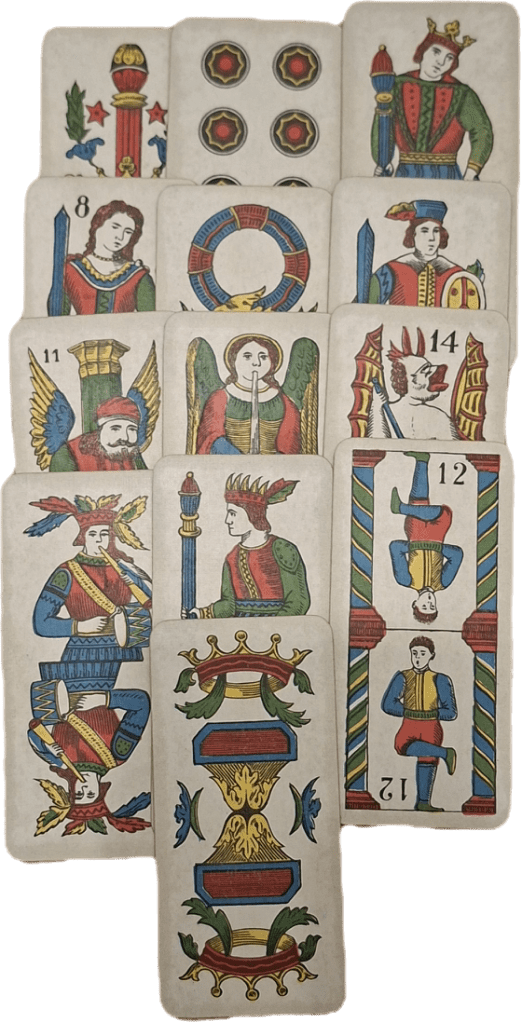
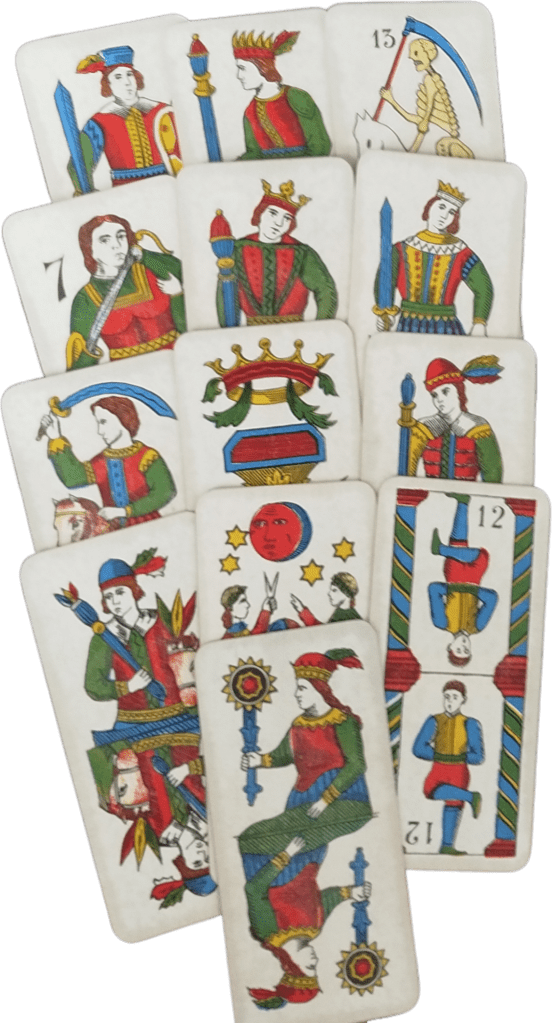
I used the Bolognese tarot, since this is the deck I’m currently studying, and the thirteen card spread, which is the most common spread with this deck.
Will the contract be renewed?
I believe the line that gives us a positive answer is the third, with the Hermit, the Angel and the Devil. Angel and Devil is one of those rare traditional combos that cannot be reduced to the basic meaning of the cards: it represents great news or great satisfaction. In general, when they fall together, they can be a hint at a yes.
Since the Hermit opens the line though, this is going to take some time (and it did: he was waiting for an answer any day from the date of the reading, instead it took two months). And the answer WAS positive, so the Hermit only influenced the time element, but it didn’t block the good news.
What about the other cards? Well, I believe the first two lines are simply describing the situation: in the first line we have the querent, my friend (the King of Wands) together with the little money card and the Ace of Wands. This can be interpreted as him having actually little (Ten of Coins) interest (Ace) for the job aside from needing it or, more positively, that the job brings him success (Ace) in little amounts (Ten of Coins). Both interpretations are actually true.
The second line has Justice and the Ace of Swords, which together can talk about a legally binding (Justice) contract (Ace of Swords). Then comes the letter card (the Page of Swords) which is followed in the next line by the Hermit, the blockage. This is where the delay was created.
What about the last line? Here I’m not sure. The cards talk about a woman, the Queen of Wands, possibly belonging to the family (she sits right on top of the Ace of Cups). She is surrounded by confusion (Fool) and betrayal (the Hanged Man). My only thought was that a woman close to him wasn’t at all expecting the contract to be renewed, was taken by surprise. I wasn’t able to confirm this detail, but there you go.
The literary landscape in Italy is rather dismal, as far as the occult arts are concerned, even though in recent years something seems to be changing. But Il Tarocchino di Bologna (the Little Tarot of Bologna) by Andrea Vitali and Terry Zanetti is not a very recent book, and this makes its outstanding quality even more of a surprise.
The book is divided into several sections, some authored by Vitali and some by Zanetti. Andrea Vitali is possibly the greatest living tarot historian (and a damn good diviner too), the one who has shed the most light on the history and origins of the tarot, bursting a lot of bubbles in the process. His section is, as usual, well documented and written, and generally aims at showing that the tarot probably originated not in Milan but in Bologna.
But, as undisputed as Vitali’s expertise in the field, our focus in this review is Zanetti’s section on cartomancy. This is well organized and competently written. Aside from a brief preamble, the largest part of her section of the book is dedicated to the meanings of the cards, which she has researched in various ways, including by looking for old decks with the meanings written on them.
Zanetti, like Celi (and currently like me), uses a 45-card deck. The deck, however, differs: instead of one Stranger, she uses two, one of them taking the place of the Ten of Coins. As I mentioned elsewhere, these discrepancies are to be expected from a tool of popular divination that was invented in a non-globalized world of isolated villages and streets. Even some of the meanings differ, as I explained in this post, where I talked about the fact that she interprets the Page of Swords not as a letter but as a young man.
Each card is presented with their Italian and Bolognese dialect name, a brief iconographic rundown, the list of meanings, an example reading with a three-card method, a saying from the Bolognese popular tradition that illustrates the meaning of the card, and a combination. Some combinations are exceedingly curious and stray far way from the original meanings of the cards.
The spreads covered by Zanetti are also interesting and worth studying. One is a variation of the great staircase spread I talked about, but Zanetti gives very specific and somewhat rigid rules for interpreting it. She then covers a pyramid spread and a variation of the cross spread, the thirteen card spread and, finally an oracle made up of only three cards.
The only small concern is the rigidity with which Zanetti treats combinations of two cards. My experience is that cards must be first and foremost combined logically based on the context of the question and the other cards, but she asserts that when two specific cards come together they always have a specific meaning regardless of everything.
This, I have found, may be true when many cards come together. For instance, even if you ask about love, if someone in your life is about to drop dead, lots of cards will amass in that regard, not just two. Yet Zanetti treats two-card combos as if they were powerful enough to transcend the question (and yes, she does give a combination about death). Again, this is a question of method and personal experience. It does not detract from the validity of her experience, but it does highlight one of its peculiar traits.
So is this book worth having? To this my answer is a big fat yes!
When someone teaches someone else the traditional meanings of the cards, they often don’t waste too much time giving them a rundown of all the applications of the one or two keywords they give them, especially at the beginning. Keep in mind that in many traditions, at least in Italy, the initial instructions for card reading are passed down on Christmas Eve, so the explanations must be quick enough to fit into one evening where you have plenty of other stuff to do.
Usually, the initial instruction is followed up by a more thorough explanation later, but the new reader is also expected to “lavorare le carte”, literally to “work the cards“. This means that while they are being given a vocabulary (the keywords) and some grammar and syntax (the various spreads and combinations) they are supposed to develop their own language.
Think about it: we all speak English on this blog, yet each of us speaks a different version of it, not only because some of us are native speakers while some aren’t, and not just because some come from the US, some from GB, some from Australia, etc. but also, and especially, because each speaker of a language has their own slightly different version of it, owing to their character, personal history, experiences, education, talents and many other factors.
This may sound like an admission that language is random and infinitely pliable at will, but it isn’t. Your own language is an emanation of you as a person, but who you are as a person is not fully under your control. In fact, the diviner and occultist in me believes that it is only very slightly under your control.
What is true for regular speech is true for the speech of the cards. Once you are given the meanings of the cards, it is not a matter of reinventing them, but rather of discovering how the meanings work for you, of understanding what your particular, individual dialect is. This is a never-ending process, because the language of divination is a difficult second language to learn and because there is no human native that can help us.
But let’s discuss an example of how you take a single keyword and turn it into a web of interrelated meanings. In the Bolognese Tarot, which is my current obsession and is quickly becoming one of my favorite systems, the Queen of Coins is called “the truth”. There. If you were sitting on grandma’s lap on Christmas Eve and she were passing the meanings down to you, that’s what she would say. The truth. Period.
The truth is a complex thing, and throughout history different people have understood it to be something different. In itself, it is an abstract concept. After receiving it, you need to make it concrete, i.e., you need to discover how the word “truth” is used in your particular divination dialect. Let’s give it a try (and this is my dialect, obviously. It may or may not overlap with yours).
The truth is what truthful people tell, so obviously the card qualifies people as truthful, dependable, reliable. Next to a person card, the person will be all these things, probably.
Once you know the truth about something, you know about it. Knowledge is therefore another aspect of truth. Who has knowledge? Professors, for sure, and people who have studied something. One might counter that so many graduates today are ignorant fools filled with prejudices they never questioned. And one would be right. Archetypally, though, the connection (the ‘signature’) holds, similarly to how astrologically scholars are ruled by Mercury, even if scholars are often up their asses.
Study, teaching, learning, explaining, science, discovering, bringing to light, intellectual (or at least not physical) occupations seem to also be concepts that beautifully complement that lonely keyword “truth”. But all these aren’t just descriptions for abstract knowledge. What is a less abstract form of knowledge? Expertise, for sure. If you call the plumber, he may not be able to tell you how the categories of Aristotle’s logic apply to your toilet, but he sure knows how to stop it puking out scum. And that’s a good deal more helpful. So a plumber with the truth on his side is certainly a plumber you want to hire.
Today, the word wisdom is almost forgotten, or relegated to describing dubious practices with no scientific stamp of approval. But wisdom used to be deeply connected to knowledge. The Queen of Coins, therefore, surely describes the ability to lead your life the right way, or to lead others the right way.
Especially in the West, the idea of truth has always been connected with the ability to see. “I see” we say, when we understand something. This may sound shallow, but it actually has its roots in the old Greek notion that the truth is what the mind sees beyond the illusions of the senses. The word “idea”, which is what we have in our minds and which we hope to be a truthful representation of reality, comes from the root ‘vid-‘, which is the same root as the latin ‘videre’, to see. So the Queen of Coins stands for sight and for the eyes, and for windows, which bring light (understanding) into the home and from which we see how the world outside looks like. And so on and so forth.
These associations can be discovered by practice and by decoding the combinations that are usually passed down. Again, it is not a matter of making up. It is, literally, a process of discovery.
I often get messages from people asking me how to learn the tarocchino. This makes me happy, because it means this extremely old divination tradition is slowly getting the attention it deserves.
I had the blessing of knowing a great teacher, Germana Tartari, whose first book I reviewed (and whose two other books I shall review in the near future). She taught me how to read the 50 card method.
For those interested, a course by her will start on 15 January. You can read more about it on the website of the Accademia degli Studi Ermetici
I did a reading recently with the Bolognesw tarot that I unfortunately forgot to record. It was one of those instances of “of course I will remember it.” The one thing I do remember is that the Tower featured prominently in the reading and did not take on a nefarious meaning, instead just indicating a place other than the home.
This gave me the idea of collecting here the combinations I have actually experimented in practice so far.
Tower + Queen of Coins (Truth) = School, Place of learning (this combo was in the reading I did recently)
Tower + World (big) = A palace (in the example of the reading I did, it was a tourist attraction)
It is not an endless list, as you can see, but then again the Tower doesn’t always come up in a reading, and when it does it doesn’t always indicate a place, and when it does it isn’t always clear what kind of place it represents, based on the other cards. But this short list is what my experience has borne out so far, and it clearly shows how the cards operate as small particles of meaning that gravitate toward each other to create complex structures.
Obviously, much depends on the context and on the other cards. The Ace of Coins, for instance, is the table, but it is also a big money card, so with other material cards it could turn the Tower into a bank instead of a restaurant. What I can say for certain at this point is that my experience with the Bolognese tarot shows the Tower isn’t necessarily an evil place (like a hospital or a prison) as some strands of the tradition seem to indicate, but its meaning can be modified by the presence of positive cards.
Working on my review of Andrea Vitali and Terry Zanetti’s book on the Bolognese tarot I came across some interesting information that matches what some Bolognese tarot readers have confirmed.
If you read my section on the card meanings of the Bolognese tarot, you will see that I call the King of Swords “Spadino”, which literally means “little sword” or, more appropriately in this context, “little sword bearer” (the ‘bearer’ part is implied). This is because the people I have chiefly learnt from all agreed on this one name, independently from one another.
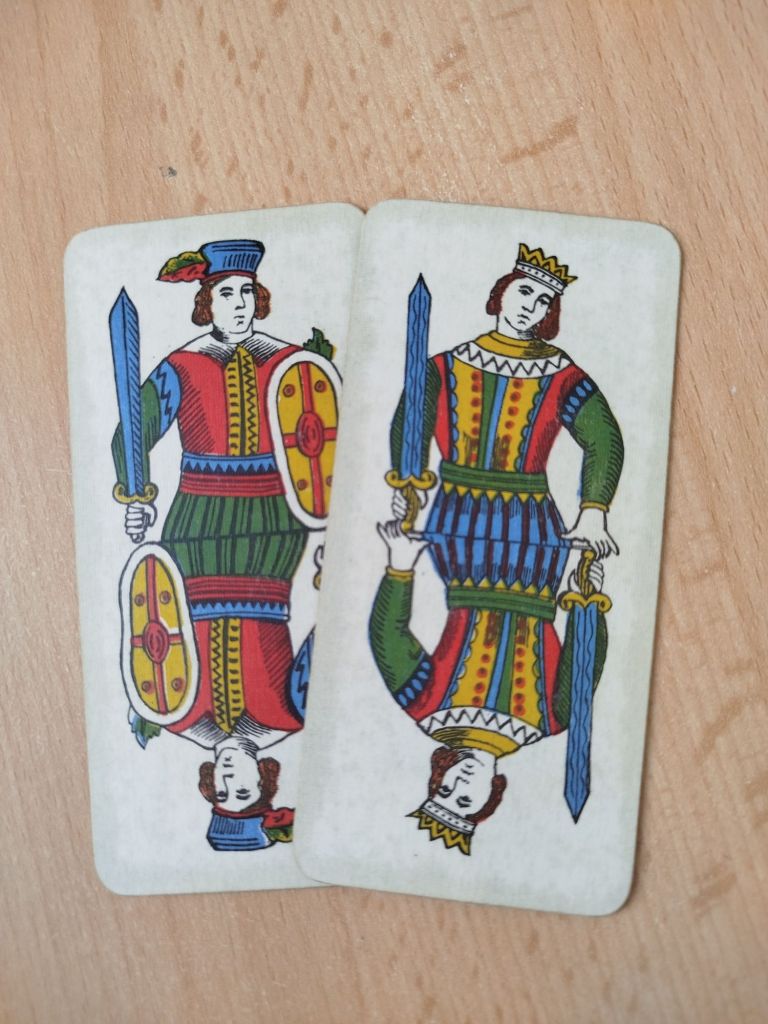
When we read Zanetti’s section on the divinatory meanings of the cards, though, we find that she calls the Page of Swords ‘Spadino’, identifying the figure with a young man. This is in contrast with the tradition I’ve received, whereby the Page of Swords is just a letter or message. Zanetti does say that the card can also sometimes signify a disquieting letter, but she chiefly identifies the Page with a young man.
The Page of Swords and the King of Swords in the Bolognese tarot / Tarocchino bolognese
I must say I find this option strangely titillating, as the Page of Swords, Spadino, would then be a male counterpart to the Page of Cups, Coppina, ‘little cup bearer’. The ending -ino, which in Italian points to something small or young, definitely fits the Page more than the King. Zanetti denies that this parallel between Coppina and Spadino exists, because the Coppina is supposed to be always negative (she’s traditionally the little floozy who snatches hubby away). But I have not found this to be the case: the Page of Cups is just a young (or younger) woman.
Ultimately, as my understanding and practice with the Bolognese tarot evolves, I know I will have to create my own deck (all traditional readers seem to have done so, preserving a part of tradition and integrating it with their own discernment and experience). Tradition is, after all, not something fixed, but something that is handed over to us (from the Latin tradere) and that we must administer intelligently.
Another interesting fact is that Zanetti emphasizes the intellectual aspect of Spadino, calling the card “young man and his thoughts”. This is in contrast with what I’ve learned from Germana Tartari, my teacher for the 50-card method, whose grandma taught her that the Knight of Swords can sometimes represent the King of Swords’ thoughts, in a kind of parallel to the Knight of Wands being the thoughts of the King of Wands.
The fact that so many traditions seem to exist should not discourage us from engaging with them. Keep in mind that the Bolognese tarot tradition evolved locally, with each city, village or even street having slightly different versions of it. Thus, this is less a matter of who is right or wrong and more one of systemic preference and whether integrating different system together leads to new systems that work, or whether it is best to keep them separate. This is something that can be established only through trial and error.
I think this reading is interesting because it showcases the odd behavior of the Death card in the Bolognese tarot of answering yes to a question. I have already written that I prefer to take this traditional rule with a grain of salt, but it does seem to apply in several cases.
Here the question the (male) querent asked is if there would be reconciliation with a friend he had had a fight with. The reason I included the cards of the cut (the King of Wands and the Angel) will become clear shortly.
Two Friends
Right off the bat, the death card comes up in the last position, and this, added to the Angel in the cut, should give us a sort of super yes. But we always need to interpret the reading.
The second thing that caught my attention was the Page of Coins (words) next to the Knight of Swords (cuts, problems, arguments, hurt) and the Love (affection). So there is affection between the two, even now (how could there not be, since they were friends?) but the Sword card creates problems.
In the next line we find the Eight of Swords, which is a card of suffering. If we see the Eight of Swords as coming after the Love card in the line before, then there is great emotional suffering surrounding this argument. However, all is not lost, as the Knight of Cups (agreement, conciliation) and the Sun (positivity, clarity) follow. So this, together with the Death card, seems to confirm there will be a great improvement after a period of uncertainty.
In the last line we have two kings. One is the friend probably the Sword. The other king, the Cup, can possibly identify him as like family, or, paired with the third king in the cut, it constitutes a triplet of success in the matter (three Kings are a success). Then the World card comes. Talking to the querent, I discovered the friend lives quite far away, but I believe the deeper meaning here is that their relationship’s path is still an open road, so it is not over.
I don’t have much to say about the first line. It isn’t clear to me. The Ace of Coins can be money, but the argument wasn’t about money, but it can also be the table, their conviviality (especially with the Seven of Cups, which is a relationship of closeness), which suffers a hiccup (the Stranger). That’s my best guess.
As for advice, the querent (the King of Wands) comes up in the cut together with the Angel, so clearly he has feelings of deep friendship. I told him to show them better, since this is what leads to the Sun card in the spread overtaking the Eight of Swords.
The 45-card method, which is the one I’m trying to specialize in on this blog, despite being acquainted with and using the other methods as well, tends to be rather more obscure than the better-known 50-card one. One possible reason is that Maria Luigia Ingallati’s niche-defining book discusses the latter, and has consequently inspired others who follow her school.
Another separate source for the 50-card system is Germana Tartari’s book, whose approach I follow when using the 50-card deck, having been her student and now friend. Tartari’s book was also met with good success, further cementing the 50-card system in people’s imagination.
But before Ingallati made the Bolognese tarot available to a wider public there were a couple of books on the 45-card method, and Lia Celi’s Il Manuale di Cartomanzia (The Cartomancy Handbook) is one of them. The book was first published in 1999 and is very difficult to come by (don’t ask me how I got my copy. Or maybe do ask me, who knows.)
The subtitle of the book, “How to read tarot cards without boring yourself to death” serves as a good introduction to the style in which the book is written. Lia Celi is not a card reader, but a writer and journalist, and this is immediately evident in the refreshingly irreverent tone of the book. She did collaborate with some card readers to put together this book.
The second thing to notice is that, if you were to buy the book based on the front or back covers, you’d never know it’s about the Tarocchino Bolognese, as the title, subtitle and description simply talk about tarot cards and cartomancy, and even the cover art pictures regular tarot cards (I believe Sergio Ruffolo’s tarot).
The third thing to take notice of is that this is, broadly speaking, a good book. Honestly, it would be worth a read even if you had no interest in cartomancy, simply because it is guaranteed to tickle your funny bone on more than one occasion. And this is probably how the book was commissioned in the first place: as a fun and exotic read for the beach, aimed mostly at young women who may or may not choose to pursue cartomancy as a passion.
Given these presuppositions, Celi’s work has no right to be this informative. Pretty much everything you need in order to start using the 45-card system is offered to you in easily digestible bits: the various traditional methods on how to acquire, christen,1 study, shuffle and lay out the deck, the individual meanings of the cards (which are often easy to remember thanks to Celi’s sharp humor), a decent, if small, selection of traditional combinations, some of which I recognize from my own source, some practical advice on how to deal with various types of querents, and a final interview with the daughter of a card reader who is just setting out to practice the art herself, and who offers some advice. Clearly, Celi did her homework and did not skimp on looking for good information.
The card selection the author discusses is the same as the one I know, with one exception: she uses the Nine of Coins as the card of tears, while I use the Seven. Also, the meanings of some of the cards differ. For instance, she says that the Star is chiefly the card of health, while for me it is chiefly the card of business. Still, she does say that the Star is good for work and study, and even my own source taught me that the Star represents medications and healing in the right context. Besides, it is perfectly normal for a tradition like that of the Bolognese Tarot to differ a little from source to source.
The spreads Celi illustrates tend to be on the shorter side: a three-card spread, a four-card cross, a variation of the thirteen-card spread and a pyramid spread of fifteen cards that may be adapted to various questions.
So what is missing? Well, as in most books, what’s missing is the practical part. We have only brief mentions of how the cards interact with one another, so that if I didn’t come from a background in cartomancy and didn’t have access to first-hand information, I don’t know if I would be able to pick up a deck and start reading after finishing this book. Still, Celi’s Cartomancy Handbook is a good addition to your library if you are interested in the Bolognese tarot.
Where to find: This is the book’s amazon page. Unfortunately the book is unavailable, so your next best shot is ebay. However, the lord does work in mysterious ways…
MQS
The traditional practice of ‘christening’ the deck or having it blessed so that, according to popular superstition, it starts working properly. In reality the deck works anyway and only in particular situations (such as curses or difficult periods) does it need to be blessed. ↩︎
A querent (a man) asked how his relationship would evolve:
A relationship reading
The first thing to notice is that both main figures appear (King and Queen of Wands) and both their thoughts (Page and Knight of Wands). The two significators are in the central column, so let’s read the central column first: King of Wands, Queen of Wands, Ace of Cups (house), Moon (darkness), Queen of Coins (truth). Clearly their relationship is not based on clarity, because the truth is hidden, and there would be a need for honesty.
The Death card next to her might show that she is the one going through some kind of transition, and it’s probably not something that has just happened (Temperance shows time). The house is not positive to the couple, as there is hurt or arguments around it (Knight of Swords).
The King of Swords was hard to interpret. It was, until the querent asked out of the blue “Do you see her cheating on me?”
Look at the column the King of Swords falls in: Death, King of Swords, Her Thoughts and the Betrayal card. In her thoughts there’s someone else. Note also that his thoughts (Knight of Wands) is next to the Moon and the Hanged Man, so he suspects.
The Queen of Coins, which is the truth, here seems to have two meanings here. One is that it shows the need for clarity (and therefore the lack of it), and secondly it acts as a sort of punctuation, as I discussed before, sealing the reading as if to say “yup, that’s exactly what you’re thinking”
Obviously we need to be very careful when announcing this sort of situations, even if the querent suspects. It is much better to caution them to seek clarity with their partner (especially in this case with the Truth card so prominent in the reading)
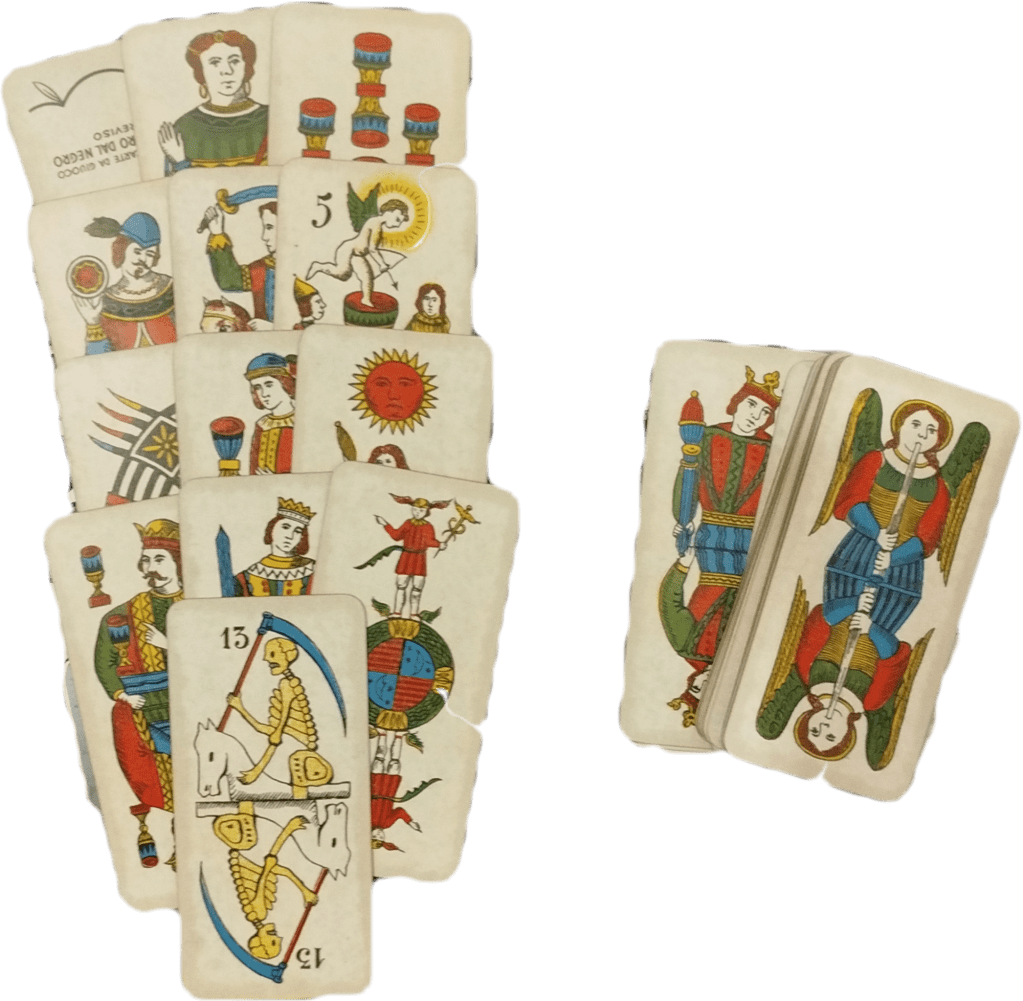
The Bolognese Tarot is traditionally read using a reduced pack of either 45 or 50 cards (the 35 card system, of historical interest, is no longer practiced today). However, since it is a tradition that varies locally, the make-up of the deck varies. In other words, the 45 cards I use are not necessarily the same used by another person who uses 45 cards. The same is true for the 50 card deck.
This uncertainty is what contributes to the relative obscurity of the method. At the end of the day, many people want a clear standard to follow. For my part, I practice the systems I have been taught: the 45-card system you often see in my readings, which I was taught three or four years ago but had left alone until recently, and the 50-card system I have been taught by Germana Tartari.
Many of the sources I have consulted seem to believe that the 45-card system is older, and later five extra cards were added by some. Germana herself told me she remembers her grandma telling her that she (her grandma) had seen the full pack of 62 used (this reconstructed system is the topic of Germana’s newer book, which I will review in the near future).
So we have several systems, which isn’t surprising: if we look at Piacentine playing cards, there are at least several full-deck methods, at least one method with 30 cards and several with 25 cards.
Going back to the tarocchino bolognese, and limiting ourselves to the two most used systems of 45 and 50, usually the cards that overlap tend to have the same or similar meanings, at least in part. For instance the Ace of Coins can be the table or desk in all systems I am aware of. Additionally, in the 45-card system I know, the Ace of Coins can also be the card of money (relatively big money). In Germana’s 50-card system, the Ace of Coins can be a table, but also a letter or document. In Ingallati’s system, the Ace of Coins is the table or the work card.
As for the work card, both Germana’s 50-card system and the 45-card system I know assign it to the Star, but the Star is also the card of material possessions and possibly of gifts, which is the main meaning assigned to the card by Ingallati. In another book on the 45-card method I have yet to review, the Star represents the health status (in my system it can represent meds), but also ‘good job opportunities’.
As you can see, there is overlap, but also space for divergence. To avoid confusion, both for myself and for the readers, I tend to stick to the meanings I know, but I think it’s fair that I bring this up.
As for the five extra cards that some add to the initial 45, there isn’t great uniformity either. Some don’t even add five cards: I know a reader who uses a pack of 49, while Giliberti, whose book I reviewed, seems to use 51 in one video I saw (how many cards she uses in the book I don’t know, due to the book’s chaotic nature).
All this chaos may be frustrating for someone who is approaching the bolognese tarot for the first time, especially from outside of Italy. One thing is growing up with a particular system, another thing is having to randomly choose one.
I don’t believe any system is inherently better or worse. All have the same potential for describing life, if properly used, and much also depends on the person’s inclination. For instance, having studied the 50-card system under Germana’s supervision, there should apparently be no reason for me to go back to the 45-card system. Yet I found myself always coming back to it, despite integrating insights from Germana’s system and from the books I read.
Ultimately I recognized that the 45-card system simply resonates with me beautifully, and while we are still in an open relationship, I tend to gravitate toward it. Certainly, if I had to write a full guide on the Bolognese tarot, I would illustrate this method. You may find otherwise.
I think anyone who is interested in this deck should take their time to explore their options. Mixing and matching randomly without having first studied the various strands of the tradition is not recommended, but as we study and practice we may find that a more individual approach emerges.