Tag Archives: how to read tarot

Tarot Encyclopedia – The Four of Swords

(Note: this is a collection of the meanings attributed to the cards by some occultists in the past centuries. It does not reflect my own study or opinion of the cards. It is only meant as a quick comparative reference as I develop my own take.)
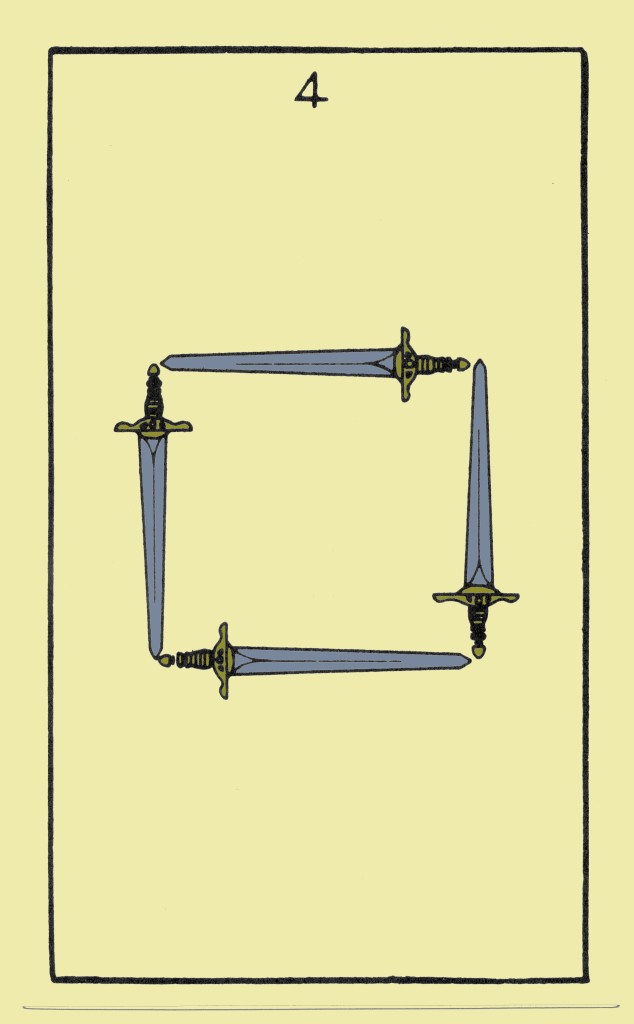
The Four of Swords from the Builders of the Adytum (BOTA) tarot deck

Paul Foster Case (and Ann Davies)

The time period is the last decanate of Libra, October 13 to October 23, under the rulership of Mercury.
Well-Dignified: rest from sorrow, yet after and through it; relief from anxiety; rest after illness; quietness; change for the better; success in legal affairs; association with others in Mercurial pursuits; strong mental attraction to a person of the opposite sex; activity in writing or short journeys.
Ill-Dignified: inharmony with partners; unsettled conditions in legal
affairs; disorder and loss through ill-considered writings or needless
short journeys; vexations through petty strife and sarcastic speech.
Keyword: Rest.
(From the Oracle of Tarot Course)

A. E. Waite

The effigy of a knight in the attitude of prayer, at full length upon his tomb. Divinatory Meanings: Vigilance, retreat, solitude, hermit’s repose, exile, tomb and coffin. It is these last that have suggested the design. Reversed: Wise administration, circumspection, economy, avarice, precaution, testament.
(From The Pictorial Key to the Tarot)

Aleister Crowley

The Four of Swords is called Truce. This seems rather on the lines of “the strong man armed, keeping his house in peace”. The masculine nature of air makes it dominant. The card is almost a picture of the formation of the military clan system of society.

[…]

The number Four, Chesed, is here manifested in the realm of the Intellect. Chesed refers to Jupiter who rules in Libra in this decanate. The sum of these symbols is therefore without opposition; hence the card proclaims the idea of authority in the intellectual world. It is the establishment of dogma, and law concerning it. It represents a refuge from mental chaos, chosen in an arbitrary manner. It argues for convention.

The hilts of the four Swords are at the corner of a St. Andrew’s cross. Their shape suggests fixation and rigidity. Their points are sheathed—in a rather large rose of forty-nine petals representing social harmony. Here, too, is compromise.

Minds too indolent or too cowardly to think out their own problems hail joyfully this policy of appeasement. As always, the Four is the term; as in this case there is no true justification for repose, its disturbance by the Five holds no promise of advance; its static shams go pell-mell into the melting-pot; the issue is mere mess, usually signalized by foetid stench. But it has to be done!
(From The Book of Thoth)
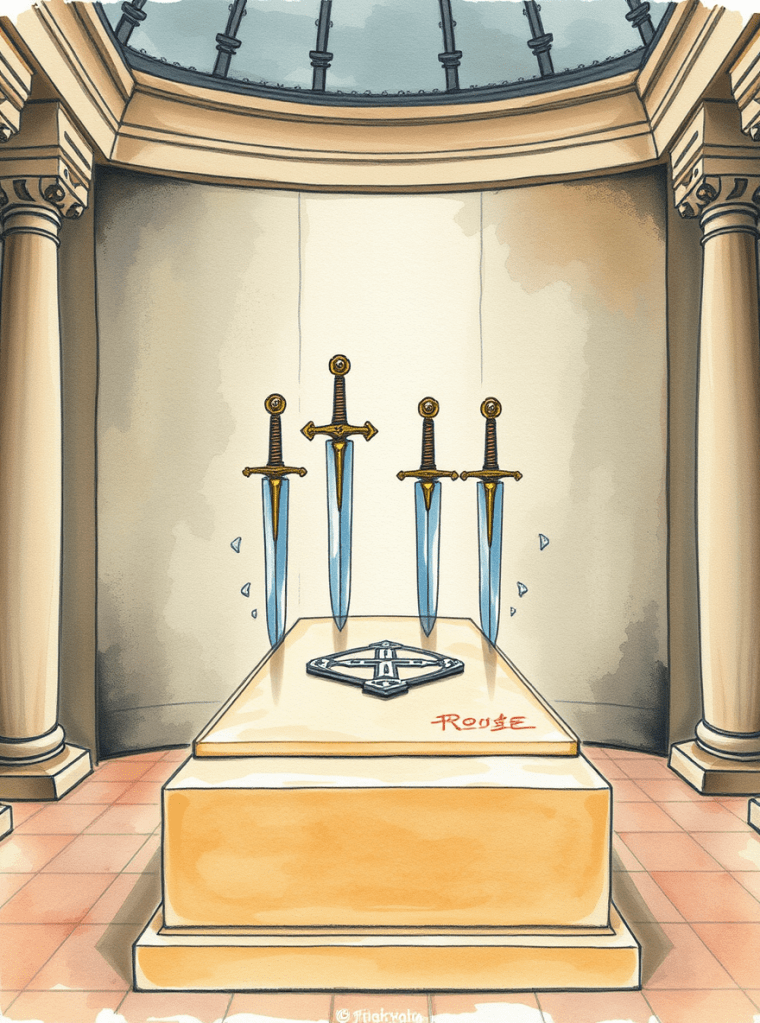
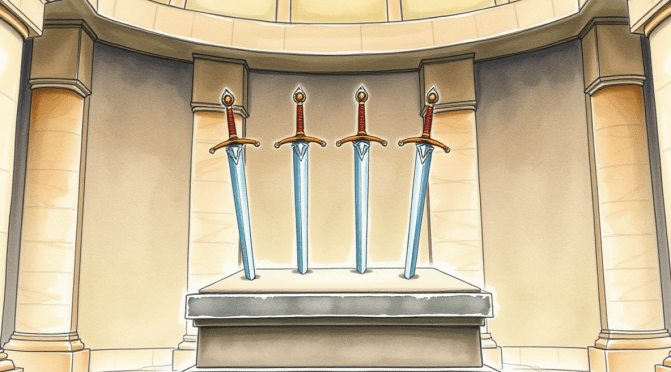
AI-generated illustration for the Four of Swords

Golden Dawn’s Book T

TWO White Radiating Angelic Hands, each holding two swords; which four cross in the centre. The rose of five petals with white radiations is reinstated on the point of their intersection. Above and below, on the points of two small daggers, are Jupiter and Libra, representing the Decanate.

Rest from sorrow; yet after and through it. Peace from and after war. Relaxation of anxiety. Quietness, rest, ease and plenty, yet after struggle. Goods of this life; abundance; modified by dignity as is usual.
Chesed of HB:V (Convalescence, recovery from sickness; change for the better).
Herein do HB:LAVYH and HB:KLYAL bear rule.

Etteilla

Solitude
Upright. This card means, as far as the medicine of the spirit is concerned and in its natural position: Solitude, Desert, Retired place, Hermitage. – Exile, Banishment, Proscription. – Uninhabited, Isolated, Abandoned, Neglected. – Tomb, Burial Ground, Coffin.
Reversed. Economy, Wise Conduct, Wise Administration. – Welfare, Management, Household management, Savings, Avarice. – Order, Arrangement, Relationship, Convenience, Concordance, Agreement, Harmony, Music, Disposition. – Will. – Reservation, Restriction, Exception. – Circumspection, Circumscription, Retention, Wisdom, Sympathy, Regard, Precaution.

MQS
Bolognese Tarot – Introduction to an Old Fortune-Telling Tradition (Part I)

As I’ve mentioned on this blog, I’ve been studying the divination tradition of the Bolognese Tarot (Tarocchino Bolognese, literally the Small Tarot of Bologna) for some months now. I’ve been doing it under the direction of a traditional practitioner of this art, whom I’ve befriended and with whom a wonderful exchange of ideas has started.

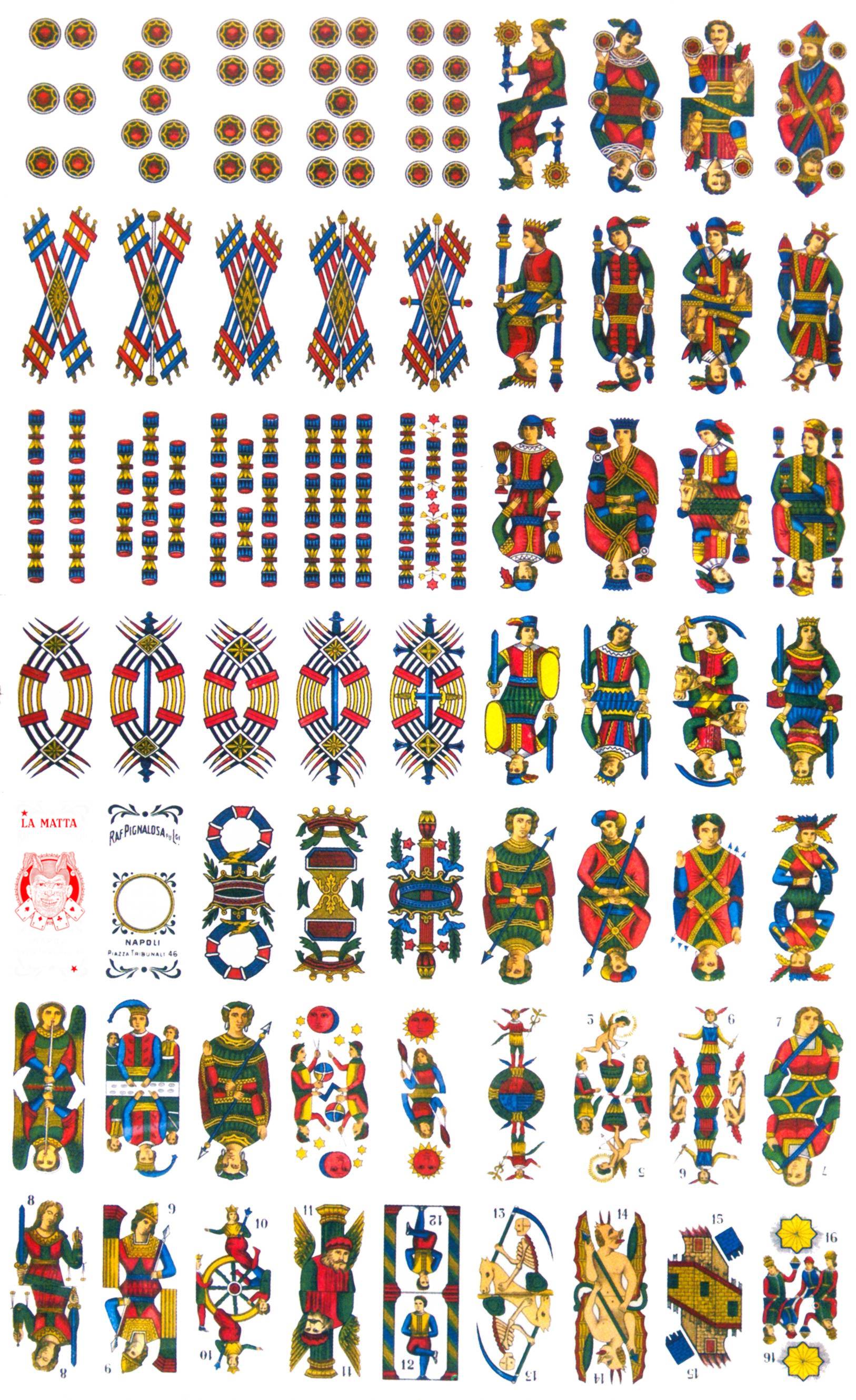
The full deck. Image from the website Labirinto Ermetico

I plan on introducing this form of divination in its main lines for a couple of reasons: 1) it is little known outside of Italy and it deserves some love 2) Its reading techniques are markedly different from the current approach and allow for a very concrete, down-to-earth approach 3) I want to discuss some spreads done with it in the future, and I can’t do it without introducing it first 4) it is the oldest tarot-related divination tradition that we know of, and it is therefore cool from a historical standpoint.1

The Ugly Duckling and Its Quirks

Like the almost totality of very old decks, with a couple of exceptions (the Visconti deck is one) the Bolognese tarot is distinctively unappealing from an esthetic standpoint, largely because, like other popular pre-RWS decks, it was meant to be used by poor people as a playing deck at the local inn.

A selection of cards from the Bolognese Tarot. As may be noted, they are symmetrical, like playing cards, though the earliest packs had full images.

The reason it is called ‘tarocchino’ (small tarot) has to do with its reduced size, probably to enhance its handlability. However, it is not just the size of the cards that is reduced, but also the number of the cards that comprise the deck: all pip cards from Two to Five are removed, leaving only the Ace of each suit plus the cards from Six to Ten and the court cards.

Furthermore, the Pope (Hierophant), Popess (High Priestess) Empress and Emperor are absent from the deck for political reasons, as Bologna was directly under the control of the Church. Instead, the deck includes four ‘Moors‘ (the Moors were Muslim colonizers that had conquered parts of Italy.)

Three of the ‘Moors’. The Fourth one is a copy of the third on the right.

Finally, the Bolognese Tarot has another peculiarity, in that the Major Trumps are out of order compared to our regular system. This may sound surprising to some, but our current ordering of the trumps is a relatively recent development and has nothing mystical about it (the oldest preserved document with the order of the trumps gives a rather different sequence).

An Old Tradition

The Bolognese Tarot tradition was almost entirely confined to the city of Bologna and the surrounding areas, and was at risk of dying out, until both the card game and the divination tradition were transmitted to a larger public thanks to the power of the Internet.

Interestingly, to this tradition is connected the most ancient set of meanings handed down by old sources. The following list dates back to the pre-Napoleonic period and gives the meanings of a reduced pack of thirty five cards. I’m copying it here for its historical interest, but it does not correspond to the system I have been taught:

  1. The Juggler (Magician): Married Man
  2. The Lovers: Love
  3. The Chariot: Journey
  4. Temperance: Time
  5. Strength: Violence
  6. The Hermit: Old (Person)
  7. The Hanged Man: Treason
  8. Death (called ‘Thirteen’): Death
  9. The Devil: Wrath
  10. The Star: A Gift
  11. The Moon: Night
  12. The Sun: Day
  13. The Angel (Judgement): Marriage or Agreement
  14. The World: Long travel
  15. The Fool: Madness
  16. King of Wands: A Bachelor
  17. Queen of Wands: A Prostitute
  18. Knight of Wands: Something Knocking at the Door
  19. Page of Wands: Thoughts of the Female Querent
  20. Ace of Wands: Sexual Escapades
  21. King of Cups: An Old Man
  22. Queen of Cups: Married Woman
  23. Knight of Cups: Reconciliation
  24. Page of Cups: The Female Querent
  25. Ten of Cups: The Roof of the House
  26. Ace of Cups: The House
  27. King of Swords: An Evil Tongue
  28. Ten of Swords: Tears
  29. Ace of Swords: A Letter
  30. King of Coins: The Male Querent
  31. Queen of Coins: The Truth
  32. Knight of Coins: Thoughts of the Male Querent
  33. Page of Coins: Unmarried Woman
  34. Ten of Coins: Money
  35. Ace of Coins: The Table

As I said, this is not the system that I’ve been taught, and it is very likely that even back then more than one system existed (usually, significant differences are found from quarter to quarter in Bologna and from small village to small village in the surrounding areas). Since this cartomantic tradition predates Etteilla’s by at least a quarter of a century, and probably more, and since Etteilla says he learned to read the tarot from an Italian card reader (though he pretends it was Alexis of Piedmont to add to the mystery), it is not to be excluded that the Bolognese tarot had some influence on him.

But this is speculation. What is clear is that tarot divination, whenever it was born, was brought into the world as a way of addressing concrete issues. This series of articles is dedicated to bringing the tarot back to these roots.

MQS

  1. If you want to read more, you can start with the Wikipedia page. More Information is contained on the webside of the Associazione Le Tarot ↩︎

Simplifications of the Opening of the Key Spread

In a previous article I discussed how the original Golden Dawn spread known as Opening of the Key fits perfectly into the mold of traditional divination by cards, although it adds certain occult layers to it. This is largely due to the absence of one-card-per-position layouts, the presence of peculiar techniques and the tendency to read cards in rows.

To sum up how the spread worked:

  • You selected a significator for the querent (usually among the court cards)
  • You shuffled the deck and let the querent cut it into four stacks (corresponding to the four letters of the Tetragrammaton)
  • You found the stack with the significator and had to divine, based on its position, the nature of the querent’s problem. If wrong, the divination wasn’t radical.
  • You had to spread out the cards into a row or arrange them into a ring and count starting from the querent’s card. Then, you had to pair the cards on either side of the querent to fill out the details.
  • Then you shuffled the deck again and dealt it out into the twelve houses. You had to find the querent’s significator and count and pair as before based on the house.
  • You shuffled the deck again and dealt it into the twelve signs. You found the stack, counted and paired.
  • You shuffled the deck, then looked for the significator and dealt out the 36 cards following it into a ring symbolizing the decans of the zodiac. You counted and paired.
  • Finally, you shuffled and dealt the deck into the ten Sephiroth of the Tree of Life, found the stack, counted and paired.

As you may have guessed, the Opening of the Key was a cumbersome spread, and while it was used for the solution of practical matters (Crowley famously remarked on this fact), it clearly was meant to be used primarily within a ritual setting, at least in its entirety.

What is also clear, though, is that the Opening of the Key is less a spread in itself than a blueprint for a complete tarot reading made up of five individual spreads, each of which analyzes the issue from a different standpoint, or rather by tapping into a different layer of it. The experienced card reader could simply choose one of the five spreads and use it without resorting to the others, as need dictates.

For the most part, it seems that many Golden Dawn members simply stuck to the first operation, which is consequently the most famous and iconic, where one cuts the pack into four smaller stacks and reads the one with the significator. The possible reason why the other operations were generally discounted is probably that almost all of them required the deck to be dealt out into small stacks, only one of which is read, so that it takes more time to deal the cards than to read them.

Other members, though, were more inventive. In his Oracle of the Tarot booklet, Paul Foster Case offers a simpler alternative to the five-operation extravaganza of the full method (which he nonetheless describes and recommends for more serious or complex questions)1

The divination starts as usual: by finding the stack containing the significator and telling the querent what he or she has come for without them telling us, based on the stack. In the original instructions, if the diviner is wrong in assessing the nature of the question, the divination should be abandoned. In reality, aside from the initial period of training, it seems that the location of the significator was simply used to color the interpretation of the cards.

At this point, Case’s simplified method diverges from the original. Instead of spreading out the stack into a single row or ring of cards and starting the counting technique from the significator, Case says the diviner must shuffle the stack and then deal it out into three smaller stacks, corresponding to the past, present, and future. Each stack is then read sequentially (as you would in playing card, Sibilla or Lenormand divination).

The simplification of the method is due to the fact that, instead of starting the exploration of the issue from the past/present with the first operation and then moving on to the further future with the other operations, one has immediately past, present and future condensed into a single method.

There are other ways of simplifying the Opening of the Key. Paul Hughes Barlow rose to some prominence a couple of years ago for his idiosyncratic way of reading the first of operation without relying on a significator, instead reading all four stacks, something for which he was reproved by some.

Personally, I have found Paul Case’s simplification very effective in my experiments, and I’ll probably post an example reading in the future.

MQS

  1. He also introduces certain specifications that are also found in the advanced BOTA course on divination elaborated by Ann Davies based on his notes. ↩︎

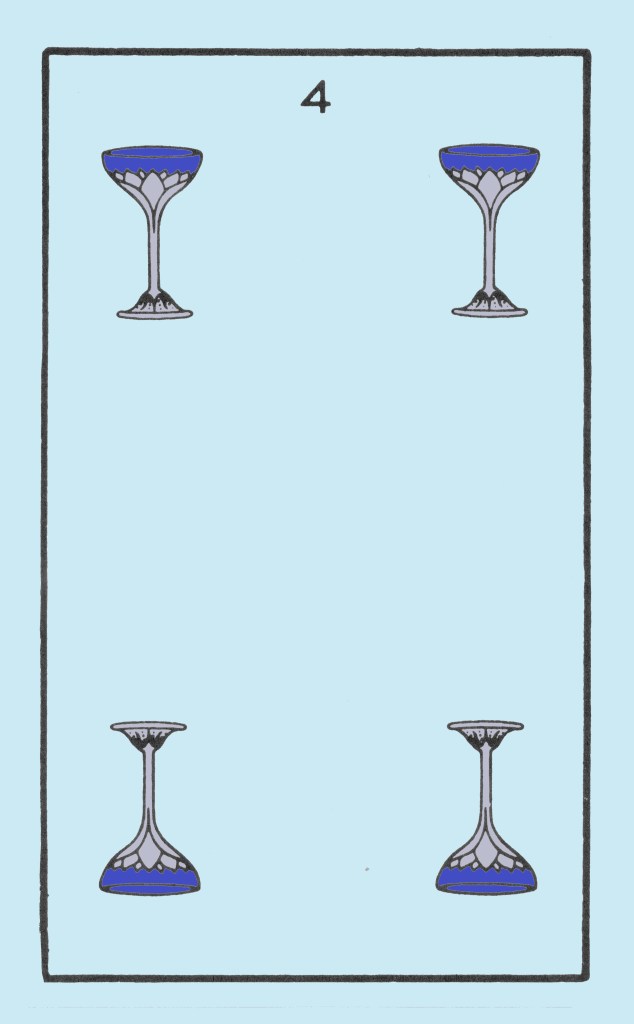
Tarot Encyclopedia – The Four of Cups

(Note: this is a collection of the meanings attributed to the cards by some occultists in the past centuries. It does not reflect my own study or opinion of the cards. It is only meant as a quick comparative reference as I develop my own take.)

The Four of Cups from the Builders of the Adytum (BOTA) tarot deck

Paul Foster Case (and Ann Davies)

The specific divinatory meanings are thus based on the attributions of Chesed, the planetary forces of Jupiter and Neptune, the zodiacal influences of Cancer ruled by the Moon, and the astrological fourth house. Jupiter’s sphere of influence is Chesed. It co-rules the third decanate of Cancer besides being exalted in this zodiacal sign. Therefore the Four of Cups has a very strong Jupiterian influence of wealth and expansiveness. The Four of Cups corresponding to the third decanate of Cancer is the time period July 13 to July 22, ruled by Jupiter and Neptune.
In specific Tarot Divination its key meanings are:
Well Dignified: success in material things, but desire for something higher; a period of comparative comfort, yet a little confining, thus suggesting a measure of satiety; it is a symbol of contemplation and of the turning away from pleasure in quest of higher things; it intimates strong psychic influences in the life or environment of the Querent.
lll-Dignified: material gain, but through injustice; sorrows resulting from satisfaction of desire; getting what one has wanted but finding no joy in it.
Keyword: Surfeit
(From the Oracle of Tarot Course)

A. E. Waite

A young man is seated under a tree and contemplates three cups set on the grass before him; an arm issuing from a cloud offers him another cup. His expression notwithstanding is one of discontent with his environment. Divinatory Meanings: Weariness, disgust, aversion, imaginary vexations, as if the wine of this world had caused satiety only; another wine, as if a fairy gift, is now offered the wastrel, but he sees no consolation therein. This is also a card of blended pleasure. Reversed: Novelty, presage, new instruction, new relations.
(From The Pictorial Key to the Tarot)

Aleister Crowley

The Four of Cups is called Luxury.

The masculine nature of fire permits the Four of Wands to appear as a very positive and clear-cut conception. The weakness in the element of water threatens its purity; it is not quite strong enough to control itself properly; so the Lord of Pleasure is a little unstable. Purity has somehow been lost in the process of satisfaction.

[…]

This card refers to Chesed in the sphere of Water. Here, below the Abyss, the energy of this element, although ordered, balanced and (for the moment) stabilized, has lost the original purity of the conception.

The card refers to the Moon in Cancer, which is her own house; but Cancer itself is so placed that this implies a certain weakness, an abandonment to desire. This tends to introduce the seeds of decay into the fruit of pleasure.

The sea is still shown, but its surface is ruffled, and the four Cups which stand upon it are no longer so stable. The Lotus from which the water Springs has a multiple stem, as if to show that the influence of the Dyad has gathered strength. For although the number Four is the manifestation and consolidation of the dyad, it is also secretly preparing catastrophe by emphasizing individuality.

There is a certain parallelism between this card and the Geomantic figures Via and Populus, which are attributed to the Moon in her decrease and increase respectively. The link is primarily the “Change=Stability” equation, already familiar to readers of this essay. Four is an “awkward” number; alone among the natural numbers, it is impossible to construct a “Magic Square” of four cells. Even in the Naples Arrangement, Four is a dead stop, a blind alley. An idea of a totally different Order is necessary to carry on the series. Note also the refolding-in-upon-itself suggested by the “Magic Number” of Four 1 + 2 + 3 + 4 which is Ten. Four is the number of the Curse of Limitation, of Restriction. It is the blind and barren Cross of equal arms, Tetragrammaton in his fatal aspect of finality, as the Qabalists knew him before the discovery of the Revolving Formula whereby the Daughter, seated upon the Throne of the Mother, “awakens the Eld of the All-Father”.

For the meanings of Via and Populus, refer to the “Handbook of Geomancy” (Equinox Vol. I, No.2).

(From The Book of Thoth)

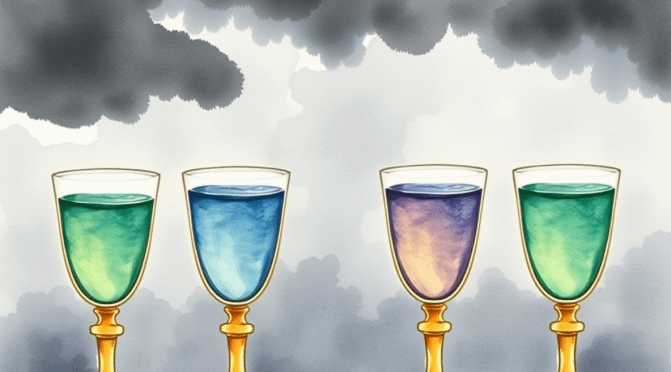
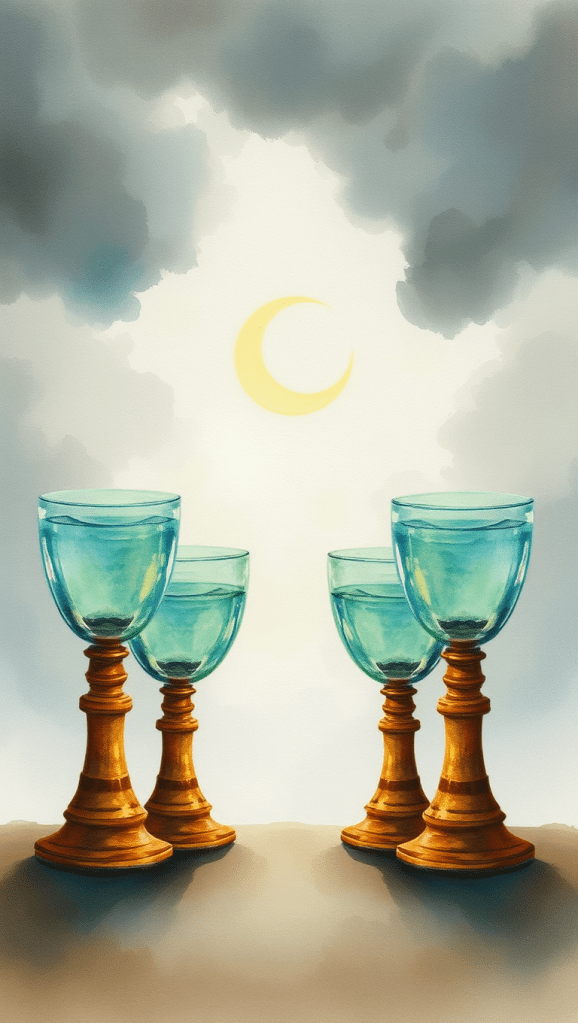
An AI-generated illustration for the Four of Cups

Golden Dawn’s Book T

FOUR cups: the two upper overflowing into the two lower, which do not
overflow. An Angelic Hand grasps a branch of lotus, from which ascends a stem bearing one flower at the top of the card, from which the white water flows into the two upper cups. From the centre two leaves pass right and left, making, as it were, a cross between the four cups. Above and below are the symbols Moon and Cancer for the Decan.

Success or pleasure approaching their end. A stationary period in happiness, which may, or may not, continue. It does not mean love and marriage so much as the previous symbol. It is too passive a symbol to represent perfectly complete happiness. Swiftness, hunting and pursuing. Acquisition by contention: injustice sometimes; some drawbacks to pleasure implied.
Chesed of HB:H (Receiving pleasure or kindness from others, but some
discomfort therewith).
Therein rule the great Angels HB:HYYAL and HB:MVMYH.

Etteilla

Boredom
Upright. This card, as far as the medicine of the spirit is concerned, means, in its natural position: Boredom, Displeasure, Discontent, Disgust, Aversion, Enmity, Hatred, Horror, Restlessness, Pain of spirit, Slight sadness, Affliction, Painful, Annoying, Unpleasant. – Saddening, Distressing.
Reversed. New Directive, New Light. – Index, Indication, Conjecture. – Augury, Foreboding. – Presentment, Foreboding, Predilection, Novelty.

MQS

An Overview of the Opening of the Key Spread

A recent exchange in the comment section made me go back to some notes I’ve been sitting on for a while about how different card spreads used to be in the past, compared to how they tend to be nowadays. A good example for this is the famous spread used by the Golden Dawn, which has become known as the Opening of the Key.

The Opening of the Key is a complex, multi-stage spread that was (and still is) used within the Golden Dawn system and has been adopted by Paul Foster Case’s and Crowley’s followers as well.

From a magical standpoint, the allure of this spread is that it mirrors within its layouts the whole GD system, being therefore a tool for learning it. Since I do not particularly advocate the Golden Dawn system, I’ll leave this aspect to your consideration, should you be so inclined.

From a purely divinatory standpoint, though, the interesting aspect of the Opening of the Key is that it affords us a glance at how card spreads used to work in traditional cartomancy.

Nowadays we are used to what many call “positional spreads“, that is, spreads where each single card is read more or less independently from the others based on the meaning of the position. The most famous positional spread is certainly the Celtic Cross, also taken from the GD system and popularized by Waite. Over time, though, more and more ridiculous spreads have emerged, with positional meanings as abstracted from actual reality as possible.

If we take a look at many books on divinations published before the 60s, when the Rider Waite deck truly took off, and with it the Celtic Cross spread, we find very different spreads.

Many traditional spreads, used both for tarot and for playing cards, share the following characteristics:

  1. They tend to be large and unwieldy. Many of them take up a whole table. In part, this reflects the old idea that you wouldn’t be potentially in contact with your go-to fortune-teller 24/7 via social media, and so the diviner ought to be able to cover as much of your life as possible in one go. There was also a certain old-fashioned mistique to these spreads, it being the idea that your life unfolds like a book that can be read page to page. Furthermore, the way of reading the cards was different: you didn’t waste too much time on each single card, but simply used it as a building block to be added to the others. Therefore, you needed many building blocks.
  2. Very few positional meanings. Many old spreads used to be either sequential or tableau-like, or a mix of the two. If certain chunks of spread did have a particular positional meaning attached to them, such positions were always covered by more than one card (usually three or more). The cross spread I was taught to use with playing cards is one such example.
  3. Strange techniques. In the English-speaking world, the idea that there are special reading techniques has largely gone lost for over half a century, as tarot became a tool for psychological masturbation that eschews all technicality in favor what one’s heart palpitations. This was until some people, tired of how ineffectual and watered-down the new-age version of the tarot had become, discovered Lenormand cards. In reality, reading techniques have been part of many cartomancers’ toolkit for centuries. Two of the most common techniques (though not the only one) used in old tarot and playing card divination were card counting (starting from a card and counting a certain number of cards to land on the next card to be read) and card pairing (pairing the cards on the opposite sides of a row two by two.)
  4. More than one stage. It was not uncommon for many spreads to have more than one stage to them. Back then, divination was not seen as something to run to for every minor inconvenience, but rather as something affording a general overview of one’s main issues and prospects. Cartomancy was, at least in part, a parlor game, though a serious one, with serious implications.

One of the characteristics of the early Golden Dawn, before it became a battle of egos, was its (relatively intelligent) syncretism, as well as its attempt to act as a reservoir of everything the occult Western tradition had created over the centuries. Many of the founding members of the Golden Dawn were very well acquainted with, and even contributed to the then-growing literature on fortune-telling.

It comes therefore as little surprise that THE Golden Dawn spread, the Opening of the Key, is just as much an occult compendium as it is a compendium of quaint fortune-telling techniques. Let’s read the original instructions together (From Book T):

A Method of Divination by the Tarot

  1. THE Significator.
    Choose a card to represent the Querent, using your knowledge or
    judgment of his character rather than dwelling on his physical
    characteristics.
  2. Take the cards in your left hand. In the right hand hold the wand over
    them, and say: I invoke thee, I A O, that thou wilt send H R U, the great
    Angel that is set over the operations of this Secret Wisdom, to lay his hand invisibly upon these consecrated cards of art, that thereby we may obtain true knowledge of hidden things, to the glory of thine ineffable Name. Amen.
  3. Hand the cards to Querent, and bid him think of the question attentively, and cut.
  4. Take the cards as cut, and hold as for dealing.

“First Operation”
This shows the situation of the Querent at the time when he consults you.

  1. The pack being in front of you, cut, and place the top half to the left.
  2. Cut each pack again to the left.
  3. These four stack represent I H V H, from right to left.
  4. Find the Significator. It be in the HB:Y pack, the question refers to work,
    business, etc.; if in the HB:H pack, to love, marriage, or pleasure; if in the
    HB:H pack, to money, goods, and such purely material matters.
  5. Tell the Querent what he has come for: if wrong, abandon the divination.
  6. If right, spread out the pack containing the Significator, face upwards.
    Count the cards from him, in the direction in which he faces.
    The counting should include the card from which you count.
    For Knights, Queens and Princes, count 4.
    For Princesses, count 7.
    For Aces, count 11.
    For small cards, count according to the number.
    For trumps, count 3 for the elemental trumps; 9 for the planetary trumps;
    12 for the Zodiacal trumps.
    Make a “story” of these cards. This story is that of the beginning of the affair.
  7. Pair the cards on either side of the Significator, then those outside them, and so on. Make another “story,” which should fill in the details omitted in the first.
  8. If this story is not quite accurate, do not be discouraged. Perhaps the
    Querent himself does not know everything. But the main lines ought to be
    laid down firmly, with correctness, or the divination should be abandoned

“Second Operation”
Development of the Question

  1. Shuffle, invoke suitably, and let Querent cut as before.
  2. Deal cards into twelve stacks, for the twelve astrological houses of
    heaven.
  3. Make up your mind in which stack you ought to find the Significator,
    “e.g.” in the seventh house if the question concerns marriage, and so on.
  4. Examine this chosen stack. If the Significator is not there, try some
    cognate house. On a second failure, abandon the divination.
  5. Read the stack counting and pairing as before.
    “Third Operation”
    Further Development of the Question
  6. Shuffle, etc., as before.
  7. Deal cards into twelve stacks for the twelve signs of the Zodiac.
  8. Divine the proper stack and proceed as before.

“Fourth Operation”
Penultimate Aspects of the Question

  1. Shuffle, etc., as before.
  2. Find the Significator: set him upon the table; let the thirty-six cards
    following form a ring round him.
  3. Count and pair as before.

Fifth Operation
Final Result

  1. Shuffle, etc., as before.
  2. Deal into ten packs in the form of the Tree of Life.
  3. Make up your mind where the Significator should be, as before; but failure
    does not here necessarily imply that the divination has gone astray.
  4. Count and pair as before.

There are many characteristics to the Opening of the Key that mirror the checklist I’ve created above:

  1. The spread is large. Especially in its fourth operation, it requires a big table to perform.
  2. Few positional meanings. No individual card signifies anything in particular. What counts is the diviner’s ability to string the meanings together into coherent sentences that apply to the querent’s concrete life. The stacks themselves do have general meanings (business, pleasure, etc.) but these are broad, and you will never find yourself applying them to just one card.
  3. Techniques. These are, more specifically, card counting and card pairing, which are plucked straight out of the fortune-telling tradition.
  4. More than one stage. This is quite evident. Although many GD initiates ended up simplifying the method (more on this in a later article), the complete operation, which could take up upwards of two hours, consisted of five stages which offered a glimpse into the various facets of a situation.

Quite clearly, there is more to the Opening of the Key than what I’ve listed, aside from the heavy occult overlays. For one, the GD added a method for discerning whether the divination is valid: one needs to find the significator in the appropriate stack. This is in part due to the desire to import the notion of ‘radicality’ used by many horary astrologers, according to which certain charts cannot be judged if certain configurations are present or absent; and in part it is a system of magical checks and balances to avoid idle curiosity (again, more on this in a later post).

MQS

Tarot Encyclopedia – The Four of Wands

(Note: this is a collection of the meanings attributed to the cards by some occultists in the past centuries. It does not reflect my own study or opinion of the cards. It is only meant as a quick comparative reference as I develop my own take.)

The Four of Wands from the Builders of the Adytum (BOTA) Tarot deck

Paul Foster Case (and Ann Davies)

The Four of Wands is associated with the third decanate of Aries, the time period April 10 to April 19, ruled by Jupiter.
Well-Dignified: this card signifies success through personal merit, good
social standing, influential friends, the perfection of something built
up after labor, benefit through travel, shipping and business with foreign countries.
lll-Dignified: loss in the same things, or in consequence of unpreparedness or by hasty action.
Keyword: Perfected work.
(From the Oracle of Tarot course)

A. E. Waite

From the four great staves planted in the foreground there is a great garland suspended; two female figures uplift nosegays; at their side is a bridge over a moat, leading to an old manorial house. Divinatory Meanings: They are for once almost on the surface–country life, haven of refuge, a species of domestic harvest-home, repose, concord, harmony, prosperity, peace, and the perfected work of these. Reversed: The meaning remains unaltered; it is prosperity, increase, felicity, beauty, embellishment.
(From The Pictorial Key to the Tarot)

Aleister Crowley

In the Wand suit, the card is called Completion. The manifestation promised by Binah has now taken place. This number must be very solid, because it is the actual dominating influence on all the following cards. Chesed, Jupiter-Ammon, the Father, the first below the Abyss, is the highest idea which can be understood in an intellectual way, and that is why the Sephira is attributed to Jupiter, who is the Demiurge.

[…]

This card refers to Chesed in the suit of Fire. Being below the Abyss, it is the Lord of all manifested active Power. The original Will of the Two has been transmitted through the Three, and is now built up into a solid system:-Order, Law, Government. It is also referred to Venus in Aries, which indicates that one cannot establish one’s work without tact and gentleness.

The wands are headed by the Ram, sacred to Chesed, the Father-god Amoun-Ra, as also to Aries; but at the other end of the wands are the Doves of Venus.

In the symbol, the ends of the wands touch a circle, showing the completion and limitation of the original work. It is within this circle that the flames (four double, as if to assert the balance) of the Energy are seen to play, and there is no intention to increase the scope of the original Will. But this limitation bears in itself the seeds of disorder.
(From The Book of Thoth)

AI-generated illustration for the Four of Wands

Golden Dawn’s Book T

TWO White Radiating Angelic Hands, as before, issuing from clouds right and left of the card and clasped in the centre with the grip of the First Order, holding four wands or torches crossed. Flames issue from the point of junction. Above and below are two small flaming wands, with the symbols of Venus and Aries representing the Decan.
Perfection or completion of a thing built up with trouble and labour. Rest after labour, subtlety, cleverness, beauty, mirth, success in completion. Reasoning faculty, conclusions drawn from previous knowledge. Unreadiness, unreliable and unsteady through over-anxiety and hurriedness of action. Graceful in manner, at times insincere, etc.
Chesed of HB:Y (Settlement, arrangement, completion).
Herein are HB:NNAAL and HB:NYThHL Angelic rulers

Etteilla

Company
Upright. This card, as far as the medicine of the spirit is concerned, in its natural position means: Society, Association, Assembly, Relation, Confederation, Alliance, Union, Gathering, Circle, Community, Assembling, Multitude, Mass, Crowd, Troop, Band, Company, Cohort, Army. – Convocation, Accompaniment, Mixing, Mixture, League, Amalgamation. – Contract, Convention, Covenant, Treaty.
Reversed. Prosperity, Increase, Accretion, Advancement, Success, Succeeding, Fortune, Blossoming, Happiness. – Beauty, Beautification.

MQS

In Divination, If You Can’t Name, Describe!

I had a conversation with a reader of this website, and he told me that the main obstacle in learning how to read the cards is that he can’t put the meanings of the cards together to form a clear picture of the situation. The example he used was that it may be hard to tell a querent that they are at risk of getting fired, when in fact the cards may be predicting a fight with a coworker or a demotion, or some other work-related problem, but not a firing.

Divination is an art in itself, and it does require practice and patience. For the first couple of years after being taught cartomancy, I couldn’t put two card meanings together to save my life, even if it was obvious. I still remember my teacher’s dismayed expression when I couldn’t tell her that “talking” and “work” meant, quite obviously, “talking at work or talking about work”. Yes, it is obvious, just like it’s obvious that you first put one leg forward and then the other in order to walk, yet it takes us time to learn.

There are plenty of reasons why divination is hard, and lack of talent is only rarely an issue. Most of the times, we are simply experiencing the same hardships we would face when learning a new language, and most people can learn a second language if they put their mind to it.

Furthermore, I find that we often feel the need to overperform in order to convince the querent we are not frauds, and we do so by wanting to give them an absolutely accurate, unambiguous and immediately recognizable picture of the future. Of course, it would be nice if every divination session was as clear, but we are limited beings and we must be grateful for what we can do with the hand we are dealt (quite literally).

What do you do if you want to say ‘apple’ in a foreign language but you just can’t remember the name? You get creative and go back to the language’s building blocks: you describe the apple. “A round, red thing to eat.” This may sound weird and it is a bit vague, as there are other round red things we can eat, but it does help you narrow down the thing you want.

The same happens with divination. Sometimes we just can’t put the building blocks together into a single unambiguous picture (“you are at risk of getting fired”). But we can always describe what the cards are telling us: “I see some potentially upsetting circumstances surrounding your career.”

This is very vague, but it’s a start. Once we have narrowed down the topic, we can look for cards and combinations that give us additional clues: “These upsetting circumstances seem to involve a man, possibly a boss, who causes you trouble, and as a result I see the potential for some money problems.”

This is still not unambiguous: there are plenty of events that fit the description, e.g., being fired, being demoted, being assigned to an unrewarding task, a boss being replaced by another one that is so terrible the querent chooses to quit, etc.

Yet in spite of only describing the outline of a situation instead of naming it specifically, this is already very helpful to our querent, because we are giving them rather specific information they can use in preparing for difficult times ahead in their career.

We can also come up with a number of likely scenarios that fit the description as examples for our querent, and often they will help us fill the blanks (“Oh right, there’s that new project coming up no one wants to take on” or “Oh right, my boss has been talking about relocating for some time now”)

Note, also, that it is perfectly acceptable to voice our insecurity to the querent: “It is something between X1 and X10, and it seems to me like X1 to X3 are more problable, but I could be wrong”.

Once the prediction has come to pass, it is always possible to go back and see if perhaps we couldn’t have been more specific. This is a very important part of learning: there’s always something we miss, some turn of phrase of the cards we have misread or some meanings we have misapplied or even forgotten.

Still, the aim of divination is to provide help to people, not to impress them, and we are of service in the measure that we can point them in the right direction. If we can’t give them precise indications on the path ahead, “Between North and West, but more West than North” is good enough.

MQS

What Makes Readings Go South

A recent comment by a visitor of this website has inspired me to write an article about what makes divination go south, whether it’s card reading or something else. I have already shared one or two readings I got wrong, but in the future I would like to share more of my hardships as well as my successes, for two reasons: 1. it gives a fairer representation of how divination works and 2. it doesn’t discourage those who are studying the material I provide (I often get messages from people despairing they will ever be good diviners)

The reality is that divination is a human activity, and like all human activities it can go wrong. In a world where lawyers, scientists and doctors can be wrong (and not seldom), it’s unclear why we would expect fortune-tellers to be infallible.

There can be a variety of factors that make a reading go south. Here’s a bunch, in no particular order.

The querent is too emotionally volatile

Usually, the querent’s attitude doesn’t matter that much. However, it has been my experience that when a querent is in a state of utter and extreme desperation or emotional volatility, they will skew the reading in one direction or the other. This is rare, but it does happen on occasion. Once a friend who was looking for a job and was absolutely desperate asked for a reading and he pulled ALL spades. He still got a job around a month later. The cards were just reflecting his emotional turmoil.

Emotional involvement is also usually not good when reading the cards for ourselves. My personal experience is that if I read for myself about a topic I don’t care too much about, the reading will be largely accurate, while if I read about something I care very much about, the cards will show me either what I hope or what I fear.

Note though that there are divination tools that work better when the querent is very emotionally involved. This is the case, for instance, for Horary Astrology, where there are no counters to manipulate and therefore a relatively strong emotional push is required for question and answer to align.

The reader isn’t grounded enough

This is more common. Divination is not an assembly line type of occupation. We are dealing with a world that is, in a very real sense, divine and that eschews the mechanic and repetitive.

The diviner needs to be relatively at peace with themselves before performing a divination. I say ‘relatively’ because we don’t need to always be at our best (otherwise we’d never be able to divine). Certainly we need to be capable of detaching at least momentarily from our deepest worries and hopes. Fits of ecstasy and cheap mysticism are also to be avoided, as the best attitude is one of sober helpfulness toward the other.

There are some partial exceptions for ‘inspired divination’, such as mediumistic spiritism, but I don’t cover these topics on this website as I avoid these practices like the plague (I had a distant relative who was an excellent natural psychic and ruined her life in her attempt at constantly staying in the required state of passive receptivity).

The reader simply doesn’t always interpret the medium right

This is obvious, and I’ve talked about it at length, but it bears repeating. Divination is a language with no native speakers. We must learn it as if it were a foreign language. or, if you are romantic about the universe and think divination is our original language, then we must relearn it, but the end result doesn’t change. Like with all secondary languages, we are bound to make mistakes.

The best we can do about it is strive to correct our mistakes and be upfront with our querents that we are not offering miracles but just help in widening their view of their own life, of where it’s coming and where it’s directed.

Drawing wrong conclusions from right premises

This is another important pitfall, and it is a particular variety of ‘not reading the medium right’. As diviners we must understand that certain things can be changed and certain things can’t. Most divination tools are very upfront about it. If they say the thing you want cannot be achieved, then it cannot be achieved (unless we are interpreting the medium wrong, see above). If it says the thing you want will fall in your lap, then it will fall in your lap. Period. But if the medium says what you want is hard, it doesn’t mean it’s impossible, just as when it says it’s easy it doesn’t mean you’ll achieve it.

As diviners, sometimes, we feel we must give our querents more certainty than we are entitled to give them based on our divination tools. If the querent wants to become a writer and the cards show that writing comes easy to them, it doesn’t mean they will become a writer if they don’t put in the effort. Usually, in such cases, the lack of effort does come up in the cards as a warning, so that the prediction will sound like: you are very talented, but unless you actually spend time honing your craft, you won’t amount to much. This, too, is a valid prediciton.

All in all, we must be careful to distinguish what the medium says from what we want to tell the querent.

MQS

Tarot Encyclopedia – The Three of Pentacles or Coins

(Note: this is a collection of the meanings attributed to the cards by some occultists in the past centuries. It does not reflect my own study or opinion of the cards. It is only meant as a quick comparative reference as I develop my own take.)

The Three of Pentacles from the Builders of the Adytum (BOTA) deck

Paul Foster Case (and Ann Davies)

The time period is the second decanate of Capricorn, under the rulership of Venus, from January 1 to January 9.
Well-Dignified: construction; increase, growth; financial gain; the building up of favorable conditions; gain in commercial transactions; rank or prestige in vocation or business; beginning of matters to be perfected later.
Ill-Dignified: selfishness; cleverness in business, but lack of scruples;
narrowness and prejudice; too much ambition.
Keyword: Constructiveness.
(From the Oracle of Tarot course)

A. E. Waite

A sculptor at his work in a monastery. Compare the design which illustrates the Eight of Pentacles. The apprentice or amateur therein has received his reward and is now at work in earnest. Divinatory MeaningsMétier, trade, skilled labour; usually, however, regarded as a card of nobility, aristocracy, renown, glory. Reversed: Mediocrity, in work and otherwise, puerility, pettiness, weakness.
(From The Pictorial Key to the Tarot)

Aleister Crowley

The Three of Pentacles, in a similar manner, exhibits the result of the idea of Earth, of the crystallization of forces; and so the Three of Pentacles is called the Lord of Work. Something has definitely been done.

[…]

The influence of Binah in the sphere of Earth shows the material establishment of the idea of the Universe, the determination of its basic form. It is ruled by Mars in Capricornus; he is exalted in that Sign, and therefore at his best. His energy is constructive, like that of the builder or engineer. The card represents a pyramid viewed from above the apex. The base is formed by three wheels-Mercury, Sulphur, and Salt; Sattvas, Rajas, and Tamas in the Hindu system; Aleph, Shin, and Mem-Air, Fire, and Water-the three Mother letters of the Hebrew alphabet.

This pyramid is situated in the great Sea of Binah in the Night of Time, but the sea is solidified; hence the colours of the back-ground are mottled, a cold thin dark grey with a pattern of indigo and green. The sides of the pyramid have a strong reddish tint, showing the influence of Mars.
(From The Book of Thoth)

AI-generated illustration for the Three of Pentacles or Coins

Golden Dawn’s Book T

A WHITE-WINGED Angelic Hand, as before, holding a branch of a rose tree, of which two white rosebuds touch and surmount the topmost Pentacle. The Pentacles are arranged in an equilateral triangle. Above and below the symbols Mars and Capricorn.
Working and constructive force, building up, creation, erection; realization and increase of material things; gain in commercial transactions, rank; increase of substance, influence, cleverness in business, selfishness. Commencement of matters to be established later. Narrow and prejudiced. Keen in matters of gain; sometimes given to seeking after impossibilities.
Binah of HB:H (Business, paid employment, commercial transaction).
Herein are HB:YChVYH and HB:LHChYH Angelic Rulers.

Etteilla

Important
Upright. This card, as far as the medicine of the spirit is concerned, means, in its natural position: Noble, Considerable, Famous, Important, Great, Major, Extended, Vast, Sublime, Renowned, Famous, Powerful, Elevated, Illustrious. – Excellence, Consideration, Greatness of mind, Nobility of conduct, Generous deeds, Magnificently, Splendidly.
Reversed. Puerility, Childhood, Infantilism, Frivolity. – Weakening, Lowering, Diminishing, Education, Modicity, Mediocrity, Minuity, Inezia, Frivolity, Lowness, Vileness, Poltrony, Rampant, Small, Puerile, Petty, Low, Servile, Vile, Abject, Humble. – Abjection, Humility, Humiliation.

MQS

Tarot Encyclopedia – The Three of Swords

(Note: this is a collection of the meanings attributed to the cards by some occultists in the past centuries. It does not reflect my own study or opinion of the cards. It is only meant as a quick comparative reference as I develop my own take.)

The Three of Swords from the Builders of the Adytum (BOTA) tarot deck

Paul Foster Case (and Ann Davies)

The time period is the second decanate of Libra, under the combined rulership of Saturn and Uranus, October 3 to October 12. Because Libra is involved, remember that the qualities of the Seventh house are prominent.
Well-Dignified: this is nevertheless a Key depicting sorrow, disappointment and tears, but it can be the beginning of deep understanding as to the basis and cause of our problems; disruption of friendship; interruption of cherished projects; quarrels; occasionally the position in the layout may indicate platonic friendships; in money matters this card is almost always a symbol of loss, but indicates that whatever money matters are under consideration have been fair and honest, so that no blame attaches to anyone for the loss.
Ill-Dignified: slander; selfishness and dissipation; deceit with respect to promises; loss in legal affairs.
Keyword: Sorrow
(From the Oracle of Tarot course)

A. E. Waite

Three swords piercing a heart; cloud and rain behind. Divinatory Meanings: Removal, absence, delay, division, rupture, dispersion, and all that the design signifies naturally, being too simple and obvious to call for specific enumeration. Reversed: Mental alienation, error, loss, distraction, disorder, confusion.
(From The Pictorial Key to the Tarot)

Aleister Crowley

The idea of division, of mutability, the idea of the airy quality of things, manifests itself in the Three of Swords, the Lord of Sorrow. Here one is reminded of the darkness of Binah, of the mourning of Isis; but this is not any vulgar sorrow dependent upon any individual disappointment or discontent. It is Weltschmerz, the universal sorrow; it is the quality of melancholy.

[…]

Binah, the Great Mother, here rules the realm of Air. This fact involves an extremely difficult doctrine which must be studied at length in The Vision and the Voice: Aethyr 14.
Binah is here not the beneficent Mother completing the Trinity with Kether and Chokmah. She represents the darkness of the Great Sea.
This is accentuated by the Celestial Lordship of Saturn in Libra.
This card is dark and heavy; it is, so to speak, the womb of Chaos. There is an intense lurking passion to create, but its children are monsters. This may mean the supreme transcendence of the natural order. Secrecy is here, and Perversion.
The symbol represents the great Sword of the Magician, point uppermost; it cuts the junction of two short curved swords. The impact has destroyed the rose. In the background, storm broods under implacable night.
(From The Book of Thoth)

A gruesome AI-generated illustration for the Three of Swords

Golden Dawn’s Book T

THREE White Radiating Angelic Hands, issuing from clouds, and holding three swords upright (as though the central sword had struck apart the two others, which were crossed in the preceding symbol): the central sword cuts asunder the rose of five petals, which in the previous symbol grew at the junction of the swords; its petals are falling, and no white rays issue from it. Above and below the central sword are the symbols of Saturn and Libra.

Disruption, interruption, separation, quarrelling; sowing of discord and strife, mischief-making, sorrow and tears; yet mirth in Platonic pleasures; singing, faithfulness in promises, honesty in money transactions, selfish and dissipated, yet sometimes generous: deceitful in words and repetitions; the whole according to dignity.
Binah of HB:V (Unhappiness, sorrow, and tears).
Herein rule the Great Angels HB:HRYAL and HB:HQMYH as Lords of the Decan.

Etteilla

Removal
Upright. This card, as far as the medicine of the spirit is concerned, means, in its natural position: estrangement, Departure, Absence, Discarding, Dispersion, Remoteness, Delay. – Contempt, Repugnance, Aversion, Hatred, Disgust, Horror. – Incompatibility, Contrariness, Opposition, Unsociability, Misanthropy, Incivility. – Separation, Division, Breaking, Antipathy, Section, Cutting off.
Reversed. Misdirection, Dementia, Vanity, Alienation of spirit, Distraction, Insane conduct. – Error, Miscalculation, Loss, Deviation, Discard, Dispersion.

MQS