Tag Archives: how to read tarot

Using Playing Card Divination on Psychological Questions (Example Reading)

There is a general stigma toward certain forms of divination such as cartomancy with playing cards, namely that they are good at discussing mundane issues, while the Tarot should be used for deeper questions. This presupposes two things: that deeper questions don’t take place in the same world as regular life and that the Tarot is too deep to talk about everyday occurences. Both these beliefs are wrong.

The Tarot is perfectly capable of talking about whatever it wishes, just like playing cards, the Sibilla deck and every other oracle. The first presupposition, though, is more insidious and requires a bit more discussion.

The oldest extant series of tarot meanings has been retrieved in Bologna. The meanings there are what you would expect from a fortune-telling deck: the Ace of Swords is a letter, the Ace of Cups the house, the Hermit an old person etc. Furthermore, some rare examples of tarot fortune-telling in pre-modern Italian literature confirm that the Tarot has probably been used for such aims long before the occult revival started by Court de Gébelin, which slowly removed the Tarot from real life and confined it to the realm of “higher metaphysics”, that is to say, of psychological onanism.

In order to justify this “higher” (I would say emptier) use, several hypotheses on the Tarot’s origins have been put forth, depending on what was considered fashionable and not too easily disproven at the time. First it was the Egyptians, then the Kabbalists, then the Cathars, etc. Instead of being seen for what it obviously is, namely a wonderful product of European Neoplatonic Christian art that anyone before the Enlightenment would have immediately understood and considered familiar, and that only the ignorance of our post-Enlightenment metaphysicians could try to disguise as a distant voice coming from distant secret masters to apply in the understanding of distant matters, rather than an immediately obvious tool to mirror immediately obvious real life situations, which are all instances of an eternal story that constantly tells itself.

So yes, the Tarot can talk about daily experience. In the same way, other, more apparently mundane forms of fortune-telling can talk about problems that some would consider ‘deep’. Just like the Tarot, they can talk about it in immediate terms, immediately understood by anyone with who has some understanding of symbols.

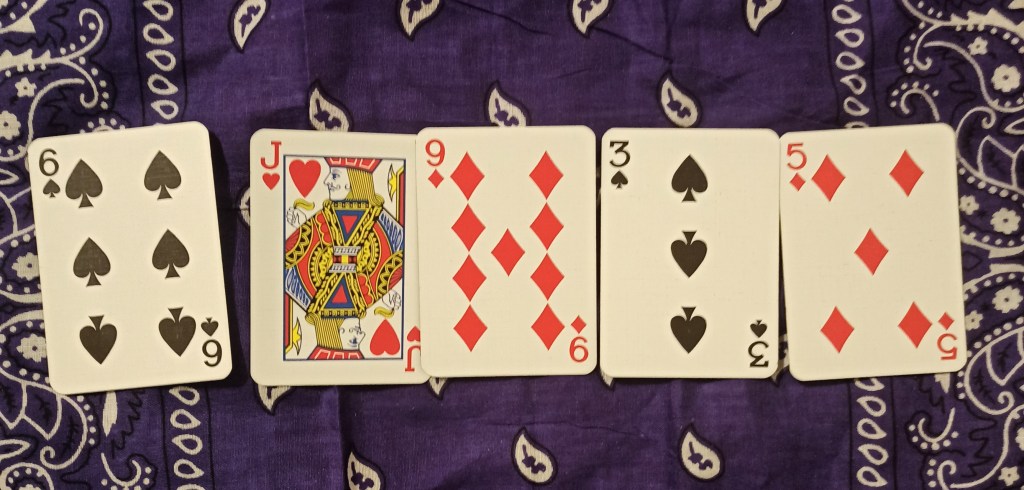
Here’s an example of playing cards used for a ‘deeper’ reading. The querent is a woman I met at an Enneagram convention. She asked what was the reason for her constant bouts of depression. These are the cards:

“Why am I always depressed?”

There is a sickness in her life, signaled by the Six of Spades. There are no cards of deep trauma, but something definitely needs healing. This card falling first sets the tone. The Jack of Hearts represents a child, a project, etc. Next we have the Nine of Diamonds, which is a card that represents the realization of ambitions, but more broadly can represent ambition. Then we have the Three of Spades and the Five of Diamonds. These two cards oftne indicate turning away from something. But the Three of Spades also comes directly before the ambition card. So she has turned away from some ambition. Two possible interpretations that came to mind are that she had the ambition of having a child but couldn’t or that she turned away from a childhood ambition.

I asked her, and it was the second possibility. She’d had big dreams for her life when was a child, but some disappointments had led to seeing them as unrealistic and she had let go of them. I told her that she hadn’t really let go of them, otherwise the Six of Spades wouldn’t have shown up: those ambitions still fester inside of her, and the fact that she is not doing anything about them could make her sick if she isn’t careful. These cards clearly show that she needs to go after her dreams, perhaps in her free time. Alternatively, if she doesn’t want to, she needs to truly let go of them and move on.

MQS

Daily Playing Card Reading and Tarot Reading Example

I don’t often use the cards to track day-to-day happenings, but sometimes, if I’m feeling inspired, I will draw three cards to see what’s going to happen the next day. Of course, daily readings are much harder to make sense of because they require you to tone down the language of the cards. Still, if something out of the ordinary is set to happen, the cards will capture it quite clearly.

A couple of days ago, I was alone at home as my husband had driven to his mom for a couple of days to help her. I couldn’t go as I had a deadline and couldn’t waste time traveling. Still, he was set to come back the following day.

I felt compelled to draw three cards for the following days. You can see them in the picture: these were the King of Hearts, the Three of Clubs and the Three of Spades.

Daily reading with playing cards, confirmed by the tarot

The King of Hearts and the Three of Clubs together usually indicate a married man. My husband, of course, is a married man, if you can believe it. But the Three of Spades usually represents a removal or at least problems intervening between two people. I didn’t think too much about it, and that was a mistake, because if I had been reading those same cards for someone else I would have certainly predicted that their partner wouldn’t come home.

It was only on the next day that I remembered the cards. Out of curiosity, I asked the Tarot if my husband would come back that day.

The cards of the cut show the Popess and the Stars, in this case probably his mother taking care of him. We then have Judgement and the Juggler / Magician, which among other things could indicate work-related communication. The Charriot, showing the journey, is then slowed down by Temperance and brought to a halt by the Hanged Man. After that, the Pope / Hierophant (my husband) and the Emperor (me) unite again.

Later that day my husband said that he had unexpectedly received some work-related task that he needed to take care of from his laptop that evening and wouldn’t be able to drive back home. He came back the next day (yesterday).

MQS

Tarot Encyclopedia – The King of Wands

(Note: this is a collection of the meanings attributed to the cards by some occultists in the past centuries. It does not reflect my own study or opinion of the cards. It is only meant as a quick comparative reference as I develop my own take.)
The King of Wands from the Builders of the Adytum (BOTA) Tarot

Paul Foster Case (and Ann Davies)

When well aspected the powers listed above are expressed by a personality represented by the King of Wands. However these same qualities when overly strong or intense can express as cruelty, oppression, ostentation and pride. Thus in Tarot divination, besides the basic principles expressed by Ab, the Father, and Yod, the Creative principle, the King of Wands has these specific meanings:
Well Dignified: an ardent, impulsive, influential man; one possessed of authority and strongly marked by the quality of leadership; somewhat hasty in temper but just, generous and friendly. lll Dignified: the same general type but cruel, ill-natured, intolerant and probably unfriendly to the querent.
(From the Oracle of Tarot course)

A. E. Waite

The physical and emotional nature to which this card is attributed is dark, ardent, lithe, animated, impassioned, noble. The King uplifts a flowering wand, and wears, like his three correspondences in the remaining suits, what is called a cap of maintenance beneath his crown. He connects with the symbol of the lion, which is emblazoned on the back of his throne. Divinatory Meanings: Dark man, friendly, countryman, generally married, honest and conscientious. The card always signifies honesty, and may mean news concerning an unexpected heritage to fall in before very long. Reversed: Good, but severe; austere, yet tolerant.
(From The Pictorial Key to the Tarot)

Aleister Crowley

(Note: Crowley and the Golden Dawn swap around King and Knight. This is in part true of Waite as well.)
The Knight of Wands represents the fiery part of Fire; he rules from the 21St degree of Scorpio to the 20th degree of Sagittarius. He is a warrior in complete armour. On his helmet for a crest he wears a black horse. In his hand he bears a flaming torch; a flame also in his mantle; and upon the flames does he ride. His steed is a black horse leaping.

The moral qualities appropriate to this figure are activity, generosity, fierceness, impetuosity, pride, impulsiveness, swiftness in unpredictable actions. If wrongly energized, he is evil-minded, cruel, bigoted and brutal. He is in either case ill-fitted to carry on his action; he has no means of modifying it according to circumstances. If he fails in his first effort, he has no resource.

In the Yi King, the fiery part of Fire is represented by the 51st hexagram, Kan. The signification there given is entirely in accordance with the doctrine of the Tarot, but great emphasis is laid on the startling, perilous, and revolutionary character of the events cognate. The Querent is advised to be apprehensive, yet cool, resolute and energetic: to beware of untimely action, but to go forward with tense confidence in his own ability.

All these correspondences of the Yi King are to be studied in that book (S.B.E. vol. XVI) and reference is here made to the text when important passages are too long to be conveniently quoted.
(From the Book of Thoth)

Oddly interesting AI-generated King of Wands illustration

Golden Dawn’s Book T

A KINGLY Figure with a golden, winged crown, seated on a chariot. He has large white wings. One wheel of his chariot is shewn. He wears corslet and buskins of scale armour decorated with a winged lion’s head, which symbol also surmounts his crown. His chariot is drawn by a lion. His arms are bare, save for the shoulder-pieces of the corslet, and he bears a torch or fire-wand, somewhat similar to that of the Zelator Adeptus Minor. Beneath the chariot are flames, some waved, some salient.
Swift, strong, hasty; rather violent, yet just and generous; noble and scorning meanness.
If ill dignified — cruel, intolerant, prejudiced and ill natured.

Etteilla

Country man
Upright. This card, as far as the medicine of the spirit is concerned, means, in its natural position: Country Man, Good and Stern Man, Well Intentioned Man, Honest Man. – Conscience, Probity. – Farmer, Worker, Cultivator.
Reversed. Good and stern man – Indulgence, Severity, Forbearance, Condescension.

Yes, Pregnancies May Be Predicted in Divination

I read somewhere that pregnancies cannot be predicted because it is impossible to bring someone into the equation who doesn’t yet exist. The cards (or any other method) supposedly cannot talk about inexistent people, and they may only be used to check on pregnancies that have already started.

I certainly agree that it may not be wise to use divination on health-related issues, especially on such delicate topics, since we diviners are fallible, and should never forget it.

That it *is* possible to use them to this end, though, is confirmed by experience. I believe I even discussed a spread where I predicted that a woman would become pregnant, even though the question wasn’t even about pregnancy.

The idea that the cards cannot talk about people that don’t exist, though, is poppycock. The child may not exist, but the woman’s body certainly does. If we can predict that the woman’s body will betake itself to a job interview, to the mall or to a date, it’s unclear why we shouldn’t be able to predict that an organism will start growing inside of it after a spirited round of nooky.

MQS

Free Will and Real Estate (Tarot Reading Example)

In the previous article I started talking about free will and prediction. There I talked about some factors that influence our freedom of decision.

Another incredibly important aspect is information. We orient ourselves by interpreting available information. If our free will were absolute, our knowledge of how the world works and how we move in it would not matter, because we’d be able to reach any result regardless of the initial conditions.

This is patently absurd, yet it is maintained by some diviners (appropriately, those who are incapable of deriving specific information from the divination process). It kind of reminds me of one of the definitions of God in the Book of the 24 Philosophers, where it says that God is that whose will is equivalent to his power and knowledge (or wisdom).

This was a fancy way of saying that God’s every action is always exactly the right one at the right moment because the fact that he wants it is the same with the fact that it can be done and also the fact that it is the right thing to do. This may be very true of God, and if we conceive (as I do) that the divine is immanent in the world, it is also true of humans, but only in so far as they understand themselves as limited fractions of this whole process. In so far as we crave things and don’t know how to get them, this view of the world is fairly deceiving, especially if you plan on charging people who expect to be given reliable information.

From a more mundane and practical standpoint, we have limited knowledge (or wisdom) and this always changes from moment to moment. As our information changes, so do our decisions. This has nothing to do with “destiny”: if we did not adjust our behavior to match our knowledge we’d already have died out. It is about survival.

The First Spread

Here’s an example. As I mentioned in my journal section, my husband and I are looking for a bigger home. We had eyed an apartment some weeks ago that seemed perfect, and upon visiting it, we were even more convinced to buy it. Some days ago I asked the tarot if we would be able to buy it.

“Will we be able to buy the apartment?”
Tarocchi di Layla, design by Elisa Scerrato

As can be seen from the cut (Strength and Justice) we were very determined (Strength) to buy (Justice).

The opening of the spread repeats the statement by showing that we are gung-ho about buying the apartment (Stars and Chariot) but that we are not considering everything (Moon) as we head toward the handshake (Lovers)

The second line shows the clarifying (Sun) intervention of a woman (Empress) who will bring certain less than pleasant aspects to light (Devil). The result is that my husband (Pope) will lose all interest in buying (Hanged Man)

This is exactly what happened. Two days after I did this spread, my husband came home and told me that one of his friends from an Enneagram group he is in has some experience with real estate and could help us decide. We set up a Zoom meeting with her, where she went through the apartment’s documents with us and raised some serious red flags we had completely missed that would have turned buying that apartment into a financial and bureaucratic nightmare. Needless to say, my husband (and I) lost all interest after that.

As you can probably guess, nobody forced us NOT to buy. Nor did destiny force our hand. In fact, we probably could have gone on with the deal, and fairly quickly (Strength + Justice in the cut of the first spread can signify a signed contract). But we would have been idiots.

And note how skewed my question was: we were completely besotted with the place, so I asked if we would be able to buy it, not if it was a good idea to buy it. The tarot clearly overrode my question and told me that certain unknown facts would surface that would influence our decision. Note also that the tarot did not say that we should not buy (my experience is that divination reflects reality, not what reality should be). The tarot said that we would change our mind.

The question is: were we destined to change our mind? Well, it is complicated, and the complication arises from the fact that the moment of divination is a very special moment, where spirit reflects on itself through the diviner. I will need to come back on this issue in more detail in some future articles.

The thing is, though, that we were not forced to change our mind: we simply realized it was the smart thing to do. Sure, you may say, if we had been more gullible, or if the apartment had completely blinded us out of our wits, we would have gone on with the deal anyway and regretted it later.

But being gullible or not is neither a choice nor an imposition: it is part of one’s being, at least to an extent, even if it is originally a learned behavior. The tarot simply computed the available information, both that which we could change and that which we had no control over, added the information about who we are at our core, and came to the conclusion that someone like my husband and I, in such a situation, would probably change their mind upon receiving better data.

The tarot predicted our behavior in the same way your mom who knows you are obsessed with chocolate icecream can predict you had chocolate icecream for dessert after dinner with your friends: it is a prediction based on knowledge of your nature and of the available information. The difference between your mom and the tarot is that the tarot (like all oracular forms) has a wider and deeper view of reality. The Tarot is, in a way, like a cosmic botanist who knows a red rose bush will sprout from this or that seed, even though this knowledge does not force the rose to be red. It is simply part of its nature.

The Second Spread

By the way, today before writing this article, I did a second spread just for kicks (the tarot is very tolerant of my shenanigans) to ask if that apartment was seriously off the table, as I am still a bit in love with it. Here’s the result

“Is the apartment really off the table?”
Tarocchi di Layla, design by Elisa Scerrato

In the cut we have Death and the Wheel: definitive change (the Death card can never be undone, just like real death). The spread itself is even more blunt. The Devil and the Moon show hidden dangers, and the contract, signified by Justice, is blocked (Hanged Man) thanks to a woman (Popess / High Priestess). Note how much more concise and harsh the spread is compared to the first one: it’s as if the cards were saying “Dude, really, knock it off already…”

Side note: I don’t know exactly why my husband’s friend came up as Empress in the first spread and as Popess in the second one. My best guess is that the tarot didn’t want me to get confused in the first one: if she had come up as the Popess, I would have linked her to the Pope, and would not have interpreted him as my husband, but since in the new spread neither I nor my husband show up, the cards were free to use a more natural significator for her.

MQS