Tag Archives: how to read playing cards

Playing Cards That Indicate Gain

I’m doing it with the Sibilla, so it stands to reason that I should do it with playing cards too. As usual, this list is not meant to be complete. It is only intended to look at the cards as if through a cross-section based on a particular topic. In this case, gain.

Three of Hearts

In my playing card system, the Three of Hearts is a gift. It represents all things that we acquire easily. It is not, strictly speaking, a card of gain, but it can entail gain. For instance, if someone asked about their business, this card falling at the end of the spread would indicate improvements and therefore, within the context, additional wealth, that is, gain.

Five of Hearts

The Five of Hearts is the card of abundance. It is one of the cards that can indicate a very positive evolution and increase of wealth. As with the Three, the Five, being in the suit of Hearts, is not strictly about money, but it can promise positive situations in a reading about finances. Furthermore, next to money cards, it increases their import.

Nine of Hearts

Not much to say here. In many respects the Nine of Hearts is like the Three of Hearts, but much more powerful.

Ace of Clubs

The Ace of Clubs is a very strong card, which indicates power within the situation. If it falls next to the querent, it shows the querent actively obtaining something, having power over it. However, unlike in the suit of Hearts, the Club suit requires effort and action, and is therefore less rosy than the Three, Five or Nine of Hearts. The Ace of Clubs can also indicate a powerful vision that comes true in material terms.

Three of Clubs

The Three of Clubs is a card of union, and can represent a business affair. As such, it usually promises gain in material issues, but we must be careful in our analysis of the whole spread, as we all know a business deal can be disastrous when attended by Spades or less promising Club cards. By itself, the Three is mildly encouraging.

Ace of Diamonds

The Ace of Diamonds represents news in general, but it also represents gold and all things that have high value. It is a card of great riches and wealth when not impeded by other difficult cards.

Three of Diamonds

The Three of Diamonds is a money card. As such it is usually read as small gains, whether in a positive sense (as in a small inheritance or a small raise) or in a negative sense (as in having only little money). Furthermore, we must be careful to note whether the little money is being gained or spent. By itself the Three shows gain.

Four of Diamonds

The Four of Diamonds represents agreements and pacts. Being in the suit of Diamonds it is geared more toward material affairs and thus indicates contract, whether positive or negative will be shown by other cards.

Five of Diamonds

The Five of Diamonds indicates change, especially (though not exclusively) within the context of money matters. It can indicate money changing hands for better or worse.

Seven of Diamonds

This is like the Three of Diamonds, but it shows a larger amount. Furthermore, the Seven is more clearly indicative of gain over loss. It is a more inherently fortunate cards.

Nine of Diamonds

The Nine of Diamonds is strongly connected with the realization of plans, material projects and with social ascent. Increase in wealth may or may not be tied to it, though in our society it usually is. It represents strong satisfaction in money matters, and upward mobility with all the perks that are entailed.

Ten of Diamonds

The biggest money card in the game, the Ten of Diamonds indicates success all around. For entrepreneurs it shows the reaching of great goals, while for business owners it can represents advantageous situations that generate wealth and ease in terms of money. Note that gain can be intended also as a reduction in expenses, so if the question is something like “Will I manage to get my landlord toreduce my rent in the next contract?” that counts as gain.

MQS
On Readings Without Question

The following is an attempt at reorganizing some old notes I have taken on the subject of divinations without a specific question, adding to them some new insights,

Divination Without Questions Is Possible (With Exceptions)

There is a relatively well-known tarot reader who says that a reading without a question is basically two people talking over a bunch of colored cardboards.

This is not true. It was customary, among old-time fortune-tellers, to have the querent sit in front of them and never have them speak anything that wasn’t their name at the beginning of the consultation. I know for a fact that this is a tradition in the Italian countryside, and I believe it is the case all over the world as soon as one leaves the hipster pseudointellectual tarot community bubble and seeks the real deal.

Let’s leave aside the fact that, technically speaking, there is always a question. Even if the querent sits with their arms crossed in front of you waiting to be astounded, the implicit question is “What’s going on in my life, now and in the near future?”

Times change, and sensibilities change with the times. Many querents nowadays wish to take a more active part in the reading. Furthermore, readings without a question are obviously more difficult, and the modern diviner who doesn’t have time to waste is certainly happy to get more cooperation. I know I do. But this doesn’t mean that a reading without a question isn’t possible.

There are exceptions to this, of course. Some oracles do require a question. Horary Astrology, for instance, usually needs one, and the more specific and focused it is, the better. True, some old authorities give rules for judging “Universal Questions“, but these universal questions were asked back when many people didn’t know their birth time and often had to travel for days to see the astrologer for probably the one and only time in their life, so instead they asked the astrologer to tell them about their future in general in more than one sector of life.

Confronted with the impossibility of looking at the person’s birth chart, the astrologer erected a horary chart for the time the consultation took place, a moment that was probably significant, since the querent had gone to great trouble to visit him. Today, the astrologer is one Zoom call away, so this hardly justifies vague Horary questions.

The peculiarity that makes Horary more sensitive than other oracles is that there is no manipulation of physical counters involved: you don’t reshuffle the planets whenever the querent’s whim settles on a new fancy. Therefore, the question put to the heavens must be meaningful and at least relatively important to the person asking it. In a way, this limitation of Horary is due to Astrology’s nobility, seeking as it does answers from the heavens themselves.

Cartomancy is not noble. It spreaded like wildfire among the lower classes exactly because you didn’t need to have studied trigonometry in order to deal out a spread. Cartomancy is therefore as sturdy as the beasts of burden that the lower classes used in the fields. Like all beasts of burden, of course, cartomancy too has its limits: you can ask random questions (“Tell me about my life. Now tell me about my sweatheart. Now tell me about my job. Now about my neighbor”) but if you abuse it, it collapses to the ground exhausted.

But the fact remains that cartomancy (and tarot reading is a form of cartomancy) is a trusty, resistant beast.

Vague Questions Don’t Necessarily Yield Vague Answers

Another common myth is that if one asks a general question the reader is entitled to give them a general answer. Even worse, some readers say that, in the absence of a question, they can read “the general energies surrounding your life.” The problem is that there is no such thing as a (meaningful) general answer. “Tell me about myself.” Well, you seem to be a featherless biped with one heart, two lungs, etc.

The thing is that when the cards have been shuffled and dealt, they always tell a specific story. Sometimes this story is not what the querent secretly wishes us to talk about, but that’s not our fault–we are merely reading what’s there. Furthermore, we as readers may sometimes not be able to decipher the story in the cards, but it’s there. We may, as a result of our confusion, try to string together the cards in a looser way than usual (“There seems to be a woman next to you whom you love dearly and is going through a rough patch in life. It could be health-related, but I may be wrong. Can you help me with this?”). The cards, however, are always specific, never vague.

As a matter of fact, our life is never vague. It is always made up of details. These details may be mundane, but they are specific. In our life there is never “the general energy of the moment”. You don’t go the supermarket and find the general energy of the moment on sale. There is no such thing.

There is the coffee I’m brewing, the floor I’m sweeping, the feeling of dread I’ve been struggling with for some months, the mom I just talked to on the phone, etc. And the mom I talked to is my mom, not a general mom floating in the world of Platonic ideas. No energy. No universals. Universals are always embodied in our limited existence. I don’t talk to “momness in itself”. I talk to my mom. Therefore, the fact that our querent asks us a general question cannot embolden us to give a general answer, though it CAN justify us in being more cautious and loose in the interpretation.

Again, if we don’t have a specific question, it may be harder to interpret the cards, especially because certain cards together may appear to be open to more than one interpretation if we don’t have enough context.

And here we come to an important point. Some diviners think they need to be able to awe the querent with incredible details without missing a beat and think they should never ask them for clarification. I say that the querent exists in order to be tortured until every last bit of useful information that I need in order to interpret his damn spread has been wrung out of his writhing body, because at the end of the day it’s him who wants to know about his future, not I.

This authoritarianism is all the more justified in case of a general question. I am not going to talk for ten minutes straight without catching my breath only to be told “no that’s not me.” I’d much rather proceed cautiously and ask the querent for clarification step by step (and, if nothing makes sense, start anew).

BUT, the point remains that when we lay out the cards, the cards are going to talk about specific situations in the querent’s past, present or future. They are not going to give us “the general energy”.

MQS

The Copyright Claim (Example Reading)

This is a fun little reading I did some time ago for myself. I’ve waited enough to know with relative confidence that it was accurate. Basically, one day, about four or so months ago, I found a message in my folder by someone claiming I had appropriated their image without asking them for permission.

Since I only use stock photos from WP’s archives or pictures I have taken myself, I knew this could not be the case. Still, the person was threatening legal action against me, and I wanted to avoid issues, so I sent them an email asking what picture they were referring to, and saying that I could take the picture down although I highly doubted I was in the wrong.

I also pulled some cards from the playing card deck. This was the reading:

Q♠ – 2♣ – 3♥ – 10♠ – 9♥

Notice immediately the Queen of Spades. The person who sent me the email was a woman. If it had been a man, in the absence of mentions of a woman, I could have taken it to indicate some evil intent on his part. The fact that the woman is represented by a Spade does not necessarily indicate that she is trying to scam me or anything. It could very well be that she thought she was in the right and was angry (Spades) at me. The reality is that I have no real evidence from the spread about her true motives.

She is immediately followed by the Two of Clubs, which indicates a step taken, so obviously the angry woman took a step, or I wouldn’t have an email in my folder accusing me of breaking the copyright law.

Finally, note the Ten of Spades, a usually negative card, besieged by two of the most positive cards in the deck, the Three of Hearts and the Nine of Hearts. The Ten of Spades is the night, and it indicates everything that is dark, secret or obscure, but also all things that come out of nothing. The two positive cards surrounding it represent the positive solution of the problem. Therefore, the solution comes out of nothing, which, I reasoned, is the same as saying that the person writing me that email will, more or less, disappear into the night. Thus, I judged that little or nothing would come of the situation. So far I seem to be correct. The woman hasn’t answered my email. It may be that she realized she had made a mistake.

MQS

Is He An Atheist? (Card Reading Example)

Traditional cartomancy, like all traditional divination systems, is full of tips on how to handle spiritual topics. The difference with contemporary psychobabble is that in traditional cartomancy we deal with a spirituality that is rooted in the earth and in everyday life rather than in Mind/Body/Spirit section poppycock. As I often remark, in such systems spirituality is seen as the logical next step for someone who is acquainted with real life, not as a consolation prize for someone who is trying to avoid it.

The querent asked if her boyfriend believes in “a superior being”, by which I assume she meant God (“being” is probably a more reassuring term compared to “bearded guy holding a lightning bolt”). She places great importance on the topic, but he seems to avoid talking about it. This is a playing card reading. In the next days I will also post a Vera Sibilla reading done on a similar question by a different person some time ago.

A♥ – 8♣ – 9♣ – K♥ – 7♣

Seeing this, I asked the querent to draw three more cards to open the reading on the Ace of Hearts, which yielded the 2♠, the 2♣ and the 6♣.

The first thing I noticed was the complete absence of Spades (except in opening the spread, but that’s a very weak Spade). This generally bodes well for spirituality. However, there is also a majority of Clubs, which indicate struggles and difficulties. There is no need to interpret the spread card by card. The spread indicates a slow or difficult relation with the divine. Belief is not denied, but it is rendered heavy, problematic.

The first card is the Ace of Hearts, which can indicate “inner” issues, but because the first card in a spread can also represent the cause of a situation described by the following cards, I ventured to interpret it as issues relating to the home causing the querent’s boyfriend to falter in his faith. The three additional cards with which I opened the spread on the Ace of Hearts reinforced my idea that there must have been a difficult atmosphere at home surrounding the topic.

What about the King of Hearts? Is it the dad? Well, no. Traditionally, in spiritual readings the King of Hearts is God himself (just like in the Sibilla): he is the lord (King) of your inner life (Hearts). Surrounded by all those Clubs, the God-side of the boyfriend’s life suffers, is stifled. Yet it is there, since the King of Hearts comes up and is not surrounded by Spades.

I asked the querent to give another three cards to open the spread on the King of Hearts. These were the 10♠, the 4♣ and the 10♥. At night (Ten of Spades) he speaks (Four of Clubs) spiritually/finding consolation (Ten of Hearts). He prays to God at night.

MQS

On Death (Example Reading)

Of the many subjects that have been banished to the realm of shadows in contemporary divination, none have become more unspeakable than death. Under no circumstances should we be reminded of our mortality and finitude, largely because these are all things that fly in the face of the “you can be whatever you want” ideology that many diviners now espouse. Divination proves that no, we can’t be whatever we want. Certain patterns of our life are laid out for us and there is precious little we can do about them except, maybe, work on our ability to accept them.

Obviously, as diviners we wield a certain degree of power over our querents, and as such we ought not to abuse it to terrorize them. I don’t usually talk about death unless the question is specifically about it or unless the context somehow allows for such a discussion. But I am also no moralist lecturing the querent on what they should be asking. In this case I was asked by a woman about her father’s wellbeing after being diagnosed with a serious illness. I told her I would not diagnose anything, but I would merely look at the general flow of his life.

2♥ – Q♥ – Q♠ – K♠
10♠ – K♣ – 9♠
8♠ – Q♦
10♥

I said it largely to comfort her, but the cards have their own language that cannot be overruled by any consideration. The pyramid can largely be summarized in one word: “funeral“. There isn’t much to discuss or interpret. Look at that group of people cards: these are not specific individuals. They are just meant to indicate many people together.

Then we have the Nine of Spades, Eight of Spades and Ten of Speads interspersed. These show great evil, tears, darkness. You get the picture. In the context of this question, many people together for something tear-related is called a funeral. So there is going to be a funeral: the father won’t survive.

Due to the Two of Hearts, I thought this was going to be within two weeks (not the funeral, but the death). It ended up being almost a month (timing is always tricky). In general, I think the cards meant “soon”.

But what about the Ten of Hearts at the end? Shouldn’t it nullify the evil meaning of the other cards? Usually it does, but the Ten of Hearts also represents Heaven or paradise. In the context of readings about this sort of issues it indicates that death comes as a release from the sufferings of life. As such, as weird and unfathomable as this sounds to us in the realm of the living, the spread is positive: it ended well because it ended in death. As a matter of fact, I have been told that the father was serene and peaceful till the end.

Why Predict Death? Philosophical and Practical Implications

I hope I haven’t put off anyone with this post, but the fact is that death is possibly the most salient event in life, so it makes sense that divination should be able to address it. The readings I do about this sort of issues are very rare, and I generally warn the person that I am fallible and have been and will be wrong again.

Other readers may choose to avoid such questions altogether. This is a legitimate choice, as no one should be forced to read about topics they feel uncomfortable about. However, it is also important to recognize that such questions are legitimate and that there is nothing inherently dark about them. It all depends about the context and about the attitude of the diviner (and of the querent, of course).

One may ask what the point is of divining about death and other such topics, since the querent cannot do much about it. In reality, there is plenty of non-morbid reasons to want to know about it: one may wish to set their affairs in order, or simply get a head start in getting closure. In pre-modern Western astrology, as well as in Chinese astrology, the prediction of the native’s death, or at least of whether they had enough life force in them to lead a relatively long life, was one of the first things the astrologer looked for. This is obvious: you can’t predict fame to someone for next year if they’ll be gone tomorrow.

Most importantly, a sober and serviceable approach to such topics has the ability to make us appreciate life from the point of view of the eternal, from the recognition that many things escape our control and we are truly actors in a cosmic play.

MQS

Should Diviners Give Advice? Yes, But…

I come from a rather traditionalist school of divination. One of the ways I learned was that my teacher often told me to do a spread on an aspect of her past I knew nothing about to see if I managed to discover what happened. Another way was when she told me to do a spread to see what would be the problem of the next person going to her for a reading. Interestingly, I have met other people, who have taught me other techniques, who used the same method.

As can be expected, there was little room for anything other than the literal interpretation of the cards. This has helped me a lot to remain  with my feet on the ground as I forged my path, which is very good, considering how littered with nonsense the esoteric landscape is.

On the other side of the spectrum you have a sizeable chunk of diviners today, though the situation now is slightly more balanced than it was just twenty years ago. These readers simply interpret the cards (or the planets, or whatever) as if they were benevolent tips from the universe about some inner issue that the person needs to work through to progress.

The problem I have with this approach, aside from the fact that it leads to unverifiable predicitions, is that it presupposes a superstitious view of the universe as some kind of benevolent nanny that teaches you how you ought to behave. These people, I should remind you, are the ones who often loathe Christianity as a bundle of silly dogmas and think they are the reasonable ones.

If there is one thing that my study of philosophy as well as my experience as fortune-teller has taught me is that there is no such thing as an ‘ought’. There’s what is and what isn’t, what was and what wasn’t, what will be and what won’t be, as well as what can be, or is more or less likely to be. For instance, there is no way you ‘ought’ to eat. You either eat well or you don’t. Eating well only becomes an ought when your current diet is checked against your desire to minimize health risks. It’s your desires that create oughts, not the universe.

I already discussed how I believe that divination tools are essentially something that gives us a bird-eye view of existence, affording us a glance at a number of considerations about our situation that we might not otherwise have. To use my old analogy, it is like being in a crowded city center and talking to a person on a walkie talkie, this person looking at your position from the top of a skyscraper and therefore seeing things you cannot see.

It goes without saying that I believe divination tools never give advice.* As maps, they simply tell you what is. Advice is contingent on what either someone wants to do or what they believe a superior authority wants them to do. My view of the superior authority is that it is too occupied exploring all its potential through us to pick and choose what’s best for us.

Does it therefore mean that a diviner should not give advice? I actually believe advice is a perfectly fine thing, as long as it is not delusional advice. I think a good divination session should always be of help to the querent in living their own life better. This is done by checking the querent’s wishes (sometimes implied, sometimes stated outright) against the wider situation as portrayed by the oracle, with its potentials, its risks, its possibilities and impossibilities, its certainties and its uncertainties.

In other words, advice must come from the diviner on the backdrop of the oracle, and not be projected onto the oracle, which just pictures reality as it is, not as it should be (because there is no way reality should be, from an objective standpoint). Sure, sometimes I tell my querents “the cards are advising you to do X”, but this is short for “I am advising you to do X based on what the cards are telling me about your situation.”

Sometimes the right bit of advice at the right time can help the querent make a turn for the better in life. These are the readings I love the most. Sometimes it can improve a situation. Sometimes, though, the advice is not enough to change an objectively difficult situation. The more heroic and nietzschean reaction to these slings and arrows that life throws at us is that of amor fati: in knowing what’s coming, one can learn to love it, thus overcoming it, making it part of oneself instead it being an alien destiny. But this is not always possible. Sometimes, all the querent can get from a difficult reading is peace of mind. And peace of mind is a great thing, all too often undervalued until it’s no longer there.

MQS

* In this, divination tools are very different from inspired divinations caused by spirits or deities, since these actually do have their own particular views and preferences.

Is This Course for Me? (Playing Cards Reading and Horary Astrology)

I’m always on the look-out for opportunities to deepen my knowledge of esoteric topics. Since the esoteric world is filled to the brim with junk covering a couple of pearls on the bottom (but don’t worry, things don’t get much better outside of lalaland) it is very useful to know some forms of divination to supplement my bullshitometer.

I recently came across a certain course on traditional Italian witchcraft which passed all my preliminary tests (no mention of Wicca or neopaganism, relating anecdotes on practices I’m already familiar with and know are valid, etc.)

Still something was off, though I couldn’t put my finger on it. On thing was probably the reference to authors, like Raven Grimassi, who have been largely debunked. I asked the heavens for a sign, and then pulled some cards. Let’s start with the cards. They were:

4♣ – 2♠ – K♦ – 2♣ – 6♦

Right off the bat, I don’t like the teacher being represented by a King of Diamonds. The King of Diamonds is the merchant, the banker, the one whose end goal is money. If he had been the King of Hearts or even the King of Spades I would have been reassured. You may argue that obviously a course is offered to earn money, to which I respond that there is a difference between earning through your passion and earning through other people’s passion.

I am unsure about the preceding combination of Four of Clubs and Two of Spades, but it likely represents contradictory (2♠, arguments, going apart) doctrines (4♣, that which is told). The Two of Clubs and Six of Diamonds traditionally represent limping (insecure steps). The King of Diamonds is not secure enough in his knowledge. Limping is still better than being bed-ridden, so there is something good to the course, but probably not enough to offset the negatives.

Horary Astrology Reading

Let’s look at the horary chart:

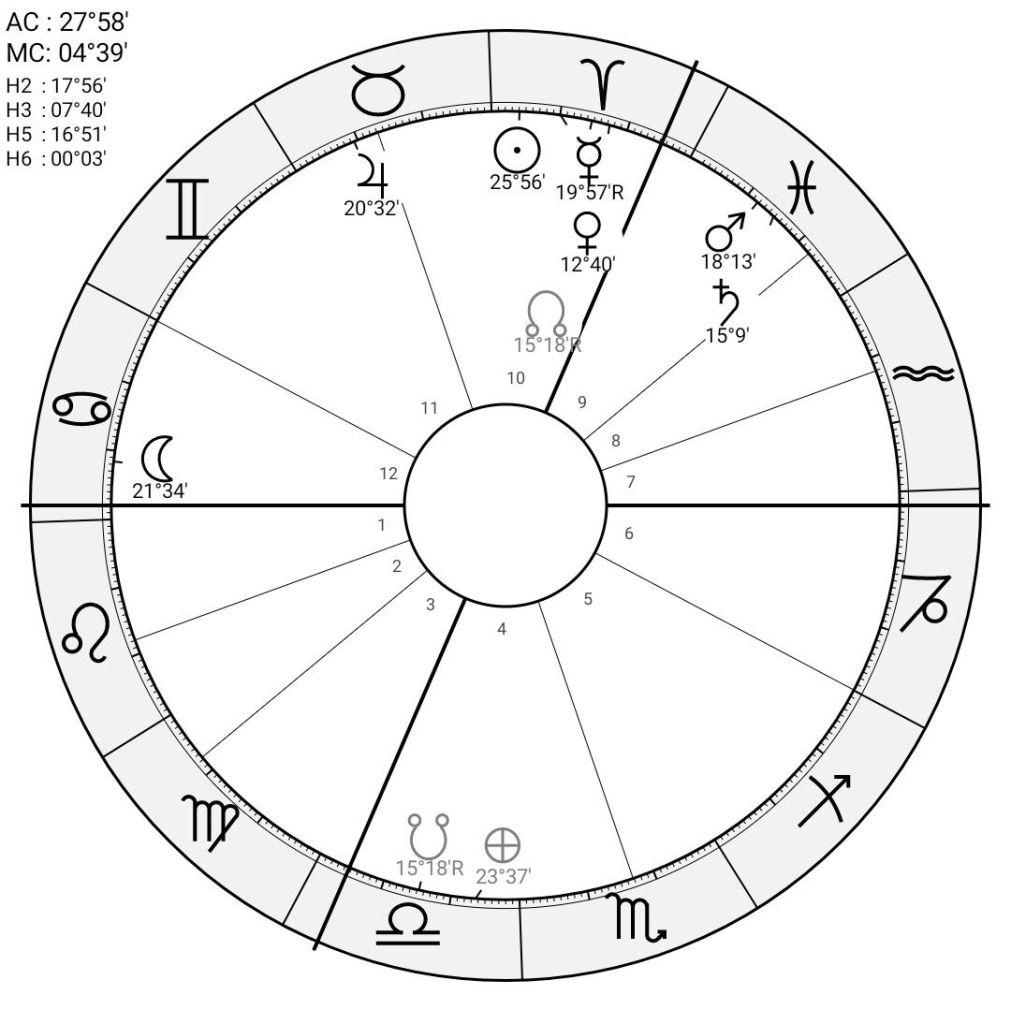
Is the course good for me?

The Moon is the Lady of the Ascendant and thus represents me. Magic is higher knowledge, so it’s Ninth House. This is Jupiter. The two malefics Mars and Jupiter are present in the Ninth house, and are both peregrine, so they afflict the house.

The Moon is in her sign, but she’s also tucked away in the very malefic Twelfth house. Interestingly, the Twlefth house represents witchcraft, but only in the sense of something done behind the querent’s back to hurt him, not magic in general (which, again, is higher knowledge). So while I’d be capable of learning (Moon in own sign) my position is not good. There’s something iffy.

Jupiter is mildly dignified by term and in the succedent Eleventh house. The Moon is in sextile with Jupiter, which is technically good, but it is separating from it, indicating growing divergence. The Moon’s next aspect is a square of the Sun, which is negative. The Sun rules the second house, the house of money. So proceeding would put a strain on my finances. This isn’t necessarily to say that it costs too much in absolute terms, but it costs too much compared to its quality. Interestingly, Jupiter is disposited by Venus, which is in detriment and moving toward the Sun, which hurts her, so Venus has a rather excessive love of my money compared to the necessary love of knowledge.

All in all, based on both readings, I would say that the course would probably contain some valuable information, but would not be a great investment in my education.

MQS

Love Fool (Horary Astrology and Playing Cards Reading)

This is the first time I use my new interest, Horary Astrology, in conjunction with playing cards. Let’s see what they have to say. The question was asked by a friend of mine who just broke up with her girlfriend. He wants to know if there is a future. This reading was made a couple of days ago.

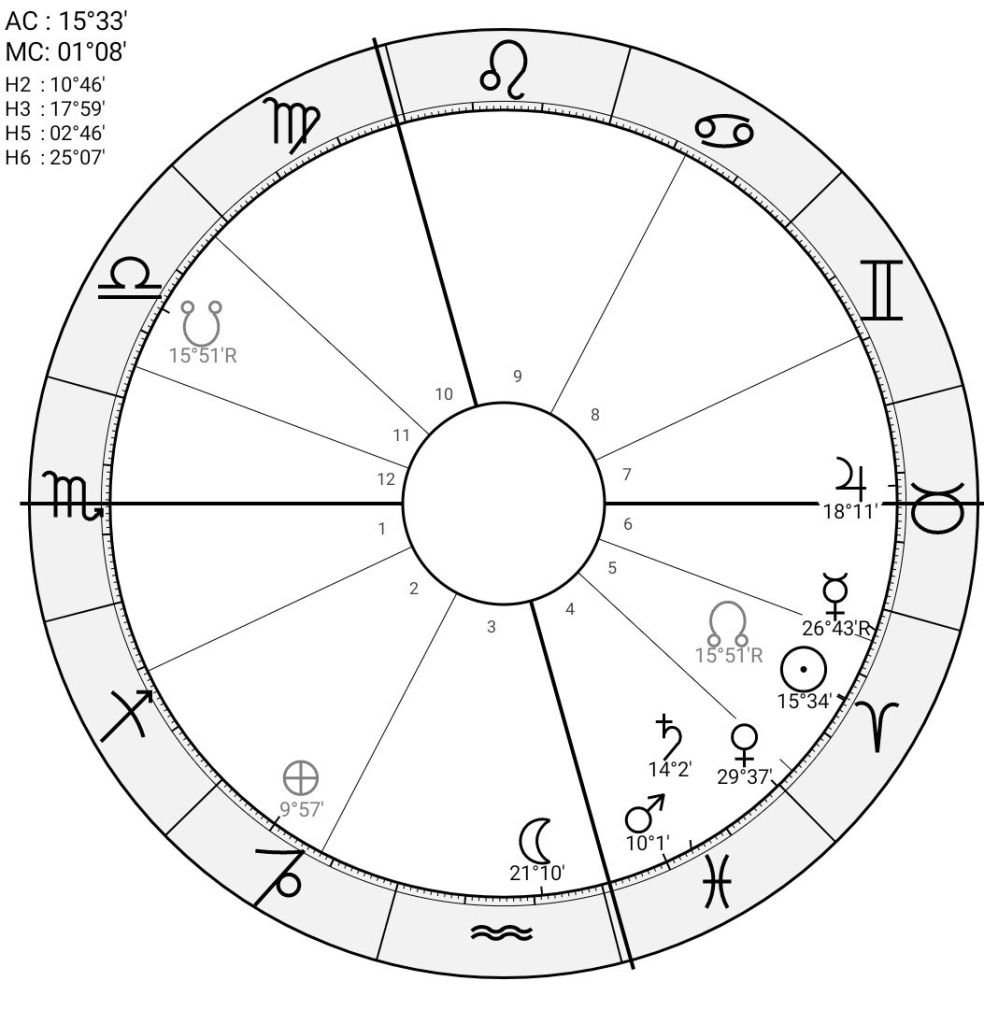
Relationship reading, is there a future?
Answered with horary astrology

The querent is Mars, lord of the Ascendant, while the quesited, i.e., the girlfriend, is Venus lord of the Seventh. The Moon indicates the flow of the action.

In a night chart, Mars is dignified by triplicity in Pisces, and is angular, while Venus is exalted, also in Pisces, and also angular. The first thing that strikes me is that Venus is moving away from Mars. Furthermore, the Moon is separating from a difficult square with Jupiter in the Seventh. I asked my friend if he had broken up with her or she had broken up with him, since from the chart it seems it was her initiative. He didn’t like to admit it, but said she had left him.

Note that Mars is in triplicity, so a decent Mars, but also conjunct Saturn. Saturn is peregrine. Also note that Venus, the girlfriend, is exalted, and exaltation is sometimes an indication of haughtiness. Clearly she thought she could do better than Saturn-like Mars as she moved away from him. My friend then told me she told him she didn’t like the fact she is to attached to her.

Well, CAN she do better? Venus is about to change sign, from Pisces to Aries, whereupon she will not only lose all her dignity, but she will also enter her detriment. Let us look at the Moon now. The Moon separates from the square with Jupiter and moves toward a sextile with Mercury Retrograde. Sextiles are positive aspects. If we put together the indications, we have: 1) Venus moving away but regretting her decision 2) A future positive contact 3) the contact is about things that go back (retrograde)

This seemed to me a sign of reconciliation. Just to be on the safe side, I had the querent pull three cards from the playing card deck. These were:

5♠ – Q♣ – 3♥

The cards are quite clear. The Five of Spades is a card of imprisonment, but it also indicates regret (which is what you are supposed to feel in prison). Then we have her significator, followed by the Three of Hearts. I would have preferred to see a Six of Hearts to show reconciliation, but the Three of Hearts will do. In this case, the added shade of meaning seems to be that the cards don’t even consider the breakup effective, because the Three of Hearts show things that flow positively without interruption.

I will update this post when I know the outcome.

MQS

Playing Card Multiples

I believe that in the development of divination techniques, the creation of meanings for multiples of cards of the same number must have probably come pretty early. When I was taught to read playing cards, the person who gave me the meanings passed also the signification of card multiples to me, with the caveat that she’d never found them to be very reliable, contrary to the rest of the method. I must confess that I almost never use them, except when the meaning can be derived from the meanings of the cards, which is why I never talked about them before. However, since someone asked me, I’ll retrieved them from my notes so that you can experiment with them.

Note that it does not matter which cards we are talking about as long as they have the appropriate number of pips. However, the presence of Spades in the combination is supposed to worsen the meaning, especially if the Spade card comes last.

Aces
2 = Surprise
3 = Positive Chance
4 = when together, death or great danger, when apart, glory or success

Twos
2 = Exchange
3 = Agreement
4 = Slowness, Boredom

Threes
2 = Tricks
3 = Increase or Progress
4 = Quick Communications

Fours
2 = Worry, Insomnia
3 = Situations speeding up, Unblocking
4 = Travel

Fives
2 = Small losses, Small torments
3 = Resolution
4 = Law

Sixes
2 = Nervousness
3 = Anger
4 = Violence

Sevens
2 = Development
3 = Sickness
4 = Dissatisfaction

Eights
2 = New acquaintances or learning something new
3 = Wedding bells
4 = Infamy

Nines
2 = Help from friends
3 = Triumph
4 = Glory

Tens
2 = Change of place
3 = Change of life
4 = Birth or rebirth

Jacks
2 = Fighting
3 = Litigation
4 = Danger

Queens
2 = Talks
3 = Gossip
4 = Slander

Kings
2 = Help
3 = Commerce
4 = Great Honor

MQS

The Height of Science is to Know Nothing

or “Summa Scientiae Nihil Scire” in Latin. This motto is very useful in practical fortune-telling. One of the greatest risks we run is of assuming. “She’s 85, how is she gonna find love?” “He’s a 23-year-old jock, he’s probably not a priest.” “She looks so prim and proper, she’s unlikely to have seven lovers.”

All these preconceptions and more cloud our mind as we try to read the oracle’s answer, regardless of the oracle, whether it be the Tarot, playing cards, astrology, the I Ching, etc. All these preconceptions are poison to the art of divination. They are not of service to us, nor to our querent. Let’s delve into why.

Let us start from the fact that bias is a natural and necessary phenomenon, as politically incorrect as this may sound. Bias comes to us from our experience, but also from the experience of others, especially family members, friends, teachers and people we trust. Bias orients our life, and this cannot be otherwise. The attempt to forcibly eliminate bias from people’s minds only causes suffering, and is its own kind of irrational crusade.

You know who is NOT biased? God. You know what God does? Everything. But you can’t do everything. You can only do something. And in order to do something, you must be biased against something else. That’s life.

This is not to say that all bias is good. For instance, I may have accepted some preconceptions from my parents, who got them from their grandparents, who got them from the priest, who got them from a crazy lady next door, etc. This kind of bias is the worst because it can needlessly limit our options and create likewise needless suffering in those around us. The best kind of bias is the critically examined one that you accept based on your actual life experience and keep open to revision.

Yet even this kind of “good” bias is harmful to divination. When someone comes to us for a reading, or when we read for ourselves, what we are doing is trying to look at reality from the point of view of a symbolic system that reflects life from an objective, or at least less subjective standpoint.

Divination is a language with no native speakers, except maybe the guy upstairs, which means that our understanding of it is always going to be imperfect and faulty. But this is a technical kind of difficulty, and in its own way it’s excusable. What is less excusable is the additional confusion we create by reading our biases into the divination. This is not just about politics, philosophy, morality or religion. It’s everything.

“A 85-year-old is not going to find love again” is one sort of bias. “An attractive young guy is probably not a priest” is another. The aim of divination is to read the truth, not ourselves. That’s why the height of science is to know nothing. If we start with a clean slate we can receive much more information from the tool we are using, simply because we are not randomly blocking out information we consciously or subconsciously deem unlikely.

The unlikely happens everyday. Think about it. Almost everyday something unlikely happens in the world. That’s not to say we must feel the urge to make our predictions as unlikely as possible in order to impress the querent. Most of the time, what’s likely is what ends up happening. Still the unlikely is not the impossible.

I am big on comparing divination with language, as those reading this blog know. And as you know, I am not a native speaker. Around fifteen years ago, I was trying to improve my English by watching youtube videos. Yet this was very hard, because the language people use on youtube is very inconsistent, erratic at times, filled as it is with memes, asides, jokes, ancdotes, interruptions… I was trying to project the artificial English I had learned in school onto this truer, more lived English.

“Surely he can’t have said what he has just said. It doesn’t make any sense,” I constantly thought. It was when I stopped projecting my presuppositions and started just taking in what was objectively being said that my English truly improved. That’s the same with divination. The height of science is to know nothing. Only if we know nothing we can take in what is being said.

MQS