I don’t remember talking about it here, but I was asked to teach evening Italian classes at the local school, mostly for adults (in that most students are adult, not because I teach NSFW vocabulary).
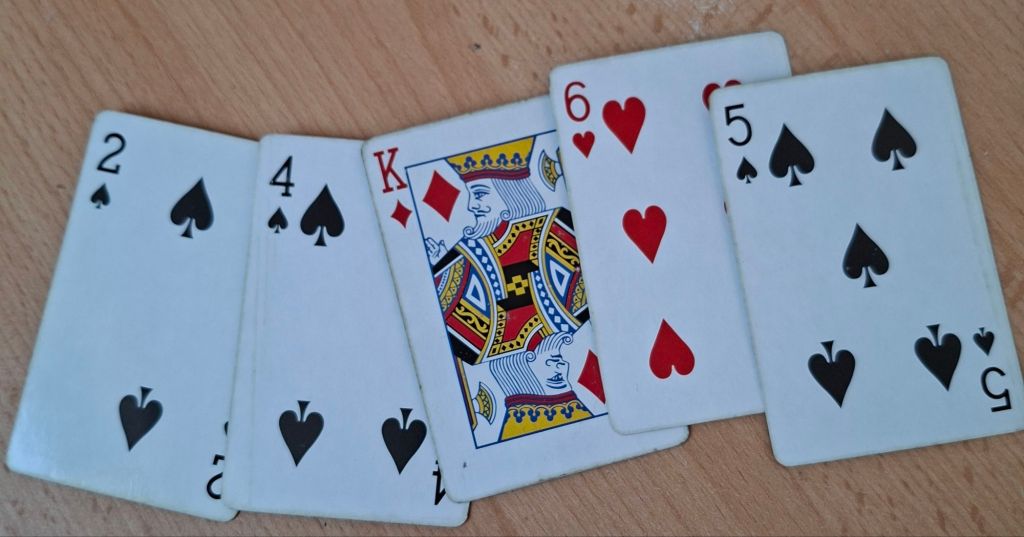
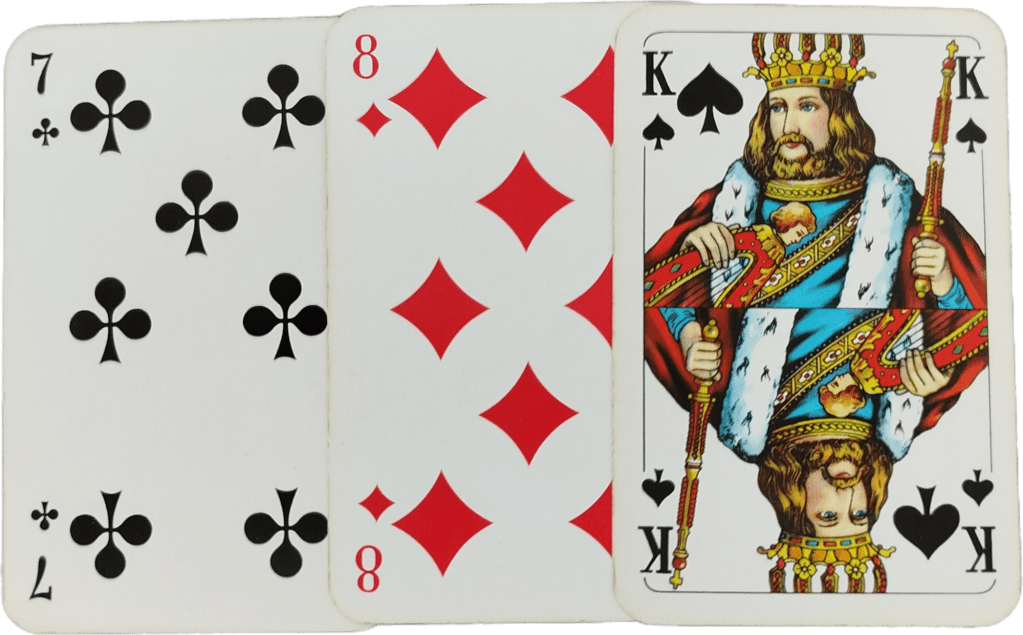
I have been having fun using the cards to predict how the classes would go. They are mostly accurate, although obviously their meanings must be toned down a bit to apply to the situation. One glaring example of the cards predicting something major is this spread on yesterday’s class.
How will the class go?
I’ll tell you what happened, and then we’ll get into the spread, especially since I didn’t predict anything ahead of time, so this is more of an exercise.
What happened was that one of the students, a man who sould have reached the age of reason some years ago, decided that I wasn’t paying enough attention to him. So when I asked him a question he reacted angrily, throwing a hissy fit and questioning me and my method. I reacted more maturely, yelling back at him that he can either get on with my method or be gone, at which point I invited him to leave.
Now let’s look at the cards I drew that evening before class. The cards are quite clear in this case, probably because what happened was relatively major compared to a boring day reading.
The King of Diamonds is ‘some dude’. He doesn’t come up as a Spade, so he’s not a sworn enemy or anything. The K♦️ dominates the spread from the center, so the situation revolves around him. The Two of Spades can be anger, while the Four of Spades can be an obstacle, but with negative cards it becomes a clean break.
So upheaval is to be expected in the relationship to this man. Since the Five of Spades ends the spread, this upheaval is unlikely to be reconciled. Especially since the Six of Hearts, the card of conciliation, is surrounded by all these spades, so it is as if the cards were saying “the conciliation is not” or, in English, there won’t be conciliation. Paradoxically, therefore, the 6♥️ worsens the spread by its presence.
When someone teaches someone else the traditional meanings of the cards, they often don’t waste too much time giving them a rundown of all the applications of the one or two keywords they give them, especially at the beginning. Keep in mind that in many traditions, at least in Italy, the initial instructions for card reading are passed down on Christmas Eve, so the explanations must be quick enough to fit into one evening where you have plenty of other stuff to do.
Usually, the initial instruction is followed up by a more thorough explanation later, but the new reader is also expected to “lavorare le carte”, literally to “work the cards“. This means that while they are being given a vocabulary (the keywords) and some grammar and syntax (the various spreads and combinations) they are supposed to develop their own language.
Think about it: we all speak English on this blog, yet each of us speaks a different version of it, not only because some of us are native speakers while some aren’t, and not just because some come from the US, some from GB, some from Australia, etc. but also, and especially, because each speaker of a language has their own slightly different version of it, owing to their character, personal history, experiences, education, talents and many other factors.
This may sound like an admission that language is random and infinitely pliable at will, but it isn’t. Your own language is an emanation of you as a person, but who you are as a person is not fully under your control. In fact, the diviner and occultist in me believes that it is only very slightly under your control.
What is true for regular speech is true for the speech of the cards. Once you are given the meanings of the cards, it is not a matter of reinventing them, but rather of discovering how the meanings work for you, of understanding what your particular, individual dialect is. This is a never-ending process, because the language of divination is a difficult second language to learn and because there is no human native that can help us.
But let’s discuss an example of how you take a single keyword and turn it into a web of interrelated meanings. In the Bolognese Tarot, which is my current obsession and is quickly becoming one of my favorite systems, the Queen of Coins is called “the truth”. There. If you were sitting on grandma’s lap on Christmas Eve and she were passing the meanings down to you, that’s what she would say. The truth. Period.
The truth is a complex thing, and throughout history different people have understood it to be something different. In itself, it is an abstract concept. After receiving it, you need to make it concrete, i.e., you need to discover how the word “truth” is used in your particular divination dialect. Let’s give it a try (and this is my dialect, obviously. It may or may not overlap with yours).
The truth is what truthful people tell, so obviously the card qualifies people as truthful, dependable, reliable. Next to a person card, the person will be all these things, probably.
Once you know the truth about something, you know about it. Knowledge is therefore another aspect of truth. Who has knowledge? Professors, for sure, and people who have studied something. One might counter that so many graduates today are ignorant fools filled with prejudices they never questioned. And one would be right. Archetypally, though, the connection (the ‘signature’) holds, similarly to how astrologically scholars are ruled by Mercury, even if scholars are often up their asses.
Study, teaching, learning, explaining, science, discovering, bringing to light, intellectual (or at least not physical) occupations seem to also be concepts that beautifully complement that lonely keyword “truth”. But all these aren’t just descriptions for abstract knowledge. What is a less abstract form of knowledge? Expertise, for sure. If you call the plumber, he may not be able to tell you how the categories of Aristotle’s logic apply to your toilet, but he sure knows how to stop it puking out scum. And that’s a good deal more helpful. So a plumber with the truth on his side is certainly a plumber you want to hire.
Today, the word wisdom is almost forgotten, or relegated to describing dubious practices with no scientific stamp of approval. But wisdom used to be deeply connected to knowledge. The Queen of Coins, therefore, surely describes the ability to lead your life the right way, or to lead others the right way.
Especially in the West, the idea of truth has always been connected with the ability to see. “I see” we say, when we understand something. This may sound shallow, but it actually has its roots in the old Greek notion that the truth is what the mind sees beyond the illusions of the senses. The word “idea”, which is what we have in our minds and which we hope to be a truthful representation of reality, comes from the root ‘vid-‘, which is the same root as the latin ‘videre’, to see. So the Queen of Coins stands for sight and for the eyes, and for windows, which bring light (understanding) into the home and from which we see how the world outside looks like. And so on and so forth.
These associations can be discovered by practice and by decoding the combinations that are usually passed down. Again, it is not a matter of making up. It is, literally, a process of discovery.
There are couples who stay together a lifetime, couples who break up at the first sign of hardship, and then couples that seem to follow some kind of fated path made of pushing and pulling. This is one example.
8♥️ 6♣️ 7♣️ 4♠️
Q♣️ J♦️ K♣️
9♣️ 3♣️
6♥️
Note the absolude predominance of Clubs. Clubs are a heavy suit that causes difficulties and slowness. There is no card of great love, but the Eight of Hearts is a card of fun and good times.
Followed by two problematic Club cards, the Six and the Seven, which end up in break-up (Four of Spades) it is clear that the two didn’t break up from one day to the other never to see each other again, but have been on a constant path of ups and downs ending up in separation.
At the time of the reading the two were broken up, so when I told the (female) querent what I was seeing she confirmed that they’ve been on again off again for quite some time.
Look the second line! We have the two significators united by the messenger card (Jack of Diamonds). So the two have broken up but are still in contact. The querent told me it’s not so much that they send each other messages as they communicate and cause misunderstandings with one another through mutual friends (the Jack of Diamonds can show a go-between). Clearly not a very healthy situation!
The final cards, the Three of Clubs and Six of Hearts, show a reconciliation in the union, but the Nine of Clubs before them implies this is going to be a long-term goal rather than a matter of days or weeks. So the unsatisfactory situation is likely to persist for a while.
As far as giving the querent some advice based on this spread is concerned, I would personally be wary of that Jack of Diamonds between them. It is much better to clear up misunderstandings directly instead of playing up the drama by involving friends as if the two were still high-schoolers (they are in their 40s).
All in all, this spread gives off bad vibes for a relationship. It seems the two are attached more to the drama than to each other. To each their own.
In every deck there are what we might call topic cards, that is, cards that represent a specific field of life: family, work, money, health, love, the law, etc.
All or most of these cards also have general meanings that apply to various contexts. For instance, the Ace of Cups in the Bolognese Tarot is the home card (just like the Ace of Hearts in playing cards or the Two of Hearts in the Vera Sibilla), so it is the topic card for everything relating to family and house questions. But it can also indicate that someone belongs to the family, e.g., when it comes up next to a court card. It can also indicate the inner side of one’s experience of life, one’s inmost, intimate world, etc. So it can also show that something is close to us and touches us.
We need to distinguish between a card acting as a stand-in for a specific topic and the same card acting out a particular meaning. To keep with the Ace of Cups example, when it comes up in a question about work, it might show that the querent’s work life interferes with their family life or vice versa, or that they work from home, or that their work environment is family-like. In all these cases, the house card qualifies the other cards by adding details of its own.
But when the House card is simply a stand-in for the topic ‘home and family life’, the card says nothing about the topic itself. It doesn’t qualify the reading. It simply tells us, “this is the topic.” It is then the role of the other cards to describe the situation, qualifying it in a positive or negative way.
When we are doing a general reading with no question, or with all the cards down on the table, this is all well and good: we see if the person’s significator is next to any of the topic cards, showing that that topic is important, and then we read the cards surrounding the topic card relating them to the topic.
When the question has been specified, though, extra care must be taken trying to figure out if the topic cards that appear are qualifying the topic of the question or if they are coming up to ignore the question and talk about something else. This is not always easy.
Let’s say you asked about work, but the house card comes up. Why? Is it because the home is involved? Or is it because the cards have decided to bypass your question and discuss something else? Or is it both? (It CAN be both). One way to solve this issue is to see if there are topic cards relating to the question, or if at least the cards seem to be predominantly of a nature that seems more akin to the question asked (e.g., lots of Diamonds and Clubs in a work-related question).
The other way is to see if the cards next to the rogue topic card coalesce with it to form a coherent statement that has nothing to do with work, or if instead the topic card allows itself to be absorbed into the querent’s question.
The third way is simply to work with the querent. This is always a good idea. After all, our aim is to interpret the oracle correctly, not to impress people.
Cards that have the potential to be topic cards are always quite strong in a reading, so it is always good to observe them first. Often they form focal points in the interpretation of the spread. Sometimes some cards in some readings can even be ignored, but topic cards always seem to have something to say. We ignore them at our peril.
Some decks have variable significators, while others assign certain cards to always represent the querent and their partner. This can cause confusion when reading for people who would not have lived their life out in the open back when cartomancy emerged, such as gay or trans people. Following are some experimental notes on how to deal with such instances in the various decks I use.
I want to stress that these are based on my practical experience, not on that of someone else and not on some theory I am trying force onto the cards. My aim is to improve my accuracy as a diviner, not to pontificate on academic eventualities.
Vera Sibilla
The Sibilla doesn’t have fixed significators, meaning that the querent will, if at all, be represented by a court card that indicates their role in the situation and/or society at the moment of the reading, always compatibly with their sex.1
And this is already problematic nowadays. I haven’t read for too many trans people, but I have noticed that if the person has either transitioned, fully or in part, or has at least adapted considerably to the other sex, then they are represented by a court card of that sex (ftm as a male, mtf as a female).
To be blunt: Jane, cashier, who has been living as Jane despite being born as Jim, and lives out her concrete life as Jane, is described as a woman in the cards, although the cards may hint at the transition, if relevant in the context; Jim, cashier, who would like to become Jane and maybe one day will, is represented as a man, even if he’s started to play with makeup since watching Myra Breckinridge; Becky, professional TikTok cheese grater, special traits no personality, who thinks an androgynous look makes her stand out, still comes up as a woman even if she pretends to identify as a man on every day with an R in it.
This has nothing to do with politics or tolerance or “passing as the other sex” and everything to do with concrete life: divination mirrors life, but social media clout simply doesn’t transfer to the cards, and there’s nothing I can do about it, even if it may offend some. The good news is that indentification with a significator is just a divinatory device and lasts only for the fifteen minutes needed to conduct a reading, and then is over.
IMPORTANT: we are talking about trans people, not crossdressers. A crossdressing man is a man who cosplays as a woman for whatever reason, but remains a man and lives as a man, at least until that fake business trip to Atlanta that his wife knows nothing about.
Talking about gay people, the Sibilla is very straightforward. In the few readings I do for myself, I usually come up as the Boyfriend, my husband as the Gentleman, and some years ago I came up as the Helper and my husband as the Boyfriend.
As for “but what about…” particular cases about any of the identities that are created daily, the best I can offer is: I’ll cross that bridge when I get to it. I trust the cards to simply describe the situation as it is and I accept the risk of not being able to understand how complex it may be, either in reality or in someone’s perception.
Playing cards and Bolognese Tarot
In some systems of cartomancy with playing cards, significators are not fixed. The way I was taught, though, the male querent is the King of Clubs and the female querent the Queen of Clubs, and the other card is the person they love. Similarly, in the Bolognese tarot the male querent is the King of Wands and the female querent the Queen of Wands.
For trans people, I think what I said about the Sibilla still holds true. Again, all I can say is to keep your mind and your eyes open (on the cards, I mean. Looking if the querent has an adam’s apple doesn’t count.)
For gay people, I have generally found that a degree of flexibility is required on the diviner’s part. Some readers seem to believe that you can just dictate to the cards how to behave, including in the case of gay querents. If that works, then bully for you, but I have always found the cards to have a mind of their own, regardless of the conventions we try to establish for them, so all I can do is be flexible.
Some people think the querent is represented by the court card of their gender, the partner by the other main significator, regardless of their sex. This theory is predicated on the fact that the two main significators are meant to show those people, and the fact that they are of two different genders is accidental or a matter of historical bias.
This may sound convincing, but have I found it to be true in practice? Sometimes. Sometimes the partner will come up as the other Club/Wand figure and there is simply no way of interpreting it other than as the partner, even if the stuff under the dress doesn’t match. Sometimes the cards will represent the partner as a court card of another suit that matches them. Sometimes the cards will throw in both cards for good measure: hubby has come up as the Queen of Clubs + King of Hearts together on more than one occasion in the past. Talk about a big personality.
Tarot
This is like the Sibilla, and doesn’t require much discussion. The male querent is usually the Emperor or the Pope, the female querent is usually the Empress or the Popess. Two men in a relationship can be shown as Emperor and Pope.
MQS
I am aware of the difference between the word ‘sex’ and the word ‘gender’, but I am going to use them quasi-interchangeably to avoid too many repetitions that hurt the ear. ↩︎
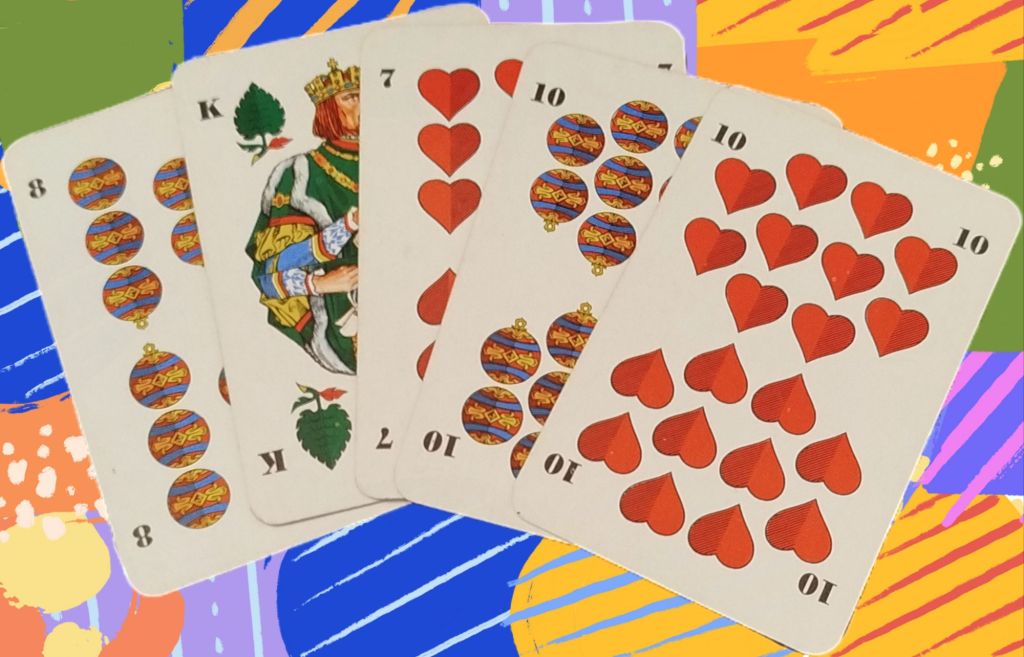
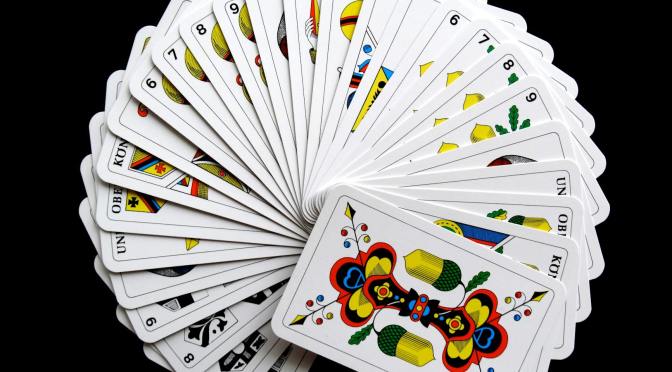
A friend and I have decided to do a little experiment with the German skat deck. He has applied for a job and we wanted to see if he’ll be hired.
An Experiment with the German Skat deck
According to the meanings I’ve received, the Eight of Diamonds (here the Eight of Bells) is the card of work and business, so the cards seem to be on the ball. We also have the Ten of Hearts which is a contract (a marriage/union) with the Ten of Diamonds/Bells indicating it’s a relatively well-paid full-time opportunity. The Seven of Hearts here should indicate relief and pleasantness in general. It could also mean the querent is going to have fun, but considering it comes before the contract, I incline more toward the former interpretation.
There’s that King of Spades / King of Leaves there, which puzzles me. Technically the querent is the King of Hearts. This could show that someone else gets the contract, but this would be a really weird way for the cards to communicate (“Will I get the job?” “Someone else is going to be really pleased”). It can happen that the cards say someone else gets the job, but they would show this as a negative for the querent. Also, this cannot be the boss, because two women are the boss and are looking for someone to hire.
Maybe the King of Leaves could represent the type of job. It is in the medical field. Technically, medical subjects would be indicated by the Ten of Clubs/Acorns or the King of Clubs/Acorns, however I have seen many sources that assign the meaning of doctor to the King of Leaves / Spades. It could indicate that the job is going to have to do with lots of bureaucracy and office stuff, and that would true.
Let’s move on with our look at the playing cards divided by concept. This time, we see which cards represent stability.
Ace of Hearts The Ace of Hearts, like in many systems of reading playing cards, represents the home. It is a symbol of durability and stability, since houses tend to be stable things that don’t change. Mostly, the Ace of Hearts symbolizes the house or the family, however, when describing someone’s character, for instance, it shows them to be family-oriented, looking at stabilizing their life, being rooted in traditional values, etc.
Four of Hearts The Four of Hearts usually brings agreement in all fields of life. However, the type of agreement it shows is effortless, and it resembles more a state of peace where the waters aren’t ruffled (and if they are, the waves calm down immediately). Usually this card indicates harmony, harmonious surroundings and ease.
Six of Hearts Unlike the previous two cards, the Six of Hearts, which represents such things as reconciliation, healing, etc. does often imply the presence of some disturbing factors (though not necessarily. We need to look at the spread as a whole), but it shows that these disturbing factors, such as a break-up or a disagreement, can and probably will be overcome, returning the situation to its previous stability.
Ten of Hearts The Ten of Hearts is one of the most powerful in the deck, as it is often capable of diminishing the negative impact of negative cards. Since it is symbolic of paradise, heaven or ultimate attainment of one’s happiness, it hints at a situation either being stable (and happy) or becoming stable (and happy). When it is followed by very negative cards, though, it can show this paradise being lost. In fact, it is sometimes a bad sign when we find the Ten of Hearts at the beginning of the spread without other strong cards, because it shows that the best is already in the past.
Three of Clubs The Three of Clubs brings union and unity. It causes situations or people to become locked in place, usually by signing contracts, celebrating a marriage of making a commitment to each other or doing things together. Sometimes it can show that a situation perseveres (it remains married to us).
Six of Clubs A somewhat obnoxious card, the Six of Clubs isn’t tragic, but it brings disturbance. It shows situations that have lost their momentum, and problems that we thought we had overcome reemerging. It shows a sort of static discontent with no disruption in sight, either for good or bad, unless other cards clearly show it.
Nine of Clubs This is the card of distance, either in terms of miles or in terms of time. As such, it lengthens out the timeframe, but unlike the Six, the Nine of Clubs has no negative undertones, except in the sense that often we want all the good in the world to happen to us quickly, and this card stalls us for some time. However, it can also make a good situation last longer.
Four of Diamonds Unlike the Four of Hearts, which shows effortless stability and agreement, the Four of Diamonds represents agreement following either tensions or negotiations. Thus it represents all things to do with bureaucracy and the government that seek to regulate life and make it more stable within the borders of a country.
Ten of Diamonds Of the Ten of Diamonds we can say something similar to the Ten of Hearts, except that the success promised by Diamonds tends to be more material, and doesn’t necessarily imply happiness. However, it does represent situations that have developmed to their utmost in a positive sense and have reached their aim.
Five of Spades Being the card of prison, the Five of Spades symbolizes constraints, blockages and the need to make great sacrifices. As such, it means that the person (symbolized by the central pip, hemmed in by the four other pips at the corners) cannot move and is bound to a situation. Usually this is in a negative sense. Even when surrounded by positive cards, thus showing a positive commitment, it still indicates a certain sense of being stifled.
Six of Spades The Six of Spades is the card of illness, and it shows all situations that are ill, broken, suffering, etc. In itself it is not the most tragic card in the suit, but it represents a state of suffering stillness, which may be overcome or lead to disruption, depending on the cards that follow this one.
We did a little experiment with a friend. She wanted to know if the bureaucratic process to get the inheritance from the recently deceased grandfather would finally come to an end, since there had been several delays (leave it to the Italian bureaucracy). We started with the Sibilla.
Sibilla
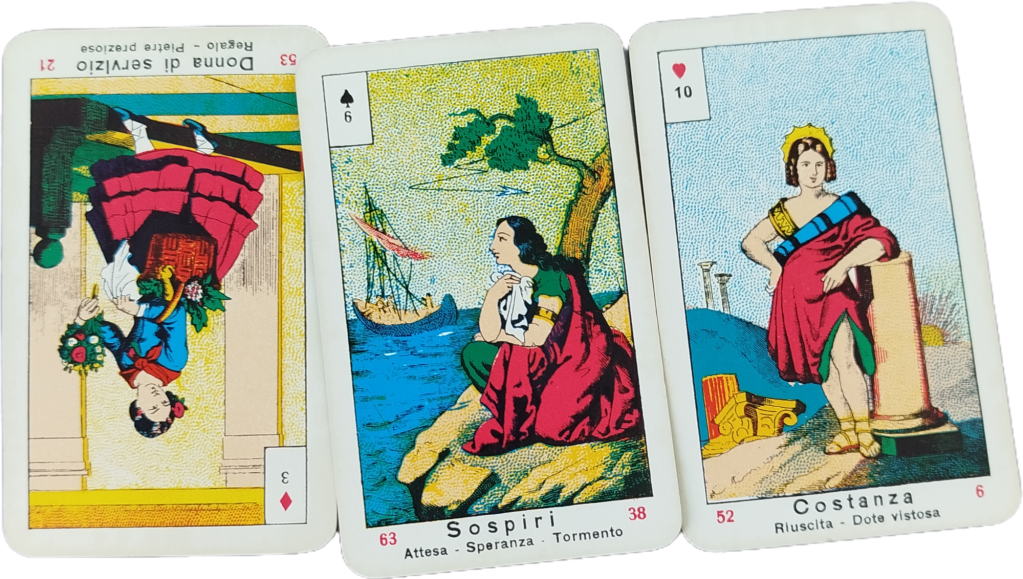
A three card reading with the Vera Sibilla
In this case, the Handmaid reversed indicates money going out (of the querent’s wallet). The Sighs card simply indicates that the person worries they’ll have to pay money. The Ten of Hearts here is not a positive influence, because it is a card that makes the uncertain certain (in the context of a trial, for instance, it might indicate the sentence being decided). So in this case the worries shown by the Sighs are confirmed.
I asked my friend if she was worried about having to pay some extra money, and she said that this was her and her dad’s worry, but that they had looked into inheritance law and thought they were safe and wouldn’t need to pay . Clearly the Sibilla begs to differ.
Playing cards
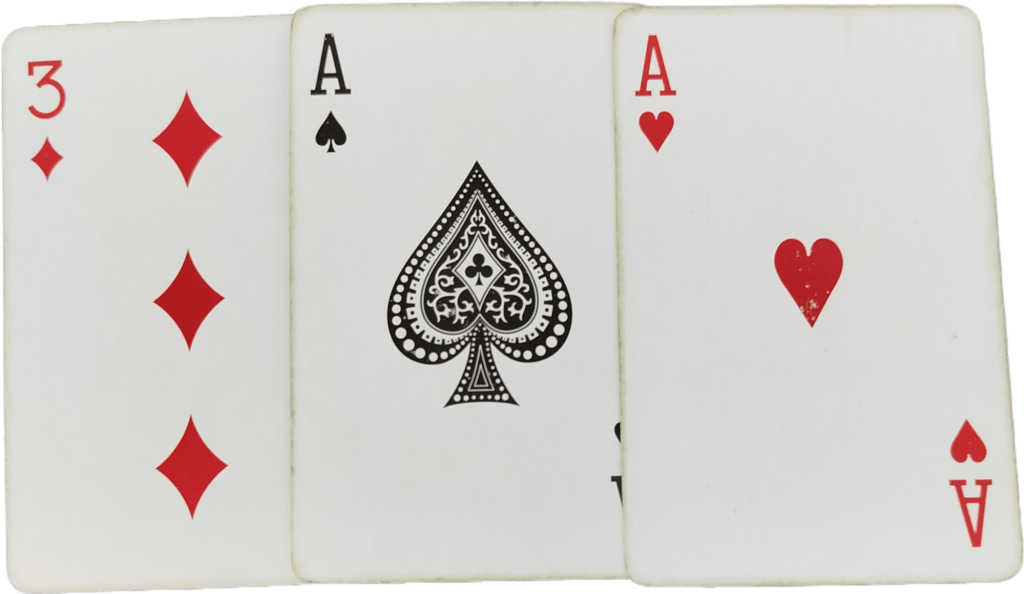
A three card reading with regular playing cards
In this case we don’t have the querent’s state of mind (which the Sibilla talked about). However, we do have, once again, the loss of money, indicated by the Three of Diamonds being covered by the Ace of Spades. The Ace of Hearts shows us that the money going out is due to family issues, something which was absent from the Sibilla.
Skat cards
A three card reading with the Skat / Piquet deck
I decided to make an experiment with the Skat cards as well, just for kicks. The Eight of Diamonds is technically the card of work. However, if I understand the meanings correctly, it represents work because it shows the flow of money, money being exchanged. So it can represent, more broadly, the economy. With the Seven of Clubs, which indicates tears, the economy will take a hit. The King of Spades might be the office worker who will give the querent the news.
A week ago they received news that they needed to pay an extra 3000€ to unfreeze the granddad’s money. My friend doesn’t know if the office worker who worked on their case was a man (the King). Still I think the Skat cards were rather accurate.
Daily readings are not my passion. Divination moves from the assumption that something is going to happen. But life is full of uneventful days, where time seems to stand still. Yet the oracle must necessarily tell us something, for the simple fact that we allow it to speak.
This is not to say that the cards (or other means) don’t mean anything, but often we need to tone down the interpretation to such a degree, or retrieve such inconsequential shades of meaning that, unless you are a god of divination, you aren’t going to be able to consistently predict much, and I am definitely not a god of divination.
On the other hand, daily readings can sometimes be easy to read into once the event has come to pass (see my recent example). Reading into the oracle always leaves us in danger of deluding ourselves. The question I always ask myself is: would I be able to see it if I didn’t know it? Often a vaguer prediction that is true to what we can see in the cards is preferable to a highly detailed account that simply regurgitates what we already know or what we have been fed.
Still, sometimes we can afford the luxury of reading-into after the fact, and daily readings can be one such instance, because at least we can learn something, if we are careful. In the example I posted about the pregnancy, the three cards, called at random to disclose a daily influence, could have meant a variety of different things, but news about a pregnancy is without a doubt one possible interpretation. Furthermore, sometimes if we know that something is bound to happen, we may gauge by the daily reading if it is likely to happen on a particular day, or if it is going to go well.
Another thing to consider is that limiting the timeframe is always somewhat arbitrary. Do you seriously think that if you ask the cards what is going to happen this week and in ten days something terrible or wonderful is bound to happen the cards are going to keep quiet about it? Just because you told them to keep it within the week?
Often, if you pull daily cards, a major event or major influence or vibe shift will start manifesting in the cards many days in advance. A romantic reunion happening next week may start manifesting with cards of love now, even if today or tomorrow aren’t especially romantic days.
What I personally prefer to do is occasionally pulling three cards for the day, while knowing that they may describe something happening further along the way. By occasionally I mean every two or three weeks, rarely every week. That way the cards are usually more meaningful than if I stress them every day on how the day is going to go. This doesn’t mean I’m going to be able to predict something, but the careful, tentative reading-into is going to be more certain and less based on wishful thinking.
The great thing about occultism being my life but not my job is that I get to do whatever I please. Well, right now it pleases me to talk about this deck, somehow.
Fortune-telling with Piquet cards or Skat cards. Like the video and subscribe