(Note: this is a collection of the meanings attributed to the cards by some occultists in the past centuries. It does not reflect my own study or opinion of the cards. It is only meant as a quick comparative reference as I develop my own take.)
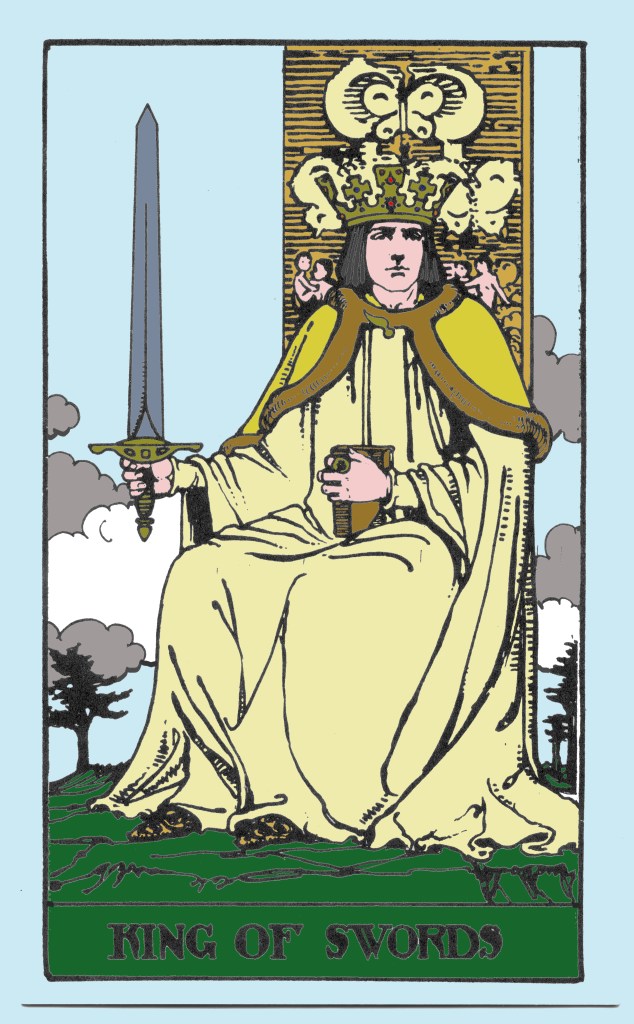
Paul Foster Case (and Ann Davies)
The time period is from the beginning of the last decanate of Virgo to the end of the second decanate of Libra, September 13 to October 12, under the combined rulerships of Venus in Taurus, Venus in Libra, and Saturn-Uranus in Aquarius. Meanings: a man of strong and powerful imagination; hard worker and having authority; keen in understanding law and capable of excellent cooperation; somewhat distrustful and suspicious and therefor e hard to convince. He sometimes surprises his friends by sudden changes of attitude, although he is usually overcautious and analytical. In a divinatory lay-out:
Well Dignified: he is friendly to the Querent and will cooperate with him. lll Dignified: he is inimical, harsh, malicious and plotting, obstinate and wholly unreliable.
Dark hair and dark eyes.
(From the Oracle of Tarot course)
A. E. Waite
He sits in judgment, holding the unsheathed sign of his suit. He recalls, of course, the conventional Symbol of justice in the Trumps Major, and he may represent this virtue, but he is rather the power of life and death, in virtue of his office.
Divinatory Meanings: Whatsoever arises out of the idea of judgment and all its connexions-power, command, authority, militant intelligence, law, offices of the crown, and so forth.
Reversed: Cruelty, perversity, barbarity, perfidy, evil intention.
(From The Pictorial Key to the Tarot)
Aleister Crowley
(Note: Crowley and the Golden Dawn swapped around King and Knight. This is in part true of Waite as well.)
The Knight of Swords represents the fiery part of Air; he is the wind, the storm. He represents the violent power of motion applied to an apparently manageable element. He rules from the 21st degree of Taurus to the 20th degree of Gemini. He is a warrior helmed, and for his crest he bears a revolving wing. Mounted upon a maddened steed, he drives down the Heavens, the Spirit of the Tempest. In one hand is a sword, in the other a poniard. He represents the idea of attack.
The moral qualities of a person thus indicated are activity and skill, subtlety and cleverness. He is fierce, delicate and courageous, but altogether the prey of his idea, which comes to him as an inspiration without reflection.
If ill-dignified, the vigour in all these qualities being absent, he is incapable of decision or purpose. Any action that he takes is easily brushed aside by opposition. Inadequate violence spells futility. “Chimaera bombinans in vacuo”.
In the Yi King, the fiery part of Air is represented by the 32nd hexagram, Hang. This is the first occasion on which it has been simple to demonstrate the close technical parallelism which identifies Chinese thought and experience with that of the West. For the meaning is long continuance: “perseverance in well-doing, or continuously acting out the law of one’s being”, as Legge puts it in his note on the hexagram; and this seems incongruous with the Qabalistic idea of violent energy applied to the least stable of the elements. But the trigram of Air also indicates wood; and the hexagram may have Suggested the irresistible flow of the sap, and its effect in strengthening the tree. This conjecture is supported by the warning in line 6: “The topmost line, divided, shows its subject exciting himself to long continuance. There will be evil.”
Allowing this, the image of “the extended flame of mind”, as Zoroaster calls it, may well be subjoined to the former description. It is the True Will exploding the mind spontaneously. The influence of Taurus makes for steadiness, and that of the first decanate of Gemini for inspiration. So let us picture him, “integer vitae scelerisque purus”, a light-shaft of the Ideal absorbing the entire life in concentrated aspiration, passing from earthy Taurus to exalted Gemini. Here, too, is shewn (as in the Yi) the danger to the subject of this symbol; for the first decan is the card called “Interference”; or, in the old pack, “Shortened Force”.
(From the Book of Thoth)
Golden Dawn’s Book T
A WINGED Warrior with crowned Winged Helmet, mounted upon a brown steed. His general equipment is as that of the Knight of Wands, but he wears as a crest a winged six-pointed star, similar to those represented on the heads of Castor and Pollux the Dioscuri, the twins Gemini (a part of which constellation is included in his rule). He holds a drawn sword with the sigil of his scale upon its pommel. Beneath his horse’s feet are dark-driving stratus clouds. He is active, clever, subtle, fierce, delicate, courageous, skilful, but inclined to domineer. Also to overvalue small things, unless well dignified. If ill dignified, deceitful, tyrannical and crafty.
Rules from 20 Degree Taurus to 20 Degree Gemini.
Etteilla
Man in Uniform
Upright: This card, as far as the medicine of the spirit is concerned, means, in its natural position: Man in Uniform, Man of the Law, Judge, Councilor, Assessor, Senator, Business Man, Medical Practitioner, Lawyer, Prosecutor, Doctor, Physician. – Jurist, Law-making. – Litigant [= Party to litigation], Jurisconsult.
Reversed: Malicious, Maliciousness, Perversity, Perfidy, Crime, Cruelty, Atrocity, Inhumanity.
MQS