In Astrology, and therefore in Geomancy, we distinguish between a friend and an acquaintance, the former being eleventh house matter, the latter seventh house. Obviously, the difference is not as clear cut as it may seem, especially in the age of social media, where all it takes to be someone’s friend is to click on the ‘add’ button.
In the old texts, both of Geomancy and Astrology, we often find examples of how to judge questions like “Will my friends be useful to me?” This may sound callous compared to our sentimental notions of friendship, but keep in mind that 1) the old notion of usefulness was broader back then, and it included everything concerned with the person’s well-being, both inner and outer 2) friends formed part of the person’s network of alliances in tackling the hardships of life 3) the eleventh house is the second from the tenth, which represents heaven, so it represents friends as wealth from heaven. Clearly friends were highly revered (just read Plato, Seneca, Xenophon or even Confucius for proofs).
As I mentioned somewhere else, my husband and I are in the process or moving, and as usual when moving, we suddenly discovered that we own three times more stuff than we thought. One friend volunteered to help us the following day, bringing us boxes and helping us with her car. In the evening though she said she didn’t know if she would make it. I cast a reading to see whether she would come:
Will she come to help us? (app used: Simple Geomancy)
Let us forget the Judge for a second and concentrate on the chart. If we take the girl as ‘our friend’ she should be eleventh house, and the eleventh house is occupied by Cauda, which also doesn’t move anywhere.
Now if my mom asked me who she is, I would say ‘a friend’. Yet she is more my husband’s friend. I am just on good terms with her, but I wouldn’t call her to spill my guts or even to ask for help, though it was of course very nice of her to volunteer.
If I take her to be my acquaintance, she is seventh house, and occupied by a more promising Conjunctio, which does spring to the second toward me. And she did end up coming.
The negative Judge, Amissio, possibly refers to the fact that we ended up losing a couple of objects due to recklessness (notice the Via Puncti reaching back to Puer in the fourth house). I also ended up losing a friend to gain an acquaintance, it seems.
Here Abano teaches how to cast a reading and then explains the main meanings of the astrological houses.
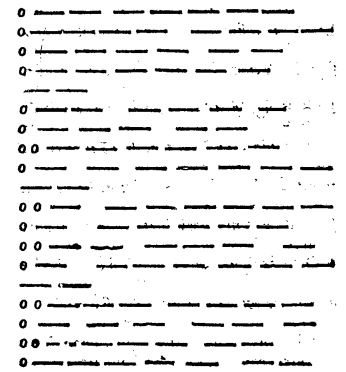
The method of forming the above mentioned sixteen figures is to use a pen to mark sixteen rows of points on a piece of paper. These must then be paired two by two, until, at the end of each row, either two points are left or only one.
Abano’s illustration of how the four mothers are formed
Then one must take the geomantic figures that emerge, in the following way.
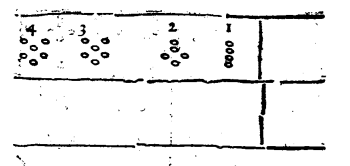
Abano illustrates how to add the Four Mothers to their place
Note, however, that the previous operation is not carried out by counting the points one makes, nor by following one’s fancy, but rather by virtue of the Primum Mobile and First Motor God the Eternal, who moves one’s hand, and is to be carried out with good intentions and by invoking God’s grace and help.1
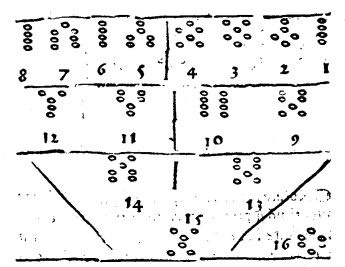
From the first four figures, four other figures are derived by taking the first points of each of the first four figures, which go to form the fifth figure; then by taking the second points of each figure to form the sixth figure, and so on with the third row of points to form the seventh, and the fourth row to form the eighth, as shown below.
Abano’s illustration of the Geomantic Shield
Once the eighth figure has been drawn, take the first and second [figure] and, proceeding in the same way as at the beginning, form the ninth; then take the third and fourth to form the tenth; then the fifth and sixth to form the eleventh; then the seventh and eighth to form the twelfth.
Then, add the tenth and the eleventh to form the thirteenth, known as the First Witness, and the eleventh and the twelfth to form the fourteenth, known as the Second Witness. Add the witnesses to discover the Judge.
This completes the chart, with every figure in its necessary place according to the question asked, as will be explained. However, often one may take the Judge and the first figure and add them together to obtain the Judge of the Judge,2 which is the sixteenth figure, which we will discuss later.
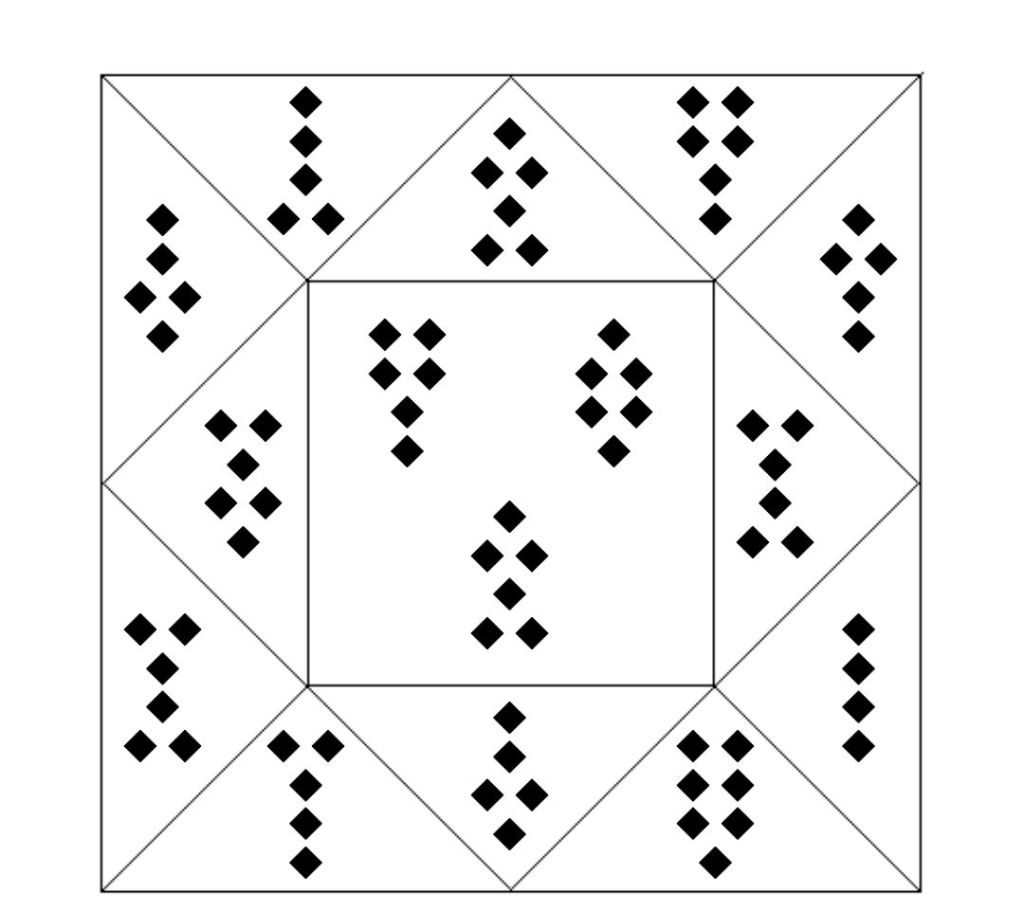
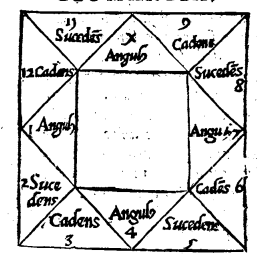
It is to be noted that the main figures are the first twelve, of which four are strongest. The first and the tenth are the best, but the first is even better. The seventh and fourth are also good. These four figures are called the angles, noting which one may know the strength and virtue of the chart. Following them, the second and fifth figure, and the eighth and the eleventh are known as succedent. Finally the last four are the third, the sixth, the ninth and the twelfth, which are called cadent, as shown in the following figure.3
Abano’s illustration of the principle of angularity as it applies to geomancy
And the first figure is called the strongest and best of all, because it signifies the virtue of the Heavens on the querent, that is, he who asks the question.4 It is called the Ascendant. Following that, the tenth is in the middle of the heavens and has great power and influence. When it is good it bodes well, but when it is unfortunate it means great misfortune in terms of how the question is going to end.5
The seventh figure is opposite the Ascendant and is called the Western Angle, and it bodes well when good, ill when bad, especially in questions concerning the seventh house, as will be shown. The fourth figure or house, although categorized as an angle, is called the feeblest of them, because it is at the bottom of the skies in our hemisphere. Nonetheless it indicates the end of the matter and of the querent’s intention.
Then we have the second, fifth, eighth and eleventh, which are succedent houses because they come after the angles, and are good or bad according to the figure [that falls in them] and the question asked, and they indicate the present and what is yet to come for the question asked. The third, sixth, ninth and twelfth figure are called cadent, meaning what runs against the question, and the worst are the sixth are twelfth. The eighth is also among the evil houses.
The above is especially to be noted because every figure has two virtues, one according to its nature and an accidental virtue depending on where it falls in the chart.6 As such, if a good figure falls in the first house, its goodness is amplified, and similarly in any other angle. When it falls in a succedent house, it has less power, and when it is cadent it has even less. And this point holds true for evil figures as well in their ability to cause bad fortune. An evil figure in an angle, therefore, will mean a great bad fortune, especially in the fourth.
Nonetheless, among the bad houses, the sixth and eighth and twelfth are the worst, and every figure falling therein is dangerous in any question.7 And they are especially dangerous if they are evil by their own nature. Said figures are considered not just according to their virtue and the places where they fall, but also according to the question, that is, according that they are appropriate or inappropriate concerning the thing asked.8 As such, what follows is the signification and the property of each of the houses.
The first house signifies the life and body, the being and soul and intention of the querent or the one for whom the question is asked. It also means the beginning of all things. It sits opposite the seventh, and signifies the goods and money of the prisoner. It is the joy of Mercury.9
The second house is wealth,10 gain and loss, and all that the querent owns. It is opposite the eighth, and it signifies the gain of the querent’s family.
The third house indicates siblings, blood relatives, short journeys and enemies of faith and of the Roman Church,11 neighbors, etc. This house is opposite the ninth. It also signifies rumors, and travel companions. It is the joy of the Moon.
The fourth house indicates buildings, buried things, the end of every question. Also, the father, the wealth of a brother or sister.12 It is opposite the tenth.
The fifth house indicates mirth and happiness, children, messengers and letters, music, food, clothes, mid-range travel, the father’s wealth. It is opposite the eleventh and it is the joy of Venus.
The sixth house indicates wrath and an evil mind, toil, malady, servants, people who are subjected to the querent, small animals. This house is the joy of Mars.
The seventh signifies the wife,13 the lover, an opponent, public enemies, games of chance, thieves, bandits, partners. The place the querent goes to, medicine, the wealth of one’s servants. It is opposite the fist house, and is absent.14
The eighth house indicates death, fear, danger, the wealth of the enemy, inheritance from the dead, the wife’s dowry, gain from the land one moves to,15 debts, Necromancy, evil spells. It is opposite the second.
The ninth house signifies religion, Ecclesiastics, the Pope, preferment, priests, the Christian faith, burials, fame or infamy, long travels, the wealth of the absent party.16 It is opposite the third, and is the joy of the Sun.
The tenth signifies the Emperor, the King, the lord,17 great honor, a doctor, a master, art, profession, sea, ship, towers, the thing stolen, famine, fertility, the church’s wealth, and advantages gained from the church. It is opposite the second.18
The eleventh signifies friends, hopes, fortune, courtesans, a lord’s wealth, common goods, the mother’s dowry. It is opposite the fifth, and is the joy of Jupiter.
The twelfth house signifies prison, prisoners, pilgrims and endless wandering, long violence,19 adversities, traitors, occult enemies, great beasts, the friend’s wealth. It is opposite the sixth. It is the joy of Saturn.
Whenever a question is asked, the issue always involves the first house, and in the second place the figure found in the house that is appropriate for the question, and depending on whether it is fortunate or not, together with the four angles, thus does one judge the issue. And especially [it is to be considered] whether the Witnesses and Judge are good.
MQS
Footnotes
Here again, as in Part 1, Abano insists on the role of the divine (and again, he does it in a typical Christian Aristotelean fashion). He is doing more than just paying lip service to the religious ideas and institutions of the time, in so much as he asserts a central point common to all forms of divination: that it is divine nature that shines through the divination process. This explains his assertion that the points must not be counted nor be created following one’s fancy: the diviner’s ego must be switched off in order for the divine to act through it. ↩︎
‘Sopragiudice’ in Italian, which literally means Superjudge or Overjudge. ↩︎
Abano follows the relatively standard (by that time) association of the astrological houses with varying degrees of strength. ↩︎
The first house is given to the querent, so a good figure in it would indicate something positive for them or that they are positive. ↩︎
This seems intended more to emphasize the importance of the angles than to link the tenth house with the ‘end of the matter’, which is a meaning typical of the fourth house. ↩︎
This is meant to reflect the notions, common in Medieval astrology, of accidental and essential dignity of the planets, though the concept must be modified a little in order for it to apply to geomancy. ↩︎
There is a certain digree of ambiguity concerning this issue, as it is not always clear if a figure in a weak house will see its power decreased or its evil import amplified. This ambiguity is present in astrology as well. ↩︎
This is an important concept. A good figure becomes bad if its meaning is opposite to the querent’s intention, and vice versa. ↩︎
Joy is an astrological term. The joys of the planets are houses where the planets are supposed to perform their heavenly duty better. A typical attribution is: the first to Mercury, the third to the Moon, the fifth to Venus, the sixth to Mars, the ninth to the Sun, the eleventh to Jupiter, the twelfth to Saturn. Abano follows this scheme. ↩︎
The term used by Abano is ‘robba’ or, in current Italian, roba. This literally means ‘stuff’. Keep in mind that in the Middle Ages, for many people, stuff was more important than money, and that the moneyed economy we have today was barely in its infancy back then. The second house indicates stuff, and therefore all moveable possessions. ↩︎
Because the third house sits opposite the ninth, which is the house of God. Obviously, Abano wrote at a time when Catholicism was the dominant and (for the most part) only allowed creed. ↩︎
This is by the principle of turned houses. The second house from every house indicates the wealth of the thing or person signified by that house. ↩︎
or husband, if the querent is a woman or a man interested in men. ↩︎
It’s unclear to me what Abano means by this. The seventh house is sometimes given to ‘the absent party’ to know if the person will come back, but the wording Abano uses is strange. ↩︎
The land one moves to is ‘there’, which is the opposite of ‘here’, signified by the first house. ↩︎
I don’t understand why the ninth should indicate the absent party’s wealth. ↩︎
‘Signore’ i.e., the ruler of a Signoria, a small Italian monarchy typical of the time. ↩︎
Background: hubby and I are on a weekly veggie delivery service from a nearby farm. Yesterday they told us they might come a bit later than usual (normally they deliver at around 12-13pm). As hubby needed to go to work and I had a ritual to carry out and carefully timed, I needed to know that I wouldn’t be disturbed during the ceremony. So I asked when the veggies would come.
Horary Astrology
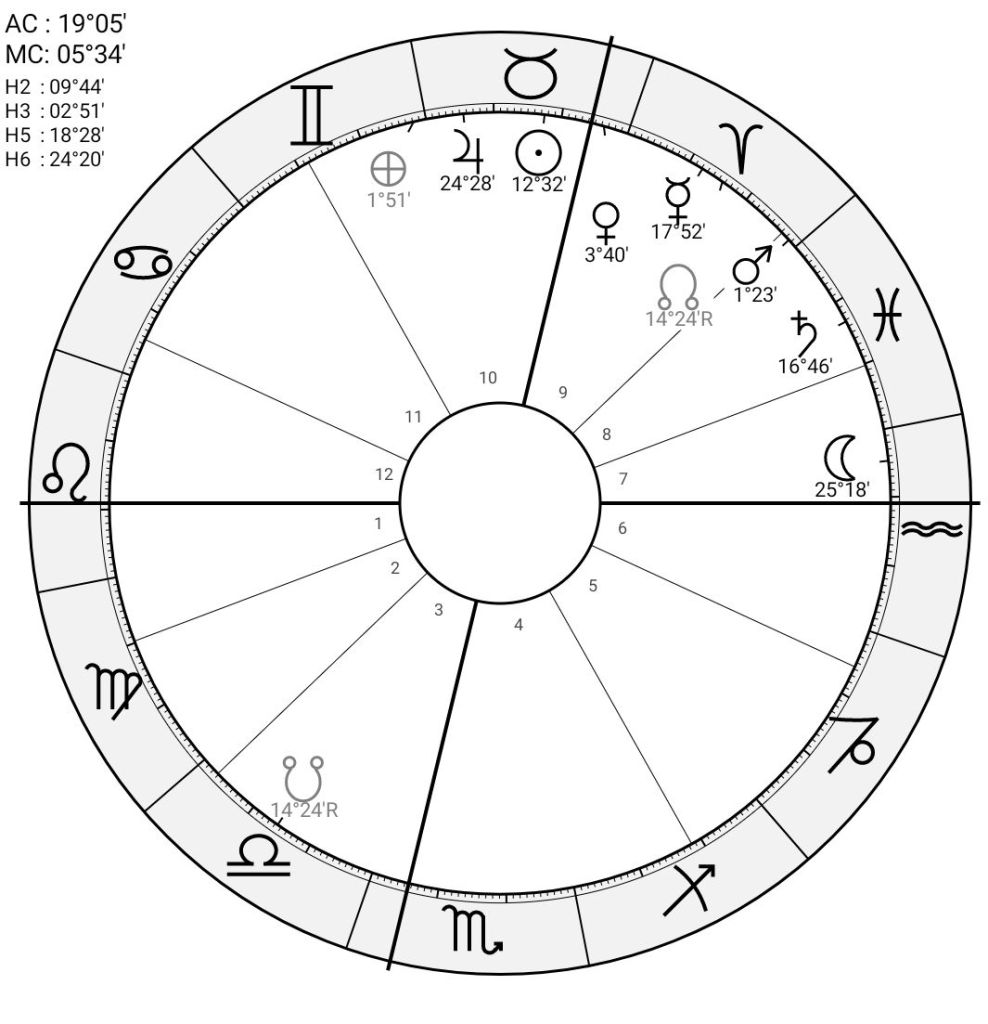
Here’s the horary chart (the time was 12:56)
Horary question: when will the veggies arrive? App used: Aquarius2go
Leo rises, so Leo’s ruler, the Sun, is my significator. The delivery service is our business partner, since we buy stuff from them and they bring it to us, so they are signified by the seventh house ruler Saturn (ruling planet of Aquarius). The veggies are their moveable possession, so they are indicated by the second house from the seventh, i.e., the eighth house, and its ruler Jupiter. The Moon is given to us as cosignificator and indicator of the flow of action.
Right off the bat we notice the Moon, weakly dignified in the seventh house, so action (obviously) starts from the delivery service. The Moon has separated from a square with reception with Jupiter, i.e., the veggies, and is now void of course. Clearly there are some problems (a square with reception is still a square). Still, there is a promising sextile (a positive aspect) between the Sun and Saturn, though it’s odd to see our significator applying to theirs (see the Outcome for why).
The Sun perfects the aspect at 17 degrees and 10 minutes of Taurus. The difference from its current position is of 4 degrees and 38 minutes, so they will come in 4 and 38 somethings. I would need to see serious testimonies to judge they won’t come. The Moon being void of course can delay them, but there is a clear aspect showing they’ll come. So they will come today, I thought.
Therefore, they will either come in 4 minutes and 38 seconds or in 4 hours and 38 minutes. I thought the second option was the most likely, so since the chart was cast at 12:56, and allowing some wiggle room for reality to follow astrology, I judged they’d come anywhere between 17.30 and 18, though I was somewhat skeptical, since this timing would have been unprecedented for them, and they’d told us they would come only a little bit later than usual. But at least this gave me plenty of time for my ritual.
Geomancy
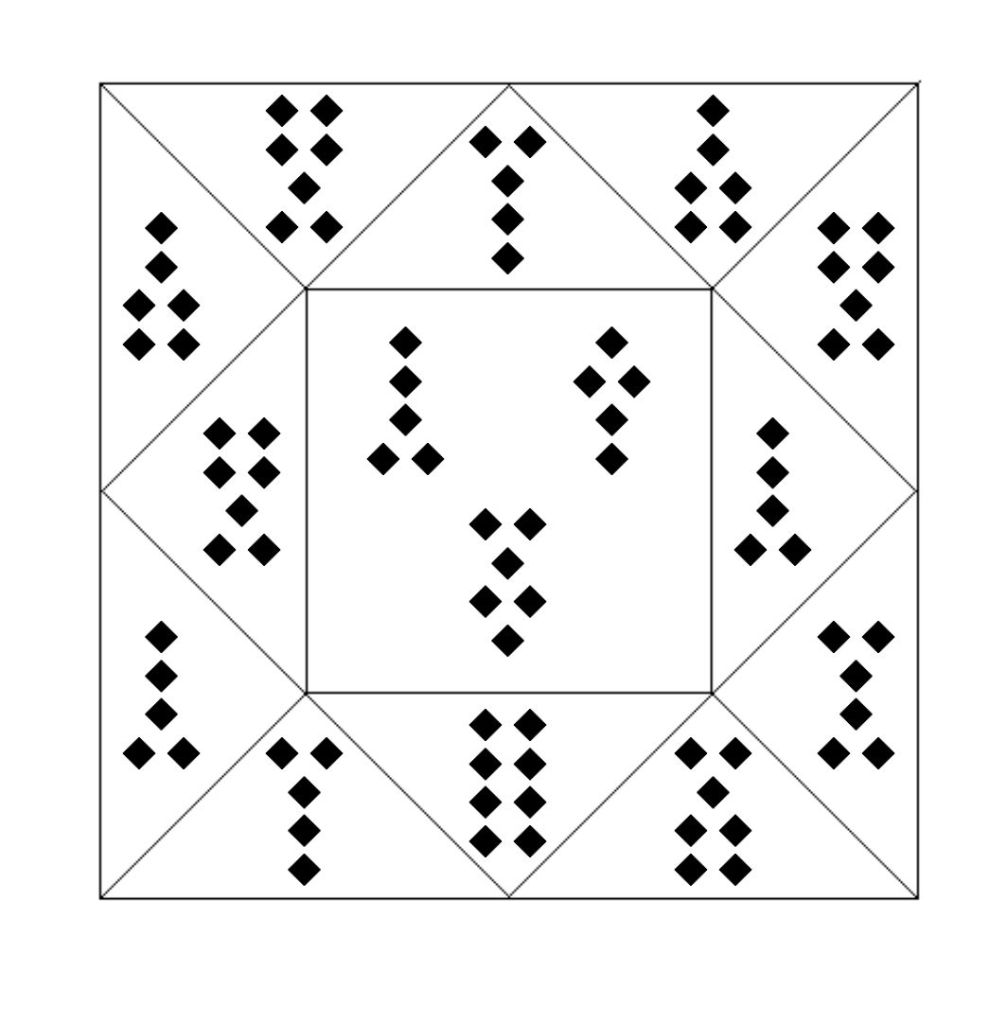
After my ritual, which was timed for around 15 in the afternoon, I decided to have a look at what Geomancy had to say about this delivery:
The Geomantic court is positive, with the Judge Acquisitio showing we’ll get the veggies, but the Witnesses are mixed, showing problems. Albus is in the first, and it’s a good figure for commerce. A very unpromising Cauda Draconis is in the seventh house (which is also the left witness). I must say that I have seldom seen things resolved satisfactorily when Cauda is involved. However, Cauda does spring to the second house, perfecting. I was also relieved, but also a bit puzzled, to see Albus spring to the eighth, also perfecting the chart. Usually, the figure that moves makes the effort. In this case, it seems both of us will make some effort, and that our effort is better than theirs.
Outcome
They did come between 17.30 and 18 (around 17.45). However, they gave us the wrong delivery, which we only noticed when they’d already gone away. So we had to call them back and go meet them to exchange the wrong veggies for the right ones. Note how in the horary our significator applies to theirs and how, in the Geomantic chart, Albus moves to the eighth.
Lessons to be learned
1. Horary questions must not be idle, but they need not be life-changing. Knowing when a delivery service will arrive may seem idle curiosity, but I had a serious reason to want to know the answer (I take my magic work seriously)
2. The divination device, whatever it may be, ALWAYS knows best, though we may be fallible in interpreting it. People like to say that divination lets you contact your unconscious. I think there is altogether too much talk about the unconscious, and not enough talk about the superconscious. I saw from the Geomancy reading that there were problems connected with the delivery, though I could not pinpoint them exactly. In hindsight it is clear what the chart meant.
3. It is a humbling and inspiring experience to see how perfectly the cosmic mechanism works.
My translation and comments on Pietro d’Abano’s Geomanzia. Please note that I am no professional translator of older texts and sometimes I had to paraphrase. Feel free to leave comments on how this project could be improved. Note that the translation and commentaries are copyrighted to me, so please ask for my permission before using it.
Book I Part I – The Figures Part II – The Chart Part III – Meanings of the Figures Part IV – Meanings of the Planets Part V – The Witnesses, Judge and Sixteenth Figure Part VI – Judging the Figures in the Houses
Book II Part I – The First House and Second House Part II – The Third and Fourth House Part III – The Fifth House and Sixth House Part IV – The Seventh House and Eighth House Part V – The Ninth House and Tenth House Part VI – The Eleventh House and Twelfth House Part VII – Example of Various Dynamics Part VIII – Geomantic Perfection
Book III Part I – Geomantic Mutation Part II – Acquisitio and Amissio in the various houses Part III – Fortuna Major and Fortuna Minor in the various houses Part IV – Laetitia and Tristitia in the various houses Part V – Albus and Rubeus in the various houses Part VI – Puella and Puer in the various houses Part VII – Populus and Via in the various houses Part VIII – Carcer and Conjunctio in the various houses Part IX – Caput Draconis and Cauda Draconis in the vatious houses
Book IV Part I – Acquisitio, Amissio, Major and Minor as they derive from other figures. Part II – Via, Populus, Caput and Cauda as they derive from other figures. Part III – Albus, Rubeus, Conjunctio and Carcer as they derive from other figures. Part IV – Laetitia, Tristitia, Puella and Puer as they derive from other figures.
Here Abano introduces the subject matter and the names and main qualities of the sixteen figures.
Geomancy is a simple science to master. It employs the same methods of astrology to answer any question the person might have—whether what one wants to undertake will meet with success or not, according to natural virtue and celestial influence.1
This method of judging [questions] and receiving information avails itself of four figures made of ink points on a piece of paper by the Geomancer’s hand, which is moved by the heavenly influence of God’s eternal grace.2 As such, one must ask one’s question with sincerity and a pure soul.
From the initial four figures, sixteen are derived (and no more than sixteen) to answer any question the person might desire to know [the answer to]. However, not all the figures are necessary in answering a specific question. Only fifteen are, and they are enough to answer any question.3 These fifteen figures don’t always come up in the same way, but only as Heaven influences them to come up.4
These are the sixteen figures and their names:
Abano’s illustration of the sixteen figures with their latin name
Four figures are assigned to each quadrant of the Heaven (North, South, East, West) and to the four elements (Fire, Air, Water, Earth) as will become clear shortly. They are called fortunate or unfortunate.
Rubeus, Amissio, Fortuna Minor and Cauda are Fiery, that is, hot and dry, and of choleric complexion,5 southern, diurnal, masculine, strongly malicious, haughty and furious.6
Acquisitio, Laetitia, Conjunctio and Puer are airy, that is, hot and wet, of sanguine complexion, eastern, masculine and diurnal, very good and temperate, and good wherever they fall in the chart.7
Puella, Populus, Via and Albus are cold and wet, of phlegmatic complexion, northern, feminine and nocturnal. Generally fortunate and good where they fall in the chart.
Caput, Fortuna Maior, Tristitia and Carcer are earthy, that is, cold and dry, and of melancholic complexion, western, feminine, nocturnal. Two are good, Caput and Fortuna Maior, while two are bad, Tristitia and Carcer. They are slow and slothful in their meanings, but they cause what they promise nonetheless.
All the above is to be noted when a figure represents a person and another figure a different person, that we may know their character and how well they may get along.
The sixteen figures have yet another cycle of attributes that renders them positive or negative. Depending on whether they are mobile or fixed, we may know how soon or how late the effect will manifest, and how the situation shall be resolved according that they are entering or exiting or mixed.
Acquisitio, Fortuna Maior, Albus, Caput, Puella and Tristitia are entering, fixed, good and fortunate, except Tristitia, which is always bad.
Amissio, Fortuna Minor, Rubeus, Cauda, Puer and Laetitia are exiting, mobile, bad and malicious, except Letitia, which is always good.
Populus, Via, Conjunctio and Carcer are said to be common, that is, neither very quick nor very slow, and they are also neither too good nor too bad, though they tend to err on the side of goodness, except for Carcer, which is always evil.8
And yet another meaning must be added, which shows whether the people signified by the figures conform to one another in terms of will and soul, according that the figures are mobile, quick or slow, and according that they are single-bodied or accompanied [double-bodied].9
Acquisitio, Fortuna Maior, Puella, Caput, Tristitia and Albus are fixed, single-bodied and regular.
Amissio, Puer, Cauda, Letitia and Rubeus are mobile, half-bodied and diminished.10
Fortuna Minor, Carcer, Conjunctio, Via and Populus are common, that is, between mobile and fixed, and they are neither too quick nor too slow, and are double-bodied and accompanied, except for Via.
And in order that one may easily know the virtue and influence of the Heavens through the sixteen figures, we must also note their correlation with the twelve zodiac signs. Similarly, they are attributed to the seven heavenly planets, according to their influence on the twelve signs.
Abano’s illustration of the astrological attributes of the geomantic figures
However, each figure does not mean the same as the other [assigned to the same planet]. Each has a separate meaning. As such, Carcer is Saturn direct, Tristitia is Saturn retrograde; Acquisitio is Jupiter direct; Letitia is Jupiter retrograde; Rubeus is Mars direct, Puer is Mars retrograde;11 Fortuna Maior is the Sun when elevated, Fortuna Minor is the Sun when depressed and obscured; Puella is Venus direct, Amissio is Venus retrograde; Albus is Mercury direct, Conjunctio is Mercury retrograde; Populus is the waxing Moon, Via the waning Moon. Consequently, the direct signs are better than the retrograde. Furthermore, Caput is attributed to Jupiter and Venus, Cauda to Saturn and Mars.12 But this is not always the case, but rather depends on the question asked.
MQS
Footnotes
The concept of natural virtue underpins the Western magical worldview. The word ‘virtue’ must not be understood in a moral sense, but rather in the sense of ‘property’ or ‘power’. It forms part of the Hermetic doctrine of Signatures. The virtues of the things under the Heavens are generally seen as corresponding to certain celestial factors. ↩︎
This is a rather typical phrasing found in various premodern handbooks. It is connected with the Christian Aristotelean worldview prevalent at the time, whereby God, the unmoved mover, ruled the world not directly, but through a series of concentric spheres, each one corresponding to a planet, except the sphere of the fixed stars and that of the primum mobile. ↩︎
The sixteenth figure is what is commonly referred to as the Judge of the Judge, formed by the Judge plus the first Mother. ↩︎
The word ‘complexion’ is used in a slightly different way from today. It refers to the theory of the four humors (black bile, yellow bile, blood and phlegm). These humors influenced not just the character, but also, up to a point, the appearance of the subject as well as their being prone to this or that illness. ↩︎
Abano seems to include Fortuna Minor among the malicious figures, though later in the text he treats it as generally positive. ↩︎
Abano however does not always treat Puer as a positive figure. ↩︎
In all this section Abano seems to be painting with a very broad brush, talking of the figures as “always good” or “always bad”. Of course things get more complicated. ↩︎
This is borrowed, as so much in geomancy, from astrological practice, where the mutable signs (Gemini, Virgo, Pisces and Sagittarius) are also called double-bodied. Double-bodied signs, and therefore geomantic figures, can indicate the involvement of more than one person. ↩︎
The concept of half-bodied does not, to the best of my current knowledge, come from astrology, but I may be wrong. ↩︎
This seems prima facie counterintuitive, as a retrograde planet is generally considered worse than a direct one, and Puer is generally not considered worse than Rubeus. ↩︎
This is in accordance with the relatively standard Medieval practice of attributing the North Node of the Moon to the two benefics, Jupiter and Venus, and the South Node to the two malefics, Saturn and Mars. This practice developed over time and does not seem to originate in older astrology of the Hellenistic period, when both nodes appear to have been considered more or less malefic, when considered at all. ↩︎
One of the things newcomers to Geomancy learn first is the distinction between shield chart and astrological chart. This distinction has been popularized by Greer in his two books on Geomancy, but it doesn’t originate with him, though he is, to my limited knowledge, the first to insinuate that the shield chart is a beginner’s tool and the astrological chart a more advanced one (his attitude changes in his Golden Dawn writings, where he tries to purge astrology from geomancy and render the shield chart autonomous).
Agrippa (followed centuries later by the Golden Dawn) clearly has the astrological chart in mind, since he advocates putting the four Mothers in the four angles, the four Daughters in the four succedent houses and the four Nieces in the four cadent houses. This idea can only come to mind to someone who primarily uses the astrological square chart, or at least pictures the geomantic reading in those terms.
There are other authors, however, like Cattan, Abano and Alfakini (note that some attribute Alfakini’s work, found in the Fasciculus Geomanticus, to Gerard of Cremona) who clearly think of geomantic practice in terms of the shield chart alone. Not because they are unaware of the possible correspondence with the astrological houses, which all employ, nor because they never attempt to draw the square astrological chart (Christopher Cattan does it in the first part of his book), but because it is clear to them that the twelve astrological houses are meant as a technique to be used to draw meaning out of the shield chart and not as a new or different way of doing geomancy.
This can be seen from the fact that both Abano and Alfakini (and possibly also Cattan, but I have to study his text more closely) clearly consider the twelfth house NOT to be contiguous to the first, as it would be in the square chart. On the other hand, both consider the ninth house, which in an astrological square chart would have no relation to the first, to be contiguous to the first, just because in a shield chart it belongs to the same triplicity as the first and is close to it (see below)
Shield chart in Geomancy, with first and ninth house connected. App used: Simple Geomancy
In this chart, Puer in the first is close to Cauda in the ninth, but not to Puella in the twelfth.
This new way of looking at the chart is also making me reevaluate the doctrine of the company of houses, which I have somewhat disparaged in a previous article, and it might even shed light on the strange doctrine of the triplicities, which Greer makes much of but which is barely present in the old texts except in an apparently purely decorative sense. I will need to read the texts more closely and experiment.
What seems clear to me though is that there was never meant to be an astrological square chart, for many authors of the Medieval tradition, but rather merely an astrological lens in looking at the shield chart.
I come from a rather traditionalist school of divination. One of the ways I learned was that my teacher often told me to do a spread on an aspect of her past I knew nothing about to see if I managed to discover what happened. Another way was when she told me to do a spread to see what would be the problem of the next person going to her for a reading. Interestingly, I have met other people, who have taught me other techniques, who used the same method.
As can be expected, there was little room for anything other than the literal interpretation of the cards. This has helped me a lot to remain with my feet on the ground as I forged my path, which is very good, considering how littered with nonsense the esoteric landscape is.
On the other side of the spectrum you have a sizeable chunk of diviners today, though the situation now is slightly more balanced than it was just twenty years ago. These readers simply interpret the cards (or the planets, or whatever) as if they were benevolent tips from the universe about some inner issue that the person needs to work through to progress.
The problem I have with this approach, aside from the fact that it leads to unverifiable predicitions, is that it presupposes a superstitious view of the universe as some kind of benevolent nanny that teaches you how you ought to behave. These people, I should remind you, are the ones who often loathe Christianity as a bundle of silly dogmas and think they are the reasonable ones.
If there is one thing that my study of philosophy as well as my experience as fortune-teller has taught me is that there is no such thing as an ‘ought’. There’s what is and what isn’t, what was and what wasn’t, what will be and what won’t be, as well as what can be, or is more or less likely to be. For instance, there is no way you ‘ought’ to eat. You either eat well or you don’t. Eating well only becomes an ought when your current diet is checked against your desire to minimize health risks. It’s your desires that create oughts, not the universe.
I already discussed how I believe that divination tools are essentially something that gives us a bird-eye view of existence, affording us a glance at a number of considerations about our situation that we might not otherwise have. To use my old analogy, it is like being in a crowded city center and talking to a person on a walkie talkie, this person looking at your position from the top of a skyscraper and therefore seeing things you cannot see.
It goes without saying that I believe divination tools never give advice.* As maps, they simply tell you what is. Advice is contingent on what either someone wants to do or what they believe a superior authority wants them to do. My view of the superior authority is that it is too occupied exploring all its potential through us to pick and choose what’s best for us.
Does it therefore mean that a diviner should not give advice? I actually believe advice is a perfectly fine thing, as long as it is not delusional advice. I think a good divination session should always be of help to the querent in living their own life better. This is done by checking the querent’s wishes (sometimes implied, sometimes stated outright) against the wider situation as portrayed by the oracle, with its potentials, its risks, its possibilities and impossibilities, its certainties and its uncertainties.
In other words, advice must come from the diviner on the backdrop of the oracle, and not be projected onto the oracle, which just pictures reality as it is, not as it should be (because there is no way reality should be, from an objective standpoint). Sure, sometimes I tell my querents “the cards are advising you to do X”, but this is short for “I am advising you to do X based on what the cards are telling me about your situation.”
Sometimes the right bit of advice at the right time can help the querent make a turn for the better in life. These are the readings I love the most. Sometimes it can improve a situation. Sometimes, though, the advice is not enough to change an objectively difficult situation. The more heroic and nietzschean reaction to these slings and arrows that life throws at us is that of amor fati: in knowing what’s coming, one can learn to love it, thus overcoming it, making it part of oneself instead it being an alien destiny. But this is not always possible. Sometimes, all the querent can get from a difficult reading is peace of mind. And peace of mind is a great thing, all too often undervalued until it’s no longer there.
MQS
* In this, divination tools are very different from inspired divinations caused by spirits or deities, since these actually do have their own particular views and preferences.
or “Summa Scientiae Nihil Scire” in Latin. This motto is very useful in practical fortune-telling. One of the greatest risks we run is of assuming. “She’s 85, how is she gonna find love?” “He’s a 23-year-old jock, he’s probably not a priest.” “She looks so prim and proper, she’s unlikely to have seven lovers.”
All these preconceptions and more cloud our mind as we try to read the oracle’s answer, regardless of the oracle, whether it be the Tarot, playing cards, astrology, the I Ching, etc. All these preconceptions are poison to the art of divination. They are not of service to us, nor to our querent. Let’s delve into why.
Let us start from the fact that bias is a natural and necessary phenomenon, as politically incorrect as this may sound. Bias comes to us from our experience, but also from the experience of others, especially family members, friends, teachers and people we trust. Bias orients our life, and this cannot be otherwise. The attempt to forcibly eliminate bias from people’s minds only causes suffering, and is its own kind of irrational crusade.
You know who is NOT biased? God. You know what God does? Everything. But you can’t do everything. You can only do something. And in order to do something, you must be biased against something else. That’s life.
This is not to say that all bias is good. For instance, I may have accepted some preconceptions from my parents, who got them from their grandparents, who got them from the priest, who got them from a crazy lady next door, etc. This kind of bias is the worst because it can needlessly limit our options and create likewise needless suffering in those around us. The best kind of bias is the critically examined one that you accept based on your actual life experience and keep open to revision.
Yet even this kind of “good” bias is harmful to divination. When someone comes to us for a reading, or when we read for ourselves, what we are doing is trying to look at reality from the point of view of a symbolic system that reflects life from an objective, or at least less subjective standpoint.
Divination is a language with no native speakers, except maybe the guy upstairs, which means that our understanding of it is always going to be imperfect and faulty. But this is a technical kind of difficulty, and in its own way it’s excusable. What is less excusable is the additional confusion we create by reading our biases into the divination. This is not just about politics, philosophy, morality or religion. It’s everything.
“A 85-year-old is not going to find love again” is one sort of bias. “An attractive young guy is probably not a priest” is another. The aim of divination is to read the truth, not ourselves.That’s why the height of science is to know nothing. If we start with a clean slate we can receive much more information from the tool we are using, simply because we are not randomly blocking out information we consciously or subconsciously deem unlikely.
The unlikely happens everyday. Think about it. Almost everyday something unlikely happens in the world. That’s not to say we must feel the urge to make our predictions as unlikely as possible in order to impress the querent. Most of the time, what’s likely is what ends up happening. Still the unlikely is not the impossible.
I am big on comparing divination with language, as those reading this blog know. And as you know, I am not a native speaker. Around fifteen years ago, I was trying to improve my English by watching youtube videos. Yet this was very hard, because the language people use on youtube is very inconsistent, erratic at times, filled as it is with memes, asides, jokes, ancdotes, interruptions… I was trying to project the artificial English I had learned in school onto this truer, more lived English.
“Surely he can’t have said what he has just said. It doesn’t make any sense,” I constantly thought. It was when I stopped projecting my presuppositions and started just taking in what was objectively being said that my English truly improved. That’s the same with divination. The height of science is to know nothing. Only if we know nothing we can take in what is being said.
In Medieval and early modern times, Astrology was everything. Being a natural consequence of the philosophical worldview tolerated by the church (that is, Aristoteleanism), Astrology was not seen, strictly speaking, as a Bible-prohibited practice, but merely as an extension of the science of the day. Though it always had its detractors, it was generally accepted. Therefore it was normal to try to astrologize everything.
We’ve already discussed geomantic perfection. This takes place thanks to something resembling aspects. But some old books go a step further and seek to introduce the actual astrological aspects of the time into geomantic practice.
In Astrology, an aspect happens when two planets occupy the same degree in different signs: a sextile happens to planets that are 60 degrees apart (e.g., Venus at 10 Aries and Jupiter at 10 Gemini); a square is between planets that are 90 degrees apart (e.g. Venus at 10 Aries and Jupiter at 10 Cancer); a trine is between planets that are 120 degrees apart (e.g., Venus at 10 Aries and Jupiter at 10 Leo); an opposition is between planets that are 180 degrees apart (e.g., Venus at 10 Aries and Jupiter at 10 Libra)
Aspects are key to astrological perfection. They show the things signified by the planets coming together, with sextile and trine indicating good contact on one hand and square and opposition showing bad or difficult contact. For instance, if in a love question my significator aspects my love interest’s significator, it shows us coming together. If by trine, we get along, if by square we argue.
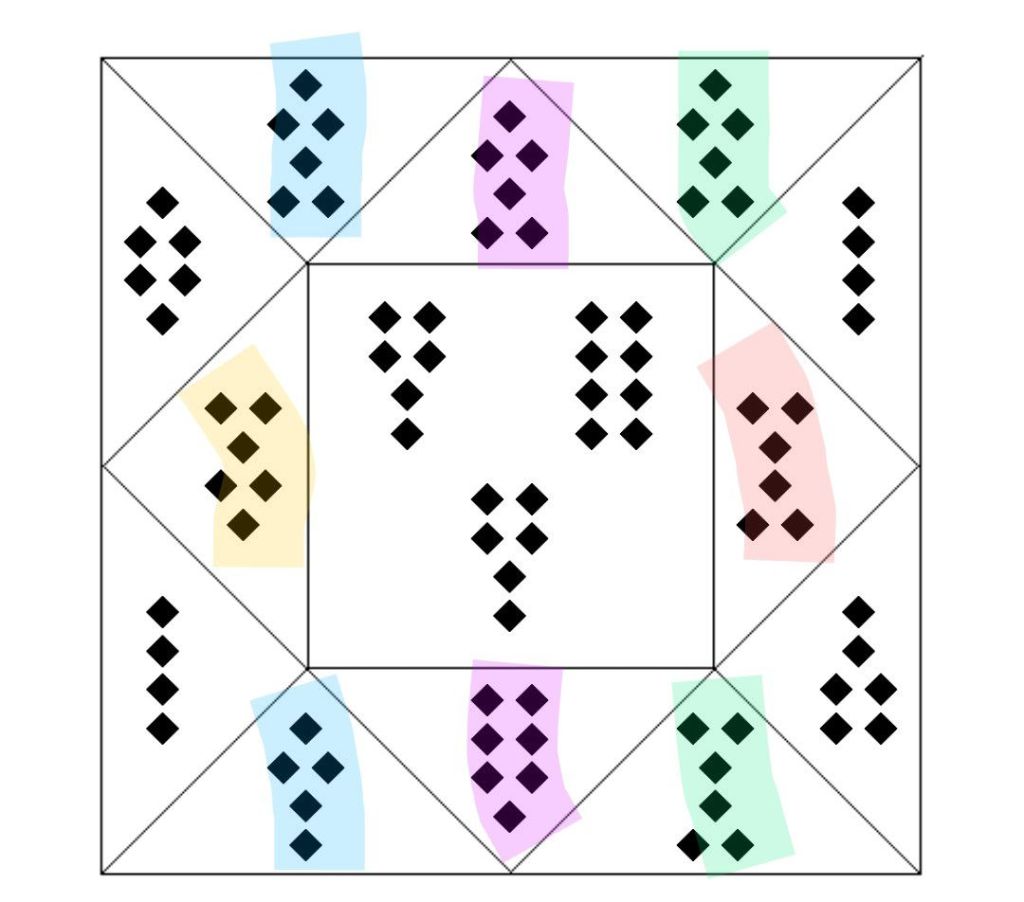
In geomancy, astrological aspects have been adapted to the chart as follows:
Astrological aspects in Geomancy (App used: Simple Geomancy)
If we take the figure in the first house (marked in yellow) as a reference point, then the figures in blue sextile it, because they are separated from it by a single sign; the figures in purple square it, because they are separated from it by two houses; the figures in green trine it because they are separated from it by three houses, and the figure in red opposes it, since it occupies the houses directly opposite.
This is supposed to shed some light on the relationship between the figures: two figures that fall into a square pattern have a difficult relationship, two figures in a trine a good one, etc.
The problem with using astrological aspects in Geomancy is that aspects work in a fundamentally different way: in Astrology, an aspect requires a planet to move in order to apply to another planet. After perfection, then, the aspect separates and its effect wanes.
Geomancy, though, is a static system with no real movement. Sure, we can say a figure moves from one house to another, but in reality that figure is already present in both houses. The only way to conceptualize movement in a geomantic chart is when we take a significator’s house to be the original position of the figure in it, and every other instance of that figure as a successive movement (e.g., in a career reading, if Laetitia is in the tenth house and in the seventh, we take it to move from the tenth to the seventh and not vice versa).
I am honestly not convinced that astrological aspects can find a meaningful place in geomancy. They certainly cannot bring matters to perfection, otherwise everyone would always be separating from their partner since the figure in the seventh house always opposes the figure in the first. Similarly, everyone would always get along with their siblings since the third house always sextiles the first.
One possibility which has been suggested is that of applying aspects only to figures that move. In a love reading, for instance, if the seventh figure moves to the tenth, it moves to square the querent, since the tenth house squares the first.
I personally find this application also problematic, because the tenth house represents the job, among other things, so that would mean that everytime the querent’s job is involved in their love life it causes trouble, which is a false assumption.
At most, I would take an aspect into consideration only if BOTH significators move. In the hypothetical love reading, for instance, if the first figure (querent) moves to the fourth house and the seventh (significant other) moves to the tenth, then they are in opposition to one another. Maybe they will argue. Or, if the first moves to the fourth and the seventh to the second, they sextile each other, which is good.
Even in a situation like this I am generally cautious about applying this theory. There are certain aspects of Astrology (pun intended) that simply don’t translate well to other systems of divination. You are of course welcome to try this theory on for size, but personally I believe Geomancy already has its particular version of aspects, and throwing other stuff into the mix feels more like an attempt at complicating this “brief and simple science” to find something more to tell the querent.
The more I delve into medieval geomancy manuscripts, the more I realize how different authors tended to put together different bundles of go-to techniques for interpreting the geomantic chart. There is always some overalap, yet not every author mentions every technique. The company of houses is one such technique. The book from Peter of Abano I am currently translating does not mention it: he tends to have a very trimmed down, minimalistic approach. However, the technique is found in other authors, so I’ll discuss it and leave it up to the reader to decide whether to experiment with it or not.
The Technique
The technique is quite simple. We start from the presupposition that the aim of a geomancy chart is to see whether the figure of the querent comes into contact with the figure of the quesited, as already discussed, because such contact, called perfection, signals the querent coming into possession of the thing quesited about (though there are exceptions, when the querent wishes to get rid of something, for instance.)
Usually, if at least one of the four modes of geomantic perfection discussed in my previous article does not show up in the chart, it’s game over. According to some authors, though, we can also see perfection in other ways, and this is where the Company of Houses comes in.
The twelve houses of a chart are said to be paired as follows: the first with the second; the third with the fourth; the fifth with the sixth; the seventh with the eighth; the ninth with the tenth; the eleventh with the twelfth. It is important to note that, although, say, the third house is next to the second, the second and the third house are not in company: only the first with the second and the third with the fourth.
Let us suppose I want to know whether I will meet with my sweetheart. In general, I would want the house of the querent (me, the first house) to perfect geomantically with the house of the quesited (my sweetheart, the seventh house). Let us furthermore suppose that this does not happen. According to the proponents of the Company of Houses, this negative testimony can be overruled.
We look at the house my house is accompanied with, in this case the second, or the house the quesited is accompanied with, i.e., the eighth. Let’s take the second house as an example. The first kind of company is if the figure in the second house is the same figure as that of the first; the second kind of company is if the figure in the second is ruled by the same planet as the figure in the first; the third kind of company is if the figure in the second is opposite the figure in the first; the final kind of company is if the figure in the second shares the same Fire line (e.g., Via and Puella, who both have a single fire line).
This figure is the opposite
Of this figure
Cauda
Caput
Conjunctio
Carcer
Puella
Puer
Acquisitio
Amissio
Albus
Rubeus
Tristitia
Laetitia
Fortuna Minor
Fortuna Major
Populus
Via
Opposite figures
When any of these four conditions is realized, the figure in the second house can act as a co-significator for the querent, and may perfect the chart in his stead.
Do you need this?
Frankly? No. You can do what you please, of course, but this reeks of “Methinks I saw mine lass turn into a dragon”, that is, how people used to come up with stuff to fill books with. Even worse, it reeks of last-ditch effort at wringing a “yes” out of a negative chart.
In some cases, what is called Company of Houses is already covered by the four regular modes of perfection. When it isn’t, it is, as far as I am concerned, at most a very, very, very weak testimony, so much so that I don’t take it into consideration. Of course one may come up with all sorts of philosophical excuses why this technique is important, but if you ask me, it feels like a useless complication of a simple divination system.