Tag Archives: history

Plotinus vs Proclus From a Hermetic Magical Standpoint

When it comes to searching for philosophical-magical inspiration from pre-Christian times, many occultists look at Plotinus and Proclus, two of the most important among Plato’s successors. After Plato, they are the most noteworthy representatives of Platonism, and if Platonism is up your alley, as it is right up mine, you’ve probably looked into them.

Proclus, who was one of Plotinus’ successors as head of the Academy, and was also the last noteworthy Platonist, is especially popular among those who seek inspiration for magical work. The reason is that, unlike Plotinus, Proclus did have a strong interest in religious and magical practices as well as being an important philosopher.

My personal preference, though, is Plotinus. I discovered his work, the Enneads, in my late teens and read it all throughout college. Unlike Proclus, Plotinus was a pure philosopher, with no interests outside of philosophy. Yet his writings have inspired many generations of theologians, occultists, hermeticians and devotees.

Writing at a time when Christianity and other early odd religious beliefs held sway, Plotinus managed to single-handedly revive philosophy as an exalted pursuit that connected the mind with the divine realm. Although he did not appear out of nowhere (his predecessors at the Academy had already laid the groundwork), his genius does tower over anything and anyone who lived in his time.

Plotinus had the aspiration to simply explain Plato’s work, and as a matter of fact we often find assertions in his writings that he is doing nothing more than saying what Plato has already said. But this is not true. His philosophy sought to coherently explain the whole of reality starting from the initial unity, and to trace the steps that mortals can take to re-experience that unity in their ascent back to the One. Although one could argue that the same aspiration is present in Plato, and especially in his esoteric doctrines, the two philosophers are still very much distinct, as is to be expected, considering how many centuries separate them.

From a philosophical standpoint, Proclus is not a cipher like some others of Plotinus’ successors. In fact, he was a gifted philosopher, who would have probably contributed much more, had he lived a couple of centuries earlier. Yet most of the innovations he introduced in the Platonic doctrine feel like complications rather than meaningful developments. His (over)zealous attempts at systematizing and consolidating the entire wisdom of the Greeks, from religion to philosophy to magic, may appear impressive at first, but soon one realizes that they are just the last ossification of the dying world of classical antiquity.

His systematic fervor, so appreciated by Hegel, finds a neat little place to everything that the Greeks had produced, yet at the cost of sucking them dry of their lymph. Everything is there–the gods, the beliefs, the art, the spirituality, the science of the time–yet only as an empty husk, as a relic with a tag underneath in an intellectual museum.

What many occultists today admire in Proclus is his commitment to theurgy. And from that standpoint, Proclus is definitely an important source of inspiration for us. Yet even that was a product of the crisis of the Greek worldview and of Proclus’ spiritual weakness (or rather, of the spiritual weakness that was typical of his time).

Plotinus, still firmly rooted in the Greek tradition, had no place for rituals. Union with the divine was certainly the aim of his philosophy, but his method was and remained that of philosophy, that is, pure inner moral, intellectual and spiritual cultivation. It’s not that he didn’t believe in the gods or in magic. He simply thought the method of philosophy was superior.

But by the time Proclus came to prominence, the old Greek confidence in the sole power of the human mind had crumbled under the attacks of early Christian or Christian-inspired irrationalism. Everywhere Proclus looked, people were scrambling for a source of salvation outside of themselves, because they felt small and powerless in an uncertain world. Come to think of it, we don’t live in much different times today.

Nothing that belongs to history can ever be retrieved and applied 1:1. But it is certainly permissible to look for inspiration. From a philosophical standpoint, there is no contest: Plotinus’ philosophy is still very much alive, if one knows how to get to its pulp, how to work with it, where to trim, where to add, where to change a part. By contrast, Proclus’ philosophy feels rigid, like a sculpted sarcophagus lid trying to capture the likeness of the dear departed.

From a magical standpoint, one would think that Proclus, given his interest in the topic, would have more to offer than the scoffing, eyebrow-raising Plotinus. Yet a look at Renaissance magic, heavily inspired by Plotinus’ philosophy, tells us otherwise. In fact, though Plotinus’ Enneads are a challenging text, the reader often comes across evocative bits full of beauty and wonder that may be easily adapted to prayer, ritual and other magical aims.

The fact is that Plotinus’ philosophy is a living thing that captures something universal, so it is a good framework for other pursuits, including occultism, while Proclus tried to supplement philosophy with magic because he had no confidence in it, so even his view of magic is remedial and somewhat desperate.

I do not mean to be overly critical of Proclus. He did what he had to, given the circumstances he found himself in. Plus, there is much in his work that can be salvaged, if one has the patience to wade through the abstractions. But what one cannot get from Proclus, or at least what I cannot get from him, is the sense that the cohesive picture he presents is still alive, whereas Plotinus’ system is considerably harder to recontruct, and less cohesive than Proclus’, but feels animated by a flame that was alive before him, was alive in him and will be alive forever.

MQS

A Water Spirit (Example Reading)

One cool thing about moving to our new place is that we now live much closer to the countryside. Although there are a couple of major cities around us, our district is basically a cluster of small pictoresque old German villages close to the woods. This is a very good place for a magic practitioner to settle down.

I also discovered that there is a small lake or large pond (depending on who you ask) nearby. It’s been my experience that old water places, just like old caves, tend to be stably inhabited by spirits. In fact, in a subtle way, these spirits *are* the place they inhabit.

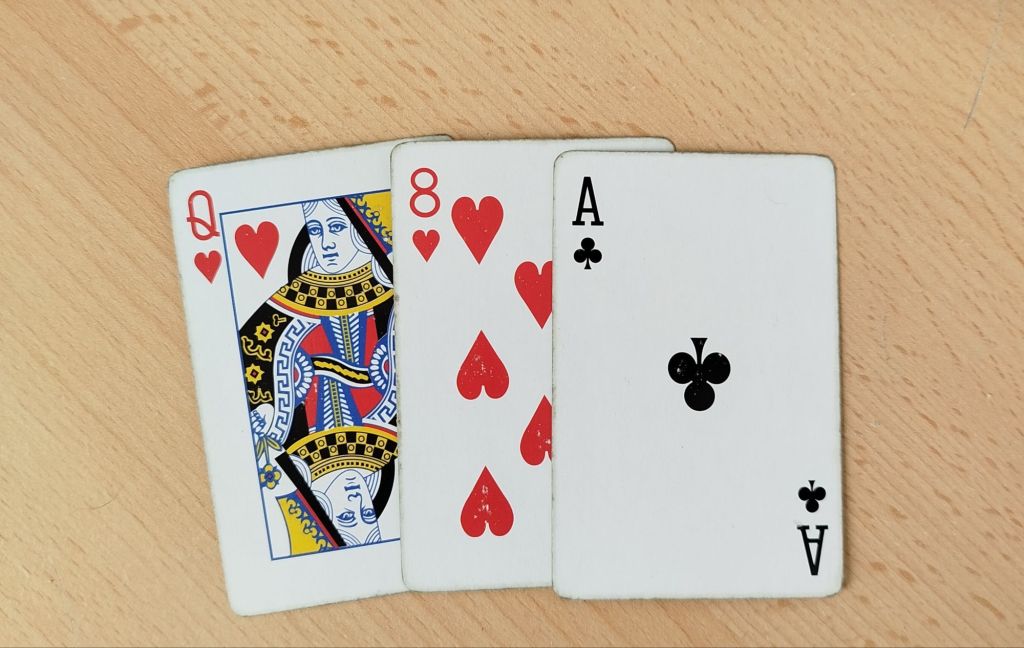
Before visiting the place I drew three cards to investigate, and these cards came up:

A water spirit – Cartomancy with playing cards

Obviously, the first thing to take note of is the presence of the Queen of Hearts, which is a motherly figure or a positive female entity. This is confirmed by the Eight of Hearts which can represent a water place, so in the context of an esoteric / magical reading it would represent a female entity of a broadly positive nature tied to water. The Ace of Clubs represents power, dominion, rulership. It indicates that the spirit has power over the place, so while she is positive, she is not the airy-fairy pushover type.

After doing the reading, I started researching local folklore. If you know of any such place near where you live, it may be wise to research local legends, as they often contain romanticized but accurate hints about the nature of the spirit.

What I discovered is that there is a medieval legend tied to the place, according to which a mother (!!!) once brought a local duke a basket of vegetables, in exchange for having a new irrigation system dug near where she lived. This irrigation system became the pond. There is no narrative reason why she should be characterized as a mother. Her being a mother serves no purpose in the legend, which makes it a very important hint in understanding the spirit: she is essentially motherly.

“But” you may be wondering “this is an artificial pond, how can it be magical?”

We must not draw strict boundaries between the world of humans and that of the great powers of nature. What we know from the legend is that a water spirit wanted to establish herself in this place and convinced the humans around her to cooperate by being motherly and nurturing toward them, and the humans were intelligent enough to accept her offer. There is nothing strange about this: in actuality, humans cooperate with nature all the time.

Note how the reading hints at a spirit that is positive (Queen of Hearts) but not submissive (Ace of Clubs). Had she been a difficult spirit she could have simply flooded the zone. There is altogether too much mischaracterization of water in the spiritual and magical community as something weak, vague and mystical. Water can be devastatingly powerful, so it is a good thing our local water spirit is a positive member of the community.

MQS

The Astro-Killer and the Need for Reason in Occultism

Danielle Johnson‘s posts on social media were like those of most popular astrology influencers: cheap mystical drivel devoid of any serious study and insight, constantly hyping up the next big astrological nothing-burger. I’ve known enough people like her in my life to know that this kind of fraudster is the worst exactly because they tend to buy the crap they peddle. Like many cult leaders, they become pleasantly accustomed to the smell of their own farts.

I am not going to examine her tragedy as a whole. You can look it up yourself if you want. Suffice to say that she ended her boyfriend’s and child’s lives, as well as her own. All because of an eclipse she thought was “the epitome of spiritual warfare” where people needed “to pick a side” in the upcoming apocalypse.

For sure there is enough going wrong in the world at present that new millenarian movements pop up from all religious and political directions. Furthermore, it is not unlikely that Johnson suffered from some kind of mental condition.

But there is more to this type of behavior. No one who seriously studies history can believe there was ever a golden age where nothing went wrong, nor there ever will be. These are the dangers of utopianism as opposed to pragmatism: in the name of something that was or will be, the utopian believer feels justified in trampling over others, either rationally (like the left-wing and right-wing dictators of yore) or psychotically.

But, again, there is more. There is a widespread malaise in the “spiritual” milieu at present, in spite of its ever growing popularity on social media. This malaise is the culmination of a historical process of decoupling of reason and spirituality. I have already touched upon this issue elsewhere.

Since official science embraced meterialism in the late XVIII century, those who believe there is more to life have found themselves without an intellectual foundation for their beliefs, and have therefore become prone to accepting any delusion as fact. This is relatively unprecedented in the history of humanity. Not that knowledge and spirituality have otherwise always enjoyed a frictionless relationship, but there had never been so stark and unanimous a rejection of the spiritual in the scientific community.

How the spiritual community tried to cope with this abandonment is paradigmatic. If you read many XVIII and early XIX century occultists, you will often find desperate attempts at fitting their ideas into the tight dress of the new scientific language. Spiritualism and vitalism, which is how occultism survived until around the 1960s are, in many ways, the evil twins of scientific materialism: they are groundless irrationalism masquerading as legitimate scientific concepts (electromagnetism, mesmerism, ‘energy’, etc.)

Yet, for all their attempts at sounding scientific, these authors have never managed to convince anyone who wasn’t already convinced. Furthermore, their attempts at proving, for instance, that this or that scientific discovery is foreshadowed in this or that spiritual doctrine made them look like asses when said discoveries were later disproved and replaced with better scientific theories–because, and this is something many occultists failed to understand, science in the modern sense ceased dealing with the eternally true in favor of ever-improving approximations of what’s likely to be the case. This is what makes modern science effective, but also what ‘spiritual seekers’ desperate for answers don’t want to hear.

Then along rolled the New Age, and the already washed-out spiritual movement started supplementing its diet with saccarine platitudes and politically correct, ill-digested mish-mashes of doctrines coming from all over the world washed down with copious drafts of unproved psychology. Any attempt at using reason became futile, or even frowned upon as a non-enlightened stance. And this is where we are now.

The medieval and Renaissance magus was as much an occultist and diviner as he was a doctor, a scientist, a philosopher, a political strategist, a war counsellor and many, many more things. In Ancient Greece, many great magi were also great philosophers and scientists (Empedocles and Pythagoras come to mind). Apparently, the contemporary spiritual guru just needs a couple of self-help concepts with a spirituar flair and he is qualitifed to tell people they need to “pick a side in the upcoming apocalypse”.

So, what is the solution? I do not know. I do not believe I have one, especially not at the collective level. All I know is that irrationalism is not the blood that sustains spirituality. it is merely the electric shock that makes its corpse convulse and appear to be alive. I also know that the future of occultism, magic and spirituality lies with few individuals who are capable of using their head rather than with desperate masses of unhinged spiritual seekers (“unhinged” because their life hinges on nothing) who let any “astrology influencer” peddle cheap illusions to them.

MQS