Name: The Peacock1
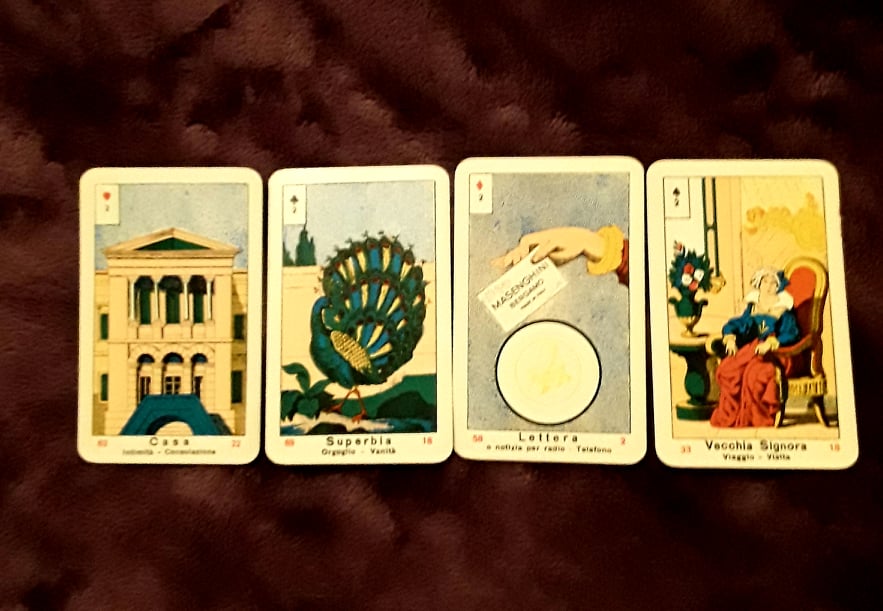
Italian Name: Superbia (also known as Carta del Pavone)
Playing Card: 2♣
Polarity when Upright: The Best and Strongest Card in the Deck
Core Meanings: The Amulet Card | Marvel, Excellence, Superb and outstanding results | Completion, Perfection, Removal of limitation and blockage | Beauty | God, Divine Power, Miracles | Outstanding, Incredible | Magic and the use of Magic
Polarity when Reversed: Negative
Reversed Core Meanings: Haughtiness, Pride, Arrogance | Overestimation of one’s abilities or prospects | Situations that cannot be improved, that have gone as far as they can | Black magic, negativity, Demonic energy, Evil
Card Description: in a walled garden, a beautiful peacock opens the feathers of its tail in a wheel. The wheel is a symbol of completion, and the peacock a symbol of immortality in the Christian symbolism of the Sibilla.
Suit and Number: twos are cards of continuation, strengthening and increase, while the suit of clubs is generally lucky. Thus, the symbolism of the Peacock takes on meanings of completion, increase of good or decrease of evil, embellishment, improvement, standing out, etc.
UPRIGHT 2♣
General: This is the best card in the whole deck. Yes, better (and more reliable) than the Fortune card. On its own, if you could choose between the 5♣, Fortune, and the 2♣, you’d be wise to pick the latter: Fortune represents luck, while the Peacock is the card of divine protection. The main function of the Two of Clubs is as ‘amulet’ or shield card, giving a positive spin to spreads, deviating the flow of the reading toward realization and happiness. Its main function is to increase the good and decrease the bad shown by the surrounding cards.
It is also connected with concepts of perfection, marvel, excellence, completion, totality, and to the removal of blockages and restrictions and to art and beauty.
Love and Relationships: the presence of this card usually allows singles to come out of difficult periods of loneliness. It is also connected with the ability to “win over” people in all fields of life and to seduce. It is a marker of self-confidence and a magnetic personality that draws people nearer. When the querent is in a relationship, the Peacock solidifies the union, making it last, and it allows the couple to get over difficult periods and arguments. Personal relationships in general are honorable and marked by a commitment to keeping one’s word. People characterized by this card are positive for the querent and usually hold the key to solving the querent’s problem. If the querent is asking about a reconciliation and the breakup happened some time ago, this card may however show that the person enquired about is already fulfilled, which means they have a new story, or it may show that the querent will be fulfilled in a new relationship. Bear in mind that there is no ‘yes’ card in the Vera Sibilla: cards must always be interpeted in the context provided by the other cards. If a reconciliation does happen, this card signals that it will bring the couple to a whole new level where old mistakes won’t be repeated. If a new relationship is shown by other cards, the Peacock signals that it’s this new relationship that will bring the querent to a whole new level or standard. If the querent has been single for a long time, it can simply show the end of the difficult period.
Work and Money: again, an extemely positive card. People who are going through a rough patch economically are often lifted up and protected. No matter how dire the situation may get, if the Two of Clubs intervenes we’ll be snatched out of the abyss. It brings freedom from worry or debt. It can also point to great career prosects and to recognition in one’s field. Businesses can expand or draw in extra clients. In itself, the card shows jobs related to beauty, the arts and professions where someone is in the public eye, or simply professions that express the querent’s true vocation. However, if the querent has been through a long spell of unemployment, it may simply signal the end of hardships, not necessarily that all of a sudden they’ll wake up the great masters of their dream job. Projects that are undertaken under this card’s influence are completed successfully and obstacles, bureaucratic red tape and difficulties tend to disappear. Everything that may limit the querent’s realization takes a blow.
Other: as said, this card points to excellence, completion, perfection in all fields. It is connected to beauty, beautiful objects and good taste. Next to a significator, it qualifies them as either beautiful, talented or key in solving a problem. Spiritually it represents God and the divine plane in general. It also represents noble magical aspirations and practices and spiritual oaths and vows. By analogy, it is the card of kept promises and honor. Artistically, the Peacock shows good taste and everything that is appealing (“eye candy”) and heralds recognition. Psychologically, it is a card of self-confidence, being at peace with who someone really is, charisma, personal magnetism and the resilience necessary to survive every experience. It also signals a person with high standards, but never a bad person.
Important Combinations:
9♠ + 2♣ = freedom from chains and limiting conditions, or solitude
2♣ + K♥ = a great protector | God (with Q♣, Mary mother of God)
5♠ + 2♣ = a positive change that may seem difficult at first
6♦ + 2♣ + 7♥ = a person of genius
3♦ + 2♣ + 8♦ = high status, nobility
REVERSED 2♣R
General: the import of this card varies from mildly to very negative. In the main, it represents the more negative side of the peacock symbolism, namely pride, vanity, haughtiness. Another meaning deriving from this basic idea is that of ego, decisions clouded by one’s ego or the overestimation of one’s ability or prospects, which may lead to problems signalled by the following cards.
When coming up reversed, the Two of Clubs is also a significator of black magic (though almost never on its own, unless a specific question is asked) and of demonic powers. Needless to say, the reversed Peacock does not function as a talisman card.
Love and Relationships: personal relationships usually suffer due to one of the two being vain, feeling superior or being too self-centered. The gravity of the situation will be shown by the other cards. As it points to rather obnoxious character traits, this card also signifies arguments and a tendency to pick fights. In any relationship, but especially in romantic relationships, in addition to the above, it shows differing sets of values causing problems and an inability to truly understand one another, as if the two were two separate universes, from the symbolism of totality and completion applied to the negative, reversed version of the card. Furthermore, if other cards concur, the symbolism of completeness of the upright version becomes negative and shows that all that could be done to salvage the relationship has been done and there’s nothing left to do. People who are alone may feel very lonely but be too proud to reach out and even feel they are owed something (think of incels).
Work and Money: generally, from a financial standpoint, the card symbolizes overspending, a tendency to miscalculate one’s odds of success, overestimating what one’s budget will accomplish and business ventures undertaken as vanity projects that no one with an objective appraisal of the situation would agree to. Businesses may fail to attract clients. With other negative cards, the 2♣R shows complete ruin.
In career readings, unemployed querents will usually struggle to find a new job. On a more positive note, with positive cards and with the appropriate querent, this card can stand for retirement, because it shows that one phase of the querent’s life is completed and now over.
Other: psychologically, the card represents someone who is haughty and thinks they are just what the world desperately needs. These days, it can also come up when someone refuses to leave his or her echo chamber that constantly reinforces their prejudices (again, from the concept of totality applied negatively). In general, it shows a big ego, self-indulgence and too much attention given to shallow things, especially appearance.
Spiritually, this is the card of Satan and all that is demonic. On a lighter note, it can point to spiritual views colored by one’s ego and prejudices and cherry picking spiritual beliefs based on one’s preconceptions (ever noticed that progressives think God’s a hippie while conservatives think he’s a hillbilly? Convenient, isn’t it?) Artistically it leads to overestimating one’s talent and can signify shallow art without depth. The Peacock reversed is also the card of black magic and demonic invocations, but don’t go around diagnosing hexes without solid evidence from the spread.
Important Combinations:
2♣R + 4♦ = a skewed view of reality
2♣R + 6♣R = a loss caused by overestimating one’s ability or the validity of a project
2♣R + 3♠R = black magic (if the 2♣ were upright, just magic)
A♥ + 2♣R = litigiousness, ego-trips in other people’s presence
2♣R + 7♣R = taking offence, being offended, being stung to the quick
Other Combinations: Vera Sibilla | Examples of Combinations – The Twos
- the meaning of the card title “Superbia” can actually be translated as “Haughtiness” or “Pride”. However, it is commonly referred to among Italian cartomancers as Carta del Pavone, which means Peacock card. The reason I use the title Peacock as main translation is that the Italian adjective “superbo” has two meanings: one connected with arrogance and one connected with excellence and everything outstanding, marvelous, perfect, the best. This latter meaning is retained by the English word “superb”, which has the same root. The ambiguity of the card’s title in Italian explains why the card has a very positive meaning when upright and a negative one when reversed. However, the English word “haughtiness” is negative and doesn’t retain the ambiguity of the Italian, hence the need for a more neutral title. ↩︎