Tag Archives: Gypsy Cards

Vera Sibilla Cards That Indicate Stability

We’ve already talked about the cards in the Vera Sibilla deck that indicate change. Now let’s see which indicate stability. As usual, do not take this as an attempt at exhausting the meanings of the cards. We are just comparing some similarities.

Two of Hearts – The House

Your house is, of course, pretty much the most stable thing in your life, considering its imposing structure. The Two of Hearts therefore represents stability, especially in love readings: it shows serious intents, the desire to start a family and a constructive attitude. It represents those couples that stay together and work out their problems together. It is, therefore, a positive stability.

Nine of Hearts – Faithfulness

Unlike the Love card, the Nine of Hearts show stable success, especially in love, and it represents deep attachment to someone or even something (this is the card of patriotism, attachment to ideology, etc.) On a less positive note, when surrounded by difficult cards, it can show those difficult situations remaining faithful to us, while in fact we’d much rather they cheated on us.

Ten of Hearts – Perseverance

This is THE card of stability. When surrounded by positive cards, it shows that those positive situations will persevere, but unfortunately the same applies to negative cards. Either way, the Ten of Hearts indicates a situation that perseveres. It also shows constancy of character.

Two of Clubs – The Peacock

Due to its symbolism of completeness and totality, which is similar to that of the World card, the Peacock represents situations that reach their peak, their complete perfection, and if it is not followed by negative cards it says that the situation will stay that way for the forseeable future.

Seven of Clubs – Realization

A card of strong material realization, the Seven of Clubs is responsible for the concretization of our aspirations, allowing them to take root in our life. In general, when surrounded by bad cards, it indicates the lack of this kind of stability rather than the stabilization of the negative things (such as was the case with the Ten of Hearts).

Ten of Diamonds Reversed – The Thief

When reversed, the Thief card represents, in the main, insurmountable problems. It therefore indicates situations that remains blocked, possibly forever depending on the other cards. Therefore, the stability brought by this card is always negative, as it shows situations that are unlikely to ever improve.

Four of Spades Upright/Reversed – The Sickness

When upright, the Four of Spades signifies sickness, but also a situation that is structurally compromised and is therefore unable to flourish or to offer positive solutions. When reversed, it is a card of long blockages and delays, among other things, so it indicates being stalled, isolated, unable to change a situation.

Nine of Spades – The Prison

The Prison card indicates something binding us, restricting us, whether physically, mentally or emotionally. It represents tight bonds (sometimes, when surrounded by positive cards, even positive bonds). More generally, it shows obstacles that last a long time, and therefore situations that stagnate. Similarly to the reversed Four of Spades, it can show isolation.

MQS

Vera Sibilla Cards That Indicate Change

Change is a vague concept. Much of contemporary occultism is predicated on the equation of change and stability, so that essentially everything is change. Still, even if we subscribe to this notion, our everyday life is made up of things that change relatively as opposed to things that remain relatively stable. It may be true that my body is a Swiss cheese of chaotic particles constantly being swapped with new ones, but from the standpoint of our daily experience, my body is a relative constant.

Therefore, divination does deal with what changes and what stays the same. Here I talk about cards that indicate change. As usual, the list is not meant to be exhaustive.

Ace of Hearts Reversed – The Conversation

When upright, the Ace of Hearts, aside from being the card of words, represents a relatively stable situation (as indicated symbolically by the table in the image). When reversed, the Ace of Hearts represents change, transformation, revolution. This may be good or bad, depending on the cards that follow.

Two of Hearts Reversed – The House

Again, when upright this card indicates a house, a very stable thing. When reversed, it shows instability. This time the connotation is quite negative, as it can indicate a couple breaking up, a family falling out, and similar situations depending on the other cards. This is rarely a positive card when reversed.

Five of Hearts – Happiness

As I discussed in the article for this card, the Five of Hearts is the card of commitment to someone or something. Traditionally it is the card of engagement, a transition phase between being single and being married. As such, the Happiness card symbolizes a positive, happy transition (when upright). It often rids us of problems and shows fidelity and the ability to honor commitments.

Ten of Hearts Reversed – Perseverance

When upright, the Ten of Hearts represents things that persevere, go on, stabilize. When reversed it shows situations going legs up, becoming shaky or stormy. It is a wildly negative card of volatile emotions and deep instability.

Three of Clubs Upright or Reversed – The Journey

When upright, the Journey card is indicative of travel, that is, change of place. However, it also indicates physical movement, or even mental movement, such as changing one’s mind. It is a card of transition, seen in a neutral to slightly positive sense (but always take the other cards into account). When reversed, the Journey card becomes intensely positive, representing the interruption of negative trends, freedom from addiction or vicious cycles in general. It represents situations starting to evolve in a positive direction, unless followed by very negative cards.

Five of Clubs Upright or Reversed – Fortune

Representing the power of fate in our life, the Five of Clubs is emblematic of strokes of luck, situations taking a different (usually positive) turn, things getting into motion in a positive way. When reversed, the card is slowed down and weakened, and it acquires the meaning of long-term transformations.

Ten of Clubs Reversed – Levity

Much like the Fortune card, the Ten of Clubs reversed represents strokes of luck shaking up the routine, offering us opportunities and chances. Its power, however, is much smaller.

Five of Diamonds – Melancholy

The Melancholy card is rather static in itself, especially when hemmed in by cards indicating a negative situation. However, it can also show situations which were once positive and are starting to show some cracks or situations that are negative but which won’t be negative forever. Therefore, in spite of its mild negativity, often the card implies future change.

Eight of Diamonds – The Handmaid

A symbol of social and personal ascent thanks to its symbolism of the stairs, the Handmaid indicates positive evolution, transition from one phase to the next, entering new segments of one’s life. This is especially true when it shows between cards indicating different situations, or when it shows up at the beginning of a spread. In general it represents positive change.

Two of Spades – The Old Lady

It may seem strange to find the static Old Lady card on this list. However, when we think about it, the Two of Spades is about things that are old and are reaching their natural conclusion. When followed by cards indicating a different situation, therefore, the Old Lady can act as a card of transition (for instance, showing that a contract is expiring.)

Four of Spades Reversed – Sickness

The Sickness card reversed is usually a card of deep stasis and blockage. There is, however, one exception: when it is preceded by negative cards and followed by positive cards. In this case, it indicates the end of the negative situation (tha situation is blocked in favor of what followed.) Of course, when the situation is reversed, i.e., with positive cards before and negative ones after, it shows a change for the worse.

Five of Spades – Death

The most archetypal card of change, the Death card usually indicates a sharp and often difficult cut in one’s life. The result is not necessarily bad, as the outcome depends on what follows. However, since it is a Spade card, it is always difficult and comes at a great price.

Six of Spades Reversed – Sighs

When upright, the Sighs card signifies sighing for something, pining and waiting. It is very static. When reversed, one of its (many) meanings is of showing the end of sighing. This doesn’t necessarily mean you get what you’ve been sighing for. Often, it shows giving up on something and moving on, letting go of it.

Seven of Spades – Tragedy

In spite of its name, the Seven of Spades can indicate a sharp turn for the better if followed by positive cards (if followed by negative ones then, yes, it can indicate being struck by tragedy). What it does imply is that the situation followed by the other cards strikes us from the outside, without us planning it, and usually in a very sudden way.

Nine of Spades Reversed – The Prison

This card acts in very much the same way as the Sickness card reversed. Attention must be paid to the cards preceding and following it.

MQS

When Mothers Smother (Reading example)

When we read for people and they only give us a broad question, I think it’s important to remain open to the twists of fate the cards are showing us, as well as to have an open dialogue with the querent  Sometimes querents lie, but more often they are either confused or fail to focus on the ‘real’ question. In the following case, the querent’s question wasn’t wrong, but it hid more than it showed. The querent is a woman of around 25. She asked me about her career without specifying anything.

A career reading using the Vera Sibilla

The querent is anagraphically covered by the Queen of Clubs, the young maiden, so we can initially assign this card to her. She is reversed, showing trouble.

The first line of the pyramid indicates the influence of a (probably older) woman. She is surrounded by the House and Love, but on the same line we find the Seven of Spades reversed. This is one of the worst cards in the deck, so whenever we see it we must tread carefully.

I asked the querent if an older female relative, possibly her mother, is involved in the issue, and at this point the querent tells me she works with her parents in the family business.

The Seven of Spades reversed represents tyranny and oppression, so I ask her if her mother is somewhat authoritarian, and she confirms. Note though that the mother is surrounded by two positive cards, hence the ‘somewhat’ in the statement. Furtermore, look at the angles of the spread: Good feelings, oppression, but not too much (Butterfly). I am aware that smothering mothers are how some serial killers get started, but this mother, while not positive, could be worse. She smothers the querent out of (real) love. She is oppressive, but not a sociopath.

Be it as it may, the querent clearly suffers from this situation (she is reversed) and therefore hopes to move away (Hope + Journey), as the Hope card can indicate the hopes of the querent or of the person preceding it, which in this case is again the querent. Probably the querent wants to find her sense of self and freedom. This would be understandable even under normal circumstances, let alone in this case. I asked her if she wanted to leave and again she confirmed.

But, woe and alas, look how the spread ends! Money is tight (Money + Sickness) so whatever job she is looking for is going to probably make her start at the very bottom. Thus we end with the Ten of Clubs, the Butterfly. This card indicates all those things that are fleeting and not rooted in the querent’s destiny. Thus her hopes are just fleeting, at least in the foreseeable future, due to the rotten (Sickness) money situation.

MQS

Vera Sibilla Cards That Indicate Groups

There is a number of cards in the Vera Sibilla that can indicate groups or at least hint at them. Each card stresses a different aspect of the experience of groups, and must be read within the context of the whole spread. As usual, this list is not meant to be exhaustive. Context is key.

Ace of Hearts (Conversation)

The Conversation card represents the act of talking, and therefore (except the querent is a lunatic) it implies someone else. It can broadly refer to the ability to express one’s thoughts or even one’s qualities with others, and is a deeply interpersonal card. It also refers to a usually tight-knit group of people, often people living together or family members,

Two of Hearts (House)

The House card does not directly refer to people, but it does refer to a close environment where people either live (a literal house) or are found (any kind of building). For instance, next to negative cards, or if reversed, it can show that the querent isn’t happy in their house, usually due to interpersonal conflict with family members or other people who spend time in that place.

Five of Hearts (Happiness)

The Happiness card can refer to relatives and blood relations or, in general, one’s “clan”. It can be another significator for the querent’s family, but it refers to relatives in a usually broader sense. However, it can also indicate groups of people held together by common interests, a clan of sorts, such as a political party. This is quite rare though. When reversed, it shows trouble with relatives.

Ten of Hearts (Perseverance)

Traditionally this card can refer to the querent’s town or motherland. Occasionally it can show how they are seen or if they are talked about in their town. This is somewhat rare.

Ace of Clubs (Marriage)

The Ace of Clubs represents all official acts binding two or more people together. It is the card of pacts, agreements, marriage, contract, partnerships. It can represent a business where people cooperate in the creation of something (a product).

Four of Clubs (Friend)

The Friend card can refer to a literal (female) friend or relative, but it can also represent a circle of friends, and the idea of a supportive environment where the querent is taken care of in a spirit of friendship or cooperation.

Eight of Clubs (Reunion)

Traditionally this is the card of reconciliation, of meetings, etc. However, it represents also a coming together, and this coming together doesn’t need to involve only two people. It can also more generally represent the querent’s interpersonal skills. When reversed, these skills are not present or are put to the test by difficult people. This is also the “more than one” card of the Sibilla (e.g., more than one job, more than one child, etc.)

Nine of Clubs (Cheerfulness)

This card can indicate one’s wider circle of acquaintances, but in general also friends or groups of people, often not tied by very deep bonds of affections. When reversed, or when near negative cards, it can refer to bullying by other people or serious problems in a particular environment due to being hated. Traditionally it also represented people from the countryside, but this is an older reading.

Ace of Diamonds (Room)

Like the House card, the Room doesn’t refer to people directly, but it can represent them indirectly by pointing to the environment they spend time in, usually an office, a shop or similar.

Nine of Diamonds (The Fools)

This card is the opposite of the Cheerfulness card, and is the only (upright) card that directly points to interpersonal problems, problematic groups, enmity and instability in a group setting and similar situations. It can represent hooligans, gangs, rioters or, more simply, a disunited family.

Three of Spades Reversed (Widower)

In general, the Widower reversed is the card of trauma, of serious loss and of bad behavior. However, it can also point to ritual settings that involve more than one person. The ritual setting needn’t be negative (it can be a christening, for instance). However, with negative cards it can signify dangerous groups, especially sects.

MQS

Spirituality and the Sibilla (Example Reading)

As promised in a previous post, I’m discussing a (rather old) reading on spiritual issues. It is common to believe that the Tarot is better suited to talk about spiritual issues and oracles such as the Sibilla or Lenormand are more useful for practical, everyday events. This is not true. The Tarot can be just as practical, and the Sibilla (and, I assume, other oracles) can be just as clear about spiritual issues. The thing that makes people think otherwise is that they are used to that kind of tarot reading where the psychic spends the whole time pulling pseudodeep psychobabble out of their butt by looking at the pictures on the cards. That’s not a tarot reading, that’s a therapy session (for the reader, not for the querent).

Spirituality is part of real life, and as such all oracles can talk about it, but always in real-life terms. Here the querent was a man and had asked me generically about his spiritual life.

A spiritual reading with the Vera Sibilla cards

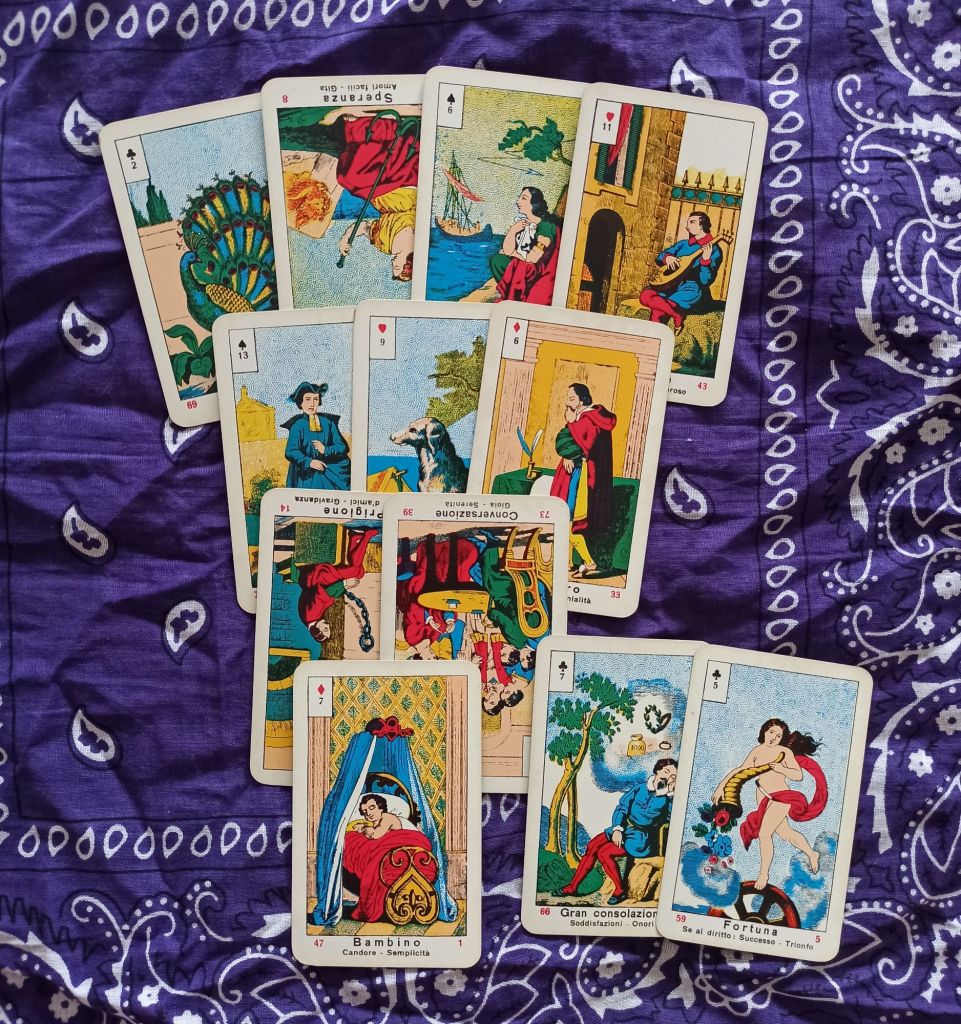
The first thing I was able to detect was the presence of the Priest in the second row. The Priest is usually not a real priest, and rather indicates a figure of authority. We also have, it seems, the significator card for the querent, represented by the Boyfriend, or Jack of Hearts, in the first line. The Priest is accompanied by the Dog/Faithfulness. This is a very good card, even outside of a love reading. It shows that, whoever the Priest is, he (or she) is good, trustworthy and has the querent’s best interest at heart. Furthermore, they are true believers.

The Thought card perplexed me a little, so I skipped over it (though you can see that the Thought card is just under the querent, so it turned out that it was the querent’s thinking process setting into motion). However, I did ask the querent if he was in contact with some kind of spiritual authority and he confirmed it, though he said it wasn’t a traditional priest or minister. This doesn’t matter: all kind of spiritual authorities can be signified by the Priest card.

The querent’s line, the first, has the card of God in it. This is the Peacock (when reversed, it represents the Devil and demons, as well as pride and haughtiness). The Peacock indicates totality, wholeness, miracles, etc. when upright. But it is followed by the Hope card reversed. Hope is the card of faith, but it is reversed, thus showing unbelief.

Yet it is not a clear atheism. Look at the Six of Spades, the Sighs card, right between the querent and the combination of lack of faith in God: the querent is sighing about his lack of faith. He is uncertain and tormented. I remember judging that he was probably a wobbly agnostic, and upon asking he confirmed that he had doubts (I didn’t ask him “are you a wobbly agnostic?” of course. We need to be kind to the querent).

It turned out, the querent had long banished spirituality from his life, had gone for an engineering degree, had been active in the skeptic community online, etc. However, some personal experiences had made him doubt his position.

Look at the last three cards of the pyramid. The Prison reversed shows unburdening, unshackling, freedom, etc. (when not followed by negative cards). Then we have the Conversation card. When reversed, it shows change. Finally, the Child, which shows a new beginning. I don’t know about you, but liberation + change + new beginning sounds like a spiritual conversion.

Furthermore, look at the angles of the pyramid plus the center: the Peacock (God), the querent, the new beginning (Child) and the Faithfulness card. This is a very positive indication.

Still, just to make sure, I asked the querent to draw two cards, and these were the Gratification and Fortune, confirming the good outcome.

As far as I know, the querent has since chosen his spiritual path.

MQS

Can I Trust Him? Well, Can He Trust You? Vera Sibilla Reading With a Twist

Querents are not always paragons of virtue. There are usually two sides to most stories. I generally distrust people whose past is littered with psychos, crazy ex and narcissists. While someone CAN be that unlucky, the general trend seems to me to be more that people who have trouble in every relationship tend to be the cause of the trouble. “My love life is always a mess!” Of course it is, Rhonda, you are always in it!

As I said, there are usually two sides to each story, but as diviners we rarely hear the other one, so what we are stuck with is the querent’s own version, their word that the universe is constantly conspiring against them and a divination system usually saying exactly the opposite. And we are stuck in the middle of the perfect storm, carefully trying to thread the fine line between politeness and truth.

We were at a friend’s house and she had invited over another friend. The latter asked me the question: “I’m always unlucky in love. I’ve started dating this new guy, can I trust him?” Our friend made an odd face I could not decipher as we did the spread. These were the cards:

Is he reliable?

As I already discussed, sometimes the cards describe the development of a situation as if it were a book. At other times, they recreate a scene that can almost be observed with the characters calling attention to what they symbolize. This is one of those situations.

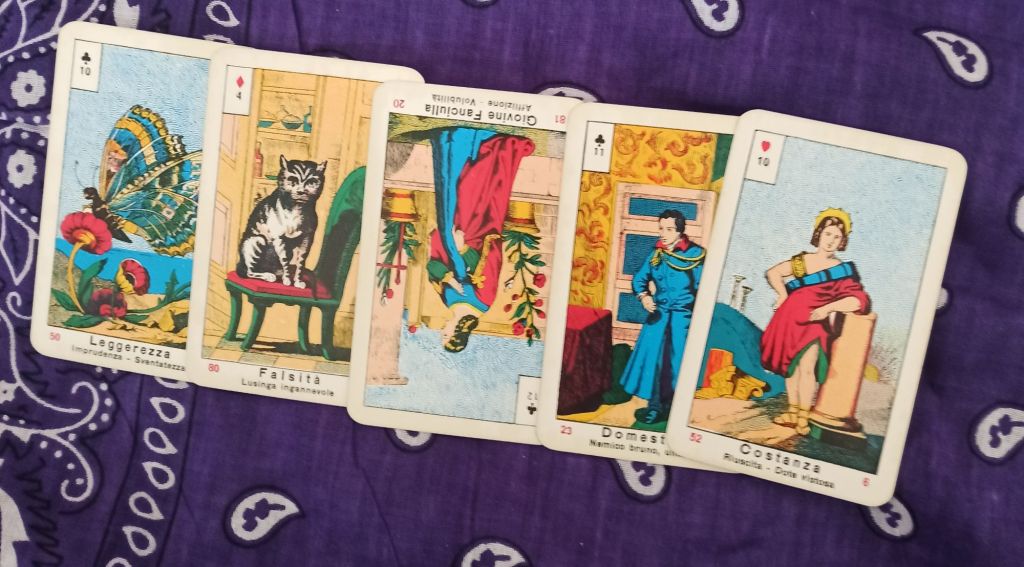
Right off the bat we notice that both querents are present. They are within the age range of the Queen of Clubs and Jack of Clubs. However, the mere fact that they are represented by these cards in a love question shows that this is not the romance of the century and will probably end, sooner or later. The cards, though, tell us something else.

Look at the Queen of Clubs! She is reversed and occupying the center of the spread. Usually, when the Young Maiden (Giovane Fanciulla) is reversed, she is afflicted by something, as opposed to other significators which, when reversed, tend to show problematic behavior.

This is unless the Maiden is reversed and near cards that show problematic behavior. This is exactly the case here. She is together with the Four of Diamonds, the Falsehood card (which, notice, is on her side of the spread, not on the guy’s side) and the Ten of Clubs, the Levity or Carefreeness card.

On the other hand, we have the Ten of Hearts, i.e., the Perseverance card, on the side of the boyfriend. Although the Perseverance card is not one of major feelings, it still shows him to be dependable. She, however, is depicted by the cards as being not only somewhat whiny, but also a little flighty (someone might say a little floozy, especially since she comes up reversed with the Ten of Hearts at the end of the spread)

In this situation, I tried to sugarcoat it to the querent by telling her that he is rather dependable, though this romance was probably not the one that would lead to marriage, and that he also had doubts about her, and that she should make sure not to send mixed signals.

Upon leaving, our friend pulled me aside and she told me that the girl has literally been the “butterfly” of the group, landing from man to man, being unreliable and not learning anything from experience. This is very well described by the reversed Queen of Clubs, who, in a negative context, can show a woman with a princess complex who thinks everyone else is at fault.

MQS

Vera Sibilla FAQ

My version has keywords. Should I use them?

Honestly? No. The keywords provided are extremely limiting, they are sometimes completely stupid (the Gift card does NOT mean obstacles) and they were clearly added by people working on the graphics of that particular version in the 60s or 70s. People working on a deck’s graphics in a big manufacturing company are NOT card readers. Their boss probably told them to add keywords so they could market the deck as ‘now improved and easier to read’ or something to that effect.

What are the little numbers supposted to mean?

They are lottery numbers. Some older versions even have three numbers. I’ve never paid attention to them, but then again my eyes glaze over at the mere mention of lottery and games of chance.

In my deck the cards of the Three of Diamonds and Eight of Diamonds are swapped. Why?

I honestly have no clue. My best guess is that there was an error made during the reelaboration of the deck for that specific edition. The traditional numbering is 3♦ for the Gift and the 8♦ for the Handmaid. If they are swapped in your version it’s not a big deal. Just don’t expect it to be due to some deep kabbalistic consideration. No “tzaddi is not the Star” and all that jazz. The Sibilla is much simpler.

Can I use playing cards with the meanings you provide?

Yes. If it helps you, write the title on each card.

What is the difference between the Vera Sibilla and the Sibilla della Zingara?

The Sibilla della Zingara (sometimes marketed as Gypsy oracle cards) is a reimagining of the Vera Sibilla, and is relatively recent compared to it. It was created because the Sibilla was popular and they wanted to update the graphics. Whether you choose it or the Vera Sibilla is a matter of taste, though I personally prefer the original. There is no difference in terms of meanings.

Do you recommend any books on the Vera Sibilla/Sibilla della Zingara?

I am a sucker for books. I believe I am aware of most, if not all books written on this deck in most languages, which isn’t to say much. I can, in all honesty, only recommend one which is still available: Alessandra Venturi’s Italian Cartomancy. It is poorly organized and it doles out information in hopes or making you fork out more money for the author’s course. There are no examples, no combinations, no spreads. But the information it does contain is solid. All other books on the Vera Sibilla/Sibilla della Zingara in all languages I PERSONALLY consider pretty bad (you are welcome to your own judgment). Italian cartomancer Etienne Valancourt is working on a book. It’s been years in the making, so I don’t know if he’ll ever publish it, but I have great respect for him and I already recommend it even before having read it.

Can I skip reversals?

Yes, you can do what you want. I myself do not actively create reversals when shuffling: any card reader will tell you that cards simply have a way of reversing themselves. I deal out the cards as they are, and then, in gathering them up, I don’t pay too much attention to how they face. However, I always try to start a new reading session with my cards upright. Even then, often one or two cards will reverse themselves. Call it chance, call it magic, but it happens. I would suggest that you pay attention when a card comes up reversed, but you can do what you want.

Can I make up my own meanings?

The first thing to realize when it comes to any psychic skill is that there is no psychic police. So yes. You can. I know some people who don’t use traditional meanings and give perfectly satisfactory readings. My own meanings are a mix of tradition and experience, and the numerology I use is invented, not traditional.
The second thing to realize is that if you are asking me, or anyone, for permission to do what you want, you’ve already lost. Detract further points if you pay someone in order to be told.
The third thing to realize is that just because you can reinvent the wheel doesn’t mean you have to. There is no psychic police, but there are established practices. To dismiss them out of hand without knowing them can be just as much an act of weakness as slavishly following them. Another point worth mentioning is that when we make up something we place our own limitations on it. It can be good to measure yourself against something you didn’t make up even just to stretch your imagination, skill and preconceptions.
My advice would be to educate yourself (here or somewhere else), make your own experience and adjust accordingly.
Or do what you want. Just don’t ask me to validate you. You don’t need validation and I am not inclined to validate people.

Can I just use the pictures as a guide?

Again, you can do what you want. Remember to keep a record of your readings, though, so you can go back to them and see what was accurate and what wasn’t.

Can I use the information you give as basis and develop it in my own way?

Of course! That’s what I did.

Do I have to memorize the combinations?

A handful of combinations are so classic (like that for pregnancy) that not to know them would be a mistake in my opinion, but combinations don’t need to be memorized, especially because you will find that the same combination could mean something totally different when surrounded by other cards. Just use the ones I provide as a mental gymnastics, but don’t confine yourself to them, nor to the interpretations I provide.

Do I need to consecrate/purify the deck?

No, but you can. I do. I would also suggest that you keep your deck near you for some time. As a rule, anything that helps you feel attuned to the deck is good.

Can I make up my own spread?

Absolutely!

Who taught you?

The mother of one of my professors. The numerology is something I made up to make sense of the meanings I learned and to expand on them.

Will you teach me one-to-one?

I will not. I don’t have the time. Besides, theory will only get you so far, and this blog is, I believe, most if not all the theory you need. You need to practice and keep a record of your readings. Don’t exaggerate with readings for yourself. Don’t force yourself to ask questions just out of idle curiosity to see what the cards say. Strive to read for others. Nag your friends and relatives. That’s the best way to start. That’s not to say you can’t read for yourself. Just know your limits.

If I send you my spread will you interpret it for me?

I will not. I don’t have the time. Also, I believe everyone should take responsibility for their spreads and I also think that the language of the cards is somewhat personal, just like different dialects within the same language. Just because all the words are found in the same general dictionary doesn’t mean every word has the same significance and importance for every speaker. Learn your own cartomancy language. You can do it!

Vera Sibilla | Twenty Five Card Spread

A last spread I wanted to cover with you, another one that can be used for general readings, is the twenty five card spread. This is similar to the twenty one card spread, but instead of seven packs of three, you use five packs of five cards.

Pack 1: The Querent
Pack 2: The Home
Pack 3: Work
Pack 4: Love
Pack 5: What you don’t expect

This method also has a short time frame, rarely beyond three months. As usual, lay out the cards and see what your interpretations are before reading mine.

Example with the twenty-five card method

This was a general fortune for a friend, more than two years ago.

Pack 1: 2♥R + 5♦ + 6♦ + 3♠ + 3♣
Pack 2: Q♦R + 4♥ + 4♠ + K♥R + A♣R
Pack 3: 3♥ + 4♣R + 9♥ + 6♣ + 6♥
Pack 4: 9♠ + 10♥ + A♠R + 2♦ + 10♣R
Pack 5: K♠R + Q♠R + 5♥R + 4♦R + 2♣

Pack one tells of a difficult situation at home, which makes the querent sad and makes her want to leave. Since the 3♣ is a card of movement, it is probably going to happen (it did)

Pack two tells of tensions in the family between two married relatives (turned out it was the aunt and uncle who lived on the second floor of the querent’s home). Their love is sick and the situation will likely lead to a divorce (A♣R)

Pack three shows that there is an upcoming recommendation or help. The querent’s interests will be fostered on the job and her finances will improve.

Pack four shows a long period of solitude. The A♠ is reversed, which makes it mildly negative together with the 9♠, as they sandwich the 10♥. However, in reference to the following cards, which are positive, the A♠R shows the end of sorrow. Probably thanks to meeting someone online. This doesn’t tell us about their story, only that she will start dating.

Pack five shows the unmasking of a negative relative, a woman who will give the querent’s family much grief and be unjust. All will be well though in the end. It turned out that a distant cousin was trying to claim the will of a common relative for herself. I don’t know the details, but she was stopped.

Vera Sibilla | Twenty One Card Spread

This spread can be used to tell a general fortune, but it is somewhat vague, meaning you will need to follow up with other spreads. It also tends not to go beyond one or two months.
You simply shuffle and cut the cards and then deal them out into seven packs of three cards each. Each small pack has a correspondence.
Pack 1: the querent (usually, but not invariably, the present moment)
Pack 2: the house
Pack 3: external influences
Pack 4: work and money
Pack 5: love life
Pack 6: potential for trouble
Pack 7: something unexpected

If a pack is not clear, shuffle the remaining cards and add two more

If you look up online, you will see that there are many different variations of this spread. This is how it was taught to me, but feel free to adopt the one that you find resonates better with you. I should also point out this is not a spread I use very often with other people, mostly I do it for myself every month or so to see what’s ahead. There are exceptions, or course.

Remember to lay out the cards as in the example and try to come up with your interpretation before reading mine

Example of 21 card spread
Pack 1: 5♦ + 9♠ + 3♣R
Pack 2: 9♣ + 8♣ + 3♦
Pack 3: J♦ + 8♦R + K♠R
Pack 4: 10♥ + 4♠ + 7♣
Pack 5: 5♥ + A♥ + 2♥
Pack 6: 9♦ + 5♣R + 2♣
Pack 7: 10♣ + 2♦ + 10

This is an old spread from some year backs. The first pack shows that I was coming out of a bout of depression. The 3♣R breaks negative cycles.
Pack 2 shows a family gathering with the exchange of gifts. A couple of weeks later was my nephew’s first birthday.
Pack 3 shows the arrival of negative communications from the authorities, possibly something to be paid or some money not granted. I hadn’t asked for money though. Around a month later I received communication that I needed to pay for the public broadcast network (even though I never watch it. Yay for unwanted public services)
Pack 4 shows that a long spell of unemployment was coming to an end. I did find a job soon after.
Pack 5 shows harmony in the relationship I’m in and talks about consolidating it. It was around the time we had started considering marriage.
Pack 6 shows that althouth there may be difficulties, all will sort itself out, albeit with a delay
Pack 7 shows the loss of correspondence. I actually ended up losing my phone (which can be signified by the Letter, considering that the Gift card was already in play). A tourist found it and I got it back (remember Pack 6)

Vera Sibilla | Fifteen Card Spread

This method is good for looking at a person in general, either the querent or someone the querent is interested in knowing about. The cards are shuffled and cut, and then dealt into five packs of three cards each, forming a cross.

The first one goes in the center, the second one to the left of it, the third one to the right, the fourth one above and the fifth one below. The center shows what hits the querent (or person) directly. It can signify the present or something that is important to them. Above shows the querent’s thoughts or hopes, or something they are aware of. Below it shows something that the querent doesn’t like or doesn’t know. To the left it shows something the querent leaves behind, to the right something the querent is approaching, usually in the near future (1-2 months).

If you want, you can also reshuffle the remaining cards and deal out another pack of three for the further future.

As usual, lay out the cards and strive to come up with your interpretation before reading mine

Example of the Cross of 15 cards

This was a general fortune for a woman
Center: 4♥ + 7♠ + 2♠R
Left: 9♥ + 10♥ + 6♣
Right: 5♠ + 7♣ + 5♥
Above: Q♠ + 10♦ + A♣R
Below: A♥ + 8♥ + 5♦

The central pack is obvious. It shows a breakup, and a rather ugly one. When the 2♠ comes up reversed there is sometimes the possibility of a third party’s involvement. Looking at the above pack, we find confirmation: the querent knows that a woman destroyed her marriage. To the left we see that the marriage was going well, there was love, stability and common interests. Unfortunately, when the spread is negative, the fact that good cards come up in the past is not a good sign. The involvement of the rival, the Q♠, destroyed a good relationship.
Below we see that communications (A♥) are negative (it comes up below) so there was a final argument without resolution (8♥) and it left a bitter feeling in the querent’s mouth (5♦).
Looking forward to the right, it is clear that the querent will not patch things up with her husband (5♠) but she will find satisfaction in a new story (7♣ + 5♥)