Tag Archives: Gran Signore

Vera Sibilla | The Kings – Gentleman, Doctor, Merchant, Priest (Gran Signore, Dottore, Mercante, Sacerdote)

King of Hearts – The Gentleman (Gran Signore)

Design: a protective lord, his hand resting confidently at his hip

UPRIGHT K♥

The card tends to be positive, unless surrounded by cards that taint its meaning. In the main, it depicts a married man, often the querent, or a father, brother, grandfather, friend etc. The person is usually a positive influence in the querent’s life. He is the archetype of the philanthropist. All kings are connected with power, and the King of hearts is power wielded to do good, in general or in the specific context. It represent someone who protects or furthers the querent’s aims. Because it represents positive power, in spiritual readings he represents God (just as the Queen of Clubs represents the Virgin Mary or other figures of virginity). When a person who has power over the querent is represented by the King of Hearts, it’s a good sign.

REVERSED K♥

The card becomes negative, showing someone who is either troubled or the cause of trouble. When the man is a source of trouble, then he tends to be overbearing, manipulative, motivated only by the furthering of his own aims and often addicted to something. The notion of addiction attaches to the card as a general meaning even when it doesn’t stand for a man. It’s the archetype of the misanthrope or the apparent helper.

King of Clubs – The Doctor (Dottore)

Design: a well-meaning doctor taking a patient’s pulse

UPRIGHT K♣

A card with a plethora of meanings. All kings represent power, and the King of Clubs represents someone in a position of power in society, often with a degree (it can signify the degree itself, and university studies). He can be a boss or a professional of some kind, whose help will be required. It’s a more neutral power than that of the King of Hearts. Figuratively, the card often signifies that a situation requires someone’s authoritative help, because something is not right. Sometimes it means that there is a health issue, so he becomes a real doctor (a GP), at other times the sickness is figurative. Rarely, the card indicates a man in the querent’s life who is not violent, but certainly controlling, such as a father or husband. This is rare though. Broadly, it signifies that health will play a role in the querent’s life.

REVERSED K♣

It becomes an extremely negative card. When it does not represent a person, its most traditional meaning is that of wrong diagnosis or wrong help. Figuratively this can mean the querent is receiving help but it’s the wrong type of help and some mistakes are being made. Broadly it signifies the wrong path, strategy or choice. When it represents a person it reperesents an untrustworthy man who abuses their position. He can even be a criminal, a boss in the mafia sense. It signifies a man with a double life.

King of Diamonds – The Merchant (Mercante)

Design: a man with a turban waiting for his cargo to ship or to arrive

UPRIGHT K♦

One of the most important cards in the deck, it very rarely represents a person. It represents financial power, and where it comes from. It is connected to money, banks, buying and selling, calculating, maths etc., but its chief role is that of significator for the querent’s job. 4/5 of the times this will be the interpretation. Even in love it usually represents the fact that work and career have something to do with the question. Rarely, the King of Diamonds can stand for selfishness and a calculating character, and a man who is completely absorbed by his own interest and doesn’t do anything for nothing.

REVERSED K♦

The chief intepretation is that of trouble at work. It may be that the querent is unemployed, or doesn’t like their job, or is not good at it, or is not paid enough. The reason will be explained by the other cards. Just as, when upright, the Merchant is connected to maths and calculating exactly what you want to achieve, when reversed it represents incompetence and lack of good old common sense. It stands for wrong financial decisions. Rarely, it represents a man who is corrupt, sleazy, and potentially connected to crime, or at least to the gray area between what’s lawful and what isn’t.

King of Spades – The Priest (Sacerdote)

Design: a priest in a wintry courtyard.

UPRIGHT K♠

A neutral card whose meaning depends greatly on the context and on the other cards. It can stand for religion (not necessarily for faith, which is signified by the Eight of Hearts) but this is rare and usually only in the context of the question. Usually it represents authority. As all Kings are connected to power, the Priest, the King of Spades, has the power to punish or reward the querent. It represents the law and all lawful authority. It signifies all those rigid structures that layer themselves on society, beating it into shape (religion, politics, mores, institutions, bureaucracy, etc). More broadly it signifies the concept of justice, equilibrium, the right way. It can stand for a person with a degree, but its status is more prestigious than that of the Doctor card, and often signifies a specialist doctor. It signifies people who are strict and perfectionistic, but just and not evil. In love it stands for faithfulness, but it lacks passion. It can be a significator card for an older man. Sometimes the card behaves peculiarly. The cards the Priest shields himself from represent a problem or issue, something wrong or something that could get the querent into trouble. The cards the Priest points toward can represent the right way or what will be done. They represent the sentence, especially in a legal framework. This behavior of the card is rare.

REVERSED K♠

It often signifies legal trouble, a decision that is made against the querent, and injustice. It can signify lack of morality and bigotry, sometimes together. It can represent a dangerous individual who will not let what’s right stop them. Broadly, it implies having the law or the bureaucracy or the system against you.
An Exercise To Do With New and Pre-Owned Decks

One fun little exercise I like to do whenever I get a new deck (any deck, of any tradition) is to ask them some questions to see if they are in tune with me. Some readers treat decks as if they were God-given artifacts. If that works for you, wonderful, no judgement, but I treat them as simple pieces of cardboard that are inserted into a universal mechanism of synchronicity. They are tools, and, like all tools, they need to be treated with some respect, but not to be revered as idols.

My own very personal experience with new decks is that the first few readings they give are often way off, until they enter into synchronicity with a particular reader and that reader alone. The only way for me to get past this phase of initial unreliability on their part is simply to use them a lot, until they get tuned to my subconscious language.

I will probably cover this in another article, but I staunchly believe that divinatory tools are like languages, and, like languages, their structure is perfectly objective, meaning that just as I cannot reinvent the English language as if it were a random convention, I cannot reinvent the meaning assigned to cards in a particular system (although there can be different systems, just as there can be different languages, and sometimes different systems use the same deck, just as sometimes different languages use the same alphabet or even similar words).

That being said, even though English is out there regardless of me, I will have my own take on the English language as I learn it, and you yours. Ever tried reading a Modernist author? Finnegan’s Wake is written in English, yet it is an English very few people who are not called James Joyce will understand. All this is to say that my own take on the issue is that card systems are objective, but you need to develop your own take on them in order for them to make sense in your particular universe (and you are your own universe).

The process of “developing your own take” cannot be decided rationally by convention, as in “From now on X will mean Y”. That’s part of the reason why Esperanto will never be a real thing aside from a laudable minority of dedicated learners. No, this process of development is largely a subconscious process of reciprocal adaptation between language and speaker, or between reader and reading system. It does take a little bit of time and patience, but then again, all things that are worth time take time.

As far as I am concerned, new decks need to be inserted into my mechanism of synchronicity. What about used deck? I have found that if a deck has been consistently used by someone else, it will take a bit more time for it to respond to me. Either way, the first question I will ask my new deck to answer is “Who is your master?” or, if you are not into kinky stuff, “Who do you respond to?” and I pull three cards. Usually, as soon as the cards start responding, I get a very clear description of myself as I am at the moment. Interestingly, if a deck belonged to someone else, I first get complete nonsense, then, as the cards start to respond to me, but not well enough, I almost always get the older owner’s description.

If you give this exercise a try, remember that the description you get of yourself needs to be beyond doubt. It’s like an “a-ha” moment. No vagueness. So, what happens if you don’t get the answer you are looking for? That is up to you and, in part, to your creativity. If you want to consecrate or cleanse your deck, go ahead. My own practice is to give the same question another couple of tries, and if the deck refuses to acknowledge me, or to let go of its previous owner, I leave it there for a couple of days, maybe spending some time shuffling it in the meantime, before giving it another try.

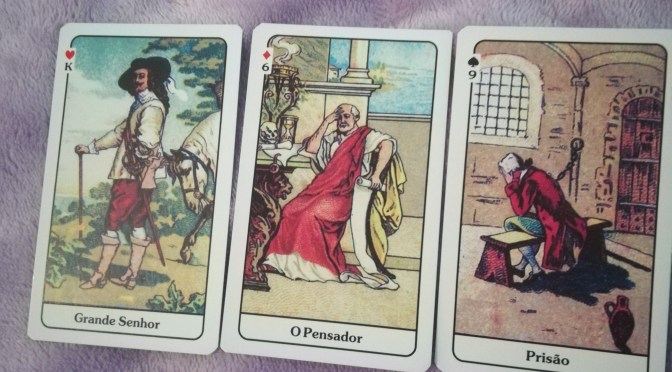
Here is what I did with my new Sibilla della Zingara deck. I asked “Who do you answer to?” and it answered perfectly on my first try, something that had never happened to me, except with my very first deck. I guess part of the reason is that it didn’t have a previous owner, as pre-owned decks tend to be a bit more stubborn, I have found. (Even then, don’t worry: my main deck was second hand, and it works perfectly now).

“Who do you answer to?” “To you, oh lord of all that’s sad, master of inner drought”

One thing you have to know about me is that I have a relatively strong depressive streak to me. I’ve always had it, and depending on the period it resurfaces. These days I was battling through a relatively strong depressive episode, and it definitely shows in the cards.

The King of Hearts is me. Usually I show up as the Jack of Clubs (unmarried man under thirty), but in the past I have come up as the Gentleman, mostly in relationship readings and in job readings, as I’m a teacher (protector/helper figure) and therefore the Jack of Clubs can represent the students. In this case I’m not sure why I showed up as Gentleman. It might be a very contingent reason, as upon searching the deck for the Jack of Clubs and the Jack of Hearts, I found them reversed. Apparently, the deck simply pushed the most serviceable significator into service.

The following combination is Six of Diamonds (Thought) + Nine of Spades (Prison). This is one of those combinations that can signal feeling down, or depressed, or oppressed. It can also signify psychological submission, but there would need to be other cards as well.

What’s interesting about this reading is that these past couple of days I had battled through the depressing feelings without even noticing them, but as soon as they came up in the reading I got my “a-ah” moment, “yep, that’s me”.

Other questions you might ask the cards are What’s going to happen in the next 24 hours?”, “What did I do yesterday?” or any other question whose answer can be easily verified within a very short timeframe. I personally would avoid questions like “What will you teach me?” or “What have you entered my life for?” as it’s all too easy to concoct a convenient answer out of any card combination, but I leave it for you to decide for yourself.

The point is: don’t feel bad if sometimes a new deck doesn’t seem to make any sense, it just takes some time to get in tune with it. At other times, however,, as in the example above, the synchronicity is perfect from the start.