Tag Archives: golden dawn

Tarot Encyclopedia – The Page of Swords

(Note: this is a collection of the meanings attributed to the cards by some occultists in the past centuries. It does not reflect my own study or opinion of the cards. It is only meant as a quick comparative reference as I develop my own take.)
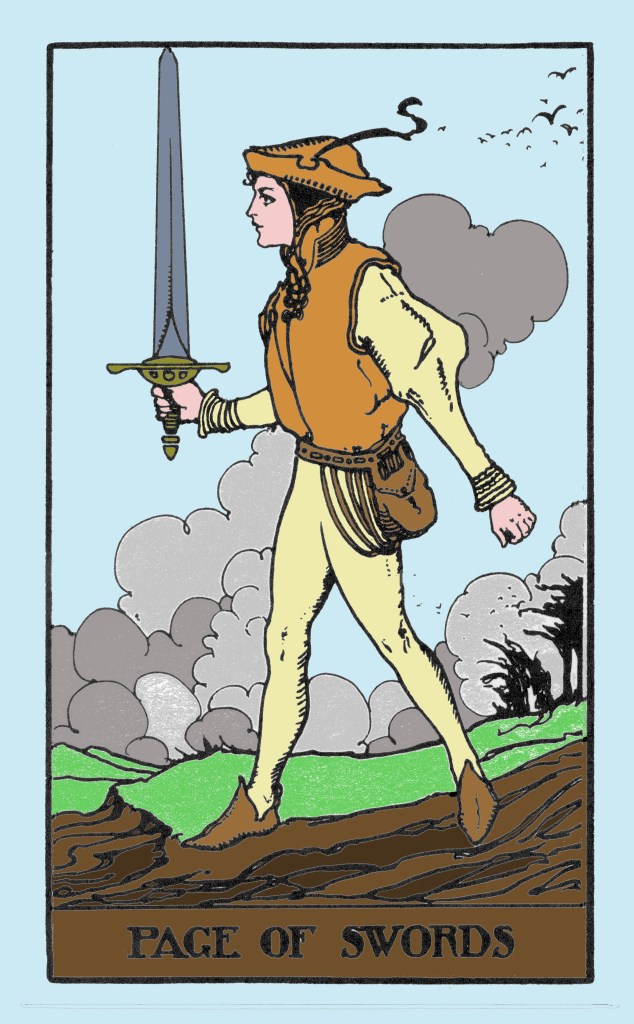
The Page of Swords from the BOTA (Builders of the Adytum) Tarot deck

Paul Foster Case (and Ann Davies)

The time period is from the beginning of Libra to the end of Sagittarius, September 23 to December 21. Meanings: a young person of either sex. Artistic, active, generous. Capable of weighing evidence, somewhat interested in occultism, philosophy or religion. Naturally aspiring, graceful.
If Ill-Dignified: frivolous, cunning and prodigal
Light brown hair and blue eyes
(From the Oracle of Tarot course)

A. E. Waite

A lithe, active figure holds a sword upright in both hands, while in the act of swift walking. He is passing over rugged land, and about his way the clouds are collocated wildly. He is alert and lithe, looking this way and that, as if an expected enemy might appear at any moment. Divinatory Meanings: Authority, overseeing, secret service, vigilance, spying, examination, and the qualities thereto belonging. Reversed: More evil side of these qualities; what is unforeseen, unprepared state; sickness is also intimated.
(From The Pictorial Key to the Tarot)

Aleister Crowley

The Princess of Swords represents the earthy part of Air, the fixation of the volatile. She brings about the materialization of Idea. She represents the influence of Heaven upon Earth. She partakes of the characteristics of Minerva and Artemis, and there is some suggestion of the Valkyrie. She represents to some extent the anger of the Gods, and she appears helmed, with serpent-haired Medusa for her crest. She stands in front of a barren altar as if to avenge its profanation, and she stabs downward with her sword. The heaven and the clouds, which are her home, seem angry.

The character of the Princess is stern and revengeful. Her logic is destructive. She is firm and aggressive, with great practical wisdom and subtlety in material things. She shews great cleverness and dexterity in the management of practical affairs, especially where they are of a controversial nature. She is very adroit in the settlement of controversies.

If ill-dignified, all these qualities are dispersed; she becomes incoherent, and all her gifts tend to combine to form a species of low cunning whose object is unworthy of the means.

In the Yi King, the earthy part of Air is represented by the 18th hexagram, Ku. This means “troubles”; it is, for all practical and material matters. The most unhappy symbol in the book. All the fine qualities of Air are weighed down, suppressed, suffocated.

People thus characterized are slow mentally, the prey of constant anxiety, crushed by every kind of responsibility, but especially in family affairs. One of both of the parents will usually be found in the aetiology.

It is hard to understand line 6, which “shows us one who does not serve either king or feudal lord, but in a lofty spirit prefers to follow his own bent”. The explanation is that a Princess as such, being “the throne of Spirit”, may always have the option of throwing everything overboard, “blowing everything sky high”. Such action would account for the characteristics above given for the card when well dignified. Such people are exceedingly rare; and, naturally enough, they appear often as “Children of misfortune”. Nevertheless, they have chosen aright, and in due season gain their reward.
(From the Book of Thoth)

Golden Dawn’s Book T

AN AMAZON figure with waving hair, slighter than the Rose of the Palace of Fire. Her attire is similar. The Feet seem springy, giving the idea of swiftness. Weight changing from one foot to another and body swinging around. She is a mixture of Minerva and Diana: her mantle resembles the AEgis of Minerva. She wears as a crest the head of the Medusa with serpent hair. She holds a sword in one hand; and the other rests upon a small silver altar with grey smoke (no fire) ascending from it. Beneath her feet are white clouds. Wisdom, strength, acuteness; subtlety in material things: grace and dexterity.
If ill dignified, she is frivolous and cunning.
She rules a quadrant of the heavens around Kether.
Earth of Air

Etteilla

Observer
Upright. This card, as far as the medicine of the spirit is concerned, means, in its natural position: Spy, Curious, Observer, Scrutinizer, Collector, Overseer, Intending. – Examination, Note, Observation, Annotation, Speculation, Account, Calculation, Conjecture. – Scientist, Artist.
Reversed. Unexpected, Suddenly, Suddenly, Suddenly. – Stunning, Astonishing, Inopinently. – Improvise, Acting and speaking without preparation, Composing and acting sitting down.

MQS

How Waite’s Contempt for the Minor Arcana Reinvented Tarot

I am old enough to remember a time when people did videos of tarot unboxings and would be shocked to discover that their deck had either unillustrated pips or different designs incompatible with the Rider-Waite-Smith tradition (which is not a tradition. I’ll come back to it)

In this regard, the average literacy of tarot enthusiasts has slightly increased in the last fifteen years or so. For whatever reason, people online still rave about the latest RWS clones, but they are also aware that the RWS is not THE tarot deck. It just happens to be a very popular variant.

As a matter of fact, its illustrated pips are probably the single major contributor to its success (it certainly wasn’t for Pamela Colman Smith’s talent or Waite’s approachable writing). Although the Waite deck is not the first to have illustrated minors (the the Sola Busca has this honor, and centuries later also the Tarot of the Master) it was the one which, after a couple of decades of obscurity between World Wars, accompanied the New Age-themed Tarot revival that lasts to this day.

The Waite deck essentially redifined tarot for decades as needing illustrated pips. People have come up with all sorts of fantastic interpretations of the most minute and inconsequential details found in the pips. We also have a relatively consolidated tradition that has nothing to do with Waite’s (or Smith’s) vision, such as for instance the Eight of Pentacles being the apprentice card, the Nine of Pentacles being basically the strong independent woman who don’t need no man card, the Seven of Swords as the thief card and so on.

This, I must confess, I find very amusing, considering Waite’s own attitude toward the minor arcana. Whoever takes the time to wade through Waite’s turgid prose quickly finds out that Waite couldn’t care less about the minor arcana in his deck (so much so that he had them almost completely eliminated from his later deck, the so-called Waite-Trinick)

Waite had been a member of the Golden Dawn, and as such he must have had to draw or color in his own deck at some point or another. He was instructed in the Golden Dawn system, wherein the pips (except the aces) are assigned to the decans of the zodiac (usually the Picatrix version) and given titles. So, for instance, the Two of Wands is the Lord of Dominion (and, lo and behold, the Two of Wands in the Waite deck has a lord observing his own dominion.)

All this is no secret, and has been discussed at length already. However, what is often not discussed enough is how scathing Waite’s attitude was toward both the Golden Dawn system and the minor arcana in general. He clearly believed that the Major Trumps were a separate, mystical device that had been merged with a regular playing deck with no meaning whatever. He certainly was intelligent enough to see that the Golden Dawn system was essentially made up and had no historical authenticity to it (though this is not to say one cannot work with it. Symbols are symbols.)

It is for this reason that he notoriously “spoon-fed” Smith the design of the Major Trumps. Because he deeply cared about them, or at least about his own interpretation of them. As far as the minor arcana are concerned, he generally had Smith follow the Golden Dawn system in illustrating the names of the pips.

This is clear when we read Waite’s interpretation of cards such as the Five of Pentacles, where the meaning of the Golden Dawn card (Lord of Material Trouble) cannot be harmonized with the other sources Waite draws from (such as Etteilla, for whom the Five of Coins is the Lovers card). That is, Waite seeks to find a harmony of the various meanings, but when this is impossible, he goes with the Golden Dawn variant, though not out of true conviction that the system is valid. He also very likely left Smith more creative freedom in decorating a bunch of cards he felt were useless distractions.

So what we have today is people finding meaning into something that never was intended to have much meaning in the first place. Surely it must be one of the great ironies of history that one of the most radical developments in the structure of the tarot, i.e., illustrated pips, came about not because the inventor cared about pip cards, but because he didn’t.

MQS

Tarot Encyclopedia – The Page of Coins or Pentacles

(Note: this is a collection of the meanings attributed to the cards by some occultists in the past centuries. It does not reflect my own study or opinion of the cards. It is only meant as a quick comparative reference as I develop my own take.)

The Page of Pentacles from the BOTA (Builders of the Adytum) tarot deck

Paul Foster Case (and Ann Davies)

The time pe r iod is from Decembe r 21 t o March 21, which encompasses the three signs of the winter quarter, Capricorn, Aquariusand Pisces, ruled by Saturn, Saturn- Uranus and Jupiter- Neptune.
Well-Dignified: good command in practical matters; ability to see the
principles be hind physical plane situations and phenomena; a young person of either sex, friendly to the Querent. Usually a friendly disposition with some leaning to the occult or a touch of psychic ability
in the make-up. Generous, diligent, compassionate.
lll-Dignified: more or less in bondage to material matters; inability to see beyond physical plane phenomena . A young person unfriendly, dull, wasteful, thoughtless, self-centered. If interested in the occult, it is usually for the sake of furthering selfish ends.
Dark eyes and rich brown hair.
(From the Oracle of Tarot course)

A. E. Waite

A youthful figure, looking intently at the pentacle which hovers over his raised hands. He moves slowly, insensible of that which is about him. Divinatory Meanings: Application, study, scholarship, reflection another reading says news, messages and the bringer thereof; also rule, management. Reversed: Prodigality, dissipation, liberality, luxury; unfavourable news.
(From The Pictorial Key to the Tarot)

Aleister Crowley

The Princess of Disks, the last of the Court cards, represents the earthy part of Earth. She is consequently on the brink of transfiguration. She is strong and beautiful, with an expression of intense brooding, as if about to become aware of secret wonder.

Her crest is the head of the ram, and her sceptre descends into the earth. There its head becomes a diamond, the precious stone of Kether, thus symbolizing the birth of the highest and purest light in the deepest and darkest of the Elements. She stands within a grove of sacred trees before an altar suggesting a wheatsheaf, for she is a priestess of Demeter. She bears within her body the secret of the future. Her sublimity is further emphasized by the disk which she bears; for in the centre thereof is the Chinese ideogram denoting the twin spiral force of Creation in perfect equilibrium; from this is born the rose of Isis, the great fertile Mother.

The characteristics of an individual signified by this card are too various to enumerate; one must summarize by saying that she is Womanhood in its ultimate projection. She contains all the characteristics of woman, and it would depend entirely upon the influences to which she is subjected whether one or another becomes manifest. But in every case her attributes will be pure in themselves, and not necessarily connected with any other attributes which in the normal way one regards as symbolic. In one sense, then, her general reputation will be of bewildering inconsistency. It is rather like a lottery wheel from which the extraction of any number does not predict or influence the result of any subsequent operation. The fruit of the Philosophy of Thelema is enjoyed, rare, ripe, nourishing and vitalizing at its highest and fullest in this meditation; for to the adept every turn of the wheel is equally probable, and equally a prize; for every Event is “a play of Nuit”.

In the Yi King the earthy part of Earth is represented by the 52nd hexagram, Kan. The meaning is “a mountain”; of how sublime a significance is this Chinese doctrine of Balance, and how closely congruous with that of the Holy Qabalah!

The mountain is the most sacred of all terrestrial symbols, stark, rugged, and immoveable in its aspiration to the Highest, thrust up as it is by the Titan energy of Hidden Fire. It is no less an hieroglyph of the Inmost Godhead than the Phallus itself, even as Capricornus, the sign of the New Year, is exalted in the Zodiac, its deity autochthonous no less than the Most Holy Ancient One himself.

It is essential for the Student to trace this doctrine for himself in every symbol: Air, the elastic and flexible, yet all-pervading and the element of combustion; Water, fluid yet incompressible, the most neutral and composed of all components of living matter, yet destructive even of the hardest rocks by physical assault, and irresistible in its burning power of solution; and Fire, so kin to Spirit that it is not a substance at all, but a phenomenon, yet so integral to Matter that it is the very heart and essence of all things soever.

The characteristic of Kan in the Yi King is rest; each line of the comment describes repose in the parts of the body in turn, and their effects; the toes, the calves, the loins, the spine, and the jaws.

This chapter is a close parallel in this respect, line by line, with the 31st, Hsien, which begins the second section of the Yi.

The Rosicrucian doctrine of Tetragrammaton could hardly be more adequately stated-to every ear that is to heavenly harmony attuned.

“There’s not a planet in the firmament
But in his motion like an angel sings,
Still quiring to the young-eyed cherubim;
But while this muddy vesture of decay
Doth wrap us round, our nature cannot hear it.

Let every student of this Essay, and of this book of Tahuti, this living Book that guides man through all Time, and leads him to Eternity at every page, hold fast this simplest, most far-reaching Doctrine in his heart and mind, inflaming the inmost of His Being, that he also, having explored each recess of the Universe, may therein find the Light of Truth, so come to the Knowledge and Conversation of the Holy Guardian Angel, and accomplish the Great Work, attain the Summum Bonum, true Wisdom and perfect Happiness!
(From the Book of Thoth)

A medieval looking AI-generated illustration for the Page of Pentacles

Golden Dawn’s Book T

A STRONG and beautiful Amazon figure with rich brown hair, standing on grass or flowers. A grove of trees near her. Her form suggests Hebe, Ceres, and Proserpine. She bears a winged ram’s head as a crest: and wears a mantle of sheepskin. In one hand she carries a sceptre with a circular disk: in the other a Pentacle similar to that of the Ace of Pentacles.
She is generous, kind, diligent, benevolent, careful, courageous, persevering, pitiful.
If ill dignified she is wasteful and prodigal. She rules over one quadrant of the heavens around the North Pole of the Ecliptic.
Earth of Earth

Etteilla

Brown-haired boy
Upright. This card, as far as the medicine of the spirit is concerned, means, in its natural position: Brown-haired Boy, Study, Instruction, Application, Meditation, Reflection. – Work, Occupation, Apprenticeship. – Schoolboy, Disciple, Pupil, Apprentice, Amateur, Student, Speculator, Shopkeeper.
Reversed. Profession, Superfluity, Width, Luxury, Lavishness, Magnificence, Abundance, Multiplicity. – Liberality, Beneficence, Generosity, Beneficence. – Crowd, Multitude. – Degradation, Dilapidation, Squandering, Dissipation.

MQS

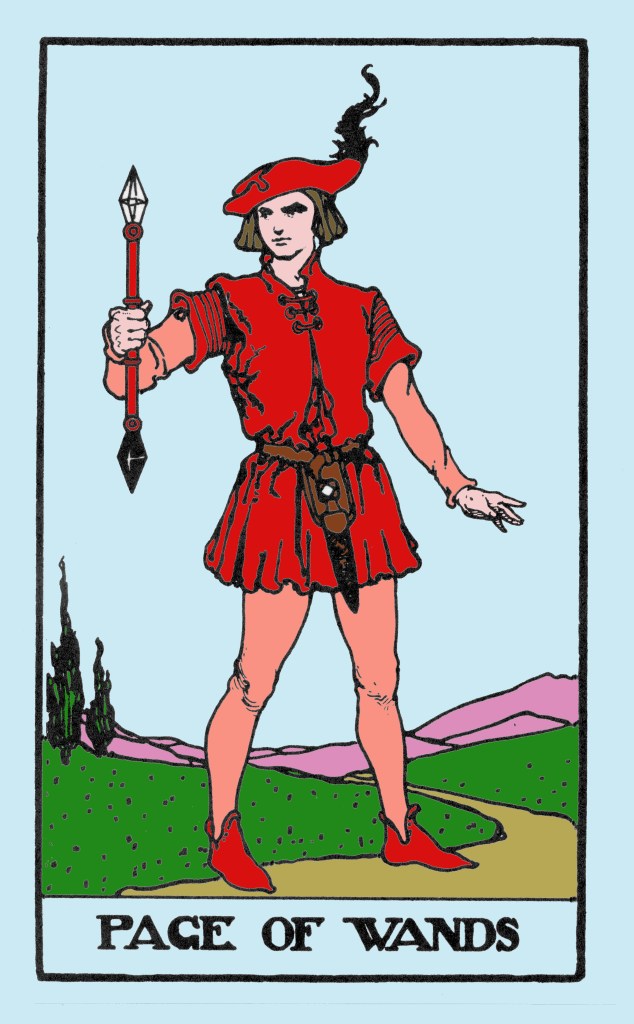
Tarot Encyclopedia – The Page of Wands

(Note: this is a collection of the meanings attributed to the cards by some occultists in the past centuries. It does not reflect my own study or opinion of the cards. It is only meant as a quick comparative reference as I develop my own take.)

The Page of Wands in the Builders of the Adytum (BOTA) tarot deck

Paul Foster Case (and Ann Davies)

The time p e riod corre la t e d with this Key is the whole first quarter of the zodiac from March 21 to June 21 inclusive, including Aries, Taurus and Gemini. The specific Divinatory meanings involved are:
Well Dignified: a young person, youth or girl; brilliant mind, courageous disposition , perhaps given to sudden anger and desirous of power. Capable of great enthusiasm.
lll Dignified: Revengeful at the least opposition, headstrong, theatrical, unstable, domineering and decidedly superficial.
This Key often stands for a messenger.
(From the Oracle of Tarot course)

A. E. Waite

In a scene similar to the former (i.e., of the Knight of Wands), a young man stands in the act of proclamation. He is unknown but faithful, and his tidings are strange. Divinatory Meanings: Dark young man, faithful, a lover, an envoy, a postman. Beside a man, he will bear favourable testimony concerning him. A dangerous rival, if followed by the Page of Cups. Has the chief qualities of his suit. He may signify family intelligence. Reversed: Anecdotes, announcements, evil news. Also indecision and the instability which accompanies it.
(From The Pictorial Key to the Tarot)

Aleister Crowley

The Princess of Wands represents the earthy part of Fire; one might say, she is the fuel of Fire. This expression implies the irresistible chemical attraction of the combustible substance. She rules the Heavens for one quadrant of the portion around the North Pole.

The Princess is therefore shewn with the plumes of justice streaming like flames from her brow; and she is unclothed, shewing that chemical action can only take place when the element is perfectly free to combine with its partner. She bears a wand crowned with the disk of the Sun; and she is leaping in a surging flame which re-calls by its shape the letter Yod

This card may be said to represent the dance of the virgin priestess of the Lords of Fire, for she is in attendance upon the golden altar ornamented with rams’ heads) symbolizing the fires of Spring.

The character of the Princess is extremely individual. She is brilliant and daring. She creates her own beauty by her essential vigour and energy. The force of her character imposes the impression of beauty upon the beholder. In anger or love she is sudden, violent, and implacable. She consumes all that comes into her sphere. She is ambitious and aspiring, full of enthusiasm which is often irrational. She never forgets an injury, and the only quality of patience to be found in her is the patience with which she lies in ambush to avenge.

Such a woman, ill-dignified, shews the defects of these qualities. She is superficial and theatrical, completely shallow and false, yet without suspecting that she is anything of the sort, for she believes entirely in herself, even when it is apparent to the most ordinary observer that she is merely in the spasm of mood. She is cruel, unreliable, faithless and domineering.

In the Yi King, the earthy part of Fire is described by the 27th hexagram, i. This shows a person omnivorous in passion of whatever kind, entirely reckless in the means of obtaining gratification, and insatiable. The Yi commentary is packed with alternate warning and encouragement.
(From The Book of Thoth)

AI generated illustration for the Page of Wands

Golden Dawn’s Book T

A VERY strong and beautiful woman with flowing red-gold hair, attired like an Amazon. Her shoulders, arms, bosom and knees are bare. She wears a short kilt reaching to the knee. Round her waist is a broad belt of scale-mail; narrow at the sides; broader in front and back; and having a winged tiger’s head in front. She wears a Corinthian-shaped helmet and crown with a long plume. It also is surmounted by a tiger’s head, and the same symbol forms the buckle of her scalemail buskins. A mantle lined with tiger’s skin falls back from her shoulders. Her right hand rests on a small golden or brazen altar ornamented with ram’s heads and with Flames of Fire leaping from it. Her left hand leans on a long and heavy club, swelling at the lower end, where the sigil is placed; and it has flames of fire leaping from it the whole way down; but the flames are ascending. This club or torch is much longer than that carried by the King or Queen. Beneath her firmly placed feet are leaping Flames of Fire.
Brilliance, courage, beauty, force, sudden in anger or love, desire of power, enthusiasm, revenge.
If ill dignified, she is superficial, theatrical, cruel, unstable, domineering.
She rules the heavens over one quadrant of the portion around the North Pole.
Earth of Fire

Etteilla

Foreigner
Upright. This card, as far as the medicine of the spirit is concerned, means, in its natural position: Stranger, Unknown, Extraordinary. – Strange, Unusual, Unheard of, Surprising, Admirable, Wonderful, Prodigy, Miracle. – Episode, Digression, Anonymous.
Inverted. Announcement, Instruction, Warning, Admonition, Anecdotes, Chronicle, History, Tales, Fables, Notions, Teaching.

MQS

Tarot Encyclopedia – The Page of Cups

The Page of Cups in the Builders of the Adytum (BOTA) tarot deck

Paul Foster Case (and Ann Davies)

In divination this Key suggests the warmth, radiance and the generous productivity of summer. Thus the Page of Cups indicates a radiant, generous, youthful personality of either sex. The time period is from the first decanate of Cancer, June 21, through the last decanate of Virgo, September 22 – the entire summer season.
Well Dignified: the character is sweet, poetical, gentle and kind; fond of home and all that it stands for; imaginative, dreamy, yet with a good deal of latent courage; friendly to the Querent and will further Querent’s hopes and wishes.
lll Dignified: may still show or profess friendship, or even wish to be of help, but the character is unstable, too indolent to be of real service and probably prone to promise far more than he can perform.
(From the Oracle of Tarot course)

A. E. Waite

A fair, pleasing, somewhat effeminate page, of studious and intent aspect, contemplates a fish rising from a cup to look at him. It is the pictures of the mind taking form. Divinatory Meanings: Fair young man, one impelled to render service and with whom the Querent will be connected; a studious youth; news, message; application, reflection, meditation; also these things directed to business. Reversed: Taste, inclination, attachment, seduction, deception, artifice.
(From The Pictorial Key to the Tarot)

Aleister Crowley

The Princess of Cups represents the earthy part of Water; in particular, the faculty of crystallization. She represents the power of Water to give substance to idea, to support life, and to form the basis of chemical combination. She is represented as a dancing figure, robed in a flowing garment on whose edges crystals are seen to form.

For her crest she wears a swan with open wings. The symbolism of this swan reminds one of the swan in oriental philosophy which is the word AUM or AUMGN, which is the symbol of the entire process of creation. [See, for a full analysis and explanation of this Word, Magick, pp. 45.]

She bears a covered cup from which issues a tortoise. This is again the tortoise which in Hindu philosophy supports the elephant on whose back is the Universe. She is dancing upon a foaming sea in which disports himself a dolphin, the royal fish, which symbolizes the power of Creation.

The character of the Princess is infinitely gracious. All sweetness, all voluptuousness, gentleness, kindness and tenderness are in her character. She lives in the world of Romance, in the perpetual dream of rapture. On a superficial examination she might be thought selfish and indolent, but this is a quite false impression; silently and effortlessly she goes about her work.

In the Yi King, the earthy part of Water is represented by the 41st Hexagram, Sun. This means diminution, the dissolution of all solidity. People described by this card are very dependent on others, but at the same time helpful to them. Rarely, at the best, are they of individual importance. As helpmeets, they are unsurpassed.
(From the Book of Thoth)

A cutesy AI generated illustration for the Page of Cups

Golden Dawn’s Book T

A BEAUTIFUL Amazon-like figure, softer in nature than the Princess of Wands. Her attire is similar. She stands on a sea with foaming spray. Away to her right a Dolphin. She wears as a crest a swan with opening wings. She bears in one hand a lotus, and in the other an open cup from which a turtle issues. Her mantle is lined with swans-down, and is of thin floating material.
Sweetness, poetry, gentleness and kindness. Imaginative, dreamy, at times indolent, yet courageous if roused.
When ill dignified she is selfish and luxurious.
She rules a quadrant of the heavens around Kether.
Earth of Water

Etteilla

Blond boy
Upright. This card, as far as the medicine of the spirit is concerned, means, in its natural position: Blond Boy, Scholar. – Study, Application, Work, Reflection, Observation, Consideration, Meditation, Contemplation, Occupation. – Craft, Profession, Employment.
Reversed. Tendency, Inclination, Inclination, Attraction, Taste, Sympathy, Passion, Affection, Attachment, Friendship. – Heart, Want, Desire, Attraction, Promise, Seduction, Invitation, Attraction. – Flattery, Moine, Ruffianry, Flattery, Praise, Praise. – In decline, threatening ruin, tending to the end.

MQS

Tarot Encyclopedia – The Knight of Swords

(Note: this is a collection of the meanings attributed to the cards by some occultists in the past centuries. It does not reflect my own study or opinion of the cards. It is only meant as a quick comparative reference as I develop my own take.)

The Knight of Swords from the Builders of the Adytum (BOTA) tarot deck

Paul Foster Case (and Ann Davies)

The time period is from the beginning of the third decanate of Taurus to the end of the second decanate of Gemini, May 11 to June 10. Meanings: youngish man; some talent for governing; materialistic, with some artistic appreciation; active, clever, skillful in management.
Well-Dignified: favorable to querent and his enterprises
Ill-Dignified: Inimical, domineering, overvalues small things, crafty.
Dark hair and eyes.
(From the Oracle of Tarot course)

A. E. Waite

He is riding in full course, as if scattering his enemies. In the design he is really a prototypical hero of romantic chivalry. He might almost be Galahad, whose sword is swift and sure because he is clean of heart. Divinatory Meanings: Skill, bravery, capacity, defence, address, enmity, wrath, war, destruction, opposition, resistance, ruin. There is therefore a sense in which the card signifies death, but it carries this meaning only in its proximity to other cards of fatality. Reversed: Imprudence, incapacity, extravagance.
(From The Pictorial Key to the Tarot)

Aleister Crowley

(Note: Crowley and the Golden Dawn made a mess with the kings and knights)
This card represents the airy part of Air. With its particular interpretation, it is intellectual, it is a picture of the Mind as such. He rules from the 21st degree of Capricornus to the 20th degree of Aquarius.

The figure of this Prince is clothed with closely woven armour adorned with definite device, and the chariot which bears him suggests (even more closely) geometrical ideas. This chariot is drawn by winged children, looking and leaping irresponsibly in any direction that takes their fancy; they are not reined, but perfectly Capricious. The chariot consequently is easy enough to move, but quite unable to progress in any definite direction except by accident. This is a perfect picture of the Mind.

On the head of this Prince is, nevertheless, a child’s head radiant, for there is a secret crown in the nature of this card; if concentrated, it is exactly Tiphareth.

The operation of his logical mental processes have reduced the Air, which is his element, to many diverse geometrical patterns, but in these there is no real plan; they are demonstrations of the powers of the Mind without definite purpose. In his right hand is a lifted sword wherewith to create, but in his left hand a sickle, so that what he creates he instantly destroys.

A person thus symbolized is purely intellectual. He is full of ideas and designs which tumble over each other. He is a mass of fine ideals unrelated to practical effort. He has all the apparatus of Thought in the highest degree, intensely clever, admirably rational, but unstable of purpose, and in reality indifferent even to his own ideas, as knowing that any one of them is just as good as any other. He reduces everything to unreality by removing its substance and transmuting it to an ideal world of ratiocination which is purely formal and out of relation to any facts, even those upon which it is based.

In the Yi King, the airy part of Air is represented by the 57th hexagram, Sun. This is one of the most difficult figures in the book, on account of its ambivalence: it means both flexibility and penetration.

Immensely powerful because of its complete freedom from settled principles, capable of maintaining and putting forward any conceivable argument, insusceptible of regret or remorse, glib to “quote Scripture” aptly and cunningly to support any thesis soever, indifferent to the fate of a contrary argument advanced two minutes earlier, impossible to defeat because any position is as good as any other, ready to enter into combination with the nearest element available, these elusive and elastic people are of value only when firmly mastered by creative will fortified by an intelligence superior to their own. In practice, this is rarely possible: there is no purchase to be had upon them, not even by pandering to their appetites. These may nevertheless be stormy, even uncontrollable. Faddists, devotees of drink, drugs, humanitarianism, music or religion, are often in this class; but when this is the case, there is still no stability. They wander from one cult or one vice to another, always brilliantly supporting with the fanaticism of a fixed conviction what is actually no more than the whim of the moment.

It is easy to be deceived by such people; for the manifestation itself has enormous potency: it is as if an imbecile offered one the dialogues of Plato. They may in this way acquire a great reputation both for depth and breadth of mind.
(From The Book of Thoth)

A futuristic AI generated illustration for the Knight of Swords

Golden Dawn’s Book T

A WINGED King with Winged Crown, seated in a chariot drawn by Arch Fays, represented as winged youths very slightly dressed, with butterfly wings: heads encircled by a fillet with a pentagram thereon: and holding wands surmounted by pentagrams, the same butterfly wings on their feet and fillets. General equipment as the King of Wands: but he bears as a crest a winged angelic head with a pentagram on the brows. Beneath the chariot are grey nimbus clouds. His hair long and waving in serpentine whirls, and whorl figures compose the scales of his armour. A drawn sword in one hand; a sickle in the other. With the sword he rules, with the sickle he slays.
Full of ideas and thoughts and designs, distrustful, suspicious, firm in friendship and enmity; careful, observant, slow, over-cautious, symbolizes GR:Alpha and GR:Omega; he slays as fast as he creates.
If ill dignified: harsh, malicious, plotting; obstinate, yet hesitating; unreliable.
Rules from 20 Degree Capricorn to 20 Degree Aquarius.
Air of Air

Etteilla

Military Man
Upright: This card, as far as the medicine of the spirit is concerned, means, in its natural position: Military Man, Man of Sword, Man of Arms, Fencing Master, Swordsman. – Soldier of any corps and weapon, Enemy Fighter. – Dispute, War, Combat, Battle, Duel. – Attack, Defense, Opposition, Resistance, Destruction, Ruin, Overthrow. – Enmity, Hatred, Anger, Resentment. – Courage, Valor, Bravery. – Satellite [= Attendant], Mercenary.
Reversed: Inexperience, Inertia, Stupidity, Bestiality, Stupidity, Imprudence, Impertinence, Extravagance, Ridiculousness, Baggianity. – Scrounging, Fraud, Bricolage, Industry.

MQS