Tag Archives: geomantic perfection

The Geomancy of Peter of Abano – Book II Pt. 4

Previous / Back to Index / Next

Here Abano discusses matters relating to the Seventh House and Eighth House.

Seventh House

Of marriage
The first and second house are for the man, the seventh and eighth for the woman.1 The first signifies the person, the second his wealth, the eighth the wife’s dowry. If these figures are good they show a positive outcome. If the third figure is conform to the first and seventh, the marriage is mediated by messenger [intermediary],2 especially if the eleventh is conform to the third. If the fourth is conform to the first and seventh, it means the marriage is arranged by one’s relatives, especially if the fifteenth figure confirms it. If the second house is bad it means the husband’s (lack of) wealth is a problem, and so judge for the wife if the eighth is unfortunate. Similarly, if the first or seventh are bad, either the husband or the wife cause problems, and if the third, the mediator, and if the fourth, the family. If the first or seventh are unfortunate and move to the sixth, it shows that the marriage won’t happen due to sickness or because one of the two has a physical defect.3

If the spouse shall be chaste and honest4
Look at the first and sixth, seventh, eighth, fourth and twelfth. If you find good figures, it shows the spouse to be chaste and honest, especially if the figures move to other houses. But if the figures are evil, it shows the contrary, especially if they move to other houses, especially if Populus is born from those houses. If Puer is in the sixth and seventh, it shows the wife to be cheating with a young(er) man, and if it is in the seventh and eighth, it means it’s common knowledge.5 If in these places you find Rubeus, and if it moved as we have said above, it means the same, and similarly if in those houses you find Rubeus and Tristitia or Puer and Laetitia. And again, the more you find Populus in the whole figure, all the more dishonest the spouse is shown to be. But if the you find that the figures add up to Carcer, it shows honesty and reserve, and if the above mentioned figures cause Tristitia in the twelfth it means dishonesty with a family member or with a vile person, or with an almost beast-like man. And if Puer or Rubeus were formed in the twelfth, it means dishonesty with young men or with strangers, especially if they are conform to the thirteenth, fourteenth and fifteenth.

If the querent shall have (the love of) the lover or girlfriend
If the first and seventh are fortunate and entering, benign and conform one to the other, it shows obtaining what he wants. If the first moves to the eighth or sixth, it means he will need to insist a little, but if the seventh moves to the second she will insist with him, but the mutation still shows a positive answer.6

Of partnerships and similar affairs
If the first, second, fifth, seventh and eleventh figures are good, fortunate, fixed, it shows the partnership is good, especially if the second and seventh are the same figure. If the figures are fixed and fortunate it will last, but if not it shows they won’t. If you want to know who will cause problems, look at which side of the chart hosts more signs of instability and ill will, and judge in the same way as with marriage.

If one’s enemy will cause one offense
If the seventh is fortunate and positive it means the enmity is of small moment, unless the enemy is a woman, because it still means ill will toward the enemy.7 But if the seventh is unfortunagte and strong and malicious, it means a great and powerful enmity, especially if the twelfth is equally evil. Look also at the fifteenth, and which planets are more fortunate, whether in the first or seventh, and in the other angles, whom they conform to. And if the first and seventh are good, fortunate, entering and the seventh conjuncts the first, or vice versa, it shows reconciliation and peace. If the figure that conjunct the other also moves to another place, it means that the reconciliation will happen through the persons signified by those houses. Always consider the fifteenth and the Witnesses. If there is no conjunction and no translation, but only conformity of the first and seventh, look at the Judge, whether it is also found in another house (of the first twelve), and the more you find it, the more the two parties shall make peace.

Whether there will be war or peace
Assign the first house to one side and the seventh to the other, and look on whose side there are more fortunate figures, and look whether the figures that signify war are in the seventh or the first, or if the figures are fortunate, entering and good. If the figures are good, there is no war, but if they are malicious and fortunate in war, they mean war from the side where they are, and it will be as bad as the figures are, and the side will win that holds the more fortunate figures. Rubeus, Tristitia, Puer, Conjunctio are fortunate in war. Carcer, Amissio, Laetitia are unfortunate in war. If Popoulus or Conjunctio are in the sixth, seventh, eighth or twelfth it means death and great loss of blood, and fleeing, and great cruelty.8 If in those places you find Rubeus and Carcer is in the eighth it means death, prison, fires and flames, and if in the seventh and eighth you find Puer it shows great victory, but always look at the tenth, fifteenth and first, whether they move.

Of litigations
The first is the querent, the seventh is the other party. The figure that is stronger and more fortunate wins, and if Amissio is found in either, that party shall lose. Laetitia and Puella signify concord, while Tristitia and Rubeus are very evil. And if the first moves to the sixth, eighth or twelfth, the person shall lose, but if the seventh moves in the same way, the other party shall lose. And if the whole figure is occupied by figures of more or less positive import, there will be agreement.

Of fled servants, prison and lost items
If the first, seventh, eighth figures are conform and are entering and fortunate, it shows retrieval, and vice versa if they aren’t. If the first is in the sixth, the servant has not fled, but has hidden, and if the figure is Carcer, he hasn’t changed place, if not very little, especially if the first, fourth and the Judge are entering and fortunate.
Acquisitio and Fortuna Major signify retrieval, but the opposite figures show the opposite.

Whether the absent party shall come back, and how soon
If the first house is fortunate and well-meaning, and similarly the seventh and ninth, it shows the absent party is well and in good state,9 and vice versa if the figures are bad, especially if the sixth is unfortunate. Also look at the fifteenth and tenth. If the first is unfortunate and moves to the eighth it means death, especially if in conjunction with Carcer, Rubeus or Conjunctio.

If the sixth is unfortunate and moves to the first or in conjunction with it, it means a deadly infirmity, and similarly when the first and seventh are unfortunate are united somewhere in the figure. But if the sixth is unfortunate (but doesn’t move) it shows an illness that shall pass, especially if the eighth is good. And if you want to know whether the absent party shall come back soon, look at the first and ninth, and if they are Cauda, Acquisitio or Laetitia he shall come back soon. If Populus or Via, very soon. If the eighth is good and is in the first, he will come back in a month, if in the second, in two, and so on. And if the said figure is in the second and in the eighth, entering, he shall come in a month.10

Eighth House

Whether one shall die within the year
If the first figure is the same as the eighth, or if it is conjunct to it, it is an indication of death, especially if it is also in the thirteenth or fifteenth house. If you want to see what kind of death one shall suffer, look at the nature and quality of the figure, and judge as follows: if it’s Rubeus, it indicates fire or steel (that is, being wounded by an arm,) if it is Puella, being beaten to death, if it is Carcer due to a long sickness, phlegm, melancholy or various health issues; and similarly judge of every other figure depending on its virtue and meaning and quality.

On who shall die first between two people
Consider the eighth and see if it is in the house of the person you are inquiring about, or if it in conjunction to it, or if it is in the first house, and judge accordingly who shall die first.

If one shall have the money back
If the eighth and the first are entering and fortunate it shows getting the money back without difficulty or problems, vice versa if they aren’t. And this is especially true if the thirteenth and the fifteenth agree, but when they don’t, and if on the side of the first house you find weak figures, it means getting back the money with great trouble. If the eighth is in the third it means one’s siblings will help, and if in the fourth, the relatives, and if in the fifth, one’s children, etc.

If the bad thing you fear shall come to pass
Consider the first, second, eighth and twelfth.11 If they are lucky it shows the thing won’t come to pass, but if some of them are unfortunate, it shows it shall partly come to pass, and if they are evil, it shall come to pass, and the bad thing will be identified by the type of figure. If the first figure is in conjunction with the eighth or the eighth with the first, it means harm to the person. If the second is in the seventh or ninth, it means harm to one’s wealth. And so judge all the other things with respect to the eighth house according to the meaning of the house and the thing inquired about. Always keep in mind the Witnesses and the Judge.

MQS

Footnotes

  1. This statement is interesting for a number of reasons. I will only mention one. Abano does not say that the First is for the querent and the Seventh for the spouse, but that the First is for the man and the Seventh for the woman. It would be easy, especially in the current cultural climate, to attribute this to Medieval sexism. I am not saying that it doesn’t play a part, but there could be more. In many Medieval astrological texts the Seventh house, as noted before, is assigned to women, and when delineating marriage from the birth chart different procedures seem to have been used to predict a man’s marriage as opposed to a woman’s, the method for the man involving the seventh house, the one for the woman being more weighed toward other considerations. ↩︎
  2. It would be easy to update this interpretation to show the influence of social media in bringing two partners together nowadays. ↩︎
  3. The modern doctrine would dictate that the marriage happens if the first figure springs to the Sixth House. ↩︎
  4. The Italian title is “if she will be chaste and honest”, again presupposing a female Seventh House. ↩︎
  5. This passage is exceedingly complex. It is not clear if Puer in the Sixth indicates a younger man because it is Puer or because it is in the Sixth (which is below the Seventh). The thing being common knowledge when it happens in the Eighth is possibly due to the fact that the Eighth house is above the horizon. ↩︎
  6. Of interest here is that the querent can obtain the lover by moving to the Eighth or Sixth House, but the Seventh can only spring to the Second, not the Twelfth. ↩︎
  7. This passage is not clear. It seems to imply that a good figure in the Seventh House still bodes ill if the enemy is a woman. ↩︎
  8. These attributes seem ill-fitting for Conjunctio. ↩︎
  9. The Ninth House is the house of journeys. ↩︎
  10. This timing method is unclear to me. ↩︎
  11. Older astrology handbooks are filled with indications on delineating the Eleventh House in a horary question to know whether what one hopes will come to pass. Abano here applies the same method to the Eighth house to delineate one’s fears. ↩︎

The Geomancy of Peter of Abano – Book II, Pt. 2

Previous / Back to Index / Next

Here Abano discusses matters relating to the Third House and Fourth House.

Third House

Of whether a messenger brings good news.
If you want to know about a messenger or letter you’ve sent out, and about what effect they will have, and whether the messenger will come back with good news, then the first house is the querent, the third is the messenger or letter. When the first figure is good and the third one is exiting, or at least if it is entering or mixed but good, this is positive.

This is especially the case if the fourth house is conform to the first, and the third to the ninth. If the first or second figure1 moves to the house of the quesited, that is, of the person you send the message or messenger to, this augments the positivity of the message you get in return. The same is true if the first or second figure are conjunct to the house of the quesited or the person. Whether the message comes soon or late is known by whether the figures are mobile and exiting or fixed and entering, and also by the fifteenth and fourth figures.

The figures representing letters or messengers are Albus and Conjunctio. If Rubeus or Puer are in the second, it means airy words2 and talking inappropriately, and rumors or gossip, and discord, unless the message is about war. And if it’s Tristitia or Carcer, it means obstacles and lateness in what you inquire about. The other positive figures have a good meaning.

Which among one’s siblings or relatives will die sooner. 3
The first house is the querent . If it moves to the eighth, or if the eighth moves to the second, it means the querent will die before his siblings, and all the sooner if the figure moves to the angles.4 On the other hand, if the second figure5 were in the eighth or the ninth, and if the eighth were unfortunate, it means the sibling or relative will die sooner, especially if it is also found in the fourteenth or fifteenth. The death is good or bad depending on whether the figure is positive or negative.

If one is loved by their relatives.
Look at the first house, whether it is good or bad, and similarly the third, and if they are conform or not, and in this way you judge whether they love each other. If they are not conform, but if the third is in the second, or the first in the fourth,6 and if the third figure is good, similarly they are friends and love each other. If the first figure is unfortunate and malicious and the third good, the querent doesn’t love the relative, but the relative loves them, and vice versa.

Fourth House

Paternal Inheritance.
If you want to know about paternal inheritance, or from an older relative, or father-in-law, look at the fourth figure, if it moves to the second and if it is fortunate and entering, of fixed, judge that the querent will have what he wishes for, but if it is unfortunate and exiting, it means not obtaining it. Similarly, if the fourth does not move to the second, and if the first does not move to the fifth or eleventh.7 If the first and fourth were contrary to one another, it means not obtaining it, and similarly if the first is unfortunate and the second is contrary to the fourth. If the fourth moves to the seventh or ninth or tenth or twelfth, it means the inheritance goes toward other people, and this according to the properties of the figures, as explained before.

If one is loved by the father or uncle or partner.8
Look if the fourth figure is good and entering and if it is conjunct to the first, that is in the second, or if the first is in the fifth.9 If the first is good and is united to the fourth in the second, it means that affection is reciprocal, and all the more if the fifth or eleventh are conform to the first or the fourth. And if the first or fourth are in the fifth, it means the same, especially if the eleventh is conform to the aforesaid figures. When the first is good and the fourth bad, even if the fourth moves to the fifth, it means that the father or uncle doesn’t love the querent, although the querent loves him. On the other hand, if the fourth is in the second and is good, but the first is bad, it means the querent is well-liked, but the querent doesn’t like him. And even if the two figures are contrary to one another and there is no conjunction between them and there is no mutation of place it has a similar [negative] effect, as it shows lack of affection, and whichever of the figures is more unfortunate shows who is more at fault, and if the first and fourth are both evil, it means one is bad and the other worse.

Whether it’s good to build
If you want to erect a building, look whether the fourth is good, entering and fixed, which means it’s good to build, especially if the tenth figure is conform to the fourth, and the first is good and fortunate. If the fourth is good but not fixed, the building is good but won’t last. If the fourth is mobile and exiting, and the seventh is contrary to it and unfortunate, it means the building will be ruined by an enemy, especially if the twelfth is unfortunate and contrary. And if the tenth is contrary to the fourth, it means ruin through one’s lord. If the fifth is contrary to the fourth, it will be ruined soon. However, note that if the fourth is exiting and the three other angles are fixed, the building will still last, especially if the fifteenth figure is fixed or entering and fortunate.

Whether there will be abundance or a famine.
If the fourth figure is entering and fixed and fortunate, it means the year is abundant and the soil fertile, especially if the figure is earthy, and similarly if the angles are so, and also the fifteenth figure. But if the figure is unfortunate and exiting it means dearth, especially if the figure is fiery, and if the angles and the fifteenth are similar. Furthermore, add up the fourth and fifth,10 and judge if the result is good or bad or mediocre.

If a besieged fortress will be taken.
The first and second figures are attributed to the fortress and those inside, the fourth means the fortress, the seventh and tenth the enemies. If the first and second houses are good, fortunate, entering and better than the seventh and tenth, it means those in the fortress will win. So also if the fourth is fixed and fortunate and earthy, and vice versa if the seventh and tenth are better. Similarly, if the fourth figure goes to the tenth or if it is conjunct to it, it means the enemies will come inside.

And if both are good and benign, they will conquer it peacefully, and if the fourth and tenth are are evil, but the first and second are strong and entering, there will be a battle, and the fortress will be taken by force, especially if the tenth figure is fortunate and powerful in virtue, and if the seventh and tenth are weak and the first and second are fortunate and entering, those in the fortress will win.

And if the third and fourth are fixed and fortunate and entering or earthy, those in the fortress will also win, and vice versa. When the first and the second are evil and unfortunate, and the seventh and tenth are likewise evil, and the fourth is fixed, it means the fortress will be conquered through betrayal.11 And if only the second is exiting and unfortunate and the first and fourth are good and fixed, money will be used [illeggibile] those of the third.

Of buried treasures and hidden things
The fourth means the buried treasure and the hidden thing. If the figure is entering and fixed and fortunate, it means the question is valid, and if the first and fifteenth are conform it means the querent will get the treasure, especially if the fourth is in the second, or any other positive, entering figure is in the second, and vice versa if the figure is exiting and unfortunate and evil, and the first and fifteenth are unfortunate.
And if the treasure or hidden thing is in a house it is shown by the figure in the fourth being fiery,12 and if it is airy it means in the attic, and if it is watery it is below, and if earthy it is buried.

What end the question shall have.
If you want to know what effect any question will have, consider the fourth, if it is good and fixed, or exiting according to the querent’s wish, whether it is good or bad, or unfortunte, and if it is conjunct to the first or to its opposite, and if it is good according to the querent’s intention, and fortunate, it means a good end, especially if the tenth and fifteenth are conform to the querent’s intention, and similarly look at the other angles and see [if the majority of them is good]. If you want to know the cause or means of reaching this end, look at the angles and the second, fifth, eighth and eleventh,13 and the one that is best or worst will cause the greatest good or evil.

MQS

Footnotes
  1. It is not clear why Abano refers to the second figure instead of the third in this passage. If it is not an oversight, then it could be a reference to the Company of Houses. ↩︎
  2. “Parole in aere” ↩︎
  3. This may sound a rather grim topic to ask about, but it was by no means uncommon in Abano’s times. Death was much more frequent and much more in the nose of people than it is today, and therefore something to prepare adequately for. I had a woman once ask me who would die first between her, her sister and her brother. ↩︎
  4. The Angles (First, Tenth, Seventh and Fourth House) were generally considered quick. ↩︎
  5. This reference to the Second House instead of the Third is difficult to explain. ↩︎
  6. Notice, once again, that Abano refers to the First and Second Houses as pertaining to the querent (but not the Twelfth) and the Third and Fourth to the sibling or relative (but not the Second). ↩︎
  7. The Fifth house is the second from the Fourth and thus represents the father’s wealth. The Eleventh house is harder to justify, except that it is considered a lucky house and, on the Geomantic Shield, it falls right underneath the Fifth. ↩︎
  8. “Compagno”. I don’t know what this should imply here, in reference to the Fourth House. ↩︎
  9. Interestingly, Abano refers to the Fifth house here in connection to the father’s or uncle’s love, but not to the third. This cannot be a reference to the Company of Houses, since by that doctrine the Fourth is in company with the Third, not with the Fifth. The Fifth house aspects the First by trine, so maybe that is an explanation. ↩︎
  10. the Fifth house represents wealth derived from the Fourth, including the fruits of the earth. ↩︎
  11. Possibly this is because the Fourth house, being strong, wouldn’t have been conquered without help from the First and Second. ↩︎
  12. Traditionally, in some old Astrology handbooks, fiery signs were symbolic of the walls of a house, because bricks were made with fire. ↩︎
  13. These are the succedent houses. ↩︎

Friend or Acquaintance?

In Astrology, and therefore in Geomancy, we distinguish between a friend and an acquaintance, the former being eleventh house matter, the latter seventh house. Obviously, the difference is not as clear cut as it may seem, especially in the age of social media, where all it takes to be someone’s friend is to click on the ‘add’ button.

In the old texts, both of Geomancy and Astrology, we often find examples of how to judge questions like “Will my friends be useful to me?” This may sound callous compared to our sentimental notions of friendship, but keep in mind that 1) the old notion of usefulness was broader back then, and it included everything concerned with the person’s well-being, both inner and outer 2) friends formed part of the person’s network of alliances in tackling the hardships of life 3) the eleventh house is the second from the tenth, which represents heaven, so it represents friends as wealth from heaven. Clearly friends were highly revered (just read Plato, Seneca, Xenophon or even Confucius for proofs).

As I mentioned somewhere else, my husband and I are in the process or moving, and as usual when moving, we suddenly discovered that we own three times more stuff than we thought. One friend volunteered to help us the following day, bringing us boxes and helping us with her car. In the evening though she said she didn’t know if she would make it. I cast a reading to see whether she would come:

Will she come to help us? (app used: Simple Geomancy)

Let us forget the Judge for a second and concentrate on the chart. If we take the girl as ‘our friend’ she should be eleventh house, and the eleventh house is occupied by Cauda, which also doesn’t move anywhere.

Now if my mom asked me who she is, I would say ‘a friend’. Yet she is more my husband’s friend. I am just on good terms with her, but I wouldn’t call her to spill my guts or even to ask for help, though it was of course very nice of her to volunteer.

If I take her to be my acquaintance, she is seventh house, and occupied by a more promising Conjunctio, which does spring to the second toward me. And she did end up coming.

The negative Judge, Amissio, possibly refers to the fact that we ended up losing a couple of objects due to recklessness (notice the Via Puncti reaching back to Puer in the fourth house). I also ended up losing a friend to gain an acquaintance, it seems.

MQS

Veggie Delivery Service! (Double reading)

Background: hubby and I are on a weekly veggie delivery service from a nearby farm. Yesterday they told us they might come a bit later than usual (normally they deliver at around 12-13pm). As hubby needed to go to work and I had a ritual to carry out and carefully timed, I needed to know that I wouldn’t be disturbed during the ceremony. So I asked when the veggies would come.

Horary Astrology

Here’s the horary chart (the time was 12:56)

Horary question: when will the veggies arrive? App used: Aquarius2go

Leo rises, so Leo’s ruler, the Sun, is my significator. The delivery service is our business partner, since we buy stuff from them and they bring it to us, so they are signified by the seventh house ruler Saturn (ruling planet of Aquarius). The veggies are their moveable possession, so they are indicated by the second house from the seventh, i.e., the eighth house, and its ruler Jupiter. The Moon is given to us as cosignificator and indicator of the flow of action.

Right off the bat we notice the Moon, weakly dignified in the seventh house, so action (obviously) starts from the delivery service. The Moon has separated from a square with reception with Jupiter, i.e., the veggies, and is now void of course. Clearly there are some problems (a square with reception is still a square). Still, there is a promising sextile (a positive aspect) between the Sun and Saturn, though it’s odd to see our significator applying to theirs (see the Outcome for why).

The Sun perfects the aspect at 17 degrees and 10 minutes of Taurus. The difference from its current position is of 4 degrees and 38 minutes, so they will come in 4 and 38 somethings. I would need to see serious testimonies to judge they won’t come. The Moon being void of course can delay them, but there is a clear aspect showing they’ll come. So they will come today, I thought.

Therefore, they will either come in 4 minutes and 38 seconds or in 4 hours and 38 minutes. I thought the second option was the most likely, so since the chart was cast at 12:56, and allowing some wiggle room for reality to follow astrology, I judged they’d come anywhere between 17.30 and 18, though I was somewhat skeptical, since this timing would have been unprecedented for them, and they’d told us they would come only a little bit later than usual. But at least this gave me plenty of time for my ritual.

Geomancy

After my ritual, which was timed for around 15 in the afternoon, I decided to have a look at what Geomancy had to say about this delivery:

Geomancy reading: veggie delivery service. App used: Simple Geomancy

The Geomantic court is positive, with the Judge Acquisitio showing we’ll get the veggies, but the Witnesses are mixed, showing problems. Albus is in the first, and it’s a good figure for commerce. A very unpromising Cauda Draconis is in the seventh house (which is also the left witness). I must say that I have seldom seen things resolved satisfactorily when Cauda is involved. However, Cauda does spring to the second house, perfecting. I was also relieved, but also a bit puzzled, to see Albus spring to the eighth, also perfecting the chart. Usually, the figure that moves makes the effort. In this case, it seems both of us will make some effort, and that our effort is better than theirs.

Outcome

They did come between 17.30 and 18 (around 17.45). However, they gave us the wrong delivery, which we only noticed when they’d already gone away. So we had to call them back and go meet them to exchange the wrong veggies for the right ones. Note how in the horary our significator applies to theirs and how, in the Geomantic chart, Albus moves to the eighth.

Lessons to be learned

1. Horary questions must not be idle, but they need not be life-changing. Knowing when a delivery service will arrive may seem idle curiosity, but I had a serious reason to want to know the answer (I take my magic work seriously)

2. The divination device, whatever it may be, ALWAYS knows best, though we may be fallible in interpreting it. People like to say that divination lets you contact your unconscious. I think there is altogether too much talk about the unconscious, and not enough talk about the superconscious. I saw from the Geomancy reading that there were problems connected with the delivery, though I could not pinpoint them exactly. In hindsight it is clear what the chart meant.

3. It is a humbling and inspiring experience to see how perfectly the cosmic mechanism works.

MQS

The Shield Chart is the Only Chart

One of the things newcomers to Geomancy learn first is the distinction between shield chart and astrological chart. This distinction has been popularized by Greer in his two books on Geomancy, but it doesn’t originate with him, though he is, to my limited knowledge, the first to insinuate that the shield chart is a beginner’s tool and the astrological chart a more advanced one (his attitude changes in his Golden Dawn writings, where he tries to purge astrology from geomancy and render the shield chart autonomous).

Agrippa (followed centuries later by the Golden Dawn) clearly has the astrological chart in mind, since he advocates putting the four Mothers in the four angles, the four Daughters in the four succedent houses and the four Nieces in the four cadent houses. This idea can only come to mind to someone who primarily uses the astrological square chart, or at least pictures the geomantic reading in those terms.

There are other authors, however, like Cattan, Abano and Alfakini (note that some attribute Alfakini’s work, found in the Fasciculus Geomanticus, to Gerard of Cremona) who clearly think of geomantic practice in terms of the shield chart alone. Not because they are unaware of the possible correspondence with the astrological houses, which all employ, nor because they never attempt to draw the square astrological chart (Christopher Cattan does it in the first part of his book), but because it is clear to them that the twelve astrological houses are meant as a technique to be used to draw meaning out of the shield chart and not as a new or different way of doing geomancy.

This can be seen from the fact that both Abano and Alfakini (and possibly also Cattan, but I have to study his text more closely) clearly consider the twelfth house NOT to be contiguous to the first, as it would be in the square chart. On the other hand, both consider the ninth house, which in an astrological square chart would have no relation to the first, to be contiguous to the first, just because in a shield chart it belongs to the same triplicity as the first and is close to it (see below)

Shield chart in Geomancy, with first and ninth house connected. App used: Simple Geomancy

In this chart, Puer in the first is close to Cauda in the ninth, but not to Puella in the twelfth.

This new way of looking at the chart is also making me reevaluate the doctrine of the company of houses, which I have somewhat disparaged in a previous article, and it might even shed light on the strange doctrine of the triplicities, which Greer makes much of but which is barely present in the old texts except in an apparently purely decorative sense. I will need to read the texts more closely and experiment.

What seems clear to me though is that there was never meant to be an astrological square chart, for many authors of the Medieval tradition, but rather merely an astrological lens in looking at the shield chart.

MQS

Astrological Aspects in Geomancy

In Medieval and early modern times, Astrology was everything. Being a natural consequence of the philosophical worldview tolerated by the church (that is, Aristoteleanism), Astrology was not seen, strictly speaking, as a Bible-prohibited practice, but merely as an extension of the science of the day. Though it always had its detractors, it was generally accepted. Therefore it was normal to try to astrologize everything.

We’ve already discussed geomantic perfection. This takes place thanks to something resembling aspects. But some old books go a step further and seek to introduce the actual astrological aspects of the time into geomantic practice.

In Astrology, an aspect happens when two planets occupy the same degree in different signs: a sextile happens to planets that are 60 degrees apart (e.g., Venus at 10 Aries and Jupiter at 10 Gemini); a square is between planets that are 90 degrees apart (e.g. Venus at 10 Aries and Jupiter at 10 Cancer); a trine is between planets that are 120 degrees apart (e.g., Venus at 10 Aries and Jupiter at 10 Leo); an opposition is between planets that are 180 degrees apart (e.g., Venus at 10 Aries and Jupiter at 10 Libra)

Aspects are key to astrological perfection. They show the things signified by the planets coming together, with sextile and trine indicating good contact on one hand and square and opposition showing bad or difficult contact. For instance, if in a love question my significator aspects my love interest’s significator, it shows us coming together. If by trine, we get along, if by square we argue.

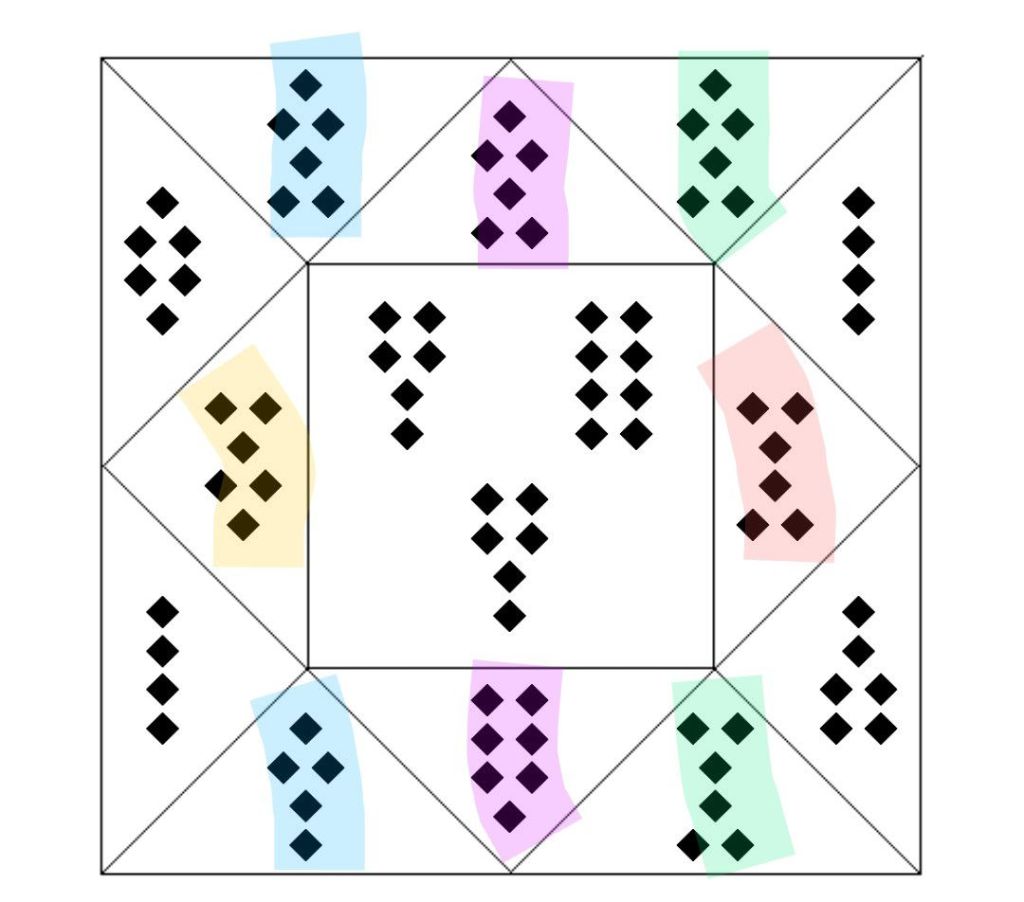
In geomancy, astrological aspects have been adapted to the chart as follows:

Astrological aspects in Geomancy (App used: Simple Geomancy)

If we take the figure in the first house (marked in yellow) as a reference point, then the figures in blue sextile it, because they are separated from it by a single sign; the figures in purple square it, because they are separated from it by two houses; the figures in green trine it because they are separated from it by three houses, and the figure in red opposes it, since it occupies the houses directly opposite.

This is supposed to shed some light on the relationship between the figures: two figures that fall into a square pattern have a difficult relationship, two figures in a trine a good one, etc.

The problem with using astrological aspects in Geomancy is that aspects work in a fundamentally different way: in Astrology, an aspect requires a planet to move in order to apply to another planet. After perfection, then, the aspect separates and its effect wanes.

Geomancy, though, is a static system with no real movement. Sure, we can say a figure moves from one house to another, but in reality that figure is already present in both houses. The only way to conceptualize movement in a geomantic chart is when we take a significator’s house to be the original position of the figure in it, and every other instance of that figure as a successive movement (e.g., in a career reading, if Laetitia is in the tenth house and in the seventh, we take it to move from the tenth to the seventh and not vice versa).

I am honestly not convinced that astrological aspects can find a meaningful place in geomancy. They certainly cannot bring matters to perfection, otherwise everyone would always be separating from their partner since the figure in the seventh house always opposes the figure in the first. Similarly, everyone would always get along with their siblings since the third house always sextiles the first.

One possibility which has been suggested is that of applying aspects only to figures that move. In a love reading, for instance, if the seventh figure moves to the tenth, it moves to square the querent, since the tenth house squares the first.

I personally find this application also problematic, because the tenth house represents the job, among other things, so that would mean that everytime the querent’s job is involved in their love life it causes trouble, which is a false assumption.

At most, I would take an aspect into consideration only if BOTH significators move. In the hypothetical love reading, for instance, if the first figure (querent) moves to the fourth house and the seventh (significant other) moves to the tenth, then they are in opposition to one another. Maybe they will argue. Or, if the first moves to the fourth and the seventh to the second, they sextile each other, which is good.

Even in a situation like this I am generally cautious about applying this theory. There are certain aspects of Astrology (pun intended) that simply don’t translate well to other systems of divination. You are of course welcome to try this theory on for size, but personally I believe Geomancy already has its particular version of aspects, and throwing other stuff into the mix feels more like an attempt at complicating this “brief and simple science” to find something more to tell the querent.

MQS

The Company of Houses in Geomancy

The more I delve into medieval geomancy manuscripts, the more I realize how different authors tended to put together different bundles of go-to techniques for interpreting the geomantic chart. There is always some overalap, yet not every author mentions every technique. The company of houses is one such technique. The book from Peter of Abano I am currently translating does not mention it: he tends to have a very trimmed down, minimalistic approach. However, the technique is found in other authors, so I’ll discuss it and leave it up to the reader to decide whether to experiment with it or not.

The Technique

The technique is quite simple. We start from the presupposition that the aim of a geomancy chart is to see whether the figure of the querent comes into contact with the figure of the quesited, as already discussed, because such contact, called perfection, signals the querent coming into possession of the thing quesited about (though there are exceptions, when the querent wishes to get rid of something, for instance.)

Usually, if at least one of the four modes of geomantic perfection discussed in my previous article does not show up in the chart, it’s game over. According to some authors, though, we can also see perfection in other ways, and this is where the Company of Houses comes in.

The twelve houses of a chart are said to be paired as follows: the first with the second; the third with the fourth; the fifth with the sixth; the seventh with the eighth; the ninth with the tenth; the eleventh with the twelfth. It is important to note that, although, say, the third house is next to the second, the second and the third house are not in company: only the first with the second and the third with the fourth.

Let us suppose I want to know whether I will meet with my sweetheart. In general, I would want the house of the querent (me, the first house) to perfect geomantically with the house of the quesited (my sweetheart, the seventh house). Let us furthermore suppose that this does not happen. According to the proponents of the Company of Houses, this negative testimony can be overruled.

We look at the house my house is accompanied with, in this case the second, or the house the quesited is accompanied with, i.e., the eighth. Let’s take the second house as an example. The first kind of company is if the figure in the second house is the same figure as that of the first; the second kind of company is if the figure in the second is ruled by the same planet as the figure in the first; the third kind of company is if the figure in the second is opposite the figure in the first; the final kind of company is if the figure in the second shares the same Fire line (e.g., Via and Puella, who both have a single fire line).

This figure is the oppositeOf this figure      
CaudaCaput
ConjunctioCarcer
PuellaPuer
AcquisitioAmissio
AlbusRubeus
TristitiaLaetitia
Fortuna MinorFortuna Major
PopulusVia
Opposite figures

When any of these four conditions is realized, the figure in the second house can act as a co-significator for the querent, and may perfect the chart in his stead.

Do you need this?

Frankly? No. You can do what you please, of course, but this reeks of “Methinks I saw mine lass turn into a dragon”, that is, how people used to come up with stuff to fill books with. Even worse, it reeks of last-ditch effort at wringing a “yes” out of a negative chart.

In some cases, what is called Company of Houses is already covered by the four regular modes of perfection. When it isn’t, it is, as far as I am concerned, at most a very, very, very weak testimony, so much so that I don’t take it into consideration. Of course one may come up with all sorts of philosophical excuses why this technique is important, but if you ask me, it feels like a useless complication of a simple divination system.

MQS

The Via Puncti (Way of the Point) in Geomancy

I already said that I am not a big fan of complications in divination. Nor do I believe that the tendency to overcomplicate things is just modern: if we look in older Horary Astrology handbooks, for instance, they are filled to the brim with (often mutually contradictory) techniques that may be thrown at the chart in an attempt to smoke a positive judgement out of it.

Still, one technique that is relatively consistent in the tradition is that of the Via Puncti, or Way of the Point. Not all traditional sources talk about it, but I have found it to be occasionally helpful. As usual, techniques are not to be used blindly, but intelligently, like tools in the hand of a surgeon.

The long and short of this technique is as follows: some Judges have one point in their Fire line (the upmost one), while others have two. In fact, out of all eight possible Judges, four have one single Fire point (Carcer, Fortuna Minor, Via, Amissio), while the other four have two (Conjunctio, Fortuna Major, Populus, Acquisitio). Due to how Geomancy’s model works, whenever the Judge has one Fire line, it is possible to trace it back unequivocally to one of the four Mothers or Daughters (that is, to one of the eight figures at the top of the shield).

Geomantic Shield Reading, drawn with the Simple Geomancy app

In the above example, Fortuna Minor is the Judge. It has one point in its Fire line. This one point is found again in the Left Witness, Laetitia, and again in the third Niece, which is again Laetitia, and finally in the second Daughter Puella. No other path is possible. This is always so (if it isn’t so and you’ve calculated the chart by hand, you’ve made a mistake.)

Usually, the Via Puncti or Way of the Point can be looked at as a root cause for at least some aspects of the final answer. In the example above, for instance, a woman may be the cause (Puella). Or, if we take the House in consideration, since Puella is in the Sixth house, it may indicate that a sickness is the cause, or a servant/subordinate, or a pet, depending on the question.

I repeat: depending on the question. I make no effort to squeeze a consideration of the Via Puncti into my readings. If it is helpful, and if the question lends itself, I will consider it.

Geomantic Shield Reading, drawn with the Simple Geomancy app

In this second example, Acquisitio is the Judge. Immediately the Via Puncti branches off, as both Witnesses have two points in their Fire line. John Michael Greer says that this shows more complex causes, but he fails to mention that, in the old books, this is not considered a valid Via Puncti. I don’t know if I am unaware of some of the old material or if Greer gave in to his tendency to mix innovation (which is fine) with pretense that it is rooted in tradition. You can of course choose to experiment with Greer’s version of the Via Puncti. Personally, I don’t even always regard it when it is there (as in the first example) let alone when it is not there.

One thing that the existence of the technique shows, though, is that the Golden Dawn’s way of reading the astrological chart by placing the mothers in the angles is completely baseless, and is a typical example of the “let’s make up a secret” tendency of the occult community.

MQS

Geomancy – Reconciling the Judge and the Chart

We’ve seen that the process reading a Geomancy chart divides into two phases: the assessment of the chart and the assessment of the court.

If the chart and the court seem to hint at the same result all is well and good. Problems start when they appear to diverge and say different things. One way the old geomancers faced this possibility was by throwing random techniques at the chart so as to tease out a straight answer. In this, they were similar to old horary astrologers (“the significators are moving away and are in detriment, but ah, look at that Part of Fortune!”)

I like to keep things simple. An understanding of the first principles is more effective, I believe, than an endless array of techniques designed to allow the reader to say whatever he feels like saying at the moment. Geomancy is a “simple and short science” to quote Abano.

Abano himself, in his book, often talks about the Judge as if it described an ultimate state of affairs beyond the immediate result. This is something that I have found in other old books as well.

We only have eight possible Judges, so the Judge won’t be able to offer much subtlety in its verdict. Even after we factor in the Witnesses we still have a limited oracle. But think about it: a real-life judge doesn’t usually have much to say except to either rule for or against someone. Sure, he can tweak this or that detail, but that’s about it.

The judge’s ruling usually determines who’s happy with the result and who isn’t, but that’s not always the case. Sometimes a judge may rule in your favor but empty your victory, or conversely he may rule against you but still grant you the one small thing you care about.

Therefore, in a Geomantic reading the Judge usually describes the general tone of the answer, especially how the matter ends (well, so so or not so well). The interrelationship of the figures in the chart, though, is much more specific as it describes in more detail what happens concretely.

This is not a matter of “perfection means yes”. Perfection doesn’t mean yes. Perfection means contact or connection. Usually, of course, contact with something or someone is a positive sign as we generally want to obtain something, but context is key. “Will I be able to leave this abusive relationship?” with the two significators perfecting is a clear no.

Suppose in this example that the significators perfect, showing continuance, but the Judge is Fortuna Major. Maybe the spouse starts taking their AA meetings seriously, or depending on the other signs in the chart it may show that the querent isn’t capable of leaving now but will at a later point (Fortuna Major shows long term success)

On the other hand, there’s plenty of situations where we get our wish but later regret it. “Will I get the job?” and the first and tenth connect, but Carcer is the Judge: yes, but you won’t like it one bit.

Some like to bring in a sixteenth figure, usually called the Reconciler or the Judge of the Judge. This figure is obtained by adding the Judge to the first house figure. This can show you how the end of the matter affects the querent, but it is not a substitute for working out the meaning of the chart. All in all, the sixteenth figure only gives details, never the answer.

Greer, in his book, offers a ton of suggestions on how to deal with an obstinate chart that resists interpretation, including using certain figures to derive a new set of Mothers. Frankly, if you are that desperate, you may just as well interrupt the divination and ask the question again the next day. In all honesty, though, it has never happened to me.

The key to interpreting any oracle is to be reminded that divination is a language and language describes the world. The oracle is always a mirror of real life situations, not an abstract set of simbols.

MQS

The Four Modes of Geomantic Perfection

Geomancy, like astrology, sets up a system of correspondences between houses and life sectors. In all cases, we use the first house to represent the querent. If the question is asked by the querent about themselves, this is enough. If the question is asked by the querent about someone else’s life, then the first house will be irrelevant, but admittedly, in most cases people ask about themselves.

In order to divine meaningfully with geomancy, we also need a quesited, that is, a topic of discussion. This will be represented by another one of the twelve houses, as discussed here. Once we have the querent and the quesited, we need to see what happens to them.

A first indication is given by the geomantic figure that occupies the respective houses. This can shed light on the querent’s and quesited’s current state or qualities. But this is not, in itself, good enough to predict that something will or will not come to pass. Something can be very good in itself, but if it doesn’t happen to me, it is of no great consolation.

This is where geomantic perfection comes in. We call geomantic perfection the way the querent and quesited relate to each other, allowing things to come to pass. In the vast majority of questions, we desire to obtain something, which involves coming into contact with that something. Geomantic perfection allows us to come into contact with it. It is to geomancy what aspects are to traditional astrology (more or less. I’ll come back to it in the next article)

There are four forms of perfection: occupation, conjunction, mutation and translation. Not all medieval handbooks describe all four, but I have found that they all work.

Occupation

Occupation is the simplest and strongest form of perfection. It occurs when the querent and the quesited are occupied by the same figure.

Example reading. App used: Simple Geomancy

Let us suppose the querent asks whether he will manage to buy a house he has seen, or whether he will meet with his father during the holidays. The querent is symbolized by the first house figure. The quesited is symbolized by the fourth house figure. In this case, both are Puer, so we can say that the first and the fourth house are connected by Occupation. There is a strong connection. In most cases this is good. It can also signify that there is perfect union between querent and quesited.

Conjunction

Conjunction is next in line in terms of strength. Conjunction happens when the first house figure (the querent) is also found in a house adjacent to that of the quesited, or vice versa if the figure of the quesited is found in a house adjacent that of the querent. This is the standard definition that has come to be accepted. In the old manuscript there are some variations (for instance, it seems that Abano did not accept the twelfth house as adjacent to the first.) In my experience, the standard definition is good enough.

Example reading. App used: Simple Geomancy

Using the same figure as before, let us suppose that the querent asks whether he shall meet with a friend, or a brother, or whether he shall go to a party. The first house is still represented by Puer. Puer moves to the twelfth, where it is adjacent to the eleventh, the house of friends. It also moves to the fourth, where it is adjacent to the house of brothers (the third) and to the house of parties (the fifth).

Note that if the querent moves to meet the quesited, it shows effort or interest on the part of the querent, while if the quesited moves to meet the querent the opposite is true. Of course, this needs to be interpreted: if the illness moves to meet you it doesn’t mean that the virus is besotted with you–it just shows that it comes to you easily. In a relationship reading, the figure that moves to meet the other is the one who is more interested or in love.

Mutation

Mutation happens when the querent and the quesited both move and end up meeting somewhere else in the chart.

Example reading. App used: Simple Geomancy

Let us suppose that the querent asks whether he shall meet with the girl he likes. The first house figure, Puer, moves to the twelfth and the seventh house figure, Rubeus, moves to the eleventh. The two houses are adjacent, so the two shall meet. Mutation indicates meeting in a third place or, depending on the question, it can show mutual effort. The houses where the figures meet can also shed light. For instance, in this case it is likely they will meet at a friend’s house (eleventh) or in some remote hidden place (twelfth).

Translation

Translation is the last form of perfection. It happens when a third figure is found in a house adjacent that of the querent *and* that of the quesited, so as to form a bridge between them.

Example reading. App used: Simple Geomancy

In this case, we have no translation to the first house. However, if we suppose the querent asked about the relationship between his father (fourth house) and his mother (tenth house), then we find that Puella forms a translation between them, being in the fifth house (adjacent to the fourth) and in the ninth (adjacent to the tenth). Translation usually shows the involvement of a third party. In this case Puella could show the influence of a woman or girl.

Prohibition

Prohibition is the absence of perfection. This is the most common way a chart has to tell us we won’t get what we want or, more broadly, that there is no connection between querent and quesited.

Example reading. App used: Simple Geomancy

Let us suppose the querent asks about the possibility of getting a job he applied for. There is no contact between first house (querent) and tenth house (quesited): no occupation, no conjunction, no mutation and no translation. The querent is unlikely to get that job.

Final Notes

  • Sometimes a figure passes into an unrelated house. This can add context and information for good or ill.
  • Perfection shows contact. It doesn’t tell us whether the contact is good or bad. In the example about the querent’s parents, if we suppose that the querent asks whether his parents will divorce, the translation by Puella may show that someone will convince them to stay together. However, if the translation were made by Cauda, it could show a mutual agreement to end the marriage.
  • The Court must always be taken into account, although we will discuss it in another article.

MQS