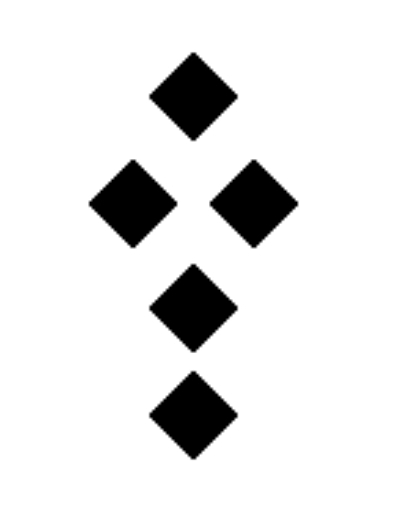
Name of the Figure: Fortuna Major (Greater Fortune); sometimes called Arriving or Incoming Help Element: Earth Planet: Sun (rising) Sign: Aquarius Quality: Entering Fortune: Good
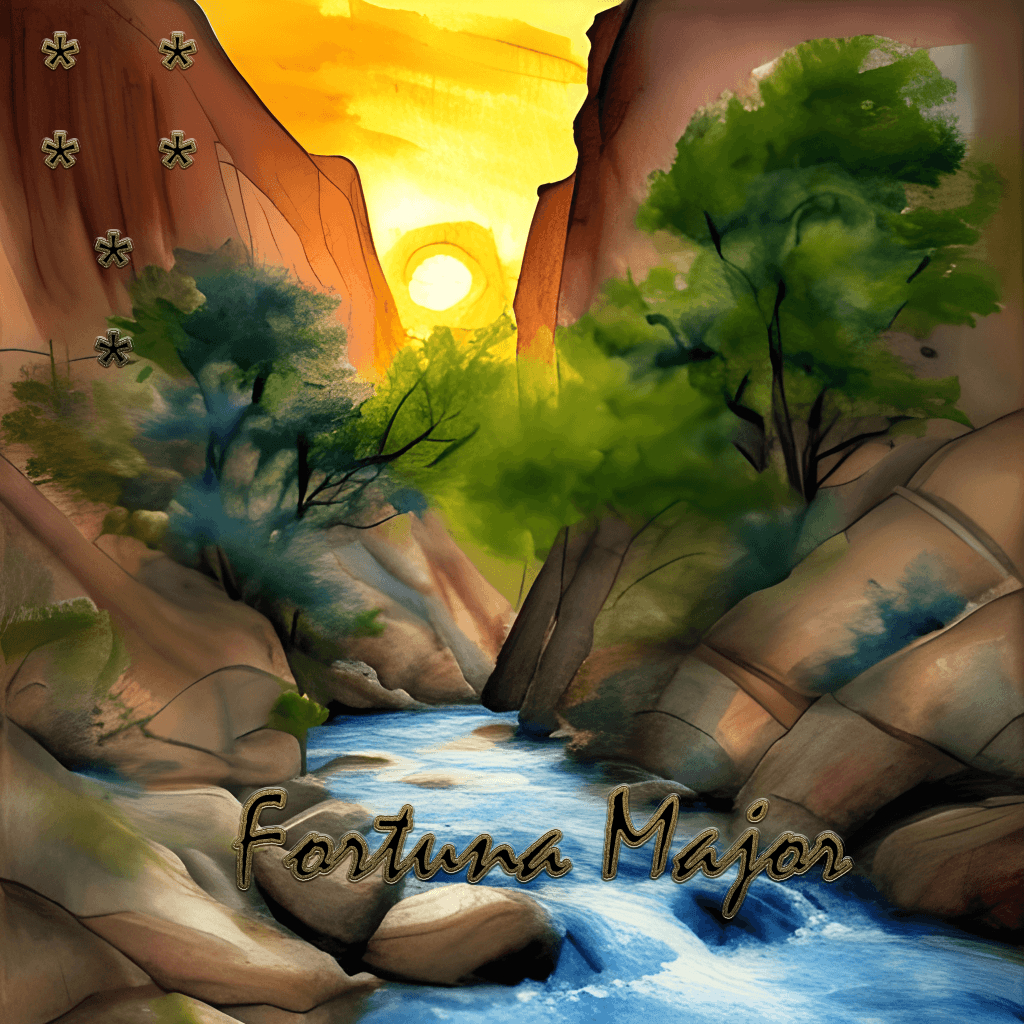
Fortuna Major is the Greater Fortune of the geomantic figures. It has a plethora of symbolic attributes that may be useful to someone looking to use geomancy as a framework for magic, but as far as divination goes, it is relatively straightforward in its meaning. From a strictly symbolic standpoint, it may be said to represent a river flowing between two mountains while the Sun rises. Whether this is the case or not, it represents a peculiar form of fortune that is not blind luck.
Illustration of the geomantic figure Fortuna Major, Greater Fortune
If we accept preliminarily the symbolic depiction and also the common view that one point means the element in the figure is active, then Fortuna Major is formed by activating the passive elements (Earth and Water) and by keeping the active elements (Fire and Air) passive. Metaphorically, the water flowing and cutting its own path through life by moisturizing the earth can be taken to show the type of fortune that Fortuna Major indicates: the hard-won one.
All, or at least most traditional sources agree that Fortuna Major is a slow figure, promising success but also delay. This can be good or bad depending on what the querent needs. For instance, it can be slightly worrying for illness, and someone in prison is probably looking at a longer sentence, but the figure remains broadly good. It is a symbol of fortitude. In good things, while it may show delay, it also promises stability.
In general, Fortuna Major promises success through effort, Nothing will be handed to the querent for free, but at the same time, the fact that this figure shows up indicates that the querent has the potential to achieve what he wants. It also has the general attributions of the Sun, signifying gold, renewal and similar.
Common Keywords: success through effort, perseverance, constancy, stability for good or ill, renewal, gold, some delay, great satisfaction, triumph
Fortuna Major in the Geomantic Houses (these are only examples. Use context to guide your interpretation)
House
Possible Meanings
First
Of great stature, resilient, kingly, a nobleman, steadfast, long life, health, honorable, well-known, accomplished
Second
Wealth, accumulation, riches, fortune
Third
Well-being of siblings, good for short trips, True rumors
Fourth
Good in stable things, inheritance, good for parents and for the father
Fifth
Friendship, good grace, talent, success of a mediator
Sixth
Gain through small animals and servants, slow recovery
Seventh
lasting union, honorable partner
Eighth
Wealth through partners of all kinds, long life, honorable death,
Ninth
Good science or skill, Long travel, Honor and success through travel, Piety, Faith
Good friends, Achievement of hope, help from government
Twelfth
Long prison sentence, freedom from occult enemies, gain through large animals
Thirteenth
Success in the past or present, stamina, power, ability to achieve what one wishes
Fourteenth
Success in the future, Still need for a lot of work
Fifteenth
Success, Accomplishment of most things through effort
Possible meanings of Fortuna Major in the various Geomantic Houses. Note that this is not meant to be exhaustive, and it only serves to jog your interpretive muscles
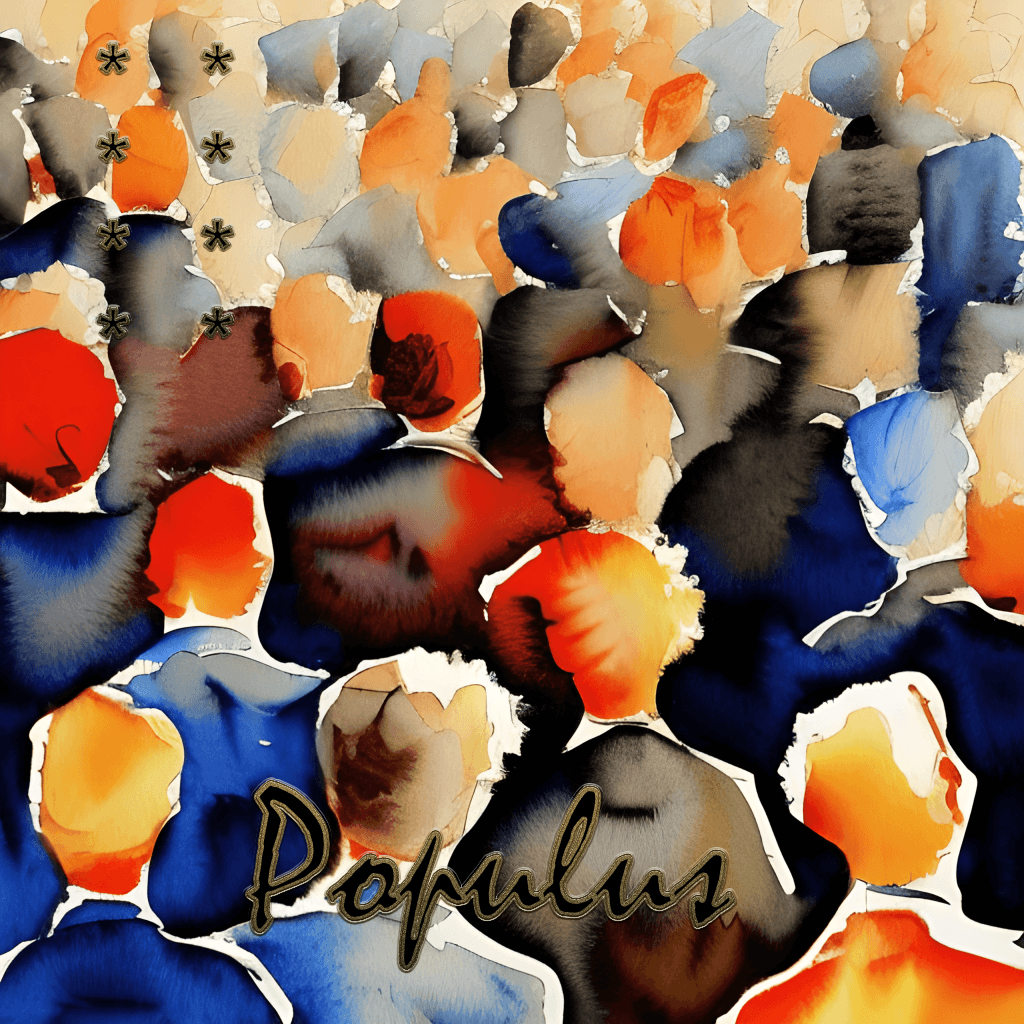
Name of the Figure: Populus (The People); sometimes called Double Way Element: Water Planet: Moon (waxing) Sign: Capricorn Quality: Common Fortune: Mixed
Populus is the opposite of Via, the other figure of the Moon. Its properties are in many ways diametrically opposite. Where Via forces a radical transformation of every figure it comes into contact with, flipping it into its opposite, Populus passively accepts every figure as it is, like a mirror or a bunch of clay waiting to be shaped. This latter comparison is very apt, as in Medieval (Aristotelian) philosophy, the Moon was seen as receptacle and a symbol of matter, which was capable of receiving all forms, just as the Moon receives her light from the Sun, but was ultimately beyond complete formation.
Illustration of the Geomantic figure Populus, the People
The Medievals, who were fond of finding similitudes and parallels everywhere, also saw the common folk as matter and the Emperor or King as the form-giver, just like they saw the female as matter and the male as form, so they must have felt a great thrill in finding all these correspondences at play in Populus, which also represents people (just like in astrology the Moon rules common people). If Via represents the Moon’s changeable nature, Populus is her passivity.
Populus is formed of the highest number of points of any Geomancy figure, eight, in contrast to Via, which had the least with four. This brings to light another common meaning of Populus: that of indicating “lots” of something, for good or ill.
Some old Geomancers considered Populus extremely bad, some saying that if Populus was the Judge, the chart wasn’t valid. I find this to be nonsense. We already have a limited number of possible charts to play with, and if we exclude those ending in Populus we eliminate a whole bunch more. Plus, in my experience, Populus is a neutral figure, augmenting the good and bad of other figures.
Common Keywords: passivity, receptivity, stability, a situation that may have various influences at play but in the end won’t change much, many people, groups of all kinds, crowd, togetherness, lots of anything that may make sense in the context, large, big, numerous
Populus in the Geomantic Houses (these are only examples. Use context to guide your interpretation)
House
Possible Meanings
First
A long and/or mediocre life, a mutable life subject to many influences, lots of water, phlegmatic temperament, companionable
Second
Lots of money, great wealth, many objects
Third
Many siblings or cousins, neighbors, small trip by water or near a body of water
Great harvest, many children, gathering of artists (like an exposition), A fun gathering
Sixth
Many servants or small animals, dangerous illness
Seventh
Many acquaintances, Good marriage, Pliable but unstable partner, Many public enemies
Eighth
Tears, A funeral, Lots of money from the partner
Ninth
Long travel especially by water, pilgrimage with other people, a class or learning group, a spiritual gathering
Tenth
A gathering of important people (like a cabinet meeting), elevation of regular people, Rebellion of the common folk
Eleventh
Lots of money from the government, Lots of friends
Twelfth
Many occult enemies, evil machinations, groups of prisoners
Thirteenth
Public favor, stable past, good company
Fourteenth
The public is against, many obstacles or lots of opposition, stable future
Fifteenth
Some delay, stability in the end, good if coming from good figures, bad if from bad ones
Possible meanings of Populus in the various Geomantic Houses. Note that this is not meant to be exhaustive, and it only serves to jog your interpretive muscles
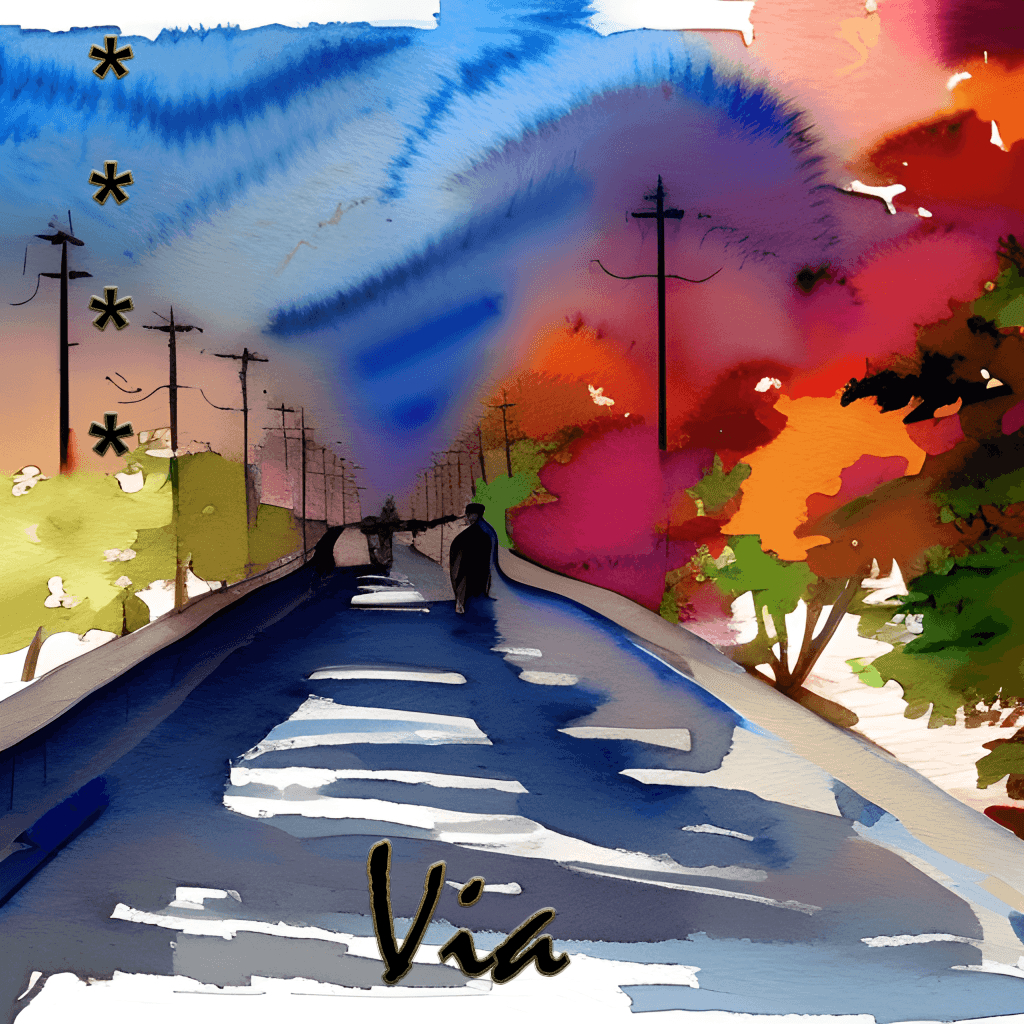
Name of the Figure: Via (The Way); some give it as Candela (Candle) Element: Water Planet: Moon (waning) Sign: Leo Quality: Common Fortune: Mixed
When interpreting Via, there’s a couple of notions to keep in mind. First, its interesting geomantic property of turning every figure into its opposite: If you add Via to Conjunctio, meaning connectivity, you get Carcer, isolation; if you add Via to Puella, innocence and balance, you get Rubeus, vice and lying; if you add Via to Caput Draconis, the beginning of something, you get Laetitia, its peak, etc. This is because Via has one point in each elemental row: one point in the Fire row, one in the Air row, one in the Water row, one in the Earth row. One point, when added to another single point, turns it into an even double point, while when added to a double point it turns it into an odd number again.
Illustration of the Geomantic figure Via, the Way
This property of Via connects well with its meaning of change, travel, etc. It is an active, transformative figure, indicating that the situation will not stay as it is. Something that began one way will finish as something different.
Another interesting and often mentioned property of Via is that it has the least amount of points of any figure in Geomancy, four. This can mean that Via stands for a small amount of something, whether for good or ill. This, however, is usually only in questions of quantity (“Will I get back the money?” “Yes, but only a small part.”)
Finally, because it is in contrast with the other figure of the Moon, Populus, which is the crowd, Via can represent aloneness, not necessarily in a bad sense. It can show someone doing something alone, following their own path. It may indicate independence. However, if you dabble in the old manuscripts, you will see that depending on the author Via is attributed better or worse qualities depending on that author’s own ideas. I personally find it a neutral figure, if an unstable one.
Common Keywords: Travel, path, journey, going, moving, acting, making inroads, change, transformation, one, only, lonely, small, little, small amount
Via in the Geomantic Houses (these are only examples. Use context to guide your interpretation)
House
Possible Meanings
First
A traveler, wayfarer, piligrim, small stature, phlegmatic temperament, changeable, A short life
Second
Traveling merchant, Little money, change in the economic situation, poverty
Third
Short trip, visit, younger siblings, arrival of news, partly true rumors, the garden or neighborhood
Fourth
mixed end results, instability at the end, a trip to see one’s parents of father, little inheritance
Fifth
Few children (possibly one), going to a party, little pleasure
Sixth
short illness, change in the health, servants are arriving or fleeing (traditionally), small animals, small gain from animals
Seventh
Unstable partner, highwaymen, little company, gain or loss of support (depending on how one is at the present moment)
Eighth
Fleeing danger or fearful situation, little money from other people
Ninth
Long travel, little faith, unworthy knowledge or teacher, a process of transformation, inner journey
Tenth
Unstable government, Unstable profession, change of job, traveling for work, authority figures are not to be trusted
Eleventh
vain hope, little hope, little help, changeable friends, few of them
Twelfth
Release from prison, Freedom from addiction, Few enemies
Thirteenth
Unstable past, ability to change, good for traveling, positive journey or path
Fourteenth
quick solution, the situation will evolve or change, issues while traveling
Fifteenth
There will be travel or change for good or ill, Quick solution
Possible meanings of Via in the various Geomantic Houses. Note that this is not meant to be exhaustive, and it only serves to jog your interpretive muscles
In a way, Geomantic figures are to Geomancy what cards are to Cartomancy. They represent the basic bundles of meanings that get shuffled around to form the sentence that will answer the question. So we need to familiarise ourselves with them.
Each Geomantic figure is made up of four rows of points. Each row can contain one or two points, so a figure can contain a minimum of four points (Via) and a maximum of eight (Populus.)
On the right, Populus (eight points); on the left, Via (four points); the result is Via
At least since Medieval Geomancy (and possibly before) each of the four rows corresponds to one of the four Aristotelian/Empedoclean elements: Fire, Air, Water, Earth. The question, however, is how important this notion is. Medieval and Renaissance geomancers seem to have almost completely disregarded this set of correspondences beyond the initial mention of them. This seems to conform to a certain premodern gusto for correspondences. If you read Christopher Cattan’s book on Geomancy, you’ll know the amount of practically useless information about elements and astrology that he shoves down our throats before getting to the practical side, where such information is never elaborated on nor used.
To put it more positively, the Medieval mindset was extremely different from our postmodern one. To the Medieval (and the Renaissance is, in spite of all we hear about it, but a colorful appendage to the Middle Ages) the world was an inherently coherent, fully interconnected system of correspondences, wherein the lower and smaller was inscribed into the larger and higher. The Macrocosm/Microcosm distinction played a major role. The Microcosm, i.e., the world of men, was in small what the Macrocosm was in large. Humans themselves, in their complexion, faculties and powers, mirrored the larger scheme of things.
Because all was seen as interconnected, it was impossible for a writer to describe a single art without describing its connection to the whole, as on such connection dependended the art’s legitimacy in the common view. This is why the four rows of a Geomantic figure, for instance, are made to correspond to the head, neck, trunk and feet of a human (microcosm) as well as to the four elemental spheres (macrocosm.)The very attempt to astrologize Geomancy must have catered to the double need to understand it in light of what was considered an already legitimate science on one hand, and to inject the omnipresent beloved astrological symbolism in it on the other.
All this is well and good. But the point remains that we don’t really know how knowledge of the elements is supposed to help us in a geomantic reading. For that matter, we don’t even know what the numbers One and Two are supposed to mean. What does it mean that the figure called Puella has a single point in its Fire row and two in its Air row? Old manuscripts never explain it. Most modern interpreters see one point as an indication that the corresponding element is active or manifest, two that the element is passive or unmanifest (Nick Farrell has proposed a slight variation of the interpretation, though. Check his blog, which is an endless source of fascinating information on all things magic.) They then launch into endless rationalizations on the complex meaning of these elemental configurations.
Puella, with two points in its second row (Air)
I don’t share this passion for overanalysis, especially because all this has very little bearing on how actual readings work. John Michael Greer says that old geomancers did not mention all this analytical stuff because it was implicit in their view. I am more inclined to suspect that all this overinterpretation of Geomancy is exquisitely new and very typical of our age. If you are familiar with the ridiculous lengths people will go to in order to justify this or that smear on the cardboard of an ancient tarot card as a deep esoteric secret, you’ll see immediately what I mean.
The Medieval mind was very much acquainted with symbols, but it was also very much used to explaining them outright when they saw them. That’s how we got endless libraries of pedantic manuscripts. But their explanations were rarely tortuous and mind-bending. Because symbols were seen as natural parts of the cosmos, the interpretation of symbols was not something to melt your brains on.
We, on the other hand, learn about symbols in roundabout ways, usually only after we’ve become actively interested in them, and when we do find them, we tend to exaggerate in the interpretation to compensate for the fact that we live in a mundane world of nihilism and meaninglessness. So maybe Puella has two points in its Air row because it symbolizes lack of communication or reasoning ability or some such. It’s more likely that the interpretation of the figures stemmed from a combination of how they more or less looked plus remnants of the old Arabic tradition plus the astrological associations.
What is true, however, is that single and double points have different practical effects on the operation of Geomantic Addition, as mentioned previously. Two points act as a mirror for the corresponding number of points in the other figure, while one point changes the number of points in the other figure from odd to even or from even to odd. In this sense, the current interpretation that one point represents activity and two points represent passivity does seem to hold some water.
This is especially noticeable in the figures of Via and Populus, shown above. Populus, whose every row is made up of two points, passively accepts the figure it is added to, replicating it. Via, on the other hand, is made up of one point in every row, so it turns any figure into its opposite. Interestingly, both figures are attributed to the Moon, astrological ruler of mirrors and chief symbol of change. When you add Via and Populus, you get Via, and whether this is because Populus mirrors Via or because Via changes Populus to its opposite is a matter of interpretation.
The astrological attributions of the figures are as follows:
Figure
Planet
Sign
Via (Way)
Moon
Leo
Populus (People)
Moon
Capricorn
Fortuna Major (Greter Fortune)
Sun
Aquarius
Fortuna Minor (Lesser Fortune)
Sun
Taurus
Puer (Boy)
Mars
Aries (sometimes given as Libra)
Rubeus (Red)
Mars
Gemini
Puella (Girl)
Venus
Libra (sometimes given as Aries)
Amissio (Loss)
Venus
Libra
Acquisitio (Gain)
Jupiter
Aries
Laetitia (Happiness)
Jupiter
Taurus
Carcer (Prison)
Saturn
Pisces
Tristitia (Sadness)
Saturn
Scorpio
Albus (White)
Mercury
Cancer
Conjunctio (Conjunction)
Mercury
Virgo
Caput Draconis (Dragon’s Head)
North Node, The Benefics
Virgo
Cauda Draconis (Dragon’s Tail)
South Node, The Malefics
Sagittarius
The astrological correspondences of the sixteen Geomantic figures
You may find tables with different attributions.
The figures are also assigned to the four elements (four each). John Michael Greer says that the figures are assigned an outer element and an inner element, but I don’t know where he pulled this from, as I’ve never seen it in older manuscripts. It may be I’m simply ignorant, but until I see confirmation of this practice I will forebear from using the double element.
Another classification that was considered very important in the past was between incoming or entering and outgoing or exiting figures. This tells us whether something will happen quickly or not, or whether it will last or not. Furthermore, the figures are said to be fortunate, unfortunate or mixed, although some ‘unfortunate’ figures can be good and vice versa. Don’t put too much stock into this classification in good and bad, as whether a figure is good or bad depends on the question. Fortuna Minor is often given as bad, only because it is the opposite of Fortuna Major, but it is actually mostly good.
Figure
Element
Quality
Fortune
Via
Water
Common
Mixed
Populus
Water
Common
Mixed
Fortuna Major
Earth
Entering
Good
Fortuna Minor
Fire
Exiting
Bad
Puer
Air
Exiting
Bad
Rubeus
Fire
Exiting
Bad
Puella
Water
Entering
Good
Amissio
Fire
Exiting
Bad
Acquisitio
Air
Entering
Good
Laetitia
Air
Exiting
Good
Carcer
Earth
Common
Bad
Tristitia
Earth
Entering
Bad
Albus
Water
Entering
Good
Conjunctio
Air
Common
Mixed
Caput Draconis
Earth
Entering
Good
Cauda Draconis
Fire
Exiting
Bad
The Geomantic figures with their element and their movement