Fludd explains how a full geomantic shield is derived from the initial four mothers.
Of the Production of the Other Figures in the Geomantic Shield
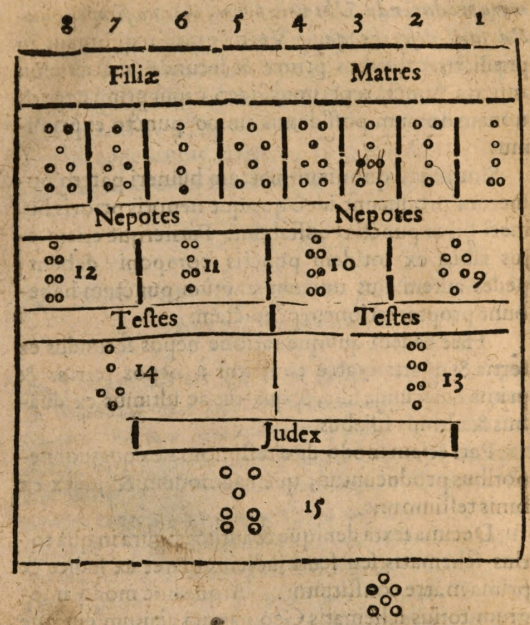
It must be noted that from the said mothers,1 who constitute the first four figures of the geomantic shield, four daughters, constituting the fifth, sixth, seventh and eighth figures, arise, taking separately the parts of all the mothers. In the previous example we take from the first figure / . / from the second / . . / from the third / . / from the fourth / . . / And thus these four parts, joined together, generate the first daughter occupying the fifth house, namely, the figure called Amissio. From the mothers’ shoulders the second daughter is born occupying the sixth house, from the legs the third, from the feet the fourth.
But first the niece is derived from the two first mothers, for her head is fused from their two heads, etc. And this is a general rule: that where two heads, shoulders, legs, or feet joined together produce an odd number, namely three, they produce a single; but when they are even, they produce two points. For example: since we find only three points in the aforesaid heads of the first and second mothers, we therefore express the head of the first niece who occupies the ninth house with a single point.
In the same way, since the mothers’ shoulders produce an equal number, therefore also the shoulders of the first niece will consist of two points. Equally, her legs must also be composed of the same number of points, and her feet will have only one point for the above reason. For this reason also, the second niece is fused from the third and fourth mother; the third niece from the first and second daughter, and the fourth and last from the two and last daughters.
In the same way, two Witnesses are produced from four nieces, just as a Judge is produced from two Witnesses. Finally, the sixteenth, the last figure in which the whole shield is summarized, is made up of the Judge and the first mother. And in this manner the whole geomantic shield and its houses must be filled, from which the judgment in this art is to be taken.
A geomantic shield, from Robert Fludd’s Geomancy handbook
Footnotes
Referring to Book I, Part 3. This section requires no commentary, as it describes the usual technique of deriving the full shield from the initial four figures. ↩︎
On the projection of sixteen lines, divided into four orders, constituting the first four geomantic figures
Before proceeding to the projection of the [geomantic] lines, which are made up of points, we shall lay down certain rules to explain the reason and manner of creating them.
Rule 1
It is not for the artist to make a judgment on any question relating to a matter which he has already known and understood before, for by doing this he is trying God and his divine knowledge, and will err on that account.1
Rule 2
Do not count the number of points of any line, for by that reason the soul will somehow be disturbed in the calculation.2
Rule 3
If you want to work in this science, you must first describe the proposed problem, so that your understanding is not disturbed otherwise.
Rule 4
You must not make a double question, but form the question in such a way that it asks for the knowledge of only one thing; otherwise your figure will be so disturbed that you will not be able to judge anything correctly. For this reason the question must be rectified in such a way that it has a single and complete purpose.
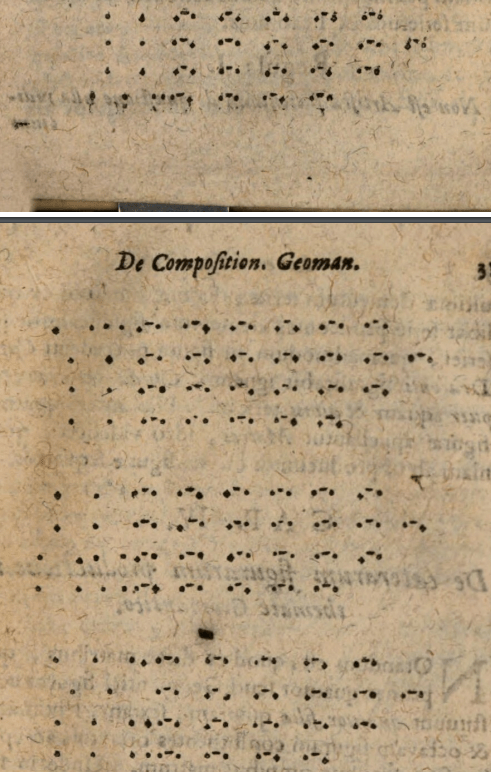
It must be noted that these geomantic lines merge from equally distant points and must have the form of the four fingers of the hand, as will be seen in the following example, and the points of each line we must connect and concatenate in such a way, proceeding from right to left, that at its extremity to the left one or two points are left free from concatenation.
Example of a geomantic projection
This also must be done with all the lines of the aforesaid four series, and in this way will come forth the four first figures of the geomantic shield, representing the four elements with their natures and combinations, likewise the four winds, and the four parts of the world; for, as regards the elements, the four first lines will signify the element of fire, the second four will denote the element of air, the second three the element of water, and the last four the element of earth.3
Of course, the figures coming out of each series will represent an element of their series, just as in the previous figure Caput will represent fire, Causa will represent air, Puer will represent water, and Albus will represent earth. Now these four figures are called Mothers, because from them all the following figures are produced.
MQS
Footnotes
Asking a question whose answer we know implies that the actual question is “Does this really work?” which is a question no system can answer from within itself, therefore the question implies doubt in the author of the system ↩︎
Counting the points not only implies trying to cheat the system, but it also robs the divination of its random, inspired aspect. ↩︎
The elemental attributions of the figures is not of major practical importance, but it serves to respect the connection between microcosm and macrocosm and to anchor the question to a cosmic mechanism. ↩︎
Fludd discusses the mystical implications of using divination.
5. The Act of a True Geomancer Is Like a Movement of the Mind in Ecstasy, or Rather a Sort of Rapture, in Which There Is Prophecy
Rapture in general is called the abstraction, alienation, and illumination of the human mind, proceeding directly from God, through which prophecy is obtained.1
Thus also a certain kind of rapture and ecstasy is required for divination by Geomancy, which is not called the illumination of the mind directly emanating from God, but rather the act of gathering of the mind’s rays into a narrower place, that is to say, into the seat of the human body and its own home, so that through them the divining soul discerns the simple truth more clearly.2
As such, ecstasy is first of all required in this knowledge, that is, the abstraction of the rays of the mind from all external things or affairs, so that they are contracted within themselves: for in a great rapture of the mind and soul the rays are lifted up to the divine essence of God, or into the region of the mental world.3
Thus, even in this minor rapture of the human soul, the rays sent out from without, and scattered here and there, are recalled to their center, and are reflected in the mind, and thus man, who was formerly dark because of the diffusion of his own light, is now enlightened and glorious by the aggregation of the expanded rays.
In a similar manner, as we gather from the opinion of the learned men, on the third day of creation the rays created by the light scattered evenly throughout the sky, and all appeared in a dark manner, as if darkness were mixed equally with light, or night with day.4
But when, on the fourth day, all that light scattered everywhere was collected in the center of the solar body by a certain magnetic property, there was produced that glorious and worthy example of light, in which God himself is said to have had his tabernacle.5
We also see, for instance, that in a fortress equipped with a thousand soldiers, if the greater part of these soldiers, either for the purpose of preparing for defeat or for some other attempt, goes out and runs to and fro, then that fortification is rendered weak, and those who are left experience great fear.
But if those who had gone forth should return safe and sound, those who had been left in the stronghold recover their former confidence and their former hope, and putting aside all fear, they are in no way afraid of the invasions of the enemy, since that place is already well-furnished with warriors.
Here, therefore, things are in the same way with the bright rays of the human soul. For the human body is a stronghold or fortress, where the rays of the mind and the middle soul are likened to soldiers, of whom we may compare those who are sent out of the body to attend to foreign affairs, to soldiers running hither and thither outside the fortress, the absence of which renders the body less confident, and more insecure and timid, and weak in facilitating some noble and bright aim, such as divination, which is the best and highest thing.
We say, therefore, that the recollection of rays of this kind is the reduction of man’s internal nature from multitude to simplicity.6 As a result the soul, recalled from external meditations, and reflected and recollected within itself, renders a man, as it were, raptured and ecstatic, because he thinks of himself and within himself, he is only present to himself, oblivious of strangers, so that it appears to the ignorant that he is not aware of himself. when, in truth, he is now more than ever before.7
For he who neglects worldly things is sure to care for himself more, and he who withdraws himself from the multitude into himself seems to be most present to himself, since there will not be a great interval of distance between him and God.8
To such an attitude or disposition must he reduce himself, who endeavors to procure for himself the gift of future divination. For those thinking of externals divert the powers of the soul from the judgment of truth, so that the uncertainty of the geomancer is great in his judgment, or to be more precise, the truth in him will be as great as the variation of the soul from its unity.9 Indeed, in the multitude of things, tricks, vanities, and lies are concealed; in true unity and simplicity perfection, identity and unity [are found].
Let the soul therefore snatch from the Macrocosm that which is its own, given to it by the Creator in its creation, and internalize it into its own Microcosm, and let no one else enjoy what is its own.
By virtue, I say, of his own excellency, he is snatched from the world, and restored to himself and recollected, and clings to ecstasy, so that in his most refined mirror or spirit he may reflect not only worldly things, but also divine ones. For the more clarity he achieves, the more effective will be his visions and motions for prophesying the truth
6. About the Hidden Properties of Geomancy, and How the Soul or Mind Passes in Its Operation Through the Whole Nature of the Macrocosm
Nor is it right that those who are ignorant of geomancy should regard a series of points as mere lines, formed from the act of divination, since under these characters, the objects of the eye and the senses, many things, both spiritual and material, are concealed. Indeed, these series of lines comprise no less the idea of the universe than the human body itself.10
In fact, although in man his body can only be seen from the outside, yet with spiritual eyes we contemplate his spirit and soul and mind inwardly. Of course, in the body we see the elements invisibly mixed in composition;11 in the spirit and soul we observe the ethereal nature, in the intellect and mind we observe the empyrean nature.
the same can be observed also in Geomancy, since readings consist of four lines of points, and we perceive that the four elements are concealed in it, that is to say, the element of fire under the first line, of air under the second, of water under the third, and of earth under the fourth. 12
Furthermore, in the figures produced by those series of points, the seven planets and the twelve heavenly signs are included, which can only be perceived by the eyes of the spirit.
Thus the figure of Carcer is attributed to Saturn direct and Tristitia retrograde: the figure Laetitia signifies Jupiter direct, Acquisitio retrograde; Rubeus denotes Mars direct, and Puella retrograde; Major indicates the Sun in a certain direction, and the Minor in retrogradation; although the astrologers deny the retrogradation of the Sun, because of its epicycle; Puer is given to Venus direct, Amissio retrograde;13 Albus is attributed to Mercury direct, Conjunctio when retrograde; the direct Moon is symbolized by Populus, the retrograde by Via;14 Caput Draconis is represented by a figure bearing the same name, and Cauda Draconis is represented by a figure bearing the same name as well.
So also those figures contain in themselves the natures of the twelve signs. For Acquisitio is of Aries in an abstract manner; Laetitia and the Minor of Taurus, Rubeus and the Puer of Gemini; Albus and Populus of Cancer; Via of Leo; Caput and Conjunctio of Virgo; Puella of Libra; Tristitia and Amissio of Scorpio; Caput of Sagittarius; Cauda of Capricorn; Major of Aquarius; Carcer of Pisces.
Furthermore, Rubeus, Minor, Amissio and Cauda denote the element of Fire and the Southern part of the world; Laetitia, Acquisitio, Puella and Conjunctio denote Air and the Eastern part of the world; Populus, Via, Puer and Albus denote Water and the Northern corner of the world; Major, Caput, Carcer and Tristitia denote Earth and the Western part of the world.
Even deeper towards the center of the sky lies the empyrean spirit,15 which is the revealer of the future and the present, that is to say, the rational or intellectual collection of these figures and the worldly things contained in them.
From all this it is evident how purely and sincerely the intellectual spirit must be preserved from the inconveniences and harms of the flesh and filth, when from it the movement to produce the Geomantic points first arises, taking with it in a secret manner the natures of the heavenly signs, the planets, and the elements, and finally hiding all these under the number and in proportion to the points, like a certain treasure in a chest.16
If, therefore, we wish to open that chest, first to the elements, then to the planets and celestial signs, and finally to the boundary from which these movements originally flowed, we shall penetrate in the sanctuary of the mind, its will, in the mythotheque of the intellect, of the will, of the signs and planets; in the closet of the ether we shall find the act or execution of the mind; and in the storehouse of the elements, we shall find the effect of the mind’s will, reason, and act (all of which are contained and hidden under figures, as if in a chest).
From the aforesaid, therefore, it is evidently clear that, just as the prophecy of the inspired is the union of the divine mind with the human mind (whence it is the most complete and greatest, this species of prophecy), so also the prophecy of the uninspired sometimes happens, when the soul is united, with its rays drawn back to itself from the multitude toward its summit, that is, with the human mind, which, without doubt, if united with the soul and collected, can perform enormous things by itself, and can lead to the summit and a happy outcome.
MQS
Footnotes
The words ‘abstraction’ and ‘alienation’ must not be understood in their usually negative sense. In Neoplatonism (and mostly in Plato himself as well), the dialectical method allows the spiritual seeker to climb up the ladder of being through a process that leads from the particulars of the material world upward and inward to unity with the divine. Ecstasy, which is the goal of Neoplatonic spirituality, literally means “going out of oneself”. This is the process of abstraction and alienation. ↩︎
That is, prophecy stems from direct union with the divine and is harder to control, while divination (such as Geomancy) happens by focusing inward. ↩︎
See Note 1. Fludd describes the Neoplatonic method of retreating inward and upward. ↩︎
If the light is evenly distributed, no difference appears and everything is as equally dark as it is equally radiant. ↩︎
In the Hermetic interpretation of Astrology, the Sun is a symbol of divinity. ↩︎
Broadly speaking, the path of magic in all its branches (and divination is one of these branches) require an endless attempt at simplifying one’s life and one’s external nature. ↩︎
This is a common theme in mystical and occult literature, and one of the great truths of our art. As we reach what some have called ‘superconsciousness’ we appear to be less aware, while in fact we exceed regular awareness. ↩︎
The phrasing here is clearly very careful to avoid scandal. As for the words “caring for himself”, this is not to be understood as being egoistic. ↩︎
that is, we are capable of seing the truth in the measure that our soul is unified. This is probably part of the reason why divining for oneself is especially difficult, since divination implies doubt about an external topic. ↩︎
Here lies a great and central secret about all functional systems of divination: that their symbolic vocabulary is complete in itself, so as to be able to reflect within its permutations the truth of things to come. Here, Fludd compares the language of Geomancy to the human body, which is a symbol of the completeness of the universe. ↩︎
He means the four elements, which were thought to be mixed to form the material bodies. ↩︎
This is a reference to the fact that in Geomancy each figure is made up of four series of points, and each series is assigned to one of the elements. ↩︎
compared to the usual attributions, Fludd switches Puer and Puella ↩︎
The Moon cannot go into retrogradation. Usually, Populus is assigned to the waxing Moon and Via to the waning Moon. ↩︎
with reference to the Aristotelean and Ptolemaic view of the cosmos. ↩︎
This comparison is very much a consequence of Fludd’s Renaissance worldview, according to which Nature is replete with symbols. ↩︎
The modern mind is used to neat distinctions and a more or less monolithic theoretical scaffolding where everything finds its little place. To our sensibility, what belongs to natural science does not belong to literature or art, let alone to astrology or occultism. Though some eccentrics try to straddle the gorge, within the current worldview they must remain what they are: eccentrics. This is largely a consequence of the evolution of science away from the mother root of philosophy and the triumph of the technical-scientific worldview. It is neither a good process nor a bad one: it is what it is, but it hasn’t always been this way.
Pietro d’Abano, who lived between the XIII and XIV century, was, like many of his time, an encyclopedic learner. This was certainly easier back then, when owning a couple of dozens books was considered a marvel and the hyperspecialization typical of our contemporary organization of knowledge hadn’t yet taken place.
The extent of Abano’s involvement in occult practices is not clear. The famous grimoire Heptameron (Book of the Seven Days) is traditionally attributed to him, though it is, in actual fact, an anonymous work. What we do know is that his knowledge of languages allowed him to study many authors (like the Averroes or Ibn Ezra) who had considerable influence on the later development of magical theory, though this influence is still little understood by contemporary occultists.
We also know that he taught a number of subjects ranging from medicine to astrology, and that he was a very adept astrologer. This is not a unicum in the history of science. Astrology was one of the few forms of divination that was, if not tolerated, at least not as consistently persecuted as other branches of occultism in the Middle Ages, largely due to the fact that a reasonable argument could be made that the astrological influence of the planets was a natural consequence of how the cosmos was believed to work according to the Platonic-Aristotelean view accepted by the Church. It was simply not always practical to distinguish astrology as astronomy from astrology as divination, though attempts were made.
Finally, Abano is the subject of a number of urban legends. For instance, he was brought before the inquisition twice, largely due to his immense erudition. Once he was acquitted, the second time he was condemned. Unfortunately, he died in custody before the sentence had been pronounced, so the tribunal ordered his body exhumed and burned. But they dug up an empty grave, since a friend of the philosopher had gotten to his body first. This fact alone was enough to cement in people’s mind the image of Abano as an ominous magus and necromancer whose body was capable of disappearing from the grave.
As for the present book on Geomancy, it is not a stretch to think that someone as versed in astrology as Abano should be interested in this form of divination, which, at least in Europe at the time, was reduced as much as possible to astrological principles. The treatise is divided into four books: in the first, Abano explains the principles and astrological correspondences of geomancy; in the second, he discusses the meanings of the various houses and the principles of geomantic perfection; in the third, he gives examples of the meanings of the figures in the houses; in the fourth, he talks about the good or bad fortune of the figures depending on which figures they derive from.
What makes this book an interesting read for any student of geomancy is that it confronts us with a way of reading the Geomantic Shield that is not typical of how geomancy has been rationalized in the late XX and early XXI centuries. This is in itself worthy of consideration, especially because it proves beyond doubt that the distinction between Shield Chart and Astrological Chart is artificial and only serves to complicate matters. Furthermore, Abano’s interpretation of the figures affords us a rare glance in the workings of the mind of an adept of geomancy, by whose example we can derive solid principles for interpreting our divinations. Abano’s examples are therefore not meant to be taken as the last word, but as a contribution to our study of the interrelation of the Geomantic figures.
My translation and comments on Robert Fludd’s Animae Intellectualis Scientia seu Geomantia (The Intellectual Science of the Soul or Geomancy). Please note that I am no professional translator of old texts and sometimes I had to paraphrase. Feel free to leave comments or contact me on how this project could be improved. The translation and commentaries are copyrighted to me, so please ask for my permission before using it.
Introduction Part I – Geomancy is an Act of the Soul Part II – Preparing to Divination, the Hermetic Way Part III – The Mystical Presuppositions of Divination
Book I Part I – Anecdotes on the veracity of Geomancy Part II – How to Prepare to Divination Part III – Basic rules on projecting the points Part IV – Filling out the geomantic shield
Book II Part I – Elemental and astrological attributes of the figures Part II – The Houses Part III – The First Four Geomantic Figures Part IV – The Second Four Geomantic Figures Part V – The Third Four Geomantic Figures Part VI – The Final Four Geomantic Figures Part VII – When the Same Figure is Found in Two Houses
Since I began reviewing my geomancy reading method I started nagging some friends for an opportunity to read for them. I am especially interested in seeing whether we can consider the houses in the shield to be adjacent across the shield (like, for instance, the First with the Ninth), as Peter of Abano seems to suggest in his handbook. This would open up the Geomantic Shield to a whole host of interactions.
A friend of mine was applying for a job, so he asked me if he would get it. This is the Shield I got:1
“Will I get the job?” Geomancy reading. App used: Simple Geomancy
The Querent is represented by the First House and the first figure, Tristitia. The Job is represented by the Tenth House and the tenth figure, Caput Draconis. Tristitia is not a great figure, indicating trouble and difficulties. The querent has been having trouble holding down a job or having contracts renewed, so it is fitting that he should be troubled by the situation. Caput is an encouraging figure, showing things beginning, but without contact between the two houses I wouldn’t predict him being hired.
Fortunately, contact is provided by Tristitia, which springs to the Eleventh House. The fact that Tristitia moves, and not Caput, indicates that the querent will need to put quite a bit of effort into the hiring process. Tristitia also springs to the Third House, and, according to Abano, this seems to count as being in contact with the Tenth House. I cannot make any definitive judgment on this issue. I will merely file it away for future consideration.
The Judge is Fortuna Maior, which is a very encouraging indication of success through effort. Possibly, I thought, the hiring process will stretch out and take longer than the querent thinks. The fact that Maior emerges from a very difficult set of Witnesses adds to the obstacles and the delay.
The outcome, thankfully, was positive. He got hired, but the pay was not as satisfying as he thought it would be (note Amissio as Left Witness) and the hiring process definitely lasted way longer than he thought it would.
MQS
Someone asked me if I do my geomancy readings with the app I use to show the chart. I don’t. I always do my readings with pen and paper. The App is only for presentation. ↩︎
Abano discusses the various meanings of Tristitia, Laetitia, Puer and Puella as they derive from other figures.
Laetitia
When from Populus and Laetitia, it means luck, gain, especially in large [or great] things. When from Acquisitio and Puer it means gain, merriment, especially in changeable things. When from Amissio and Albus it means luck, but with mediocre gain. When from Major and Puella it means fixity, gain and good luck.
When from Minor and Rubeus it means mediocre gain or honor or good luck. When from Via and Caput it means gain, honor, positive change. When from Cauda and Conjunctio it means misfortune, evil, but incapable of doing all it wants.1 When from Tristitia and Carcer it means mifortune, difficulties and problems.
Tristitia
When from Populus and Tristitia it means misfortune, danger, evil. When from Acquisitio and Rubeus it means fixity and misfortune, except in in things lascivous or feminine. When from Major and Albus it means luck, gain and honor with firmness.2 When from Minor and Puer it means better3 luck in every question.
When from Caput and Conjunctio it means great fortune, gain and stability. When from Via and Cauda it means mediocre luck, difficulties, problems. When from Laetitia and Carcer it means a good deal of luck, but with more problems than positive things.4
Puella
When from Populus and Puella it means infirmity, lascivousness, luck, gain. When from Acquisitio and Cauda it means mobility, mediocre luck. When from Amissio and Tristitia it means good luck after much toiling and difficulties, gain in venereal5 things.
When from Via and Rubeus it means misfortune and anger, rumors, change, damage. When from Albus and Carcer it means gain, good luck, firmness. When from Conjunctio and Puer it means fortune in everything, luck.
Puer
When from Populus and Puer it means gain, good luck, change. When from Acquisitio and Laetitia it means gain, honor, mirth, goodness in everything. When from Amissio and Caput it means good luck, bood in easy things and in seeking pleasure.
When from Major and Cauda it means unfortunate change, damage. When from Via and Albus it means useful variety,6 fortune, good change. When from Carcer and Rubeus it means major misfortune in everything, loss. When from Minor and Tristitia it means fortune, some kind of gain, strife.
THE END
MQS
Footnotes
It is not clear wheter Abano means that the person won’t be able to do all he or she wants, or whether the evil signified by this combination is not all-pervasive. ↩︎
In this case, it seems that Tristitia’s role is to solidify the good fortune signified by the two figures it comes from. ↩︎
‘migliore’ means ‘better’, but it’s unclear better than what. ↩︎
These two meanings might be hard to harmonize, though maybe not impossible. ↩︎
Abano discusses the various meanings of Albus, Rubeus, Conjunctio, Carcer depending on the figures they come from.
Albus
When from Populus and Albus it means love of women,1 good luck in everything, especially in feminine things. When from Acquisitio and Caput it means excellent good luck, stability, love, gain. When from Amissio and Laetitia it means changeability, variety, and its effect is strong.2
When from Major and Tristitia it means positive stability, mediocre luck. When from Minor and Cauda it means change, variety, mediocre luck or gain. When from Via and Puella it means good luck, change.
Rubeus
When from Populus and Rubeus it means danger, misfortune, loss of blood, tears. When from Acquisitio and Tristitia it means misfortune, loss. When from Cauda and Amissio it means weak fortune, problems in everything. When from Minor and Laetitia it means variety, mutability, mediocre luck. When from Via and Puella it means changeability, misfortune, loss.
When from Albus and Conjunctio it means well, positive things, honor, stability.3 When from Puer and Carcer it means mutability, misfortune, except in war. When from Conjunctio and Albus it means positive things, succession, some difficulties, bad outcome. When from Puella and Carcer it means stability and positive outcome
Conjunctio
When from Populus and Conjunctio it means good luck, gain, getting one’s wish. When from Acquisitio and Major it means great good luck in everything. When from Amissio and Minor it means bad luck, but good outcome in the end.4
When from Via and Carcer it means mediocre bad luck, but inclining more to bad than good. When from Caput and Tristitia it means stability, fortitude, great troubles, honor, gain. When from Cauda and Laetitia it means problems, mediocre honor.
Carcer
When from Populus and Carcer it means major troubles, long-lasting issues, delay in obtaining freedom (from prison). When from Acquisitio and Minor it means good outcome, gain.5 When from Amissio and Major it means misfortune, loss. When from Conjunctio and Via it means bad luck, tragedy in everything.
When from Caput and Cauda it means misfortune, trouble, loss, problems. When from Albus and Puella it means luck, gain, honor, mediocre stability.6 When from Rubeus and Puer it means grave danger, misfortune, loss, fights. When from Laetitia and Tristitia it means misfortune, prison, troubles, loss.
MQS
We usually assign women to Puella (and Venus) but in many old texts Mercury (and therefore also its figure Albus) is often described as more female than male, possibly by simple virtue of not being masculine. ↩︎
Why Rubeus should indicate these things is beyond my understanding. ↩︎
Possibly because Minor alters the loss into a final gain. ↩︎
While it is clear it derives from positive figures, it is unclear then what Carcer’s contribution to the meaning would be, except that maybe it crystallizes the good luck, making it last. ↩︎
I do not understand how Carcer can indicate honor. ↩︎
Abano discusses the various meanings of Via, Populus, Caput and Cauda when deriving from various figures.
Via
From Via and Populus, its meaning is weakened, but quickened.1 From Acquisitio and Amissio its efficacy is mediocre in every question. From Major and Minor it means good luck, but it is still mediocre. From Laetitia and Caput, it means good luck and success.
From Tristitia and Cauda it means misfortune in the question at hand, and it is very strong in its malice. From Albus and Puer it is mediocre good luck. From Rubeus and Puella it shows a mix of good and bad, but it brings about the thing quesited. From Conjunctio and Carcer it means good luck, stability and firmness in all one asks about.
Populus
From Populus and Populus it means stability, getting one’s wish, copious amounts. From Acquisitio and Acquisitio it means great good luck, great acquisition of what one wishes, usefulness. From Amissio and Amissio it shows good luck, and being venereal and lascivious. From Major and Major it means fortune, stability, great gain, honor. From Minor and Minor it means mediocre good fortune. From Via and Via it means weakness in the thing enquired about. From Caput and Caput it means good luck, usefulness. From Cauda and Cauda, it means great misfortune.
From Albus and Albus it means good effect, good outcome especially in watery things and womanly or white things. From Rubeus and Ruveus it means excessive evil, war, loss of blood. From Laetitia and Laetitia it means good luck, happiness, honor, easily getting what one wants. From Tristitia and Tristitia it means great misfortune, long lengths of time, difficulties and problems, enmities. From Conjunctio and Conjunctio it means good luck, getting one’s wish, good for marriage and partnerships. From Carcer and Carcer it means great good luck in everything, melancholy and difficulties, anger, discord, infirmity, prison. From Puella and Puella it means good luck and fortune, firmness, usefulness, getting one’s wish. From Puer and Puer it means war, fighting, discord, good for merchandise, mediocre gain, good for marriage.2
Caput
From Populus and Caput it means great firmness, good outcome. From Acquisitio and Albus it means great good luck, getting one’s wish. From Amissio and Puer it means misfortune, loss, difficulties. From Major and Rubeus great good luck, mediocre gain or honor, good fortune. From Tristitia and Conjunctio it means good luck and gain, but with delay and difficulties. From Cauda and Carcer it means misfortune and tragedy.
Cauda
From Populus and Cauda it means misfortune, long illness, difficulties, weakness in getting one’s wish. From Acquisitio and Puella it means good fortune, firmness, usefulness in mobile things.3 From Amissio and Rubeus it means misfortune and grave danger. From Major and Puer, it means misfortune under the guise of gain.
From Via and Tristitia it means misfortune in getting what one wishes, and long-lasting difficulties. From Caput and Carcer it means mediocrity, good for virtue and honorable things, otherwise loss. From Laetitia and Conjunctio it means mediocre fortune, but gain from merchandise. From Albus and Minor, it means good luck and freedom from difficulties, but mediocre gain.4
MQS
Footnotes
One of the reasons this Book IV is interesting is that it affords us a look into how old geomancers derived meanings from the interaction of figures. Unfortunately Abano’s process is not always clear. Furthermore, it is not clear whether Abano means what I have written (namely, Via’s meaning is weakened but quickened) or if he is saying that Via’s meaning is weakened more than any other figure. I have chosen my interpretation based on this logical argument: that Populus tends to accentuate the meaning of the figure it interacts with, and Via is weak and quick, so in interacting with Populus it would become weaker and quicker. ↩︎
Generally speaking, it seems the effect of Populus is that of accentuating the meaning of the figures it comes from (‘lots of…’). However, some interpretations are not clear, for instance Carcer and Carcer meaning great good luck. Note also that Populus is the only figure that Abano explains in full, giving all possible combinations. ↩︎
It seems here that the two positive figures rub off on the otherwise foreboding Cauda. ↩︎
Again, the two positive figures it comes from seem to bring out the best in Cauda, according to Abano. ↩︎
Here Abano begins a discussion of how the genesis of each of the figures from other two figures can modify their meaning.
Since one is not only supposed to consider the springing of the figures from one place to the other, but also their origin and generation one from the other,1 an esposition of of the meanings of each of the figure depending on the figures it is born from is in order, without forgetting the inherent meaning of the figure, as well as that of the querent’s and quesited’s, and those figures in the angles, and those conjoined to them.
Acquisitio
From Populus and Acquisitio: recovering one’s losses or recovery from damage; gain, profitable journey. From Amissio and Via: dishonorable journey, but useful, recovering something lost. From Fortuna Major and Conjunctio: good luck, mediocre gain, and [it is positive for] the thing asked. From Fortuna Minor and Carcer: love between husband and wife,2 and [it is good for] the thing asked. From Puella and Cauda Draconis: gain, usefulness in things of merchandise, and gain from difficulties.
From Puer and Laetitia: gain from minerals, gain from merchandise. From Tristitia and Rubeus: fortitude, stability in everything, good outcome, victory, loss of merchandise. From Conjunctio and Fortuna Major: good luck, mediocre gain. From Carcer and Fortuna Minor: usefulness; kings and lords, noble people. From Albus and Caput Draconis: good luck in material things, loss of objects.
Amissio
From Populus and Amissio: loss, trouble, good luck for the ill and the imprisoned, good for traveling. From Acquisitio and Via: damage, trouble, loss, the lost or stolen thing is not found, vain friends or servants. From Carcer and Fortuna Major: trouble, problems, little gain. From Caput Draconis and Puer: good luck in things connected with women; in other questions, gaining what one wants results in damage. From Rubeus and Cauda Draconis: misfortune [or accident], injury, fear, fighting, trouble, damage, illness.
From Conjunctio and Fortuna Minor: loss of animals, lots of trouble, desperation for the thing lost. From Albus and Laetitia: freedom from illness or prison, the absent party will come back, white clothes, mobile things, quick ending. From Puella and Tristitia: poverty, vile things, trouble due to secrets, desperation, mirth, luck in debauched things. From Fortuna Major and Carcer: recovering the lost or stolen thing.3
Fortuna Maior
From Populus and Fortuna Maior: luck in everything, getting what one wishes to get, but with delay. From Carcer and Amissio: being very lucky and obtaining what one wants, but with difficulties. From Albus and Tristitia: it means good news, messenger, usefulness, dignity, good salary [remuneration]. From Caput Draconis and Rubeus: great accident or misfortune, hanging, health problems, violent death.
From Amissio and Carcer: accident, problems, prison, good ending but with difficulties. From Fortuna Minor and Via: fighting, good news, quick dispatch, honorable journeys. From Acquisitio and Conjunctio: good fortune, prosperity, getting one’s wish. From Puer and Cauda: good fortune, tranquillity after much trouble, getting one’s wish with much delay. From Puella and Laetitia: mediocrity in everything, good things.
Fortuna Minor
From Populus and Fortuna Minor: its meaning has more virtue in good as in bad depending on the question. From Acquisitio and Carcer: stability, certainty, mediocre fortune. From Amissio and Conjunctio: good but mediocre fortune, especially in mobile things, less in stable things. From Fortuna Major and Via: great virtue, great good fortune.
From Caput and Puella: good luck, especially in friendship and marriage. From Albus and Cauda Draconi: mediocre good luck, especially in feminine things. From Laetitia and Rubeus: very noble things, luck in mobile, outgoing things. From Puer and Tristitia: mediocrity, but more bad and mutable than otherwise.
MQS
Footnotes
This seems to imply that we must consider how the figures are generated on the shield. Whether this applies only to the Judge is not clear, though Abano seems to hint at the need to consider all figures, since he also considers those that cannot be Judge. ↩︎
Admittedly, some of these explanations are hard to follow. I do not know, for instance, why this combination should indicate positive things between husband and wife. ↩︎
Abano does not present all possible combinations. It is not clear whether he forgot or he thought it was enough to give some examples. Note also that some explanation almost seem contrary to reason. ↩︎