Tag Archives: Geomancy

Veggie Delivery Service! (Double reading)

Background: hubby and I are on a weekly veggie delivery service from a nearby farm. Yesterday they told us they might come a bit later than usual (normally they deliver at around 12-13pm). As hubby needed to go to work and I had a ritual to carry out and carefully timed, I needed to know that I wouldn’t be disturbed during the ceremony. So I asked when the veggies would come.

Horary Astrology

Here’s the horary chart (the time was 12:56)
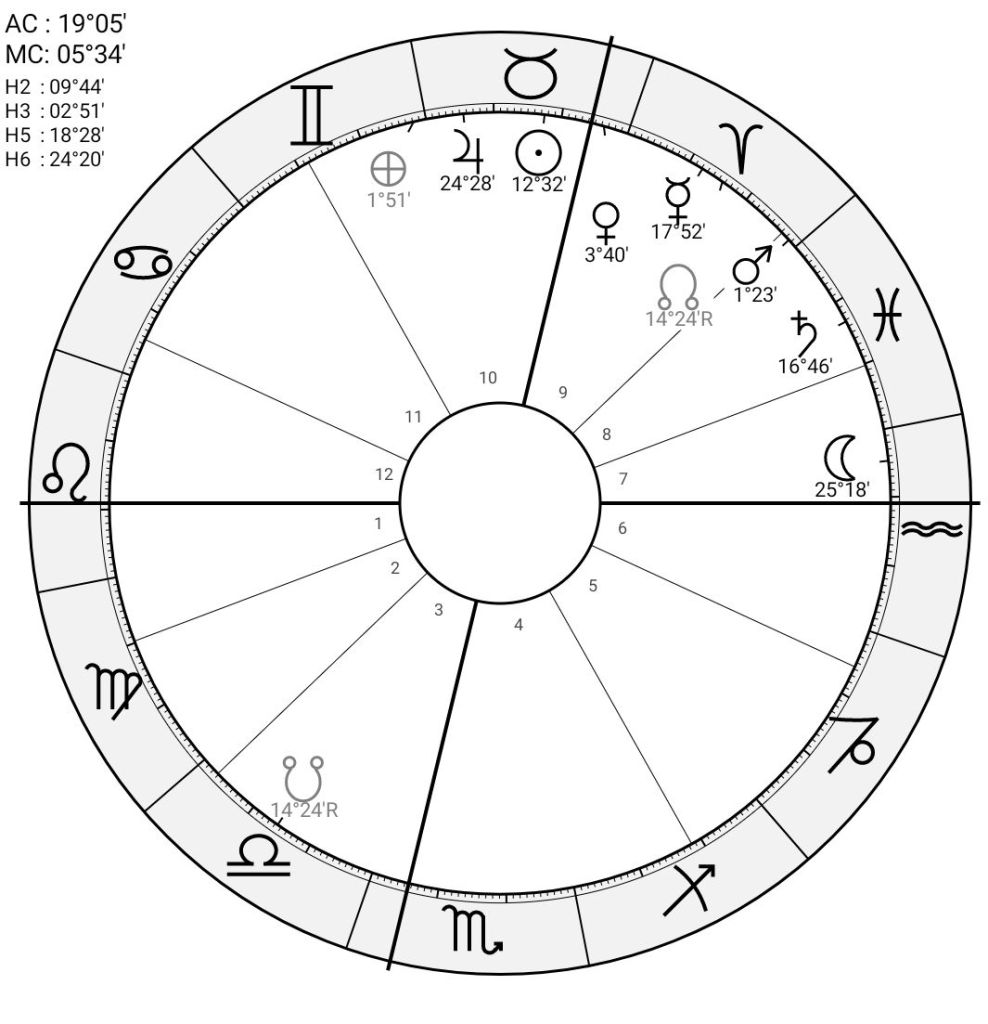
Horary question: when will the veggies arrive? App used: Aquarius2go

Leo rises, so Leo’s ruler, the Sun, is my significator. The delivery service is our business partner, since we buy stuff from them and they bring it to us, so they are signified by the seventh house ruler Saturn (ruling planet of Aquarius). The veggies are their moveable possession, so they are indicated by the second house from the seventh, i.e., the eighth house, and its ruler Jupiter. The Moon is given to us as cosignificator and indicator of the flow of action.

Right off the bat we notice the Moon, weakly dignified in the seventh house, so action (obviously) starts from the delivery service. The Moon has separated from a square with reception with Jupiter, i.e., the veggies, and is now void of course. Clearly there are some problems (a square with reception is still a square). Still, there is a promising sextile (a positive aspect) between the Sun and Saturn, though it’s odd to see our significator applying to theirs (see the Outcome for why).

The Sun perfects the aspect at 17 degrees and 10 minutes of Taurus. The difference from its current position is of 4 degrees and 38 minutes, so they will come in 4 and 38 somethings. I would need to see serious testimonies to judge they won’t come. The Moon being void of course can delay them, but there is a clear aspect showing they’ll come. So they will come today, I thought.

Therefore, they will either come in 4 minutes and 38 seconds or in 4 hours and 38 minutes. I thought the second option was the most likely, so since the chart was cast at 12:56, and allowing some wiggle room for reality to follow astrology, I judged they’d come anywhere between 17.30 and 18, though I was somewhat skeptical, since this timing would have been unprecedented for them, and they’d told us they would come only a little bit later than usual. But at least this gave me plenty of time for my ritual.

Geomancy

After my ritual, which was timed for around 15 in the afternoon, I decided to have a look at what Geomancy had to say about this delivery:
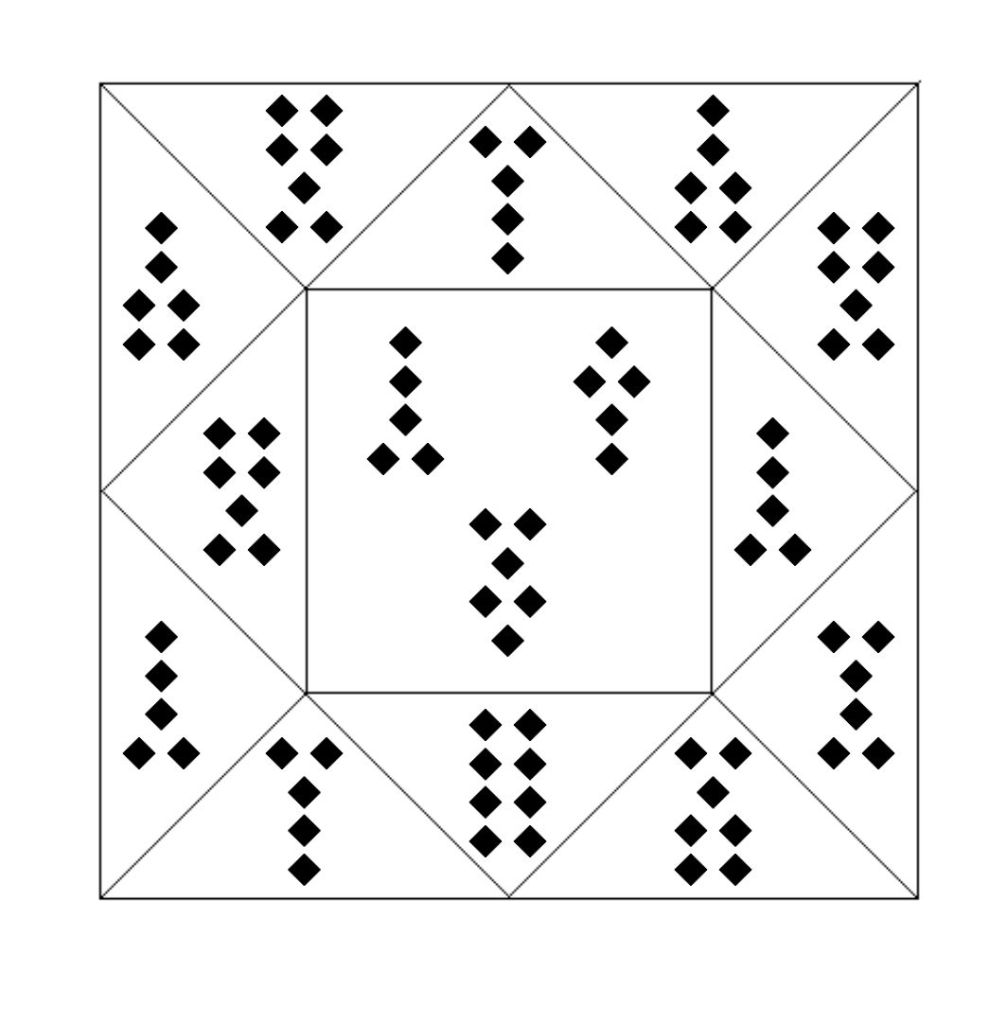
Geomancy reading: veggie delivery service. App used: Simple Geomancy

The Geomantic court is positive, with the Judge Acquisitio showing we’ll get the veggies, but the Witnesses are mixed, showing problems. Albus is in the first, and it’s a good figure for commerce. A very unpromising Cauda Draconis is in the seventh house (which is also the left witness). I must say that I have seldom seen things resolved satisfactorily when Cauda is involved. However, Cauda does spring to the second house, perfecting. I was also relieved, but also a bit puzzled, to see Albus spring to the eighth, also perfecting the chart. Usually, the figure that moves makes the effort. In this case, it seems both of us will make some effort, and that our effort is better than theirs.

Outcome

They did come between 17.30 and 18 (around 17.45). However, they gave us the wrong delivery, which we only noticed when they’d already gone away. So we had to call them back and go meet them to exchange the wrong veggies for the right ones. Note how in the horary our significator applies to theirs and how, in the Geomantic chart, Albus moves to the eighth.

Lessons to be learned

1. Horary questions must not be idle, but they need not be life-changing. Knowing when a delivery service will arrive may seem idle curiosity, but I had a serious reason to want to know the answer (I take my magic work seriously)

2. The divination device, whatever it may be, ALWAYS knows best, though we may be fallible in interpreting it. People like to say that divination lets you contact your unconscious. I think there is altogether too much talk about the unconscious, and not enough talk about the superconscious. I saw from the Geomancy reading that there were problems connected with the delivery, though I could not pinpoint them exactly. In hindsight it is clear what the chart meant.

3. It is a humbling and inspiring experience to see how perfectly the cosmic mechanism works.

MQS

Peter of Abano’s Geomancy, Translated and Annotated / Index

Back to the Geomancy Page

My translation and comments on Pietro d’Abano’s Geomanzia. Please note that I am no professional translator of older texts and sometimes I had to paraphrase. Feel free to leave comments on how this project could be improved. Note that the translation and commentaries are copyrighted to me, so please ask for my permission before using it.

Introduction to Abano’s Geomancy – And why it makes for an interesting read

Book I
Part I – The Figures
Part II – The Chart
Part III – Meanings of the Figures
Part IV – Meanings of the Planets
Part V – The Witnesses, Judge and Sixteenth Figure
Part VI – Judging the Figures in the Houses

Book II
Part I – The First House and Second House
Part II – The Third and Fourth House
Part III – The Fifth House and Sixth House
Part IV – The Seventh House and Eighth House
Part V – The Ninth House and Tenth House
Part VI – The Eleventh House and Twelfth House
Part VII – Example of Various Dynamics
Part VIII – Geomantic Perfection

Book III
Part I – Geomantic Mutation
Part II – Acquisitio and Amissio in the various houses
Part III – Fortuna Major and Fortuna Minor in the various houses
Part IV – Laetitia and Tristitia in the various houses
Part V – Albus and Rubeus in the various houses
Part VI – Puella and Puer in the various houses
Part VII – Populus and Via in the various houses
Part VIII – Carcer and Conjunctio in the various houses
Part IX – Caput Draconis and Cauda Draconis in the vatious houses

Book IV
Part I – Acquisitio, Amissio, Major and Minor as they derive from other figures.
Part II – Via, Populus, Caput and Cauda as they derive from other figures.
Part III – Albus, Rubeus, Conjunctio and Carcer as they derive from other figures.
Part IV – Laetitia, Tristitia, Puella and Puer as they derive from other figures.

MQS

The Geomancy of Peter of Abano – Book I Pt. 1

Back to Index / Part 2

Here Abano introduces the subject matter and the names and main qualities of the sixteen figures.

Geomancy is a simple science to master. It employs the same methods of astrology to answer any question the person might have—whether what one wants to undertake will meet with success or not, according to natural virtue and celestial influence.1

This method of judging [questions] and receiving information avails itself of four figures made of ink points on a piece of paper by the Geomancer’s hand, which is moved by the heavenly influence of God’s eternal grace.2 As such, one must ask one’s question with sincerity and a pure soul.

From the initial four figures, sixteen are derived (and no more than sixteen) to answer any question the person might desire to know [the answer to]. However, not all the figures are necessary in answering a specific question. Only fifteen are, and they are enough to answer any question.3
These fifteen figures don’t always come up in the same way, but only as Heaven influences them to come up.4

These are the sixteen figures and their names:

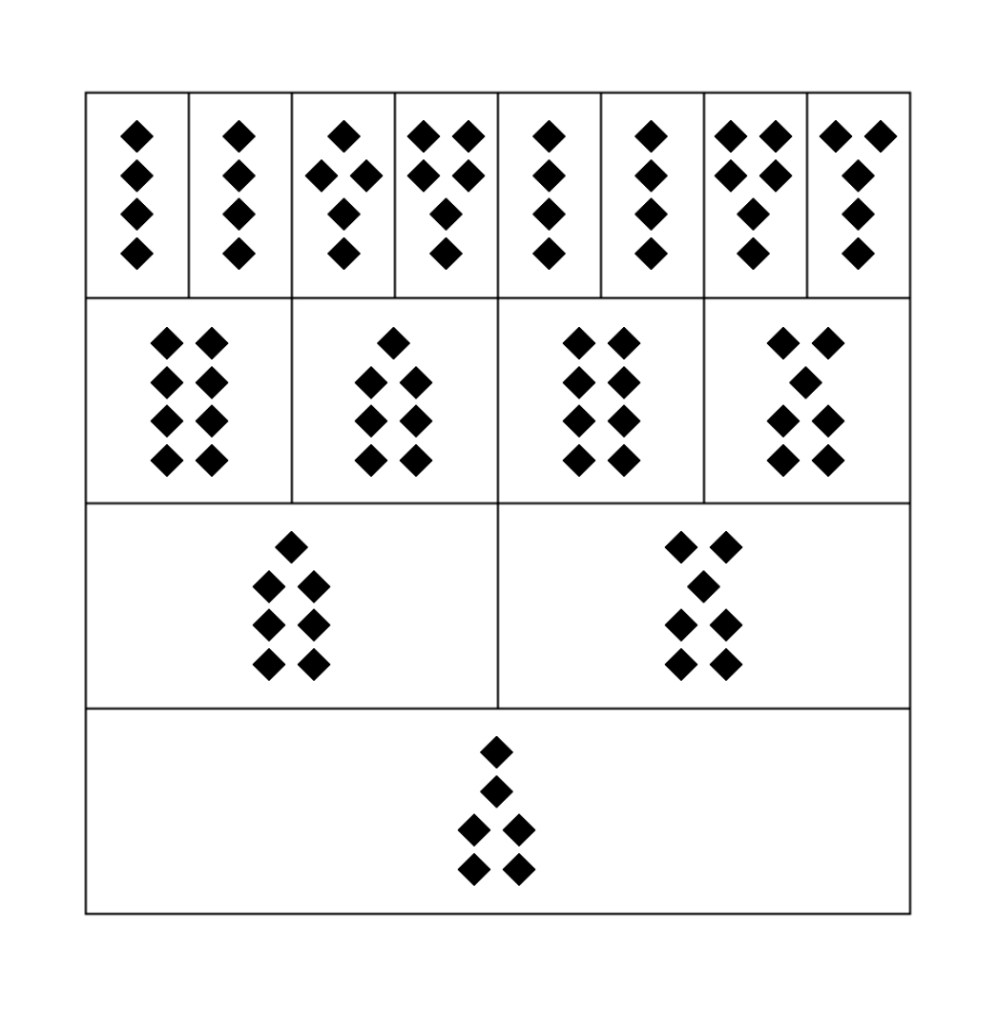
Abano’s illustration of the sixteen figures with their latin name

Four figures are assigned to each quadrant of the Heaven (North, South, East, West) and to the four elements (Fire, Air, Water, Earth) as will become clear shortly. They are called fortunate or unfortunate.

Rubeus, Amissio, Fortuna Minor and Cauda are Fiery, that is, hot and dry, and of choleric complexion,5 southern, diurnal, masculine, strongly malicious, haughty and furious.6

Acquisitio, Laetitia, Conjunctio and Puer are airy, that is, hot and wet, of sanguine complexion, eastern, masculine and diurnal, very good and temperate, and good wherever they fall in the chart.7

Puella, Populus, Via and Albus are cold and wet, of phlegmatic complexion, northern, feminine and nocturnal. Generally fortunate and good where they fall in the chart.

Caput, Fortuna Maior, Tristitia and Carcer are earthy, that is, cold and dry, and of melancholic complexion, western, feminine, nocturnal. Two are good, Caput and Fortuna Maior, while two are bad, Tristitia and Carcer. They are slow and slothful in their meanings, but they cause what they promise nonetheless.

All the above is to be noted when a figure represents a person and another figure a different person, that we may know their character and how well they may get along.

The sixteen figures have yet another cycle of attributes that renders them positive or negative. Depending on whether they are mobile or fixed, we may know how soon or how late the effect will manifest, and how the situation shall be resolved according that they are entering or exiting or mixed.

Acquisitio, Fortuna Maior, Albus, Caput, Puella and Tristitia are entering, fixed, good and fortunate, except Tristitia, which is always bad.

Amissio, Fortuna Minor, Rubeus, Cauda, Puer and Laetitia are exiting, mobile, bad and malicious, except Letitia, which is always good.

Populus, Via, Conjunctio and Carcer are said to be common, that is, neither very quick nor very slow, and they are also neither too good nor too bad, though they tend to err on the side of goodness, except for Carcer, which is always evil.8

And yet another meaning must be added, which shows whether the people signified by the figures conform to one another in terms of will and soul, according that the figures are mobile, quick or slow, and according that they are single-bodied or accompanied [double-bodied].9

Acquisitio, Fortuna Maior, Puella, Caput, Tristitia and Albus are fixed, single-bodied and regular.

Amissio, Puer, Cauda, Letitia and Rubeus are mobile, half-bodied and diminished.10

Fortuna Minor, Carcer, Conjunctio, Via and Populus are common, that is, between mobile and fixed, and they are neither too quick nor too slow, and are double-bodied and accompanied, except for Via.

And in order that one may easily know the virtue and influence of the Heavens through the sixteen figures, we must also note their correlation with the twelve zodiac signs. Similarly, they are attributed to the seven heavenly planets, according to their influence on the twelve signs.

Abano’s illustration of the astrological attributes of the geomantic figures

However, each figure does not mean the same as the other [assigned to the same planet]. Each has a separate meaning. As such, Carcer is Saturn direct, Tristitia is Saturn retrograde; Acquisitio is Jupiter direct; Letitia is Jupiter retrograde; Rubeus is Mars direct, Puer is Mars retrograde;11 Fortuna Maior is the Sun when elevated, Fortuna Minor is the Sun when depressed and obscured; Puella is Venus direct, Amissio is Venus retrograde; Albus is Mercury direct, Conjunctio is Mercury retrograde; Populus is the waxing Moon, Via the waning Moon. Consequently, the direct signs are better than the retrograde. Furthermore, Caput is attributed to Jupiter and Venus, Cauda to Saturn and Mars.12 But this is not always the case, but rather depends on the question asked.

MQS

Footnotes
  1. The concept of natural virtue underpins the Western magical worldview. The word ‘virtue’ must not be understood in a moral sense, but rather in the sense of ‘property’ or ‘power’. It forms part of the Hermetic doctrine of Signatures. The virtues of the things under the Heavens are generally seen as corresponding to certain celestial factors. ↩︎
  2. This is a rather typical phrasing found in various premodern handbooks. It is connected with the Christian Aristotelean worldview prevalent at the time, whereby God, the unmoved mover, ruled the world not directly, but through a series of concentric spheres, each one corresponding to a planet, except the sphere of the fixed stars and that of the primum mobile. ↩︎
  3. The sixteenth figure is what is commonly referred to as the Judge of the Judge, formed by the Judge plus the first Mother. ↩︎
  4. In other words, they are ‘random’. ↩︎
  5. The word ‘complexion’ is used in a slightly different way from today. It refers to the theory of the four humors (black bile, yellow bile, blood and phlegm). These humors influenced not just the character, but also, up to a point, the appearance of the subject as well as their being prone to this or that illness. ↩︎
  6. Abano seems to include Fortuna Minor among the malicious figures, though later in the text he treats it as generally positive. ↩︎
  7. Abano however does not always treat Puer as a positive figure. ↩︎
  8. In all this section Abano seems to be painting with a very broad brush, talking of the figures as “always good” or “always bad”. Of course things get more complicated. ↩︎
  9. This is borrowed, as so much in geomancy, from astrological practice, where the mutable signs (Gemini, Virgo, Pisces and Sagittarius) are also called double-bodied. Double-bodied signs, and therefore geomantic figures, can indicate the involvement of more than one person. ↩︎
  10. The concept of half-bodied does not, to the best of my current knowledge, come from astrology, but I may be wrong. ↩︎
  11. This seems prima facie counterintuitive, as a retrograde planet is generally considered worse than a direct one, and Puer is generally not considered worse than Rubeus. ↩︎
  12. This is in accordance with the relatively standard Medieval practice of attributing the North Node of the Moon to the two benefics, Jupiter and Venus, and the South Node to the two malefics, Saturn and Mars. This practice developed over time and does not seem to originate in older astrology of the Hellenistic period, when both nodes appear to have been considered more or less malefic, when considered at all. ↩︎

The Shield Chart is the Only Chart

One of the things newcomers to Geomancy learn first is the distinction between shield chart and astrological chart. This distinction has been popularized by Greer in his two books on Geomancy, but it doesn’t originate with him, though he is, to my limited knowledge, the first to insinuate that the shield chart is a beginner’s tool and the astrological chart a more advanced one (his attitude changes in his Golden Dawn writings, where he tries to purge astrology from geomancy and render the shield chart autonomous).

Agrippa (followed centuries later by the Golden Dawn) clearly has the astrological chart in mind, since he advocates putting the four Mothers in the four angles, the four Daughters in the four succedent houses and the four Nieces in the four cadent houses. This idea can only come to mind to someone who primarily uses the astrological square chart, or at least pictures the geomantic reading in those terms.

There are other authors, however, like Cattan, Abano and Alfakini (note that some attribute Alfakini’s work, found in the Fasciculus Geomanticus, to Gerard of Cremona) who clearly think of geomantic practice in terms of the shield chart alone. Not because they are unaware of the possible correspondence with the astrological houses, which all employ, nor because they never attempt to draw the square astrological chart (Christopher Cattan does it in the first part of his book), but because it is clear to them that the twelve astrological houses are meant as a technique to be used to draw meaning out of the shield chart and not as a new or different way of doing geomancy.

This can be seen from the fact that both Abano and Alfakini (and possibly also Cattan, but I have to study his text more closely) clearly consider the twelfth house NOT to be contiguous to the first, as it would be in the square chart. On the other hand, both consider the ninth house, which in an astrological square chart would have no relation to the first, to be contiguous to the first, just because in a shield chart it belongs to the same triplicity as the first and is close to it (see below)

Shield chart in Geomancy, with first and ninth house connected. App used: Simple Geomancy

In this chart, Puer in the first is close to Cauda in the ninth, but not to Puella in the twelfth.

This new way of looking at the chart is also making me reevaluate the doctrine of the company of houses, which I have somewhat disparaged in a previous article, and it might even shed light on the strange doctrine of the triplicities, which Greer makes much of but which is barely present in the old texts except in an apparently purely decorative sense. I will need to read the texts more closely and experiment.

What seems clear to me though is that there was never meant to be an astrological square chart, for many authors of the Medieval tradition, but rather merely an astrological lens in looking at the shield chart.

MQS

Three Enemies of Good Divination (and One Ally)

Remember those listicles that were much in demand about ten years ago, before people grew tired of the rage-bait? Yea, they still do them, but they have somewhat fallen out of favor, especially since they are so basic even AI can do them better than the poorly paid saps who wrote them back then. Anyway, here’s a short one, hopefully more interesting than the average listicle, on what generally hinders good divination, plus a bonus entry for what helps.

Mechanic Behavior

Divination eschews mechanic repetition. Asking the same question one or two times is fine because there is still enough emotion behind it to put the system into motion. In fact, it is fine to ask the same question many times as long as the querent is truly invested in it, but the more the querent asks the same question with the same emotional drive as the first time, the more you know the querent is cuckoo and is best avoided. In general, it is best to wait a little between divinations.

This point is one that skeptics seem unable to wrap their heads around, because it seems to run against the principle that experiments can be repeated ad libitum, but it is really quite simple: divination is not an experiment, and the more you mechanically ask the same question, the more the real question changes to whatever it was at the beginning to “does divination really work?” and this question cannot be answered by divination itself.

All in all, a balanced relationship to divination as a means of intelligence gathering, together with the understanding that we are attempting something more exceptional than cleaning the cat’s litterbox, is in order.

Shallow Understanding of the System You Work With

If you asked your doctor how he knows his diagnosis is right and he told you it was just his intuition, you’d feel justified in seeking a second opinion. Yet among ‘spiritual seekers’ anything that reeks of effort and study is frowned upon and people go to extraordinary lengths in order to avoid the simple fact that both knowledge and experience are needed to perform satisfactorily in any sector of life. So they come up with anything from intuitive advice (which essentially means “don’t ask me how I know”) to the great angel HRU to fairies to ‘kickass schools of non-duality.’

The reality is that divination is a method for the acquisition of knowledge. If we don’t make the effort of studying the method we don’t get much knowledge. I believe the current distrust of study comes in part from the distrust of intellectual knowledge (see the bonus entry in this list) and in part from the fact that many people who become interested in divination do it to create a little bubble of mystery and mysticism away from the golden cage that is modernity.

Either way, it is a misguided attitude. Divination requires study. Lots of it. In fact, the study will never end. The good news is that we can start practicing much sooner. As for intuition, it does have a place in divination, and I’ll talk about it in the future, but unbridled intuition is just a badly behaved kid.

Bias and Preconceptions

I’ve already talked at length about this, and I will probably still talk about it in the future. It bears repeating: the more we think we know, the less we’re open to discovery.

Aside from ideological forms of bias, which are always bad regardless of the ideology, there are also other forms. One of the most deadly forms of bias is, for instance, the belief that the querent knows what they are talking about. A querent doesn’t need to be malicious in order to confuse us: they can just be confused themselves, or they can have built a whole scenario inside their heads before sitting in front of us.

On the other hand, talking over our querent and treating them like a special needs child won’t do either. There needs to be a balance between our ability to see the truth of the matter in a dispassionate way (thanks to the divination system we are employing) and open-heartedness toward the querent. As a matter of fact, an open heart can go a long way.

Querents can also be biased against us, but we can do nothing about it. People sometimes ask me what happens when someone asks false questions maliciously. What happens is that if I’m lucky, I’ll understand it from the cards, while if I’m not lucky I’ll make a fool of myself. Either way, the person won’t change their mind about divination or about me, so why bother getting worked up about it? Stuff happens.

Your Brain, Your Best Friend

Ever since Madame Blavatsky disgracefully started peddling poorly understood principles of oriental philosophy, the Western esoteric world has become convinced that the “mind is the enemy”. People generally think so (isn’t it ironic? The mind thinking that the mind is the enemy) because they are incapable of using it but want to sound deep in their incompetence.

In reality, if there is such a thing as overthinking, there is also such a thing as underthinking. The idea that everything must come immediately and instinctively to us in a space of pure knowing and that everything resembling logic is the work of the devil is patently wrong.

Aside from the fact that this is philosophically delusional, most people who think only the mind lies never stop to consider how many times their instincts or their heart actually let them down on a day-to-day basis. The reality is that our mind, our body and our heart are ways for us to acquaint ourselves with the world, and all three can lead us astray depending on the context, just as much as they can guide us to profound insight.

Therefore, if it is not correct to let the other two dry up, it is also not correct to become mindless pseudomystics, sacrificing our understanding on the altar of an ill-digested and rather offensive orientalism (“Counterfeit Asian philosophy 101 says the mind is poo poo, therefore it’s true. See how smart I am? I misquote exotic people!”)

The funny thing is that most Eastern forms of divination are not at all intuitive, and in fact verge on the overly technical (see Da Liu Ren, Qi Men Dun Jia, Wen Wang Gua, Vedic Astrology, Purple Emperor Astrology, etc.) They are also incredibly accurate exactly because of how majestically brainy they are, though they may not have the glamour of the latest useless set of empowering witchy cards. Traditional Western divination systems, of course, can be just as accurate, but people usually have the expectation that they need to unplug their brains on the way in. Let’s not do this. Our mind can sometimes lead us astray. It can also help a great deal.

MQS

Astrological Aspects in Geomancy

In Medieval and early modern times, Astrology was everything. Being a natural consequence of the philosophical worldview tolerated by the church (that is, Aristoteleanism), Astrology was not seen, strictly speaking, as a Bible-prohibited practice, but merely as an extension of the science of the day. Though it always had its detractors, it was generally accepted. Therefore it was normal to try to astrologize everything.

We’ve already discussed geomantic perfection. This takes place thanks to something resembling aspects. But some old books go a step further and seek to introduce the actual astrological aspects of the time into geomantic practice.

In Astrology, an aspect happens when two planets occupy the same degree in different signs: a sextile happens to planets that are 60 degrees apart (e.g., Venus at 10 Aries and Jupiter at 10 Gemini); a square is between planets that are 90 degrees apart (e.g. Venus at 10 Aries and Jupiter at 10 Cancer); a trine is between planets that are 120 degrees apart (e.g., Venus at 10 Aries and Jupiter at 10 Leo); an opposition is between planets that are 180 degrees apart (e.g., Venus at 10 Aries and Jupiter at 10 Libra)

Aspects are key to astrological perfection. They show the things signified by the planets coming together, with sextile and trine indicating good contact on one hand and square and opposition showing bad or difficult contact. For instance, if in a love question my significator aspects my love interest’s significator, it shows us coming together. If by trine, we get along, if by square we argue.

In geomancy, astrological aspects have been adapted to the chart as follows:

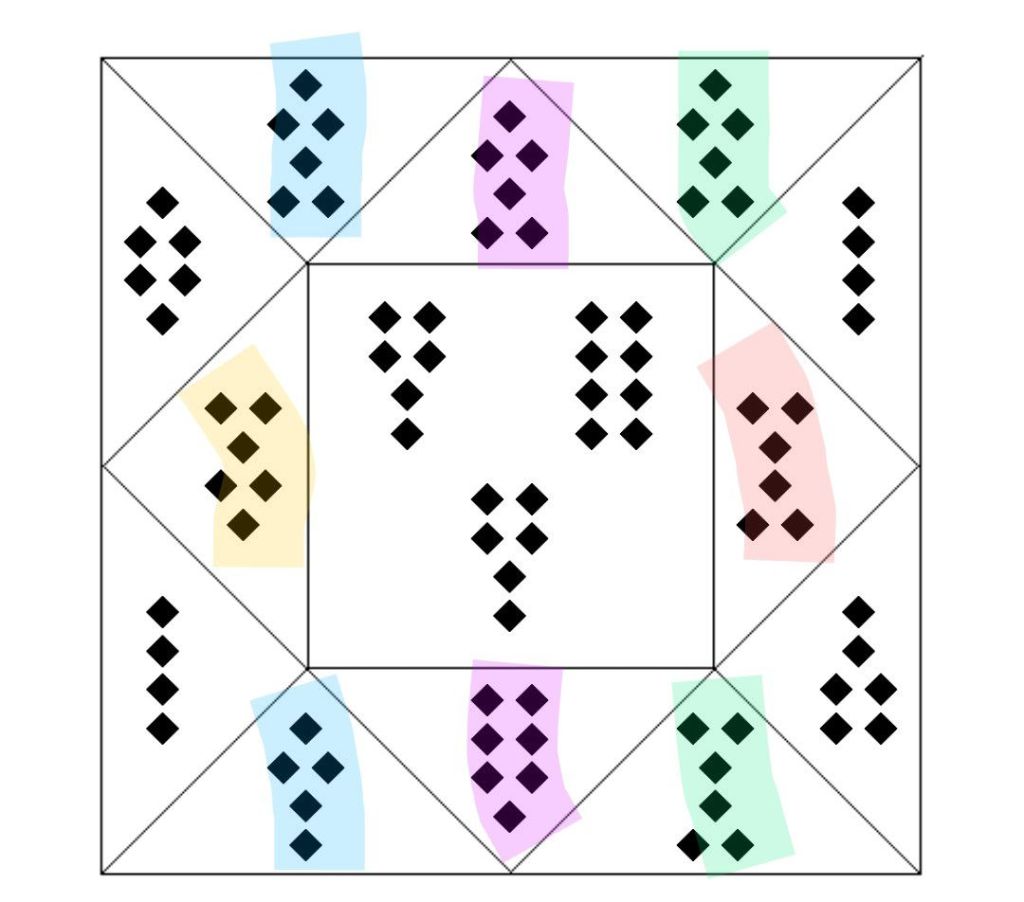
Astrological aspects in Geomancy (App used: Simple Geomancy)

If we take the figure in the first house (marked in yellow) as a reference point, then the figures in blue sextile it, because they are separated from it by a single sign; the figures in purple square it, because they are separated from it by two houses; the figures in green trine it because they are separated from it by three houses, and the figure in red opposes it, since it occupies the houses directly opposite.

This is supposed to shed some light on the relationship between the figures: two figures that fall into a square pattern have a difficult relationship, two figures in a trine a good one, etc.

The problem with using astrological aspects in Geomancy is that aspects work in a fundamentally different way: in Astrology, an aspect requires a planet to move in order to apply to another planet. After perfection, then, the aspect separates and its effect wanes.

Geomancy, though, is a static system with no real movement. Sure, we can say a figure moves from one house to another, but in reality that figure is already present in both houses. The only way to conceptualize movement in a geomantic chart is when we take a significator’s house to be the original position of the figure in it, and every other instance of that figure as a successive movement (e.g., in a career reading, if Laetitia is in the tenth house and in the seventh, we take it to move from the tenth to the seventh and not vice versa).

I am honestly not convinced that astrological aspects can find a meaningful place in geomancy. They certainly cannot bring matters to perfection, otherwise everyone would always be separating from their partner since the figure in the seventh house always opposes the figure in the first. Similarly, everyone would always get along with their siblings since the third house always sextiles the first.

One possibility which has been suggested is that of applying aspects only to figures that move. In a love reading, for instance, if the seventh figure moves to the tenth, it moves to square the querent, since the tenth house squares the first.

I personally find this application also problematic, because the tenth house represents the job, among other things, so that would mean that everytime the querent’s job is involved in their love life it causes trouble, which is a false assumption.

At most, I would take an aspect into consideration only if BOTH significators move. In the hypothetical love reading, for instance, if the first figure (querent) moves to the fourth house and the seventh (significant other) moves to the tenth, then they are in opposition to one another. Maybe they will argue. Or, if the first moves to the fourth and the seventh to the second, they sextile each other, which is good.

Even in a situation like this I am generally cautious about applying this theory. There are certain aspects of Astrology (pun intended) that simply don’t translate well to other systems of divination. You are of course welcome to try this theory on for size, but personally I believe Geomancy already has its particular version of aspects, and throwing other stuff into the mix feels more like an attempt at complicating this “brief and simple science” to find something more to tell the querent.

MQS

Reading Old Sources (for Geomancy, Astrology, Occultism)

I’m currently studying horary astrology under Chris Warnock’s supervision. He puts a great deal of emphasis on studying old sources, which is perfect for a guy like me who breaks out in hives when occultism is boiled down to “just wear a deep knowing expression, drink herbal tea and let the ascended masters guide your intuition.”

Geomancy is similar to horary astrology in that it allows you to answer questions, though it is less dependent on the time the question is asked. It is also similar in that you need to go back to really old books in order to study it seriously.

When reading premodern sources we always run a couple of risks:

  1. Unless they’ve been edited and discussed by a modern, they are probably written in a language that is not our own, or, even if it is, it’s an old version of it. This makes room for misunderstanding.
  2. More subtly, the world in which the author lived and wrote is not our world: it has different cultural, political and spiritual reference points.
  3. The source is written by someone who is just as fallible as we moderns (or rather postmoderns) are.

If one thing that grinds my gears is when people just turn occultism into their little escape from reality (“I wanna believe the world is magical but I’m too special for Christianity”), the other thing that equally grinds my gears is when people desperately seek a doctrine to follow blindly just because it happens to run against the Zeitgeist.

An occultist (and divination is a branch of occultism, though we often forget it) must be capable of being equally distant from intellectual lassitude and fanaticism, from scientism and religion. It takes a particular temperament that most people don’t possess, and I say this in a neutral sense: most people simply don’t have the temperament for most things, which is why only few people in any generation do any one thing.

Point three on the list is what I’m referring to here. The few on the occult path who have what it takes to move beyond the sanitized, advertiser-friendly version of occultism that gets tarot readers invited to corporate meetings often run the contrary risk: that of believing “if something says the opposite of what we hear everyday in our decadent world, it must be true and I must worship at its altar.”

When reading old sources (and I’m talking about geomancy, but it could refer to any other branch) this can turn us into fanatics if we don’t constantly remind ourselves that a book, even in the old days, could be written for a variety of reasons:

  1. to pass on important knowledge (but still from the author’s limited perspective)
  2. to record your experience
  3. to help others
  4. as a publicity stunt
  5. to impress others
  6. to confuse others
  7. a mix of all the above

Furthermore, old authors are just as capable as modern ones of believing crap. As such, while it is vital to question our own worldview, it is also just as vital to question all others. The moment you are asked (or you feel like you ought) to stop questioning is exactly the point where prejudice has crystallized, be it yours or someone else’s. It is also the point where you can break new ground if you proceed cautiously and with intelligence.

All this is to say, old books are treasure troves of information that we can study, learn from, adapt sensibly to our current needs, and much more. But if you are looking for a new Bible, you’re better off sticking to the old one.

MQS

The Company of Houses in Geomancy

The more I delve into medieval geomancy manuscripts, the more I realize how different authors tended to put together different bundles of go-to techniques for interpreting the geomantic chart. There is always some overalap, yet not every author mentions every technique. The company of houses is one such technique. The book from Peter of Abano I am currently translating does not mention it: he tends to have a very trimmed down, minimalistic approach. However, the technique is found in other authors, so I’ll discuss it and leave it up to the reader to decide whether to experiment with it or not.

The Technique

The technique is quite simple. We start from the presupposition that the aim of a geomancy chart is to see whether the figure of the querent comes into contact with the figure of the quesited, as already discussed, because such contact, called perfection, signals the querent coming into possession of the thing quesited about (though there are exceptions, when the querent wishes to get rid of something, for instance.)

Usually, if at least one of the four modes of geomantic perfection discussed in my previous article does not show up in the chart, it’s game over. According to some authors, though, we can also see perfection in other ways, and this is where the Company of Houses comes in.

The twelve houses of a chart are said to be paired as follows: the first with the second; the third with the fourth; the fifth with the sixth; the seventh with the eighth; the ninth with the tenth; the eleventh with the twelfth. It is important to note that, although, say, the third house is next to the second, the second and the third house are not in company: only the first with the second and the third with the fourth.

Let us suppose I want to know whether I will meet with my sweetheart. In general, I would want the house of the querent (me, the first house) to perfect geomantically with the house of the quesited (my sweetheart, the seventh house). Let us furthermore suppose that this does not happen. According to the proponents of the Company of Houses, this negative testimony can be overruled.

We look at the house my house is accompanied with, in this case the second, or the house the quesited is accompanied with, i.e., the eighth. Let’s take the second house as an example. The first kind of company is if the figure in the second house is the same figure as that of the first; the second kind of company is if the figure in the second is ruled by the same planet as the figure in the first; the third kind of company is if the figure in the second is opposite the figure in the first; the final kind of company is if the figure in the second shares the same Fire line (e.g., Via and Puella, who both have a single fire line).

This figure is the oppositeOf this figure      
CaudaCaput
ConjunctioCarcer
PuellaPuer
AcquisitioAmissio
AlbusRubeus
TristitiaLaetitia
Fortuna MinorFortuna Major
PopulusVia
Opposite figures

When any of these four conditions is realized, the figure in the second house can act as a co-significator for the querent, and may perfect the chart in his stead.

Do you need this?

Frankly? No. You can do what you please, of course, but this reeks of “Methinks I saw mine lass turn into a dragon”, that is, how people used to come up with stuff to fill books with. Even worse, it reeks of last-ditch effort at wringing a “yes” out of a negative chart.

In some cases, what is called Company of Houses is already covered by the four regular modes of perfection. When it isn’t, it is, as far as I am concerned, at most a very, very, very weak testimony, so much so that I don’t take it into consideration. Of course one may come up with all sorts of philosophical excuses why this technique is important, but if you ask me, it feels like a useless complication of a simple divination system.

MQS

The Via Puncti (Way of the Point) in Geomancy

I already said that I am not a big fan of complications in divination. Nor do I believe that the tendency to overcomplicate things is just modern: if we look in older Horary Astrology handbooks, for instance, they are filled to the brim with (often mutually contradictory) techniques that may be thrown at the chart in an attempt to smoke a positive judgement out of it.

Still, one technique that is relatively consistent in the tradition is that of the Via Puncti, or Way of the Point. Not all traditional sources talk about it, but I have found it to be occasionally helpful. As usual, techniques are not to be used blindly, but intelligently, like tools in the hand of a surgeon.

The long and short of this technique is as follows: some Judges have one point in their Fire line (the upmost one), while others have two. In fact, out of all eight possible Judges, four have one single Fire point (Carcer, Fortuna Minor, Via, Amissio), while the other four have two (Conjunctio, Fortuna Major, Populus, Acquisitio). Due to how Geomancy’s model works, whenever the Judge has one Fire line, it is possible to trace it back unequivocally to one of the four Mothers or Daughters (that is, to one of the eight figures at the top of the shield).

Geomantic Shield Reading, drawn with the Simple Geomancy app

In the above example, Fortuna Minor is the Judge. It has one point in its Fire line. This one point is found again in the Left Witness, Laetitia, and again in the third Niece, which is again Laetitia, and finally in the second Daughter Puella. No other path is possible. This is always so (if it isn’t so and you’ve calculated the chart by hand, you’ve made a mistake.)

Usually, the Via Puncti or Way of the Point can be looked at as a root cause for at least some aspects of the final answer. In the example above, for instance, a woman may be the cause (Puella). Or, if we take the House in consideration, since Puella is in the Sixth house, it may indicate that a sickness is the cause, or a servant/subordinate, or a pet, depending on the question.

I repeat: depending on the question. I make no effort to squeeze a consideration of the Via Puncti into my readings. If it is helpful, and if the question lends itself, I will consider it.

Geomantic Shield Reading, drawn with the Simple Geomancy app

In this second example, Acquisitio is the Judge. Immediately the Via Puncti branches off, as both Witnesses have two points in their Fire line. John Michael Greer says that this shows more complex causes, but he fails to mention that, in the old books, this is not considered a valid Via Puncti. I don’t know if I am unaware of some of the old material or if Greer gave in to his tendency to mix innovation (which is fine) with pretense that it is rooted in tradition. You can of course choose to experiment with Greer’s version of the Via Puncti. Personally, I don’t even always regard it when it is there (as in the first example) let alone when it is not there.

One thing that the existence of the technique shows, though, is that the Golden Dawn’s way of reading the astrological chart by placing the mothers in the angles is completely baseless, and is a typical example of the “let’s make up a secret” tendency of the occult community.

MQS

Geomancy – Reconciling the Judge and the Chart

We’ve seen that the process reading a Geomancy chart divides into two phases: the assessment of the chart and the assessment of the court.

If the chart and the court seem to hint at the same result all is well and good. Problems start when they appear to diverge and say different things. One way the old geomancers faced this possibility was by throwing random techniques at the chart so as to tease out a straight answer. In this, they were similar to old horary astrologers (“the significators are moving away and are in detriment, but ah, look at that Part of Fortune!”)

I like to keep things simple. An understanding of the first principles is more effective, I believe, than an endless array of techniques designed to allow the reader to say whatever he feels like saying at the moment. Geomancy is a “simple and short science” to quote Abano.

Abano himself, in his book, often talks about the Judge as if it described an ultimate state of affairs beyond the immediate result. This is something that I have found in other old books as well.

We only have eight possible Judges, so the Judge won’t be able to offer much subtlety in its verdict. Even after we factor in the Witnesses we still have a limited oracle. But think about it: a real-life judge doesn’t usually have much to say except to either rule for or against someone. Sure, he can tweak this or that detail, but that’s about it.

The judge’s ruling usually determines who’s happy with the result and who isn’t, but that’s not always the case. Sometimes a judge may rule in your favor but empty your victory, or conversely he may rule against you but still grant you the one small thing you care about.

Therefore, in a Geomantic reading the Judge usually describes the general tone of the answer, especially how the matter ends (well, so so or not so well). The interrelationship of the figures in the chart, though, is much more specific as it describes in more detail what happens concretely.

This is not a matter of “perfection means yes”. Perfection doesn’t mean yes. Perfection means contact or connection. Usually, of course, contact with something or someone is a positive sign as we generally want to obtain something, but context is key. “Will I be able to leave this abusive relationship?” with the two significators perfecting is a clear no.

Suppose in this example that the significators perfect, showing continuance, but the Judge is Fortuna Major. Maybe the spouse starts taking their AA meetings seriously, or depending on the other signs in the chart it may show that the querent isn’t capable of leaving now but will at a later point (Fortuna Major shows long term success)

On the other hand, there’s plenty of situations where we get our wish but later regret it. “Will I get the job?” and the first and tenth connect, but Carcer is the Judge: yes, but you won’t like it one bit.

Some like to bring in a sixteenth figure, usually called the Reconciler or the Judge of the Judge. This figure is obtained by adding the Judge to the first house figure. This can show you how the end of the matter affects the querent, but it is not a substitute for working out the meaning of the chart. All in all, the sixteenth figure only gives details, never the answer.

Greer, in his book, offers a ton of suggestions on how to deal with an obstinate chart that resists interpretation, including using certain figures to derive a new set of Mothers. Frankly, if you are that desperate, you may just as well interrupt the divination and ask the question again the next day. In all honesty, though, it has never happened to me.

The key to interpreting any oracle is to be reminded that divination is a language and language describes the world. The oracle is always a mirror of real life situations, not an abstract set of simbols.

MQS