The way we do things, the way we say things, matters. The same apologetic arguments we find in Blaise Pascal’s most feverish and haunting pages would be enough to bring a doubter to conversion, yet when coming out of the lips of a cheap street preacher holding a sign, they are often received with distrust, when not with disgust.
The way we do and say things matters in occultism as well. The old texts of magical tradition, and even some old accounts of rituals and supernatural occurrences, are full of the frenzy-stillness dichotomy: some things seem to happen in a state of ecstasy, others in a state of torpor.
My path, both as diviner and as occultist, has been informed by the pursuit of stillness more than by that of frenzy. All the teachers I’ve had the honor to learn from have always required of me to reach a state of calm rather than one of heightened overexcitement.
In divination, there is always a moment of randomness required in order to break the barrier between what the personality thinks it knows and what is actually the case. Arranging the cards (or geomantic points, or whatever) consciously in the order we wish they would come out may teach us something about ourselves, but very little about the reality of a situation. Randomness ensures that our self-consciousness doesn’t interfere with the processof allignment between oracle and reality.
Whether through a frenzy or through calmness, randomness introduces itself into the process by bypassing the limits of our personality’s structure, with its limits and its biases. The choice between the “inspired” moment of frenzy and the “deadened” moment of calm rests on a partially different view of the relationship between individual and whole, between ourselves and the divine.
Ecstasy, which is the process of leaving oneself behind, occurs in both cases, but it occurs differently. By achieving a drunken confusion one simply rams through the walls of one’s personality, achieving contact with what is outside of it. By stilling oneself, one reaches the point within one’s core where individual and divine coincide.
Obviously, once each option is brought to an extreme, it bleads into its opposite. Pure frenzy becomes absence of limits and therefore absence of what is limited, and its movement resolves itself in calm. Pure calm is delivered from all difference from change, so it coincides with pure frenzy.
After getting our little Ciuffy, we were on the lookout for another ‘tiel. I kept browsing through the ads for a young, tame male, but I kept seeing either clear scams or birds with other issues. I did a geomancy reading, asking if I would soon find one that fit the bill of what we were looking for:
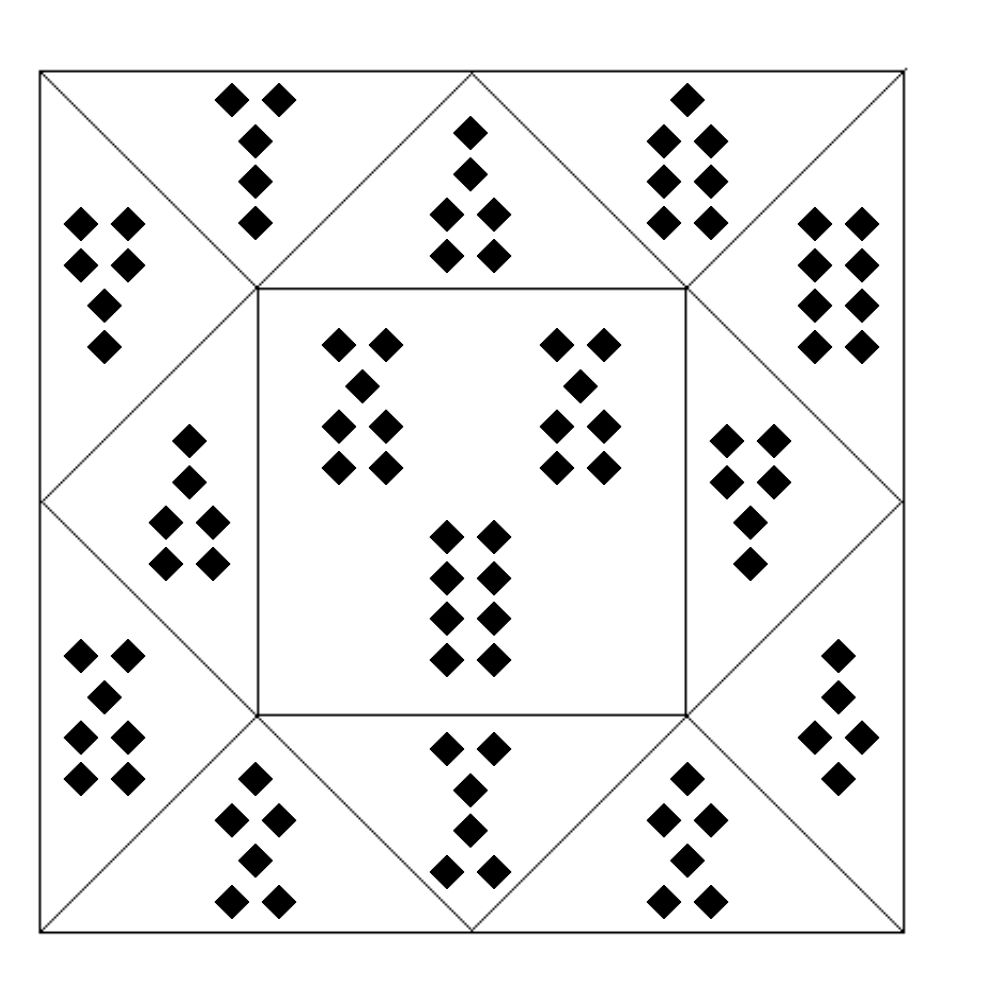
Geomancy reading: will we find a young tame male? App used: simple geomancy
I am signified by the ruler of the Ascendant, Fortuna Minor. Small animals are a Sixth House matter. Technically, if this was a horary chart, I would have to turn the chart (will I get someone else’s bird? Sixth from the Seventh, i.e., the radical Twelfth). However, I have found that Geomancy is less prescious about this kind of stuff. Let’s see how the chart speaks and let us follow it instead of trying to impose ideas on it.
The Sixth House is occupied by Puer: a male! That bodes well. The Judge, however, is Populus, which doesn’t say much. Worse still, Populus comes from two Rubeus. Still, we also find that Fortuna Major connects the Ascendant ruler with the Sixth House, since it is found both in the Seventh and the Twelfth house. A positive figure connecting two positive figures is a positive sign (Puer is more neutral, but still good in context).
Fortuna Minor, furthermore, usually indicates shorter timespans, and it moves to an angle (the Tenth house), which is also a generally positive sign as far as time is concerned.
The reading was done a couple of weeks ago, and we found Zazu yesterday.
Zazu, also known as Pollo
I am still unsure about that Geomantic Court, with two Rubeus and Populus as judge. It is sometimes said that Populus has little to say, but I don’t believe that. One possible interpretation is that, since Rubeus has the quality of being excessive, the Populus resulting from two Rubeus might show too many birds (a crowd of too many), which is why the person I got it from wanted to get rid of him (or rather, his wife wanted to get rid of him). The court could also simply be warning about potential scams or questionable deals (and I had to sift through a fair share of those).
Be it as it may, I am not too worried about the Court, since the Judge of the Judge (Judge + First House) gives Fortuna Minor, a positive sign for the long run. I’ll update the post if something comes up.
Fludd explains some of the meanings of Acquisitio, Amissio, Laetitia and Tristitia in the various houses.
Of the Nature and Meaning of the Sixteen Figures in Each of the Houses of the Shield
Acquisitio
In the First house, riches, prudence, profit, good end (or aim)1 luck, receiving what one wishes, but this figure is not good for selling;2 but it is truthful. In the Second house, wealth, gain, profit, good luck in commerce, reception of something promised, recovery of lost property, increase of all good things. In the Third house, good luck from relatives, good relatives, siblings, neighbors, good journey, good sense (or feeling).3
In the Fourth house, good inheritance, good and useful house, in which one will acquire riches, rich father, positive solution to all things connected with inheritance. In the Fifth house, gain from one’s children,4 good children, good letters, good clothes, happiness in the heart, delighting in women, the fruits of the inheritance.5 In the Sixth house, long illness,6 which however will be cured, good animals, good servants.
In the Seventh house, a chaste and submissive woman,7 good company, good dealings, peace, reconciliation with enemies, whether it be in litigation or in war. In the Eighth house, redress, natural death, gain in foreign land, freedom from fear of death, the enemy is happy and rich.8 In the Ninth house, gain from death, path or travel, fear of God, positive journey, benefit, good dreams, good sense in all actions, piety and religious devotion, good in things of church.
In the Tenth house, profit from (or for) the master or king, peaceful and happy masters, obtaining one’s wish, good sentence from the judge. In the Eleventh house, good luck, good friends, gain from commerce, immediate reception of gain. In the Twelfth house, poverty or incarceration due to debts, profit for (or from) servants and beasts,9 long prison sentence, good in case of illness and in being paid back a debt.
In the Thirteenth house, loss and change in profits,10 good journey, acquisition in everything, receipt, implementation of the wish of the absent person.11 In the Fourteenth house, gain in everything one wishes, long life, luck, usefulness, goodness. In the Fifteenth house, good in everything, recovery of lost things, delay in one’s journey.
Note that this figure in the first house shows a man who is handsome, with yellow or beautiful hair, mediocre build, a red face, a merchant.12
Amissio
In the First house, a bold, unstable man, full of crime and deception, receiving nothing. in the Second house loss of merchandise and goods, no profit, loss of all goods from robbers. In the Third house enmity between relatives, parents, brothers, neighbors full of deception, fear on the way.
In the Fourth house falsity and loss of inheritance and patrimony, bad end of the city or house.13 In the fifth house loss of fruits of the inheritance,14 bad and unstable children, bad letters,15 no pleasure in the love of unserious women. In the Sixth house escape from disease, loss of animals, flight of slaves, likewise injury and perversity.
In the Seventh house an evil woman, a quarrel with one’s master16 or partner, an unstable and lustful woman, loss of merchandise, fugitive robbers, inimical partners, changeable and deceitful, bad change (or removal).17 In the Eighth house loss from death, loss of sense, no profit in the place where one goes, poor enemies, loss a woman’s dowry. In the Ninth house a long journey without pleasure, no knowledge, some evil for the querent from the Church.
In the Tenth house evil lords, loss of honour, dominion or office, unstable lords, troubles of kingdoms, obstacles to honour. In the Eleventh house loss of friends, loss of merchandise, false hope, changeable and useless friends. In the Twelfth house loss of animals, escape from debts, bad change, escape from prison, friends full of falsehood, changeable and derisive.
In the Thirteenth house loss and change in authority or government, bad luck. In the Fourteenth house loss of friends, much toil in every matter.18 In the Fifteenth house a reception of nothing, a bad conclusion.
note, when this figure Loss is found in the first house, it signifies a pale man, a liar, a predator, a thief.
Laetitia
In the First house judges, wise men, a good and upright life, fullness of joy and exaltation, joy to the querent in all things. In the Second house a multitude of honors, a life full of fidelity and joy. In the Third house good fortune through one’s brothers, no fear of God,19 good love of brothers, neighbors, parents, much joy in everything.
In the Fourth house profit from inheritances and from all things on earth,20 a happy end, happiness through real estate, happiness of parents, peaceful inheritance. In the Fifth house profitable children, long life, happiness in all things, happy and delightful letters and news, happiness from women and all good things. In the Sixth house servants, animals cured from disease, joyful and cheerful servants.
In the Seventh house a good marriage, profitable partners or profit from partners, victory due to a cheerful and chaste woman, cheerful company, peace and harmony, good change (or removal). In the Eighth house profits inherited from the dead, escape from fear, profit and profits in the place where one removes to. In the Ninth house, journeys, fear of God, knowledge, faithfulness, cheerfulness, a holy man,21 business of the church, good news, fine arts, devotion and love of the church.
In the Tenth house exaltation to great honors, bishops and prelates, help from the lords, a happy and cheerful office, beautiful temples, a good judge, a just and good opinion, a warm place.22 In the Eleventh house good fortune from associates, profitable animals,23 joyous love, good hope from a good man, cheerful and good friends, a prudent man and of good knowledge, profit in trade. In the Twelfth house profitable beasts and slaves, coming out of prison, deliverance from debt, and from all tribulation, peace and reconciliation with enemies.
In the Thirteenth house, profit from a journey, from the king, from the lord, positive change. In the Fourteenth house good hope of fulfilling one’s will, happy hope, the fulfillment of one’s wishes, joy and exaltation.
When this figure is found in the first house, it signifies a bishop, a prelate of the church, religious and ecclesiastical, a long beard, some evil existing in the finger,24 remaining in high places.
Tristitia
In the First house, sad thoughts, debts, poverty, hidden loss, obligations, prison, roadblocks, bad change, unbelieving and without hope.25 In the Second house fortune and commerce,26 avarice, loss of property, an unfortunate usurer, dishonor. In the Third house bitterness with relatives, silent hatred with neighbors and relatives, a secret obstacle on the way.27
In the Fourth house loss of inheritance and in battles, loss of house, trouble, bad house, bad luck, poverty of parents, loss. In the Fifth house bad and poor children, false letters, sadness and anguish of heart, secrets in love of sad women, poor food and clothes. In the Sixth house evil servants, fear of captivity and poverty, timid and useless animals, long illness or death, poverty, rejection without injury and confusion.28
In the Seventh house a bad woman, a victorious man,29 a thief in the night, poor condition, loss, bad change (or removal), a sad woman. In the Eighth house being poor from the death of another, loss in a foreign nation, damage from the absent person.30
In the Ninth house the road is unprofitable, hindrances in the journey and loss, a man without wisdom and knowledge, a crude understanding, the downfall of the church and benefits.
In the Tenth house, loss and degradation of men, the exaltation of the wicked,31 loss of duties, sad lords, fear of kings and kingdoms, wrong judgment of judges, a fall from honor. In the Eleventh house, contemptuous friends, bad luck which will last for a long time, but still with hope, a poor friend, no failure in business.32 In the Twelfth house, debts, enemies, loss, long imprisonment or death in prison, a timid and poor enemy, trouble, fear of obligations and debts, long or incurable illness.33
In the Thirteenth house evil on the road and sadness. In the Fourteenth house, bad luck, small journeys, anxiety and trouble, despair and irreparable evil.
When this figure is found in the first house, it signifies a dark man,34 having torn clothes, and who deals in dark, foul, and vile things.
MQS
Footnotes
It is unclear to me whether he means a good end to the matter at hand or a positive aim in mind. ↩︎
Because it implies receiving rather than giving away. ↩︎
This sentence is not clear to me, nor why Acquisitio would imply loss. ↩︎
“Implementum desiderii absentis.” This is obscure to me. ↩︎
Fludd attributes, like many others, physical descriptions to the figures when they are in the First House. This is typical of traditional astrology, where the first house represents the querent. Note that these descriptions are rather limiting and conform to old stereotypes. Plus, they imply that the same querent would always be represented by the same figure whenever they come to the geomancer for a consultation, which is highly unlikely. They are still useful on occasion, but one must “mix discretion with art”. ↩︎
In addition to one’s home, the Fourth house indicates the city. ↩︎
Again because the Fifth is the second from the Fourth. However, the Fourth house also rules orchards and lands, so the Fifth can indicate literal fruits from the lands. ↩︎
There is some confusion in traditional astrology on which house rules letters. Some say the Third house, some the Fifth, some the Ninth. As far as I can rationalize this matter, the Third house represents communication and private correspondence; the Fifth house represents messengers because it is the second from the Fourth, the Fourth house being the city, and the second house from any house indicates that thing’s representatives (for instance, my Second house would indicate my lawyer, who represents me in a court of law.) ↩︎
It’s unclear why the Seventh would indicate the master. ↩︎
The Seventh house represents “there”, while the Firsth house is “here”. ↩︎
The Thirteenth and Fourteenth houses, i.e., the Witnesses, generally receive their signification (as we have seen in Abano’s case) from the two houses they derive from on the Shield: the Right Witness from the Ninth and Tenth, the Left Witness from the Eleventh and Twelfth. ↩︎
It is unclear whether this is positive or negative, as fear of God was considered the beginning of wisdom. As for why it is attributed to the Third house instead of the Ninth, in some very old Astrological texts the Third House is the house of the Goddess, and in Christian times it possibly came to represent how one’s faith affected one’s everyday life. ↩︎
The Fourth house, the Imum Coeli, is the earth. ↩︎
All these positive religious connotations stem from Acquisitio’s attribution to Jupiter. ↩︎
The Tenth house, the M.C., represents the sky and therefore the weather. ↩︎
The reference to absent people is due to how common it was to ask astrologers or geomancers about people who had simply gone away or vanished. This is understandable, considering astrology was probably the only tracking device available at the time. ↩︎
Because the Tenth House is the highest place in the chart and Tristitia indicates downward movement and lowly things or people, it can show the elevation of someone unworthy or the downfall of someone who is in a high place. ↩︎
This last part is unclear to me. Possibly because the failure announced by Tristitia is mitigated by the positivity of the house. ↩︎
Typically we assign illness to the Sixth house. However, there are old handbooks that assign illness (especially serious illness) to the Twelfth house. Some distinguish between the Illness (Sixth House) and the confinement that derives from it (Twelfth House). ↩︎
Fludd introduces some preliminary classifications of the houses.
Of The First Twelve Figures Of a Shield
the first twelve shields of the geomantic house refer to the 12 signs of the zodiac, as we must understand in astrology. Therefore, the first house, both in astrology and in geomancy, is given to Aries, and is always by itself a movable house,1 the second to Taurus, and is a fixed house, and the third to Gemini, and is a common house. The fourth is Cancer and is movable, the fourth is Leo and is fixed, the sixth is Virgo and is common, the seventh is Libra and is movable, the eighth is Scorpio and is fixed, the ninth is Sagittarius and is common, the tenth is Capricorn and is movable, the eleventh is Aquarius and is fixed, the twelfth is Pisces and it is common, that is, neither fixed nor movable, but intermediate between both.
And it must be noted that, when the [geomantic] figures are in these houses, nevertheless the nature of the house is not changed, but remains in itself, that is, it will not change the nature of its sign: hence the first house will be called Aries, and so forth, so that every house, whatever attribute it may have, will stay movable, fixed, or common according to its own nature.
Rule I
Bad Houses make good figures bad, and they make bad ones worse: on the contrary, good figures are better in good houses.
Rule II
A figure in a house of contrary nature, that is to say a fixed figure in a movable house, or a movable figure in a fixed house, is rendered worse in judgment. But a fixed figure in a fixed house or a mobile figure in a mobile house are fortified.2
Rule III
The first four of the twelve houses, namely, the first house, the second, and the third will always signify the season of spring, and so on in the rest, as stated in astrology.3
MQS
Footnotes
Today we call the astrological signs cardinal, fixed and mutable. A more archaic way of describing them is as movable, fixed and common. Note that Fludd is equating the signs with the houses, which is natural in geomancy. In traditional astrology, however, the houses are quite distinct from the signs. ↩︎
Here the reference is to the classification of the geomantic figures shown in Book II, Part 1. ↩︎
In astrology (as well as in magic), the four quarters of the Heaven hold much symbolic meaning, lending themselves to the allotment of various fourfold distinctions. ↩︎
Fludd gives some basic details about the geomantic figures.
Of the Names, Forms and Natures of the Geomantic Figures
those figures which can be drawn from the series of four geomantic lines are sixteen in number, which are distinguished from one another by name and form, as follows:1
Rule I Strong and firm figures make a thing stable and firm, for better or worse, depending on whether the figure is found in a good or evil house.
Rule II Weak figures are so called, because they render a weak judgement without stability, neither are they so good and stable as much as they are mediocre,8 whether in a question of illness or incarceration or pregnancy.
Rule III Mediocre figures are so called, because they are between strong and weak figures, and they make a situation mediocre, that is, neither totally good nor totally bad.
MQS
Footnotes
Fludd was fond of using tables. I will try to make the layout of the translation as clear as possible ↩︎
Fludd gives here to Puer the form we typically assign to Puella and vice versa. ↩︎
The Sun cannot go into retrogradation, which is why some sources, like Fludd, attribute the two Fortunes to the Sun at different speeds. This is still somewhat odd, considering the Sun is always rather constant in its speed (which is probably behind the traditional symbolic view of the Sun as a source of stability, as opposed to the Moon’s changeability). ↩︎
Generally, today, we would assign Venus to Puella and Mars to Puer. It is unclear to me the extent to which Fludd was making a mistake or providing a blind to challenge the reader’s thinking. He is not the only traditional authority who swaps Puer and Puella, though. ↩︎
The Moon cannot go into retrogradation. Usually, Populus is assigned today to the waxing Moon, Via to the waning Moon. ↩︎
There exist other lists with partially different attributions. ↩︎
It is unclear to me whether Fludd means that weak figures are mediocre or that they are worse than those called mediocre. Logic would dictate that the latter interpretation is correct. ↩︎
As Christmas draws near I recently bought the ingredients for my home-made 5-hour lasagna sauce. Yesterday I set about preparing it, and I started noticing an odd smell coming from the minced meat, even though it was supposedly fresh.
At first it was barely detactable, so my Christmas spirit decided to interpret it as just a figment of the imagination. The immediate red flag was seeing my husband emerge from his den asking what the strange odor was. Hubby is extremely sensible to smells. Whenever I see him curling his nose I know something is off.
What’s worse, around three hours into the preparation the subtle whiff had turned into a miasma. So I did a geomancy reading, asking if the sauce would be safe to eat.
Before casting the reading I had some doubt on how I would interpret such a question: what astrological house rules food?
In old astrology and geomancy books, when a king asks if the food served at the banquet has been poisoned, usually the diviner consults the fifth house of parties and fun. On the other hand, astrologer John Frawley makes a compelling point that your food is what sustains your person and goes into your throat, which is the second house. I decided that it was useless to worry about these distinctions, and that the chart would find a way to show me the truth.
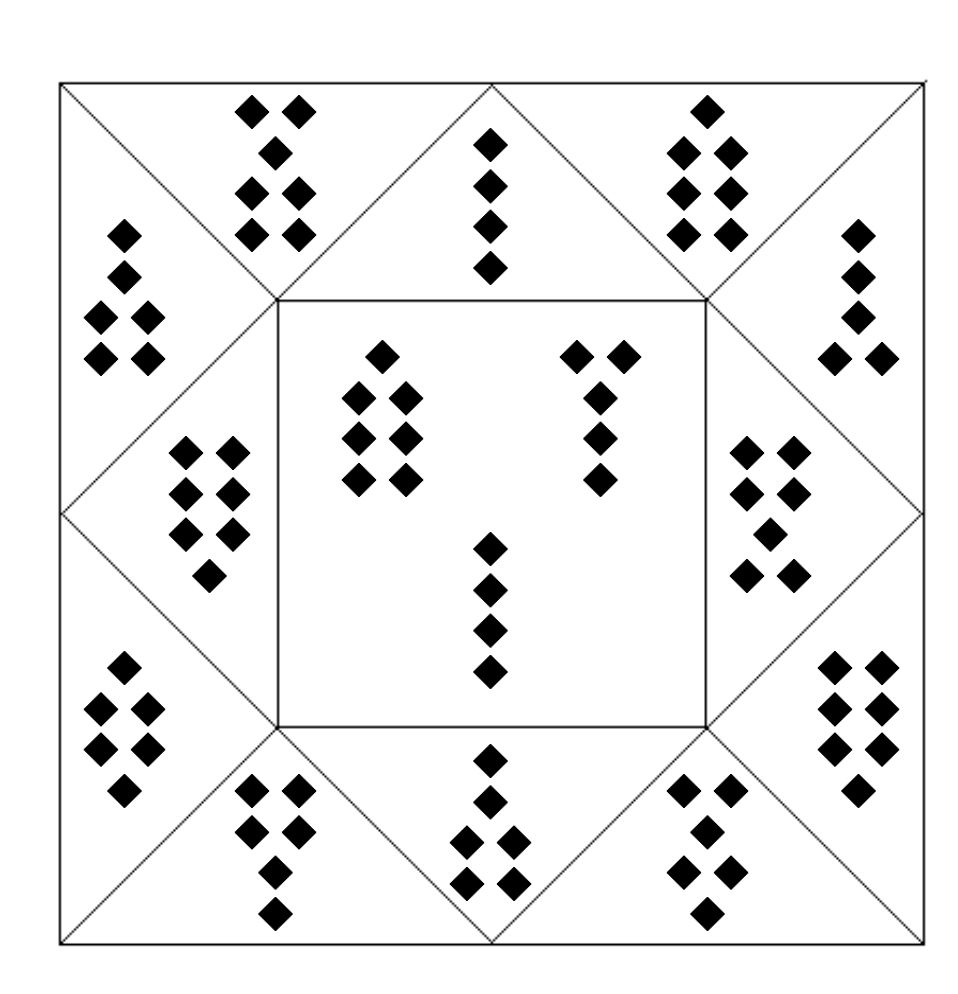
Is the sauce safe to it? Geomancy reading (app used: Simple Geomancy)
And show me it did. This is a reading that requires very little interpretation. Tristitia is in the first house, portending trouble, and it springs into the sixth house, which is the house of sickness: neither the second house nor the fifth house were involved. The sauce is definitely unsafe.
True, the court is not negative, possibly showing that it wouldn’t cause any major trouble. On the other hand, the Way of the Point goes from the Judge Via to Cauda Draconis in the eighth house, and Cauda is a negative figure, but I doubt the sauce would be the end of us.
I still decided to dump everything out and start from scratch, meaning today I had to run to the market to get new ground meat.
Fludd explains how a full geomantic shield is derived from the initial four mothers.
Of the Production of the Other Figures in the Geomantic Shield
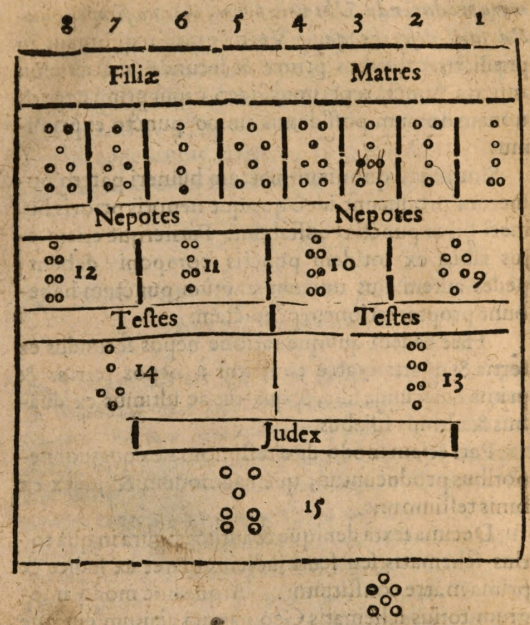
It must be noted that from the said mothers,1 who constitute the first four figures of the geomantic shield, four daughters, constituting the fifth, sixth, seventh and eighth figures, arise, taking separately the parts of all the mothers. In the previous example we take from the first figure / . / from the second / . . / from the third / . / from the fourth / . . / And thus these four parts, joined together, generate the first daughter occupying the fifth house, namely, the figure called Amissio. From the mothers’ shoulders the second daughter is born occupying the sixth house, from the legs the third, from the feet the fourth.
But first the niece is derived from the two first mothers, for her head is fused from their two heads, etc. And this is a general rule: that where two heads, shoulders, legs, or feet joined together produce an odd number, namely three, they produce a single; but when they are even, they produce two points. For example: since we find only three points in the aforesaid heads of the first and second mothers, we therefore express the head of the first niece who occupies the ninth house with a single point.
In the same way, since the mothers’ shoulders produce an equal number, therefore also the shoulders of the first niece will consist of two points. Equally, her legs must also be composed of the same number of points, and her feet will have only one point for the above reason. For this reason also, the second niece is fused from the third and fourth mother; the third niece from the first and second daughter, and the fourth and last from the two and last daughters.
In the same way, two Witnesses are produced from four nieces, just as a Judge is produced from two Witnesses. Finally, the sixteenth, the last figure in which the whole shield is summarized, is made up of the Judge and the first mother. And in this manner the whole geomantic shield and its houses must be filled, from which the judgment in this art is to be taken.
A geomantic shield, from Robert Fludd’s Geomancy handbook
Footnotes
Referring to Book I, Part 3. This section requires no commentary, as it describes the usual technique of deriving the full shield from the initial four figures. ↩︎
One pro of using more than one system of divination is that sometimes they clarify each other: sometimes one reading is somewhat obscure in one system but clear in the other, and we can use the clear one to navigate the one that has us scratching our heads. Granted, obscurity is in the eye of the beholder, being always a consequence of our own limitations, but it is still an occasion to learn.
I was at the airport yesterday, trying to catch a flight to get back home. Suddenly, and to my horror, I noticed that plenty of flights were being cancelled due to the heavy mist, including one flight on the same route I needed. My first instinct was to cast a Horary chart, asking if I’d be able to get back home.
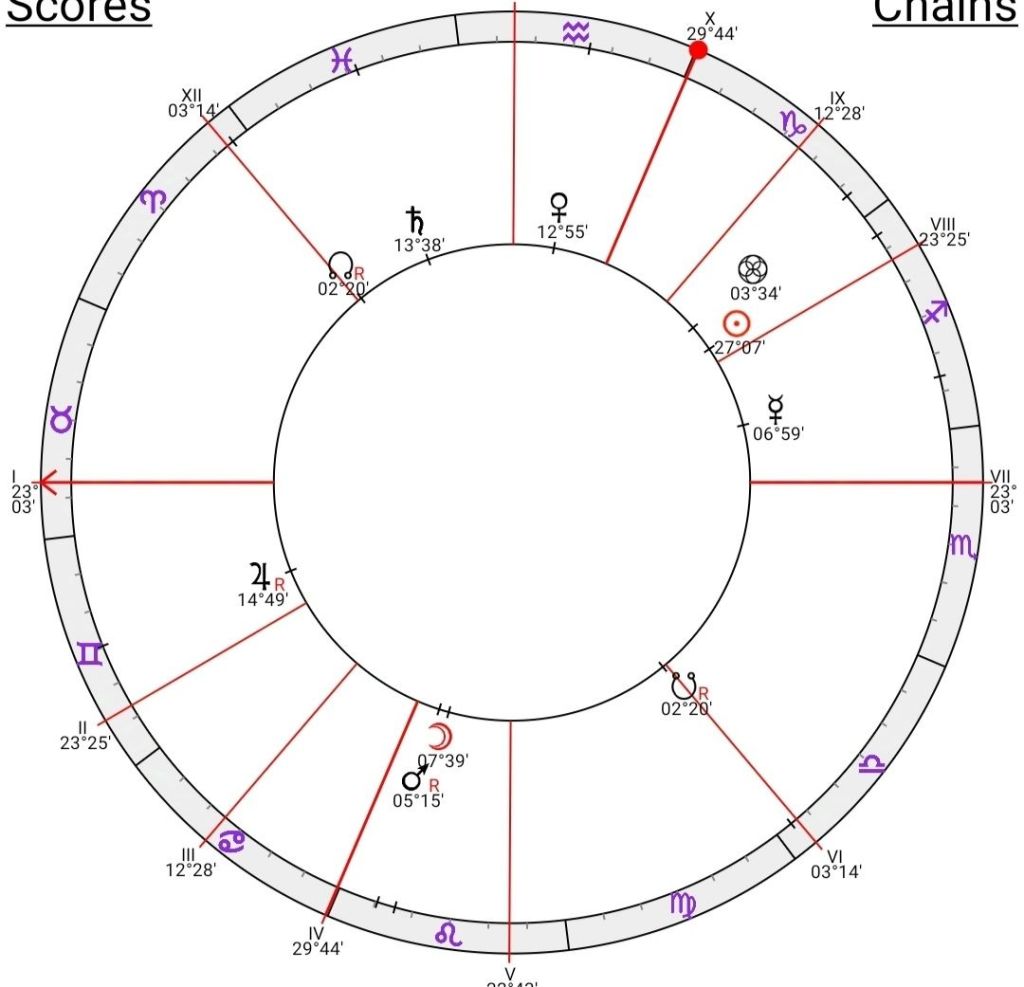
Will my flight go as planned or will it be cancelled? Horary Astrology
This was my first interpretation. I am represented by Venus, ruler of the ascendant. The place I want to get is my home, which is ruled by the Fourth House and therefore by the Moon (Cancer is on the cusp). The Moon is approaching an opposition of Venus. Bam! The flight will be cancelled.
After a while, as I was waiting for information, I did a Geomancy reading on the same question. Here is the chart:
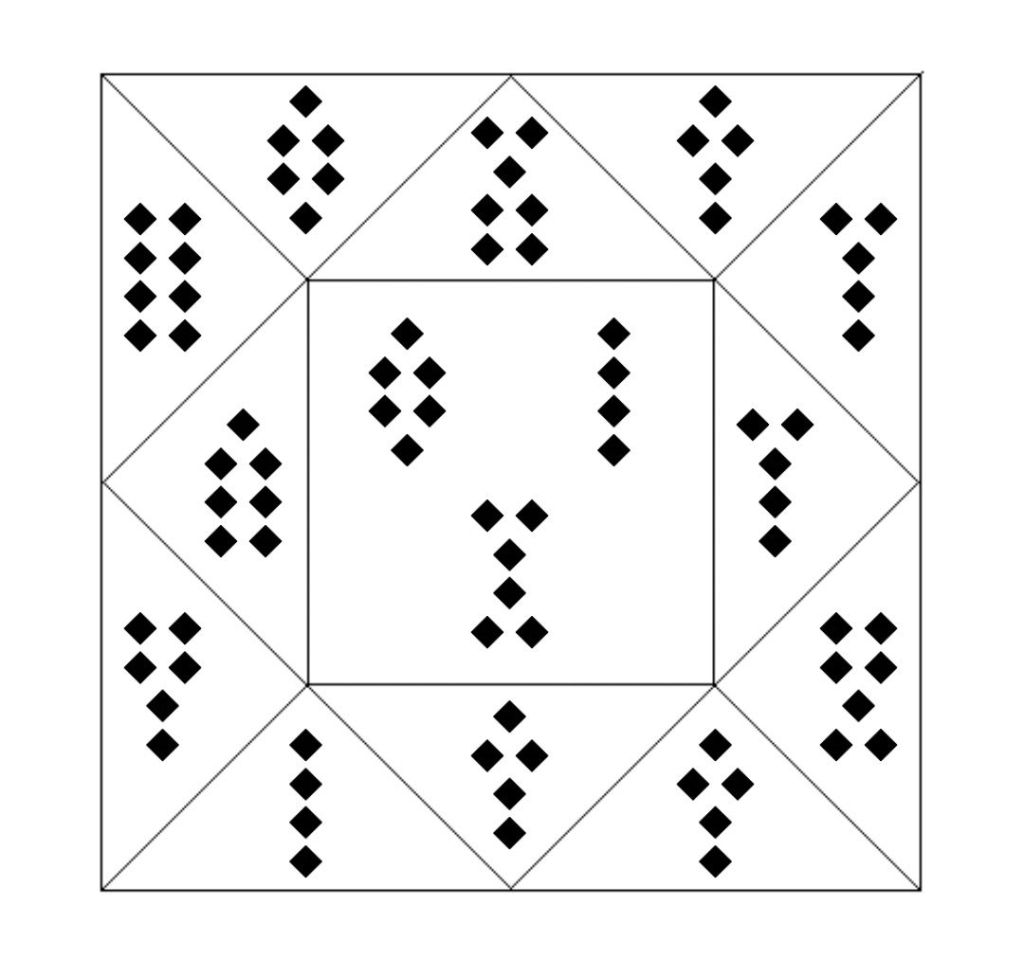
Will the flight go as planned or will it be cancelled? App used: Simple Geomancy
The first thing the struck me is the generally positive Judge, Conjunctio, which arises from Carcer and Via. It argues mobility more than stasis, and obstacles that are removed. The second important point is the figure that represents me: Laetitia in the first. Laetitia represents upward motion. It is an exiting figure, meaning movement. What a wonderful symbol for a plane taking off!
Even if we want to involve the Fourth house, we see that it is occupied by Puella, a mildly benefic figure, which is also connected to the ninth house of journeys (it occupies it). So the journey (Ninth) connects with the home (Fourth).
Obviously,two systems of divination cannot give contradictory answers if correctly interpreted, and the Geomancy seemed rather obviously positive. So I went back to the Horary Chart (again below)
Will my flight go as planned or will it be cancelled? Horary Astrology
I meditated on this chart quite a while (I had plenty of time, after all). Then it hit me. I am represented by Venus. Venus is in the Midheaven (up in the sky) in Aquarius, an *air* sign. Not only, but Aquarius is fixed: it doesn’t change. My being in the sky is fixed. So there will be a flight: I will be up in the sky as planned.
But what about that opposition by the Moon? Well, there was significant delay, so the Moon could show the flow of events causing trouble to my being up in the air.
Ultimately, the Fourth House didn’t need to get involved. The point of the question was not whether I would get home (I would have gotten home anyway at some point) but what would happen to me/my flight.
No matter what kind of divination we practice: if it’s worth its salt and is not just some feelgood angel therapy oracle, it has the potential to deliver bad news. How we handle bad news is a mark of how helpful we are capable of being as diviners.
People can come to us for a variety of reason. They may need reassurance, hope, advice or just a quick look ahead. They may even come to us for fun or curiosity, and as long as they are not disrespectful, there is nothing wrong in indulging them.
The principle of respect for our querent stems from seeing them as a whole person rather than a sack of meat endowed with more than its fair share of doubts. We, as diviners and as handlers of odd devices (decks, charts, counters of various kinds) hold a degree of power over them. It is symbolic power, for sure, but reality itself is symbolic (that’s how magic works), therefore symbolic power is real power, and must not be misused.
Finding the right balance between informing the querent and respecting them can be difficult. It’s all well and good as long as the cards talk about pleasant trips and job interviews. But occasionally we recognize messages that we know are going to deeply upset our querent.
Causing unnecessary anguish is a no-no, and there are things that cannot be said without causing unnecessary anguish (“You’ll die soon”, “You’ll lose the baby). Even less serious topics (at least, less serious than death), such as marital infidelity must be treated with caution. We cannot just destroy whole families willy-nilly simply because our cards seem to hint at untoward dealings.
We must also distinguish whether a querent directly asks for something or something unpleasant simply shows up in the cards. Usually, if the querent asks for something, we can be more forthcoming, if we can speak with tact. If they ask “Will I get the job?”, they need to be able to accept “I’m not infallible, but it seems they appear more inclined to go with someone else.”
If they ask “Is my spouse faithful?” and the cards show clear signs of interference, an answer like “Remember that I could be wrong, but there does seem to be someone who’s trying whisk them away from you. Maybe it’s time to have an honest talk and try to solve the issue.”
Incredibly enough, even some taboo topics may occasionally be addressed in this guise. For instance, there are plenty of non-morbid reasons querents might want to know about death: “Do you think my elderly father going to survive long? I want to be able to visit him one last time but the situation at home is just crazy.”
While we must not delude the querent, we have no right to rob them of all hope. Aside from the mantra “Remember I’m a fallible human being”, and even aside from potential advice we might sometime give the querent to soften the blows of bad luck, there are occasionally ways of preparing the querent for a difficult situation without hurting them.
“Is the pregnancy going to go alright?” This is a question I am become more and more skeptical of answering as time goes by, because there is no way of saying anything other than “yes” and still be able to look at myself in the mirror. If we do find ourselves somehow coerced into answering it and the cards are less than positive, the only thing we may say is something to the effect of “Yes, but remember to take it easy, and the cards are saying you should pay extra attention to the doctor’s orders.”
Where all else fails, human empathy is our last line of defense. Helping the querent even for just some minutes by sharing their burden is part of what we may have to sign up for when we choose the path of divination.
On the projection of sixteen lines, divided into four orders, constituting the first four geomantic figures
Before proceeding to the projection of the [geomantic] lines, which are made up of points, we shall lay down certain rules to explain the reason and manner of creating them.
Rule 1
It is not for the artist to make a judgment on any question relating to a matter which he has already known and understood before, for by doing this he is trying God and his divine knowledge, and will err on that account.1
Rule 2
Do not count the number of points of any line, for by that reason the soul will somehow be disturbed in the calculation.2
Rule 3
If you want to work in this science, you must first describe the proposed problem, so that your understanding is not disturbed otherwise.
Rule 4
You must not make a double question, but form the question in such a way that it asks for the knowledge of only one thing; otherwise your figure will be so disturbed that you will not be able to judge anything correctly. For this reason the question must be rectified in such a way that it has a single and complete purpose.
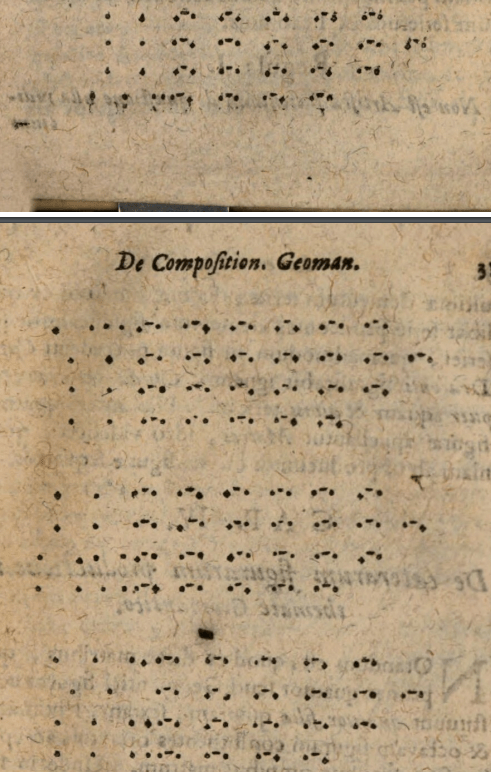
It must be noted that these geomantic lines merge from equally distant points and must have the form of the four fingers of the hand, as will be seen in the following example, and the points of each line we must connect and concatenate in such a way, proceeding from right to left, that at its extremity to the left one or two points are left free from concatenation.
Example of a geomantic projection
This also must be done with all the lines of the aforesaid four series, and in this way will come forth the four first figures of the geomantic shield, representing the four elements with their natures and combinations, likewise the four winds, and the four parts of the world; for, as regards the elements, the four first lines will signify the element of fire, the second four will denote the element of air, the second three the element of water, and the last four the element of earth.3
Of course, the figures coming out of each series will represent an element of their series, just as in the previous figure Caput will represent fire, Causa will represent air, Puer will represent water, and Albus will represent earth. Now these four figures are called Mothers, because from them all the following figures are produced.
MQS
Footnotes
Asking a question whose answer we know implies that the actual question is “Does this really work?” which is a question no system can answer from within itself, therefore the question implies doubt in the author of the system ↩︎
Counting the points not only implies trying to cheat the system, but it also robs the divination of its random, inspired aspect. ↩︎
The elemental attributions of the figures is not of major practical importance, but it serves to respect the connection between microcosm and macrocosm and to anchor the question to a cosmic mechanism. ↩︎