I was having one of my philosophical discussions with a friend, and she was venting about how she doesn’t believe in love anymore, and that, at the end of the day, love is just a chemical reaction of the brain.
I thought this was an interesting take, not because it hasn’t been done before (it’s a cliché for a reason), but because it is ripe with philosophical (and magical) presuppositions that are worth exploring.
Usually, by saying that love is only a chemical reaction, we are trying to decrease the power or importance of love. This in turn implies that we consider chemistry something inferior to feelings, since we are trying to reduce feelings to chemistry.
Yet why should such a statement make us believe that love is less than we think it is, instead of opening us to the idea that chemistry is more than we give it credit for? After all, if love = chemical reaction X, then saying ‘chemical reaction X’ instead of ‘love’ is just a rebranding excercise: we are merely giving a different name to the same experience. It doesn’t change one iota of how love works, its effects on us and on existence itself.
So love *is* a chemical reaction we experience. It isn’t *just* a chemical reaction we experience. And who does the experiencing anyway? Is it the same biological substance that is subject to the chemical reaction or is it something further beyond it, an observing consciousness which can become aware of it, as well as being aware of its own awareness?
Even if we choose the first route (i.e., it is the same biological substance) , we are still saying that the chemical reaction has awareness attached to itself. So we are saying that same substance subject to chemical reactions is capable of developing awareness of them. That’s no small fit. And yet again, we are still left with something that polarizes into two aspects: love and awareness of it. In this majestic self-aware process there is plenty of space for wonder, and love is once again restored to the status of powerful driving force.
The Greek philosopher and magus Empedocles considered love/friendship one of the two great powers setting existence in motion, together with hatred/enmity, because they fuse the four elements together and then disintegrate them. Magicians ever since have worked with the links of sympathy and antipathy (of love and hatred, of compatibility and incompatibility) that animate everything. Empedocles was, at heart, a naturalist, who didn’t try to introduce extra principles into his philosophy. Be he, too, saw that the fusion and disintegration of the elements (chemical reactions, one might say) is something so universal and so fundamental that without it nothing can get done.
In a way, Geomantic figures are to Geomancy what cards are to Cartomancy. They represent the basic bundles of meanings that get shuffled around to form the sentence that will answer the question. So we need to familiarise ourselves with them.
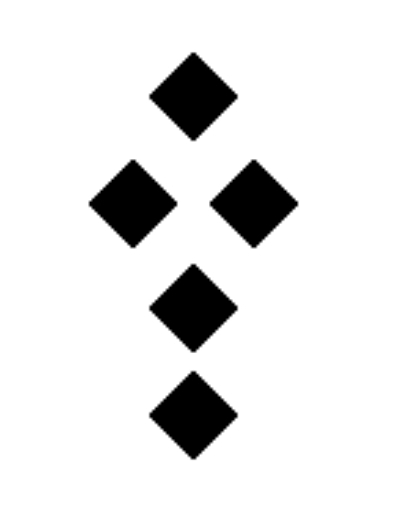
Each Geomantic figure is made up of four rows of points. Each row can contain one or two points, so a figure can contain a minimum of four points (Via) and a maximum of eight (Populus.)
On the right, Populus (eight points); on the left, Via (four points); the result is Via
At least since Medieval Geomancy (and possibly before) each of the four rows corresponds to one of the four Aristotelian/Empedoclean elements: Fire, Air, Water, Earth. The question, however, is how important this notion is. Medieval and Renaissance geomancers seem to have almost completely disregarded this set of correspondences beyond the initial mention of them. This seems to conform to a certain premodern gusto for correspondences. If you read Christopher Cattan’s book on Geomancy, you’ll know the amount of practically useless information about elements and astrology that he shoves down our throats before getting to the practical side, where such information is never elaborated on nor used.
To put it more positively, the Medieval mindset was extremely different from our postmodern one. To the Medieval (and the Renaissance is, in spite of all we hear about it, but a colorful appendage to the Middle Ages) the world was an inherently coherent, fully interconnected system of correspondences, wherein the lower and smaller was inscribed into the larger and higher. The Macrocosm/Microcosm distinction played a major role. The Microcosm, i.e., the world of men, was in small what the Macrocosm was in large. Humans themselves, in their complexion, faculties and powers, mirrored the larger scheme of things.
Because all was seen as interconnected, it was impossible for a writer to describe a single art without describing its connection to the whole, as on such connection dependended the art’s legitimacy in the common view. This is why the four rows of a Geomantic figure, for instance, are made to correspond to the head, neck, trunk and feet of a human (microcosm) as well as to the four elemental spheres (macrocosm.)The very attempt to astrologize Geomancy must have catered to the double need to understand it in light of what was considered an already legitimate science on one hand, and to inject the omnipresent beloved astrological symbolism in it on the other.
All this is well and good. But the point remains that we don’t really know how knowledge of the elements is supposed to help us in a geomantic reading. For that matter, we don’t even know what the numbers One and Two are supposed to mean. What does it mean that the figure called Puella has a single point in its Fire row and two in its Air row? Old manuscripts never explain it. Most modern interpreters see one point as an indication that the corresponding element is active or manifest, two that the element is passive or unmanifest (Nick Farrell has proposed a slight variation of the interpretation, though. Check his blog, which is an endless source of fascinating information on all things magic.) They then launch into endless rationalizations on the complex meaning of these elemental configurations.
Puella, with two points in its second row (Air)
I don’t share this passion for overanalysis, especially because all this has very little bearing on how actual readings work. John Michael Greer says that old geomancers did not mention all this analytical stuff because it was implicit in their view. I am more inclined to suspect that all this overinterpretation of Geomancy is exquisitely new and very typical of our age. If you are familiar with the ridiculous lengths people will go to in order to justify this or that smear on the cardboard of an ancient tarot card as a deep esoteric secret, you’ll see immediately what I mean.
The Medieval mind was very much acquainted with symbols, but it was also very much used to explaining them outright when they saw them. That’s how we got endless libraries of pedantic manuscripts. But their explanations were rarely tortuous and mind-bending. Because symbols were seen as natural parts of the cosmos, the interpretation of symbols was not something to melt your brains on.
We, on the other hand, learn about symbols in roundabout ways, usually only after we’ve become actively interested in them, and when we do find them, we tend to exaggerate in the interpretation to compensate for the fact that we live in a mundane world of nihilism and meaninglessness. So maybe Puella has two points in its Air row because it symbolizes lack of communication or reasoning ability or some such. It’s more likely that the interpretation of the figures stemmed from a combination of how they more or less looked plus remnants of the old Arabic tradition plus the astrological associations.
What is true, however, is that single and double points have different practical effects on the operation of Geomantic Addition, as mentioned previously. Two points act as a mirror for the corresponding number of points in the other figure, while one point changes the number of points in the other figure from odd to even or from even to odd. In this sense, the current interpretation that one point represents activity and two points represent passivity does seem to hold some water.
This is especially noticeable in the figures of Via and Populus, shown above. Populus, whose every row is made up of two points, passively accepts the figure it is added to, replicating it. Via, on the other hand, is made up of one point in every row, so it turns any figure into its opposite. Interestingly, both figures are attributed to the Moon, astrological ruler of mirrors and chief symbol of change. When you add Via and Populus, you get Via, and whether this is because Populus mirrors Via or because Via changes Populus to its opposite is a matter of interpretation.
The astrological attributions of the figures are as follows:
Figure
Planet
Sign
Via (Way)
Moon
Leo
Populus (People)
Moon
Capricorn
Fortuna Major (Greter Fortune)
Sun
Aquarius
Fortuna Minor (Lesser Fortune)
Sun
Taurus
Puer (Boy)
Mars
Aries (sometimes given as Libra)
Rubeus (Red)
Mars
Gemini
Puella (Girl)
Venus
Libra (sometimes given as Aries)
Amissio (Loss)
Venus
Libra
Acquisitio (Gain)
Jupiter
Aries
Laetitia (Happiness)
Jupiter
Taurus
Carcer (Prison)
Saturn
Pisces
Tristitia (Sadness)
Saturn
Scorpio
Albus (White)
Mercury
Cancer
Conjunctio (Conjunction)
Mercury
Virgo
Caput Draconis (Dragon’s Head)
North Node, The Benefics
Virgo
Cauda Draconis (Dragon’s Tail)
South Node, The Malefics
Sagittarius
The astrological correspondences of the sixteen Geomantic figures
You may find tables with different attributions.
The figures are also assigned to the four elements (four each). John Michael Greer says that the figures are assigned an outer element and an inner element, but I don’t know where he pulled this from, as I’ve never seen it in older manuscripts. It may be I’m simply ignorant, but until I see confirmation of this practice I will forebear from using the double element.
Another classification that was considered very important in the past was between incoming or entering and outgoing or exiting figures. This tells us whether something will happen quickly or not, or whether it will last or not. Furthermore, the figures are said to be fortunate, unfortunate or mixed, although some ‘unfortunate’ figures can be good and vice versa. Don’t put too much stock into this classification in good and bad, as whether a figure is good or bad depends on the question. Fortuna Minor is often given as bad, only because it is the opposite of Fortuna Major, but it is actually mostly good.
Figure
Element
Quality
Fortune
Via
Water
Common
Mixed
Populus
Water
Common
Mixed
Fortuna Major
Earth
Entering
Good
Fortuna Minor
Fire
Exiting
Bad
Puer
Air
Exiting
Bad
Rubeus
Fire
Exiting
Bad
Puella
Water
Entering
Good
Amissio
Fire
Exiting
Bad
Acquisitio
Air
Entering
Good
Laetitia
Air
Exiting
Good
Carcer
Earth
Common
Bad
Tristitia
Earth
Entering
Bad
Albus
Water
Entering
Good
Conjunctio
Air
Common
Mixed
Caput Draconis
Earth
Entering
Good
Cauda Draconis
Fire
Exiting
Bad
The Geomantic figures with their element and their movement