Not even the best card readers are 100% correct, and I’m far from being the best card reader. This is an example from some time ago. The querent was a woman she asked me, generally, about her finances.
Cartomancy with playing cards – a cross spread about money
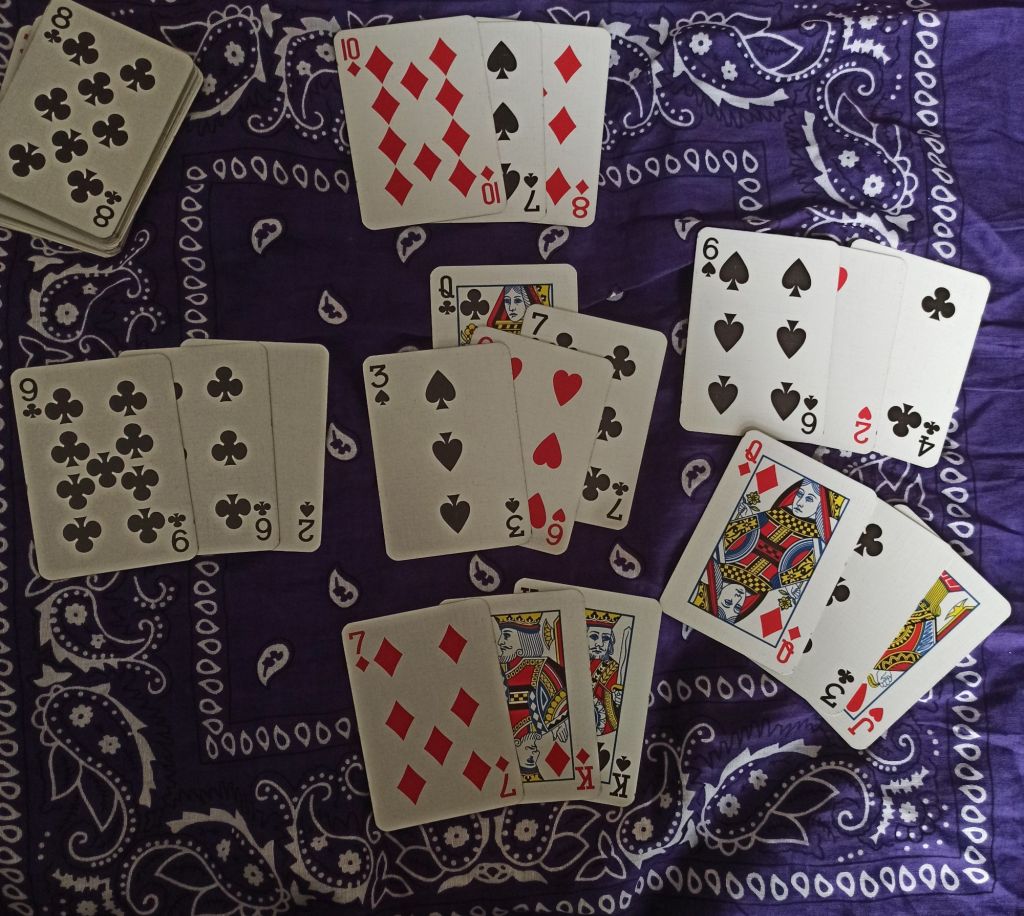
Looking at the spread as a whole, it is clear that it’s about money. In the upper position there are money issues highlighted, particularly a sudden (Seven of Spades) expense. The position below, which often needs to be connected to the one above, indicates issues connected with authority, possibly a bank or other financial institution (the King of Spades and King of Diamonds). In the past position we have a situation of slowness and difficulties for a long time, while in the heart position there are difficulties, possibly either obtaining something or getting it back (the Six of Hearts can mean that) or just simply difficulties finding one’s footing.
I ask the querent and she tells me that she’s a small business owner and business has been slow, and she’s been having trouble applying for financial help in the form of loans to renovate her business (note the Six of Hearts) and make it more appealing.
Encouraged by how responsive the spread seems to be, a look at the future positions. This is where I got everything wrong. I tell her that, although there is trouble (Six of Spades) she will get a positive answer (the last fan with the Three of Clubs and the Jack of Hearts). Looking back it is quite obvious the cards were saying something else.
She didn’t get the loan. The fan with the Six of Spades is not positive at all, even though I had decided to interpret it positively: it merely shows she will be quickly (Two of Hearts) refused the loan, possibly because she is not deemed to have her finances in order.
However, she later did end up partnering (Three of Clubs) with another woman (Queen of Diamonds) to start something new (Jack of Hearts).
It’s not just about love. Playing cards (and any other oracle) can be used to identify people, find lost objects and animals and many other things. Unfortunately, this type of reading is extremely complex, and I have a less than stellar track record in this regard (as opposed to the lady who taught me, who was sort of known for finding lost rings and describing thieves)
The reason for the difficulty is that the world’s complexity is almost endless, and we only have a limited number of cards at our disposal, so that there is always a need for combining card meanings in new and clever ways to signify everything. One of the subjects I want to touch on in a next article on the philosophy of divination is exactly the fact that the limits of our imaginations can also be the limits of our ability to make predictions.
Furthermore, the language of the cards is otherworldly, at least as far as making predictions is concerned, so that the oracle will not necessarily answer the question in a linear form that is readily understood. This is why my error rate by people descriptions and by finding lost items tends to be higher than in other readings. Sometimes I can’t so much as make sense of one of the cards, let alone the whole composition.
There is, however, a reading I want to share because of how clear the cards were, which makes this a good case study. A woman had lost her bracelet and, after looking for it everywhere, was beginning to suspect her niece of stealing it, possibly as a game. Here’s the spread:
Playing Card Divination, A Reading about Theft
There is one woman in the spread. She is next to the Ace of Clubs. This is extremely important. The Ace of Clubs represents initiative, and if you ask whether someone will or won’t do something, if their significator comes up next to the Ace of Clubs (or the Five of Clubs, representing action, or, sometimes, even the Two of Clubs, which means taking steps) it shows the person will do it.
In this case, though, we are talking about theft. So this woman took the initiative, i.e., she stole the bracelet. She is next to the Eight of Clubs, which represents work. So this is not the querent’s niece, but a coworker or superior.
Note, though, that she comes up as the Queen of Diamonds, not as the Queen of Spades, so there is no inherent ‘evil’ about her. Furthermore, we have the Three of Diamonds next to the Eight of Clubs. The Three of Diamonds represents all activities that are done part-time. Metaphorically, therefore, the woman is not a ‘full-time’ thief, i.e., she doesn’t have the habit of stealing. She probably just seized the moment to have something that caught her fancy. The Ten of Hearts closing the spread shows the possibility of a happy ending.
To be more sure, I asked the querent to pick another card for the Queen of Diamonds, and she chose the Four of Clubs. So this is a woman the querent speaks to habitually. Furthermore, even though the Queen is a Diamonds, and should technically be very fair, she is surrounded by Clubs, which represent a dark complexion and/or hair (but not as dark as Spades)
Well, some days after the reading the querent’s coworker, a woman of dark complexion and hair, came forward to her, wracked with guilt, and gave her back the bracelet, which the querent had left on her desktop unattended. The woman said she didn’t know what had possessed her to steal the item.
Geomancy has changed a bit since Medieval times, but one thing that remains constant is how a Geomantic figure or Geomantic Shield is formed. This is done in order to answer a question.
As I said in the previous article, we don’t draw the whole figure in the same way. We can divide the process in two parts: the creation of the four Mothers on one side; and the deriving of the rest of the figure from the four Mothers on the other side. The first is the “divinely inspired” part, i.e., the part where you allow chance into your life, while the second part is automatic and fixed and will follow with mathematical rigor from the first.
So, how do we get a set of four Mothers? In reality, Geomancy is a rather flexible oracle, as any method is technically valid. Once you are well versed in the main operations required to draw a Geomantic figure, you can pretty much use any method that suits you in order to obtain the four mothers.
Still, some methods are more traditional than others. It seems that the Arab Magi used a stick to poke points in the sands of the desert, a method that is still perfectly valid and has even been accepted and adapted by the Golden Dawn. By the time Geomancy reached Europe in the Middle Ages, it was customary to use a stylus or pen and a tablet or piece of paper or parchment. Dice were also used, and one could, and can use dried beans or pebbles or playing cards. Anything that can give you odd and even numbers will do.
Needless to say, some have devised software that calculate everything automatically. I don’t particularly trust this method, and yes, partly it’s because technology is still so new that my mind doesn’t accept it as a valid substitute for things that are more dependent on my direct manipulation–it may very well be that in five hundred years occultists will use geomantic software without thinking twice about it, but we’ll cross that bridge when we get to it.
The Pen and Paper Method
My personal favorite method remains pen and paper. I almost always use it, and I find it has an odd beauty, even power to it. It also reminds me of a playful oracle that we used to use as kids in middle school and high school in Italy to answer yes or no questions. Usually, some love-stricken teen would ask the fateful question, “does he love me?” and would start drawing random numbers of points on a piece of paper. Then she would pair up the points until either one point was left (yes) or none at all (no). I have no idea how this oracle originated, but I remember it being very much in vogue when I was a kid.
A set of geomantic Mothers is obtained in a similar, albeit more complex, manner. First off, it pays to write down the question. This has the incredible advantage that it forces you to think about it seriously, and it also makes it more real and objective.
Then, after concentrating on the question, you should ask for divine help. I’m not saying this to be preachy. Consult any Medieval handbook of Geomancy and you will find the same instruction: it’s the “Unmoved Mover” that sends his “vertue” down from the skies to answer your question. At the very least, you should take a moment to relax.
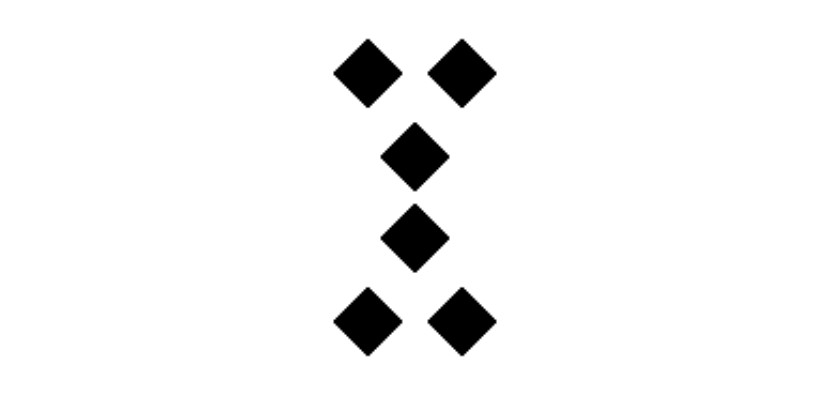
Once you feel ready, start drawing sixteen consecutive rows of points. Try to be orderly, but don’t worry too much: as long as the rows don’t cross or merge you are fine. Also, I have found that it is better to draw I’s instead of points, for the simple reason that it makes it easier to recognize the marks instead of leaving you wondering “is it a point or a random inkblot?”
Do not count the points or I’s you are making, and do not bother counting the rows as you make them. Do not engage in any kind of mathematical or rational thinking. In fact, I have found it pays to write down numbers from 1 to 16 before starting the operation, so as to be free from the worry of drawing too many or too few rows of points. Still, in the traditional instruction, you are normally told not to bother if you end up with an extra row of two–just go overboard and then discount the extra ones. Either way you will end up with something like this:
1) IIIIIIIIII
2) IIIIIIIIIIIII
3) IIIII
4) IIIIIIIIIIIIIIIIIIII
5) IIIIIIII
6) IIIIIIIIIIIIIIIIII
7) IIII
8) IIIIIIIIIIIII
9) IIIIIIIIIIIII
10) IIIIIIIIIIIIIII
11) IIIIIIIIIIII
13) IIIIIII
14) IIIIIIIIIIIIIIIIIIIII
15) IIIIIIIII
16) IIIIIIIIIIIIIII
Once this operation is over, you have your four Mothers, but only in a raw form. Each Mother figure is made up of four rows (4×4 = 16). Now you need to pair up the I’s in each row until either one is left over or two. Let’s make the example of the first Mother, which is made up of rows 1 through 4:
1) I-I I-I I-I I-I I I = O O
2) I-I I-I I-I I-I I-I I-I I = O
3) I-I I-I I = O
4) I-I I-I I-I I-I I-I I-I I-I I-I I-I I I = O O
The figure we have received as first Mother is comprised by a sequence of two points on top, then one point, then one point, then two points. The same process of pairing up must be done for all sixteen rows to obtain the four Mothers (the second Mother being made up of rows 5 through 8, etc.) The first Mother we have obtained is called Conjunctio.
The Geomantic figure Conjunctio. From the App ‘Simple Geomancy’
Once this operation is over, you will be left with four figures, each made up of four rows of either one or two points. From these figures you will need to derive the rest of the chart, which I will go over in the next post.
Here I gather all my articles on (mostly European) Geomancy.
Geomancy has been an ongoing interest of mine. It is an ancient divination system that is being rediscovered after a couple of centuries spent in obscurity. It exists in various flavors, the most commonly recognized in the West being the one practiced by Medieval and early Modern magi. It derives in its main lines from Arabic Geomancy, and is only distantly related to African practices that use similar figures.
Of course, at the time when Geomancy was introduced to the West, Astrology was all the rage, which means that European Geomancy has a marked astrological bent. In most of its variations, Geomancers obtain a response by generating a random number of points which are then organized according to a fixed series of rules. Note that geomancy has nothing to do with Feng Shui and related practices (Flying Stars, Qi Men Dun Jia, Ba Gua Sectors, etc.)
I’m currently translating an old manuscript on Geomancy from Italian into English and I wanted to seize the opportunity to give someone a reading. My husband proved to be the guinea pig I needed. He was about to enroll in a course at the local VHS (Volkshochschule, a network of continuing education institutes in Germany) and wanted to know if he would be happy with the course.
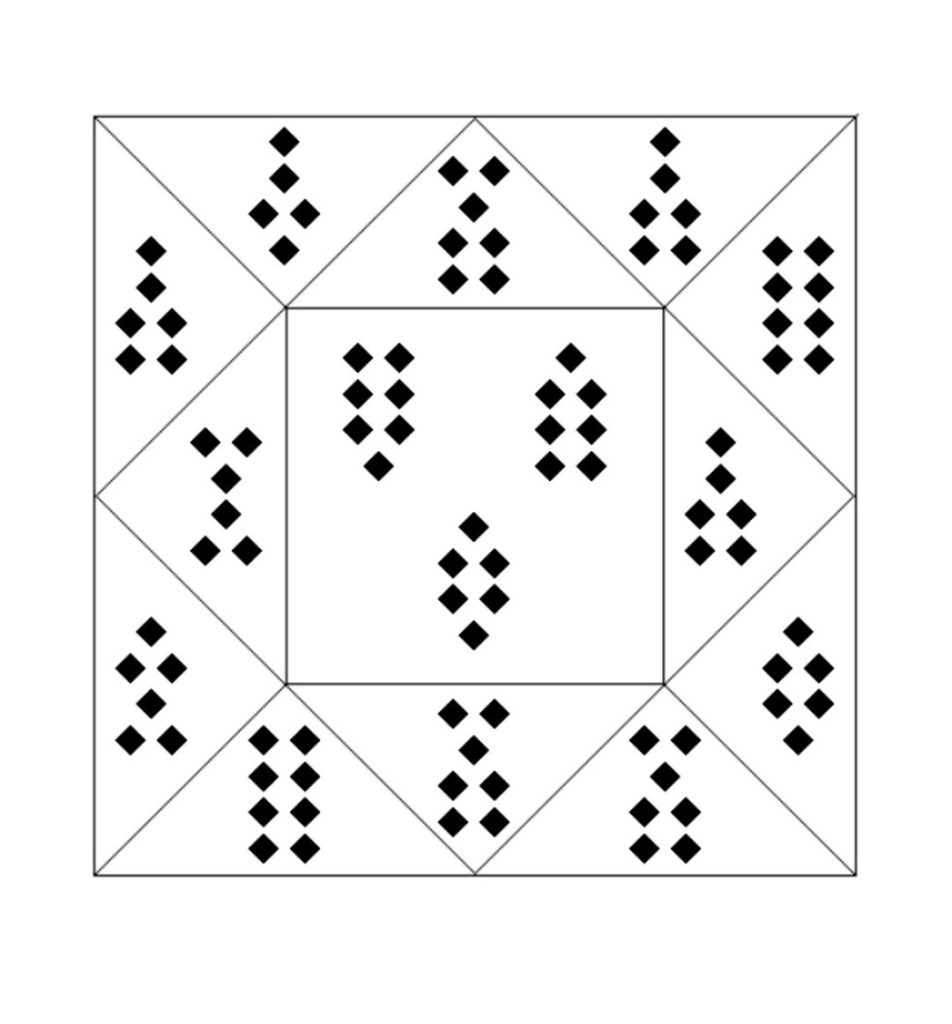
Will I be happy with the course I’m about to start?
The lord of the first is Conjunctio, which indicates mental flexibility and the ability to learn. The quesited is the lord of the ninth house, Fortuna Minor, which is outside help. It often indicates good opportunities that need to be seized.
Fortuna Minor moves to the twelfth house, perfecting the chart. This is a very good indication, as it shows contact between querent and quesited, in this case the transfering of knowledge/skill. The perfection happens by the ninth figure moving, showing that the course organizer(s) will do their best.
However, F. Minor also moves to the seventh house, from which it opposes the querent. Furthermore, Minor plus Conjunctio gives Amissio, Loss, which shows either waste of money or the inability/impossibility to learn everything.
Carcer is the Judge, which indicates that overall it’s a wash, especially since the Right Witness is Laetitia but the Left Witness is Tristitia, indicating a downward or negative trend. The Judge of the Judge (Judge + Lord of the First) is Via, which in general can be seen as something of little consequence, something that is there and then is gone.
The Way of the Points leads back to Amissio in the second house, it’s an investment that is not wholly justified.
Outcome: my husband was somewhat happy with the course, but his interest waned with every class, especially because he found that he disagreed with some of what the teacher was saying (that opposition) although the teacher was generally enthusiastic and helpful. He didn’t get buyer’s remorse. He was still happy he had done it, but he had hoped for way more, especially considering the price.