
Tag Archives: Fear

Enneagram Type Six – A Quick Introduction

Often Known As: Doubter, Skeptic, Loyalist, Underdog (note that names are as limiting as they are revealing.)
Sin/Passion: Fear
Focus: on security
Fear: of not finding any stable protection
Energy Center: Head (energy is suppressed)
Social Stance: Compliant
Key Positive Traits (embodied at their best): Dependable, Friendly, Supportive, Dutiful, Mild, Reasonable, Gregarious, Courageous, Cooperative, Group-conscious, Good partner, A buddy, With good hunches, Encouraging, Loyal, Funny, Hardy, Good at foreseeing problems
Key Negative Traits (embodied at their worst): Fearful, Critical, Cynical, Cowardly, Mindless, Ideological, Catastrophizing, Alternating between following blindly and rebelling blindly, between conformism and mutiny, A deer in the headlights, Given to unwarranted fight or flight behavior
Growth and Stress Directions: to Nine and Three respectively
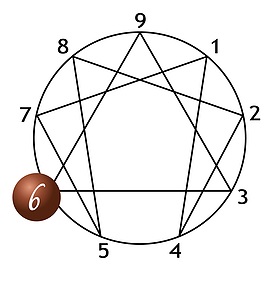
Enneagram chart with Type Six highlighted.

Introduction

In a way, Type Six represents Joe Citizen. Supportive, generally friendly, Sixes are usually mild-mannered and dependable with others. They tend to form strong and stable bonds and they are normally there for the people they have bonded with. Often capable of a great spirit of sacrifice in the name of fairness and friendship, they are always willing to fight for the underdog and try to be good neighbors with their fellow humans.

They often have incredible hunches that almost invariably turn out to be true. This is nothing supernatural. It is the consequence of a life spent trying to anticipate and prevent uncertainties and dangers. When a Six tells you that something is off about someone or something, they are probably right.

Sixes value loyalty–loyalty to ideas and to people. It is rare for them to question the motives of people they trust, and they usually go well out of their way to justify friends and associates. There is little they dislike more than untrustworthy people and traitors. They also occasionally display an obdurate unwillingless to trust others and have trouble with authority figures (unless they blindly trust them).

Sixes often have a good sense of humor, but also a cynical streak. Occasionally they make skeptical remarks that feel unwarranted or exaggerated, and they are seldom satisfied with the level of proof required by others in order to feel confident in a situation: Sixes need more.

The defenseless lamb, a good symbol for Enneagram Type Six

Core Mechanism

It is incredibly hard to pin down Type Six in a single description. In a way, it is the most complex type. Sixes can and often do showcase opposite tendencies at different times, or even at the same time, and sometimes it is hard to see what links them to other Sixes. From a behavioral standpoint, Sixes are probably the most heterogeneous Enneagram type.

Sixes often swing between extremes of obedience and rebellion, mindless acceptance and rejection, aggression and passivity, fight and flight, faith and skepticism. The reason is that they lack any inner sense of certainty about life.

In the introduction I said that Sixes are always willing to fight for the underdog. This is because Sixes often feel like they are underdogs. Their worldview is one of great uncertainty. In a way, Sixes feel like they have been cast into the world with no protection–a world full of wolves that are waiting to attack.

Sixes are a Head type, but unlike the major head type, Fives, who trust only their own mind and relish in endless doubt and uncertainty, Sixes don’t trust themselves to have something figured out for good, but they do want to figure it out for good. Their mental processes are forever undermining their choices and their sense of certainty: “What if this happens? What if that happens? What is the worst that could happen?”

To compensate for their lack of inner guidance, Sixes seek a source of guidance outside of themselves (something Fives would never do). Once this source of guidance (which may be a person, a political ideology, a religion, an institution, etc.) is selected, the Six is unlikely to question them, and will become a brave little soldier fighting for the cause. Sixes also tend to find strength in number and in networking with other people they deem dependable, often on the assumption that they are all potential victims of this uncertain world and so they can help each other.

As soon as the cracks start showing in whatever source of certainty the Six has selected (after all, nothing and no one is perfect one hundred percent of the times) Sixes may try to overlook them by becoming more mindless, but if the cracks become impossible to ignore, Sixes turn on their “protectors” becoming the stereotype of the torch-bearing villagers. Once the rebellion is over, Sixes look for another anchor, and the cycle starts over.

Passion

The passion of Enneagram Type Six is Fear. To understand this we must take a step back and recognize that fear is, in a way, the foundation of every form of life. As soon as an organism exists, it seeks to perpetuate itself and to avoid what damages it, which it fears.

Sixes embody this idea in a visceral and almost archetypal way. Their primary concern is with their safety (and that of the people they care about, of course). Their fear stems from the fact that they cannot find anything around them that they can one hundred percent rely upon.

This leads them to their famous trait of catastrophizing about everything under the sun. Paradoxically, Sixes do this because it calms them, as it allows them to come up with endless Plans B (and C, and D) in case something goes south.

Unfortunately, their fear interferes with this focus on certainties, as eventually they’ll manage to poke a hole even in their fifth, sixth and seventh wheel, leading to a breakdown of their view of reality as it is, and not in a positive sense.

Fear is the constant companion of a Six’s life. It manifests as an ocean of variables when they don’t know what or whom to trust; when they have found this solid rock, fear manifests as a mute, nagging sensation that all is not well, that something is escaping them and will bite them in the ass one day.

In relation to the passion of fear, we distinguish two possible reactions on the Six’s part: the phobic reaction, which consists in running away from fear, and the contraphobic reaction, which consists in ramming through fear (if you’ve seen a herbivore attack a predator in a fearful frenzy, you’ve seen a contraphobic Six). Most Sixes fall somewhere between the two extremes, but some crystallize on one end or the other of the spectrum.

Fear, the passion of Enneagram Type Six

Misconceptions

A common misconception about Sixes is that, because they tend to undermine people’s credibility when they do not fully trust them, they are personally out to get them. Although it can be difficult to deal with a Six in these circumstances, their cynicism and snide remarks are not to be taken personally (which does not make them acceptable, of course).

Sixes are constantly looking for an anchor, something in the world that they can rely on, something that won’t change or be found faulty. As is often the case with psychological mechanisms, other people are simply casualities in our war with ourselves. Knowing this can help you in defusing difficult situations.

Another common misconception is that, because Hitler was supposedly a contraphobic Six, then every contraphobic Six is Hitler or a potential serial killer. I’ve heard this from a number of supposed authorities on the Enneagram. In an age where all it takes to be called Hitler is to mildly disagree with someone with funny hair, it should perhaps be pointed out that, since most Sixes have contraphobic tendencies buried more or less deep within them, and since Six is probably the most common type, it would be silly to say that more than one ninth of the population is made up of deranged dictators, but maybe this is a conversation for a more sane age.

Under normal circumstances, a contraphobic Six is simply someone who has a tendency to react to fear by moving toward and against it (it’s the “fight” part of “fight or flight”). This is not in itself a negative thing. It is just yet another survival strategy.

Wings

6w5: Sixes with a Five wing have definite intellectual, even scientific bent. They are very systematic in their survey of all possibilities, variables and factors, and they are likewise very systematic in their attempt at finding the solution to all of them. They often come up with ponderous defenses of the ideas that give them certainty, which tend to be somewhat more conventional than the ideas a pure Type Five might be interested in, but less than what a pure Six would find comforting.

6w7: Sixes with a Seven wing are very friendly and very entertaining. They often have a sharp sense of humor and a tendency to like and to be liked by others. The Six’s strategy to make friends with everyone so as not to end up eaten by wolves finds application, in part, through the Seven-ish drive toward enjoying time with others and networking. Less intellectual and more practical in their orientation, they fare well in social contexts, especially in group efforts.

(note that wings can have some minor descriptive power in terms of superficial behavior, but they are irrelevant in terms of what motivates the person. Many people have no noticeable wing, while few show signs of both.)

MQS

Focus, Fear and Conditional Self-Acceptance (Enneagram Plain and Simple)

Developing a personality means excluding something of the whole from one’s self-image. We cannot have a distinct sense of self without contracting our identity from ‘everything all the time’ to ‘some things some of the time’.

This partiality becomes the reason why we seek some things while avoiding other things. If we weren’t partial to pleasure rather than pain we wouldn’t look before crossing the street. If we weren’t partial to recognition we wouldn’t seek it, while avoiding shame, and so on. If the world were populated by enlightened sages, we would never have left our caves and we’d still be dying of the flu.

Each Enneagram type has its own mechanism, which revolves around a specific passion, as discussed previously. This mechanism drives us to the accomplishment of certain things, focus on certain aspects of ourselves and of reality, but it also, complementarily, leads us to fear certain other things. These two aspects are two faces of the same coin: one cannot strive for something without fearing the opposite outcome.

Therefore, each of us tends to justify their existence and their efforts by subconsciously adhering to propositions like “I am only ok if…” or “Everything will be alright if I…” We shall call this proposition the “contract with ourselves and with reality.” These are ways we use to subconsciously attempt to manipulate ourselves, reality, and others, dictating the conditions that allow us to accept ourselves. In other words, we accept ourselves on the condition that we fulfill the drive that is implicit in our mechanism. This, of course, colors the way we relate to other people, as we tend to project these subconscious issues outside of ourselves. Usually, this fear is counterbalanced by an opposite longing that we feel, in our lucid moments, to abandon the mechanism and simply be: “So what if I’m….” If the mechanism is a night of debauchery and drunkenness, this is the moment where sobriety kicks in.

The Nine Fears

TYPE ONE
One’s focus: Ones are highly self-critical, with a strong conscience. They tend to mediate their right to autonomy by measuring it in terms of how much they adhere to a certain ideal of how they should behave. Their focus is consequently on standards. They are keenly aware of the difference between their life as it is and their life as it ought to be in order for the ideals that move them to be fulilled. It becomes almost a mathematical subtraction: What ought to be – What I’m not doing to fulfill it = myselfmyself currently.
One’s fear: their basic fear is to be wrong, or rather, to act wrongly or badly. Note that a One’s idea of good or bad is not solely moral but also technical. In a One’s perspective, morality (what we ought to do) and procedural issues (how to carry it out) are deeply intertwined, and it is not always easy to disentangle them.
One’s contract with themselves and with reality: “I am only ok if I act rightly, all will be alright if I do the right thing.”
One’s projection toward others: it is widely reported that merely being in the presence of a One is enough to feel like something is wrong with our life. Ones who are not conscious of their mechanism tend to exude their sense of being in the wrong toward others.
One’s longing: to cut themselves some slack and have some respite form the inner critic. “So what if I’m not perfect?”

TYPE TWO
Two’s focus: Twos are deeply interpersonal. As a matter of fact, they basically live at the intersection between themselves and others. Their primary focus is on other people’s needs, and how they may anticipate those needs and take care of them.
Two’s fear: a Two’s basic fear is of being surrounded by a world that doesn’t take them into consideration, doesn’t validate them and that doesn’t love them with all their needs.
Two’s contract with themselves and with reality: “I am only ok when I put others ahead of myself , all will be alright if I meet others’ needs.”
Two’s projection toward others: Twos have a marked tendency to infantilize others, seeking unconsciously to deprive them of their autonomy, so that they will come to recognize that they need the Two. It is not uncommon to feel helpless and incapable of taking care of oneself in the presence of a Two. It is also not uncommon to develop a dirty conscience for nothing, especially for exerting one’s autonomy without the help of the Two. This is the same dirty conscience that Twos have when they think about themselves and their own needs without taking others into consideration.
Two’s longing: to be appreciated and loved for how they are, even if they are not needed. “So what if I think of myself?”

TYPE THREE
Three’s focus: Threes are showmen. They are constantly driven to excel in enterprises that will gain them validation and ammiration. Because they overidentify with their actions, rather than with their being, they tend to act within conventionally accepted fields so as to maximize the likelihood of being met with approval. Therefore, their focus is on what’s valuable.
Three’s fear: Obviously, their great fear lies in not being considered worthy or valuable. They fear that the activities they seek to impress others and win accolades with will be found lacking or, even worse, that they will be called out as fake or phony in some manner.
Three’s contract with themselves and with reality: obviously, this is “I am only ok if I earn respect, all will be alright if what I do gains recognition.”
Three’s projection toward others: being by nature very competitive, Threes easily hurt other people’s feelings, sometimes unwittingly, sometimes very wittingly. In their presence it is easy to feel like one doesn’t have their life together and isn’t worthy of respect, recognition or approval.
Three’s longing: to simply let go of the pretense, quit the charade and show their true selves honestly. “So what if I’m not some admirable hero?”

TYPE FOUR
Four’s focus: Fours see themselves as defective, as if everyone else has an undefinable something that makes their lives ok, while Fours lack it. This is what they focus on. Therefore, they perceive the normal instability of their personality as something dramatic, and they wish to be rid of this suffering by fashioning an identity for themselves.
Four’s fear: Four’s nemesis is their sense that they don’t have a stable identity to which they can point to to tell themselves they are significant. They fear the idea that they might be just another collection of whirring atoms catching dust while waiting for the inevitable. Because they attribute great importance to this unique identity, they fear that they won’t be loved unless they have it. if there is a word they flee from, it’s “ordinary.”
Four’s contract with themselves and with reality: “I am only ok if I am unique and have a deeply meaningful existence, all will be alright if I differentiate myself from others by finding my own self and expressing it.”
Four’s projection toward others: because Fours fear the possibility of being just another human being, they tend to project this fear toward others, making them feel coarse, ordinary, and that whatever suffering they experience, the Four has suffered more and is more justified in lamenting (or is more admirable for not lamenting)
Four’s longing: when in their own mechanism, Fours tend to spend a lot of time longing, but deep inside, the real longing is to be loved even if they are ordinary. “So what if I’m just another living thing?”

TYPE FIVE
Five’s focus: Fives are incredibly cerebral, which is a strategy they use to avoid the uncertainty they have about their own ability to live ‘in the world’ together with the rest of humanity. They feel they first need to retreat to stock up on resources, knowledge, time, competence, etc. Their focus is on competence and on resources, broadly construed.
Five’s fear: Five’s basic fear is of being incompetent, of lacking the skills required to succeed in life or even just to make a contribution to society. They tend to procrastinate on engaging the world until such time as they’ll be fully prepared. Inside, a sometimes unconscious, sometimes loud voice taunts them, “You are so dumb.”
Five’s contract with themselves and with reality: as a consequence, their contract with themselves is “I am only ok if I know exactly what I’m doing, all will be alright if I gain enough competence.” This usually leads Fives toward futile overspecialization, and to avoiding all situations where the particular branch of knowledge they are mastering won’t be of use.
Five’s projection toward others: Five’s emphasis on knowledge, competence and rationality tends to find expression in a sarcastic attitude toward others, who consequently often feel unjustifiably dumb or irrational when in a Five’s presence.
Five’s longing: to stop fiddling with empty concepts and join the world with simplicity. “So what if I’m not all-knowing?”

TYPE SIX
Six’s focus: Sixes can’t for the life of them stop questioning whatever it is that is giving them security, which they usually find outside of themselves. Obviously, their focus is on security, which keeps them poking holes in anything where a hole may be poked in hopes of finding something stable they can depend on.
Six’s fear: it shouldn’t come as a surprise that Six’s fear is fear itself. However, because they are working overtime to find something or someone that will allay the fear, their greatest fear is of not finding it, and that they will be left to their own devices, weak and small in a large, threatening world teeming with wolves.
Six’s contract with themselves and with reality: this reads, “I am only ok if I know something is beyond doubt, all will be alright if I find someone or something to trust without reservations”
Six’s projection toward others: Sixes are masters in destroying other people’s certainties. If the Six you have to do with is a hypochondriac, you’ll soon be one as well. Sixes, by the way, have the sense that they are being completely rational in worrying so much, so in instilling their fears into others they often feel that they are educating them or making them understand their situation, sometimes with the aim of showing them that they are similar, they are both (potential) victims, and should become allies. Either way, Sixes project their fears onto their peers.
Six’s longing: to simply turn off the ceaseless questioning and just accept reality and trust others to be decent human beings. “So what if I don’t know what tomorrow will bring?”

TYPE SEVEN
Seven’s focus: Sevens are excitable and quick-witted, focusing usually only on the positive side, and feeling that negativity would drag them down overmuch if they allowed their mind to dwell on it. Therefore, their focus is on planning diversions and pleasurable activities.
Seven’s fear: normally, Sevens are terrorized by the idea of experiencing want or pain or fear itself. That’s what sets them on their journey of pleasure-seeking. There is a sense that, unless they keep stuffing the hole in their soul full of pleasure, the gaping wound is going to start hurting.
Seven’s contract with themselves and with reality: “I am only ok if I stay positive, all will be alright if I plan something new to move toward.”
Seven’s projection toward others: as they tend to avoid less than positive feelings and states of mind, Sevens can be put off by others’ willingless to explore such issues when they arise in their own life. Yet, in a Seven’s presence one often feels that it’s not the time to be a Debbie Downer. Sevens can make others feel that they are being too negative or are taking life too seriously. They accomplish this both actively, by minimizing and joking about people when they open up, and more subconsciously by the way they carry themselves to drown everyone around them in mirth.
Seven’s longing: to stop the obsessive planning and consuming of life and acknowledge the deep wounds they carry. “So what if not everything is fine and I take care of my darker side?”

TYPE EIGHT
Eight’s focus: Eights go out into the world and conquer it for themselves. Each Eight is like a warring nation, constantly looking to increase their wins, minimize their losses and defend their borders. They feel the need to be strong and look for ways to prove it. Their focus is on power, on who has it, who lacks it, and how to exert it.
Eight’s fear: predictably, an Eight’s greatest fear is for their soft, weak side to come to light and be exploited or used against them. This prompts them to always keep their guard up and not sit on their hands: attack is the best defense.
Eight’s contract with themselves and with reality: this would be, “I am only ok if I am strong and unconquered, all will be alright if I make it clear I’m not to be underestimated.”
Eight’s projection toward others: anyone who’s seen a couple of Eights brawling in the streets knows the feeling of helplessness and weakness that comes from the experience. Eights tend to make other people feel the weakness that they want to hide from themselves.
Eight’s longing: to let their guard down and call a truce with life. “So what if I’m not a perfect fortress?”

TYPE NINE
Nine’s focus: Nines are diffuse and conciliatory. Being a body type, they are concerned with autonomy, but they achieve this by not creating struggles or problems or going against the flow. Their primary focus is therefore on peace and peacekeeping. As a former boss of mine, a Nine, once said, “how many problems have been avoided by people doing nothing!” (He said it while running his business into the ground out of inaction)
Nine’s fear: Nine’s fear is that, by rocking the boat, they will lose contact with others and not be acknowledged or ‘seen’ as a consequence. They fear that if they asserted themselves conflict would inevitably ensue.
Nine’s contract with themselves and with reality: “I am only ok if I remain passive, all will be alright if I just keep peace.”
Nine’s projection toward others: the narcotic properties of many Nines are almost legendary. In a Nine’s presence, other people often find that they have to struggle twice as much as they are used to in order to achieve their aims. This is partly due to Nine’s passive sabotage, partly due to Nine’s desire for pure, unadulterated, unmoving harmony that they tend to project outwards. They are not rocking the boat, and nobody should. Because Nines have trouble finding themselves, others can lose their sense of self in their presence.
Nine’s longing: to be seen as individuals with their aims even if they assert themselves. “So what if I do my own thing?”