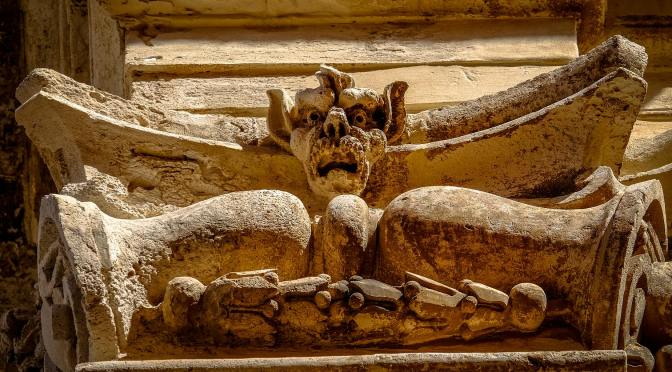
In many supernatural movies about exorcism, the priest trying to free the victim needs to discover the demon’s name. This is actually founded in (part of) the real practice of exorcism and does have its roots in the magical belief of the power of names. For instance, there are certain practices in folk magic in Italy that require the magician to go to the christening of a child whose name translates to the effect he or she wants to achieve.
But belief in the power of names is not just found in Italy and it probably goes back to the most ancient and elemental relationship that humans established with the things around them in their attempt to dominate them. Traces of this fact are found in the doctrines of many Greek philosophers, sophists, poets and playwrights, and I have also found some similarities with Chinese Daoist literature. A wonderful fictionalized account of this belief is found in Ursula LeGuin’s Earthsea saga, which anyone interested in magic should read, in my humble opinion.
I am not one who seeks to psychologize occultism, although I believe that psychology is not at all a useless discovery and can be part of a modern magus’ training. I think that the attempt to reduce occultism to psychology is just as misguided as the attept to condemn anything that modernity has brought us as a deviation from an ancient splendor.
That being said, as someone who practices divination for others, there is also a certain sense in which naming works in a cathartic way. Most of the people that consult me are rather upfront about their problems, especially since I don’t ask for money and therefore feel no guilt in telling them to go sit on a cactus if they are trying to waste my time.
But people can be reticent about their issues for a variety of reasons, and malice is not always the motivation. Among the many possible reasons is the fact that people sometimes feel the need to have their demons driven out of them by someone outside of their regular field of experience.
Having someone discover our particular demon’s name without us feeding it to them can be a powerful and cathartic experience, because it smokes the demon out of the dark recesses of our subjective experience and into the light of objectivity, where it can be addressed as a definite and therefore limited issue, rather than being consumed by its overwhelming lack of contours.
Not every divination session calls forth such existential experiences, nor should we as diviners try to turn each session into a catharsis. We are not therapists and our duty is not to give people advice, although advice can certainly be given if required. Our role is to provide information, whatever that may mean in the context of each particular reading. For this reason, our language and that of our divination tool needs to be earthly, concrete and objective.
But sometimes informing the querent can mean gathering the diffuse knowledge that they already have festering inside of them and turning it into useable information by giving it its proper name.
MQS