Enneagram Type Five and Enneagram Type Nine can share some similarities, though they remain vastly different. Nines are a Body type, who seeks to maintain a sense of harmony within themselves and their surrounding by avoiding conflicts that would undermine their sense of autonomy. Fives are a Head type, who withdraw from the world to observe it from a distance and to gain skills that will ideally allow them to succeed.
Both Fives and Nines withdraw from others, but in different ways. Average Nines withdraw their energy and suppress their agenda to avoid it clashing with that of other people. Average Fives withdraw themselves, often physically, or at least emotionally, from social situations.
Nines, however, generally remain friendly and often go with other people’s flow, as long as it doesn’t threaten their inner sense of calm. Fives, on the other hand, have a strong sense of self as opposed to all other, refuse to be swept along in their flow and tend to have a supercilious and combative demeanor that most Nines would never display.
Withdrawing
Internally, Nines usually pacify themselves with happy or comforting thoughts and a positive, if vague, attitude. They tend to think in terms of generalities, which makes them very good at finding common grounds with all humanity at an almost archetypal level. Fives are internally high-strung and constantly mulling over some thought or theory, they disdain generalities and are as laser-focused on details as they are preoccupied with finding their universal significance. Furthermore, in general Nines will stop themselves from trespassing into “scary thought territory”, while Fives will usually willingly go there.
The decisive difference between Nines and Fives is in what drives the two types. Fives are driven by knowledge. At their best they are as wise as they are knowledgeable, at their worst they are obnoxious collectors of obscure trivia. Nines are motivated by peace. At their best they are deeply embracing of themselves and others, at their worst they are dollar-store mystics detached from reality.
Enneagram Type Five and Enneagram Type Eight are apparently very different, so much so that they are each other’s arrow on the Enneagram symbol: Five is Eight’s stress point, Eight is Five’s growth point. Fives are a Head type, concerned with security, and tend to find it by removing themselves from the world and observing it from a distance. Eights are a Body type, whose drive for independence leads them to asserting themselves in most situations, even and especially when there is resistance against them.
Interestingly, both Fives and Eights assert the energy of their center: Fives assert the intellectual urge of the Head center, Eights the instinctual urge of the Body center. In this, they both tend to break down opposition on the plane on which they operate: Eights break down physical opposition, often by asserting themselves on others more or less fiercely; Fives assert their mind’s right to be the judge of the truth of this or that idea by breaking it down, rarely accepting it as a given. Both Eights and Fives can be confrontational when unhealthy: Eights physically, Fives intellectually.
Assertion
Both types are strongly concerned with truth. Fives seek to develop a true appraisal of reality beyond social or even academic conventions. Eights usually have a very instinctual conception of the truth (their famous bullshittometer). Fives’ danger is of getting lost in the hair-splitting byzantinisms of their mental process; Eights’ danger is of failing to realize that sometimes their instincts do fail them and not everything is as simple and black-and-white as their guts tell them. Eights usually tend to simplify, Fives to complexify. Both excesses are best curbed.
Socially, both Eights and Fives have an individualistic, maverick-like streak, and both can be socially awkward and be somewhat timid. Yes, this also applies to Eights: as soon as they feel they are out of their depth Eights tend to become withdrawn and insecure, like regular Fives, often out of fear of being called out for being stupid or incompetent (this is Five’s fear, which is Eight’s stress point). Usually, though, Eights, while not necessarily social, tend to be imposing and even demanding. Fives, on the other hand, are almost always distant and even remove themselves physically from contact with others. Fives who have consciously worked on their social skills may, however, develop some of Eight’s bodily confidence.
Enneagram Type Five and Enneagram Type Seven are very different, but they do share some connections, so much so that Seven is the stress point of Five and Five the growth point of Seven. Both are Head types. Fives are intellectual individualists who remove themselves from the world to feel safe from it. Sevens are exciteable planners who seek to escape their inner sense of fear or pain by taking refuge into the opportunities the world seems to offer them.
Both Fives and Sevens are Head-driven, but in vastly different way. Fives are THE brainy type, as they spend the majority of their time in their heads, thinking odd ideas and formulating concepts almost as an aim in itself. For Sevens the mind is declassed to the rank of means in formulating plans for enjoyment and flight from (or rationalization of) the things the Seven fears.
Both Fives and Sevens are very good at establishing connections between disparate things, subjects and ideas that few would ever think of mentioning in the same sentence. Still, they do it in vastly different ways and following different avenues. Sevens usually move on the surface of things, casting a wide net on their multiplicity in a bid to explore as many of them as the Seven wishes to. They enjoy this sense of variety and love having options and freedom, and this almost inevitably leads them to heaping up odd experiences and ideas in never-before-seen patterns. They are, in a way, the Renaissance men and women of the Enneagram.
Fives, on the other hand, delve deeply, with an almost surgical focus, into a single abstruse and socially disregarded idea that interests them until they have broken it into its smallest possible components, which they can reassemble, often with a taste for paradox, into widely different ideas. Then they break them apart again and start over in the same endless process of analysis and synthesis. Since, at the end of the day, everything in the universe is connected with everything else, Fives end up (or at least aim at) possessing the Whole within a single concept by leveraging a single, obsessively developed core idea that allows them access to all other ideas. In other words, Sevens tend to be exploratory, Fives tend to be conceptual.
The Mind’s Eye
Socially, the two types are very different. Sevens, while not necessarily extroverts, are outgoing, in the very real sense that they go out of themselves and toward others, often directly if not bluntly. Fives tend to withdraw from social contact in a hermit-like fashion.
Furthermore, both types have a keen awareness of their needs, but take care of them in starkly different ways. Fives generally minimize their needs in order to avoid offering themselves up to the vagaries of good and bad fortune, but in pursuing this course they often end up withered and emotionally dry. Sevens on the other hand are usually anything except minimalistic, tending more toward extravagance, as they fear confinement, because confinement and lack of external fulfillment force them to bear witness to a less than happy inner reality that, in one way or another, they refuse to confront.
Enneagram Type Five and Enneagram Type Six belong both to the Head triad, yet they give off markedly different energies. Fives actively employ their Head energy, using it to make sense of the world from a distance. Sixes often suppress their Head energy, don’t trust their own judgment and seek someone or something that will explain reality to them.
Being both Head types, both Fives and Sixes deal at their core with fear of the world around them.Fives thus retreat from the world into the safe realm of their own intellect, from which they observe life without being touched by it. It is often held that Fives are taking time off from real life in order to look for something, an idea or strategy, with which they may join the others and be useful or have a fighting chance, but while some great Fives really do come up with revolutionary ideas that changed the world, most Fives become lost and almost hooked on their own thinking power.
Sixes deal with fear differently. They don’t trust their own mind, so they seek structures outside of them, whether social, political, religious or other kind. For them, life is a sea of difficult choices, risks and dangers, a place where nothing seems certain. They therefore become engaged in an endless quest for the person, idea, group or thing that will give them clear answers that they don’t need to question anymore. Once they have found (or if they find) something that stands up to their scrutiny, they espouse it with militant fervor.
Fives tend to be philosophical and rational (though not always reasonable). Their approach to ideas and concepts is seldom practical, and they tend build up mental constructs not to employ them but to sharpen their overactive mind’s claws on them. Their attitude toward ideas is often playful and nihilistic. Sixes on the other hand are more practically oriented because their sense of fear is less rarefied and is almost palpable, as if they needed to actually survive from moment to moment. Their attempt at tearing down ideas and concepts is not playful at all: they keep poking holes in everything in hopes of finding the one thing where holes cannot be poked.
From a social standpoint, the difference between Fives and Sixes is often marked. Fives are withdrawn, remote, aloof. Even at average levels they are often socially inept, nor do they care to work on this aspect of their life, as they consider it inessential. Sixes, on the other hand, while often questioning people’s motivations, put on a friendly and even cheerful facade, because they are aware of how important networking is in dealing with the uncertainties of the world.
In reality, both Fives and Sixes are mistrustful of people. However, as far as Fives are concerned, rather than mistrusting people’s motives, like Sixes do, they tend to mistrust other people’s ability to understand reality better than them. On the other hand, a Six’s skepticism is generally oriented at people’s loyalties and competence in providing answers the Six can rely on. For instance, in an educational context, a Six pupil may not believe the teacher is good and is, in a way, faking it, while a Five pupil will often think they are better.
Enneagram Type Four and Enneagram Type Five are, on paper, extremely different, yet they end up sharing a number of similarities. Fours are a Heart type whose main focus is on what makes them uniquely deficient in life and on attracting someone who will see them and love them in their brokenness. Fives are a Head type, preoccupied with security and with trying to overcome their ineptitude in facing life’s unpredictability and problems.
Fives are on the quest for pure objectivity, completely devoid of the dross of personal belief, feeling, hopes and desires. Fours are possibly the most subjective type in the Enneagram, whose attention always goes to their particular emotional reaction to life.
Both Fours and Fives share an often deeply negative view of reality and have no problem facing the dark side of life. Both are individualistic and ‘odd’ by social standards and don’t care if what they do or say isn’t accepted or common. Fours tend to defy conventions because they are primarily concerned with being true to themselves, while Fives defy conventions because they derive pleasure from the iconoclastic process of disruption. Fours are primarily existentialists, Fives are primarily nihilists, though of course there is some overlap.
Both types interpret the theme of aloneness, albeit in different ways. Type Four represents the single heart, with its ability to feel, to explore emotions of all shades and to create worlds of great beauty and meaning, longing for someone or something. Type Five is the single mind, with its ability to think, to explore concepts of all degrees of subtlety and to erect magnificent cathedrals of philosophical thought, only to smash them to bits like a kid would a sand castle.
Individual
For both types it is extremely important to be given space for self-expression, both dislike canned views and highly value individualism and creativity, and both types find themselves by difference from the world around them: Fours feel they are uniquely flawed and are on a quest to find themselves, their identity and their meaning, Fives feel that they can’t count on anything or anyone but their own mind and are on a quest to crack open the ultimate secrets of life.
That being said, there are also a number of differences. Fives are rarely very expressive of their feelings (which doesn’t mean they don’t have them), unless they have worked a lot on themselves, and even then it is often a conscious exercise. Fours are naturally expressive and they are capable of great emotional honesty in all circumstances, even if it’s uncomfortable for others. On the other hand, Fives are naturally cool-headed and always cut through endless layers of emotional nonsense in one fell swoop to reach the logical core of any situation, while Fours can only do so by consciously learning to disengage from their emotional reactions when it is not helpful to cling to them.
Even the way the two types are self-oriented is different. Fours are self-oriented because they relate everything to their experience of life, their pain, their longings, their particular idiosyncrasies, etc. Fives are self-oriented because they relate everything to their own ability to analyze it, without automatically accepting what anyone else has to say about it.
Both types tend toward pessimism, but with different motivations and implications. Fours are pessimistic about themselves and their life, believing they are unlucky or broken or that they have messed up somehow. Fives tend to be cosmic pessimists, that is, they observe the nature of things in a pessimistic or nihilistic light.
Enneagram Type Three and Enneagram Type Five are quite different and are not easily mistaken. Threes are a Heart type, whose main preoccupation is recognition of their merits and outstanding qualities. Fives are a Head type, and they focus on security, which they achieve by withdrawing from the world and identifying with their intellectual prowess.
Threes are usually driven, adaptable and outgoing, while Fives tend to be withdrawn, aloof and preoccupied solely with what’s between their ears. While many Threes may seek recognition in whatever field they have a shot at succeeding in, Fives rarely care about social approval and in fact may go out of their way to defend outlandish ideas to scandalize their peers.
This paradoxically makes Threes better fits for places like the academia, since they are more likely to be performance-oriented, adhere to social conventions and run with the Zeitgeist rather than against it. On the other hand, Fives tend to be more original and deep, almost deriving pride from how offbeat and weird their ideas may sound, sometimes to the detriment of clarity.
Mind
Socially, the two types couldn’t be more distant. Even more reservedThrees are generally good at reading social cues and put a good deal of thought into making a good impression or being appropriate, while Fives tend to dislike people and their expectations, so much so that they seek to reduce their expectations toward people as a way to avoid having expectations placed on them. What many Fives fail to understand is that expectations are a natural part of our social existence, so while blind compliance is not necessarily good, there is something important about social interactions that Threes understand on an intuitive level and from which Fives may learn.
Both Threes and Fives have a hard time processing their emotions. Both see them as distractions: Threes see them as distractions from working on success, while Fives see them as distractions from a clear and objective view of reality. However, Threes usually display emotions in social contexts if it seems like the appropriate thing to do, while Fives generally remain aloof. In general, there is a “See? I’m hitting all the right notes!” attitude to Threes and a “Let’s get this over with quickly so I can go back to my own thing” attitude to Fives.
Enneagram Type Two and Enneagram Type Five are opposite in almost every way. No one with a brain stem connected would see many similarities between them. Twos are a Heart type, and their main issue is with recognition and validation, which they seek by taking care of others. Fives are a Head type, focused on security, which they seek by detaching from the insecurities of the world and identifying with their mental prowess.
The only similarity between the two types is that both assert the energy of their respective center: Twos assert the energy of the Heart, Fives that of the Head. In this sense, both tend to sacrifice everything else to make exclusive use of their gift: even very intelligent Twos tend to place little value in arid reasoning, and even lovestruck Fives tend to have a logical way of dealing with their partner.
Furthermore, both types have a complex relationship with otherness: Twos cannot tolerate the idea of the other existing without needing their love, help or presence, so they try to merge inseparably with them, creating a psychological unity; Fives often cannot tolerate an idea, theory or concept that they have not personally created, so they attack it until it either falls or it is as good as if they had conceived it (this drive is behind their often sardonic behavior).
Separation
That being said, Twos and Fives are opposite in every aspect: Twos are mushy, sentimental, emotionally expressive, personable and other-oriented; Fives are aloof, secretive, dry, rational and focused on themselves and on what they risk losing by interacting with other people. Twos are giving, although the things they give usually come with some strings attached; Fives are withholding, although on the rare occasion when they share they can be touchingly honest, because they have likely pondered long and hard about losing for themselves what they are giving away.
In general, Twos and Fives value different things in life. Twos value soulful connections, Fives value complex knowledge. Twos need company (at least in their head), fear losing connections by behaving badly and tend to be gentle, at least until they feel slighted; Fives are highly individualistic, iconoclastic, sometimes intractable, at least until they form a connection they really care about. Needless to say, Two and Five are an awfully common pairing in relationships.
Enneagram Type One and Enneagram Type Five can occasionally resemble each other in that both are rational, unsentimental, emotionally controlled, but they are also very different. Ones are a Body type, and they are concerned with acting rightly as an autonomous being in the world. Fives are a Head type, and they are focused on security, which they get by detaching from the world and identifying with their rational power, which is often considerable.
Both Ones and Fives have a difficult relationship with emotions. Both tend to set their own subjective reaction to reality aside: Ones to make truth and righteousness prevail; Fives to quickly get to the logical core of a given situation and analyze it from that objective standpoint. Fives, however, do not consider emotions such as anger as something that needs to be justified, as Ones do, but rather know emotions to be logically meaningless and therefore unimportant to their survival strategy. Ones on the other hand are nagged by emotions (especially anger) that they would love to express but fail to.
Both Ones and Fives can care little about social approval, but while Ones can stand up to the crowd for what they believe to be the right ideal, that is, the one everyone should obey, Fives are more clearly anarchic and chaotic, and laugh in the face of consensus not because they have the ultimate solution to push, but because they know this consensus to be relative, arbitrary, meaningless. In the end, Fives are inherently outsiders, while Ones are only outsiders if they deem the insiders wrong.
Truth
Ones use their mind as a tool to strategize the best, most moral and most correct way to embody their ideal. However, they rarely question this ideal from a rational standpoint, although they are keen on finding positive proofs that it is, indeed, the right ideal. In a way, they resemble those Medieval theologians who made up proofs of the existence of a God they already believed in anyway. Ones are rarely concerned with ideas for the sake of ideas. They are action-oriented and want to improve themselves and the world. In this, they have a very somber, serious, practical demeanor.
Fives, on the other hand, would perceive this behavior as an arbitrary limitation of their analytical faculties. They are far more playful and far more unrestrained, almost Dionysian, in their rationality. They entertain thoughts and create new concepts, worlds, stories just for the joy of doing so, or just for the joy derived from destroying them, like a child on a beach gleefully destroying a sand castle it just spent an hour building. Fives rarely care about right and wrong, moral and immoral, or rather, they usually don’t let these concepts color their objectivity. Their rational abilities are like a highly corrosive substance that burns its way out of every container: no concept, ideal, belief can stop it and keep it sealed forver. Of course, Fives are also terribly impractical and usually care as little to lead others as they care to follow them.
Enneagram Type Five, sometimes called the Observer, belongs to the Head triad. Those of this Enneatype are often recognizable for their tendency to withdraw from social contact and interaction with the world in order to observe it and accumulate knowledge and understanding. Fives tend to have a sense of energetic dearth, as though their inner resources weren’t enough for them to meaningfully impact the world, or even just to be in the world. Highly intellectual, they value objectivity and facts, which they often recombine in new and creative way, and are generally unsentimental and unbothered by social conventions.
Enneagram Type Five
Enneatype Five Grows: Move to Eight
Many Fives report that at some point they realized they were going through life as though they were constantly getting prepared for it, with the result that when they felt ready, life was already over. This is an understandably heartbreaking situation to be in, so it’s vital that Fives come to terms with it as soon as possible in order to live life before it’s gone.
A large chunk of a Five’s growth path comes from understanding that it is ok to get started without knowing everything, and that their marvelous mental abilities will inevitably go to waste if they don’t cultivate them in a practical setting and in the midst of real life action. Ultimately, Fives’ tendency to withdraw from others, withhold their presence and accumulate knowledge is a defense mechanism against fear, but as long as they withdraw they reinforce the implicit notion that the world is so fear-inducing that it must be seen from a distance.
The only way to break the cycle is for Fives to gradually let go of their tendency to let go of the world (it’s a letting go of the letting go) and to dive into it and take full charge of their body and their instincts, taking up space and showing up. In doing this, they start to embody the better qualities of Enneagram Type Eight, the most physically expansive and assertive of the nine type. Interestingly, Eights, like Fives, deal a lot with the idea of truth, but Eights have an instinctive awareness of it, whereas Fives have an analytical understanding of it.
In allowing their insights to take physical form, Fives reduce their tendency to detach from reality and become capable of bringing their objectivity and knowledge to fruition. Their ability to let go of things is used not to renounce the world, but to experience it all equally in all its transient permutations. Detachment thus becomes non-attachment.
Non-Attachment, the virtue of Enneagram Type Five
Enneatype Five under Stress: Move to Seven
Fives generally hate having to jump into things without preparation. They tend to plan ahead as if they possessed half the energy, time and resources they actually have and often don’t communicate their thoughts unless they have had the time to polish, proof and justify them. This is why going to war with a Five in a field they know a lot about is often a lost cause: they are always five or six steps ahead in the argument.
But, as much as they would like to be omniscient, Fives aren’t. The world is too complex to hold it all inside one’s mind before one ventures into it (which is how Fives get started on their journey of observation.) Variables are bound to intrude into one’s views. More importantly, Fives may not always have the chance to step back from quickly unfolding situations to take a breath and organize their mental response.
When this happens, Fives may initially still try to withdraw, but if their usual strategy becomes impossible, it is not uncommon to see them make fools of themselves, like unhealthy Sevens. This is not because Fives (or Sevens, for that matter) are actually fools, but because they panic at the prospect of not being able to employ their typical strategy.
Often, Fives that move to Seven under stress become volatile, scattered, given to missing the mark with odd jokes or comments. Because they haven’t had the time to establish clear boundaries within which they feel secure, they become erratic and aimless, thus lending credence to their own worst fear of being incompetent and needing to withdraw even further.
Often Known As: Observer, Thinker, Investigator, Philosopher (note that names are as limiting as they are revealing.) Sin/Passion: Avarice Focus: on competence and knowledge Fear: of being incompetent Energy Center: Head (energy is asserted) Social Stance: Withdrawing Key Positive Traits(embodied at their best): Analytical, Objective, Unsentimental, Penetrating, Philosophical, Deep, Focused, Unswayed by mass opinion, Independent, Offbeat, Whimsical, Original, Humorous in presenting own observations, Good at making distinctions and connecting disparate subjects and details Key Negative Traits (embodied at their worst): Remote, Unavailable, Preoccupied, Sardonic, Socially inept, Self-isolating, Secretive, Unwilling to share, Impractical, Hyperfixated on trivia, Relishing in proving others wrong, Argumentative, Rational but unreasonable, Hair-splitting, Nihilistic, Destructive, Emotionally constipated Growth and Stress Directions:to Eight and Seven respectively
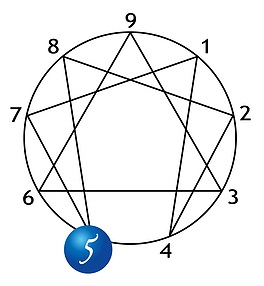
Enneagram chart with Type Five highlighted
Introduction
Fives are the unmistakable intellectuals of the Enneagram. Cool-headed, detached and curious, they rarely speak on what they aren’t sure about, and they usually find it hard to connect with people on an emotional level.
A Five’s expertise is often precious for those that need a pointer, although Fives may not always be willing to share it, as they tend to be very selective with their social contacts. In fact, they almost seem to have a tendency to disappear in interpersonal contexts. If they show up at all at social events, you will likely find them in a corner or outside, absorbed in their own inner discourse.
Fives are often innovative in their way of thinking, not necessarily because they are contrarians (this is often more the case with other types) but because they don’t let conventional prejudices taint their reasoning, which means that they will uphold any view that they find rational, regardless of its popularity or the controversies surrounding it, and even regardless of their personal preference.
Offbeat and eccentric in their interests, Fives would love to live in a world where people put their emotional reaction to things aside and simply use their heads. Fives find it very easy to do, as this is precisely part of their survival strategy: feelings just cloud reality, so better keep them to yourself and take an objective look at things.
They have a tendency to live in their head, with the consequence that they look ill at ease with their physical existence, where they often appear clumsy like fish out of water. They easily feel intruded upon by others and consequently develop very strong boundaries, keeping any but their closest friends at arm’s length.
The hiding tortoise, a good symbol for Enneagram Type Five
Core Mechanism
Fives are a Head type, and they rely on their considerable intellectual power to get by. They process the world in terms of information, facts, logical relations and concepts. They grow their notions organically rather, like unfolding crystals, developing them coherently without regard with their own personal feelings and preferences.
Out of all the types, Fives are the most likely to follow premises to their logical conclusions without batting an eye if they don’t like the conclusions. Sometimes, due to their mental prowess, Fives reach conclusions almost intuitively, embracing large quantities of rational passages in the blink of an eye. Their thinking process is rarely linear. The speed of their rational mind is a counterpart to their awkwardness on the physical plane.
Fives’ reliance on their mind is primarily a defense against the uncertainty of the world. Fives feel small and powerless compared to the vast unpredictable universe around them. They seek to remedy their sense of impotence by accumulating knowledge, often in very specialistic and abstruse fields, which become their anchor in times of turbulence.
As they accumulate knowledge, they retreat from the world, often developing frugal habits. Ideally, they feel that one day they will know enough to be able to join the world as competent individuals who are capable of performing normally. Unfortunately, for many Fives such time never comes.
The world becomes a distraction from their absorption in more and more abstruse layers of thought. Human interaction is often dialed down to a minimum and everything, even well-meaning attempts at socializing, is perceived as an intrusion, a waste of energy and/or time.
While healthy Fives are often capable of surprising and deep insights and manage to integrate themselves, less healthy individuals paint themselves into a corner where the only thing they can do is digging further into the same arcane topics and their distance from their fellow humans widens, incommunicability grows, others are seen as idiots who simply do not understand the subtlety of their vision, the world becomes more unpredictable and dangerous, and this cycle continues.
Passion
Avarice is the passion of Enneagram Type Five. As with many types, this is to be taken figuratively. Fives are rarely attached to money or material possessions, and they tend rather to become minimalists and to learn to do without whatever is not a bare necessity.
This is partly because they feel that having too many needs will put them in danger of being dependent on others or on outside factors they feel unable to control, and it will therefore increase their chances of not meeting those needs, so they learn to go without the unessential.
Avarice, as far as Type Five is concerned, is referred mainly to their tendency to withhold themselves from the world and from others. Fives have a keen awareness of how much energy they feel they can spend on any given day, and they administer it very sparingly. It is as if their fuel gauge were constantly in the red, and contact with other people were extremely draining.
Therefore, they go without the human contact they cannot avoid, and when they do accept contact this is usually an unspoken sign of great appreciation for the person: it means the person is so in tune with the Five that the Five does not consider them a hinderance to their energetic survival.
Fives are elusive to most people: even when they are there with you, you cannot really tell what they are thinking or feeling. This is because the act of opening up is energetically costly for them, as it implies an act of trust, and Fives are usually only capable of trusting themselves, even though ideally they long for people to open up with.
Avarice, the passion of Enneagram Type Five
Misconceptions
There is a tendency on other people’s part to think that Fives don’t have feelings, mostly because Fives don’t show them. Unless they suffer from specific mental illnesses (which any type can suffer from) this is not true.
Fives do have an often rather intense emotional life and are often incredibly sensitive, but because they don’t know how to deal with it, they learn to put these feelings into brackets, sometimes resorting to thinking them rather than feeling them.
They normally see their feelings as something that has no bearing on the world, on how things really are, and on some level feel they must not visit their emotional issues on others (of course, they expect the same in return.) However, unhealthy Fives can become so detached from their concrete life that they fail to locate anything within themselves except arid mental abstractions.
Deep down, Fives would love to find someone with whom they can open up about their emotions, but depending on how entangled they are in their mechanism, this can take quite a while, because they are not used to giving importance to subjective reactions.
Furthermore, Fives tend to feel very easily rejected by others, in part because they expect people will find their personal presence as intolerable and intrusive as Fives usually find the personal presence of others. Therefore, anything except the most ideal response to a Five’s intimate feelings is interpreted by them as proof that they should have kept those feelings to themselves and that they are silly anyway.
Wings
5w4: Fives with a Four wing tend to have a melancholic and poetic streak to them. Their ceaseless intellectual activity is both personal and universal and often has an autobiographical slant (think Nietzsche). More rhapsodic and less systematic than other Fives, they usually dislike canned notions and beaten paths and have a certain aesthetic appreciation of the truth. Deeply individualistic and somewhat aristocratic in their demeanor, they often come into conflict with the prevailing ideas of what is acceptable and become easily disdainful of them.
5w6: Fives with a Six wing are usually more clearly intellectual and somewhat more conventional in their reasoning style and possibly their interests. Nervous and high-strung, they are good at systematically formulating and probing hypotheses. They are more clearly detached from their feelings and their explorations have less to do with their own life and more to do with life in itself (think Darwin). Out of the two variants, Fives with a Six wing tend to fare better in academic and scientific settings, although this is more due to the Six wing than the Five type, as Fives in themselves are not especially academically minded (Fives often don’t give a rat’s behind about academic conventions)
(note that wings can have some minor descriptive power in terms of superficial behavior, but they are irrelevant in terms of what motivates the person. Many people have no noticeable wing, while few show signs of both.)