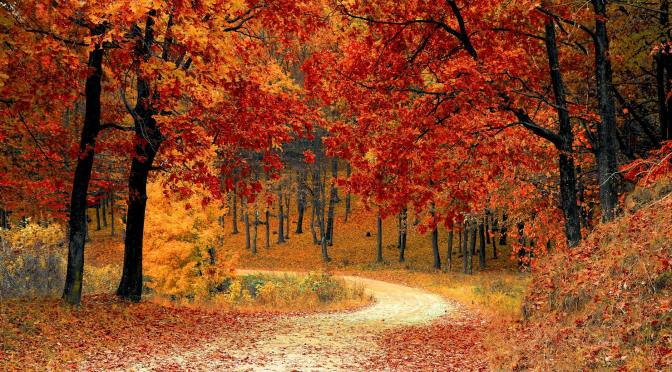
Following my deep dive into the Door Knockers, which seems to be an exclusive symbol (or almost) of Italian cartomancy, let’s talk about a much more universal presence in many traditions: the Road. Still, even though the symbol is widespread, the interpretations may vary.
I was introduced to the symbol of the road when being taught to read playing cards. In the system I was introduced to, the Two of Clubs is the card of the steps. Actually, the word for it was “cammino”, which means a way, road or path, but it also implies the idea of people taking steps on it. That is, a ‘cammino’ is a road that exists because people walk on it, rather than being a road that has been created so that people may or may not use it. An example would be a path through a forest or a road created by pilgrims as they progress on their pilgrimage.
The Two of Clubs therefore implies forward motion toward a goal of some kind, and the taking of steps, whether literal or figurative. In this, it is similar to the Two of Wands in some Piacentine cards systems, which interpret the card as a road, largely due to its design showing two parallel staves, no doubt (although in some other Piacentine systems the road is the Knight of Wands).
The Vera Sibilla doesn’t have a road card per se, although it does have various cards connected with movement, journeying or taking steps/fighting for something. For instance, the Journey card is connected to traveling, while the Soldier may imply fighting to attain a goal (although, being a Spade card, the struggle is more accentuated).
Etteilla famously attributed the meaning of road to the Six of Swords, and his pupils developed a whole vocabulary of synonyms that extend the meaning into other areas. An example of this is the meaning of conduct, which is, figuratively speaking, the path of the person’s actions through life. Etteilla’s attribution of the meaning of road to the Six of Swords remained attached to tarot through the Golden Dawn, who preserved it in part as a possible meaning in their Book T, and then through Waite, who had Smith design the Six of Swords as a card of journey. Even in the Crowley tradition this attribution has in part been rediscovered in Eshlemann’s Liber Theta.
In the Bolognese tarot, the meaning of road is attributed usually to the Six or Eight of Wands. Some strands of the tradition also distinguish between an open road (Six/Eight of Wands) and a closed road (Nine of Wands or Ten of Swords). The road is in itself a card of forward motion, like the Two of Clubs, it can indicate short trips and it is a card of openness.
The road or path is also present in the Lenormand and Kipper traditions. I am unclear on the Lenormand meaning, as the interpretation seems to have evolved considerably through time. Most contemporary English-speaking sources seem to see it as a card of choice (with two paths, although I am unsure if this duality was intended in the original design). Most German sources interpret it differently. Since I am not a Lenormand reader, I will leave it at that.
As for the Kipper cards, they have a card called Ein langer Weg, a long road. In most of the sources I have consulted, the card is more static than in the other traditions, highlighting the element of time (some call it the Two Years card). Interestingly, in many German Skat systems of divination, the suit of Spades / Leaves is connected with movement, and the low-numbered cards, mostly the Seven and Eight, can show a short trip or something happening quickly, while the Ten is also called the long road, and it can indicate an actual journey or the need to wait a long time.
BONUS: The Road is obviously present in Geomancy as well. The Geomantic figure Via, attributed to the Moon, is a symbol of journey and change. It is the symbol with the least amount of points, only one in every position, so some sources also attribute it to the concept of ‘little’ and to the waning of something.
MQS