Tag Archives: Divination

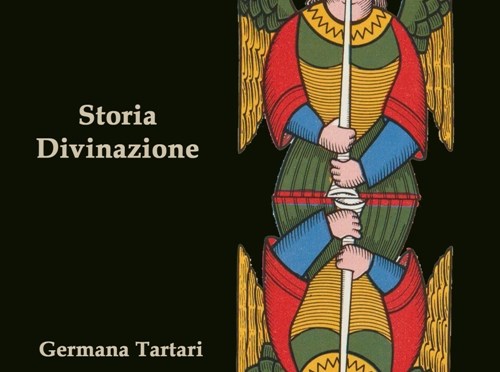
Tarocchino Bolognese. Storia Divinazione, by Germana Tartari (A Short Review)

English Version (scroll down for the Italian version)

In this blog I haven’t yet talked about one of the decks I am most interested in learning, yet one about which very little material is to be found. I’m talking about the Bolognese Tarot, or Tarocchino Bolognese.

The word “tarocchino” is a diminutive form of “tarocco”, thus meaning “small tarot.” I am not going to cover the history of the cards here. There’s plenty of great sources online. The reason for the diminutive form is that the deck is actually a reduced pack, with some variations in the order and makeup of the Major Trumps.

What I am going to discuss is a marvelous little book that has been recently published on the matter: Tarocchino Bolognese. Storia Divinazione, by Germana Tartari. The book is currently available only in Italian.

Miss Tartari has been taught to read the Bolognese Tarot by her grandmother, and has started teaching it in turn following what she describes as a call to spread the traditional meanings she has received.

The book is relatively short, but it succeeds as a comprehensive introduction for neophytes. As most books on the tarot, it starts with what I usually consider the “boring part”, i.e., the history of the cards. I say “boring” because most of the times, writers feel that it is bad to lead off with the juicy stuff and sense that it’s best to preface it with some historical remarks fished at random from the most dubious sources.

But this is not the case for Miss Tartari’s book. The historical introduction is not at all boring. It has been handled by the Museo Internazionale dei Tarocchi, and it is as succinct as it is interesting, as well as historically accurate.

Miss Tartari then goes on to describe her history and relationship with the cards in moving detail. The great passion that animates her shines through every single turn of phrase and choice of words. What also struck me was her understanding of cartomancy as an activity that is deeply embedded in the way people relate to one another: as described by her, cartomancy is almost an interpersonal skill, a way of caring for other people. I greatly enjoyed her take, and think most people who are into traditional tarot would profit from reading it.

The meat of the book consists of the divinatory meanings and combinations of the cards. As is usual for the Bolognese Tarot, the meanings have nothing grandiose and philosophical about them. There is no flight of fancy. There are no pseudo-deep elucubrations as usual among tarot readers who try to remove the tarot from observable reality by relegating it to a vapid mystical system.

The Bolognese Tarot is earthbound. It concerns the ordinary life of ordinary people. And, frankly, there is more depth in the recognition that the Sun means “by day” rather than in some obscure intellectual abstraction. As Miss Tartari put it in a video about the book, people once consulted the tarot about whether they would be able to put food on the table or not. They wanted to know whether the year’s crop would be good or poor. This is not to say that more spiritual concerns cannot be part of ordinary life, nor that the tarot cannot answer such questions, but its language remains clear, the language of simple people with their feet firmly planted on the ground.

The last part of the book describes two types of spread, and what distinguishes this book from many other books on the subject is that the writer describes some real readings she has done for querents. I thought this was a great way to demonstrate the great potentiality that the tarot has for describing real life and real concerns. In fact, I would gladly buy another book by Miss Tartari that his wholly focused on interpreting practical examples of real spreads.

In short: a must-have for anyone who is interested in the Bolognese Tarot, in the actual (and not fanciful) history of Tarot, and in one of the most traditional systems of divination in the West.

Where to buy: Mutus Liber

Versione Italiana

In questo blog non ho ancora parlato di uno dei mazzi che più mi interesserebbe studiare, ma sul quale si trova pochissimo materiale. Sto parlando dei Tarocchi Bolognesi, o Tarocchino Bolognese.

La parola “tarocchino” è una forma diminutiva di “tarocco”, quindi significa “piccolo tarocco”. Non tratterò qui la storia delle carte. Ci sono molte ottime fonti online. La ragione del diminutivo è che il mazzo è in realtà un mazzo ridotto, con alcune variazioni nell’ordine e nella composizione dei Trionfi.

Quello di cui parlerò è un meraviglioso piccolo libro pubblicato di recente sull’argomento: Tarocchino Bolognese. Storia Divinazione, di Germana Tartari. Il libro è attualmente disponibile solo in italiano.

La signora Tartari è stata educata alla lettura del tarocchino bolognese dalla nonna e ha iniziato a insegnarlo a sua volta seguendo quella che lei stessa definisce una vocazione a diffondere le conoscenze tradizionali che ha ricevuto.

Il libro è relativamente breve, ma riesce ad essere un’introduzione completa per i neofiti. Come la maggior parte dei libri sui tarocchi, inizia con quella che di solito considero la “parte noiosa”, cioè la storia delle carte. Dico “noiosa” perché la maggior parte delle volte gli scrittori ritengono che non sia appropriato iniziare con le cose più succose e pensano che sia meglio farle precedere da alcune osservazioni storiche pescate a caso dalle fonti più dubbie.

Ma questo non è il caso del libro della signora Tartari. L’introduzione storica non è affatto noiosa. È stata curata dal Museo Internazionale dei Tarocchi ed è tanto sintetica quanto interessante, oltre che storicamente accurata.

La signora Tartari descrive poi la sua storia e il suo rapporto con le carte con parole toccanti. La grande passione che la anima traspare ad ogni singolo passaggio e da ogni scelta di parole. Mi ha colpito anche il suo modo di intendere la cartomanzia come un’attività profondamente radicata nel modo in cui le persone si relazionano tra loro: così come da lei descritta, la cartomanzia è quasi una competenza interpersonale, un modo di prendersi cura degli altri. Ho apprezzato molto il suo punto di vista e penso che la maggior parte delle persone che sono appassionate di tarocchi tradizionali trarrebbero beneficio dalla sua lettura.

Il cuore del libro è costituito dai significati divinatori e dalle combinazioni delle carte. Come di consueto per i Tarocchi bolognesi, i significati non hanno nulla di grandioso e filosofico. Non ci sono voli pindarici. Non ci sono elucubrazioni pseudo-profonde, come di solito accade tra i lettori di tarocchi che cercano di allontanare i tarocchi dalla realtà osservabile relegandoli a un vago sistema mistico.

I Tarocchi bolognesi sono legati alla terra. Riguardano la vita ordinaria della gente comune. E, francamente, c’è più profondità nel riconoscere che il Sole significa “di giorno” piuttosto che in qualche oscura astrazione intellettuale. Come dice la signora Tartari in un video di presentazione sul libro, una volta le persone consultavano i tarocchi per sapere se sarebbero state in grado di mettere pane in tavola o meno. Volevano sapere se il raccolto sarebbe stato buono o meno. Questo non vuol dire che le preoccupazioni più spirituali non possano far parte della vita ordinaria, né che i tarocchi non possano rispondere a tali domande, ma il loro linguaggio rimane chiaro, il linguaggio di persone semplici con i piedi ben piantati a terra.

L’ultima parte del libro descrive due tipi di stesa, e ciò che distingue questo libro da molti altri libri sull’argomento è che la scrittrice descrive alcune letture reali che ha fatto per i propri consultanti. Ho pensato che questo fosse un ottimo modo per dimostrare la grande potenzialità che i tarocchi hanno nel descrivere la vita reale e preoccupazioni reali. In effetti, comprerei volentieri un altro libro della signora Tartari che si concentri interamente sull’interpretazione di esempi pratici di stese reali.

In breve: un libro imperdibile per chiunque sia interessato ai Tarocchi bolognesi, alla storia reale (e non fantasiosa) dei Tarocchi e a uno dei sistemi di divinazione più tradizionali dell’Occidente.

Dove Acquistarlo: Mutus Liber

Playing Cards and Numerology – The Queens

In cartomancy with playing cards, Queens are generally representative of women, and this is just about their only role. It is very rare that they come up to signify something else. That being said, they also have a connection with receptivity, nourishment and growth.
In some systems, the significators for the querents vary, but in the one I have been taught, it’s normally the Queen and King of Clubs that represent the querent.

The Queen of Hearts is usually a woman who is known to the querent. She represents a mother, daughter, relative or close friend. In general, she is a woman who has the querent’s best interest at heart, or at least should (you’ll need to check the surrounding cards). Even if she is not related, she could stand for a positive woman in general. For a lesbian querent, the Queen or Hearts can be the partner. The Queen of Hearts is also a symbol of acceptance and receptivity. It shows an environment where the querent thrives and is allowed to grow. Broadly, it confirms the receipt of something and it is a symbol of motherhood.

The Queen of Clubs is the female querent. If the querent is a man, she is usually the partner, either actual or perspective. If this interpretation is out of the question, she is still a woman in the querent’s life, usually not related to him. The Queen of Clubs is also connected to the idea of tending to something, working on it to make it grow or perfect it. She is not a symbol of great accomplishments, but she signifies honest effort, and doing what’s honorable. She is connected to harvest.

The Queen of Diamonds is a woman outside of the querent’s immediate circle. She is an acquaintance, a superior, a businesswoman, a professor. Her role is ambiguous, because her primary loyalty is to herself and her interests, but this doesn’t make her evil (after all, the woman you buy flowers from sells flowers to make money, not to please you). Compared to the Queen of Hearts she can be colder. She can also be a rival. The card is also a symbol of prosperity and of reaping the good fruits of one’s labor.

The Queen of Spades is a lonely or elderly woman. She can be an enemy or a difficult person. She doesn’t love the querent, nor does she further the querent’s aims (this is a great difference with the Queen of Diamonds, that the latter’s aims can allign with the querent’s, while those of the Queen of Spades are usually opposite). She can also be a woman who is very powerful, wears a uniform or represents the law. She can be an ex or a doctor. The card is a symbol of things that rot or are overripe or spoiled, and also signifies lack of acceptance (including lack of submission) privation, hunger, miscarriage. Finally, the card signifies falsehood, false words, false promises and false people.

Playing Cards and Numerology – The Jacks

The way I was taught to read playing cards, Queens and Kings are often real people, representing women and men respectively, while Jacks are only rarely real people, although the Jack of Hearts can represent a real child.

Jacks tend to represent news and attitudes.
The Jack of Hearts, in addition to representing a child, can represent someone or something who is fresh, naive, immature, honest, happy-go-lucky. In love readings, for instance, it tends to show flirts and situations that haven’t fully matured yet. It is also a card of inexperience.

The Jack of Clubs represents friendship and help. It represents also service to others. Next to another court card representing a person, it shows that he or she is helpful, friendly, positive, serious, constructive. The card is also connected to cooperation and, as an extended meaning, to co-workers.

The Jack of Diamonds represents messages and the knowledge of facts. It shows the acquisition of information. As an extended meaning, it signifies study and research. It can also signify a go-between (you will notice that the Jacks of Diamonds and Clubs are similar to their Sibilla counterparts). The card points to someone who is inquisitive, curious and desirous to delve deeper into something.

The Jack of Spades signifies enmity. It shows a negative attitude toward the querent (or of the querent toward someone or something). It is a card of ill-will. It is also the uniform card, especially when together with the King of Spades. Animosity, a competitive attitude and the desire to dominate another are all part of the meanings of this card.

Despite the Jack of Hearts being the Child card, all Jacks can represent children. Usually, the Jack of Spades is a child with problems, or a sick child, or a child that misbehaves. The Jack of Clubs is a good child, while the Jack of Diamonds is a smart child.

Playing Cards and Numerology – The Tens

The tens in playing cards represent goals and destinations.

The Ten of Hearts is another lucky card in the deck, signifying happiness and well-being. Just like the Nine of Hearts, the Ten has the power to greatly reduce the negative impact of other cards. It represents lasting joy and a sense of not needing to look further. It is a great love card. It is also connected with the querent’s city or homeland.

The Ten of Clubs is the card of travel. Clubs are cards of action, but the aim of the action is represented by Diamonds. By themselves, Clubs are just a means, and travel is the means to get from where you are to your destination. Likewise, the Ten of Clubs signifies metaphorical pathways, the course of action.

The Ten of Diamonds is the card of success, and broadly speaking of accomplishment of aims. It is a generally material card, and can signify a large sum of money, or at the very least that money is not an issue. It also represents cities other than the querent’s, seen as goals or destinations to travel toward.

The Ten of Spades has a variety of meanings. Some are neutral. For instance, it represents unknown destinations, stranger places and destinations abroad. It is also a card of negative goals, illegal aims and, more generally, of secrets and silence. It is connected to night time, just as the Ten of Hearts is connected to day time. Broadly, it is a card of failure, but only if together with other cards that point in that direction.

Playing Cards and Numerology – The Nines

The nines in cartomancy with playing cards are associated with the idea of wishes and hopes.

The Nine of Hearts is, as in many other systems, the wish card. It represents realization, fulfillment, sincerity of heart and, in general, things going as we wish them to go. It’s a positive card in most instances, as it has the power to alleviate the negative import of other cards that precede it.

The Nine of Clubs represents distance. It is a neutral card that represents things of long duration, long waits and delays, matters slowing down. It can also relate to physical distance. Generally, it shows the separation between what what we want and us. It’s the long road ahead.

If the Nine of Clubs is the road, the Nine of Diamonds is making progress on that road, and advancement in general. It is an extremely positive card, showing improvement, recognition, increase, fame, even. It represents other people’s views and expectations concerning the querent, if he has a good name or not, etc. By itself, it shows a good name. It is symbolic of career.

The Nine of Spades is notoriously the worst card in the deck, and some call it the wish denied card. If the Nine of Hearts shows things going as we wish them to go, the Nine of Spades mean things going against our wish. As a further consequence, it signifies things happening that we don’t want to happen, and against which we are relatively powerless.

Playing Cards and Numerology – The Sevens

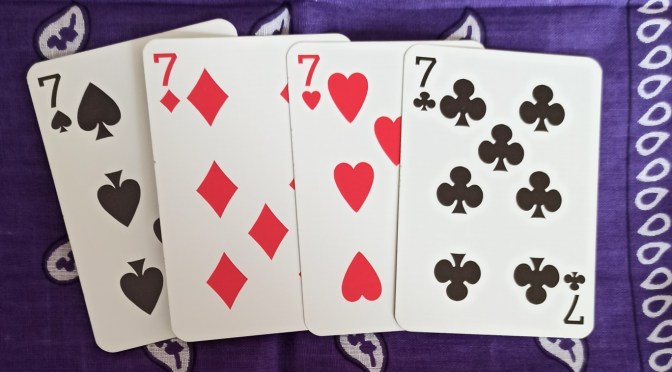
In cartomancy with playing cards, the sevens in general represent the idea of achievement.

The Seven of Hearts has the general meaning of surprise. This is because the suit of Hearts does not contemplate the notion of effort, so anything that happens happens either thanks to other people or thanks to positive circumstances. This card signals positive turns of events, fortunate breakthroughs and good luck. It is also connected with the idea of talent, because if we have a talent for something, achieving great results in it is easy.

The Seven of Clubs is less fortunate. It is a card of problems, things that stand in the way of achievement and that need to be worked through. It is not a tragic card. Sometimes it limits the amount of success shown by the other cards, while at other times it signifies that the sailing will be less than smooth. Either way, the problems shown by this card are solvable (which doesn’t automatically mean they will be solved). Supported by positive cards, the Seven of Clubs becomes a card of hard-won achievement. It can signal the conclusion of an agreement or that of a practical project.

The Seven of Diamonds is the card of money and financial achievement, and of achievement in general. It is a simple card most of the times. Unlike the Seven of Hearts, here effort is implied. By extension, this card is positive for recognition and winning prizes, and allegorically it is connected to harvesting.

The Seven of Spades is a card of misfortune. It shows obstacles that are difficult to solve, against which the querent has little power. More broadly, the card has to do with all negative unforeseen circumstances that either prevent us from achieving what we want or strongly limit us. With positive cards it shows that success won’t be complete, while with negative cards it’s a sign of utter capitulation.

Playing Cards and Numerology – The Sixes

The way I read playing cards, sixes are the difficult number. In general, six brings out the worst in the cards. I’ve noticed that this is a trend in Italian systems of cartomancy (althouth not in Kapherus’ system).

The Six of Hearts is the only positive card of the bunch, as it signifies the solution of trouble, adjustment and the return to happiness, health, etc. It shows peace, improvement and relax. Only when hemmed in by nasty cards it turns foul and it brings tears (which the card graphically reminds me of) and the impossibility of a solution.

The Six of Clubs is a very static card. It signifies tiredness and a situation with all work and no play and no enthusiasm. It is symbolic of subordinate work and, more broadly, it implies the inability to definitely put a problem behind you, as it keeps showing up. With positive cards, it shows the ability to reach your goal, but usually without a great sense of realization.

The Six of Diamonds is also a meh card. It is connected with insecurity, worries, confusion and indecision, especially but not exclusively of a financial nature. It shows all those situations where you can’t stop thinking about something and being tormented by it. However, with positive cards it can signify a situation that is sorted out by being resourceful, planning and making an informed decision.

The Six of Spades is a card of illness, as it figuratively depicts the wards of a hospital. It is one of those cards that is very difficult to put a positive spin on. The illness can be literal or figurative, when it symbolizes a situation of suffering and upset, or even one that is noxious or damaged. In itself, it negates reconciliations and the possibility of returning to the past, though of course the following cards may alleviate it.

Playing Cards and Numerology – The Fives

In cartomancy with playing cards, fives have an affinity with the idea of change, just as fours are related to stability.

The Five of Hearts shows positive change coming our way without effort. It is a card of evolution, good opportunities, gifts, offers (it is somewhat similar to the Three) and in general it shows that the querent thrives. Its general meaning is that of abundance and flourishing, freedom and being in a positive environment.

The Five of Clubs also signifies change, but change that is enacted by the querent. It implies effort, even physical effort. Nothing is free in the realm of Clubs, and therefore the card implies combativeness and even competition and the need to fight for what you want. While the Five of Hearts shows abundance, this card has an inherent sense of scarcity to it and the need to make the best of your chances.

The Five of Diamonds is the card that I thought exemplifies this number best, because in my system it just means change in a neutral sense. Generally it’s a positive card and it can bring some dynamic energy to a static spread. Of course it is also connected to the movement of money, information and energy, all of which are themes of the suit of Diamonds.

The Five of Spades is a bad card. The main meaning is that of prison, but of course it needs to be interpreted figuratively most of the times. It signifies the inability to move or to act, and it is symbolic of all things that keep us fenced in (like the pip in the middle) and chained, unable to change, be it guilt or an addiction. In general it signifies lack of opportunities, scarcity, dejection, the need for great sacrifice or, if followed by negative cards, a definite turn for the worse.

Playing Cards and Numerology – The Fours

In most systems of cartomancy with playing cards, the fours are cards of stability. However, a further connotation that I think attaches to them is that of pact or agreement between parts. Possibly this is due to the four pips resembling the legs of a table where people sit to talk.

The Four of Hearts is the card of reunions, gatherings and positive social occasions. It is also a symbol of agreements that come easy or are easily restored (Hearts): harmony and affinity all play into the meaning of the card. Because of the emotional connotation of the suit, the card can signify sex.

The Four of Clubs represents talks, and it is mainly the conversation card. However, it is not splendid. Because of the neutral nature of the suit of Clubs, which implies struggle and the need for action, the Four can go either way: toward agreement or toward breakup. It implies a degree of difference that needs to be reconciled, which is why talks are necessary. It’s not a bad card, but it is open-ended.

The Four of Diamonds is the card of formal agreements. It represents all things to do with papers, documents, offices, etc. Because the suit is more material than that of Hearts, the agreement can be interpreted as a transaction, and therefore the card represents buying and selling, and, by extension, all objects. In general, it signifies economic activity and has an affinity with the more material side of life.

The Four of Spades takes the basic theme of the number and runs it into the ground. The card represents loneliness and isolation. It shows the inability to get along or reach a positive conclusion. It shows complete disharmony and the impossibility of proceeding in a given direction, thus implying blockage. With other negative cards it means failure and trouble that cannot be overcome.

Playing Cards and Numerology – The Threes

The threes or treys share their low value with the twos. Once again, we are dealing with small cards. They are, however, stronger than the twos, and tend to form strong or noteworthy combinations when the fall with the two of the same suit.

All threes are connected with the idea of interaction, mediation and that of “getting” or receiving.

The Three of Hearts is the Gift card. This can be a real gift, or it can signify anything that we receive easily and for nothing. Allegorically, it signifies solution, the overcoming of small obstacles, positive development and happiness. It also means positive interactions, small gatherings, good mediation between parts and the positive influence of a third party.

The Three of Clubs represents the binding of people together by common interests that they pursue together. It can signify a small group of people, like all threes, and a union, a contract, a marriage etc. More broadly the card means doing things together. It is also the card of intermediation in a neutral sense. As for “getting”, nothing is free in the world of Clubs, so the card indicates enterprise and getting progressively nearer to your goals, heaping those small steps of the Two on top of each other to get where you want. In general, it signifies situations slowly taking root.

The Three of Diamonds is a small money card. It shows the receiving of money or of profitable offers. It can indicate things appreciating in value, but generally the card is restricted to material affairs. Symbolizing the reception of money, it can indicate a job, but usually  part-time. Like the Three of Hearts, it shows positive interactions, but more transactional in nature.

The Three of Spades is the card of Intrigue, but the title is rather dramatic. Unless the cards point specifically to third party interference (which is how this card interprets the idea of interaction and mediation) it can signify other more plausible things. One of the classical meanings is that of “loss”, which is the opposite of getting something. Alternatively, it can point to the receiving of something bad. Broadly, the card symbolizes bumps on the road between you and what you want, but not huge bumps, unless the following cards are horrible. Think intrigue in the sense of complication or tangled affair that needs to be sorted out.