Tag Archives: Divination

Cartomancy with Playing Cards | Two of Hearts

In cartomancy with playing cards, the Two of Hearts (2♥), as it was taught to me, has the meaning of “near the home”. In fact, the traditional name for the card is the Door Knockers. The meanings that may be derived from this concept are varied.

Door knockers are used by guests to announce themselves to the family they are visiting. Furthermore, the twos in cartomancy all connect with the notion of movement, and Hearts, because they are a positive suit, and the suit of warmth, prefer when movement brings things together rather than apart. Therefore, the first, broad meaning of the Two of Hearts is that of visit, the arrival of something or someone. Usually, the thing or person that arrives is positive and is probably awaited, but all this is subject to change if the cards say otherwise. In itself, the Two of Hearts is a positive card.

Illustration of the Two of Hearts in cartomancy with playing cards

Because it speaks of things close to the home, figuratively, the Two of Hearts symbolizes the family, just like the Ace of Hearts. However, it also shows relatives and close friends in general, i.e., people who are close to the core of the family. This is especially true if the Face card falling next to it is a Heart.

In love readings, the Two of Hearts shows closeness and warmth, and it can also signal the arrival of someone (with negative cards, even of a third party). When two lovers have quarreled, the Two of Hearts can signal positive developments on the way, and a general tendency of the couple to be drawn back together. With negative cards, though, it can show endless waiting. Because of its connection with waiting, the card can signal a pregnancy (“we’re expecting”).

In material affairs, the card is not so important, and its meaning may be derived from the context. It can show family help, working with children or pregnant women, etc. Psychologically and spiritually, the card shows a positive attitude, unless attended by bad cards, in which case it shows anxiety and restlessness.

The Two of Hearts can act as a time card, signaling that the event is immiment, being about to knock at your door (traditionally, within two days or two weeks, but take this with a pinch of salt).

Some Combinations:

2♠ – 2♥ – 6♥ = a reconciliation
2♥ – J♣ – 8♥ = visit from friends
2♥ – 4♠ or 5♠ = waiting in vain
Any Q – 2♥ – J♥ = a pregnancy (if a Spade, she doesn’t want it)
2♥ – 3♥ – 4♦ = arrival of a gift

Cartomancy with Playing Cards | Ace of Spades

In cartomancy with playing cards, the Ace of Spades is the death card. This is another almost universal card, like the Ace of Hearts, and it keeps its meaning in most systems.

All aces in cartomancy have to do with beginnings, but because the suit of Spades is negative, it turns the meaning into the opposite, that of ending. Ending comes in many forms, although the most vivid archetype of change is, of course, death. This meaning, however, is drastic and should only be applied when with other horrible cards. More often than not, the Ace of Spades brings change. We have another card in the deck that brings change, namely the Five of Diamonds. In the case of the Ace of Spades, though, the change is drastic and likely to be less gradual and more important, often (but not always) negative and usually rather traumatic even when it ends well.

The Ace of Spades is connected through the notion of death to the idea of cutting and therefore to all sharp instruments. Think of a scythe fatally swinging through the barley, felling it. The accent, in this card, is on what ends, rather than what begins, even if what begins is positive.

Death is the last thing we experience in life, so the Ace of Spades is connected to everything that is last, as opposed to the Ace of Diamonds which is everything that is first. It represents the poor (the last in society), it represents a country’s borders (the last thing before the country ends), a last place in a competition, etc. Figuratively, the last thing in something is its extremity, so the Ace of Spades also represents extreme things, extremism, excess, violence.

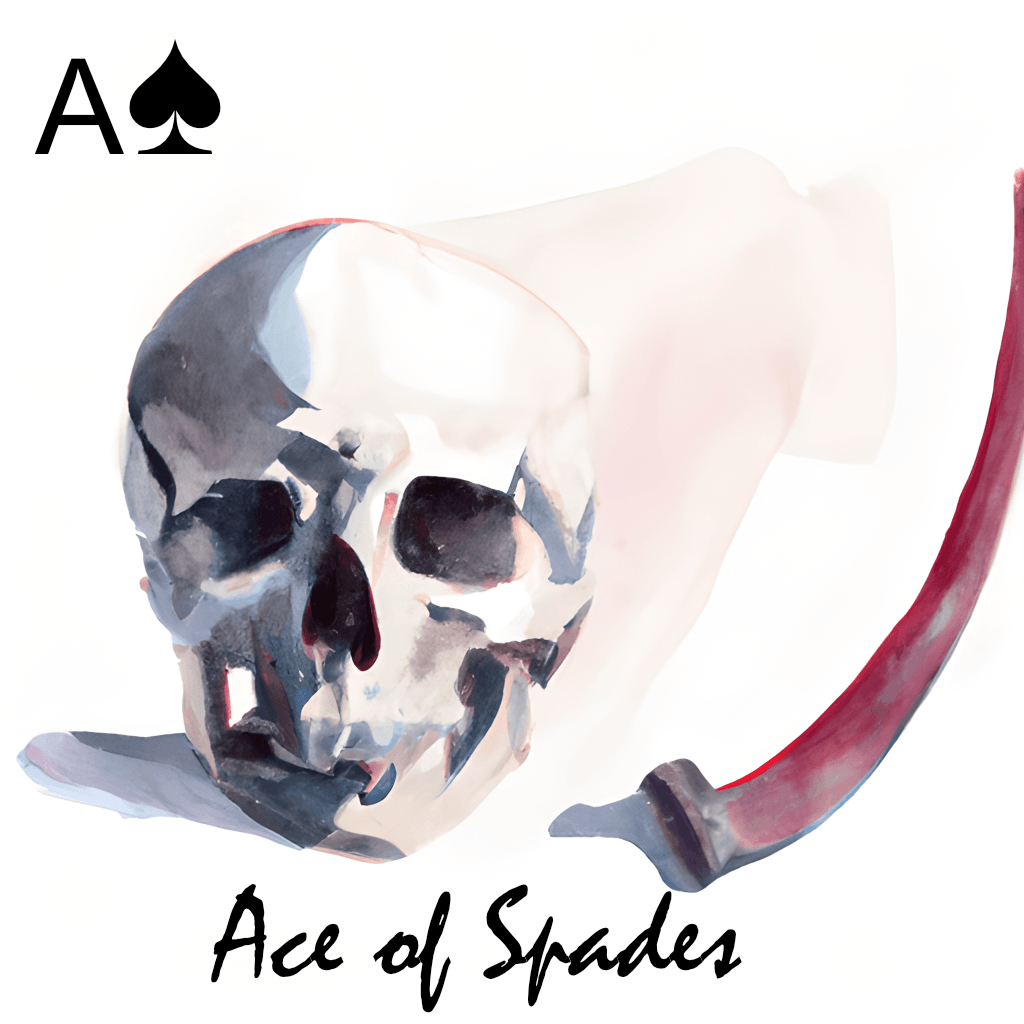
Illustration of the Ace of Spades in cartomancy with playing cards

Aces also have to do with the idea of source, and the Ace of Spades is definitely a source of trouble or of grief. Figuratively, it becomes a thorn, something that makes you suffer. When surrounded by Hearts, it can mean that the querent suffers emotionally (with other negative cards it can point to traumas and great disappointments, sometimes leading to depression). With Diamonds it points to financial hardships, while with Clubs it shows obstacles of all kind, especially of an objective nature, hardships at work and difficulties realizing your plans. If the cards are bad, the Ace of Spades bring failure, the abandonment of a plan.

In love readings, sometimes the card describes a widow or widower (especially when near a Spade Face card). At other times it can signify someone who has come out of an important story, not necessarily due to the partner going legs up. Broadly, the Ace of Spades is a card of great suffering, but when bombarded by positive cards it shows positive, if drastic, changes.

In more material affairs, the card is very seldom positive. It announces stressful times where the querent’s nerves will be put under great strain. It can, of course, announce a will or inheritance with the appropriate cards.

Psychologically and spiritually this is not a good card. It brings great worry, grief even at times, and in general it shows a nervous mind, often due to great uncertainty or owing to a sharp change of direction in the querent’s life. With very positive cards following it, it announces a new way of thinking or even a conversion.

Some Combinations:

A♠ – 3♠ – 9♠ = Death (often other bad cards show up)
A♠ – 9♠ = a bad combination in general. It augurs ill.
A♠ – 3♠ – A♣ and/or 4♦ – 7♦ or 10♦ = inheritance
K♠ – A♥ – A♠ – 2♠ = eviction
A♠ – 9♥ = a drastic change that leads to the fulfillment of your wishes

Cartomancy with Playing Cards | Ace of Diamonds

In cartomancy with playing cards, the Ace of Diamonds (A♦) is mainly the symbol of all inceptions. If all aces are about beginnings, the Ace of Diamonds typifies the idea itself of beginning.

The general meaning is that of news. News, however, must be understood broadly as anything that is new. The card can herald the arrival of actual information, for instance in the form of a text, but much more generally the Ace of Diamonds signifies new things. It’s the card of impulses and dynamic moments where things begin to happen. If this card comes up after a row of bad cards and it is followed by good ones, it signals a complete renewal and the arrival of a new phase in the querent’s life.

The Ace of Diamonds signifies everything that begins and therefore also everything that is first or of the highest value. It signifies diamonds, gold, the sun, eagles (first among birds), lions (first among animals), a first place in a competition, etc.

In a love reading, the Ace of Diamond does not speak of love, but it does tend to bring renewal or at least solidity. Because of its connection with valuable things, it can signify a jewel and therefore the wedding ring, and by extension it shows a solid union. This card often comes up when the third wheel hopes he will leave his wife, and it usually signifies that the marriage won’t break. If the querent is single, the Ace of Diamonds can foretell a new exciting phase, social contacts and even a new person coming into the querent’s life (usually not someone the querent knows well, because the person is “new”).

In work readings, it shows the arrival of news, broadly. It also adds value to the cards around it. Usually, a person coming up with the Ace of Diamonds next to them will be a higher-up or boss, or even a business owner.

Psychologically, the Ace of Diamonds speaks of an energetic person and one who is not easily satisfied. This can be good or bad, of course. When the Ace of Diamonds is hemmed in by Spades, it can show the inability to bring about new conditions, possibly feeling stuck.

Some Combinations:

A♦ – K♦ or Q♦ = news from someone | a business owner or powerful person
A♦ – 10♠ – J♠ = a spy
3♣ – 4♠ – A♦ = the end of a marriage and the beginning of a new phase
A♦ – 4♦ = an object of great value, among other possible interpretations
A♦ – 2♦ = important news, important message

Cartomancy with Playing Cards | Ace of Clubs

In cartomancy with playing cards, the Ace of Clubs (A♣) represents the inception of the suit. The Suit of Clubs is material and concerned with toil and the physical reality that exists out there as opposed to the inner realm of the Hearts.

Because Clubs are a suit of action and the ace is the beginning, the Ace of Clubs signifies what action begins with, namely with an objective, an aim, a commitment, something that drives us outside of ourselves in pursuit of something or someone else. It is a very powerful card. In fact, one of the most powerful in the deck. It gives the querent strength and power over the situation and it shows active commitment toward something or someone. When a face card comes up with the Ace of Clubs next to them, he or she is a strong person, one whose say matters, and usually a truthful person. Broadly, the card gives qualities of creativity, productivity and reliability.

Attended by Spades, the Ace of Clubs shows difficulties concerning a commitment or plan, and it points to an inability to get what you want. With Hearts, the querent’s will is realized easily.

The Ace of Clubs is connected with the notion of out there, and just as the Ace of Hearts signifies the home, the Ace of Clubs signifies a place out in the world, outside of the home, such as an office, a government building, a prison, a church, a shop, a restaurant, etc.

Another meaning of the Ace of Clubs is that it represents official documents, because an official document is objectively binding and is not just an inner fantasy. More specifically, the Ace of Clubs signifies signed documents and the act of signing, i.e., of committing to an interpersonal agreement.

In love readings, this card can signify a strong commitment of one person to another or of both person to their common projects. It can of course signify a marriage license. In work readings it shows the querent’s commitment or his commitments and duties, and how and whether he lives up to them. It also brings new opportunities and possibilities.

The Ace of Clubs is a card of vigor and power. Even when a line of card is not completely satisfactory, if it ends with the Ace of Clubs, the querent will still come out on top, or at least land on his feet.

Examples of Combinations:

A♣ – 3♣ – 10♥ = it can signify a marriage (commitment to a happy union)
A♣ – 5♠ = being overwhelmed by your commitments, feeling sacrificed by them
A♣ – 7♠ = impossibility to live up to a promise or commitment, but not through your own fault
6♣ – A♣ – 10♦ = completion of a project after much sweating, especially something to do with money
A♣ – 4♦ = the signing of papers

Cartomancy with Playing Cards | Ace of Hearts

The Ace of Hearts (A♥) is almost universally known as the house card. I do not know why this is the case. Since I recently talked about the Bolognese Tarot, I will note that the Ace of Cups (which correspond to Hearts) is called the House in that system, which goes back many centuries, even before Etteila (who, after all, admits to having learned from Italian card readers, although he ended up switching some cards around).

The way I have rationalized the Ace of Hearts in my system is that Hearts represent all things inner and intimate and aces have to do with beginnings. They are in a way the source of the theme they speak of. The source of our inner side, of our intimate side, is our family, our house, the place where we consider ourself “inside” rather than “outside”.

The Ace of Hearts is the card of the Querent’s house, and usually describes it in a neutral to slightly positive way. The house can be intended as the physical place of residence or as the group that inhabits it, thus signifying the querent’s family. A Court Card falling near the Ace of Hearts can show a family member (or, depending on the question, a person who wants to start a family with the querent).
However, if the Ace is attended by Spades, it shows a negative environment or tears at home. These can very well end up affecting other aspects of the querent’s life.

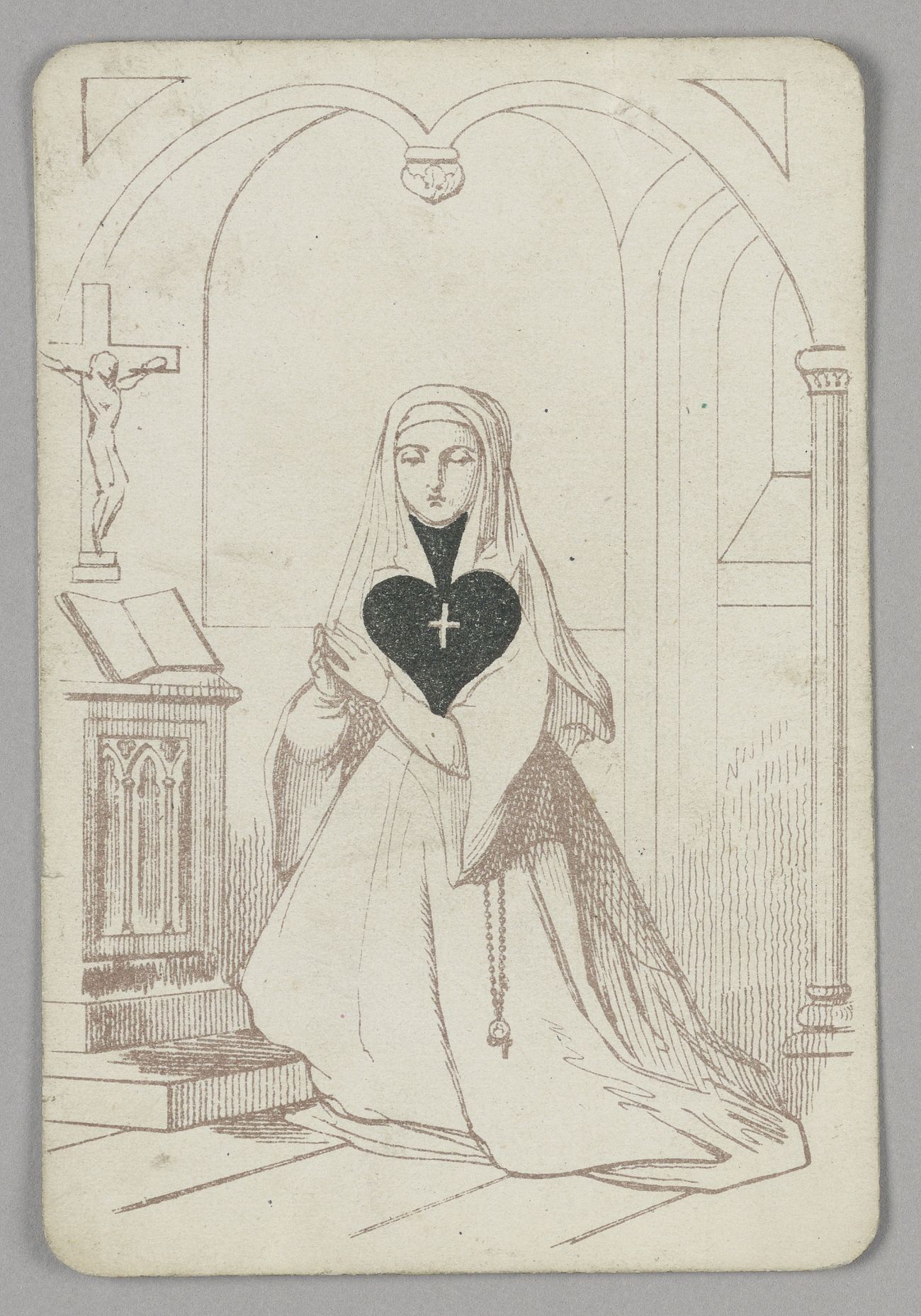
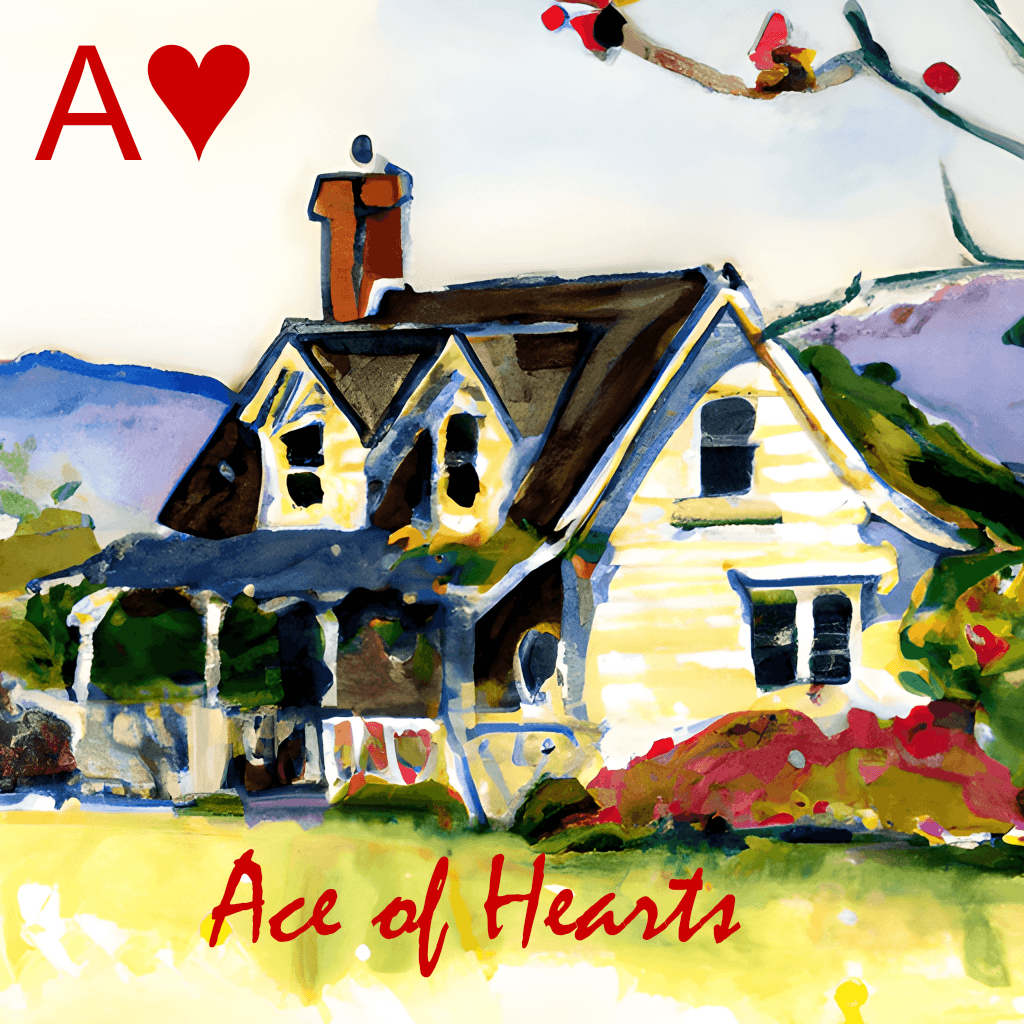
Illustration of the Ace of Hearts in cartomancy with playing cards

Broadly, the Ace of Hearts can show a positive beginning to anything, and something that is solid and stable or brings stability to the querent. It also shows serious intentions in all aspects of life. For instance, if a perspective business partner shows up with the Ace of Hearts next to him, it doesn’t necessarily mean he has the hots for the querent. It can simply mean he’s serious and dependable, solid.
Because the Ace of Hearts shows positive beginnings, it is auspicious for pregnancies.

Psychologically and spiritually, the Ace of Hearts is a card of protection, but more broadly it signifies the querent’s inner side, his intimate feelings and perceptions, which may be described by the surrounding cards. Thus, the card can shed light on the whys and wherefores of his behavior.
With Diamonds preceding it, the Ace of Hearts can show money being invested in the family or in the house. With Clubs it can point to family activities or plans, while with other Hearts it shows harmony in the house. Spades, as already said, bring strife in the family.

Some Combinations:

A♥ – 2♥ = family visits | broadly, it refers to relatives | it can signify the arrival of something positive
A♥ – 9♥ = traditionally it signifies greetings in the family, but more generally it shows a great joy about one’s intimate and family life
A♥ – 6♠ – Q♣ or K♣ = can mean an inherited desease or more generally catching an illness from a family member
A♥ – 3♣ = married life, a strong family bond
3♦ – A♥ – 5♦ = spending money on renovations

Vera Sibilla FAQ

My version has keywords. Should I use them?

Honestly? No. The keywords provided are extremely limiting, they are sometimes completely stupid (the Gift card does NOT mean obstacles) and they were clearly added by people working on the graphics of that particular version in the 60s or 70s. People working on a deck’s graphics in a big manufacturing company are NOT card readers. Their boss probably told them to add keywords so they could market the deck as ‘now improved and easier to read’ or something to that effect.

What are the little numbers supposted to mean?

They are lottery numbers. Some older versions even have three numbers. I’ve never paid attention to them, but then again my eyes glaze over at the mere mention of lottery and games of chance.

In my deck the cards of the Three of Diamonds and Eight of Diamonds are swapped. Why?

I honestly have no clue. My best guess is that there was an error made during the reelaboration of the deck for that specific edition. The traditional numbering is 3♦ for the Gift and the 8♦ for the Handmaid. If they are swapped in your version it’s not a big deal. Just don’t expect it to be due to some deep kabbalistic consideration. No “tzaddi is not the Star” and all that jazz. The Sibilla is much simpler.

Can I use playing cards with the meanings you provide?

Yes. If it helps you, write the title on each card.

What is the difference between the Vera Sibilla and the Sibilla della Zingara?

The Sibilla della Zingara (sometimes marketed as Gypsy oracle cards) is a reimagining of the Vera Sibilla, and is relatively recent compared to it. It was created because the Sibilla was popular and they wanted to update the graphics. Whether you choose it or the Vera Sibilla is a matter of taste, though I personally prefer the original. There is no difference in terms of meanings.

Do you recommend any books on the Vera Sibilla/Sibilla della Zingara?

I am a sucker for books. I believe I am aware of most, if not all books written on this deck in most languages, which isn’t to say much. I can, in all honesty, only recommend one which is still available: Alessandra Venturi’s Italian Cartomancy. It is poorly organized and it doles out information in hopes or making you fork out more money for the author’s course. There are no examples, no combinations, no spreads. But the information it does contain is solid. All other books on the Vera Sibilla/Sibilla della Zingara in all languages I PERSONALLY consider pretty bad (you are welcome to your own judgment). Italian cartomancer Etienne Valancourt is working on a book. It’s been years in the making, so I don’t know if he’ll ever publish it, but I have great respect for him and I already recommend it even before having read it.

Can I skip reversals?

Yes, you can do what you want. I myself do not actively create reversals when shuffling: any card reader will tell you that cards simply have a way of reversing themselves. I deal out the cards as they are, and then, in gathering them up, I don’t pay too much attention to how they face. However, I always try to start a new reading session with my cards upright. Even then, often one or two cards will reverse themselves. Call it chance, call it magic, but it happens. I would suggest that you pay attention when a card comes up reversed, but you can do what you want.

Can I make up my own meanings?

The first thing to realize when it comes to any psychic skill is that there is no psychic police. So yes. You can. I know some people who don’t use traditional meanings and give perfectly satisfactory readings. My own meanings are a mix of tradition and experience, and the numerology I use is invented, not traditional.
The second thing to realize is that if you are asking me, or anyone, for permission to do what you want, you’ve already lost. Detract further points if you pay someone in order to be told.
The third thing to realize is that just because you can reinvent the wheel doesn’t mean you have to. There is no psychic police, but there are established practices. To dismiss them out of hand without knowing them can be just as much an act of weakness as slavishly following them. Another point worth mentioning is that when we make up something we place our own limitations on it. It can be good to measure yourself against something you didn’t make up even just to stretch your imagination, skill and preconceptions.
My advice would be to educate yourself (here or somewhere else), make your own experience and adjust accordingly.
Or do what you want. Just don’t ask me to validate you. You don’t need validation and I am not inclined to validate people.

Can I just use the pictures as a guide?

Again, you can do what you want. Remember to keep a record of your readings, though, so you can go back to them and see what was accurate and what wasn’t.

Can I use the information you give as basis and develop it in my own way?

Of course! That’s what I did.

Do I have to memorize the combinations?

A handful of combinations are so classic (like that for pregnancy) that not to know them would be a mistake in my opinion, but combinations don’t need to be memorized, especially because you will find that the same combination could mean something totally different when surrounded by other cards. Just use the ones I provide as a mental gymnastics, but don’t confine yourself to them, nor to the interpretations I provide.

Do I need to consecrate/purify the deck?

No, but you can. I do. I would also suggest that you keep your deck near you for some time. As a rule, anything that helps you feel attuned to the deck is good.

Can I make up my own spread?

Absolutely!

Who taught you?

The mother of one of my professors. The numerology is something I made up to make sense of the meanings I learned and to expand on them.

Will you teach me one-to-one?

I will not. I don’t have the time. Besides, theory will only get you so far, and this blog is, I believe, most if not all the theory you need. You need to practice and keep a record of your readings. Don’t exaggerate with readings for yourself. Don’t force yourself to ask questions just out of idle curiosity to see what the cards say. Strive to read for others. Nag your friends and relatives. That’s the best way to start. That’s not to say you can’t read for yourself. Just know your limits.

If I send you my spread will you interpret it for me?

I will not. I don’t have the time. Also, I believe everyone should take responsibility for their spreads and I also think that the language of the cards is somewhat personal, just like different dialects within the same language. Just because all the words are found in the same general dictionary doesn’t mean every word has the same significance and importance for every speaker. Learn your own cartomancy language. You can do it!

Cartomancy with the Skat / Piquet Deck of 32 Cards – Spreads

The German Skat / Piquet deck is normally read in a großes Blatt or große Tafel, i.e., a grand tableau. Usually, the composition of the Blatt is 8×4 or, alternatively, 6×5 plus two remaining cards in the last row. Maybe I will cover it in a future post, but as it’s a method I’m still studying and am not familiar with, it may take a while 🙂 there are, however, other methods.

For starters, nothing prevents you from using regular rows of cards for answering simple questions or just to get a general look at the future.  You can also take a look at the spreads I presented for the Sibilla and adapt them.

Another popular method used with Skat cards is that of the star. There are several variations online. The star spread is relatively simple and is normally used for general readings.
You place the significator card for the querent on the table, shuffle (or have the querent shuffle, depending on who you listen to). You then cut three times and read the cut. You restore the cut by placing the central heap on the last and then on the first, and you start dealing the cards.

One goes to the left of the significator, one to the right, one above, one below, one in the upper left corner, one in the lower right corner, one in the upper right corner, one in the lower left corner. You now have the significator completely surrounded by cards, like in a square of 9. But it’s not over. You then place another card to the left, one to the right, one above, one below, upper left, lower right, upper right, lower left. This will get you the shape of a star.

You then go on to interpret the spread, with the cards to the left as the past, those to the right as the future and those in the middle as the present. As I said, there are many variations on this spread, and I haven’t personally used it yet. I will update this post when I do.

Cartomancy with the Skat / Piquet Deck of 32 Cards – Card Meanings

This is the list of meanings I have received for the German Skat deck. If you need a background, click here for part I.

Hearts – Hearts (also called “Rot”, red)

Ace – The home, The Family
Seven – Intimacy, Someone or something close, Something imminent
Eight – Fun, Entertainment, Festivity
Nine – Friendship, Joy, Love
Ten – Marriage, Union, Connection, Bond
Jack / Unter – A Child, Naive, Inexperienced, Positive, Immature
Queen / Ober – The female querent
King – The male querent

Spades – Leaves (called “Grün”, green)*

Ace – A letter, Document, A book, Study
Seven – Visit, Meetings, Hopes, A short trip (even just going out on foot)
Eight – Society, People meeting, Groups, Talks, Also a short trip, but a bit longer than the Seven
Nine – Worry, Uncertainty, Preoccupation
Ten – Long road, Travel, A long time, Abroad
Jack / Unter – Message, News, also relatives
Queen / Ober – An older woman, A dark-haired woman, A friend or relative
King – The male counterpart to the Queen

Diamonds – Bells (“Schellen”)

Ace – Success, Great fortune, Gift, Good for career and business
Seven – Small money, Something small, Objects, little by little, of small account
Eight – Job, Occupation, also Praise
Nine – Success, Growth, Increase, Recognition, Satisfaction, Improvement
Ten – Money, Success
Jack / Unter – Good luck, Fortunate occurrence
Queen / Ober – A blond woman, A younger woman
King – The male counterpart to the Queen

Clubs – Acorns (note that Clubs are called “Kreuzkarten”, Crosses)

Ace – Sorrow, Suffering, Spirituality, Loss, Shock, A large building
Seven – Tears, can rarely be tears of happiness
Eight – Anger, Arguments, Clashes
Nine – Loss, Lack of success, Also jealousy
Ten – Illness, Situations that are sick
Jack / Unter – Disruption, Bad luck, Falseness, also wearing a uniform
Queen / Ober – An elderly woman, An ex, A negative woman, Lonely, lying, A female doctor or a woman in a position of authority
King – The male counterpart to the queen

Combinations

A♣ – 10♣ – K♣ = hospital, sickness
K♣ – 10♥ – 8♥ = marriage
7♥ – 7♠ – J♥ = pregnancy
8♦ – A♠ = a new job
8♦ – 9♦ – A♦ = career advancement
8♦ – 7♦ = part-time job
8♦ – 10♦ = full-time job
10♦ – K♦ – A♦ = successful businessman
8♠ – 8♥ = meeting people, a party
A♥ – 7♣ – 9♣ – A♣ = loss in the family
10♥ – K♣ – 8♣ = divorce
K♣ – J♣ – A♣ = problems with the law, prison (if another bad card instead of the Ace, problems with the law)
10♠ – 7♠ = someone visiting from far away
8♥ – J♦ – A♦ – 10♦ = winning money
J♦ – J♣ = bad luck, lost opportunity
J♣ – J♦ = good luck
7♥ – 7♦ = flirt, just sex, small money coming in
7♠ – 8♥ = going out with friends
10♠ – 8♥ = a pleasant trip
10♠ – 10♣ = problems with the car
10♠ – 8♣ – A♣ = an accident
7♦ – A♥ – 9♦ = house renovations
A♠ – 10♦ – A♥ – A♦ = buying a house
K♥ or Q♥ – 9♠ – 9♣ = person is jealous
7♦ – 7♣ = money problems

* as I said in part I, in the German tradition Spades are good and Clubs bad. If that seems weird to you, feel free to swap them.

Cartomancy with the Skat / Piquet Deck of 32 Cards – Introduction

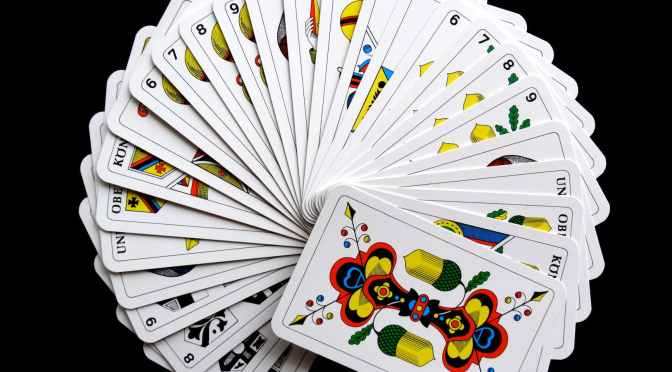
Before moving on with the regular deck of 52 cards, I wanted to spend some time on the reduced pack of 32. Reduced decks are very common across Europe. Usually, a reduced deck consists of all Aces, Sevens, Eights, Nines, Tens, Jacks, Queens and Kings.
Reduced packs are used not just in divination, but for playing games, and that’s probably how fortune-tellers and diviners got the idea. A reduced deck is usually called a Piquet deck or, in German-speaking countries, a Skat deck. I say this because the method I have been taught is of German origins.

Another important point to consider is that not all traditions see the suits in the same way. In Italy, as well as in most English traditions, Diamonds are neutral to good, while in France they are often seen more critically, as opposed to Clubs, which are seen as more positive, while in English fortune-telling they are neutral and, in Italian cartomancy, neutral to bad depending on who you ask.

In German-speaking countries we find a curious variation: Spades, which are considered invariably bad all across Europe, are seen positively, while Clubs are considered bad. This is due to the fact that in German, Clubs are called Kreuze (e.g., Kreuz-10, Kreuz-König, etc.), which means Crosses. As such, they are considered symbols of suffering. Spades, on the other hands, are associated with social activities and movement.

The method that I have been taught, which I admittedly do not practice, but have been allowed to pass along in case someone is interested in it, was originally devised for traditional German decks. German decks have peculiar suits which are completely different from the standard poker deck.
These are
Hearts (actually called Rot, Red)
Leaves (actually called Grün, Green)
Schellen (small bells)
Eicheln (Acorns)

These suits can be made to correspond to the suits of the regular poker deck, although the correspondence depends on what value you ascribe to the regular suits.
If I were to translate the German deck into regular suits, we would have the following.
“Red” or Heart cards correspond to Hearts. They deal with happiness, family, love, fun.
“Green” or Leaf cards correspond to Spades. They symbolize society, travel, movement.
Bells correspond to Diamonds. They have to do with money, success, luck.
Acorns translate as Clubs, and are symbolic of struggle, tears and difficult situations.

The system I am going to discuss in the next post can be used indifferently with German cards or with a regular reduced deck, using the correspondences above. If, however, you feel uncomfortable giving positive meanings to Spades and negative meanings to Clubs, feel free to just swap them. As long as you are consistent, you won’t have any problems.

Playing Cards and Numerology – The Kings

In cartomancy with playing cards, Kings are almost always significators for men. On rare occasion, Kings can come up to signify action, judgments and protection.
In some systems, the significators for the querents vary, but in the one I have been taught, it’s normally the Queen and King of Clubs that represent the querent.

The King of Hearts is a family man. He can be a father, a brother, an uncle, etc. For a gay man, the King of Hearts can be a partner. He is a good man, one who has an interest in the querent’s welfare. He is the archetype of the philanthrope. Even when he is not close to the querent, he is warm and kind. Even on the rare occasions when it doesn’t stand for an actual man, the card symbolizes a positive opinion of the querent (for instance, a judge ruling in the querent’s favor or a public servant furthering his aims). It shows positive outcomes thanks to protection. In general, it shows action taken in favor of the querent.

The King of Clubs is the male querent or the female querent’s male partner. When this figure doesn’t exist, he still represents a man, not necessarily related to the querent. Broadly, the card speaks of action, a positive role model, fair judgement and fair procedures.

The King of Diamonds is a man who is not close to the querent. He can be an acquaintance, a boss, a professor, a businessman. He is a person of good means and, like the Queen of Diamonds, one who follows primarily his self-interest, though he is not necessarily evil. He can be a rival in love in the appropriate context. Even when it doesn’t represent a man, the card symbolizes financial institutions, decisions concerning money and situations where there are interests at play that are greater and more powerful than the querent’s.

The King of Spades can be the male counterpart to the Queen of Spades, a man who is lonely, bitter, a rival, an enemy, an ex etc. He can be a difficult person, a bad father and all the things that apply to the Queen. However, the allegorical meaning of this card is also quite common, in that it represents the law itself, as well as a doctor or even the concept itself of medicine. It signifies great power being brought to bear on the querent, often in a cold and impersonal manner, if not altogether antagonistic. With negative cards it also signifies evil deeds and the will (and ability) to hurt