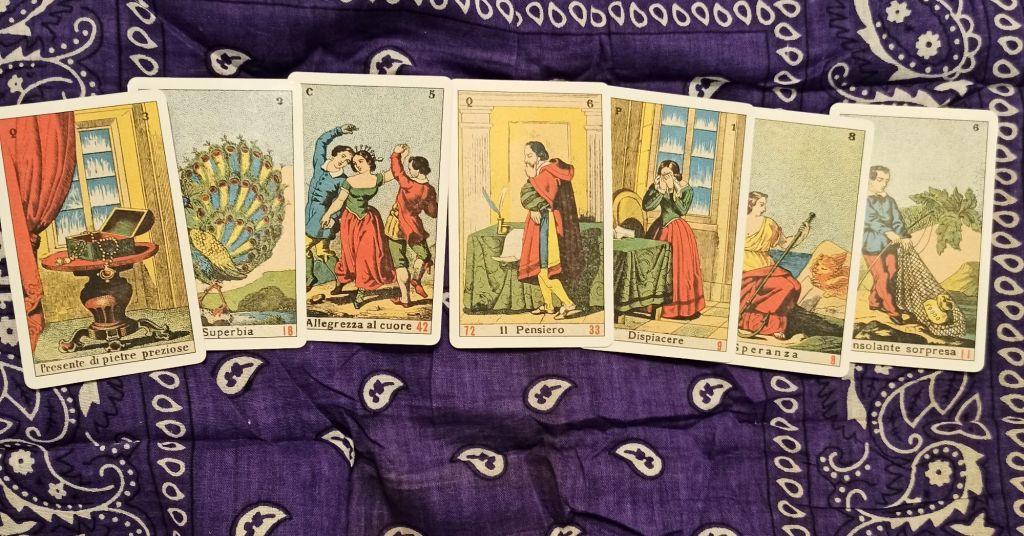
I said some time ago that my husband and I are looking for a home (I have a tarot reading ready for that). I also wholeheartedly believe that once you are interested in something, everyone else who has the same interest tends to show up in your life, and real estate questions have been common lately. Here’s the spread for a woman who asked if she would manage to buy a house she was interested in (it started out as a five card spread, but I asked her to draw two more cards, for reasons that will become obvious shortly, and then a third I forgot to take a picture of)
Real estate question with the Vera Sibilla Italiana
The first cards that caught my attention in the original five cards are the Five of Hearts and the Eight of Diamonds. Traditionally this means an engagement ring, but in this context it shows the proposal of a down payment (which is basically your engagement ring with the house you want to buy). According to the Peacock card between the two, this is a very high down payment, so I asked the querent, and she said they are (understandably) trying to pay off as much as possible in advance, almost half the total price.
The Thought card gives us some insight into the querent’s psyche: since it is followed by the Ace of Spades, she is worried, preoccupied or pessimistic. But the spread clearly isn’t complete, so I asked her to draw two more cards, and these were the Eight of Hearts, Hope, and the Six of Clubs, the Surprise. Clearly things will end up well, because these two cards together indicate the receipt of the hoped for money or the receipt of awaited money – for instance, money you’ve loaned or invested.
So I asked the querent if she’s waiting for money to invest into the home and she confirmed that she has some money tied down in an investment and she’s waiting for her bank to agree to free that money ahead of time. I was 99% sure this was possible, but to be on the safe side I asked her to draw a further card: this was the Seven of Clubs, the Realization (gran consolazione). Everything will be fine.
(Note: this is a collection of the meanings attributed to the cards by some occultists in the past centuries. It does not reflect my own study or opinion of the cards. It is only meant as a quick comparative reference as I develop my own take.)
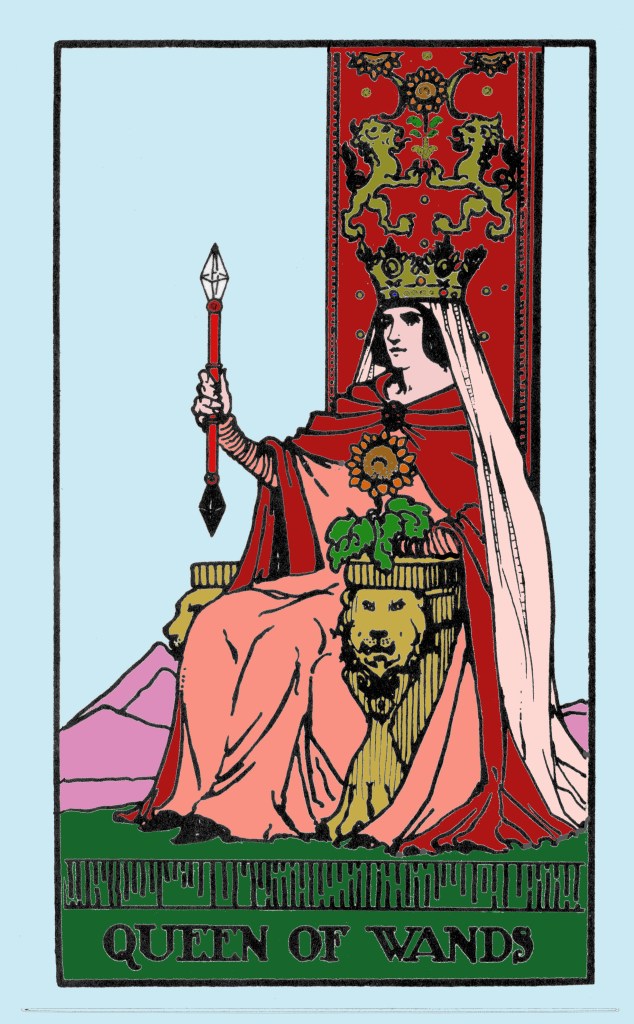
The Queen of Wands from the Builders of the Adytum (BOTA) tarot deck
Paul Foster Case (and Ann Davies)
The time period related to the Queen of Wands is from July 13 to August 12, symbolizing the influence of Jupiter and Neptune in Cancer and of the Sun and Jupiter in Leo. The basic power suggested by this Key is that of command. Well Dignified: in a divination the Queen of Wands symbolizes a kind, generous woman, resolute in the face of opposition, strongly psychic and intuitive but practical in applying her spiritual gifts; intense; magnetic ; friendly to the querent and a favorable influence for the success or business of the querent. Ill Dignified: Inimical to the querent; obstinate, dangerous woman, unfavorable to querent’s affairs; revengeful and tyrannical. (From the Oracle of Tarot course)
A. E. Waite
The Wands throughout this suit are always in leaf, as it is a suit of life and animation. Emotionally and otherwise, the Queen’s personality corresponds to that of the King, but is more magnetic. Divinatory Meanings: A dark woman, countrywoman, friendly, chaste, loving, honourable. If the card beside her signifies a man, she is well disposed towards him; if a woman, she is interested in the Querent. Also, love of money, or a certain success in business. Reversed: Good, economical, obliging, serviceable. Signifies also–but in certain positions and in the neighbourhood of other cards tending in such directions–opposition, jealousy, even deceit and infidelity. (From The Pictorial Key to the Tarot)
Aleister Crowley
The Queen of Wands represents the watery part of Fire, its fluidity and colour. Also, she rules in the Zodiac from the 21st degree of Pisces to the 20th degree of Aries. Her crown is topped with the winged globe and rayed with flame. Her long red golden hair flows down upon her armour of scaled mail. She is seated upon a throne of flame, ordered into geometrical light by her material power. Beneath the throne the surging flames are steady. She bears a wand in her left hand; but it is topped with a cone suggestive of the mysteries of Bacchus. She is attended by a couchant leopard upon whose head she lays her hand. Her face expresses the ecstasy of one whose mind is well in-drawn to the mystery borne beneath her bosom.
The characteristics of the Queen are adaptability, persistent energy, calm authority which she knows how to use to enhance her attractiveness. She is kindly and generous, but impatient of opposition. She has immense capacity for friendship and for love, but always on her own initiative.
There is as much pride in this card as in the Knight, but it lacks the spontaneous nobility which excuses that error. It is not true pride, but self-complacent vanity and even snobbery.
The other side of her character is that she may have a tendency to brood, come to a wrong decision thereon, and react with great savagery. She may be easily deceived; then she is likely to shew herself stupid, obstinate, tyrannical. She may be quick to take offence, and harbour revenge without good cause. She might turn and snap at her best friends without intelligible excuse. Also, when she misses her bite, she breaks her jaw!
In the YI King, the watery part of Fire is represented by the 17th hexagram, Sui. It indicates reflection upon impulse, and the consequently even flow of action. There is great capacity for lucid conception and steady prosecution of work; but this is only at the bidding, and under the guidance, of some creative mind. There is a tendency to be fickle, even disloyal; the ideas which she obeys make no deep or permanent impression. She will “cleave to the little boy and let go the man of age and experience” or the reverse (lines 2 and 3) without realizing what she is doing. There is liability of fits of melancholy, which she seeks to cure by bouts of intoxication, or by panic-stricken outbursts of ill-considered fury. (From The Book of Thoth)
Strangely Crowley-esque AI-generated illustration for the Queen of Wands
Golden Dawn’s Book T
A CROWNED queen with long red-golden hair, seated upon a Throne, with steady flames beneath. She wears a corslet and buskins of scale-mail, which latter her robe discloses. Her arms are almost bare. On cuirass and buskins are leopard’s heads winged, and the same symbol surmounteth her crown. At her side is a couchant leopard on which her hands rest. She bears a long wand with a very heavy conical head. The face is beautiful and resolute. Adaptability, steady force applied to an object, steady rule, great attractive power, power of command, yet liked notwithstanding. Kind and generous when not opposed. If ill dignified, obstinate, revengeful, domineering, tyrannical, and apt to turn against another without a cause. She rules the heavens from above the last Decan of Pisces to above the 20 Degree of Aries: including thus a part of Andromeda.
Etteilla
Country Woman Upright: This card, as far as the medicine of the spirit is concerned, means, when upright: Country woman, housewife, economy, honesty, civility – Sweetness, virtue – Honor, chastity Reversed: Good woman, goodness, excellence – Respectful, caring, obliging – Service, favor, benefit
While in Italy for the holidays, I retrieved my first notes from when I had started learning cartomancy from the person who taught me to read playing cards and the Sibilla. It’s just a couple of loose sheets on the basic meanings of the playing cards, the main combinations and two spreads (the row of cards, hardly a spread at all, and the cross).
This brought back so many memories of that period, but most of all it reminded me of how eminently practical divination used to be before its current glamorization. Of course, over time I learned a lot more from that lady than what is on that couple of now yellowed sheets, but the core of the system is there, and I believe she must have passed it on to me in no more than two sittings, if not just in one.
People who spend their time musing on the arcane meaning of the splotch of color on this or that card in the latest glossy and overly ornate oracle deck may laugh at how bare-bones that system is, but they would forget what significance divination had for the regular folks that used it to solve everyday matters.
Folk systems of fortune-telling, especially by cards, were designed to be quickly memorizable in their main lines, because they formed part of every housewife/househusband’s toolkit of remedies to the difficulties and uncertainties of life.
When an elderly person passed their meanings on to you, they did so not to introduce you to a different world detached from the real one, where you could dilly-dally with pleasant platitudes, but to send you into this life with another string to your bow. In principle, they revealed their system to you for the same reason that they taught you how to make preserves and liquors and how to best cultivate your garden.
Folk fortune-telling, in a word, was just another traditional remedy to the complexities of life. It did not involve stepping into a different plane of existence, because the everyday one was already enough, and it was looked on with the same pragmatic, solution-oriented gaze that was cast on all other problems people faced back in the day. “Don’t forget to add a small pinch of sugar to your tomato sauce. The Ace of Spades is a thorn in the heart.”
This is an attitude toward life that is hard to recapture nowadays. The idea of divination being useful has been so utterly eradicated from our mind that, when we approach it again, we do it as if it were an exotic, quaint, arcane world separate from our own. Our immediate reaction is therefore to keep it separate from our life, divorcing it from veriafiable prediction.
This stance is fatal, because it implies that our world is not inherently meaningful as it is; that meaning is found elsewhere and cannot be reconciled with our real life; that in order to find it, one must learn to look at one’s everyday struggles as illusions or as silly preoccupations not worthy of the attention of those in the know about the cosmic mechanism. All this ends up debasing both life and divination, because once life is debased, divination, which is the language of life’s drama, becomes a meaningless mirror only reflecting vague vapors.
(Note: this is a collection of the meanings attributed to the cards by some occultists in the past centuries. It does not reflect my own study or opinion of the cards. It is only meant as a quick comparative reference as I develop my own take.)
The Queen of Cups from the Builders of the Adytum (BOTA) tarot deck
Paul Foster Case (and Ann Davies)
The time period is the beginning of the last decanate of Libra to the end of the second decanate of Scorpio, October 13 to November 11, combining the rulerships of Mercury, Mars, Jupiter and Neptune. Well Dignified: through the influence of Mercury in Libra the Queen of Cups personifies a woman, mentally alert, yet somewhat superficial, who probably has a touch of the poetic in her nature. She is kindhearted though not likely to go to too much trouble for anyone. The Scorpio influence added gives her strong desires and makes her emotionally responsive and attractive to the opposite sex; very psychic, and if her hig he r nature is developed she depicts a very powerful spiritual force akin to the influence of the purified desire nature and the influence of Neshamah. Ill Dignified: a woman who is subtle, decidedly coquettish and may even be a deliberate heart-breaker. Usually gold-brown hair with blue eyes. (From the Oracle of Tarot course)
A. E. Waite
Beautiful, fair, dreamy–as one who sees visions in a cup. This is, however, only one of her aspects; she sees, but she also acts, and her activity feeds her dream. Divinatory Meanings: Good, fair woman; honest, devoted woman, who will do service to the Querent; loving intelligence, and hence the gift of vision; success, happiness, pleasure; also wisdom, virtue; a perfect spouse and a good mother. Reversed: The accounts vary; good woman; otherwise, distinguished woman but one not to be trusted; perverse woman; vice, dishonour, depravity. (From The Pictorial Key to the Tarot)
Aleister Crowley
The Queen of Cups represents the watery part of Water, its power of reception and reflection. In the Zodiac it rules from the 21St degree of Gemini to the 20th degree of Cancer Her image is of extreme purity and beauty, with infinite subtlety; to see the Truth of her is hardly possible, for she reflects the nature of the observer in great perfection.
She is represented as enthroned upon still water. In her hand she bears a shell-like cup, from which issues a crayfish, and she bears also the Lotus of Isis, of the Great Mother. She is robed in, and veiled by, endless curves of light, and the sea upon which she is enthroned conveys the almost unbroken images of the image which she represents.
The characteristics associated with this card are principally dreaminess, illusion and tranquillity. She is the perfect agent and patient, able to receive and transmit everything without herself being affected thereby. If ill-dignified, all these qualities are degraded. Everything that passes through her is refracted and distorted. But, speaking generally, her characteristics depend mostly upon the influences which affect her.
In the Yi King, the watery part of Water is represented by the 8th hexagram, Tui. The commentary is as colourless as the card; it consists of mild exhortations on the subject of pleasure. It may really be said that, normally, people of this type have no character at all of their own, unless it can be called a characteristic to be at the disposition of every impact or impression.
There is, however, a hint (line 6) that the chief pleasure of people of this type is to lead and attract others. Such are accordingly (often enough) exceedingly popular. (From The Book of Thoth)
AI-Generated illustration for the Queen of Cups
Golden Dawn’s Book T
A VERY beautiful fair woman like a crowned Queen, seated upon a throne, beneath which is flowing water wherein Lotuses are seen. Her general dress is similar to that of the Queen of Wands, but upon her crown, cuirass and buskins is seen an Ibis with opened wings, and beside her is the same bird, whereon her hand rests. She holds a cup, wherefrom a crayfish issues. Her face is dreamy. She holds a lotus in the hand upon the Ibis. She is imaginative, poetic, kind, yet not willing to take much trouble for another. Coquettish, good-natured and underneath a dreamy appearance. Imagination stronger than feeling. Very much affected by other influences, and therefore more dependent upon dignity than most symbols. She rules from 20 Degree Gemini to 20 Degree Cancer.
Etteilla
Blonde Woman Upright: As far as the medicine of the spirit is concerned, this card, when upright, means: Blonde Woman, Honest Woman, Virtue, Wisdom, Honesty Reversed: Distinguished woman, Vice, Dishonesty, Debauchery, Corruption, Scandal
I already said that I am not a big fan of complications in divination. Nor do I believe that the tendency to overcomplicate things is just modern: if we look in older Horary Astrology handbooks, for instance, they are filled to the brim with (often mutually contradictory) techniques that may be thrown at the chart in an attempt to smoke a positive judgement out of it.
Still, one technique that is relatively consistent in the tradition is that of the Via Puncti, or Way of the Point. Not all traditional sources talk about it, but I have found it to be occasionally helpful. As usual, techniques are not to be used blindly, but intelligently, like tools in the hand of a surgeon.
The long and short of this technique is as follows: some Judges have one point in their Fire line (the upmost one), while others have two. In fact, out of all eight possible Judges, four have one single Fire point (Carcer, Fortuna Minor, Via, Amissio), while the other four have two (Conjunctio, Fortuna Major, Populus, Acquisitio). Due to how Geomancy’s model works, whenever the Judge has one Fire line, it is possible to trace it back unequivocally to one of the four Mothers or Daughters (that is, to one of the eight figures at the top of the shield).
Geomantic Shield Reading, drawn with the Simple Geomancy app
In the above example, Fortuna Minor is the Judge. It has one point in its Fire line. This one point is found again in the Left Witness, Laetitia, and again in the third Niece, which is again Laetitia, and finally in the second Daughter Puella. No other path is possible. This is always so (if it isn’t so and you’ve calculated the chart by hand, you’ve made a mistake.)
Usually, the Via Puncti or Way of the Point can be looked at as a root cause for at least some aspects of the final answer. In the example above, for instance, a woman may be the cause (Puella). Or, if we take the House in consideration, since Puella is in the Sixth house, it may indicate that a sickness is the cause, or a servant/subordinate, or a pet, depending on the question.
I repeat: depending on the question. I make no effort to squeeze a consideration of the Via Puncti into my readings. If it is helpful, and if the question lends itself, I will consider it.
Geomantic Shield Reading, drawn with the Simple Geomancy app
In this second example, Acquisitio is the Judge. Immediately the Via Puncti branches off, as both Witnesses have two points in their Fire line. John Michael Greer says that this shows more complex causes, but he fails to mention that, in the old books, this is not considered a valid Via Puncti. I don’t know if I am unaware of some of the old material or if Greer gave in to his tendency to mix innovation (which is fine) with pretense that it is rooted in tradition. You can of course choose to experiment with Greer’s version of the Via Puncti. Personally, I don’t even always regard it when it is there (as in the first example) let alone when it is not there.
One thing that the existence of the technique shows, though, is that the Golden Dawn’s way of reading the astrological chart by placing the mothers in the angles is completely baseless, and is a typical example of the “let’s make up a secret” tendency of the occult community.
The astounding thing about all oracular forms is that they reflect the real world in the same way a recording of a scene does. This reading is from five or six months back, and it was partially confirmed a couple of weeks later, but the final feedback came only very recently.
I friend of ours was dating a new man. She’d been out of the dating scene for a while due to focusing on other things in her life. But she noticed that the guy was acting weird, as if he was looking for any excuse to cause a fight that would end the (still budding) relationship. We asked the cards and this is what happened:
Relationship reading with the tarot (Tarocchi di Layla, by Elisa Scerrato)
The cards of the cut are the Fool and Justice. Justice usually represents a solid union, not one that has just started and where the partners don’t even live together. The instability caused by the fool was already an alarm bell.
Then we have a full scene playing out: the Tower breaks up the relationship between her (Empress) and him (Emperor), but there is an obscure (Moon) influence next to him. Another woman (Popess / High Priestess). This is not even a new girl he met. The Popess has the World card next to her, showing a solid family, and the Hanged Men indicates being bound to someone, a serious commitment. I told our friends that I didn’t think the relationship had much of a future, and that she should be careful that there wasn’t any other woman around the dude.
A couple of weeks later he left her abruptly via text message. A couple of days ago, we met with our friend and she confirmed the guy was married all along, although he has an on again, off again relationship with his wife and, due to his cultural background, he doesn’t see it as strange to date multiple women, even without them knowing.
Notice how the readings flows from one card to the next in true cinematic fanshion. This ability of divination to act as a mirror is partly why I don’t believe in asking the cards for advice. This would be like asking a map for advice on where to go. The map gives you a larger picture, but the advice doesn’t come from the map: it comes from checking your plans against the available options.
It’s not just about love. Playing cards (and any other oracle) can be used to identify people, find lost objects and animals and many other things. Unfortunately, this type of reading is extremely complex, and I have a less than stellar track record in this regard (as opposed to the lady who taught me, who was sort of known for finding lost rings and describing thieves)
The reason for the difficulty is that the world’s complexity is almost endless, and we only have a limited number of cards at our disposal, so that there is always a need for combining card meanings in new and clever ways to signify everything. One of the subjects I want to touch on in a next article on the philosophy of divination is exactly the fact that the limits of our imaginations can also be the limits of our ability to make predictions.
Furthermore, the language of the cards is otherworldly, at least as far as making predictions is concerned, so that the oracle will not necessarily answer the question in a linear form that is readily understood. This is why my error rate by people descriptions and by finding lost items tends to be higher than in other readings. Sometimes I can’t so much as make sense of one of the cards, let alone the whole composition.
There is, however, a reading I want to share because of how clear the cards were, which makes this a good case study. A woman had lost her bracelet and, after looking for it everywhere, was beginning to suspect her niece of stealing it, possibly as a game. Here’s the spread:
Playing Card Divination, A Reading about Theft
There is one woman in the spread. She is next to the Ace of Clubs. This is extremely important. The Ace of Clubs represents initiative, and if you ask whether someone will or won’t do something, if their significator comes up next to the Ace of Clubs (or the Five of Clubs, representing action, or, sometimes, even the Two of Clubs, which means taking steps) it shows the person will do it.
In this case, though, we are talking about theft. So this woman took the initiative, i.e., she stole the bracelet. She is next to the Eight of Clubs, which represents work. So this is not the querent’s niece, but a coworker or superior.
Note, though, that she comes up as the Queen of Diamonds, not as the Queen of Spades, so there is no inherent ‘evil’ about her. Furthermore, we have the Three of Diamonds next to the Eight of Clubs. The Three of Diamonds represents all activities that are done part-time. Metaphorically, therefore, the woman is not a ‘full-time’ thief, i.e., she doesn’t have the habit of stealing. She probably just seized the moment to have something that caught her fancy. The Ten of Hearts closing the spread shows the possibility of a happy ending.
To be more sure, I asked the querent to pick another card for the Queen of Diamonds, and she chose the Four of Clubs. So this is a woman the querent speaks to habitually. Furthermore, even though the Queen is a Diamonds, and should technically be very fair, she is surrounded by Clubs, which represent a dark complexion and/or hair (but not as dark as Spades)
Well, some days after the reading the querent’s coworker, a woman of dark complexion and hair, came forward to her, wracked with guilt, and gave her back the bracelet, which the querent had left on her desktop unattended. The woman said she didn’t know what had possessed her to steal the item.
Much has been said in academic circles concerning the origins of this book, but the truth is quite simple.
Anciently, people used to be able to derive answers to their questions directly from the Macrocosmicon, the book of life. But this ability was lost, so the Kanj of Nebol ordered 1000 stories gathered from around the universe to serve as oracle.
Originally, to answer a question, 1000 eunuchs were left on Scorpion Island for 42 days, after which the story was read and interpreted that corresponded to their remaining number.
Today, a simple randomly generated number is used for practicality.
Geomancy has changed a bit since Medieval times, but one thing that remains constant is how a Geomantic figure or Geomantic Shield is formed. This is done in order to answer a question.
As I said in the previous article, we don’t draw the whole figure in the same way. We can divide the process in two parts: the creation of the four Mothers on one side; and the deriving of the rest of the figure from the four Mothers on the other side. The first is the “divinely inspired” part, i.e., the part where you allow chance into your life, while the second part is automatic and fixed and will follow with mathematical rigor from the first.
So, how do we get a set of four Mothers? In reality, Geomancy is a rather flexible oracle, as any method is technically valid. Once you are well versed in the main operations required to draw a Geomantic figure, you can pretty much use any method that suits you in order to obtain the four mothers.
Still, some methods are more traditional than others. It seems that the Arab Magi used a stick to poke points in the sands of the desert, a method that is still perfectly valid and has even been accepted and adapted by the Golden Dawn. By the time Geomancy reached Europe in the Middle Ages, it was customary to use a stylus or pen and a tablet or piece of paper or parchment. Dice were also used, and one could, and can use dried beans or pebbles or playing cards. Anything that can give you odd and even numbers will do.
Needless to say, some have devised software that calculate everything automatically. I don’t particularly trust this method, and yes, partly it’s because technology is still so new that my mind doesn’t accept it as a valid substitute for things that are more dependent on my direct manipulation–it may very well be that in five hundred years occultists will use geomantic software without thinking twice about it, but we’ll cross that bridge when we get to it.
The Pen and Paper Method
My personal favorite method remains pen and paper. I almost always use it, and I find it has an odd beauty, even power to it. It also reminds me of a playful oracle that we used to use as kids in middle school and high school in Italy to answer yes or no questions. Usually, some love-stricken teen would ask the fateful question, “does he love me?” and would start drawing random numbers of points on a piece of paper. Then she would pair up the points until either one point was left (yes) or none at all (no). I have no idea how this oracle originated, but I remember it being very much in vogue when I was a kid.
A set of geomantic Mothers is obtained in a similar, albeit more complex, manner. First off, it pays to write down the question. This has the incredible advantage that it forces you to think about it seriously, and it also makes it more real and objective.
Then, after concentrating on the question, you should ask for divine help. I’m not saying this to be preachy. Consult any Medieval handbook of Geomancy and you will find the same instruction: it’s the “Unmoved Mover” that sends his “vertue” down from the skies to answer your question. At the very least, you should take a moment to relax.
Once you feel ready, start drawing sixteen consecutive rows of points. Try to be orderly, but don’t worry too much: as long as the rows don’t cross or merge you are fine. Also, I have found that it is better to draw I’s instead of points, for the simple reason that it makes it easier to recognize the marks instead of leaving you wondering “is it a point or a random inkblot?”
Do not count the points or I’s you are making, and do not bother counting the rows as you make them. Do not engage in any kind of mathematical or rational thinking. In fact, I have found it pays to write down numbers from 1 to 16 before starting the operation, so as to be free from the worry of drawing too many or too few rows of points. Still, in the traditional instruction, you are normally told not to bother if you end up with an extra row of two–just go overboard and then discount the extra ones. Either way you will end up with something like this:
1) IIIIIIIIII
2) IIIIIIIIIIIII
3) IIIII
4) IIIIIIIIIIIIIIIIIIII
5) IIIIIIII
6) IIIIIIIIIIIIIIIIII
7) IIII
8) IIIIIIIIIIIII
9) IIIIIIIIIIIII
10) IIIIIIIIIIIIIII
11) IIIIIIIIIIII
13) IIIIIII
14) IIIIIIIIIIIIIIIIIIIII
15) IIIIIIIII
16) IIIIIIIIIIIIIII
Once this operation is over, you have your four Mothers, but only in a raw form. Each Mother figure is made up of four rows (4×4 = 16). Now you need to pair up the I’s in each row until either one is left over or two. Let’s make the example of the first Mother, which is made up of rows 1 through 4:
1) I-I I-I I-I I-I I I = O O
2) I-I I-I I-I I-I I-I I-I I = O
3) I-I I-I I = O
4) I-I I-I I-I I-I I-I I-I I-I I-I I-I I I = O O
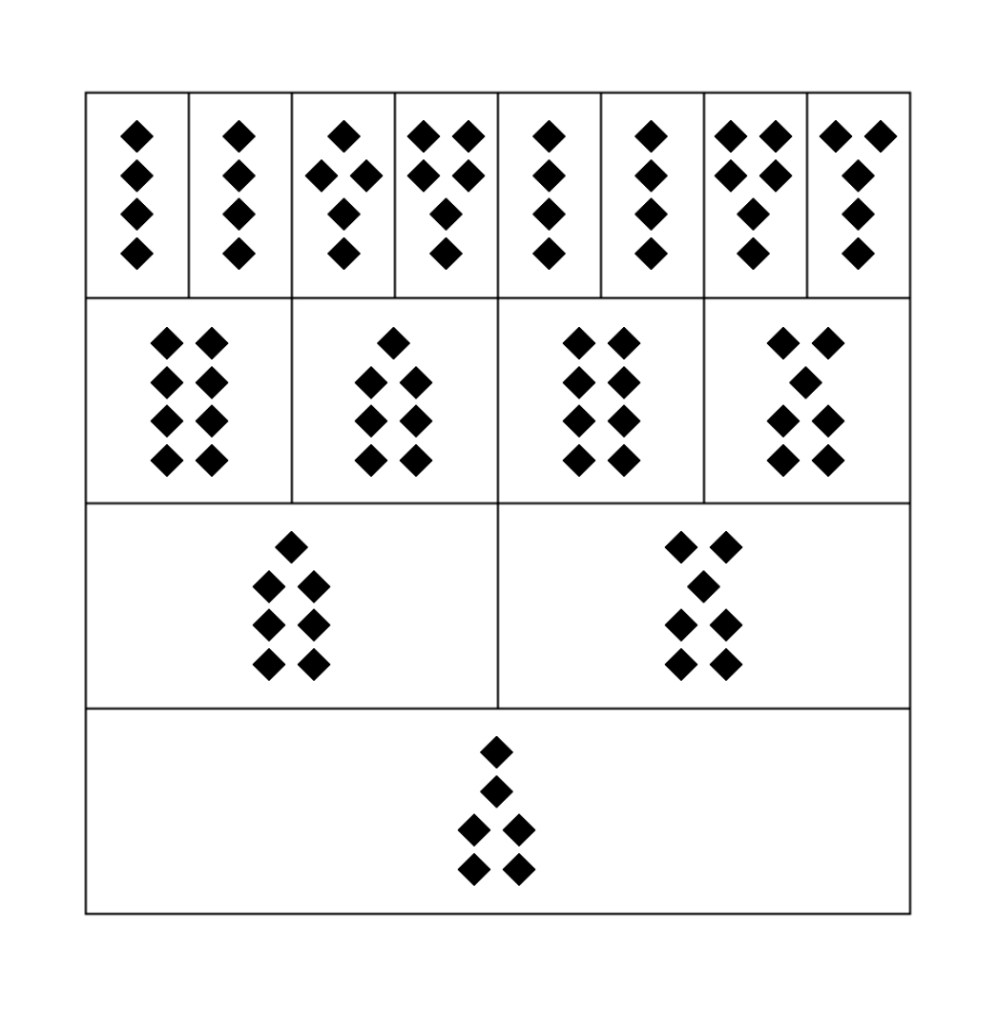
The figure we have received as first Mother is comprised by a sequence of two points on top, then one point, then one point, then two points. The same process of pairing up must be done for all sixteen rows to obtain the four Mothers (the second Mother being made up of rows 5 through 8, etc.) The first Mother we have obtained is called Conjunctio.
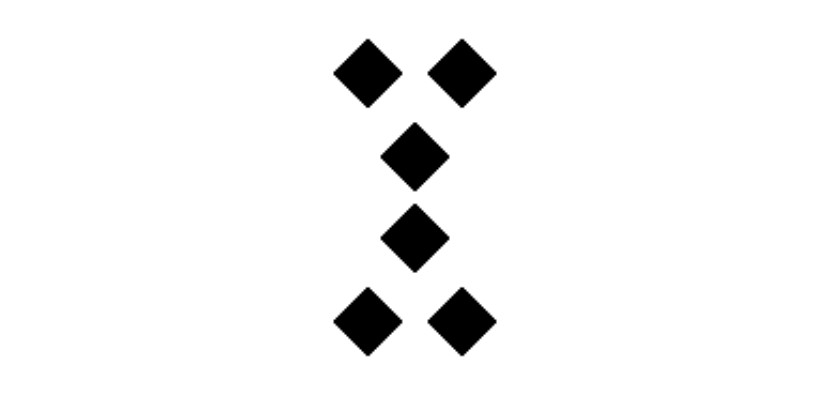
The Geomantic figure Conjunctio. From the App ‘Simple Geomancy’
Once this operation is over, you will be left with four figures, each made up of four rows of either one or two points. From these figures you will need to derive the rest of the chart, which I will go over in the next post.
Here I gather all my articles on (mostly European) Geomancy.
Geomancy has been an ongoing interest of mine. It is an ancient divination system that is being rediscovered after a couple of centuries spent in obscurity. It exists in various flavors, the most commonly recognized in the West being the one practiced by Medieval and early Modern magi. It derives in its main lines from Arabic Geomancy, and is only distantly related to African practices that use similar figures.
Of course, at the time when Geomancy was introduced to the West, Astrology was all the rage, which means that European Geomancy has a marked astrological bent. In most of its variations, Geomancers obtain a response by generating a random number of points which are then organized according to a fixed series of rules. Note that geomancy has nothing to do with Feng Shui and related practices (Flying Stars, Qi Men Dun Jia, Ba Gua Sectors, etc.)