This may sound like a silly question, but it is one I get asked constantly in private. I think the reason is that, especially at the beginning, we are very unsure of how to go about the reading and we are afraid we may get it wrong on technical grounds even before the interpretation starts.
Unfortunately, there is no clear answer to this. I know of old-time diviners who shuffle the deck for a fixed (usually odd) number of times, like seven, nine or thirteen. I have never been able to get behind this way of doing things. It is, however, a traditional approach, so I thought it better to mention it.
I distinguish between when I’m reading for myself, or even for someone else, but who isn’t there; and when the person is with me, even just on the phone or on skype (I used to do skype readings for friends all the time when I was in college).
The second case is the easiest, so I’ll talk about it first: when I’m reading for someone and I am directly in contact with them, I simply ask them to think about the question and to give me a stop when they are ready. Meanwhile, I decide which spread to use, then I relax and I take on an attitude of calm focus, without strain.
The person may have me shuffle for two minutes, or they may tell me to stop after two shuffles. After the stop, if the person is physically there, I also let them cut the deck, otherwise I do it for them after knocking three times on its back (that’s my little ritual). As weird as it sounds, the cards always seem to fall into place very well regardless of how long it took to shuffle them.
I believe this is because, in a reading, there is more at play than just two eccentrics’ focus on a topic. We may like to concoct philosophies that give us ultimate power over external reality, but the fact remain that we live at the intersection of cosmic, personal and interpersonal currents, a number of which are beyond our control. Our focus may catalyze these forces, but they are more ingenious than our conscious awareness could be.
In the first case, i.e., when I’m reading for myself or for someone who isn’t there, I need to be especially at peace with myself. If I’m distracted, depressed, in a heightened mood or very sick, the reading won’t go well. Even when I am at peace, there is always a question mark at the end of my readings, like they are never as crisp as when I’m reading for someone else who is there with me.
So, how long do I shuffle in this case? The answer may be disheartening for some, but it’s: as long as I feel I need to. This is hard to explain, but one soon learns to recognize the feeling of a well-shuffled deck. Some may feel the deck becomes heavier, others seem to just get an undefined feeling.
For my part, I usually feel a sensation akin to being full after eating a hearty meal and being unable to take another bite, while at the same time the deck itself seems to oppose resistance to being shuffled as the cards lock into the right place. Your experience may vary.
(Note: this is a collection of the meanings attributed to the cards by some occultists in the past centuries. It does not reflect my own study or opinion of the cards. It is only meant as a quick comparative reference as I develop my own take.)
The Page of Pentacles from the BOTA (Builders of the Adytum) tarot deck
Paul Foster Case (and Ann Davies)
The time pe r iod is from Decembe r 21 t o March 21, which encompasses the three signs of the winter quarter, Capricorn, Aquariusand Pisces, ruled by Saturn, Saturn- Uranus and Jupiter- Neptune. Well-Dignified: good command in practical matters; ability to see the principles be hind physical plane situations and phenomena; a young person of either sex, friendly to the Querent. Usually a friendly disposition with some leaning to the occult or a touch of psychic ability in the make-up. Generous, diligent, compassionate. lll-Dignified: more or less in bondage to material matters; inability to see beyond physical plane phenomena . A young person unfriendly, dull, wasteful, thoughtless, self-centered. If interested in the occult, it is usually for the sake of furthering selfish ends. Dark eyes and rich brown hair. (From the Oracle of Tarot course)
A. E. Waite
A youthful figure, looking intently at the pentacle which hovers over his raised hands. He moves slowly, insensible of that which is about him. Divinatory Meanings: Application, study, scholarship, reflection another reading says news, messages and the bringer thereof; also rule, management. Reversed: Prodigality, dissipation, liberality, luxury; unfavourable news. (From The Pictorial Key to the Tarot)
Aleister Crowley
The Princess of Disks, the last of the Court cards, represents the earthy part of Earth. She is consequently on the brink of transfiguration. She is strong and beautiful, with an expression of intense brooding, as if about to become aware of secret wonder.
Her crest is the head of the ram, and her sceptre descends into the earth. There its head becomes a diamond, the precious stone of Kether, thus symbolizing the birth of the highest and purest light in the deepest and darkest of the Elements. She stands within a grove of sacred trees before an altar suggesting a wheatsheaf, for she is a priestess of Demeter. She bears within her body the secret of the future. Her sublimity is further emphasized by the disk which she bears; for in the centre thereof is the Chinese ideogram denoting the twin spiral force of Creation in perfect equilibrium; from this is born the rose of Isis, the great fertile Mother.
The characteristics of an individual signified by this card are too various to enumerate; one must summarize by saying that she is Womanhood in its ultimate projection. She contains all the characteristics of woman, and it would depend entirely upon the influences to which she is subjected whether one or another becomes manifest. But in every case her attributes will be pure in themselves, and not necessarily connected with any other attributes which in the normal way one regards as symbolic. In one sense, then, her general reputation will be of bewildering inconsistency. It is rather like a lottery wheel from which the extraction of any number does not predict or influence the result of any subsequent operation. The fruit of the Philosophy of Thelema is enjoyed, rare, ripe, nourishing and vitalizing at its highest and fullest in this meditation; for to the adept every turn of the wheel is equally probable, and equally a prize; for every Event is “a play of Nuit”.
In the Yi King the earthy part of Earth is represented by the 52nd hexagram, Kan. The meaning is “a mountain”; of how sublime a significance is this Chinese doctrine of Balance, and how closely congruous with that of the Holy Qabalah!
The mountain is the most sacred of all terrestrial symbols, stark, rugged, and immoveable in its aspiration to the Highest, thrust up as it is by the Titan energy of Hidden Fire. It is no less an hieroglyph of the Inmost Godhead than the Phallus itself, even as Capricornus, the sign of the New Year, is exalted in the Zodiac, its deity autochthonous no less than the Most Holy Ancient One himself.
It is essential for the Student to trace this doctrine for himself in every symbol: Air, the elastic and flexible, yet all-pervading and the element of combustion; Water, fluid yet incompressible, the most neutral and composed of all components of living matter, yet destructive even of the hardest rocks by physical assault, and irresistible in its burning power of solution; and Fire, so kin to Spirit that it is not a substance at all, but a phenomenon, yet so integral to Matter that it is the very heart and essence of all things soever.
The characteristic of Kan in the Yi King is rest; each line of the comment describes repose in the parts of the body in turn, and their effects; the toes, the calves, the loins, the spine, and the jaws.
This chapter is a close parallel in this respect, line by line, with the 31st, Hsien, which begins the second section of the Yi.
The Rosicrucian doctrine of Tetragrammaton could hardly be more adequately stated-to every ear that is to heavenly harmony attuned.
“There’s not a planet in the firmament But in his motion like an angel sings, Still quiring to the young-eyed cherubim; But while this muddy vesture of decay Doth wrap us round, our nature cannot hear it.
Let every student of this Essay, and of this book of Tahuti, this living Book that guides man through all Time, and leads him to Eternity at every page, hold fast this simplest, most far-reaching Doctrine in his heart and mind, inflaming the inmost of His Being, that he also, having explored each recess of the Universe, may therein find the Light of Truth, so come to the Knowledge and Conversation of the Holy Guardian Angel, and accomplish the Great Work, attain the Summum Bonum, true Wisdom and perfect Happiness! (From the Book of Thoth)
A medieval looking AI-generated illustration for the Page of Pentacles
Golden Dawn’s Book T
A STRONG and beautiful Amazon figure with rich brown hair, standing on grass or flowers. A grove of trees near her. Her form suggests Hebe, Ceres, and Proserpine. She bears a winged ram’s head as a crest: and wears a mantle of sheepskin. In one hand she carries a sceptre with a circular disk: in the other a Pentacle similar to that of the Ace of Pentacles. She is generous, kind, diligent, benevolent, careful, courageous, persevering, pitiful. If ill dignified she is wasteful and prodigal. She rules over one quadrant of the heavens around the North Pole of the Ecliptic. Earth of Earth
Etteilla
Brown-haired boy Upright. This card, as far as the medicine of the spirit is concerned, means, in its natural position: Brown-haired Boy, Study, Instruction, Application, Meditation, Reflection. – Work, Occupation, Apprenticeship. – Schoolboy, Disciple, Pupil, Apprentice, Amateur, Student, Speculator, Shopkeeper. Reversed. Profession, Superfluity, Width, Luxury, Lavishness, Magnificence, Abundance, Multiplicity. – Liberality, Beneficence, Generosity, Beneficence. – Crowd, Multitude. – Degradation, Dilapidation, Squandering, Dissipation.
Remember those listicles that were much in demand about ten years ago, before people grew tired of the rage-bait? Yea, they still do them, but they have somewhat fallen out of favor, especially since they are so basic even AI can do them better than the poorly paid saps who wrote them back then. Anyway, here’s a short one, hopefully more interesting than the average listicle, on what generally hinders good divination, plus a bonus entry for what helps.
Mechanic Behavior
Divination eschews mechanic repetition. Asking the same question one or two times is fine because there is still enough emotion behind it to put the system into motion. In fact, it is fine to ask the same question many times as long as the querent is truly invested in it, but the more the querent asks the same question with the same emotional drive as the first time, the more you know the querent is cuckoo and is best avoided. In general, it is best to wait a little between divinations.
This point is one that skeptics seem unable to wrap their heads around, because it seems to run against the principle that experiments can be repeated ad libitum, but it is really quite simple: divination is not an experiment, and the more you mechanically ask the same question, the more the real question changes to whatever it was at the beginning to “does divination really work?” and this question cannot be answered by divination itself.
All in all, a balanced relationship to divination as a means of intelligence gathering, together with the understanding that we are attempting something more exceptional than cleaning the cat’s litterbox, is in order.
Shallow Understanding of the System You Work With
If you asked your doctor how he knows his diagnosis is right and he told you it was just his intuition, you’d feel justified in seeking a second opinion. Yet among ‘spiritual seekers’ anything that reeks of effort and study is frowned upon and people go to extraordinary lengths in order to avoid the simple fact that both knowledge and experience are needed to perform satisfactorily in any sector of life. So they come up with anything from intuitive advice (which essentially means “don’t ask me how I know”) to the great angel HRU to fairies to ‘kickass schools of non-duality.’
The reality is that divination is a method for the acquisition of knowledge. If we don’t make the effort of studying the method we don’t get much knowledge. I believe the current distrust of study comes in part from the distrust of intellectual knowledge (see the bonus entry in this list) and in part from the fact that many people who become interested in divination do it to create a little bubble of mystery and mysticism away from the golden cage that is modernity.
Either way, it is a misguided attitude. Divination requires study. Lots of it. In fact, the study will never end. The good news is that we can start practicing much sooner. As for intuition, it does have a place in divination, and I’ll talk about it in the future, but unbridled intuition is just a badly behaved kid.
Bias and Preconceptions
I’ve already talked at length about this, and I will probably still talk about it in the future. It bears repeating: the more we think we know, the less we’re open to discovery.
Aside from ideological forms of bias, which are always bad regardless of the ideology, there are also other forms. One of the most deadly forms of bias is, for instance, the belief that the querent knows what they are talking about. A querent doesn’t need to be malicious in order to confuse us: they can just be confused themselves, or they can have built a whole scenario inside their heads before sitting in front of us.
On the other hand, talking over our querent and treating them like a special needs child won’t do either. There needs to be a balance between our ability to see the truth of the matter in a dispassionate way (thanks to the divination system we are employing) and open-heartedness toward the querent. As a matter of fact, an open heart can go a long way.
Querents can also be biased against us, but we can do nothing about it. People sometimes ask me what happens when someone asks false questions maliciously. What happens is that if I’m lucky, I’ll understand it from the cards, while if I’m not lucky I’ll make a fool of myself. Either way, the person won’t change their mind about divination or about me, so why bother getting worked up about it? Stuff happens.
Your Brain, Your Best Friend
Ever since Madame Blavatsky disgracefully started peddling poorly understood principles of oriental philosophy, the Western esoteric world has become convinced that the “mind is the enemy”. People generally think so (isn’t it ironic? The mind thinking that the mind is the enemy) because they are incapable of using it but want to sound deep in their incompetence.
In reality, if there is such a thing as overthinking, there is also such a thing as underthinking. The idea that everything must come immediately and instinctively to us in a space of pure knowing and that everything resembling logic is the work of the devil is patently wrong.
Aside from the fact that this is philosophically delusional, most people who think only the mind lies never stop to consider how many times their instincts or their heart actually let them down on a day-to-day basis. The reality is that our mind, our body and our heart are ways for us to acquaint ourselves with the world, and all three can lead us astray depending on the context, just as much as they can guide us to profound insight.
Therefore, if it is not correct to let the other two dry up, it is also not correct to become mindless pseudomystics, sacrificing our understanding on the altar of an ill-digested and rather offensive orientalism (“Counterfeit Asian philosophy 101 says the mind is poo poo, therefore it’s true. See how smart I am? I misquote exotic people!”)
The funny thing is that most Eastern forms of divination are not at all intuitive, and in fact verge on the overly technical (see Da Liu Ren, Qi Men Dun Jia, Wen Wang Gua, Vedic Astrology, Purple Emperor Astrology, etc.) They are also incredibly accurate exactly because of how majestically brainy they are, though they may not have the glamour of the latest useless set of empowering witchy cards. Traditional Western divination systems, of course, can be just as accurate, but people usually have the expectation that they need to unplug their brains on the way in. Let’s not do this. Our mind can sometimes lead us astray. It can also help a great deal.
(Note: this is a collection of the meanings attributed to the cards by some occultists in the past centuries. It does not reflect my own study or opinion of the cards. It is only meant as a quick comparative reference as I develop my own take.)
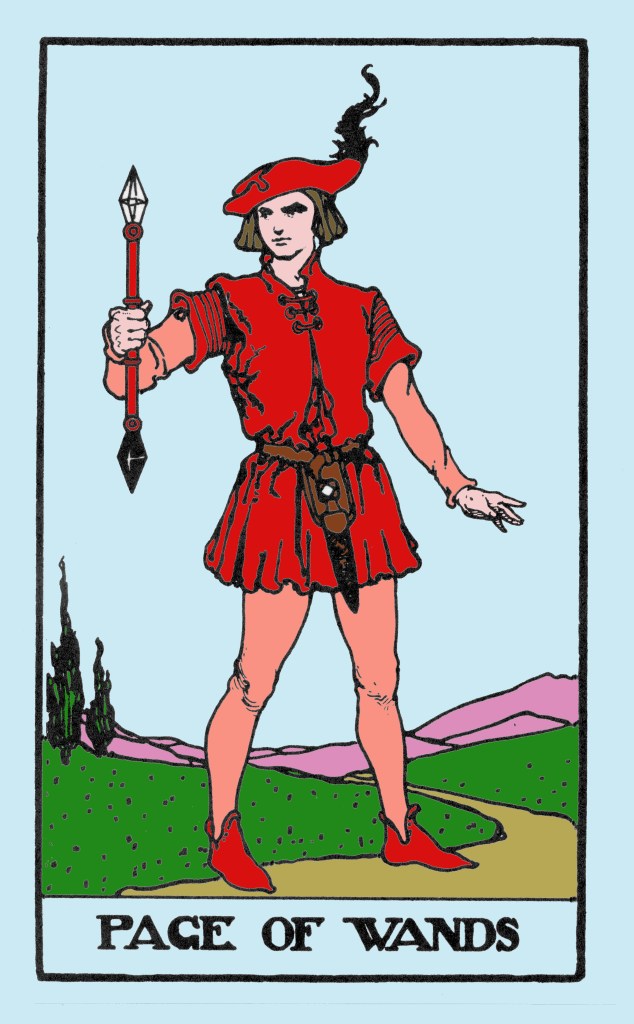
The Page of Wands in the Builders of the Adytum (BOTA) tarot deck
Paul Foster Case (and Ann Davies)
The time p e riod corre la t e d with this Key is the whole first quarter of the zodiac from March 21 to June 21 inclusive, including Aries, Taurus and Gemini. The specific Divinatory meanings involved are: Well Dignified: a young person, youth or girl; brilliant mind, courageous disposition , perhaps given to sudden anger and desirous of power. Capable of great enthusiasm. lll Dignified: Revengeful at the least opposition, headstrong, theatrical, unstable, domineering and decidedly superficial. This Key often stands for a messenger. (From the Oracle of Tarot course)
A. E. Waite
In a scene similar to the former (i.e., of the Knight of Wands), a young man stands in the act of proclamation. He is unknown but faithful, and his tidings are strange. Divinatory Meanings: Dark young man, faithful, a lover, an envoy, a postman. Beside a man, he will bear favourable testimony concerning him. A dangerous rival, if followed by the Page of Cups. Has the chief qualities of his suit. He may signify family intelligence. Reversed: Anecdotes, announcements, evil news. Also indecision and the instability which accompanies it. (From The Pictorial Key to the Tarot)
Aleister Crowley
The Princess of Wands represents the earthy part of Fire; one might say, she is the fuel of Fire. This expression implies the irresistible chemical attraction of the combustible substance. She rules the Heavens for one quadrant of the portion around the North Pole.
The Princess is therefore shewn with the plumes of justice streaming like flames from her brow; and she is unclothed, shewing that chemical action can only take place when the element is perfectly free to combine with its partner. She bears a wand crowned with the disk of the Sun; and she is leaping in a surging flame which re-calls by its shape the letter Yod
This card may be said to represent the dance of the virgin priestess of the Lords of Fire, for she is in attendance upon the golden altar ornamented with rams’ heads) symbolizing the fires of Spring.
The character of the Princess is extremely individual. She is brilliant and daring. She creates her own beauty by her essential vigour and energy. The force of her character imposes the impression of beauty upon the beholder. In anger or love she is sudden, violent, and implacable. She consumes all that comes into her sphere. She is ambitious and aspiring, full of enthusiasm which is often irrational. She never forgets an injury, and the only quality of patience to be found in her is the patience with which she lies in ambush to avenge.
Such a woman, ill-dignified, shews the defects of these qualities. She is superficial and theatrical, completely shallow and false, yet without suspecting that she is anything of the sort, for she believes entirely in herself, even when it is apparent to the most ordinary observer that she is merely in the spasm of mood. She is cruel, unreliable, faithless and domineering.
In the Yi King, the earthy part of Fire is described by the 27th hexagram, i. This shows a person omnivorous in passion of whatever kind, entirely reckless in the means of obtaining gratification, and insatiable. The Yi commentary is packed with alternate warning and encouragement. (From The Book of Thoth)
AI generated illustration for the Page of Wands
Golden Dawn’s Book T
A VERY strong and beautiful woman with flowing red-gold hair, attired like an Amazon. Her shoulders, arms, bosom and knees are bare. She wears a short kilt reaching to the knee. Round her waist is a broad belt of scale-mail; narrow at the sides; broader in front and back; and having a winged tiger’s head in front. She wears a Corinthian-shaped helmet and crown with a long plume. It also is surmounted by a tiger’s head, and the same symbol forms the buckle of her scalemail buskins. A mantle lined with tiger’s skin falls back from her shoulders. Her right hand rests on a small golden or brazen altar ornamented with ram’s heads and with Flames of Fire leaping from it. Her left hand leans on a long and heavy club, swelling at the lower end, where the sigil is placed; and it has flames of fire leaping from it the whole way down; but the flames are ascending. This club or torch is much longer than that carried by the King or Queen. Beneath her firmly placed feet are leaping Flames of Fire. Brilliance, courage, beauty, force, sudden in anger or love, desire of power, enthusiasm, revenge. If ill dignified, she is superficial, theatrical, cruel, unstable, domineering. She rules the heavens over one quadrant of the portion around the North Pole. Earth of Fire
Etteilla
Foreigner Upright. This card, as far as the medicine of the spirit is concerned, means, in its natural position: Stranger, Unknown, Extraordinary. – Strange, Unusual, Unheard of, Surprising, Admirable, Wonderful, Prodigy, Miracle. – Episode, Digression, Anonymous. Inverted. Announcement, Instruction, Warning, Admonition, Anecdotes, Chronicle, History, Tales, Fables, Notions, Teaching.
I come from a rather traditionalist school of divination. One of the ways I learned was that my teacher often told me to do a spread on an aspect of her past I knew nothing about to see if I managed to discover what happened. Another way was when she told me to do a spread to see what would be the problem of the next person going to her for a reading. Interestingly, I have met other people, who have taught me other techniques, who used the same method.
As can be expected, there was little room for anything other than the literal interpretation of the cards. This has helped me a lot to remain with my feet on the ground as I forged my path, which is very good, considering how littered with nonsense the esoteric landscape is.
On the other side of the spectrum you have a sizeable chunk of diviners today, though the situation now is slightly more balanced than it was just twenty years ago. These readers simply interpret the cards (or the planets, or whatever) as if they were benevolent tips from the universe about some inner issue that the person needs to work through to progress.
The problem I have with this approach, aside from the fact that it leads to unverifiable predicitions, is that it presupposes a superstitious view of the universe as some kind of benevolent nanny that teaches you how you ought to behave. These people, I should remind you, are the ones who often loathe Christianity as a bundle of silly dogmas and think they are the reasonable ones.
If there is one thing that my study of philosophy as well as my experience as fortune-teller has taught me is that there is no such thing as an ‘ought’. There’s what is and what isn’t, what was and what wasn’t, what will be and what won’t be, as well as what can be, or is more or less likely to be. For instance, there is no way you ‘ought’ to eat. You either eat well or you don’t. Eating well only becomes an ought when your current diet is checked against your desire to minimize health risks. It’s your desires that create oughts, not the universe.
I already discussed how I believe that divination tools are essentially something that gives us a bird-eye view of existence, affording us a glance at a number of considerations about our situation that we might not otherwise have. To use my old analogy, it is like being in a crowded city center and talking to a person on a walkie talkie, this person looking at your position from the top of a skyscraper and therefore seeing things you cannot see.
It goes without saying that I believe divination tools never give advice.* As maps, they simply tell you what is. Advice is contingent on what either someone wants to do or what they believe a superior authority wants them to do. My view of the superior authority is that it is too occupied exploring all its potential through us to pick and choose what’s best for us.
Does it therefore mean that a diviner should not give advice? I actually believe advice is a perfectly fine thing, as long as it is not delusional advice. I think a good divination session should always be of help to the querent in living their own life better. This is done by checking the querent’s wishes (sometimes implied, sometimes stated outright) against the wider situation as portrayed by the oracle, with its potentials, its risks, its possibilities and impossibilities, its certainties and its uncertainties.
In other words, advice must come from the diviner on the backdrop of the oracle, and not be projected onto the oracle, which just pictures reality as it is, not as it should be (because there is no way reality should be, from an objective standpoint). Sure, sometimes I tell my querents “the cards are advising you to do X”, but this is short for “I am advising you to do X based on what the cards are telling me about your situation.”
Sometimes the right bit of advice at the right time can help the querent make a turn for the better in life. These are the readings I love the most. Sometimes it can improve a situation. Sometimes, though, the advice is not enough to change an objectively difficult situation. The more heroic and nietzschean reaction to these slings and arrows that life throws at us is that of amor fati: in knowing what’s coming, one can learn to love it, thus overcoming it, making it part of oneself instead it being an alien destiny. But this is not always possible. Sometimes, all the querent can get from a difficult reading is peace of mind. And peace of mind is a great thing, all too often undervalued until it’s no longer there.
MQS
* In this, divination tools are very different from inspired divinations caused by spirits or deities, since these actually do have their own particular views and preferences.
I occasionally help my husband when he needs to work from home and I’m free. Yesterday was one such occasion. He’s a stenographer and was sent several audio bits from a famous company so that he would make a protocol out of them. I don’t think I need to stress how tedious this is. I do it mostly to improve my German, aside from being helpful to my husband. At around 18:04, he was told that the meeting was running late and that there was the possibility of us receiving audios well into the night. Horrified, I asked “when will it be over?”
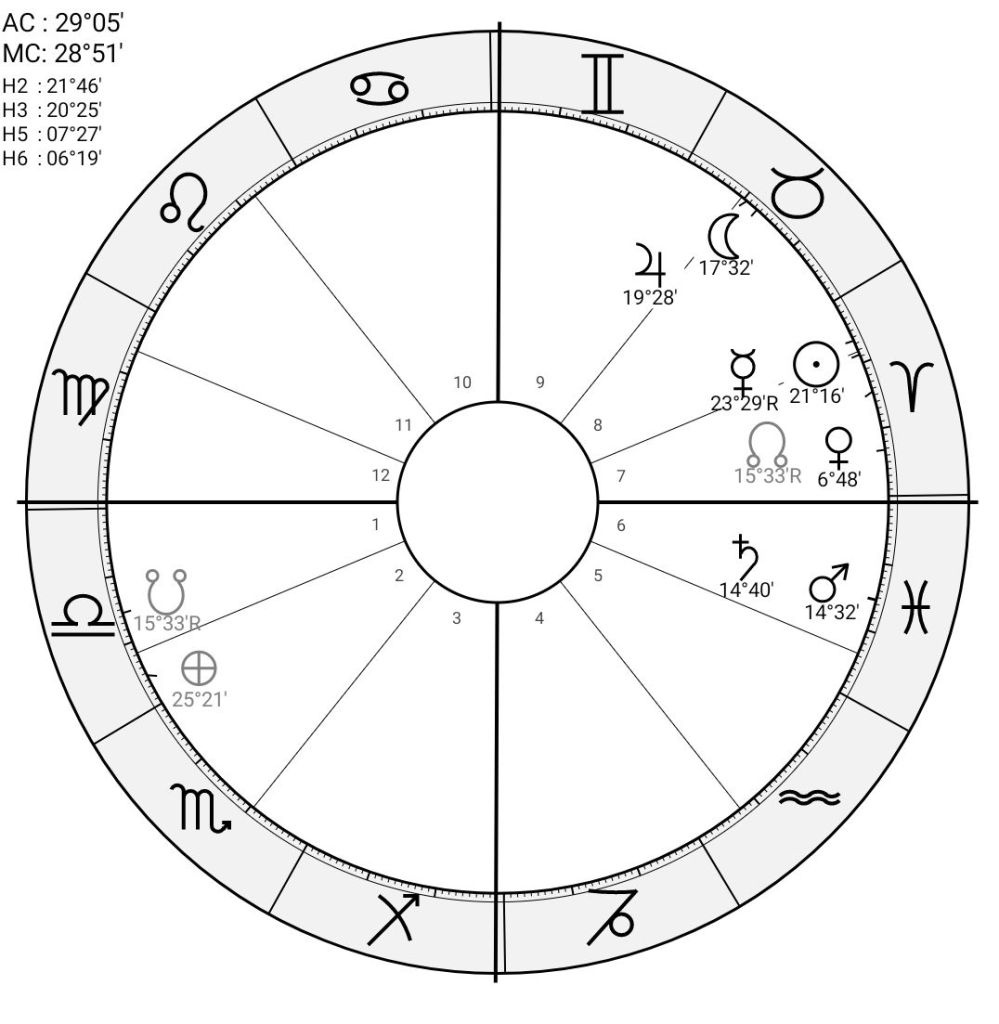
The Heavens answered with this chart.
When will it be over?
I am represented by Mercury, Lord of the Ascendant. Mercury is retrograde, stuck in the evil Eight House of “fear and anguish of Minde”, as William Lilly wrote, and speeding into Combustion of the Sun. In a word, my poor Mercury is a mess. At this point I am unsure if only I am signified by Mercury and my husband by Jupiter, Lord of the Seventh House, or if we are both signified by Mercury. The fact that a Bi-Corporeal sign is rising (Virgo) seems to indicate we are both Mercury. Our stress is well captured by Mercury’s affliction.
However, one thing that gives me hope is the VERY late ascendant (29.05 Virgo), which seems to indicate it won’t take that much. Let’s look at the Moon. She is in her exaltation in Taurus, separating from a sextile of the two Malefics and about to bump into Jupiter, the Great Benefic. Help may be at hand! Initially, as I said, I half-thought that Jupiter was my husband. However, reflecting on my question “when will it end?” I realized that Jupiter rules the Fourth House, which can indicate the end of the matter. In this case, it is quite appropriate that the end of the matter be signified by a benefic.
If that’s the case, then the Moon approaching Conjunction with Jupiter must indicate that things are about to end. When though? The Moon perfects the aspect in around two degrees, so we are left with “two somethings”, i.e., two seconds, two minutes, two hours (days wasn’t an option). The Moon is in a fixed sign, but also very quick in motion and strongly dignified, so my sense was that it would be over in less than two hours. Looking at the ascendant, which had less than one degree of Virgo left on it, I had the feeling that it could possibly be around an hour.
The question was asked at around 18:04, and at 19:02 we were told it was over.
or “Summa Scientiae Nihil Scire” in Latin. This motto is very useful in practical fortune-telling. One of the greatest risks we run is of assuming. “She’s 85, how is she gonna find love?” “He’s a 23-year-old jock, he’s probably not a priest.” “She looks so prim and proper, she’s unlikely to have seven lovers.”
All these preconceptions and more cloud our mind as we try to read the oracle’s answer, regardless of the oracle, whether it be the Tarot, playing cards, astrology, the I Ching, etc. All these preconceptions are poison to the art of divination. They are not of service to us, nor to our querent. Let’s delve into why.
Let us start from the fact that bias is a natural and necessary phenomenon, as politically incorrect as this may sound. Bias comes to us from our experience, but also from the experience of others, especially family members, friends, teachers and people we trust. Bias orients our life, and this cannot be otherwise. The attempt to forcibly eliminate bias from people’s minds only causes suffering, and is its own kind of irrational crusade.
You know who is NOT biased? God. You know what God does? Everything. But you can’t do everything. You can only do something. And in order to do something, you must be biased against something else. That’s life.
This is not to say that all bias is good. For instance, I may have accepted some preconceptions from my parents, who got them from their grandparents, who got them from the priest, who got them from a crazy lady next door, etc. This kind of bias is the worst because it can needlessly limit our options and create likewise needless suffering in those around us. The best kind of bias is the critically examined one that you accept based on your actual life experience and keep open to revision.
Yet even this kind of “good” bias is harmful to divination. When someone comes to us for a reading, or when we read for ourselves, what we are doing is trying to look at reality from the point of view of a symbolic system that reflects life from an objective, or at least less subjective standpoint.
Divination is a language with no native speakers, except maybe the guy upstairs, which means that our understanding of it is always going to be imperfect and faulty. But this is a technical kind of difficulty, and in its own way it’s excusable. What is less excusable is the additional confusion we create by reading our biases into the divination. This is not just about politics, philosophy, morality or religion. It’s everything.
“A 85-year-old is not going to find love again” is one sort of bias. “An attractive young guy is probably not a priest” is another. The aim of divination is to read the truth, not ourselves.That’s why the height of science is to know nothing. If we start with a clean slate we can receive much more information from the tool we are using, simply because we are not randomly blocking out information we consciously or subconsciously deem unlikely.
The unlikely happens everyday. Think about it. Almost everyday something unlikely happens in the world. That’s not to say we must feel the urge to make our predictions as unlikely as possible in order to impress the querent. Most of the time, what’s likely is what ends up happening. Still the unlikely is not the impossible.
I am big on comparing divination with language, as those reading this blog know. And as you know, I am not a native speaker. Around fifteen years ago, I was trying to improve my English by watching youtube videos. Yet this was very hard, because the language people use on youtube is very inconsistent, erratic at times, filled as it is with memes, asides, jokes, ancdotes, interruptions… I was trying to project the artificial English I had learned in school onto this truer, more lived English.
“Surely he can’t have said what he has just said. It doesn’t make any sense,” I constantly thought. It was when I stopped projecting my presuppositions and started just taking in what was objectively being said that my English truly improved. That’s the same with divination. The height of science is to know nothing. Only if we know nothing we can take in what is being said.
In Medieval and early modern times, Astrology was everything. Being a natural consequence of the philosophical worldview tolerated by the church (that is, Aristoteleanism), Astrology was not seen, strictly speaking, as a Bible-prohibited practice, but merely as an extension of the science of the day. Though it always had its detractors, it was generally accepted. Therefore it was normal to try to astrologize everything.
We’ve already discussed geomantic perfection. This takes place thanks to something resembling aspects. But some old books go a step further and seek to introduce the actual astrological aspects of the time into geomantic practice.
In Astrology, an aspect happens when two planets occupy the same degree in different signs: a sextile happens to planets that are 60 degrees apart (e.g., Venus at 10 Aries and Jupiter at 10 Gemini); a square is between planets that are 90 degrees apart (e.g. Venus at 10 Aries and Jupiter at 10 Cancer); a trine is between planets that are 120 degrees apart (e.g., Venus at 10 Aries and Jupiter at 10 Leo); an opposition is between planets that are 180 degrees apart (e.g., Venus at 10 Aries and Jupiter at 10 Libra)
Aspects are key to astrological perfection. They show the things signified by the planets coming together, with sextile and trine indicating good contact on one hand and square and opposition showing bad or difficult contact. For instance, if in a love question my significator aspects my love interest’s significator, it shows us coming together. If by trine, we get along, if by square we argue.
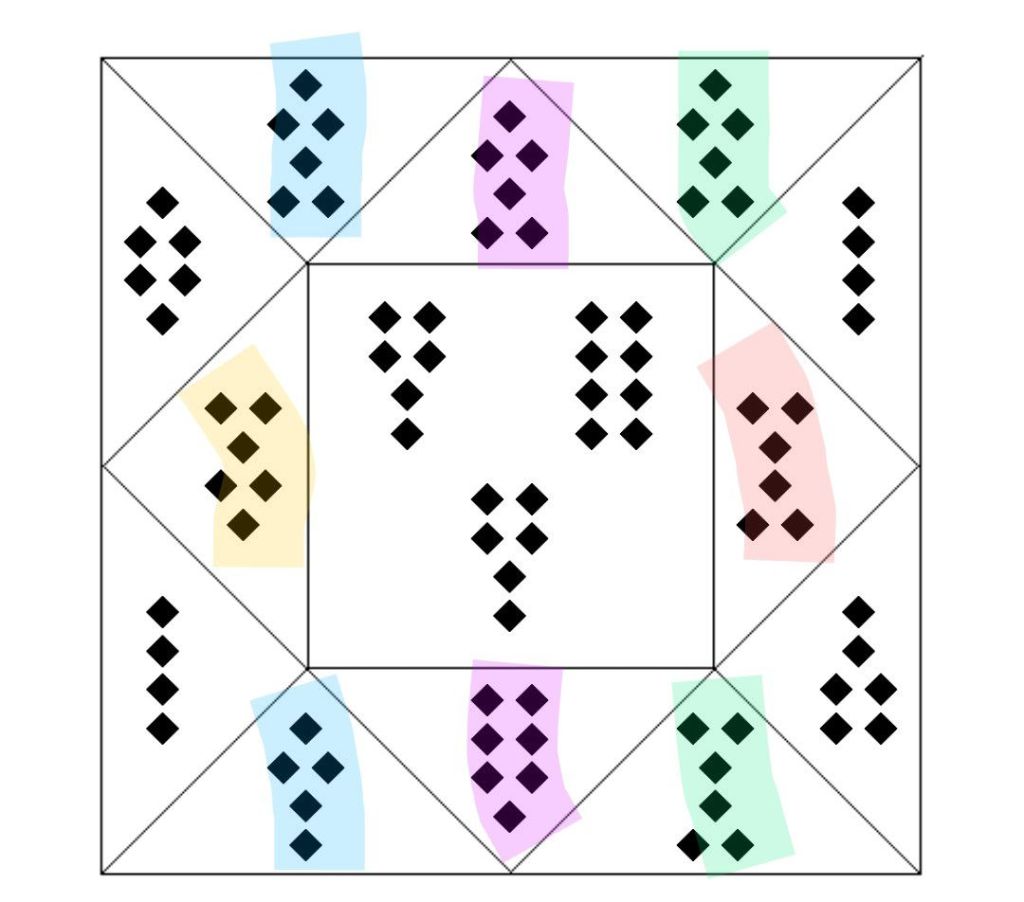
In geomancy, astrological aspects have been adapted to the chart as follows:
Astrological aspects in Geomancy (App used: Simple Geomancy)
If we take the figure in the first house (marked in yellow) as a reference point, then the figures in blue sextile it, because they are separated from it by a single sign; the figures in purple square it, because they are separated from it by two houses; the figures in green trine it because they are separated from it by three houses, and the figure in red opposes it, since it occupies the houses directly opposite.
This is supposed to shed some light on the relationship between the figures: two figures that fall into a square pattern have a difficult relationship, two figures in a trine a good one, etc.
The problem with using astrological aspects in Geomancy is that aspects work in a fundamentally different way: in Astrology, an aspect requires a planet to move in order to apply to another planet. After perfection, then, the aspect separates and its effect wanes.
Geomancy, though, is a static system with no real movement. Sure, we can say a figure moves from one house to another, but in reality that figure is already present in both houses. The only way to conceptualize movement in a geomantic chart is when we take a significator’s house to be the original position of the figure in it, and every other instance of that figure as a successive movement (e.g., in a career reading, if Laetitia is in the tenth house and in the seventh, we take it to move from the tenth to the seventh and not vice versa).
I am honestly not convinced that astrological aspects can find a meaningful place in geomancy. They certainly cannot bring matters to perfection, otherwise everyone would always be separating from their partner since the figure in the seventh house always opposes the figure in the first. Similarly, everyone would always get along with their siblings since the third house always sextiles the first.
One possibility which has been suggested is that of applying aspects only to figures that move. In a love reading, for instance, if the seventh figure moves to the tenth, it moves to square the querent, since the tenth house squares the first.
I personally find this application also problematic, because the tenth house represents the job, among other things, so that would mean that everytime the querent’s job is involved in their love life it causes trouble, which is a false assumption.
At most, I would take an aspect into consideration only if BOTH significators move. In the hypothetical love reading, for instance, if the first figure (querent) moves to the fourth house and the seventh (significant other) moves to the tenth, then they are in opposition to one another. Maybe they will argue. Or, if the first moves to the fourth and the seventh to the second, they sextile each other, which is good.
Even in a situation like this I am generally cautious about applying this theory. There are certain aspects of Astrology (pun intended) that simply don’t translate well to other systems of divination. You are of course welcome to try this theory on for size, but personally I believe Geomancy already has its particular version of aspects, and throwing other stuff into the mix feels more like an attempt at complicating this “brief and simple science” to find something more to tell the querent.
I don’t remember if I already talked about a reading I did for myself some time ago. I was expecting a parcel but needed to go somewhere else, so I asked the cards if the package would come on that day. The cards clearly answered in the negative, and I was right: I went out, and the parcel arrived the day after.
Thinking back on this, I was reminded of an experience reported by famous British astrologer John Frawley. I cannot remember if he discusses it in The Real Astrology or in his Horary Textbook, but it goes somewhat like this: he was waiting for some repairman to come to his house, but he also wanted to take a relaxing bath, so he cast a horary chart to know when the guy would come, only to discover that he wouldn’t. So he slipped into the bathtube, and his prediction proved correct
I believe this kind of readings is the most fun and instructive on the nature of divination. Ultimately, divination is intelligence-gathering. Sentient beings organize their behavior based on the information available to them. Therefore, new information is bound to change the being’s behavior.
The more complex the organism, of course, the more factors come into play, but the basic principle remains true. This is not to say that anything is possible, because only someone with infinite knowledge would know how to overcome all kinds of situations he or she finds unpleasant. We humble mortals are always restricted by difficult circumstances. Still, the information we gather through divination is not, in principle, different from the one we gather through other means which are all just as imperfect.
A fatalist might try to defend the idea of an all-encompassing destiny by arguing that the prediction is itself part of the person’s fate. I was destined to pull those cards and go out. But this stance, interestingly enough, invalidates the idea of prediction itself. If everything is destiny, then even knowledge that everything is destiny is destiny, rather than the truth.
I believe that divination is not simply communication with the divine, but also a form of deification: if we take God on one hand, that is, someone who is capable to be the pure consequence of its own choice, and a rock on the other, that is, something that simply passively receives whatever action external forces exert on it, then divination moves us closer to the divine condition of being the consequence of our own choice.
This is also why I am skeptical of airy-fairy forms of divination that try to take the focus away from concrete life in the name of some vapid divine idea. Ultimately, there is far more divine depth to Frawley’s ability to take a bath thanks to a horary chart than there is to questions like “How can I embody the divine feminine and honor my ancestral heritage more fully?”
This post is part of my Notes on Divination series.This gets somewhat philosophical and is rough and not organized, so bear with me.
In the previous post in this series, I started discussing some general ideas on why fatalism is an inherently flawed view, while in the one before I had shown why pure free will makes just as little sense. To summarize, pure free will simply doesn’t take into account the fact that we don’t live and move within a blank space that we can change at whim.
On the other hand, pure fatalism cannot even be articulated as a view without contradicting itself: if fatalism is real, then my fatalism is not due to me assessing reality and forming a fatalistic worldview that corresponds to how reality factually is, but it’s due to destiny forcing me to be a fatalist. This implies that when I say I am a fatalist, I don’t really mean it. I *cannot* really mean it – It is conceptually impossible. In order to be a fatalist, I must have the freedom to develop a fatalistic worldview. This is a contradiction.
My view of the universe is consequently inherently libertarian, though it is a reasonable and limited libertarianism.* No matter how small our personal freedom is, it exists and is the place we our soul inhabits. Freedom is the consequence of consciousness. When I become aware of something, I posit it as the object of my awareness, outside of myself, and therefore incapable of completely determining my whole being.
Now let us ask: what happens during a (serious) divination session? What does divination do, at heart? At the very least, divination must either make us aware of unknown facts about the past, present or future, or it must shed new light on known facts, thus revealing them from a different, previously unknown point of view. A divination session that does not do this is not a divination session. It may or may not be helpful in other regards, but it is not divination.
The Moment of Divination
It is clear, therefore, that divination is inherently connected to consciousness and to increasing our conscious awareness of (our) reality. This is another reason why a (mildly) libertarian view of divination makes more sense. Suppose you cross the fortune-teller’s palm with silver and then you get told you will win over your crush: is the fortune-teller right because she actually sees this in the crystal ball or is she doomed to say this to you? If she is doomed to say it, then the fact that she is saying it has nothing to do with the statement being true and everything to do with destiny forcing her to say it.
Furthermore, in revealing your future to you, the fortune-teller cannot help but modify it. This has nothing to do with some odd theories I’ve read on the internet, about the fact that if you predict something you make it happen. If that were true, I could predict myself into a billionaire. Besides, even if the fortune-teller saw your future and didn’t tell you, she would still be modifying your future.
Reality is much more subtle. Suppose that X is going to happen to you. If the fortune-teller tells you, then you are aware of X happening. X happening with your awareness is different from X happening without your awareness. The fabric of the fact itself changes with your awareness of it, for the simple fact that something that happens with your knowledge is not something that happens without your knowledge.
The moment of divination, therefore, has a very important place in our life, because it is part of our life, but it is also a part of our life wherein our awareness of reality increases, thereby changing our reality. This does not automatically mean that divination can make us realize every whim that crosses our mind, nor that it can always save our butt. Sometimes the only choice possible is between accepting a fact and not accepting it.
I like to liken an oracle to a friend on top of a high building, who has a wider view of our surroundings than us as we move in a busy intersection of streets, and who texts us hints that increase our understanding of our reality and can help us make better choices, though sometimes the choices we can make are so severely limited as to border on predestination.
MQS
* I mean ‘libertarian’ from a metaphysical standpoint.