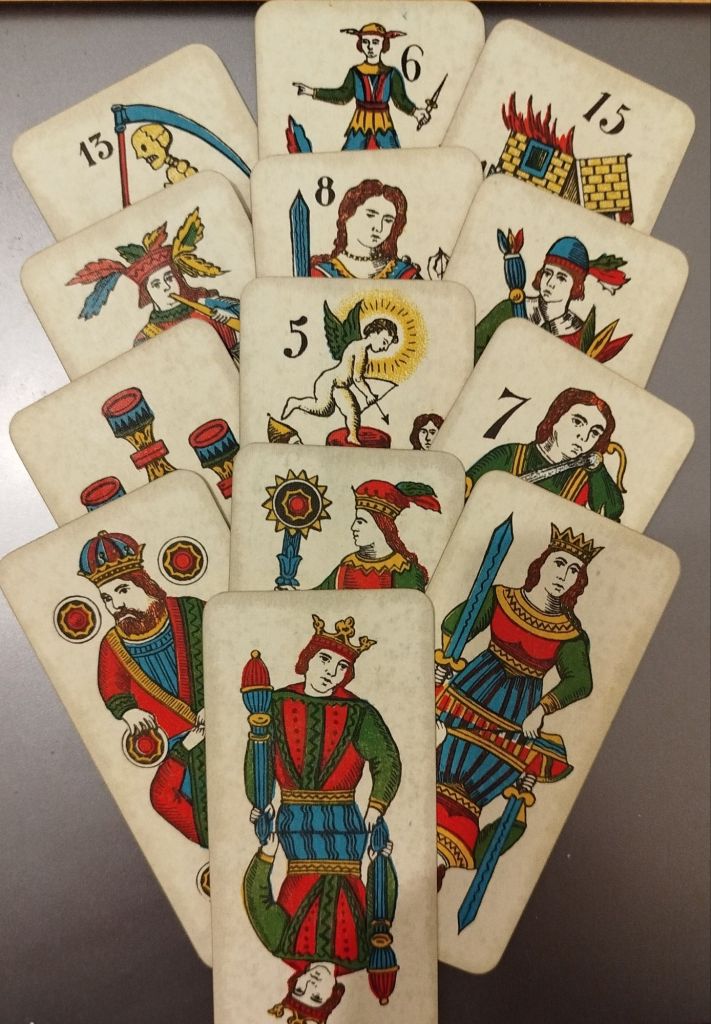
Plenty of readings this time of year, and an above average number on health issues. An acquaintance of ours, an elderly man whom we know from theater, had to go under the knife for major surgery, my husband and I decided to see how the situation would evolve. I used the 45-card Bologna tarot system and the 13 card spread.
Recovery from Surgery. Spread with the Bologna
I am immediately reassured by the lack of dramatic sequences. However, the first row is interesting: Death can indicate a major turning point, the Chariot is the bed card in this tradition, and the Tower is a place of suffering, such as a hospital. Death and Tower can be a tragedy or painful situation. Technically you’d need the Knight of Swords together with the Chariot and Tower to predict surgery, but considering I didn’t even need to predict it (I knew it already) the cards are being remarkably specific.
We also find that his thoughts (the Knight of Wands) are not at ease (the Fool and Justice, that is, irrgularities on his idea of what is right). It could simply indicate bewilderment at the question of how he is going to move on from this. Note that the Tower weighs his thoughts down.
In the following row we see that there is love and care around him (Seven of Cups and Love) and that this care is going to have to last quite a while (Temperance). The recovery is going to take its time. Finally, the cards reassure us that the people and doctors taking care of him mean well and know what they are doing (the Queen of Coins is the truth, wisdom and knowledge).
Here Abano discusses matters relating to the Fifth House and Sixth House.
Fifth House
If one shall have children. If the question is about having children, look at the first, fifth and seventh figures.1 If they are entering and fortunate and the fifth is united or conjunct to the first or seventh house, the querent shall have children, especially if if the figures are Albus, Populus, Conjunctio or Laetitia. And depending on how many figures are on the side of the first figure,2 it means this is thanks to the husband’s inclination, and if the on the side of the seventh, of the wife’s, and if in said places you find exiting and unfortunate figures, it means the opposite, and if the fifth moves to the eighth or twelfth it means miscarriage and death of one’s children.3
If a woman is pregnant, and if the child is a boy or a girl. And if you want to know if a woman is pregnant and whether she will give birth to a boy or a girl, look at the aforementioned figures, to wit, the first, fifth and seventh, and also the fourth. If they are entering and fortunate, and if the fifth joins the seventh, then the woman is pregnant, especially if the figure is Major, Caput or Carcer. And this is especially true if the same is found in the fifteenth house. But if in those houses you find Puella, Cauda or Amissio, she is not pregnant. If the majority of the figures in those places, but also in the rest of the chart (and especially the angles and the fifteenth) are masculine, she will give birth to a boy, and if they are mostly feminine to a girl. If you find Populus or Conjunctio, she will give birth to twins. And if there are still doubts, form a figure from the fourth and seventh, and if the resulting figure is more consonant to the fourth the baby is a boy, if to the seventh, a girl.4
If the children shall be good or evil. If one wishes to know whether his children will be good or evil, look at the first, fourth, fifth and seventh and also the sixth figure, and if all these figures are good, entering, fortunate, then the children shall be good, and vice versa. And if the picture is mixed, you ought to form a figure from the fourth and fifth figure, and judge by the goodness or malice of the result. But you should never neglect to keep in mind the tenth and fifteenth figure.5
Sixth House
If one shall fall ill. If you want to know whether you shall fall ill during the year, look at the first and sixth figures, whether the first figure is good and the sixth shows good health, and judge accordingly. And especially if the first is unfortunate and it moves to the sixth, or if the first is bad and the sixth moves to the seventh, or if the sixth should come into contact with the first by falling in the second house, and if the fifteenth figure is unfortunate, and if you want to know the quality of the illness look at the sixth, of what nature and complexion, and whether it is malicious or unfortunate.
If they are earthy and unfortunate it means a grave illness, long and melancholic, and if they are fiery and unfortunate, it means a choleric illness, sudden and strong and acute; and if they are airy and more unfortunate than fortunate, it means a light illness, but bothersome and long, and maybe accompanied by another illness; and if they are watery and more unfortunate than fortunate, it means the illness is troublesome, whether long or short depending ont he nature and property of the figure.6
And if you are afraid of dying of said illness, if the sixth is in the eighth or in the ninth, judge the illness very serious. Similarly, if the sixth shows an illness and the first, being unfortunate, moves to the eighth it shows death. Always judge with diligence and in everything consider the nature and condition of the planets, and judge the great secrets and admirable things always keeping into account the angles and the fifteenth.7
Whether the sick person shall die. Look at the first, sixth, eighth, tenth and fifteenth figures. If you find Caput, Puella, Major, Acquisitio or Laetitia, it shows liberation from illness. If it is Albus, Tristitia, Cauda, Rubeus, Populus, Conjunctio or Pure, it shows a deadly illness and especially if the first, being one of these figures, goes to the eighth or ninth, and similarly if the sixth goes to the seventh or fifteenth. And if this figure is Carcer, by as much as it multiplies itself in these places, so much the more it shows the illness to be deadly, and if Tristitia moves to the eleventh figure it indicates healing and then relapsing and dying, especially if you find it in the thirteenth or fourteenth or fifteenth.8 And if it’s Rubeus in the first and it agrees with the sixth, it shows long infirmity.
Whether the doctor will help the patient. The seventh is attributed to the doctor. If the first, sixth and seventh are good, fortunate and in agreement with each other, it means the doctor shall heal the sick person, and vice versa. If the first, sixth and eleventh are good and fortunate, it shows a quick recovery because the eleventh indicates goodness and the perfection of one’s nature and complexion.9
Of a lost or stolen item The first figure is the querent, the sixth the thief, the second, the tenth, the eleventh and seventh are the thing inquired about. If the tenth is in the second, third or fourth, the thing lost or stolen is in the house of the querent or nearby. If it is in the seventh it shows it to be in the house of the thief, if in the ninth, eleventh or twelfth it means it is far from home, and according to the fortune or malice of the figure, judge whether it shall be gotten back or not, and the condition and identity of the thief, and where.
Whether the servant is good or bad. If the sixth is good, fortunate and in agreement with the first it means a good servant, and similarly if it is in conjunction with the first, especially if it is fixed and fortunate. Look also at the angles and the ninth figure.10
If it is good to buy a small animal. Look at the first, sixth, ninth and tenth.11 If they are good, entering and fortunate, it means it is good to buy, and vice versa if they aren’t. If the first, sixth and tenth are bad but the Witnesses and Judge good, it means it is good to buy, but not at the time you thought was ideal, and you must delay by as many days as are the points in the first figure.12 If you want to know what kind of animal it is good to buy, look at the figure in the sixth and thirteenth and fourteenth, and if you find Rubeus it means pigs, Albus sheep, Minor and Major horses, Tristitia and Laetitia oxen. If you find Caput, Acquisitio or Cauda, other small animals. Look also if the second house is fortunate.
I believe Abano means the two sides of the Geomantic Shield. Abano says “how many figures”, but in reality, of course, the number of figures is always the same. What he means is how good they are. ↩︎
Note that the Eighth house, aside from indicating death, is also conjunct the Seventh, so it seems Abano is giving us contradictory indications. However, the chart must be read as a whole. A bad figure in the Fifth house springing to the Eighth is a bad omen. ↩︎
We are accustomed to calling the Seventh the house of the spouse, but in many older texts it is called the house of women, and it is not at all clear that this is just due to the old bias against women. There may be something to it. Similarly, the Fourth house is generally considered a house mostly of men. ↩︎
The rationale behind the choice of house is not always clear, but I believe the First House is to show the child’s attitude toward the querent, the Seventh to judge their attitude toward the spouse, the Fourth is the end of the matter, the Sixth is in Company with the Fifth, the Tenth has to do with one’s actions. Furthermore, the angles are always important, regardless of their meaning. ↩︎
This paragraph offers insight into the old theory of humors as applied to matters of health. Though this theory is thoroughly alien to us now, Abano’s description is eminently practical and worth exploring. ↩︎
Abano is not the poetic kind of writer, but here he is clearly intimating that there is more to judging and treating illnesses than merely interpreting an oracle. ↩︎
Many of these indications are somewhat obscure. Furthermore, Tristitia cannot be the judge. ↩︎
The Eleventh House was known as the “Good demon” of the person. It is also connected with the Guardian Angel. ↩︎
I don’t understand why the Ninth ought to be involved into this kind of judgment. ↩︎
Again, it is not clear why the Ninth and Tenth ought to be involved. However, they are the first two Nieces, and are on the querent’s side of the chart. This might be the connection. ↩︎
This timing technique is especially interesting. I do not believe I have seen it anywhere else. ↩︎
Abano discusses matters related to the First House. and Second House
Having shown in the first book how one may know and judge (questions), we must now show some practical examples of this science according to the twelve houses of the chart, so that everyone may more easily understand what they wish to know. And this always according to the above described rule of giving the first house to the querent and the appropriate one to the quesited.
First House
Of the life of the man or woman.1 Having made the chart and the fifteenth figure, and wanting to know one’s fortune or misfortune,2 consider the figure in the first house and, depending on its meaning and the virtue of the planet ruling this figure, judge whether it is good or bad.
And if you want further clues, look whether the figure moves toward one of the angles or in more than one of them.3 And the life is all the more long and better and fortunate depending on how good the angle is, as said before.4 And if the figure doesn’t move, but it is still good and fortunate, it means one still has a long time to live, but is lonely.5 And if it moves to the second, it causes gain through one’s industriousness and solicitude. And if it moves to the third, it means getting along with younger relatives and siblings, and if to the fourth, it indicates increase of patrimony and wealth of the father or of the older relatives.
If to the fifth, it means happiness through children, and usefulness, but if to the sixth, misfortune, tragedy, accidents, but also other people’s service (to the querent), depending on whether the figure is fortunate or not. If it moves to the seventh, it means good things from the wife or girlfriend, and good deals, or gain through war or gambling, and maybe in a foreign country, depending on the quality and condition of the figure. If it moves to the eighth, the life is short, unless one is a butcher or deals in dead animals, that is, skin, wool, or if one is a loan shark.6
If it moves to the ninth, it means much journeying, and being a knight or a wayfarer or a churchman, and the person’s luck is better if the figure is good. If it moves to the tenth, it means honors and public office and receiving dignity from people up high, or through them, depending as the figure is fortunate or not. If it moves to the eleventh, it shows good luck with friends and from people who are noble or from the Roman Curia. If it moves to the twelfth, the person will meet his end in prison, or through long infirmity, or it shows being kidnapped or being in a remote place like some religious people do.
If the figure shows up as a Witness or as the Judge, the person’s fortune depends on how good the figure is. And what we have said of the first figure, whether it is good, mediocre or bad depends on its nature.
Second House
Of wealth, possessions and gain. If you want to know about merchandise, one must judge the first house, whether it is good or bad, and then the second, depending on its virtue, and judge thus: if it contains one figure among Acquisitio, Major, Conjunctio, Caput and Albus, it means that gain will come from things that are easily movable from place to place, or from things that change, or that are sold by approximation (that is, without carefully weighing them).
If it were Puer it signifies gain through things sold after careful weighing. If it were Puella, it means gain through things that are easily obtained. If it were Rubeus, it means in things that cause fire or that have to do with blood. If it were Amissio, Cauda or Via, it shows little gain, and if it were Tristitia or Carcer, it means ups and downs of fortune or possessions. And if it is Laetitia or Minor, it means being able to keep one’s possessions. If it is Populus, then it depends on how good the first figure is, however by its own nature it means abundance. Note that every entering figure indicates gain or buying, and exiting indicates loss or selling.7
Whether one will retrieve the lost possession. If the question is about lost items, or stolen items, and we want to know whether we will get them back, look at the first figure, whether it is good or not, and then the second, and if they are entering or exiting. Afterwards, if you are looking for the thing, look at the tenth figure, if it is entering and good it means retrieval of the lost thing, especially if the same figure is in the second, or if here is another figure that is entering.8 Also look at the eleventh and the fifteenth. If instead the figures are exiting or bad, it means the opposite.
If you are looking for a stolen item, look at the seventh house, if it is entering and fortunate, and if it moves to the second or first house, which means retrieval.9 Similarly in the tenth, eleventh of fifteenth. And if the seventh [figure] is in the third, it means that the lost or stolen item is in the house of a sibling or relatives; if in the fourth, in or around the house of the father or of the older relatives, or near the house or place were it was originally. If it is in the fifth or sixth or eighth it means it is far away. If it is entering, however, you still will get it back.
If one will get back the money they lent to someone else. The first figure is he who must receive back the money, the second is the thing that he wants to get back, and the seventh is the borrower. If the first and second figure, or at least one of them (especially the second) are entering, and if the seventh is exiting, it means getting it all back easily. Similarly, if the second and seventh are the same, that is, entering. But if they aren’t, it means the opposite.
MQS
Footnotes
The First House was often called “Life, Body and Wit/Talent” ↩︎
This type of question may sound vague nowadays, but it must have been common in the premodern era, as Astrology and Geomancy handbooks are full of tips on how to handle it. This was especially true at a time when one couldn’t just arrange an online meeting with the diviner and when one’s time of birth was unknown, so that one may have looked at other possible alternatives to know about their general fortune in life that didn’t involve the birth chart. ↩︎
the angles, i.e., the First, Tenth, Seventh and Fourth houses, are considered strong and highly performant, so they endow the figure with strength. ↩︎
I am not sure what Abano means here. The angles are traditionally arranged as stronger (First and Tenth) and weaker (Seventh and Fourth) though all are generally strong. He may be referring to this. Or he may be referring to the practice of assigning the angles to the four phases of life, so that maybe a good figure passing, say, in the Seventh, shows good midlife. ↩︎
Because the eighth represents other people’s money (being the second from the seventh). ↩︎
“Every entering figure” probably implies “to the exception of Tristitia”. ↩︎
It is not clear why Abano mentions the Tenth House. It is possible that this is because the Tenth House opposes the Fourth House of buried and invisible things, and thus shows visibility and coming to light. ↩︎
Abano does not seem to count the Twelfth house as being next to the First. He is not the only authority to do so. Possibly this has to do with the doctrine of the Company of Houses, or simply with the fact that, on the Geomantic Shield, the First and Twelfth houses are visually distant. ↩︎