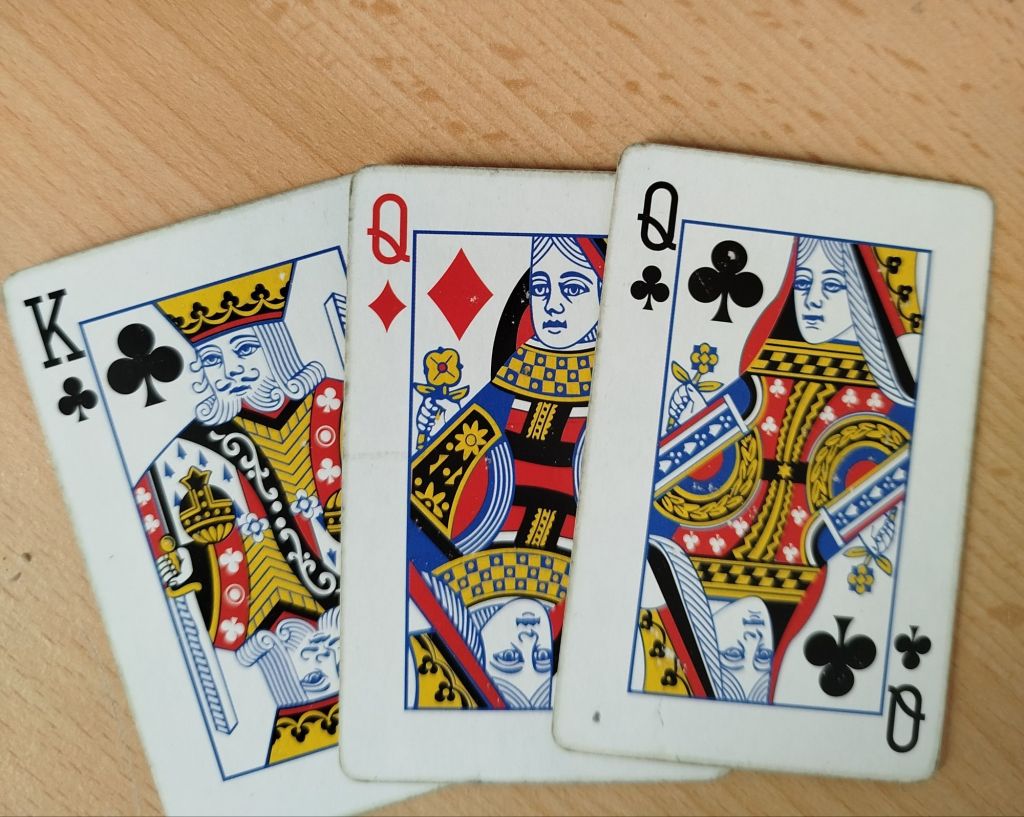
I was asked by a visitor if I take into account the direction court cards look. The idea that the direction faced by court cards gives us important details is ingrained in several strands of card divination. In recent decades it has even been appropriated by certain scam artists (like Jodorowsky and his various imitators) when trying to sell the Tarot of Marseille as a deep metaphysical tool rather than for what it has always been–a cheap gaming deck, which, like all tarot decks, is as good for divination as it is for playing at the local inn.
But directionality does have its place in certain legitimate divination traditions. It just happens not to be part of mine. I do not take into account the way court cards face when reading playing cards, as I have never found it useful or revealing.
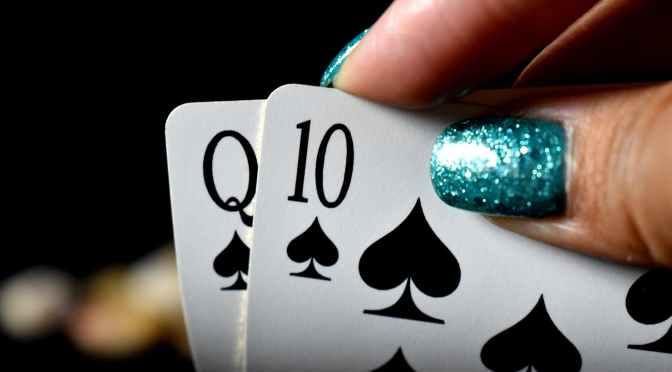
To me, each card is a place-holder for a cluster of certain ideas that are called to mind when the card appears: the Ace of Hearts is a place-holder of a cluster of ideas relating to the home or family, and similarly the Queen of Spades is a place-holder for a cluster of ideas relating to problematic women or issues traditionally associated with the negative side of womanhood. In this cluster of ideas there is nothing inherently left-looking or right-looking. That’s just the fantasy of whoever drew the picture.
What matters most to me is not so much where the card looks, but in what relationship it is with respect to the other cards. Suppose we have:
Q♣️ – 3♣️ – K♣️
Here we have a typical sequence of marriage. Even if the two court cards were swapped, it would change nothing. Now let’s take:
3♣️ – K♣️ – Q♣️
This positioning of the cards may or may not be the same as the previous one. In itself it is just another sequence of marriage. But if it makes sense within the context of the spread, it could indicate that he is the one who is more attached to the marriage, because he falls closer to the card that symbolizes union. However, let’s now look at this:
Q♦️ – 3♣️ – K♣️ – Q♣️
Here it is very important that the King of Clubs fell next to the union, because through it he is united to another woman. This sequence shows that the female querent is the lover (it would be even more clear if the 10♠️ fell between the two Club court cards, as it would show that the married man sees the female querent in secret).
In all this, where the court cards face is of no consequence, because what truly matters is their dynamic interplay. That being said, I know of playing card traditions where directionality is taken into account and I have nothing against it. It just happens not to be part of my toolkit.
They are the bane of many a reader: Court Cards are seen as difficult to read, in part because they clearly represent people, and so refuse to be banished into the realm of woolly platitudes inhabited by way too many readers, in part because locating them within the querent’s life can be objectively difficult.
In cartomancy with playing cards, however, the inherent signification of the cards can help us: The Queen and King of Clubs are almost always the main protagonists (the querent and his/her significant other), though there may be exceptions. I know of cartomancy systems where the querents are represented by the Heart suit, but this is just semantics.
Then we have the Heart court cards, of which the Jack is a child, a pet or something fresh and immature and small and the Queen and King represent people close to the querent’s heart. This is actually a modern interpretation: traditionally, they would be people sharing the querent’s bloodline, but modern times require modern solutions. I have found that the Heart courts can simply indicate very dear friends. For gay people, usually the significant other is a Heart card of the same sex, although occasionally the cards simply use the Club cards. We need to stay open. The Jack of Clubs can indicate friendship, help, cooperation.
The Diamond suit represents people usually unrelated to the querent, though they can indicate relatives by marriage. More usually, they show colleagues, acquaintances, bosses, rich people or people who have a more neutral or even cold perspective of the querent compared to the Hearts. The Jack of Diamonds usually represents a message.
Finally, Spades show people who are downright inimical to the querent, or who wield power over the querent’s well-being and enforce an objective set of rules, such as the police, doctors, judges, etc. This is especially the case for the King. The Jack can represent enmity, scheming, etc.
All Jacks can indicate children or very young people, though in practice this is more likely with the Jack of Hearts.
Usually, one court card within a reading is already more than we can tolerate, but sometimes we find that there are ONLY court cards. This is an example of a reading a did yesterday for a man who asked about his relationship:
A marriage-related three-card spread
When more than one court card shows up, it is important to look at the cards between them, as they show the nature of their relationship, or what’s between them.
It is easy to jump to conclusions here: there’s a woman between you two! You have a lover! This could very well be the case, actually, but it is always important to keep in mind that, with so few cards on the table, more than one interpretation is possible. Here are some possibilities:
There could actually be a woman between them. He may have a lover (or, more rarely, she may have a female lover)
It might be a threesome
There could be a woman who interferes but who is not a lover: it could be her mother, her friend, any other person.
There might be a person mediating between them in a positive way
He might know her from work or from a business context, since sometimes, two queens or two kings together can represent a single person, merging the qualities of two suits.
So, how do we know which interpretation applies? Well, first off, we ought never to play Nostradamus: in doubt, we ask. This may sound unimpressive, but our aim is not to impress, but to give accurate information. Still, with experience, we may rule out a couple of possibilities as being less likely:
This is a simple three-card spread. If the querent were in some kind of odd polyamorous arrangement, the cards would not lead off with three court cards, but by telling us the querent is weird. This may sound politically incorrect, but the cards are keyed to a rather traditional view of the world. This doesn’t mean they are a compass of morality: it’s just their language. They highlight the strange and untypical in rather clear ways. Three court cards together aren’t strange enough.
This is a simple three-card reading. If the querent had a hidden lover they would tell us the relationship is in danger, or at least they would highlight the lover by assigning her to the Queen of Spades rather than Diamonds (The Queen of Diamonds can be a lover, but it requires more hints from the surrounding cards). Even the Queen of Spades wouldn’t necessarily be a lover, but at least we’d know she’s trouble.
This is a simple three-card spread. If there were a positive influence mediating between them, the cards would have given her to the suit of Hearts, or they would have omitted the information altogether and told us the querent and his significant other are in a positive phase (the mediator isn’t that important, and a three-card spread only has space for what’s important).
With that in mind, I asked the querent if he knew his girlfriend from work or from a business context, and he denied this. I asked him then if there was a woman causing some issues between them. He smirked and said: “A friend of hers doesn’t like me, she’s trying to break us up.”
Obviously, this spread doesn’t tell us how it’s going to end. It just describes the situation rather than how it will evolve, and more cards should be drawn.
This is intended as a collection of meanings attributed by some sources to the Major Arcana and Minor Arcana of the Tarot. I will add sources as I study them. If you have sources to recommend, hit me up.
If you are interested in a (partial) list of the meanings I attribute to the Major arcana in my reading examples and case studies, click here.
(Note: this is a collection of the meanings attributed to the cards by some occultists in the past centuries. It does not reflect my own study or opinion of the cards. It is only meant as a quick comparative reference as I develop my own take.)
The Knight of Wands in the Builders of the Adytum (BOTA) tarot deck
Paul Foster Case (and Ann Davies)
Astrologically the Knight of Wands includes the time period from the third decanate of Scorpio through the second decanate of Sagittarius, November 12 to December 11, representing, as we have seen, the combined influences of the Moon in Scorpio and of Jupiter and Mars in Sagittarius. In Divination we find the more specific meanings of each Key, but always remember that as advanced B.O.T.A. members, treading the Path of Return, you must use this art with discretion. It is best not to give querents for your help too specific instruction. Try to act as an emissary for the Hierophant and give them the principles behind their problems as they are unveiled to you by the sequence of Keys. Leave it to those you are helping to apply universal principles to specific problems in their lives. Well Dignified: an active, generous, impetuous, quickmoving man, younger than the King of Wands. He is secretive, probably interested in the occult, somewhat psychic and mysterious. He is friendly to the querent and may bring him news relating to his enterprises. Ill Dignified: e vil-minded, false, cruel, bigoted, brutal young man (or situation), dangerous or unfriendly to the querent1 s affairs. This card sometimes signifies departure or change of residence. (From the Oracle of Tarot course)
A.E. Waite
He is shewn as if upon a journey, armed with a short wand, and although mailed is not on a warlike errand. He is passing mounds or pyramids. The motion of the horse is a key to the character of its rider, and suggests the precipitate mood, or things connected therewith. Divinatory Meanings: Departure, absence, flight, emigration. A dark young man, friendly. Change of residence. Reversed: Rupture, division, interruption, discord. (From The Pictorial Key to the Tarot)
AI-generated illustration for the Knight of Wands
Aleister Crowley
(note that Crowley and the Golden Dawn made a mess with the knights and kings) The Prince of Wands represents the airy part of Fire, with its faculty of expanding and volatilising. He rules from the 21st degree of Cancer to the 20th degree of Leo. He is a warrior in complete armour of scale mail, but his arms are bare on account of his vigour and activity. He wears a rayed crown surmounted by a lion’s head winged, and from this crown depends a curtain of flame. On his breast is the sigil of To Mega Therion. In his left hand he bears the Phoenix wand of the Second Adept in the Ritual of 5○=6□ of R.R. at A.C.), the wand of Power and Energy, while with his other arm he reins the lion which draws his chariot, the chariot which is fortified by a wheel radiating flame. He rides upon a sea of flames, both waved and salient.
The moral qualities appropriate to this figure are swiftness and strength. But he is sometimes inclined to act on impulse; sometimes easily led by external influences; sometimes, especially in trifles, a prey to indecision. He is often violent, especially in the expression of an opinion, but he does not necessarily hold the opinion about which he is so emphatic. He states a vigorous proposition for the sake of stating it. He is in fact very slow to make up his mind thoroughly on any subject, but always sees both sides of every question. He is essentially just, but always feels that justice is not to be attained in the intellectual world.
His character is intensely noble and generous. He may be an extravagant boaster, while slyly laughing both at the object of his boast and at himself for making it. He is romantic, especially in matters of history and tradition, to the point of folly, and may engineer “stunts” or play elaborate practical jokes. He might select some inoffensive nobody, and pursue him for years with every weapon of ridicule) as Swift tormented the unhappy Partridge, all without the least animus, ready to give the shirt off his back, should his victim be in need. His sense of humour is omnivorous, and may make him a mysterious figure, dreaded without reason by people who actually know nothing about him but his name-as a symbol of Terror.
This is due to the influence of the last decan of Cancer upon this card. One of his greatest faults is pride; meanness and pettiness of any kind he holds in infinite scorn. His courage is fanatically strong, and his endurance indefatigable. He is always fighting against odds, and always wins in the long-the very long-run. This is principally due to his enormous capacity for work, which he exercises for its own sake, “without lust of result”; perhaps his haughty contempt for the world at large-which however coexists with profound and ecstatic respect for “every man and every woman” as “a star”-is responsible for this.
When this card is badly dignified, the character degenerates. Each of the qualities mentioned above is found in its antithesis. There is great cruelty in him, partly sadistic and partly due to callousness arising from indifference-and, in a sense, laziness! So too he may be intolerant, prejudiced and idle-principally because it saves trouble. He may furthermore be an empty boaster and a great coward.
In the YI King, the airy part of Fire is represented by the 42nd Hexagram, Yi, which signifies addition, increase. Full of virtue, and confident therein, he contemplates work of stupendous scope, often with the idea expressed in line 5: “with sincere heart seeking to benefit all below”. In this he may achieve immense success. But this course is fraught with commensurate danger. “We see one to whose in crease none will contribute, while many will seek to assail him. He observes no regular rule in the ordering of his heart”. (line 6) This peril avoided, there come “parties adding to the store of its subject ten pairs of tortoise shells whose oracles cannot be opposed-Let the King employ them in presenting his offerings to God….” (line 2). (From The Book of Thoth) Note: Crowley clearly sees himself in this card, which is why he depicts the Prince as the adorable occult prankster he saw himself as.
Golden Dawn’s Book T
A KINGLY Figure with a golden, winged crown, seated on a chariot. He has large white wings. One wheel of his chariot is shewn. He wears corslet and buskins of scale armour decorated with a winged lion’s head, which symbol also surmounts his crown. His chariot is drawn by a lion. His arms are bare, save for the shoulder-pieces of the corslet, and he bears a torch or fire-wand, somewhat similar to that of the Zelator Adeptus Minor. Beneath the chariot are flames, some waved, some salient. Swift, strong, hasty; rather violent, yet just and generous; noble and scorning meanness. If ill dignified — cruel, intolerant, prejudiced and ill natured.
Etteilla
Departure Upright: This card, as far as the medicine of the spirit is concerned, means, in its natural position: Departure, Displacement, Removal, Absence, Abandonment, Change, Escape, Desertion, Transmigration, Emigration. – Transposition, Translocation, Transplantation, Transmutation, Evasion. Reversed: Disunion, Disagreement, Rupture, Dissension, Division, Competition, Separation, Partition. – Faction, Party. – Complaint, Altercation. – Cut, Fracture, Discontinuity, Interruption.
(Note: this is a collection of the meanings attributed to the cards by some occultists in the past centuries. It does not reflect my own study or opinion of the cards. It is only meant as a quick comparative reference as I develop my own take.)
The Knight of Cups in the Builders of the Adytum (BOTA) tarot deck.
Paul Foster Case (and Ann Davies)
The time period is from the beginning of the last decanate of Aquarius to the end of the second decanate of Pisces, February 9 to March 10, under the rulerships of Venus, Jupiter, Neptune and the Moon. Well Dignified: a man of graceful, somewhat indolent, personality; generous and enthusiastic, when he is really interested. Somewhat impressionable and psychic. Fond of home and probably puts all women more or less on a pedestal. Friendly to the Querent. Ill Dignified: lazy, untruthful, likely to be effeminate and ‘catty’. Brown hair, grey or brown eyes. (From the Oracle of Tarot course)
A. E. Waite
Graceful, but not warlike; riding quietly, wearing a winged helmet, referring to those higher graces of the imagination which sometimes characterize this card. He too is a dreamer, but the images of the side of sense haunt him in his vision. Divinatory Meanings: Arrival, approach–sometimes that of a messenger; advances, proposition, demeanour, invitation, incitement. Reversed: Trickery, artifice, subtlety, swindling, duplicity, fraud. (From The Pictorial Key to the Tarot)
Aleister Crowley
(Note: Crowley and the Golden Dawn made a mess with Knights and Kings) The Prince of Cups represents the airy part of Water. On the one hand, elasticity, volatility, hydrostatic equilibrium; on the other hand, the catalytic faculty and the energy of steam. He rules from the 21st degree of Libra to the 20th degree of Scorpio.
He is a warrior partly clad in armour, which seems, however, rather a growth than a covering. His helmet is surmounted by an eagle, and his chariot, which resembles a shell, is also drawn by an eagle. His wings are tenuous, almost of gas.. This is a reference to his power of volatilization understood in the spiritual sense.
In his right hand he bears a Lotus flower, sacred to the element of Water, and in his left hand is a cup from which issues a serpent.
The third totem, the scorpion, is not shewn in the picture, for the putrefaction which it represents is an extremely secret process. Beneath his chariot is the calm and stagnant water of a lake upon which rain falls heavily.
The whole symbolism of this card is exceedingly complicated, for Scorpio is the most mysterious of the Signs, and the manifested portion of it symbolized by the eagle is in reality the least important part of his nature.
The moral characteristics of the person pictured in this card are subtlety, secret violence, and craft. He is intensely secret, an artist in all his ways. On the surface he appears calm and imperturbable, but this is a mask of the most intense passion. He is on the surface susceptible to external influences, but he accepts them only to transmute them to the advantage of his secret designs. He is thus completely without conscience in the ordinary sense of the word, and is therefore usually distrusted by his neighbours. They feel they do not, and can never, understand him. Thus he inspires unreasonable fear. He is in fact perfectly ruthless. He cares intensely for power, wisdom, and his own aims. He feels no responsibility to others, and although his abilities are so immense, he cannot be relied upon to work in harness.
In the Yi King, the airy part of Water is represented by the 61st hexagram, Kung Fu. This is one of the most important figures in the Yi: it “moves even pigs and fish, and leads to great good fortune”. Its dignities and correspondences are manifold and great; for it is also a “big Li”, the trigram of Sol formed by doubling the lines. By shape it suggests a boat, but also the geomantic figure of Cancer, Saturn in Capricornus.
This card is in consequence one of great power; Libra going over into Scorpio is of tremendous, active, critical energy and weight. To such people good will, sincerity, and right mating are the essentials of success; their danger is overweening ambition. (From The Book of Thoth)
An AI generated illustration for the Knight of Cups
Golden Dawn’s Book T
A WINGED Kingly Figure with winged crown seated in a chariot drawn by an eagle. On the wheel is the symbol of a scorpion. The eagle is borne as a crest on his crown, cuirass and buskins. General attire like King of Wands. Beneath his chariot is the calm and stagnant water of a lake. His armour resembles feathers more than scales. He holds in one hand a lotus, and in the other a cup, charged with the sigil of his scale. A serpent issues from the cup, and has its head tending down to the waters of the lake.
He is subtle, violent, crafty and artistic; a fierce nature with calm exterior. Powerful for good or evil but more attracted by the evil if allied with apparent Power or Wisdom. If ill dignified, he is intensely evil and merciless. He rules from 20 Degree Libra to 20 Degree Scorpio. Air of Water
Etteilla
Arrival Upright: This card, as far as the medicine of the spirit is concerned, means, in its natural position: Arrival, Coming, Approach, Landing, Welcoming, Entrance, Reapproachment. – Conformity. – Coming, Approximation. – Access. – Affluence. – Comparison. Reversed: Deception, Scoundrelishness, Briccony, Deception, Artifice. – Fineness, Dexterity, Cunning, Fraud. – Subtlety, Irregularity. Nefariousness.
(Note: this is a collection of the meanings attributed to the cards by some occultists in the past centuries. It does not reflect my own study or opinion of the cards. It is only meant as a quick comparative reference as I develop my own take.)
The Queen of Pentacles or Coins from the Builders of the Adytum (BOTA) tarot deck
Paul Foster Case (and Ann Davies)
The time period is from the beginning of the last decanate of Aries to the end of the second decanate of Taurus, April 10 to May 10. This period is under the rulerships of Jupiter, Venus and Mercury. Well-Dignified: the ability to detect the workings of Divine Guidance in all aspects of incarnate life. In divination, a generous, somewhat ceremonious, great-hearted woman who is both charming and graceful. She is probably possessed of considerable means and is friendly to the Querent. lll-Dignified: some problem with materialism and ability to express unselfish love. A woman who is ostentatious, loose in morals, capricious, changeable, superficial. Likely to do Querent harm through foolish talk, exposure of his plans, etc. Dark hair and eyes. (From the Oracle of Tarot course)
A. E. Waite
The face suggests that of a dark woman, whose qualities might be summed up in the idea of greatness of soul; she has also the serious cast of intelligence; she contemplates her symbol and may see worlds therein. Divinatory Meanings: Opulence, generosity, magnificence, security, liberty. Reversed: Evil, suspicion, suspense, fear, mistrust. (From The Pictorial Key to the Tarot)
Aleister Crowley
The Queen of Disks represents the watery part of Earth, the function of that element as Mother. She rules from the 21st degree of Sagittarius to the 20th degree of Capricornus. She represents passivity, usually in its highest aspect.
The Queen of Disks is throned upon the life of vegetation. She contemplates the background, where a calm river winds through a sandy desert to bring to it fertility. Oases are beginning to shew themselves amid the wastes. Before her stands a goat upon a sphere. There is here a reference to the dogma that the Great Work is fertility. Her armour is composed of small scales or coins, and her helmet is adorned with the great spiral horns of the markhor. In her right hand she bears a sceptre surmounted by a cube, within which is a three-dimensional Hexagram, and in her left arm is curved her proper disk, a sphere of loops and circles interlaced. She thus represents the ambition of matter to take part in the great work of Creation.
Persons signified by this card possess the finest of the quieter qualities. They are ambitious, but only in useful directions. They possess immense funds of affection, kindness, and greatness of heart. They are not intellectual, and not particularly intelligent; but instinct and intuition are more than adequate for their needs. These people are quiet, hard-working, practical, sensible, domesticated, often (in a reticent and unassuming fashion) lustful and even debauched. They are inclined to the abuse of alcohol and of drugs. It is as if they could only realize their essential happiness by getting outside themselves.
If ill dignified, they are dull, servile, foolish; they are drudges rather than workers. Life for them is purely mechanical; and they cannot rise, or even seek to rise, above their appointed lot.
In the Yi King, the watery part of Earth is represented by the 31st hexagram, Hsien. This has the meaning: Influence. The commentary describes the effect of moving various parts of the body, from the toes to the jaws and tongue. This is rather an amplification of what has been said above than an exact correspondence; yet there is no discordance. The general advice is to go forward quietly without overt attack upon existing situations. (From The Book of Thoth)
AI-generated illustration for the Queen of Pentacles or Coins
Golden Dawn’s Book T
A WOMAN of beautiful face with dark hair; seated upon a throne, beneath which is dark sandy earth. One side of her face is light, the other dark; and her symbolism is best represented in profile. Her attire is similar to that of the Queen of Wands: but she bears a winged goat’s head as a crest. A goat is by her side. In one hand she bears a sceptre surmounted by a cube, and in the other an orb of gold. She is impetuous, kind; timid, rather charming; great-hearted; intelligent, melancholy; truthful, yet of many moods. If ill dignified she is undecided, capricious, changeable, foolish. She rules from 20 Degree Sagittarius to 20 Degree Capricorn.
Etteilla
Dark Woman Upright. This card, as far as the medicine of the spirit is concerned, means, in its natural position: Dark Woman, Opulence, Wealth, Lavishness, Luxury, Sumptuousness. – Assurance, Reliability, Trust, Certainty, Confirmation. – Confidence, Boldness, Freedom, Frankness. Reversed. Unsafe, Doubtful, Uncertain, Doubt, Indecision, Uncertainty. – Fear, Fright, Timidity, Apprehension, Vacillation, Hesitation. – Indeterminate, Irresolute, Perplexed, He who is suspended.
(Note: this is a collection of the meanings attributed to the cards by some occultists in the past centuries. It does not reflect my own study or opinion of the cards. It is only meant as a quick comparative reference as I develop my own take.)
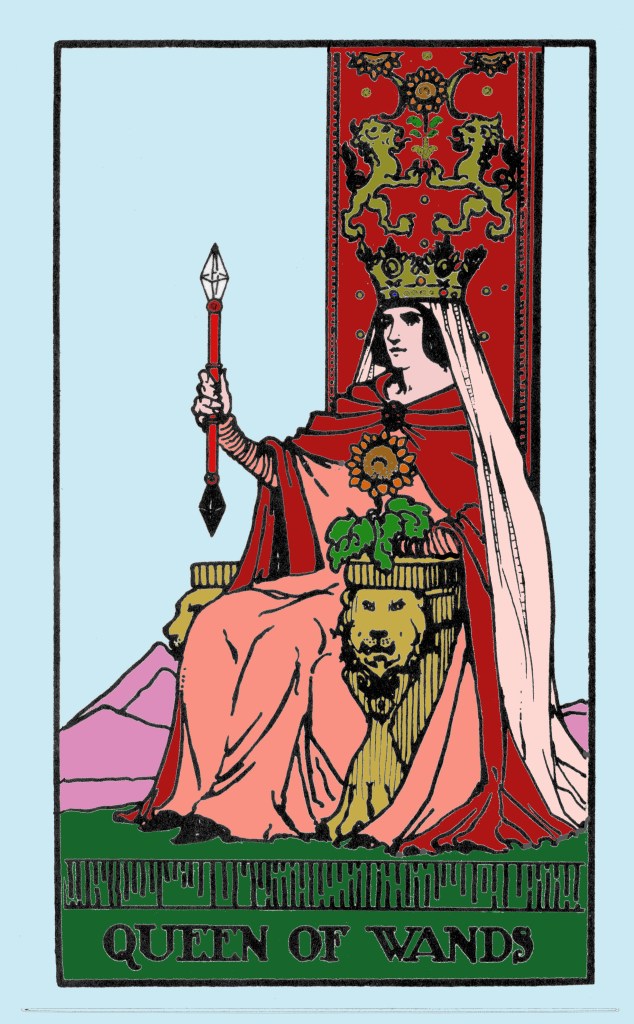
The Queen of Wands from the Builders of the Adytum (BOTA) tarot deck
Paul Foster Case (and Ann Davies)
The time period related to the Queen of Wands is from July 13 to August 12, symbolizing the influence of Jupiter and Neptune in Cancer and of the Sun and Jupiter in Leo. The basic power suggested by this Key is that of command. Well Dignified: in a divination the Queen of Wands symbolizes a kind, generous woman, resolute in the face of opposition, strongly psychic and intuitive but practical in applying her spiritual gifts; intense; magnetic ; friendly to the querent and a favorable influence for the success or business of the querent. Ill Dignified: Inimical to the querent; obstinate, dangerous woman, unfavorable to querent’s affairs; revengeful and tyrannical. (From the Oracle of Tarot course)
A. E. Waite
The Wands throughout this suit are always in leaf, as it is a suit of life and animation. Emotionally and otherwise, the Queen’s personality corresponds to that of the King, but is more magnetic. Divinatory Meanings: A dark woman, countrywoman, friendly, chaste, loving, honourable. If the card beside her signifies a man, she is well disposed towards him; if a woman, she is interested in the Querent. Also, love of money, or a certain success in business. Reversed: Good, economical, obliging, serviceable. Signifies also–but in certain positions and in the neighbourhood of other cards tending in such directions–opposition, jealousy, even deceit and infidelity. (From The Pictorial Key to the Tarot)
Aleister Crowley
The Queen of Wands represents the watery part of Fire, its fluidity and colour. Also, she rules in the Zodiac from the 21st degree of Pisces to the 20th degree of Aries. Her crown is topped with the winged globe and rayed with flame. Her long red golden hair flows down upon her armour of scaled mail. She is seated upon a throne of flame, ordered into geometrical light by her material power. Beneath the throne the surging flames are steady. She bears a wand in her left hand; but it is topped with a cone suggestive of the mysteries of Bacchus. She is attended by a couchant leopard upon whose head she lays her hand. Her face expresses the ecstasy of one whose mind is well in-drawn to the mystery borne beneath her bosom.
The characteristics of the Queen are adaptability, persistent energy, calm authority which she knows how to use to enhance her attractiveness. She is kindly and generous, but impatient of opposition. She has immense capacity for friendship and for love, but always on her own initiative.
There is as much pride in this card as in the Knight, but it lacks the spontaneous nobility which excuses that error. It is not true pride, but self-complacent vanity and even snobbery.
The other side of her character is that she may have a tendency to brood, come to a wrong decision thereon, and react with great savagery. She may be easily deceived; then she is likely to shew herself stupid, obstinate, tyrannical. She may be quick to take offence, and harbour revenge without good cause. She might turn and snap at her best friends without intelligible excuse. Also, when she misses her bite, she breaks her jaw!
In the YI King, the watery part of Fire is represented by the 17th hexagram, Sui. It indicates reflection upon impulse, and the consequently even flow of action. There is great capacity for lucid conception and steady prosecution of work; but this is only at the bidding, and under the guidance, of some creative mind. There is a tendency to be fickle, even disloyal; the ideas which she obeys make no deep or permanent impression. She will “cleave to the little boy and let go the man of age and experience” or the reverse (lines 2 and 3) without realizing what she is doing. There is liability of fits of melancholy, which she seeks to cure by bouts of intoxication, or by panic-stricken outbursts of ill-considered fury. (From The Book of Thoth)
Strangely Crowley-esque AI-generated illustration for the Queen of Wands
Golden Dawn’s Book T
A CROWNED queen with long red-golden hair, seated upon a Throne, with steady flames beneath. She wears a corslet and buskins of scale-mail, which latter her robe discloses. Her arms are almost bare. On cuirass and buskins are leopard’s heads winged, and the same symbol surmounteth her crown. At her side is a couchant leopard on which her hands rest. She bears a long wand with a very heavy conical head. The face is beautiful and resolute. Adaptability, steady force applied to an object, steady rule, great attractive power, power of command, yet liked notwithstanding. Kind and generous when not opposed. If ill dignified, obstinate, revengeful, domineering, tyrannical, and apt to turn against another without a cause. She rules the heavens from above the last Decan of Pisces to above the 20 Degree of Aries: including thus a part of Andromeda.
Etteilla
Country Woman Upright: This card, as far as the medicine of the spirit is concerned, means, when upright: Country woman, housewife, economy, honesty, civility – Sweetness, virtue – Honor, chastity Reversed: Good woman, goodness, excellence – Respectful, caring, obliging – Service, favor, benefit
We’ve been talking a little bit about identifying court cards in cartomancy. Another possible key for identifying them, of course, is combinations. There is no need to memorize endless lists of combinations, as they are generally self-explanatory.
The difficulty comes when a reading contains many Court Cards, or even just court cards. Usually, this indicates a situation that involves many people, often a reunion of some kind. Note that when a bunch of Court Cards are together, Jacks usually count as people, that is, they strengthen the meaning of “many people together” even if they don’t indicate any specific person. However, if many Jacks show up, this can indicate that there will be children.
I know that some readers panic when a string of cards consists only or mostly of Court Cards, but I have learned to see this possibility as one of the easiest to deal with. This is because readers coming from a tarot background (especially in America) want to drown questioners in saccarine or self-helpy words, and Court Cards are hard to use in this respect.
But if we learn to see cartomancy (with the tarot or with playing cards, or any other means) as a way of decoding simple sentences, then Court Cards become very easy to interpret, even if a lot of them shows up. Usually there isn’t much to say, only that there has been or will be shortly a reunion of some kind. Here’s a recent example. I was visiting a friend and she asked me to do a reading about her job prospects. Here are the cards that came up:
8♥ – Q♣ – K♥ – J♥ – Q♥ – K♠ – Q♦
I asked her if there was a family reunion of some kind coming up, and she said that she was invited as a photographer to the christening of a friend’s child. She would get paid and, of course, she would also be there as a guest. Since this is something she already knew, we tried asking again, this time with five cards. Here’s what came up:
Q♣ – J♥ – K♠ – K♥ – Q♦
Clearly, the cards still wanted to talk about the christening, so we decided to let it go for now and I told my friend we would do another reading after the event. A couple of weeks later she told me that at the party she had been introduced to one of her friend’s relatives (probably the Queen of Diamonds here) who put her in contact with a photographer she knows personally, and who has a studio and hired her for some gigs.
I found it fascinating that the cards managed to talk about something partly unrelated to the question, but yet so pertinent to my friend’s job situation.
In many card reading systems, the appearance of a court cart is enough to make the reader panic. This is partly because there is no fudging with real people: they are there in flesh and blood, so if you botch the interpretation, it’s gonna show.
It’s hard to place people cards in the querent’s life. But there are some tricks that can help us. These are rules of thumb, and need to be applied flexibley. Be sensible and reasonable. If something doesn’t make sense for whatever reason, don’t say it: if it doesn’t make sense in divination it doesn’t make sense in real life, and vice versa. Leave space for some intuition as well.
In general, we know that the Club court cards represent the two querents. In general, the Club court card of the opposite sex represents the significant other for straight querents (for gay querents it’s the Heart court card of the same sex, while the other Club card becomes an important figure who is close to the querent or will have an important role)
Often, Heart cards represent people the querent already knows as they have a close bond with them, shown by the Heart suit. However, if the cards surrounding them show newsness or being unknown, then the Heart suit represents that they are good to the querent.
Diamond and Spade figures may or may not be known. If they are surrounded by Hearts, they are more likely to have a close relationship with the querent, although Spades surrounded by Hearts still show a problematic relationship. Surrounding Clubs suggest a more distant relationship, while Diamonds and Spades suggest the relationship is purely transactional or even hostile (in the case of Spades.)
When two court cards show up next to each other, they are related in some way. Related doesn’t necessarily mean that they are relatives, but that they know each other and have already interacted in the past. When the two cards come up with some other cards between them, we need to pay attention to the cards that separate them. If these separating cards describe a type of relationship, they simply describe their interaction. if they describe happenings, then it may be that the two people don’t know each other yet.
A court card next to the Ace of Hearts is usually a member of the household. A court card next to the Two of Hearts is usually a relative, but usually not a sibling or parent. Obviously, a court card next to the Eight of Clubs is a colleague, and so on.
Here’s an example. The acquaintance of a friend asked me once if she would find a new boyfriend. I knew nothing about her.
K♣ – 6♣ – Q♣ – 5♠ – 10♠ – 2♦ – J♥
It is patently clear that this person is already in a committed relationship: the King of Clubs shows up at the beginning. He and the Queen do not interact directly, because their court cards don’t touch. However, the card that separates them, the Six of Clubs, represents the type of relationship they have: a tired one. This makes the Queen feel confined and unwell (Five of Spades) which leads her to sending secret flirty messages (Ten of Spades, Two of Diamonds, Jack of Hearts) probably over the internet. This spread does not show new relationships, it just shows that the querent is already in a relationship.
Face cards are those that represent people. This is a more comprehensive notion than “court cards”, because not all face cards are court cards: for instance, the 2♠ can behave like a face card, a significator, but it is not a court card. Conversely, not all court cards necessarily behave like face cards: for instance, the K♦ is rarely a physical person, being a significator of the querent’s job.
Face cards are, for the most part, neutral. Heart cards tend to be slightly positive in themselves, but they also absorb the meaning of the cards surrounding them. Spade cards tend to be negative (though the K♠ is neutral when it is a face card) and being black they tend to assert their negativity over the positive meanings of other cards.
Face cards are neutral, and this means that they are heavily influenced by their surroundings. The cards immediately outside of a face card often give us the context and description of the person in terms of the situation. For instance, if the J♣ falls between K♦ and A♥, he can be a coworker or a work contact. If the same card falls between the 4♥ and the 9♥, he is either your best friend or your boyfriend. If he falls next to the A♣, he is probably a young husband. And so on.
When a face card does NOT appear in the spread even though you’d expect it to, that’s a sign. The person is not active in the events of the spread and is unlikely to be able to change them.
When a face card DOES appear in the spread, its suit will give us a hint of the role it takes on, if caring, helpful, disinterested, disingenuous, axe-grinding, inimical, if they are active, optimist, or passive and in need of help, etc. This is to be understood within the context of the question. For instance, a mature woman may occasionally show up as the Q♣ if she is either immature or in a precarious situation where she needs help.
When a face card appears as a suit that is not good for the question, the cards surrounding it may supplement positive connotations that the suit lacks. For instance, the Q♦ is a married woman, however when a married woman appears as the Q♦ in a love reading, her primary loyalty is not to the partner but to the marriage itself, which doesn’t mean she doesn’t love, but that she is primarily in the relationship out of inertia or tradition. However, if the Q♦ is next to the 4♥ or the 9♥, then she is very much in love, as though she were the Q♥.
When two face cards fall immediately next to each other, this is a sign that they know each other and interact (or will interact), unless other signs contradict this. Sometimes, if two face cards falling immediately next to each other are of the same sex, they can represent the same person. For instance, the Q♦ and Q♠ together can either signify two people or the same person, depending on the context. This is rarer when one of the two is reversed and the other isn’t, but it can still happen. Usually, when two face cards signify the same person it means the person has a dual role in the situation (in the example above, a wife who is inimical, maybe in the process of getting a divorce, etc.)
When two face cards have one or two or three cards between them (on occasion even more) those cards can be taken to describe their relationship and what unites them. For instance, J♣ + 9♦ + 5♠ + K♥ can show a very turbulent father-son relationship. Usually, when a combination showing the dynamics between two people fall between those people, they tend to have a less predictive effect. In the example above, if the 9♦ + 5♠ had fallen outside of the two significators it could have shown a breakup, and a rather painful one. But because it falls between them, it tends to only show how they relate to each other, and other cards will tell us whether or not they will fall out. If the sequence is followed by 8♣, there will be reconciliation, if 7♠, a break in the relationship.
When of two face cards one is reversed, they tend to be incompatible for whatever reason (look at the other cards). When they are both reversed they are still incompatible, but the incompatibility is more pervasive and visceral and less due to circumstances.
In general, a face card that is not the querent who is reversed signifies either someone who is in trouble or someone who works against the querent or, at least, disagree with them within the context of the situation.
When a face card is reversed, sometimes it signifies that the person has some type of issue related to the cards surrounding his significator. For instance, K♥R + 7♣ can signify a man who doesn’t feel realized. His card being reversed introduces a negation. It is similar to K♥ + 7♣R, the difference being subtle and somewhat psychological: if the face card is reversed, he is probably one who generally doesn’t feel realized. This notion however must be supported by other considerations.
Another example. Q♥R + 9♥ can signify a woman who is not faithful. The meaning is similar to Q♥ + 9♥R, but in the former case it is possible that she generally has a tendency not to be faithful–it is more rooted in her character than in the context of the situation. Again, you need to check for other signs.
When a slew of cards come up reversed (possibly all of them) it is a sign that the person’s world has been turned upside down.