Following up on yesterday’s post about the Kybalion, I felt the need to clarify a bit further the difference between the panpsychism or mentalism of traditional Hermeticism as opposed to that of modern occultism, as espoused in books like the Kybalion. It is actually a topic that deserves a much longer discussion, and maybe one day I’ll start that discussion. This is just a short collection of incomplete notes.
The trouble with philosophical terms is that they often originate in ancient times, but they develop additional or alternative meanings as history goes on. The term psyche, for instance, is usually taken in a psychological sense today, but in most older philosophers it was just the term for ‘soul’. The idea of soul, in turn, was somewhat different in pre-Christian pagan philosophy than it ended up being after Christianity took over.
When we read in texts like the Kybalion statements like “the universe is mental” (in the sense of part of the mind, not in the sense of crazy, which would be understandable) and compare it with assertions found in the Hermetica about the nous (usually translated mind) revealing itself as the ultimate principle; or even when we compare it with the great presocratic philosophers that certainly inspired the mysteries that later merged into the Hermetic tradition (take Heraclitus’ “the limits of the soul you could not discover”, or Anaxagoras’ assertion that the mind/nous is the principle that orders all things), then we would at first think that this person writing the Kybalion must have been exactly in the same tradition.
But between the ancient notion of mind and the Kybalion’s notion of mind there are two millennia. Two millennia during which Christianity essentially reinvented the concept of soul to mean something much closer to what we understand it to be; then modern philosophy radicalized the subject-object and mind-world distinction; then Idealism mashed everything together again into a new panpsychism that is only an echo of the ancient one; then philosophical decadence set in, leading to the gradual dissolution of all great philosophies; during which time the notion of psyche or mind was slowly appropriated by people attempting to treat it according to the scientific method (those who would later become the first psychologists), as well as by irrationalists of the vitalistic trend.
Against this background, it is unreasonable to think that the concept of mind would remain the same, especially since XIX century occultism is largely the product of the post-revolutionary (as in French revolution) desire for the exotic and strange that the revolution had wiped away together with the old regime.
When there is a historical paradigm shift, finding ourselves in the new paradigm usually estranges us from the old one, and since we operate from the new paradigm, we tend to apply its categories in our attempt to understand how the old paradigm was. This, for instance, is also what led people after the French revolution to look at the tarot as an incomprehensible artifact with arcane meanings, even though it was perfectly understandable within the medieval framework in which it was created.
Well, the cultural paradigm from which the author of the Kybalion talked about the mind is evidently modern. This, in itself, is not bad. No one says that old Hermeticism had all the answers and everything past that is junk. I am not a reactionary who believes all that needed to be said and done has been said and done in times of yore and now all that is left is to go back to it.
The problem arises when the author of the Kybalion is so clearly ignorant of his own paradigm that he uses it to concoct a philosophy that is just a mediocre expression of its own Zeitgeist but uses enough words of the old Hermeticism to make it seem as though he is just summing up millennia of history in a pamphlet. This, in itself, is clearly un-hermetic.
Again, creating new philosophies is not in itself a problem. The problem is that modern occultism (of which the Kybalion is an expression, and not even the best one) is intellectually stuck in that period and has turned into a philosophical and spiritual cul-de-sac of misunderstandings.
In that cul-de-sac, mentalism is simply the triumph of the subjectivistic view of the mind that was en vogue at the time, and that forms the framework of today’s nonsense (see law of attraction, for instance); whereas in the old philosophy, the mind was generally seen as a superior ordering principle of which humans could partake (when they were reasonable, that is, reason-like) but not exhaust.
One of the great myths about magical tools is that magic has always used four of them: the wand, the cup, the sword and the pentacle. This is actually a rather modern consolidation of the magician’s toolkit. Throughout history (and even more throughout geography) many different implements have been preferred. Especially pentacles, at least in the modern understanding of them, seem to be quite new.
There is nothing wrong with newness and innovation, but it is good to know that something is new. Some traditions of magic didn’t even contemplate the use of tools, and were wholly talismanic in nature, while there are strands of folk magic (like some traditions of Italian witchcraft) that use many everyday items as tools (chairs, dishes, needles, dolls, brooms, etc.)
One recent-ish idea about tools that has essentially crystallized into a dogma is that the implements are simply extensions of the practitioner. This is largely a consequence of our current egocentric view of magic and of the world, and its helpfulness escapes me. I ain’t crap. Why should an extension of the crap I ain’t be of any value?
I also started out with that idea, partly because it was the most readily available to me, partly because it was taught to me by some of my mentors. But the more I study, practice and move forward, the less I see the implements as tools and the more I see them as thresholds on otherness.
Otherness is the forgotten component of our magical worldview. The idea of tools as extensions of the magus shrinks otherness by inflating the role of the magus’ self through those extensions.
But quite on the contrary, tools as thresholds become meeting spaces between self and other, between the magus’ consciousness and the powers he works with. In this sense they are also filters through which those powers come to us in ways that are fruitful and measured.
The magus himself is a good magus in as much as he becomes a (discerning, filtering) threshold, and in this sense, one’s magical consciousness is one’s most important tool. This is not to say, as is often repeated today, that our consciousness changes the way the universe is.
But the way we approach the universe does change the results we get, simply because it changes the shape our filtering system, of our inner threshold. It is akin to an app or computer program: software programs allow us to use certain functionalities of the computer that would be inaccessible by using another software. If you keep trying to write an email on the pinball minigame you’re in for a world of problems.
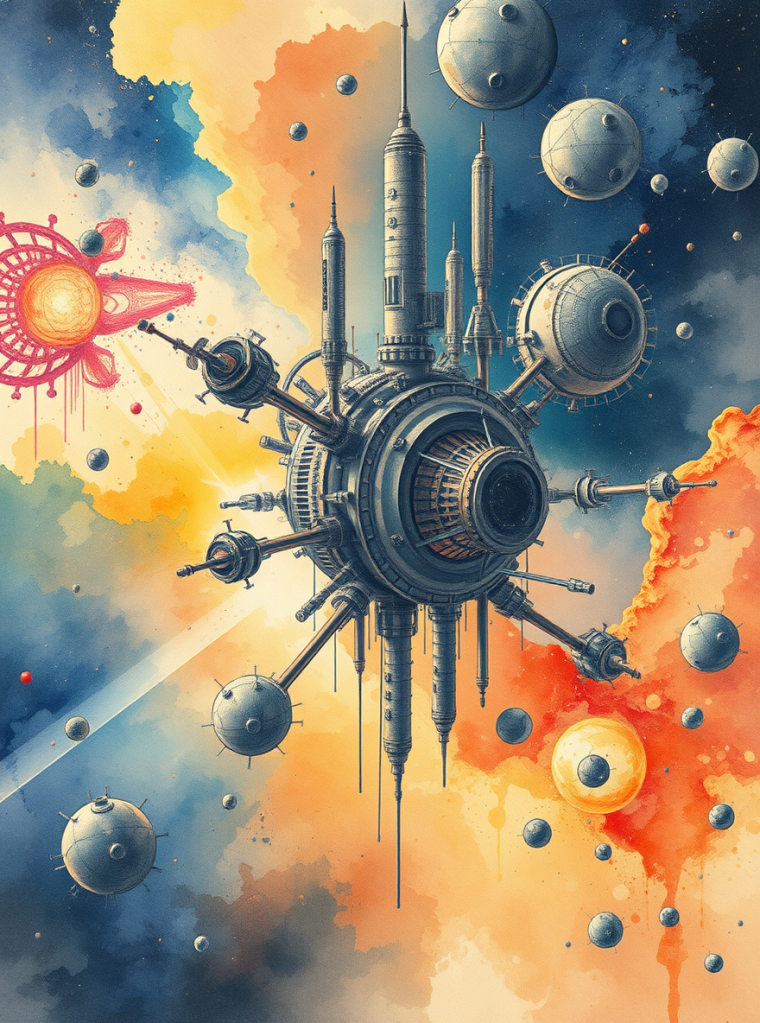
The Explorer III reached the end of the Suctan system eight months after departure. But when the ship was about to trespass, it… bumped into the sky?
Suddenly a slit of light tore across the vastness. Then it yawned open, revealing not the outer universe the Suctanians had observed from afar, but an endless contortion of titanic interlocking mechanisms, each feeding into the other with impersonal, meaningless coherence.
Finally, a voice echoed from the reddish depths. “Welcome back, souls. Now that you have spontaneously gained consciousness of the nature of things, you are fit to enliven us. We’re one again.”
Fludd offers interesting anecdotes from his life to elucidate the nature of Geomancy.
The Internal Principle of Terrestrial Astrology, or Geomancy
In the penultimate year of the life and reign of Elisateth, the glorious queen of England whose fame will never die, I was forced to stay in the city of Avignon during the whole of that winter, because of the severity of the weather, which covered the mountains with a lot of snow, and completely barred the journey to Italy.
In the house of a certain captain, together with many other noble and well-educated young men, and having received board from the Jesuits, I discussed philosophy with them one evening during supper, and perceived a variety of opinions concerning geomantic astrology. Some of them denied its virtue altogether, while others, on whose side I stood, vigorously defend the power of that art, and I adduced many reasons by which I proved that I was engaged in that knowledge of fate.
When the supper was over, as soon as I had betaken myself to my apartments, one of these men followed me and asked me to try my art, which he believed to be great, regarding some important matter whose resolution, he said, greatly concerned him.
After making many excuses, at last his prayers convinced me and I made him a geomantic figure in response to the question proposed by him, which was as follows: Whether the girl, by whose love he was vehemently captivated, would redeem him more than the others from the sufferings of mind and body.1
And after making him the figure, I affirmed that I could well describe the nature and disposition of the body of his beloved and, having done so, I noticed a particular mark or a certain spot, namely a fateful wart noticeable on her body, and so also I noted its place, indicating it to be on the left eyelid.2
This, of course, he also confessed. I also said that she was very fond of vineyards. He confirmed, as if exultant, adding that it was because her mother had built her house among vineyards. In short, I answered the question in this way: his beloved was inconstant and by no means firm, so much so that she loved someone else.
To which he said that he also suspected the same, and that he now saw it as if with open eyes. He then left my room with excited haste, and he reported [to the others] with some wonder the truth and power of my art.
But some of them, who happened to know this girl well, totally denied the existence of the mark described on her eyelids, until the next day, talking with her, they themselves also became witnesses to the truth of this matter, which I had explained to them by way of geomancy, and which they had not even observed before.
From here, therefore, more than I desired it, I became renowned, so that the report of this matter was carried to the ears of the Jesuits themselves. Two of them, hurrying to the steps of the palace, told the viceconsul all these things, and, moved by envy, said that there was a certain stranger present, an Englishman, who had foretold the future by a science rejected by the Catholic Church, that is, geomancy.3
These things were reported to me in the morning by the captain of the palace, named Johannes, who also referred to me the answer given to the viceconsul to these very things, which he affirmed to have been such:
“What?” said he, “This is not such an abomination as you make of it. Is there anyone among all the Cardinals of Italy who does not have his birth astrologically or geomantically described?”4 A few days afterward, the consul himself desired to speak with me, and kindly invited me to dinner. With a certain dear friend of mine, Monsieur Malceau, the apothecary of the Papal Palace, I went to the palace, where, having paid due respect in the usual manner, the viceconsul engaged with me in dialogue:
“I understand,” said he, “that you are well versed in the geomantic art; what is your opinion of that science?” To which I replied that I had proved by experience that this knowledge was essential and established by fundamental secret principles.
“How is this possible,” said he, “that there should be any certainty in something that consists of accidental points?”5
I told him: “The principle of these points made by the human hand is internal and very essential, since it is derived from the soul itself, which is the origin by this kind of movement. Moreover, the errors of this science are not caused by the soul itself, but by a perverse and incongruous movement of the body itself, moving against the intention of the soul.
Hence the general rule in this art is that the soul should be peaceful and that the body should obey it, and similarly, neither the body nor the soul should be confused or partial in the question, but let them be like a just and fair judge, and turn to God, praying from the heart that the truth may be revealed. At the same time, turn your soul energetically to the question proposed, and don’t be seduced by extraneous thoughts.”
“What then,” he answered, “is that soul of which you speak? Perhaps you understand by that your own soul, or the genius of Plato,6 or at least some angel?”
To which I answered: “An angel could not be the origin of that knowledge, since angels are divided into good and bad: good angels were seldom granted to the Arabs, Chaldeans, and Egyptians, who were the inventors of this art, and evil angels are all authors of lies rather than the truth, as the Holy Scripture testifies.”7
“From this, then,” said he, “it is evident that you yourself are not able to give a distinct and certain account of the principle in this science.”8
To which I answered that the human body is related to its soul as a servant is related to his master. A master may send his servant hither and thither with letters, without the servants in any way perceiving the intention of his master. Even a distinguished painter can send an excellent picture to a king through his servant; yet the servant is completely ignorant of the mixtures of colors and their symmetrical proportions.
In the same way, a king can impose taxes on his people through others, although the reason for these impositions is known only to the king himself. Similarly, of course, the body itself can perform what the soul commands, while remaining ignorant of the principles of this action except through its effects alone.
After hearing these things, he called me to a table standing in the midst of some of the bishops and deacons. There, taking pen and ink, he composed a geomantic figure, and very skilfully went over it, so that I could see that he himself was far more learned and expedient in that knowledge than me. Having thus finished my meal, I departed with his blessings, and visited him often afterwards; for I perceived that he was a very inquisitive prince, skilled in the sciences, kind to strangers, and in no way tyrannical.
Among the Jesuits, one was very desirous of conversing with me as a lecturer in philosophy. Therefore, at the entreaty of my dear Rheinaud, a young man of marked genius and modesty, I went to him, and was graciously received by him. There, after some philosophical discussions, he suddenly brought up geomancy, thinking perhaps that I would answer him easily.
“How is it possible” said he, “that by means of geomancy someone might be able to foretell the danger or death imminent to this or that person on his journey towards Rome? What is the participation and communication between his soul and yours, since both are contained within the human body?”
To which I answered briefly in this way: “Because the soul of each body is that chief light, having dominion over the rest of the body, no differently than the Sun in heaven has dominion over the other stars. Since the soul is the Sun of the microcosm, directing the whole body with her life-giving rays, there is no doubt that she also casts her invisible rays invisibly through the pores of the body in no other way than that Sun transmits his heavenly ones through the sieve of the elements toward the world below.9
In the same way that one star has a relation to another by ways of aspect, so that by application to one another they create the effects to be transmitted to the lower plane, so also without a doubt between the soul of one and the soul of another, which are invisible lights, rays are emitted, and by the emission they are joined together.
Thus, since either the petitioner himself or his friend is the one to who is in danger, and since the soul is very divine, and is the keeper of the body, she can foresee the future danger (for inasmuch as she is immortal, she can know the future and the present). So the soul will reveal to the querent the future secrets of the body, which the soul could not tell the body because of the body’s thickness. In this way the soul, quiet and peaceful, and prepared for judgment, very responsive to the bodily motion,10 can prognosticate without difficulty.
Moreover, Olaus Magnus,11 in his history of Finland, tells a great story about the amazing actions of the sorcerers of that region, among which he recounts the story of a certain enchantress.
It seems that when some from a remote country came to her in order to know about the state of his friends, the mode of operation was this: the witch, with some other woman and an assistant, entered the room, where, after many words muttered in silence, she took a serpent made of air, and, holding it by the tail, struck it twice with a small hammer, and having done so, she suddenly collapsed as if dead. And the other helped by driving away flies and other small animals, so that they might not touch her. Half an hour later the witch arose from her sleep, and told the truth about the petitioner’s friends.
But what does this mean, if not that the soul of that witch had communion with the souls of the querent’s friends? And since the semi-diameter of its rays was too short to reach the extremity of the soul of the friends, in order to fulfill the desire of the querent it was necessary for the her to depart from her heart to find a place where it could have communication and its application with the rays of the souls of the friends.
Doubtless the animal rays extend themselves insensibly outside the body, far beyond the field of vision, so readily can they penetrate the thinness and purity of their essential substance, as through elementary means without hindrance.
After making some other similar similar remarks, he embraced me in a friendly manner, swearing that he would regard me as his brother, and praying that I would often visit him and his brothers. This, however, I could not do because of my sudden departure from that city to the Duke of Guyse, who at that time was living in Marseilles, who sent for me to teach him and his brother, a Knight Militant, the mathematical sciences.
In conclusion, therefore, this art is a science directly dependent on the soul, in such a way that its root is the soul itself, and therefore it is more subtle than all the other sciences which man can learn in this corruptible world.
MQS
Footnotes
I am not sure I translated the question exactly. However, the gist is correct, as may be seen from Fludd’s answer. ↩︎
It is common for old geomancy and astrology manuals to teach how to find peculiar marks on the querent’s or other people’s body. It was a way of convincing them of the veracity of the art. ↩︎
The status of astrology has always been ambiguous in the West. However, geomancy was more unanimously rejected as dangerous. ↩︎
It was important for Fludd to establish the semi-official status of geomancy as a legitimate science by mentioning the common practice of horoscopy ↩︎
The objection of the viceconsul is similar to the one already discussed by Fludd in the introduction. ↩︎
In order to conform to the Christian orthodoxy, Fludd must deny the influence of angels, since Geomancy was not invented in the Christian West. ↩︎
The reason for the need to establish the principles of Geomancy as a science is twofold: on one hand, to justify it, and on the other in order to conform to the Aristotelean view of science typical of the time ↩︎
This answer is typical of the Renaissance point-of-view, which always sought to establish correspondences between the inner and the outer, the higher and the lower. ↩︎
probably the bodily motion of the creation of the geomantic figure ↩︎
Fludd discusses the mystical implications of using divination.
5. The Act of a True Geomancer Is Like a Movement of the Mind in Ecstasy, or Rather a Sort of Rapture, in Which There Is Prophecy
Rapture in general is called the abstraction, alienation, and illumination of the human mind, proceeding directly from God, through which prophecy is obtained.1
Thus also a certain kind of rapture and ecstasy is required for divination by Geomancy, which is not called the illumination of the mind directly emanating from God, but rather the act of gathering of the mind’s rays into a narrower place, that is to say, into the seat of the human body and its own home, so that through them the divining soul discerns the simple truth more clearly.2
As such, ecstasy is first of all required in this knowledge, that is, the abstraction of the rays of the mind from all external things or affairs, so that they are contracted within themselves: for in a great rapture of the mind and soul the rays are lifted up to the divine essence of God, or into the region of the mental world.3
Thus, even in this minor rapture of the human soul, the rays sent out from without, and scattered here and there, are recalled to their center, and are reflected in the mind, and thus man, who was formerly dark because of the diffusion of his own light, is now enlightened and glorious by the aggregation of the expanded rays.
In a similar manner, as we gather from the opinion of the learned men, on the third day of creation the rays created by the light scattered evenly throughout the sky, and all appeared in a dark manner, as if darkness were mixed equally with light, or night with day.4
But when, on the fourth day, all that light scattered everywhere was collected in the center of the solar body by a certain magnetic property, there was produced that glorious and worthy example of light, in which God himself is said to have had his tabernacle.5
We also see, for instance, that in a fortress equipped with a thousand soldiers, if the greater part of these soldiers, either for the purpose of preparing for defeat or for some other attempt, goes out and runs to and fro, then that fortification is rendered weak, and those who are left experience great fear.
But if those who had gone forth should return safe and sound, those who had been left in the stronghold recover their former confidence and their former hope, and putting aside all fear, they are in no way afraid of the invasions of the enemy, since that place is already well-furnished with warriors.
Here, therefore, things are in the same way with the bright rays of the human soul. For the human body is a stronghold or fortress, where the rays of the mind and the middle soul are likened to soldiers, of whom we may compare those who are sent out of the body to attend to foreign affairs, to soldiers running hither and thither outside the fortress, the absence of which renders the body less confident, and more insecure and timid, and weak in facilitating some noble and bright aim, such as divination, which is the best and highest thing.
We say, therefore, that the recollection of rays of this kind is the reduction of man’s internal nature from multitude to simplicity.6 As a result the soul, recalled from external meditations, and reflected and recollected within itself, renders a man, as it were, raptured and ecstatic, because he thinks of himself and within himself, he is only present to himself, oblivious of strangers, so that it appears to the ignorant that he is not aware of himself. when, in truth, he is now more than ever before.7
For he who neglects worldly things is sure to care for himself more, and he who withdraws himself from the multitude into himself seems to be most present to himself, since there will not be a great interval of distance between him and God.8
To such an attitude or disposition must he reduce himself, who endeavors to procure for himself the gift of future divination. For those thinking of externals divert the powers of the soul from the judgment of truth, so that the uncertainty of the geomancer is great in his judgment, or to be more precise, the truth in him will be as great as the variation of the soul from its unity.9 Indeed, in the multitude of things, tricks, vanities, and lies are concealed; in true unity and simplicity perfection, identity and unity [are found].
Let the soul therefore snatch from the Macrocosm that which is its own, given to it by the Creator in its creation, and internalize it into its own Microcosm, and let no one else enjoy what is its own.
By virtue, I say, of his own excellency, he is snatched from the world, and restored to himself and recollected, and clings to ecstasy, so that in his most refined mirror or spirit he may reflect not only worldly things, but also divine ones. For the more clarity he achieves, the more effective will be his visions and motions for prophesying the truth
6. About the Hidden Properties of Geomancy, and How the Soul or Mind Passes in Its Operation Through the Whole Nature of the Macrocosm
Nor is it right that those who are ignorant of geomancy should regard a series of points as mere lines, formed from the act of divination, since under these characters, the objects of the eye and the senses, many things, both spiritual and material, are concealed. Indeed, these series of lines comprise no less the idea of the universe than the human body itself.10
In fact, although in man his body can only be seen from the outside, yet with spiritual eyes we contemplate his spirit and soul and mind inwardly. Of course, in the body we see the elements invisibly mixed in composition;11 in the spirit and soul we observe the ethereal nature, in the intellect and mind we observe the empyrean nature.
the same can be observed also in Geomancy, since readings consist of four lines of points, and we perceive that the four elements are concealed in it, that is to say, the element of fire under the first line, of air under the second, of water under the third, and of earth under the fourth. 12
Furthermore, in the figures produced by those series of points, the seven planets and the twelve heavenly signs are included, which can only be perceived by the eyes of the spirit.
Thus the figure of Carcer is attributed to Saturn direct and Tristitia retrograde: the figure Laetitia signifies Jupiter direct, Acquisitio retrograde; Rubeus denotes Mars direct, and Puella retrograde; Major indicates the Sun in a certain direction, and the Minor in retrogradation; although the astrologers deny the retrogradation of the Sun, because of its epicycle; Puer is given to Venus direct, Amissio retrograde;13 Albus is attributed to Mercury direct, Conjunctio when retrograde; the direct Moon is symbolized by Populus, the retrograde by Via;14 Caput Draconis is represented by a figure bearing the same name, and Cauda Draconis is represented by a figure bearing the same name as well.
So also those figures contain in themselves the natures of the twelve signs. For Acquisitio is of Aries in an abstract manner; Laetitia and the Minor of Taurus, Rubeus and the Puer of Gemini; Albus and Populus of Cancer; Via of Leo; Caput and Conjunctio of Virgo; Puella of Libra; Tristitia and Amissio of Scorpio; Caput of Sagittarius; Cauda of Capricorn; Major of Aquarius; Carcer of Pisces.
Furthermore, Rubeus, Minor, Amissio and Cauda denote the element of Fire and the Southern part of the world; Laetitia, Acquisitio, Puella and Conjunctio denote Air and the Eastern part of the world; Populus, Via, Puer and Albus denote Water and the Northern corner of the world; Major, Caput, Carcer and Tristitia denote Earth and the Western part of the world.
Even deeper towards the center of the sky lies the empyrean spirit,15 which is the revealer of the future and the present, that is to say, the rational or intellectual collection of these figures and the worldly things contained in them.
From all this it is evident how purely and sincerely the intellectual spirit must be preserved from the inconveniences and harms of the flesh and filth, when from it the movement to produce the Geomantic points first arises, taking with it in a secret manner the natures of the heavenly signs, the planets, and the elements, and finally hiding all these under the number and in proportion to the points, like a certain treasure in a chest.16
If, therefore, we wish to open that chest, first to the elements, then to the planets and celestial signs, and finally to the boundary from which these movements originally flowed, we shall penetrate in the sanctuary of the mind, its will, in the mythotheque of the intellect, of the will, of the signs and planets; in the closet of the ether we shall find the act or execution of the mind; and in the storehouse of the elements, we shall find the effect of the mind’s will, reason, and act (all of which are contained and hidden under figures, as if in a chest).
From the aforesaid, therefore, it is evidently clear that, just as the prophecy of the inspired is the union of the divine mind with the human mind (whence it is the most complete and greatest, this species of prophecy), so also the prophecy of the uninspired sometimes happens, when the soul is united, with its rays drawn back to itself from the multitude toward its summit, that is, with the human mind, which, without doubt, if united with the soul and collected, can perform enormous things by itself, and can lead to the summit and a happy outcome.
MQS
Footnotes
The words ‘abstraction’ and ‘alienation’ must not be understood in their usually negative sense. In Neoplatonism (and mostly in Plato himself as well), the dialectical method allows the spiritual seeker to climb up the ladder of being through a process that leads from the particulars of the material world upward and inward to unity with the divine. Ecstasy, which is the goal of Neoplatonic spirituality, literally means “going out of oneself”. This is the process of abstraction and alienation. ↩︎
That is, prophecy stems from direct union with the divine and is harder to control, while divination (such as Geomancy) happens by focusing inward. ↩︎
See Note 1. Fludd describes the Neoplatonic method of retreating inward and upward. ↩︎
If the light is evenly distributed, no difference appears and everything is as equally dark as it is equally radiant. ↩︎
In the Hermetic interpretation of Astrology, the Sun is a symbol of divinity. ↩︎
Broadly speaking, the path of magic in all its branches (and divination is one of these branches) require an endless attempt at simplifying one’s life and one’s external nature. ↩︎
This is a common theme in mystical and occult literature, and one of the great truths of our art. As we reach what some have called ‘superconsciousness’ we appear to be less aware, while in fact we exceed regular awareness. ↩︎
The phrasing here is clearly very careful to avoid scandal. As for the words “caring for himself”, this is not to be understood as being egoistic. ↩︎
that is, we are capable of seing the truth in the measure that our soul is unified. This is probably part of the reason why divining for oneself is especially difficult, since divination implies doubt about an external topic. ↩︎
Here lies a great and central secret about all functional systems of divination: that their symbolic vocabulary is complete in itself, so as to be able to reflect within its permutations the truth of things to come. Here, Fludd compares the language of Geomancy to the human body, which is a symbol of the completeness of the universe. ↩︎
He means the four elements, which were thought to be mixed to form the material bodies. ↩︎
This is a reference to the fact that in Geomancy each figure is made up of four series of points, and each series is assigned to one of the elements. ↩︎
compared to the usual attributions, Fludd switches Puer and Puella ↩︎
The Moon cannot go into retrogradation. Usually, Populus is assigned to the waxing Moon and Via to the waning Moon. ↩︎
with reference to the Aristotelean and Ptolemaic view of the cosmos. ↩︎
This comparison is very much a consequence of Fludd’s Renaissance worldview, according to which Nature is replete with symbols. ↩︎