
MQS

MQS
I finally decided that there was no point in learning the theory of how to make videos. Much better to make crappy ones until something goes right. So yea, here’s the first video on my channel.
Please be patient, I am a very special kid.
MQS
Those who read my Sibilla and Playing Cards sections are probably familiar with the cross spread I use with those decks. Turns out, the same spread can be used with the Bolognese tarot.
This querent is the same I read for here and had a crush on a colleague. The cross spread I present here is a prequel to that spread.

The cross spread may be used to look at a person’s life in general or to answer general questions (“tell me about my career”). In this case it was general. I’ll keep it short:
And the reason we didn’t look further into it is that the most important cards (those comprising the central column, i.e., above, heart and below) are all connected with love. This is how the spread about the colleague was born. Note, however, that this spread, when done in general, can give us brief messages about the most disparate fields of life, and it is up to us then to expand on them by either adding cards or doing other spreads.
MQS
When I was taught to read playing cards, the cross spread was presented to me as a general spread. However, over time I discovered that it can also be used to answer specific questions of a general nature, or simply to explore certain compartments of the querent’s life. Here is a recent spread on a male querent asking about his career:
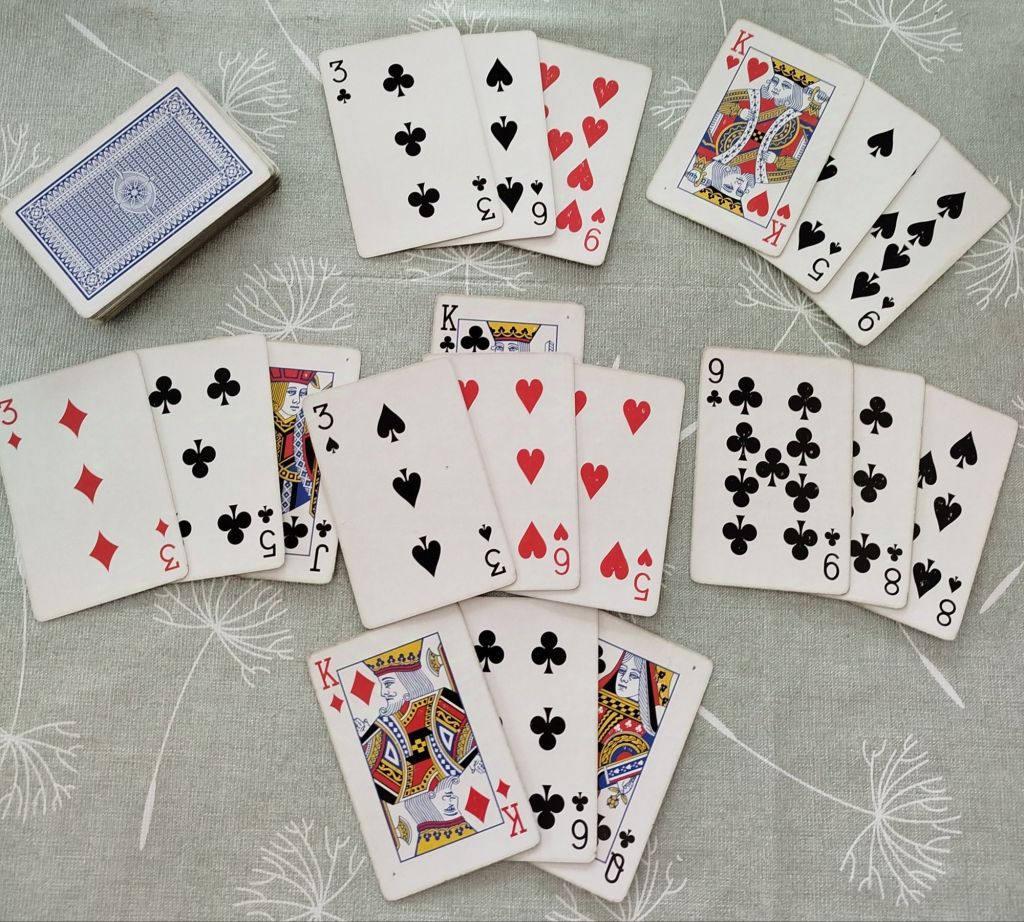
To summarise the main meanings of the various fans:
The cool thing about larger spreads is that sometimes we can just identify a single spot that answers the question clearly, and everything else gives details that may or may not interest the querent. Here, the clear answer occurs in the right spot: 9♣️ 8♣️ 8♠️, which translates as “for a long time the job will give the querent tears”.
Now that we have identified a clear sentence, let’s fill out the details. Since the sentence is quite negative, let’s look at other negative spots. In his heart, the querent has the 3♠️ which brings difficulties, complications etc. But it is followed by cards that bring hopes of a solution (the two Hearts). Clearly there has been something that caused the querent to start hoping.
Now look at the fan above: he would like a contract (3♣️) that gives him happiness (10♥️). Between these two cards we find the sickness card (6♠️). This could indicate that it is a vain hope or a sick hope, one that is not grounded in reality. On the left we see that he has a small income (3♦️) but works hard (5♣️ J♣️) so it’s not that he doesn’t deserve job security. Below we see a difficult situation with a man that might be his boss or a superior. Clearly he is not the teacher’s pet (the Q♣️ simply shows that the querent’s troubles reflect badly on his love life).
The final fan unfortunately robs the querent of all hope, although it argues that there will be help from a man. To dig deeper I should have done another spread. As it stands, the detail is quite vague.
MQS

A recent exchange in the comment section made me go back to some notes I’ve been sitting on for a while about how different card spreads used to be in the past, compared to how they tend to be nowadays. A good example for this is the famous spread used by the Golden Dawn, which has become known as the Opening of the Key.
The Opening of the Key is a complex, multi-stage spread that was (and still is) used within the Golden Dawn system and has been adopted by Paul Foster Case’s and Crowley’s followers as well.
From a magical standpoint, the allure of this spread is that it mirrors within its layouts the whole GD system, being therefore a tool for learning it. Since I do not particularly advocate the Golden Dawn system, I’ll leave this aspect to your consideration, should you be so inclined.
From a purely divinatory standpoint, though, the interesting aspect of the Opening of the Key is that it affords us a glance at how card spreads used to work in traditional cartomancy.
Nowadays we are used to what many call “positional spreads“, that is, spreads where each single card is read more or less independently from the others based on the meaning of the position. The most famous positional spread is certainly the Celtic Cross, also taken from the GD system and popularized by Waite. Over time, though, more and more ridiculous spreads have emerged, with positional meanings as abstracted from actual reality as possible.
If we take a look at many books on divinations published before the 60s, when the Rider Waite deck truly took off, and with it the Celtic Cross spread, we find very different spreads.
Many traditional spreads, used both for tarot and for playing cards, share the following characteristics:
One of the characteristics of the early Golden Dawn, before it became a battle of egos, was its (relatively intelligent) syncretism, as well as its attempt to act as a reservoir of everything the occult Western tradition had created over the centuries. Many of the founding members of the Golden Dawn were very well acquainted with, and even contributed to the then-growing literature on fortune-telling.
It comes therefore as little surprise that THE Golden Dawn spread, the Opening of the Key, is just as much an occult compendium as it is a compendium of quaint fortune-telling techniques. Let’s read the original instructions together (From Book T):
A Method of Divination by the Tarot
- THE Significator.
Choose a card to represent the Querent, using your knowledge or
judgment of his character rather than dwelling on his physical
characteristics.- Take the cards in your left hand. In the right hand hold the wand over
them, and say: I invoke thee, I A O, that thou wilt send H R U, the great
Angel that is set over the operations of this Secret Wisdom, to lay his hand invisibly upon these consecrated cards of art, that thereby we may obtain true knowledge of hidden things, to the glory of thine ineffable Name. Amen.- Hand the cards to Querent, and bid him think of the question attentively, and cut.
- Take the cards as cut, and hold as for dealing.
“First Operation”
This shows the situation of the Querent at the time when he consults you.
- The pack being in front of you, cut, and place the top half to the left.
- Cut each pack again to the left.
- These four stack represent I H V H, from right to left.
- Find the Significator. It be in the HB:Y pack, the question refers to work,
business, etc.; if in the HB:H pack, to love, marriage, or pleasure; if in the
HB:H pack, to money, goods, and such purely material matters.- Tell the Querent what he has come for: if wrong, abandon the divination.
- If right, spread out the pack containing the Significator, face upwards.
Count the cards from him, in the direction in which he faces.
The counting should include the card from which you count.
For Knights, Queens and Princes, count 4.
For Princesses, count 7.
For Aces, count 11.
For small cards, count according to the number.
For trumps, count 3 for the elemental trumps; 9 for the planetary trumps;
12 for the Zodiacal trumps.
Make a “story” of these cards. This story is that of the beginning of the affair.- Pair the cards on either side of the Significator, then those outside them, and so on. Make another “story,” which should fill in the details omitted in the first.
- If this story is not quite accurate, do not be discouraged. Perhaps the
Querent himself does not know everything. But the main lines ought to be
laid down firmly, with correctness, or the divination should be abandoned“Second Operation”
Development of the Question
- Shuffle, invoke suitably, and let Querent cut as before.
- Deal cards into twelve stacks, for the twelve astrological houses of
heaven.- Make up your mind in which stack you ought to find the Significator,
“e.g.” in the seventh house if the question concerns marriage, and so on.- Examine this chosen stack. If the Significator is not there, try some
cognate house. On a second failure, abandon the divination.- Read the stack counting and pairing as before.
“Third Operation”
Further Development of the Question- Shuffle, etc., as before.
- Deal cards into twelve stacks for the twelve signs of the Zodiac.
- Divine the proper stack and proceed as before.
“Fourth Operation”
Penultimate Aspects of the Question
- Shuffle, etc., as before.
- Find the Significator: set him upon the table; let the thirty-six cards
following form a ring round him.- Count and pair as before.
Fifth Operation
Final Result
- Shuffle, etc., as before.
- Deal into ten packs in the form of the Tree of Life.
- Make up your mind where the Significator should be, as before; but failure
does not here necessarily imply that the divination has gone astray.- Count and pair as before.
There are many characteristics to the Opening of the Key that mirror the checklist I’ve created above:
Quite clearly, there is more to the Opening of the Key than what I’ve listed, aside from the heavy occult overlays. For one, the GD added a method for discerning whether the divination is valid: one needs to find the significator in the appropriate stack. This is in part due to the desire to import the notion of ‘radicality’ used by many horary astrologers, according to which certain charts cannot be judged if certain configurations are present or absent; and in part it is a system of magical checks and balances to avoid idle curiosity (again, more on this in a later post).
MQS