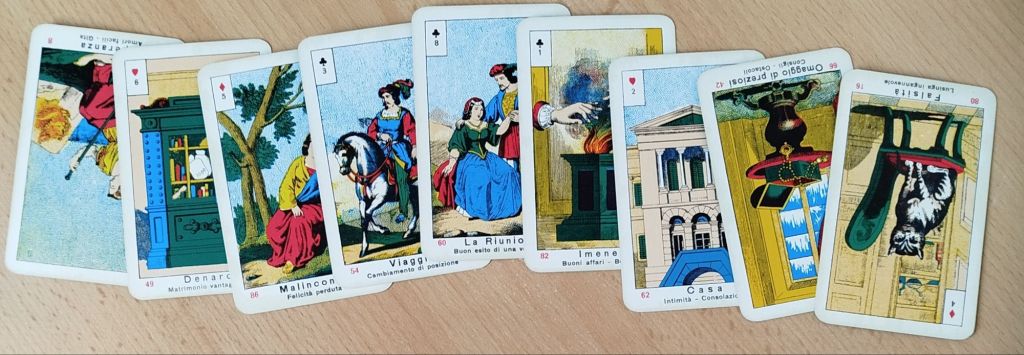
Sometimes we spend a lot of time stuck in one phase of our life, only to be surprised by fate when we’d given up hope. This is a career reading for a man in his 40s:
Vera Sibilla – A career reading
I started with three cards and then kept adding. The first three cards are Hope reversed, Money and Melancholy. It is true that the Six of Hearts, Money, generally has to do, well… With money. However, it is also the card of the past. The Five of Diamonds, Melancholy, also broadly describes the past, especially when occurring this early in the spread. However, it describes the past in a more negative light, as having somehow scarred us and left us dissatisfied or wounded.
Two cards talking about the past reinforce the idea of past. What has wounded the querent in the past? A reversal of his hopes (Eight of Hearts reversed) concerning his career!
Then we find the Three of Clubs, the Journey. The Journey can be literally about travelling, but it can also herald a transition from one phase to another. The Melancholy card itself, when not followed by evil cards, shows that the melancholy won’t last forever, but is just a phase. Once again: two cards talking about a transitory phase reinforce the idea of transitory phase!
What does the Journey bring? A meeting concerning a business or firm! The Ace of Clubs, Marriage, with the Two of Hearts, the House, can represent a relationship where we live together with the partner, but also a business or firm. Since we are talking about career, it must be the latter.
Finally, two reversed cards seal the spread in a positive way. Reversed cards have a bad reputation, but in this case they are life-savers: the reversed Gift card shows solution of problems, the reversed Falsehood card shows relief and supports the idea of a positive solution.
There is a tradition in Italian cartomancy (and possibly in other forms of folk cartomancy as well) that concerns the so-called christening of the querent’s significator. This is possibly done in order to have the divination be more certainly about the querent who comes for a reading.
Some systems, like my system for reading playing cards, have a fixed significator for the querent (the Queen or King of Clubs),1 while others (like the Vera Sibilla) do not. Either way, once the significator is known, a small magical operation takes place to connect the cards to the querent. This is what is called ‘battesimo’ or baptism/christening of the card.
There are many traditional ways of doing so. One is called ‘getting the card drunk‘ and it consists in taking the card that represents the querent and rotating it seven times (some say three times) while repeating the querent’s name each time. Another one I’ve seen used looks more similar to an actual christening, and it consists in again taking the querent’s significator and drawing a small cross symbol on the figure’s head with one’s thumb while saying “You are *name of the querent*”. There may be other systems I’m not aware of.
The practice of using a significator has largely fallen out of favor in modern tarot practice, mostly because reality has fallen out of favor with too many tarot readers, who no longer aim at describing it. This is not to say that a good tarot reader necessarily uses significators (I know some who are really good and don’t use them), but significators are a reminder that the tarot pack is a microcosm of reality, and reality contains actual people. Interestingly, many people recently became aware of the concept of significators because of traditional fortune-telling is experiencing a small resurgence.
However, it is noteworthy that the Golden Dawn and its offshoots and representatives, who greatly influenced modern tarot, did use significators. For instance, Waite recommended to select a significator even for the Celtic Cross in his Pictorial Key to the Tarot. The traditional Golden Dawn spread, The Opening of the Key, hinges on selecting a significator and counting and pairing the cards from it.
The Opening of the Key instruction recommends a brief ritual that serves to make the divination valid. This is not exactly the same as the christening I talked about, because it usually involves targeting the whole pack rather than just a card. However, I have seen GD diviners who take some time to connect the significator to the querent.
This is especially interesting to me because it shows a correspondence between folk magic and high magic (which is a distinction I don’t believe in, since ‘high’ magic is usually high only in the sense that it is practiced by people who are often high, and not just on their own farts). In part, this is because the GD, in his attempt at preserving and consolidating the whole Western tradition, often took folk traditions very seriously. In part, however, I believe that there must necessarily be such a correspondence, in as much as many streams often come from a single original spring.
MQS
Same goes for the Bologna Tarot, where the Queen and King of Wands are the significators ↩︎
(Note: this is a collection of the meanings attributed to the cards by some occultists in the past centuries. It does not reflect my own study or opinion of the cards. It is only meant as a quick comparative reference as I develop my own take.)
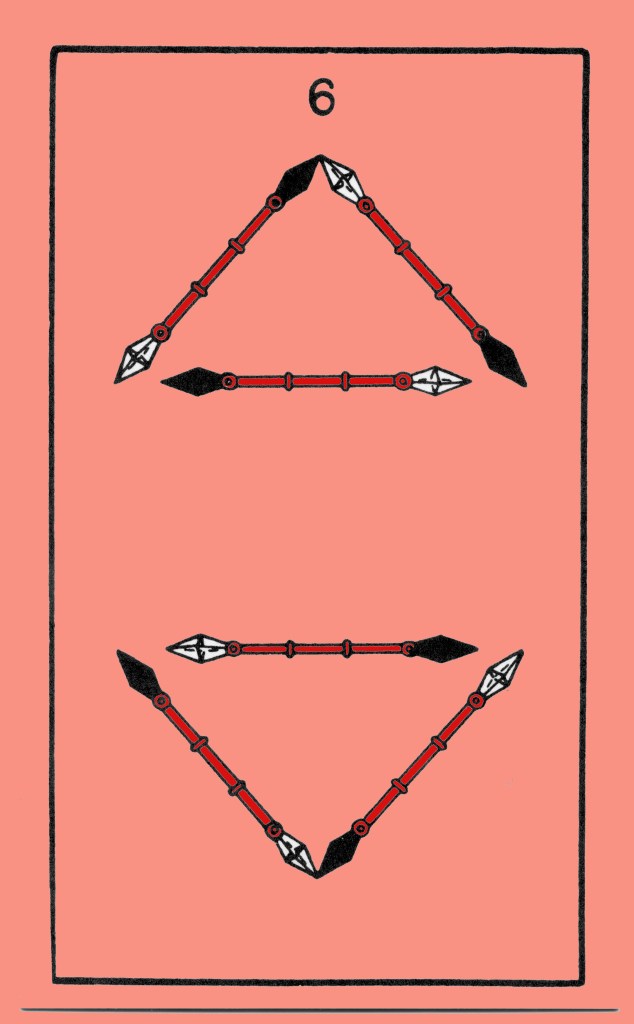
The Six of Wands from the Builders of the Adytum (BOTA) Tarot deck
Paul Foster Case (and Ann Davies)
The second decanate of Leo, related to this Key, is the time period of August 2 to August 12, ruled by Jupiter. In Tarot divination, the Six of Wands partakes of a meaning similar to the conjunction of the Sun and Jupiter, combined with the influence of Leo and its natural fifth house. Well-Dignified: success, happiness, gain; gain through love affairs or by the opposite sex; pleasure in labor; gain after a period of uncertainty and competition. lll-Dignified: loss through the same things; waste in pleasure; trouble through pride of riches or through insolence based on success. Keyword: Victory (From the Oracle of Tarot course)
A. E. Waite
A laurelled horseman bears one staff adorned with a laurel crown; footmen with staves are at his side. Divinatory Meanings: The card has been so designed that it can cover several significations; on the surface, it is a victor triumphing, but it is also great news, such as might be carried in state by the King’s courier; it is expectation crowned with its own desire, the crown of hope, and so forth. Reversed: Apprehension, fear, as of a victorious enemy at the gate; treachery, disloyalty, as of gates being opened to the enemy; also indefinite delay. (From The Pictorial Key to the Tarot)
Aleister Crowley
The Six of Wands is called Victory. The outburst of energy in the Five of Wands, which was so sudden and violent that it even gave the idea of strife, has now completely won success. The rule, or lordship, in the suit of Wands is not quite as stable as it might have been if there had been less energy displayed. So, from this point, as soon as the current leaves the middle pillar, the inherent weakness in the element of Fire (which is this: that, for all its purity, it is not completely balanced) leads to very undesirable developments.
[…]
This card represents Tiphareth of the suit of Fire. This shows Energy in completely balanced manifestation. The Five has broken up the closed forces of the Four with revolutionary ardour, but a marriage has taken place between them; and the result is the Son, and the Sun.
The reference is also to Jupiter and Leo, which seems to imply a benediction on the harmony and beauty of this arrangement. It Will be seen that the Three Wands of the Three Adepts are now orderly arranged; and the flames themselves, instead of shooting out in all directions, burn steadily as in lamps. They are nine in number, in reference to Yesod and the Moon. This shows the stabilization of the Energy, and its reception and reflection by the Feminine.
There is no circle to enclose the system. It is self-supporting, like the Sun. (From The Book of Thoth)
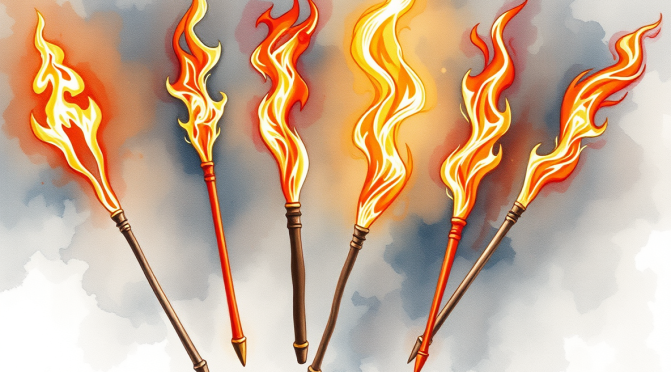
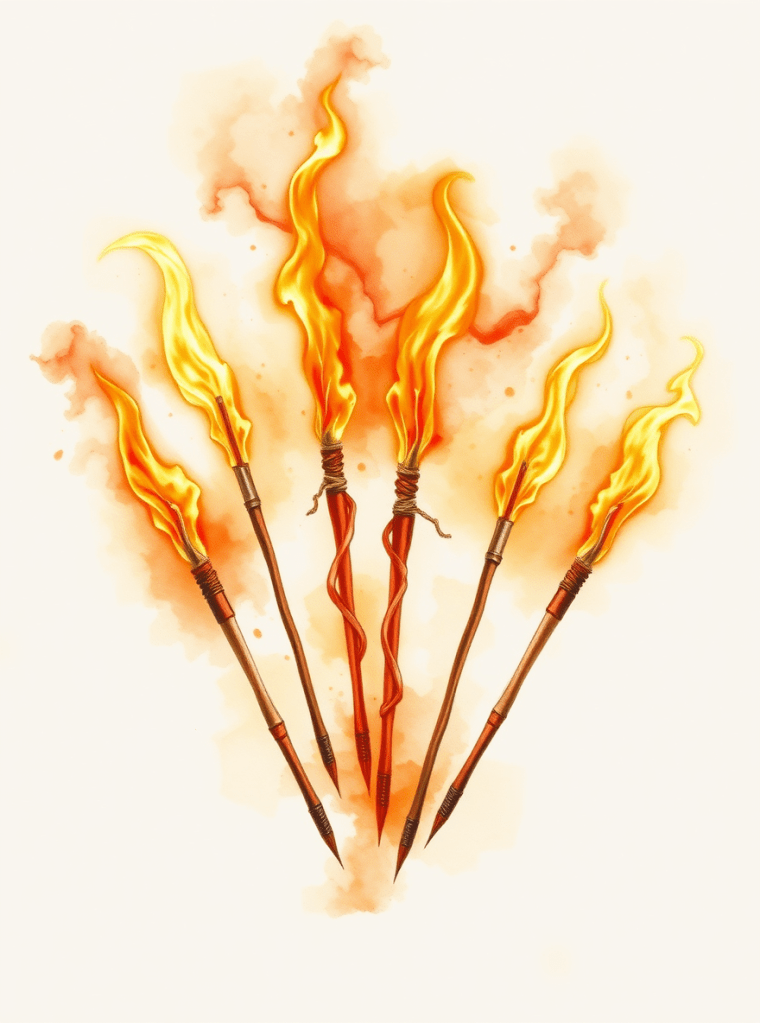
Rather prosaic AI-generated illustration for the Six of Wands
Golden Dawn’s Book T
TWO hands in grip as the last, holding six wands crossed three and three. Flames issue from the point of junction. Above and below are short wands with flames issuing, surmounted respectively by the symbols of Jupiter and Leo, representing the Decan.
Victory after strife: Love: pleasure gained by labour: carefulness, sociability and avoiding of strife, yet victory therein: also insolence, and pride of riches and success, etc. The whole dependent on the dignity.
Tiphareth of HB:Y (Gain).
Hereunto are allotted the great Angels HB:SYTAL and HB:a’aLMYH of the Schemhamphorash.
Etteilla
Servant Upright. This card, as far as the medicine of the spirit is concerned, means, in its natural position: Housekeeper, Servant, Valet, Lackey, Slave, Mercenary, Inferior. – Courier, Commissary, Factor. – Interior of the house, Ménage, Family, Complex of the servants of the house. Reversed. Expectation, Expectation, Hope, Relying on, Grounding, Trusting, Promise. – Confidence, Foresight. – Fear, Apprehension.
Yesterday we had a nice reunion with some friends. One of them asked the cards if she has a shot with her dance instructor, whom she’s crushing hard on. These were the cards:
The first thing that jumped at me was that nasty Eight of Spades at the end, which literally says “it will end in tears.” If we take the three angles of the pyramid, they are the Six of Clubs, Nine of Spades and Eight of Spades. Bleak.
My querent’s card falls on the first line, together with the Six, the Ten of Hearts and the Nine of Spades. If we were to read this line as a literal sentence, it would be “Coming from a place of fatigue your happiness there’s not“. In other words, my friend is not just single, but lonely, has been for a while and she’s unhappy about it. This is interesting, because it shows that her crush is more like a compensation mechanism.
Then we come to him, the King of Clubs, who is on a journey (Ten of Clubs) with a loved woman (Queen of Hearts) that leads to a house (Ace of Hearts) of union (Three of Clubs). He is engaged. The final Eight of Spades does not say that he is unhappy about the engagement, but that the engagement brings tears to the querent.
I’ve recently talked about understanding the order of the cards when using the Vera Sibilla and playing cards. The Bolognese tarot, being a traditional fortune-telling system, follows similar rules, and as such it is important to understand whether the cards add their meanings together or contradict each other. Example:
Page of Coins + Queen of Coins
The Page indicates words, while the Queen represents the truth. Therefore, in this case, we get “true words”, “trustworthy words”, and similar combinations.
Queen of Coins + Moon
The Queen of Coins is the truth, but it is followed by the Moon, which indicates negativity, falseness, secrets. Therefore the combination talks about hidden truths, and thus of potential lies to cover the truth.
Moon + Sun
In the Bolognese tarot, the Moon is the card of negativity, while the Sun is the card of positivity. Traditionally, the Sun and Moon together are called “the two red cards” (due to the color of the two celestial bodies in the card) or the sorrow combination. Since here the Moon comes first and is followed by the Sun, the sorrow is passing, the problem will be solved.
Sun + Moon
In this case, the Moon more decisively blocks the Sun, so the sorrow doesn’t stop, or at least will last longer.
Tower + Justice
The tower can represent a large building one would rather avoid. Justice represents the law. Together, the two cards can represent a courthouse (but they can also indicate that justice or fairness is impeded, if the reading is not about a trial).
Justice + Sun
The Sun affirms the positivity of something. Together with Justice, it shows justice, fairness, equilibrium, etc
Justice + Moon
This is the opposite. The Moon negates justice.
Justice + King of Coins
The King of Coins is an important person, usually one with a degree. With Justice, he becomes an attorney, a notary, someone who is competent in some area of law or bureaucracy.
Love + Hanged Man
The Love card indicates, of course, love. In the Bolognese Tarot, the Hanged Man represents betrayal (being hanged upside down was the punishment for traitors). Together, they can indicate some kind of dishonesty connected to love (with the figure of a third party, it would become a triangle).
Love + Ten of Cups
The Ten of Cups brings feasting and jollity, so this combination would describe a happy-go-lucky love that is blooming, and if we add the Fool, that’s obviously a very fun love with not much commitment.
Love + King of Coins + Justice + Tower
We’ve seen that the King of Coins with Justice indicates a lawyer, and Justice and the Tower indicate a court of law. Connected with Love, this combination could show a divorce.
World + Eight of Wands
The World card means “around the world” or journey. The Eight of Wands indicates a road or path. Clearly, the two cards together strengthen the idea of a literal journey.
World + Page of Cups
The Page of Cups can indicate a younger woman, while the World shows “from afar” or “from around the world”. So this young woman probably isn’t part of the querent’ life: she’s a stranger.
All in all, combining the cards of the Bolognese tarot is a relatively intuitive process, although there are some traditional combinations that we’ll need to talk about in a future post.
One thing that I often receive messages about is how to understand the order in which the cards fall. Whether it’s the Vera Sibilla or playing card, there is one fundamental rule that applies in the majority of cases: later cards modify those that fall before.
Keep in mind that divination with cards is like the reading of a book, so the cards build the equivalent of sentences with their own grammatical structure. This is why I prefer to read the cards together rather than in isolation, as would happen in many contemporary positional spreads, where to each position corresponds one card.
In the tradition I come from, there can be positions, but there are always at least three cards, and sometimes five, covering one position. When we have two or more cards together, it becomes possible to “agglutinate” their meanings.
“Boy” and “run” becomes “the boy is running.” “Boy” and “friend” becomes “the boy is with a friend” or “the boy is a friend.” “Boy” and “Australian” becomes “the boy is Australian.”
Similarly, if we put two playing cards together such as the Three of Clubs (Union, marriage) and the Ten of Hearts (Happiness) they say: the marriage is happy. In the Sibilla, if we put the Ace of Club (Marriage) and the Four of Hearts (Love) together, it becomes “a loving marriage” or “a marriage of love.”
These are the first steps only. There are many more nunaces. However, the basic thing we must ask ourselves when interpreting two or more cards together is whether they add to each other or they contradict each other.
When they add to each other, the sequence in which they fall doesn’t matter that much (though it may add shades of meaning). “A beautiful girl” is roughly the same as “A girl who is beautiful.” But if we have “War” and “Peace”, saying “Peace and then war” is very different from saying “War and then peace”.
In the Sibilla, Fortune + Death is the end of fortune (literally, “the fortune meets its end”), whereas Death + Fortune is an end that brings fortune. Generally speaking, the cards falling after have the power to modify those that fall before.
That being said, divination is an art more than a science: we should never apply our rules so rigidly that we stop thinking about what the cards are saying. In most cases, in the Sibilla, Thief + Marriage has a similar meaning as Marriage + Thief: someone or something is interfering with the marriage.
Ultimately, each spread is a world in itself and the specific key to it must be found by following the clues that the cards leave behind.
(Note: this is a collection of the meanings attributed to the cards by some occultists in the past centuries. It does not reflect my own study or opinion of the cards. It is only meant as a quick comparative reference as I develop my own take.)
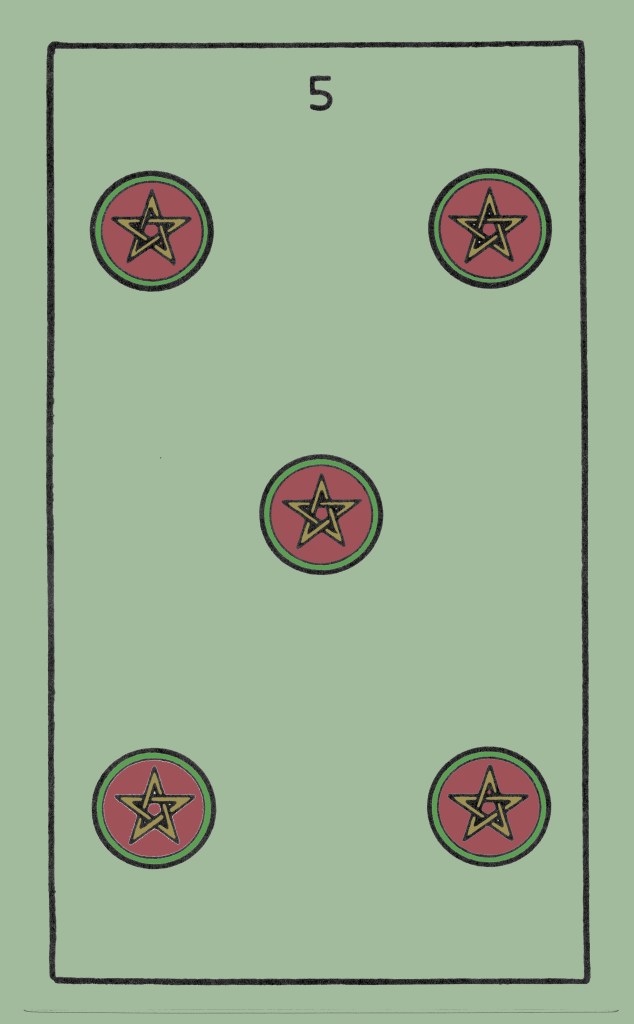
The Five of Pentacles from the Builders of the Adytum (BOTA) tarot deck
Paul Foster Case (and Ann Davies)
The time period is the first decanate of Taurus, under the rulership of Venus, April 20 to 29. Meanings: Well-Dignified: labor, toil, the cultivation of the land; building, and plans concerning it; some anxiety over money. lll-Dignified: toil unrewarded; loss of money; poverty; trouble for the Querent through lack of imagination and foresight. Keyword: Uncertainty; material trouble. (From the Oracle of Tarot course)
A. E. Waite
Two mendicants in a snow-storm pass a lighted casement. Divinatory Meanings: The card foretells material trouble above all, whether in the form illustrated–that is, destitution–or otherwise. For some cartomancists, it is a card of love and lovers-wife, husband, friend, mistress; also concordance, affinities. These alternatives cannot be harmonized. Reversed: Disorder, chaos, ruin, discord, profligacy. (From The Pictorial Key to the Tarot)
Aleister Crowley
The Five of Disks is in equally evil case. The soft quiet of the Four has been completely overthrown; the card is called Worry. [See Skeat, Etymological Dictionary. The idea is of strangling, as dogs worry sheep. Note the identity with Sphinx.] The economic system has broken down; there is no more balance between the social orders. Disks being as they are, stolid and obstinate, as compared with the other weapons, for their revolution serves t9 stabilize them, there is no action, at least not in its own ambit, that can affect the issue.
[…]
The Number Five, Geburah, in the suit of Earth, shows the disruption of the Elements, just as in the other suits. This is emphasized by the rule of Mercury in Taurus, types of energy which are opposed. It needs a very powerful Mercury to upset Taurus; so the natural meaning is Intelligence applied to Labour.
The symbol represents five disks in the form of the inverted Pentagram, instability in the very foundations of Matter. The effect is that of an earthquake. They are, however, representative of the five Tatvas; these hold together, on a very low plane, an organism which would otherwise disrupt completely. The background is an angry, ugly red with yellow markings. The general effect is one of intense strain; yet the symbol implies long-continued inaction. (From The Book of Thoth)
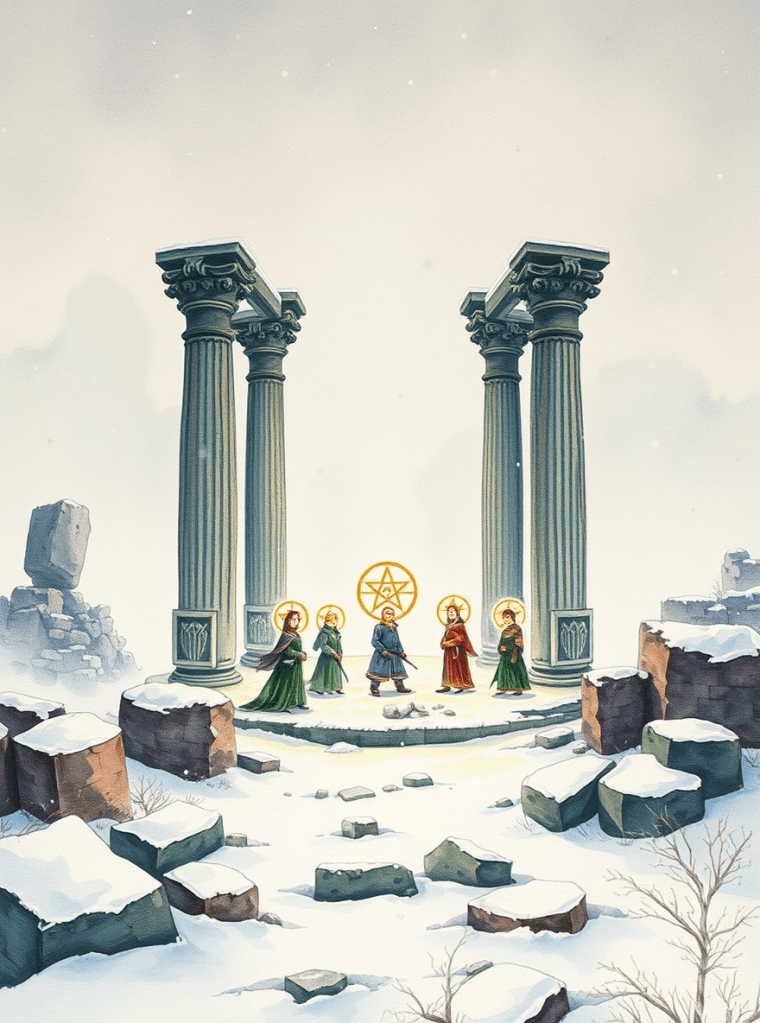
A peasantly mystical AI-generated illustration for the Five of Pentacles
Golden Dawn’s Book T
A WHITE Radiant Angelic Hand issuing from clouds, and holding a branch of the white rose tree, but from which the roses are falling, and leaving no buds behind. Five Pentacles similar to the Ace. Above and below are Mercury and Taurus.
Loss of money or position. Trouble about material things. Labour, toil, land cultivation; building, knowledge and acuteness of earthly things, poverty, carefulness, kindness; sometimes money regained after severe toil and labour. Unimaginative, harsh, stern, determined, obstinate. Geburah of HB:H (Loss of profession, loss of money, monetary anxiety). Herein the angels HB:MBHYH and HB:PNYAL rule.
Etteilla
Lover Upright. This card, as far as the medicine of the spirit is concerned, means, in its natural position: Lover [man], Lover [woman], In love, Gallant man, Gallant woman, Husband, Wife, Groom, Bride, Friend, Friend. – Lover. – Loving, Lovingly, Adoring. – Harmony, Agreement, Convenience, Concordance, Good manners. Reversed. Disorderly, Contrary to order. – Debauchery, Disorder, Turmoil, Confusion, Chaos. – Damage, Devastation, Ruin. – Dissipation, Consumption. – Unruliness, Libertinism. – Discord, Disharmony, Discordance.
(Note: this is a collection of the meanings attributed to the cards by some occultists in the past centuries. It does not reflect my own study or opinion of the cards. It is only meant as a quick comparative reference as I develop my own take.)
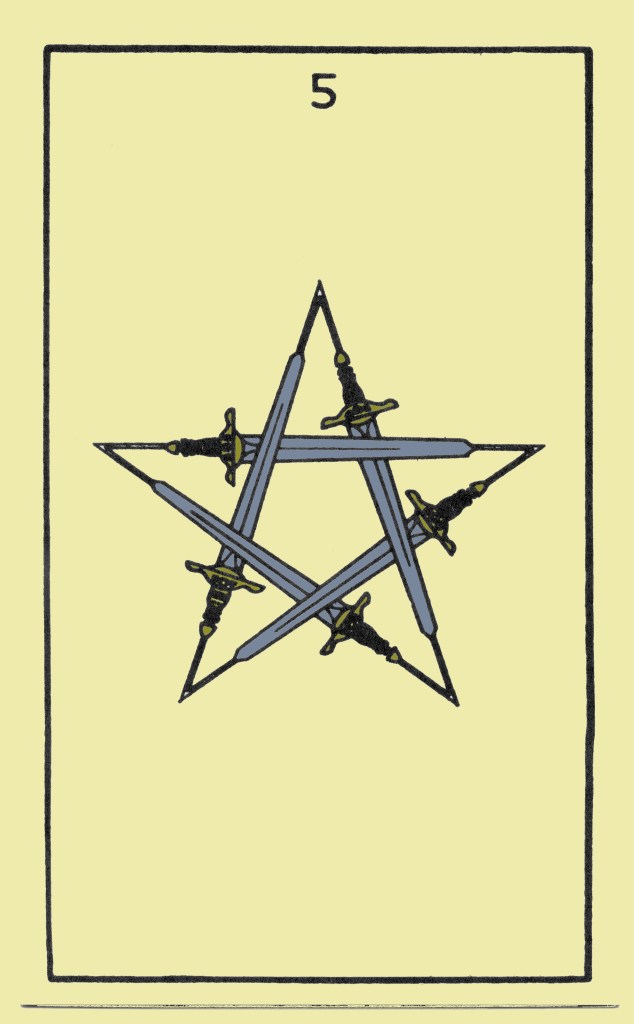
The Five of Swords from the Builders of the Adytum (BOTA) tarot deck
Paul Foster Case (and Ann Davies)
The time period is the first decanate of Aquarius, from January 20 to 29, under the rulers hip of Saturn and Uranus. Well-Dignified: the decision is adve rse to the Querent in any matter of a material nature. In spiritual affairs this card portends apparent troubles which work out ultimately to good result. Thus this Key is one of trouble and anxiety, but rightly comprehended can be the turning point for positive good . Ill-Dignified: the troubles are intensified and are probably due to the Querent’s own lack of understanding of the true nature of the situation. If the question is one of speculation, the Querent is likely to be disappointed due to his own desire to get something for nothing, to over-reach somebody else, or to get rich quick. Keyword: Defeat. (From the Oracle of Tarot Course)
A. E. Waite
A disdainful man looks after two retreating and dejected figures. Their swords lie upon the ground. He carries two others on his left shoulder, and a third sword is in his right hand, point to earth. He is the master in possession of the field. Divinatory Meanings: Degradation, destruction, revocation, infamy, dishonour, loss, with the variants and analogues of these. Reversed: The same; burial and obsequies. (From The Pictorial Key to the Tarot)
Aleister Crowley
The Five of Swords is similarly [to the other fives] troublesome; the card is called Defeat. There has been insufficient power to maintain the armed peace of the Four. The quarrel has actually broken out. This must mean defeat, for the original idea of the Sword was a manifestation of the result of the love between the Wand and the Cup. It is because the birth had to express itself in the duality of the Sword and the Disk that the nature of each appears so imperfect.
[…]
Geburah, as always, produces disruption; but as Venus here rules Aquarius, weakness rather than excess of strength seems the cause of disaster. The intellect has been enfeebled by sentiment. The defeat is due to pacifism. Treachery also may be implied.
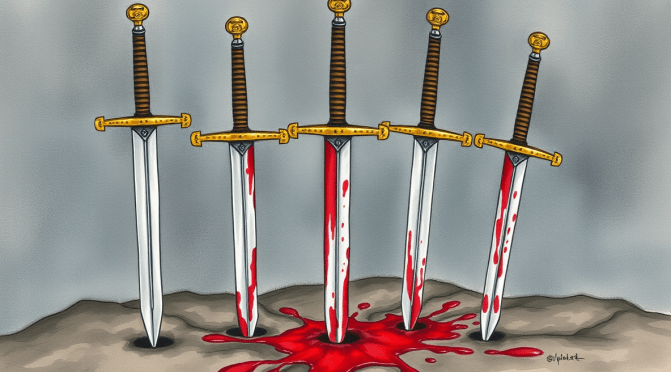
The hilts of the swords form the inverted pentagram, always a symbol of somewhat sinister tendency. Here matters are even worse; none of the hilts resembles any of the others, and their blades are crooked or broken. They give the impression of drooping; only the lowest of the swords points upwards, and this is the least effective of the weapons. The rose of the previous card has been altogether disintegrated.
The historian is happy to observe two perfect illustrations of the mode of this card and the last in the birth of the Aeon of (1) Osiris, (2) Horus. He will note the decay of such Virtue as characterized Sparta and Rome, ending in the establishment of the Pax Romana. As Virtue declined, corruption disintegrated the Empire from within. Epicene cults, such as those of Dionysus (in its degraded form), of Attis, of Adonis, of Cybele, the false Demeter and the prostituted Isis, replaced the sterner rites of the true Solar-Phallic gods; until finally (the masters having lost the respect, and so the control, of the plebs, native and alien) the lowest of all the slave-cults, dressed up in the fables of the vilest of the parasitic races, swept over the known world, and drenched it in foul darkness for five hundred years. He will delight to draw close parallels with the cognate phenomena displayed before the present generation. (From The Book of Thoth)
AI-generated illustration for the Five of Swords
Golden Dawn’s Book T
TWO Rayed Angelic Hands each holding two swords nearly upright, but falling apart of each other, right and left of the card. A third hand holds a sword upright in the centre as though it had disunited them. The petals of the rose, which in the four had been reinstated in the centre, are torn asunder and falling. Above and below are Venus and Aquarius for Decan.
Contest finished and decided against the person; failure, defeat, anxiety, trouble, poverty, avarice, grieving after gain, laborious, unresting; loss and vileness of nature; malicious, slanderous, lying, spiteful and tale-bearing. A busybody and separator of friends, hating to see peace and love between others. Cruel, yet cowardly, thankless and unreliable. Clever and quick in thought and speech. Feelings of pity easily roused, but unenduring.
Geburah of HB:V (Defeat, loss, malice, spite, slander, evil-speaking). Herein the Angels HB:ANYAL and HB:Cha’aMYH bear rule.
Etteilla
Loss Upright. This card, as far as the medicine of the spirit is concerned, means, in its natural position: Loss, Alteration, Discredit, Degradation, Perdition, Decay, Destruction, Deterioration, Deterioration, Diminution, Depression, Diminution, Damage, Failure, Prejudice, Blemish, Torts, Avarice, Decline of business, Failure, Disadvantage, Devastation, Dilapidation, Dissipation, Injury, Disgrace, Reversal, Reversal of fortune, Ruin. – Defeat – Debauchery, Disgrace, Dishonor, Infamy, Ignominy, Affront, Ugliness, Difformity, Humiliation. – Theft, Thievery, Rape, Plagiarism, Abduction, Filthy, Horrible. – Infamy, Corruption, Profligacy, Seduction, Libertinism. Reversed. Mourning, Abasement, Affliction, Sadness, Grief, Pain of spirit, Funeral pump, Burial, Funeral, Inhumation, Burial.
They are the bane of many a reader: Court Cards are seen as difficult to read, in part because they clearly represent people, and so refuse to be banished into the realm of woolly platitudes inhabited by way too many readers, in part because locating them within the querent’s life can be objectively difficult.
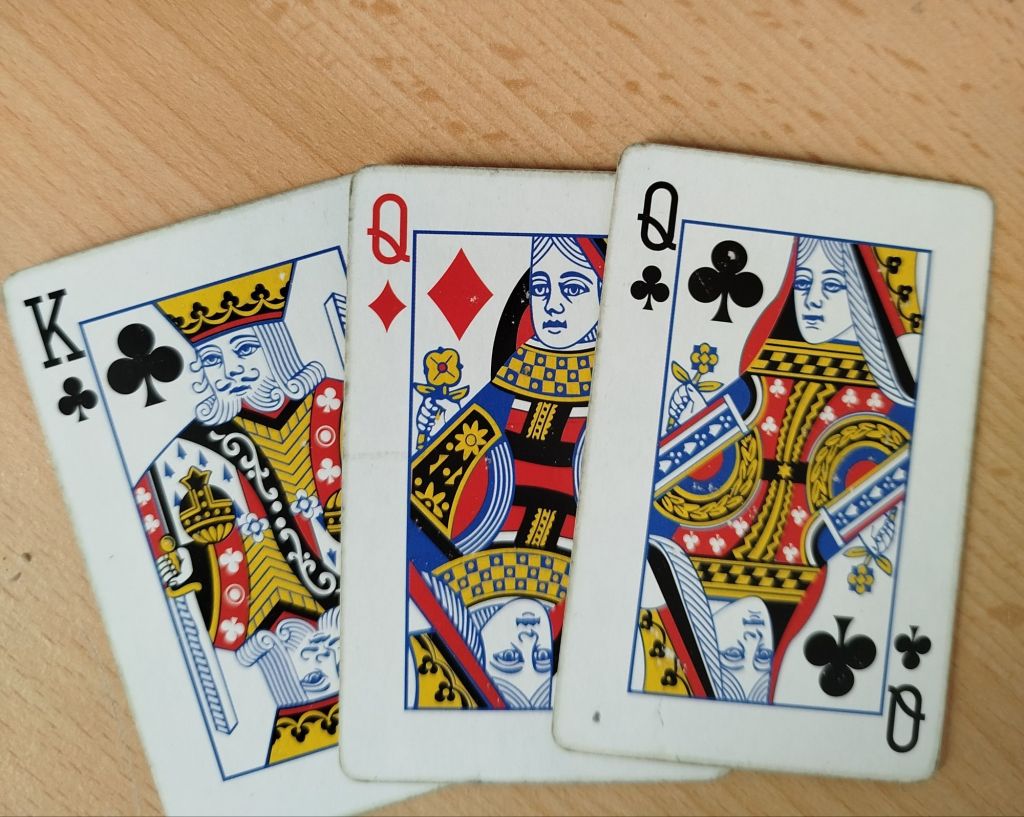
In cartomancy with playing cards, however, the inherent signification of the cards can help us: The Queen and King of Clubs are almost always the main protagonists (the querent and his/her significant other), though there may be exceptions. I know of cartomancy systems where the querents are represented by the Heart suit, but this is just semantics.
Then we have the Heart court cards, of which the Jack is a child, a pet or something fresh and immature and small and the Queen and King represent people close to the querent’s heart. This is actually a modern interpretation: traditionally, they would be people sharing the querent’s bloodline, but modern times require modern solutions. I have found that the Heart courts can simply indicate very dear friends. For gay people, usually the significant other is a Heart card of the same sex, although occasionally the cards simply use the Club cards. We need to stay open. The Jack of Clubs can indicate friendship, help, cooperation.
The Diamond suit represents people usually unrelated to the querent, though they can indicate relatives by marriage. More usually, they show colleagues, acquaintances, bosses, rich people or people who have a more neutral or even cold perspective of the querent compared to the Hearts. The Jack of Diamonds usually represents a message.
Finally, Spades show people who are downright inimical to the querent, or who wield power over the querent’s well-being and enforce an objective set of rules, such as the police, doctors, judges, etc. This is especially the case for the King. The Jack can represent enmity, scheming, etc.
All Jacks can indicate children or very young people, though in practice this is more likely with the Jack of Hearts.
Usually, one court card within a reading is already more than we can tolerate, but sometimes we find that there are ONLY court cards. This is an example of a reading a did yesterday for a man who asked about his relationship:
A marriage-related three-card spread
When more than one court card shows up, it is important to look at the cards between them, as they show the nature of their relationship, or what’s between them.
It is easy to jump to conclusions here: there’s a woman between you two! You have a lover! This could very well be the case, actually, but it is always important to keep in mind that, with so few cards on the table, more than one interpretation is possible. Here are some possibilities:
There could actually be a woman between them. He may have a lover (or, more rarely, she may have a female lover)
It might be a threesome
There could be a woman who interferes but who is not a lover: it could be her mother, her friend, any other person.
There might be a person mediating between them in a positive way
He might know her from work or from a business context, since sometimes, two queens or two kings together can represent a single person, merging the qualities of two suits.
So, how do we know which interpretation applies? Well, first off, we ought never to play Nostradamus: in doubt, we ask. This may sound unimpressive, but our aim is not to impress, but to give accurate information. Still, with experience, we may rule out a couple of possibilities as being less likely:
This is a simple three-card spread. If the querent were in some kind of odd polyamorous arrangement, the cards would not lead off with three court cards, but by telling us the querent is weird. This may sound politically incorrect, but the cards are keyed to a rather traditional view of the world. This doesn’t mean they are a compass of morality: it’s just their language. They highlight the strange and untypical in rather clear ways. Three court cards together aren’t strange enough.
This is a simple three-card reading. If the querent had a hidden lover they would tell us the relationship is in danger, or at least they would highlight the lover by assigning her to the Queen of Spades rather than Diamonds (The Queen of Diamonds can be a lover, but it requires more hints from the surrounding cards). Even the Queen of Spades wouldn’t necessarily be a lover, but at least we’d know she’s trouble.
This is a simple three-card spread. If there were a positive influence mediating between them, the cards would have given her to the suit of Hearts, or they would have omitted the information altogether and told us the querent and his significant other are in a positive phase (the mediator isn’t that important, and a three-card spread only has space for what’s important).
With that in mind, I asked the querent if he knew his girlfriend from work or from a business context, and he denied this. I asked him then if there was a woman causing some issues between them. He smirked and said: “A friend of hers doesn’t like me, she’s trying to break us up.”
Obviously, this spread doesn’t tell us how it’s going to end. It just describes the situation rather than how it will evolve, and more cards should be drawn.
(Note: this is a collection of the meanings attributed to the cards by some occultists in the past centuries. It does not reflect my own study or opinion of the cards. It is only meant as a quick comparative reference as I develop my own take.)
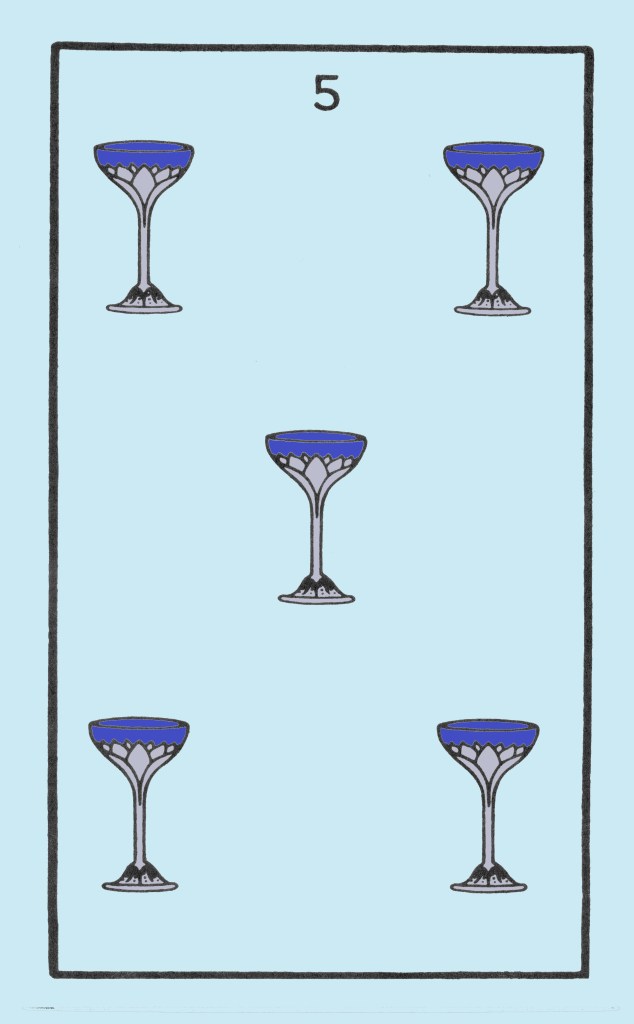
The Five of Cups from the Builders of the Adytum (BOTA) tarot deck
Paul Foster Case (and Ann Davies)
The Five of Cups is the first decanate of Scorpio, ruled by Mars, time period October 22 to October 31. Well-Dignified: strength, power to do; ability to introduce needed changes and let go of relationships, prejudices and false ideas that are hindering spiritual progress. lll-Dignified: loss in pleasure, vain regret, disappointment, sorrow and loss of those things which have been much desired; treachery, deceit; unexpected troubles and anxieties; disappointments in love, broken engagements, broken friendships. (Note: These sorrows and disappointments, as indicated by the Five of Cups, lll Dignified, are often the necessary destruction before the beginning of a new and greater expansion and growth in the life of the Querent, depending on his basic understanding and evolutionary level.) Keyword: Defeated desire. (From the Oracle of Tarot course)
A. E. Waite
A dark, cloaked figure, looking sideways at three prone cups two others stand upright behind him; a bridge is in the background, leading to a small keep or holding. Divanatory Meanings: It is a card of loss, but something remains over; three have been taken, but two are left; it is a card of inheritance, patrimony, transmission, but not corresponding to expectations; with some interpreters it is a card of marriage, but not without bitterness or frustration. Reversed: News, alliances, affinity, consanguinity, ancestry, return, false projects. (From The Pictorial Key to the Tarot)
Aleister Crowley
[…] the Five of Cups is called Disappointment, as is only natural, because Fire delights in superabundant energy, whereas the water of Pleasure is naturally placid, and any disturbance of ease can only be regarded as misfortune.
This card is ruled by Geburah in the suit of Water. Geburah being fiery, there is a natural antipathy. Hence arises the idea of disturbance, just when least expected, in a time of ease.
The attribution is also to Mars in Scorpio, which is his own house; and Mars is the manifestation on the lowest plane of Geburah, while Scorpio, in its worst aspect, suggests the putrefying power of Water. Yet the powerful male influences do not show actual decay, only the beginning of destruction; hence, the anticipated pleasure is frustrated. The Lotuses have their petals torn by fiery winds; the sea is arid and stagnant, a dead sea, like a “chott” in North Africa. No water flows into the cups.
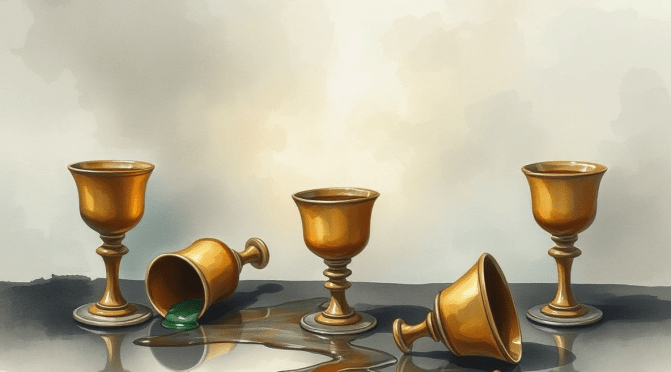
Moreover, these cups are arranged in the form of an inverted pentagram, symbolizing the triumph of matter over spirit.
Mars in Scorpio, moreover, is the attribution of the Geomantic figure Rubeus. This is of such evil omen that certain schools of Geomancy destroy the Map, and postpone the question for two hours or more, when Rubeus appears in the Ascendant. Its meaning is to be studied in the “Handbook of Geomancy” (Equinox Vol. I, No.2). (From The Book of Thoth)
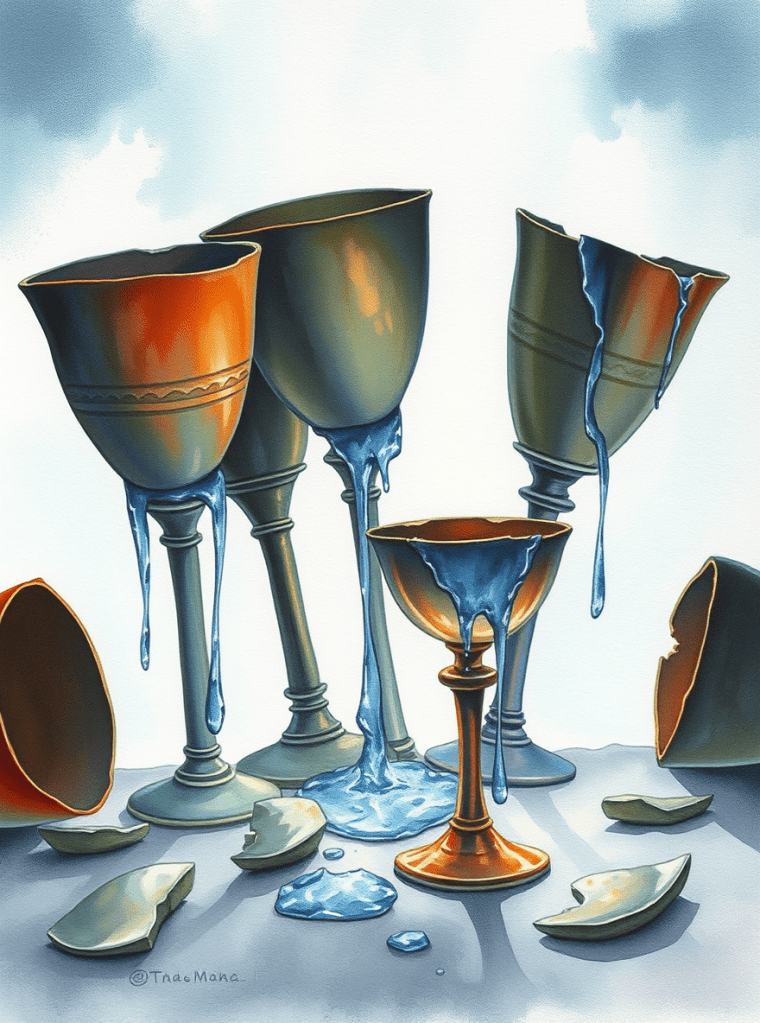
AI-generated illustration for the Five of Cups
Golden Dawn’s Book T
A WHITE Radiating Angelic Hand, holding lotuses or water-lilies, of which the flowers are falling right and left. Leaves only, and no buds, surmount them. These lotus stems ascend between the cups in the manner of a fountain, but no water flows therefrom; neither is there water in any of the cups, which are somewhat of the shape of the magical instrument of the Zelator Adeptus Minor. Above and below are the symbols of Mars and Scorpio for the Decan.
Death, or end of pleasure: disappointment, sorrow and loss in those things from which pleasure is expected. Sadness, treachery, deceit; ill-will, detraction; charity and kindness ill requited; all kinds of anxieties and troubles from unsuspected and unexpected sources. Geburah of HB:H (Disappointment in love, marriage broken off, unkindness of a friend; loss of friendship). Herein rule HB:LVVYH and HB:PHLYH.
Etteilla
Legacy Upright. This card, in its natural position, means, as far as the medicine of the spirit is concerned: Inheritance, Succession, Bequest, Gift, Donation, Endowment, Estate, Transmission, Will. – Tradition, Resolution [=Decision]. – Kabbalah. Reversed. Consanguinity, Blood, Family, Avi, Ancestors, Father, Mother, Brother, Sister, Uncle, Aunt, Cousin, Cousin. – Filiation, Extraction, Race, Lineage, Alliance. – Affinity, Attachment, Relationship, Ties.