Tag Archives: Cartomancy

Bolognese Tarot – I Tarocchi Parlano by Maria Luigia Ingallati (Review)

I Tarocchi Parlano (The Tarot Speaks) by Maria Luigia Ingallati is perhaps the most well-known book about the Tarocchino Bolognese in Italy, and the one that, thanks to its success, launched the rediscovery of this deck outside of its native region. Since the publication of Ingallati’s book, the Bolognese tarot has enjoyed a small but growing cult following. This, we shall see, is probably the book’s greatest merit, though not the only one.

Ingallati herself is not from Bologna. She relocated there many years prior to the publication of her first book (‘Il Tarocchino Bolognese’, which I will review separately). There, she started seeing the local card readers, getting her fortunes told and learning a great deal from them, until she began practicing the art herself and synthesizing a personal method from the Bolognese tradition and her own experience as a card reader.

The book does a good job of presenting Ingallati’s journey, and it is undeniable that her personality shines through the pages of the richly illustrated volume. Ingallati is a good story-teller, enjoys reading and talking about poetry, philosophy and psychology, all of which she uses to shed light on the Bolognese tarot.

Ingallati uses a personal variation of the 50-card method, comprised of the following cards: the 18 surviving Major Arcana; the 3 Strangers or Moors; 7 Cup cards (Ace, Nine, Ten and the Court); 6 Wand cards (Ace, Six and the Court); 8 Coin cards (Ace, Six, Nine, Ten and the Court); 7 Sword cards (Ace, Six, Seven and the Court); and the red Joker.

Of Ingallati’s selection, the choice to include the Joker is the one that has always stuck out like a sore thumb to me. The traditional deck includes no Jokers, since they are not needed for playing card games, and to this day only one producer has recently randomly decided to add them. That being said, Ingallati is very careful in acknowledging what she took from the tradition and what she introduced as her own innovation.

The book starts off with a chapter on the history of the Tarocchino. It is not the best and most accurate historical account, but it covers most of the basics and it is the one most people will skip anyway. Then, Ingallati presents the spreads she uses. This is a peculiar trait of her method, which she also teaches in her private classes: she uses a huge variety of spreads one after the other to move from an account of the querent’s past to the future.

No time is wasted on the technical details of how to lay out the cards, in what order, etc.: the reader is left to his or her own initiative of how to apply the traditional spreads. This may overwhelm us at the beginning, but it is clear that she thinks everyone should find their own way of laying out the traditional spreads, which is fair. This is possibly the most interesting part of the book: Ingallati’s method is a synthesis of many strands of traditional lore about the spreads which can be mined by reading the section carefully and comparing it to other sources.

Only after the section on the spreads does Ingallati start her discussion of the card meanings. Here, the writer spends, in my opinion, way too much time overanalyzing the various details of color and symbol. We learn, thus, that the shape of the lace on this or that character’s tunic has this or that meaning; that the number of triangular shapes on the Queen of Coin’s scepter suggests certain symbolic interpretations; that the colors of the Fool’s feathers is very important.

Of course, none of this has any historical relevance nor any bearing on the interpretation of the cards, nor with the traditional, succint meanings that Ingallati scatters around in the descriptions, sometimes almost as an afterthought. This leaves one wondering if the overzealous interpretation of the various bits of design was just the happy meeting point between the publisher needing a longer book and the writer being happy to provide it with a clear poetic gusto for the mysterious and the metaphorical. Almost every card is accompanied by snippets of poetry and aphorisms, anecdotes as well as by illustrations of some combinations.

The final part of the book is dedicated to Jungian character analysis based on the Bolognese tarot, something that the author clearly has a great deal of interest in, and for which she provides some curious combinations that might be worth trying.

Ingallati’s book is hard to review objectively. It has the incredible historical merit of having brought the Bolognese tarot to a wider public, and it is undeniable that her poetic and evocative style and her attempt at ennobling it as a ‘legitimate’ tool for divination is part of why she succeeded.

The esoteric landscape has a growing public of people I like to call educated suckers, those who think themselves too smart and learned for folk superstitions but can easily be sold on the idea of reinterpreting them as deeper mysteries of personal development and esoterically flavored self-help. This is the reason why so many ‘real and only’ Tarot of Marseilles’ get sold every year, together with ridiculously expensive courses on ‘this is not divination’ and books of metaphysical platitudes that sound deep if you don’t think too much about them.

Ingallati struck gold when she managed to appeal to this kind of public with her literary style while also preserving the teachings she received and developed from the card readers she met in Bologna. In doing so she succeeded where the small handful of other books published before and since failed: creating a niche for the Bolognese tarot. Despite my sarcasm in the previous paragraph, this is no small accomplishment. Pragmatically speaking, it is a serious merit.

The book also excels at being a treasure trove of meanings, spreads, combinations and suggestions that can be studied, reflected on and compared with other sources. It is certainly a book I recommend, in this regard.

Where to buy: Amazon

MQS

Cards That Change Topic

In the latest reading I presented, an interesting phenomenon occurred. At some point during the reading, two cards came up that seemed very negative, but which actually had nothing to do with the reading in itself. Instead, they simply acted as some form of punctuation. This happens especially with simple methods like the one I used, called ‘alla zdoura’ (literally, ‘method of the housewife’, or ‘like the housewives do it’ in dialect), where we start with a very limited number of cards, usually one, two or three, and then we keep adding them without following a specific layout.

In this type of reading, if the cards need to signal that we are changing topics and moving on to a new one, they may use cards or combinations that show an ending (sometimes even just the Death card). Of course, I had a huge deal of luck in this reading, because it came up clear. It isn’t always like that. Often, these combinations look really bad, but if we look around we see that they feel out of place.

In playing cards, the same can happen when the Four of Spades and Five of Spades, or the Ace of Spades, or the Five of Diamonds come up. Usually, in these situations, it pays to zoom out of the reading and catch the general flow of it: it will become apparent, generally, whether these cards are part of the reading or if they act as punctuation. 

I am also experiencing a similar phenomenon while experimenting with the Bolognese tarot. For instance, in the first few lines of a thirteen- card spread, it may happen that the Angel and Death cards come up together, and then the cards seem to discuss other topics. In this case, the cards seem to be answering the question positively and quickly, only to introduce new discussions. At other times, the Queen of Coins comes up to say “and that’s the truth about it, period.” or the Justice card, to say “and that ok the way it is.” Of course, I need to experiment a little more, especially to see if apparently negative combinations can act in the same way.

MQS

Another Way of Reading the Skat / Piquet Deck

A couple of years ago I published a series of three articles on the Skat deck. This is not a system I use, merely one that has been kindly passed down to me, together with the premission to translate it. I came into contact with another reader, who also kindly accepted to share her system, which she learned from a friend some years back. This is another German system, which is recognizable in that Spades tend to be neutral and Clubs negative. There are also many similarities with the previous system I published, which is not surprising since the various systems tend to be regional, and both readers come from the same region ( the Südpfalz). Still, there are some interesting differences. What follows is my translation of the meanings, combinations and reading method. Thanks to Anke for this method.

Hearts

Ace – The Home
King – The Man (Herzensmann, the man of my heart)
Queen – The Woman (Herzensfrau, the woman of my heart)
Jack – Thoughts, Projects, Hopes, Positive Feelings/Thoughts (gute Gesinnung)
Ten – Great Joy, Wish Fulfillment, Wedding Bells (Hochzeitsglocken)
Nine – Joy, Love, Sympathy, Affection / Inclination (Zuneigung)
Eight – A Relationship, Harmony, Accord / Deal, Reconciliation
Seven – Fun, Entertainment (Fröhlichkeit, Spaß)

Spades

Ace – Office (Amt), understood as official things, Bureaucracy, Documents, Laws, Lawsuits, etc.
King – A friend or relative, Can be an office worker
Queen – A friend, relative or office worker (Büroangestellte)
Jack – Message, Contacts
Ten – Journey, A long period of time, The Long Road (auf dem langen Weg), An important change (Umbruch)
Nine – Uncertainty, Uncertain timeframe, Jealousy, Unwarranted turmoil, at the end of a sequence it improves the situation (the worry is unwarranted)
Eight – A short timeframe, Also the card of society (Gesellschaftskarte)
Seven – Very short timeframe, Discussions and Talks, The Short Road (auf dem kurzen Weg)

Diamonds

Ace – Letter, Invitation or Gift
King – A Man of position, Respected (angesehener Mann), Someone who counts
Queen – A woman of position, Respected, Who counts
Jack – The Jack of Good Luck (Glücksbube)
Ten – Big Money
Nine – Success, Ambition, Idealism
Eight – Work, Also buying and selling, Business (Geschäftskarte)
Seven – Small Money, A child

Clubs

Ace – Shock (Schreck), Fear, Fright, Suffering or Loss
King – A lonely man, Older or inimical, Father-in-law
Queen – A lonely woman, Older or inimical, Mother-in-law
Jack – The Jack of Bad Luck (Pechbube), Bad/evil ideas / feelings / disposition (böse Gesinnung)
Ten – Great sorrow, Illness
Nine – Falseness, Antipathy (Abneigung), Dislike
Eight – Arguments, Fights, The need to fight, Obstacles
Seven – Tears

Some Combinations

Ace of Hearts – Ace of Spades – Ten of Hearts = Wedding
Ace of Spades – Ten of Clubs – King of Clubs = Hospital stay
Any Queen – Seven of Diamonds – Ten of Clubs = Pregnancy (apparently pregnancy is seen as a sickness)
Ace of Clubs – Ace of Spades – Evil card (especially the Jack of Clubs) = death
Ace of Spades – Eight of Clubs – King of Clubs = Court case
Ten of Spades – Person card = Someone who comes from afar (but can also be someone who is away)

Spreads

There are two phases to a general reading. The first is a cross spread not unlike the one I use. Lay out the querent’s card (King or Queen of Hearts), but with some slight variations. Let’s say you are reading for a woman:

4914
2712QH3813
1611
51015

The positions’ meanings are quite similar, although the order of laying out the cards differs: above are the thoughts, underneath the problems or what she has command over, behind is the past, in front is the next future. The second stage is as follows:

38134914
QH
1611
271251015

This second spread is called the Rundum Blick, literally the comprehensive view or all-around view. The cards covering the Queen are supposed to be the most important ones, while the others all cover the future, with those to the left being a bit closer than the ones to the right, unless the Ten of Spades (the long time card) is present, in which case it can change the timeframe.

I didn’t receive any instructions on how to read the cards for answering specific questions, which is not surprising, since many folk methods of divination were simply meant to talk generally about what was ahead. Still, I am quite sure you can devise your own strategy.

MQS

Bolognese Tarot – The Love / Couple’s Spread (Three Variants)

The Bolognese Tarot tradition has several spreads for the couple. One that has been taught to me, and which I have also found is practiced by other Bolognese tarot readers, is the following:

123456
HeShe
789101112
131415

He and She are, of course, the King and Queen of Wands. However, we can explore the relationship between any two individuals. The cards above the two significators show what’s on their mind (1-2-3 his mind, 4-5-6 her mind, in this case).

The cards covering them (7-8-9 for him, 10-11-12 for her) are ambiguous. The way the method has been passed down to me, these cards show what’s going on with him and what’s going on with her, but I have found other readers (such as Rossella Giliberti) who say that these cards show what’s in his heart and what’s in her heart. Choose the variant you prefer, and remember that these are local methods, so there’s bound to be variations between one town and the other. The final three cards (13-14-15) show what’s happening to them as a couple in the near future, or if there is potential, or what connects them.

Another spread, which is found in Maria Luigia Ingallati’s book on the Bolognese Tarot (which I will review in the near future together with the few others that have been published). The layout is as follows:

HeShe
1231516178910
456181920111213
72114

Here we have cards 1 through 7 talking about what’s going on with him, cards 8 through 14 telling us what’s going on with her, and finally the group in the center (15 through 21) talking about them as a couple. Another reader I know (Monica Barbieri) uses thirteen cards for each group instead of seven.

Another variant is found in Lia Celi’s out-of-print book on the 45-card method. This is the layout:

He and She
12345
67 – 89
1011 12
13 – 14
15

As can be seen, this is a pyramid spread. Here, cards 1, 2, 6, 7, 10 and 13 talk about him, cards 4, 5, 8, 9, 12 and 14 talk about her, and cards 3, 11 and 15 talk about them.

These methods are specific for analyzing two people’s interaction, but nothing prevents you from using a simpler spread, like the thirteen card spread. To be honest, that’s what I do. Still, this is an interesting bit of traditional lore about the Bolognese tarot.

MQS

Great News, I’m Pregnant!

No, not me–science hasn’t come that far. I picked three cards for the day around a week ago.

A daily reading reveals news about a pregnancy

In a daily reading, these cards could indicate just about anything, although the tone is positive and it is connected with good news for sure. But two days later a friend in our group announced she was pregnant. The Hope card is strongly connected with maternity and nourishment, and is often present when asking about pregnancies, and the Child card speaks for itself. Also note that daily readings can come true even in the following days.

MQS

Tarot Encyclopedia – The Eight of Wands

(Note: this is a collection of the meanings attributed to the cards by some occultists in the past centuries. It does not reflect my own study or opinion of the cards. It is only meant as a quick comparative reference as I develop my own take.)

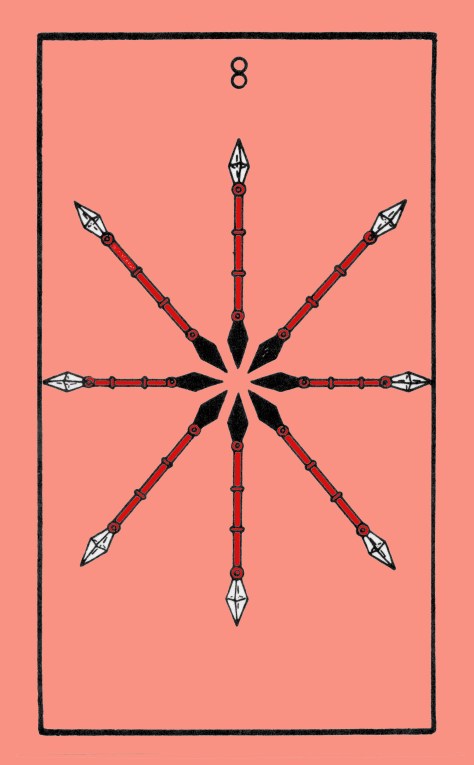
The Eight of Wands from the Builders of the Adytum (BOTA) Tarot deck

Paul Foster Case (and Ann Davies)

As the first decanate of Sagittarius, the Eight of Wands is the time period of November 22 to December 1, ruled by Jupiter, suggesting a combination of the powers of Mercury and Jupiter together with the zodiacal attributions of the sign Sagittarius and its natural 9th house. Well-Dignified: aspiration; foresight; rapid expression of force, but quickly expended; the acceleration of anything in which the querent is interested; generosity; confidence ; freedom.
Ill-Dignified: violence; warfare; rapacity; insolence; theft or robbery. These are suggested by some of the evil meanings connected with Hermes or Mercury associated with misuse of human intellect.
Keyword: Swiftness
(From the Oracle of Tarot course)

A. E. Waite

The card represents motion through the immovable-a flight of wands through an open country; but they draw to the term of their course. That which they signify is at hand; it may be even on the threshold. Divinatory Meanings: Activity in undertakings, the path of such activity, swiftness, as that of an express messenger; great haste, great hope, speed towards an end which promises assured felicity; generally, that which is on the move; also the arrows of love. Reversed: Arrows of jealousy, internal dispute, stingings of conscience, quarrels; and domestic disputes for persons who are married.
(From The Pictorial Key to the Tarot)

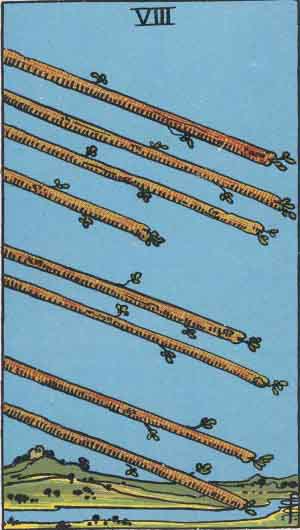
The Eight of Wands from the Rider Waite Smith tarot

Aleister Crowley

The Eight of Wands is called Swiftness, as one might expect from its attribution to Mercury and Sagittarius. This is an etherealization of the idea of fire; all gross elements have disappeared.

[…]

The remaining three cards of the suit belong to Sagittarius, which represents the subtilizing of the Fiery energy; and Mercury rules the card, thus bringing down from Chokmah the message of the original Will.

The card also refers to Hod, splendour, in the suit of Fire, whence it refers to the phenomena of speech, light, electricity. The pictorial representation of the card shows the Light-wands turned into electrical rays, sustaining or even constituting Matter by their vibrating energy. Above this restored universe shines the rainbow; the division of pure light, which deals with maxima, into the seven colours of the spectrum, which exhibit interplay and correlation.

This card, therefore, represents energy of high velocity, such as furnishes the master-key to modern mathematical physics. It will be noted that there are no flames; they have all been taken up into the wands to turn them into rays. On the other hand, the electric energy has created intelligible geometrical form.
(From The Book of Thoth)

The Eight of Wands from the Thoth Tarot

Golden Dawn’s Book T

FOUR White Radiating Angelic Hands (two proceeding from each side) issuant from clouds; clasped in two pairs in the centre with the grip of the First Order.
They hold eight wands, crossed four with four. Flames issue from the point of junction. Surmounting the small wands with flames issuing down them, and placed in the centre at the top and bottom of the card respectively, are the symbols of Mercury and Sagittarius for the Decan.

Too much force applied too suddenly. Very rapid rush, but quickly passed and expended. Violent, but not lasting. Swiftness, rapidity, courage, boldness, confidence, freedom, warfare, violence; love of open air, field-sports, gardens and meadows. Generous, subtle, eloquent, yet somewhat untrustworthy; rapacious, insolent, oppressive. Theft and robbery. According to dignity.

Hod of HB:Y (Hasty communications and messages; swiftness).
Therein rule the Angels HB:NThHYH and HB:HAAYH.

Etteilla

Countryside
Upright. This card, as far as its medicine is concerned, means, in its natural position: Countryside, Field, Plain, Agriculture, Cultivation, Landed Property, Immovable Property, Farm, Homestead, Garden, Orchard, Prairie, Forest, Grove, Foliage, Pleasure, Amusement, Leisure, Pastime, Recreation, Enjoyment, Peace, Calm, Tranquility, Innocence, Country Life. – Forest, Valley, Mountain, Battlefield.
Reversed. Inner dispute, Examination, Reasoning, Incomprehension. – Regret, Remorse, Repentance, Inner turmoil, Irresolution, Uncertainty, Indecision, Inconceivable, Incomprehensible, Doubt, Scruple, Fearful consciousness.

MQS

The End of Misfortune (Example Reading)

This is a cool reading because it shows that the cards tend to describe a situation and take their time to do so, so that trying to immediately get a yes or no out of them can be problematic and cause mistakes (though making mistakes is part of the human condition, obviously). This is the reason why, talking about the Bolognese tarot, I tend to disregard the yes and no rule of the Death card. It is also the reason why I don’t believe in the yes and no value of playing card colors.  To me, that’s just a coin flip, and coin flips don’t work as reliably as actual divination, which is a language.

Here the question was if an unemployed man would get a job.

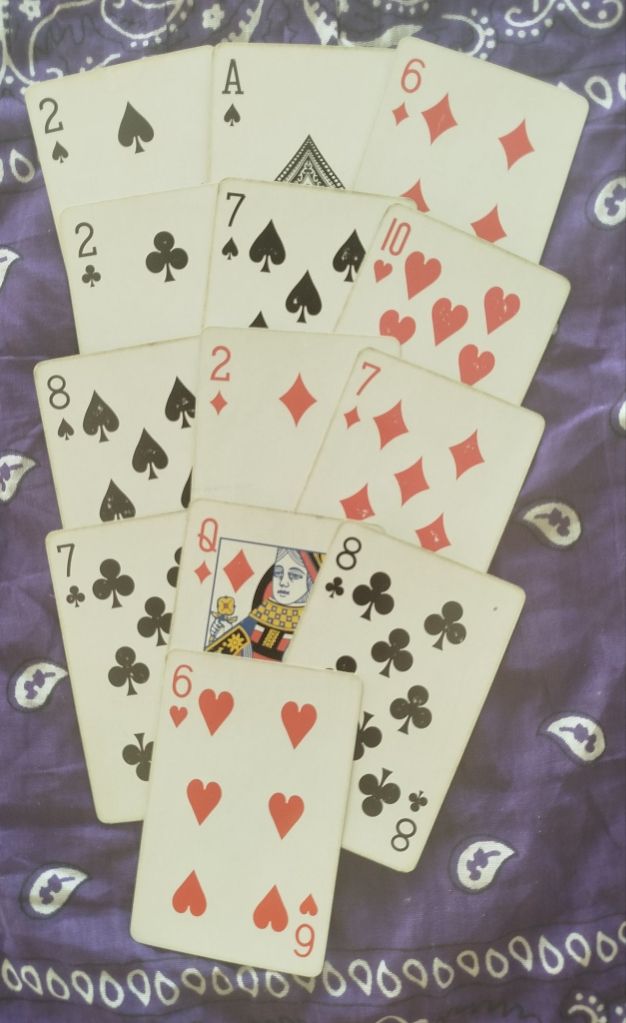
A career spread. Divination with playing cards.

The first thing I noticed is that the reading ends with a very positive combination of Queen of Diamonds, Eight of Clubs (work) and Six of Hearts (reconciliation/solution/adjustment). This bodes well, but the rest of the spread is more disastrous.

The first row shows that the subject is a thorn in the heart of the person (Two of Spades, Ace of Spades and the Six of Diamonds showing worry). Then we see that every step taken (Two of Clubs) to solve the issue has met with misfortune (Seven of Spades), meaning that the person has probably tried to find a job repeatedly but failed. This explains the very emotional cards in the first row, as well as the fact that the Happiness card (Ten of Hearts) is squeezed between Misfortune (Seven of Spades) and Tears (Eight of Spades). This is a whole unfortunate period unfolding in the person’s life.

There are some cards I am not quite sure about: the Two of Diamonds, Seven of Diamonds, Seven of Clubs. 2♦️ + 7♦️ can be a cheque or paper money, or projects about money. I asked the querent a couple of questions and it didn’t really help. I think a more general reading would be that, quite obviously, the lack of a job has impacted negatively (7♣️) his financial situation.

Then finally we have a woman who is either going to help him find a job or give him a job. If I had to bet I would say this is a female boss, since she shows up as a Diamond and not as a Heart. Either way, the period of misfortune is going to thankfully end.

MQS

Vera Sibilla Cards That Indicate Spirituality and Occultism

Pretty much every card in the Vera Sibilla has some connection with spirituality and occultism, especially when that’s the topic of the question. However, some cards are more pronounced in the kind of indications they give. The unfortunate thing about this sort of topics is that people tend to use them as a substitute for real life. So, for instance, once someone wrote that the Queen of Clubs can indicate a psychic vampire, and then everyone started reading that card primarily as that for a while (becuase, of course, you are such a wonderful person that everyone wants to leech off of your energy). In reality, unless the question is about spiritual or occult topics, such interpretations are best kept rare, and even then, the surrounding cards need to be kept in mind.

Ace of Hearts – The Conversation (Conversazione)

This is not an especially esoteric or spiritual card, but I’ll talk about it to show how easy it can be to expand a card’s regular meaning to cover those topics. The Conversation card is about words and people meeting or living together. In a spiritual or esoteric reading it can therefore indicate prayers (communion with the divine), exorcisms or spells (the spiritual or esoteric use of words). It can also indicate a group of people operating a ritual or praying together.

Four of Hearts – Love (Amore)

Again, not an especially esoteric card, but it is one of the possible cards indicating the soul (winged, heart-related). It can also indicate that one has the otherworldly tendency to attract certain types of happenings into their life. This has nothing to do with the law of attraction, but merely a statement of the fact that certain people simply tend to end up in specific situations.

Seven of Hearts – The Scholar (Letterato)

The Scholar is connected with the constructive use of the mind. It can therefore indicate plans, including esoteric plans, mostly tending to be good ones. It can also show the divine plan, providence etc.

Eight of Hearts – Hope (Speranza)

The Hope card is the main significator of faith, though not necessarily religious faith. It is heavily indicative of our psychic connection with the divine. It is also involved in those situations where the person has prophetic dreams, psychic powers and all those abilities witches on WitchTok pretend to have but really don’t. Reversed, it can indicate atheism (lack of hope in the divine) or, with very evil cards, it can indicate negative faith systems, such as satanism (we’re talking O9A, not the coastal post-crowleyan, occult-flavored performance art that passes itself off as satansim).

Nine of Hearts – Faithfulness (Fedeltà)

The Faithfulness card is one of great protection and support, whether from worldly friends or from otherworldly ones. As such, it can indicate angels (the Messenger is another possible card for angels, but in a more neutral sense). More commonly, it can indicate devotion to a belief system.

King of Hearts – The Gentleman (Gran Signore)

Obviously, God is the esoteric and spiritual gentleman par excellence, and this is usually what this card can represent. It indicates great protection from the divine (the female counterpart would be the Maiden for the Virgin Mary, or the Girlfriend for a female saint or goddess).

Two of Clubs – The Peacock (Pavone)

The Peacock is one of the cards we look for in sequences about magic and spirituality. When upright, it represents the god-power which unfolds at its own pace, like the peacock’s tail, creating opportunity for marvel and salvation. Esoterically, it shows magic in a neutral to positive sense. It represents oaths and religious vows. Reversed, it is the card of the devil (the one who was doomed by his pride), demons and dark magic.

Three of Clubs Reversed – The Journey (Viaggio)

When reversed, the Journey has a specific connection with white magic in its ability to interrupt any negative trend, harmonizing us with our path in life.

Five of Clubs – Fortune (Fortuna)

In itself the Five of Clubs is the card of destiny, of one’s path through life, whether good or bad. It can represent protection, though not necessarily divine, from magical forces. It can be present when a magical attack is aimed at modifying a person’s natural destiny.

Four of Diamonds – Falsehood (Falsità)

The Falsehood card is the card of negativity in all contexts. Esoterically, it shows negativity in the person’s aura and/or the evil eye, but it usually doesn’t represent heavy black magic.

Six of Diamonds – Thought (Pensiero)

Our thought is where past, present and future coincide and gather in the form of memories, plans and inclinations. It can give us hint as to the person’s inner life, their religious beliefs, their inner and esoteric talent, etc. Reversed, in addition to indicating negative thoughts, it can have a connection with subonsciousness and the powers that are buried within it, or with thought-forms and spirits.

Three of Spades – The Widower (Vedovo)

The Widower is one of the primary culprits we look for when discussing rituals, whether religious or magical. This is especially true when the card is reversed. It is also the card of graveyards and graveyard magic, and it can indicate sects (mostly in a negative sense).

Five of Spades – Death (Morte)

The Death card is always very incisive. It can talk about the person’s aura being out of wack, and it is one of the possible cards representing the summoning of dark forces, especially when reversed.

Eight of Spades – Desperation and Jealousy (Disperato per Gelosia)

The Eight of Spades is strongly connected with magical attacks, whether upright or reversed. It is indicative of demonic presences or dealing with dark forces in a negative sence. Being the card of envy, it can indicate the ill will of the dark magician. Spiritually, it can herald a crisis of faith or beliefs, either leading to loss of faith or to conversion.

Nine of Spades – The Prison (Prigione)

On a positive note, it can indicate the taking of religious vows (which bind us). More commonly it indicates feelings of guilt or feeling limited. Magically it represents the creation of magical bonds.

Ten of Spades – The Soldier (Militare)

Another strongly esoteric card, the Soldier is the card of the night, and therefore of the occult (which means that which is hidden). Because it is the card of attacks, esoterically it can show the tackling of the problem, or more commonly the psychic attack.

King of Spades – The Priest (Sacerdote)

Just like the two Enemies, the Priest can represent a magician. However, it usually signifies the magus in a more neutral and high sense, unless the card is reversed. Spiritually it can indicate spiritual institutions and religions, but also divine justice.

MQS

Is He Gay? (Example Reading)

A reading with the Bolognese Tarot. Like and subscribe to my YT channel to support my work

MQS