Tag Archives: Cartomancy

Vera Sibilla and Numerology – The Tens

The Tens in the Vera Sibilla have a lot to do with the concept of materiality, matter and physicality. Each of them shows how the suit relates to the notion of an external reality that needs to somehow be conquered, or that the Self and the Will needs to enter into contact with. As the final number in the sequence, it shows how the suit materializes.

The Tens in the Vera Sibilla deck: The Ten of Hearts (Perseverance), The Ten of Clubs (Levity), The Ten of Diamonds (The Thief) and the Ten of Spades (The Soldier)

The Ten of Hearts, Perseverance, is known for its general meaning of success after toil and, well, perseverance. This is a result of the combination of the positive meaning of the suit of Hearts with the rather challenging notion of materiality.

It represents the hard, unyielding surface of external things bending to our patient effort, being incorporated into our picture of how things should be and therefore being beaten into shape. Note how the image on the card shows the young lady confidently resting on a column at the break of dawn, having withstood the long night. She may be living in a material world, but, just like Judge Judy, they definitely don’t keep her there because she’s gorgeous. She means business!

At the same time, the other important meaning of the card, i.e. a long duration, is derived from the fact that once matter has been beaten into a particular shape, it has a tendency to retain it until a strong counter-impulse is given.

Finally, the third important meaning of the Ten of Hearts, i.e. the querent’s city (but, in general, it can also represent the homeland) is derived from the fact that the realm of Hearts is concerned with what is closest to us, and which therefore we are intimately connected with. The physical, material space we are connected with is our city or homeland, because it is immediately around us. Incidentally, Perseverance is also connected with the patrimony, the drowry and accumulated wealth, again, showing the positive side of materiality.

At the opposite end of the spectrum, the Ten of Spades, the Soldier, shows materiality overwhelming the Self and the Will, engulfing it into its morass of inert darkness. That is why, at its best, the Ten of Spades represents the physical body’s ability to fight or to react, but no victory is automatically shown. Alternatively, this is another card that can show violence, arguments etc., i.e. negative physical contact.

It is also why this card represents impervious places, like mountains and deserts and, in a metaphorical sense, all uphill battles. It’s the card of darkness and the night (and, as an extension, of secrets), which is an obvious contrast with the sense of liberation coming to us as we see the Sun peeking from under the horizon in the Ten of Hearts.

Finally, it’s why this is one of the cards connected with strangers and strange cities and countries -though, usually, not by itself. If, in the Ten of Hearts, we were dealing with familiar physical spaces we are intimately connected with, with the Soldier we are faced with people, situations and places that remain outside of our sphere of familiarity, and that therefore remain outside of our control and sense of security.

With the Ten of Clubs, Levity, and the Ten of Diamonds, The Thief, we are shown gradations on the spectrum. The Butterfly is a simbol of everything that is light, impalpable and indefinite, as shown by its association with the element of Air. It represents a strong departure from the commited consistency of the Ten of Hearts. In the Ten of Clubs we have the self gliding from flower to flower, aimlessly wandering and always avoiding leaving a permanent mark in any direction.

The compromise is that we don’t get much in terms of results, but we are not crushed by the weight of matter either. All the main meanings of the Levity card are derived from this, including the idea of lack of focus, of carelessness and of “just a little”. Note that, in readings where physical death is shown, the Ten of Clubs might appear to show the soul leaving the body and flying away, i.e. relinquishing its ties to the material world.

With the Thief card things start to get ugly. Here we have the Self and the Will very much focused on doing something with the physical world. Unfortunately, it’s not anything that will win them a Nobel prize for peace. The Suit of Diamonds has a lot to do with material values, so the idea, here, is that the Self is hell-bent on appropriating physical things, and it has no moral compass to tell him where a line should be drawn. 

Note that, for their connection with the concept of matter and physical space, the four Tens are also representative of the four directions: the Ten of Hearts is assigned to the South, the Ten of Clubs to the North, the Ten of Diamonds to the West and the Ten of Spades to the East.

Vera Sibilla and Numerology – The Twos

The Twos in the Vera Sibilla. Like and subscribe to my YT channel to support my work

We’ve seen how the Aces in the Vera Sibilla already contain the idea of duality, albeit only in principle. The Twos, on the other hand, take the impulse that comes from the Ace and elaborate on it. They start from the point, as it were, and draw a line by extending that point. The Twos are connected with ideas of extension, consolidation, strengthening and elaboration.

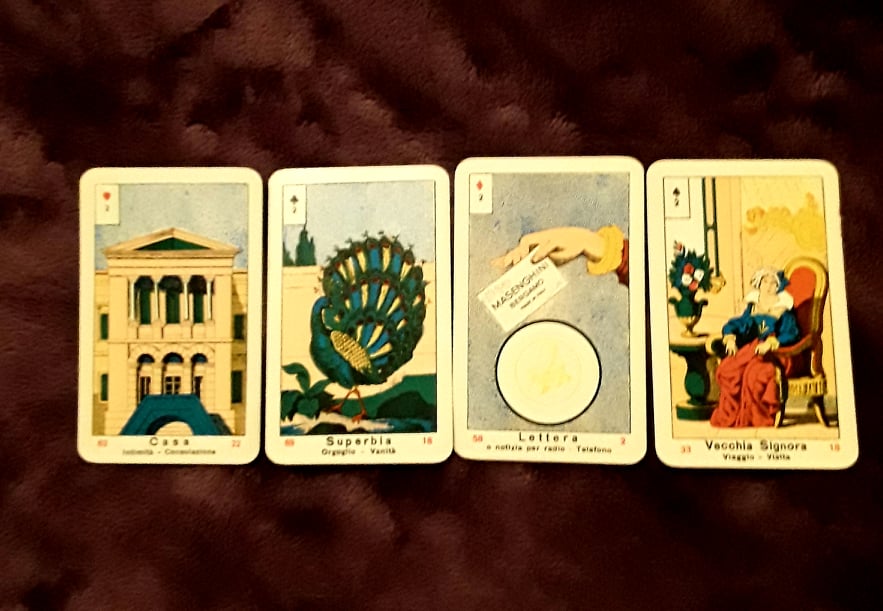
The Twos in the Vera Sibilla deck: The House, Haughtiness or the Peacock, The Letter and The Old Lady

As usual, the suits of Hearts and Spades represent opposite polarities. The Two of Hearts, the House, is a card of solidity. Aside from representing the querent’s house or any type of building, it shows the consolidation of a love situation. It can signify an established couple (not necessarily living together), and the cards nearby are going to tell us how strong their relationship is and what affects it.

In general, it represents the consolidation, usually in a positive sense, of a situation. In other words, it shows a situation that is built on good foundations. As an analogy, it shows the foundations or roots of a problem: the cards around it will tell us why something is the way it is, its origin.

On the opposite end of the spectrum, the Two of Spades, the Old Lady, is the card that represents losing strength. It shows a process of decline. This card encompasses all those situations that are approaching their natural end, just as the old crone is now too weak to be standing up all day and would rather have you come visit her while she’s comfortably sitting in her chair (indeed, this card can also represent a visit or very short journey, as connected with the idea of little mobility).

Because the suit of Spades is a generally negative one, the idea of strengthening is reversed into one of weakening, and that of elaboration becomes the not on of reaching a final conclusion. It can be any conclusion: from the natural end of the year to the natural end of a contract or job, etc. In a love reading, aside from being the ex (your old woman) it can represent a relationship that has lost impetus.

Between Hearts and Spades we have Clubs and Diamonds. The Two of Clubs, Haughtiness or the Peacock, is famously the traditional lucky charm or “amulet” card. It’s the best in the whole deck (much better than the Five of Clubs, Fortune). Through the image of the peacock’s feathers arranged in a complete “wheel”, the card suggests the idea of completion, of liberation from all limitations and bonds, of amplification of all that’s good and diminishing of all that’s bad.

We might also connect the traditional meaning of beauty that this card has with its other meaning of completion, as traditionally beauty was seen as an attribute of wholeness and proportion between parts of a whole. The Two of Clubs is also the main esoteric card of the deck. If you are a hexer, you want to keep an eye on this eye-catcher. In general, it represents (when upright and with other appropriate cards) things that are completed or elaborated through a work of magic. When it’s reversed, it becomes black magic.

Finally, let’s talk about the Two of Diamonds, the Letter. It’s a very simple card, showing the receiving of correspondence. But what are communication and correspondence if not an extension or consolidation of our connection with the world and the inputs that come to us from it, which is the main theme of the suit of Diamonds? In other words, the Letter shows that the matter under consideration will be added on by the arrival of news, telephone calls, explanations, documents, etc.

An important secondary meaning of the Letter connects it with writing, books and the elaboration of projects. It’s about pouring your brains on a piece of paper, which is why it is an important card to look for when you are going for a written exam: you’ll need to elaborate on your ideas in a written form.

Vera Sibilla and Numerology – The Aces

The Aces of the Vera Sibilla. Like and subscribe to my YT channel support my work.

The four aces, like the aces in many cartomancy systems, deal with the idea of newness. This can mean news or simply something new. However, in the Vera Sibilla they also add a further layer: they show people coming together in a unity of some kind. This can overlap with the meaning of news. In a way, it is as if the Sibilla was asking: “Oh wise reader, if you were to reduce the meaning of each of the suits to a single spark or seed idea, what would that be?” In this sense, the newness is how the suit first manifests, how it comes into being. And the way it comes into being is by containing the interaction between people, or between inside and outside, in a single unity.

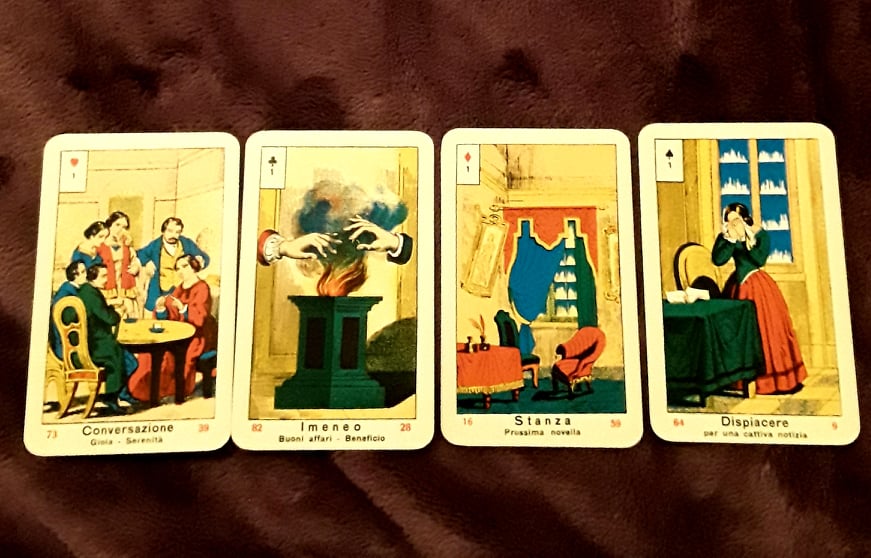
The four Aces of the Vera Sibilla: Ace of Hearts (Conversation), Ace of Clubs (Marriage), Ace of Diamonds (Room), Ace of Spades (Sorrow).

The Ace of Hearts, Conversation, is a good example of this overlapping of newness, news and relationship between people. This is the card of words and interpersonal relationships. The type of unity between people that this card shows is one of peace: word is an alternative to violence, and it allows us to find compromises, hence the further meaning of negotiation. Additionally, it represents people coming together in a further sense, as it is the card of people living under the querent’s same roof.

Note how, in a more metaphorical sense, the Ace of Hearts represents the idea of opening up to other people, or simply to a new situation, in that talking means connecting with the outside world in a peaceful, positive way. It describes a type of work where you need to stay in contact with people, and also the ability to communicate, to mediate, to make people understand where you are coming from.

The Ace of Spades, Sorrow, is in more than one sense the opposite of the Conversation card. It represents, first and foremost, sad tidings, the precise nature of which is shown by the cards nearby. Something from the outside comes to the I, and the I is saddened by it. From this comes a whole set of meanings assigned to the Ace of Spades, from grief to tears etc.

The difficulty that this card shows in interpersonal relationships is typified by one of its other meanings: violence. This is one of the cards that can show people coming together not, as in the previous card, with good intentions, or with the idea of finding a compromise, but holding a big club behind their back.

In between the two extremes, we have other types of news and unity. With the Ace of Clubs, Marriage or “Hymenaios”, the coming together is a legal one: it shows two or more people joined in a venture that requires a signature. From marriage to contracts, partnerships, this is a card of prosperity, and unless other cards modify it for the worse, it promises good. It shows something that is legally valid and legally binding because it has been intersubjectively been agreed upon.

From this we have further secondary meaning of this card. The Ace of Clubs represents everything that materializes, and becomes concrete, that is not just a vague abstraction, but is grounded in the outside world. In this sense, it shows how the inner and outer sides of reality are joined together.

Finally, the Ace of Diamonds, the Room, shows yet a different type of news and a different type of coming together. It is the card of intimacy and of the querent’s privacy and private sphere. While it is certainly a good card for material affairs, its most important meaning is that of confidential news and of intimate relationships.

As card of privacy, it represents something close to the querent, something that remains within their sphere of influence, and it shows property. From this a whole host of meanings related to intimacy, hanky panky (especially with the Ace of Clubs, and especially if it is reversed) and so on. Note how the Room card and the Marriage card complement each other: the Ace of Clubs shows a “masculine” type of energy which is projected outwardly, from subjectivity into intersubjectivity, while the Ace of Diamonds, with its symbology of Room, shows retreat and welcoming inside.

To sum up, the Ace of Hearts shows words and new situations of a peaceful kind (unless other cards show otherwise) and peaceful unity among people; the Ace of Clubs shows contractual unity and, if other cards concur, a beginning of prosperity; the Ace of Diamonds is the card of news coming from a confidential source and intimate unity among people; the Ace of Spades is the card of bad news, sorrow and violence, i.e. people joined by their hands pulling the other person’s hair.

Numerology and the Vera Sibilla – Introduction

Traditional oracle cards (Vera Sibilla, Kipperkarten, Gypsy cards, etc.) are sometimes thought to be somewhat shallow and pedestrian when compared to Tarot. Take the Vera Sibilla: here you have images like the Butterfly, the House, the Letter, the Room, the Soldier, etc. You even have someone about to blow their brains out in the Jealousy card. It all sounds like Soap Opera material. Compare it with the High Priestess, the Hanged Man, the Devil, all figures which seem to warrant a greater degree of symbolic interpretation in order to yield some tangible answer.

That seems to be why we often do not look for deeper layers of meaning in our oracle cards. It’s easy to disregard them (or to treasure them, depending on where you’re coming from) as the scullery maid that does Tarot’s dirty job while her master is locked in his tastefully decorated room, listening to Händel and thinking up philosophical abstractions.

I am certainly guilty of this sin. I have been studying the Vera Sibilla for some time now, and I had never even considered the possibility of there being some numerological factor at play. This, in spite of the fact that the Sibilla is a rare instance of a traditional oracle with four complete suits, Ace through Ten plus Jack, Queen and King.

The Suit of Hearts in the Vera Sibilla, Ace through King. Say “hi” to your strong lesbian aunt Martha there in the Ten of Hearts.

One of the reasons I tended to disregard numerology is that the way the Sibilla is taught is through its traditional meanings, upright and reversed, and then its combinations. Look at one of the very few valid books about the Sibilla out there, Alessandra Venturi’s Italian Cartomancy.

In her book, she devotes two to four pages to each card, but without any structure. All the meanings she relays are traditional, but they are thrown at the reader without any hint as to how to use them or how to prioritize them. She mentions numerology very briefly as a reason to prefer the attribution of the Handmaid card to the Eight of Diamonds, but she doesn’t explain why, and the subject of numerology is dropped altogether for all other cards.

I only started thinking about possible numerological structures when one of my favorite youtubers, the Italian card reader Etienne Valancourt, suggested in a couple of his videos that some cards with the same number do have some similarities. He makes the example of the Threes and the Fives, but he also suggests that other numbers do not seem to show any similarities among them. By the way, if you understand Italian I absolutely recommend his video course on the Vera Sibilla. I am personally waiting for his book like the second coming of Christ.

In this series of blog articles, I am going to (respectfully) challenge Etienne’s idea, and I am going to show how the core traditional meanings of all numerical cards can be boiled down to a numerological essence. Although I do use reversals, I am going to concentrate on the upright meanings only, for the simple fact the reversed meanings are often a modification of the upright ones, albeit not always.

Another important point I am going to mention is that I am not trying to say that every possible meaning of the cards can be reduced to numbers. The Two of Clubs, the Peacock, for instance, is traditionally the talisman card, the best in the deck. I suggest that the core meanings of this card, which are liberation, completion, help from above, etc. can be seen as a development of the meaning that the number Two seems to have in the Sibilla deck. But it also has other meanings, such as beauty, which seem to be derived from its iconography and archetypal essence more than from its numerical value.

In other words, I am not attempting to reduce everything to numerology, but show that numerology does play a role in this oracle deck. Nor am I suggesting that whoever drew the deck was trying to use a numerological system, but that the traditional set of meanings has, for some cosmic synchronicity, ended up developing according to a certain structure. Yes, it’s a very newagey explanation, and yes, I am ok with it.

Finally, I admit that, although I consider the system I am elaborating to be relatively well thought out, it is not necessarily perfect. I am sure that, as I keep studying this amazing deck, I will come up with more fitting numerological coordinates. I am aware of the fact that while most of my explanations fall perfectly in line with the meanings of the cards, some require a bit of mental gymnastics, which to me suggests that my system is going to have to be improved in the future.

Sure, I could take the easy way out and simply adjust the meanings to the numerology, but that would defeat my purpose of finding an order in this deck rather than beating the poor Sibilla senseless with my own preconceptions until it fits them. My aim is to use the traditional meanings of the cards, not to substitute them. My wish would be to make the Sibilla easier to assimilate and study, easier to remember in its enormous wealth of meanings than it currently is.