Tag Archives: Cartomancy

A Note On The Ten Of Cups

I always maintain that the Golden Dawn were not great astrologers, largely because the XIX century astrology they had access to was not very good. Still, for the purposes of deriving symbolism for magical operations, their take was acceptable.

One thing that has always fascinated me about the Golden Dawn’s take on astrology was how they tried to synthesize it into their tarot system. Aside from the attributions of Zodiac signs and planets to the Hebrew letters and of the Hebrew letters to the major trumps, they also assigned the thirty-six decans to the thirty-six minor cards two through ten and, in different ways, to the aces and court cards as well.

This way of allocating the symbolism was not unique to them, but (as someone who doesn’t like to mix cartomancy and astrology) I must say that it probably produced the most coherent system.

Crowley generally doesn’t stray too far from the GD interpretation of the minors, but there are a couple of exceptions, the most obvious of which is the Ten of Cups.

For the GD, the Ten of Cups is an excellent card (which is what inspired Waite’s take on it). Crowley, however, disagrees on account of the decan assigned to the card, which is the third decan of Pisces, ruled by Mars. This leads Crowley to argue that this is a card ruled by two disarmonious symbols (Pisces and Mars) and so it produces bad results.

The problem with Crowley’s take is that he constantly, throughout the book, mistakes decan rulership with the influence of a planet in a sign. This is wrong. Rulerships represent affinities of a planet with a sign or subdivision of the sign.

For instance, Aries is ruled by Mars, which means there is an affinity and so when Mars is in Aries it is said to be well-dignified, at least according to the astrological practice that developed in the middle ages. The Sun is also exalted in Aries, which means there is also an affinity. Then we have the three decans: the first ten degrees ruled my Mars, the second ten by the Sun and the last ten by Venus.

Now, Venus is in detriment in Aries, which means there is disharmony between Venus and Aries, so Venus is ill-dignified in it. She is like a dainty ballerina stranded in a war-torn country. It’s not her place. However, in the last ten degrees of Aries, Venus has subrulership by decanate. This means that, even though she is the anti-venusian environment of Aries, she has a small room where she is a bit more comfortable, though not by much: it’s as if our dainty ballerina had been hired to entertain the troops in the barracks. She’s still in the wrong place, but in a less uncomfortable subplace.

Therefore, when Crowley says that Mars is not compatible with Pisces he is saying something that is irrelevant: by definition, the fact that Mars rules the third decan of Pisces means that Mars is at least a bit comfortable in the last ten degrees of the sign. This is because the last decan of Pisces has some kind of Mars-like quality to it: it is the part of Pisces that expresses through Mars.

This is not to say that his system is more right or wrong than the GD (one can stretch symbolism in almost any direction by abusing it long enough), but his misunderstanding runs through the whole minor arcana section, and I thought it would be interesting to bring it up.

MQS

A Tale of Two Friends (Example Reading)

I think this reading is interesting because it showcases the odd behavior of the Death card in the Bolognese tarot of answering yes to a question. I have already written that I prefer to take this traditional rule with a grain of salt, but it does seem to apply in several cases.

Here the question the (male) querent asked is if there would be reconciliation with a friend he had had a fight with. The reason I included the cards of the cut (the King of Wands and the Angel) will become clear shortly.

Two Friends

Right off the bat, the death card comes up in the last position, and this, added to the Angel in the cut, should give us a sort of super yes. But we always need to interpret the reading.

The second thing that caught my attention was the Page of Coins (words) next to the Knight of Swords (cuts, problems, arguments, hurt) and the Love (affection). So there is affection between the two, even now (how could there not be, since they were friends?) but the Sword card creates problems.

In the next line we find the Eight of Swords, which is a card of suffering. If we see the Eight of Swords as coming after the Love card in the line before, then there is great emotional suffering surrounding this argument. However, all is not lost, as the Knight of Cups (agreement, conciliation) and the Sun (positivity, clarity) follow. So this, together with the Death card, seems to confirm there will be a great improvement after a period of uncertainty.

In the last line we have two kings. One is the friend probably the Sword. The other king, the Cup, can possibly identify him as like family, or, paired with the third king in the cut, it constitutes a triplet of success in the matter (three Kings are a success). Then the World card comes. Talking to the querent, I discovered the friend lives quite far away, but I believe the deeper meaning here is that their relationship’s path is still an open road, so it is not over.

I don’t have much to say about the first line. It isn’t clear to me. The Ace of Coins can be money, but the argument wasn’t about money, but it can also be the table, their conviviality (especially with the Seven of Cups, which is a relationship of closeness), which suffers a hiccup (the Stranger). That’s my best guess.

As for advice, the querent (the King of Wands) comes up in the cut together with the Angel, so clearly he has feelings of deep friendship. I told him to show them better, since this is what leads to the Sun card in the spread overtaking the Eight of Swords.

MQS

Tarot Encyclopedia – The Nine of Pentacles or Coins

(Note: this is a collection of the meanings attributed to the cards by some occultists in the past centuries. It does not reflect my own study or opinion of the cards. It is only meant as a quick comparative reference as I develop my own take.)

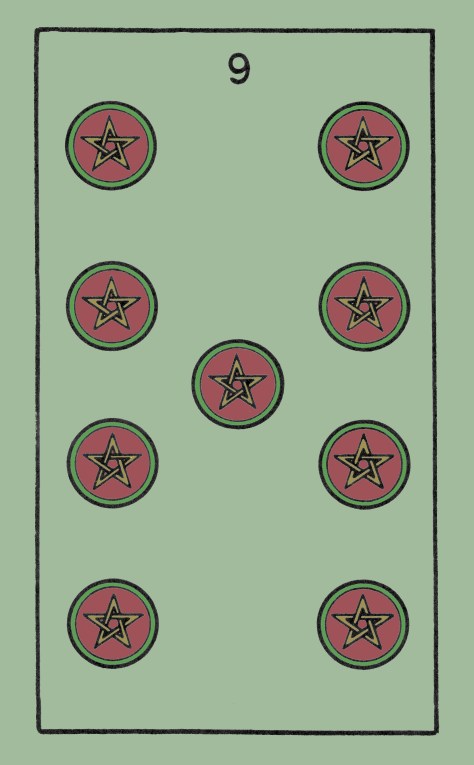
The Nine of Pentacles from the Builders of the Adytum (BOTA) tarot deck

Paul Foster Case (and Ann Davies)

The time period is the second decanate of Virgo, under the rulership of Saturn, September 3 to September 12. Meanings:
Well-Dignified: reserve, discretion, caution, frugality; some worries over money matters because of slow-maturing of plans; gain through careful investment. Occasionally when this card is especially welldignified, and other cards in the layout confirm it, this Key represents inheritance, material gain and much increase of goods, corresponding to the positive meanings of Saturn in Capricorn.
Ill-Dignified: discouragement; troubles through theft and knavery.
Keyword: Harvest.
(From the Oracle of Tarot course)

A. E. Waite

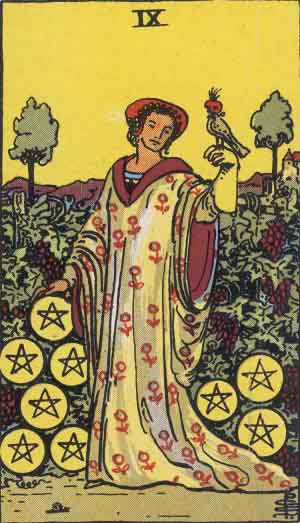
A woman, with a bird upon her wrist, stands amidst a great abundance of grapevines in the garden of a manorial house. It is a wide domain, suggesting plenty in all things. Possibly it is her own possession and testifies to material well-being. Divinatory Meanings: Prudence, safety, success, accomplishment, certitude, discernment. Reversed: Roguery, deception, voided project, bad faith.
(From The Pictorial Key to the Tarot)

The Nine of Pentacles from the Rider Waite Smith tarot

Aleister Crowley

The Nine of Disks is called Gain. The suit of Disks is much too dull to care; it reckons up its winnings; it does not worry its head about whether anything is won when all is won. This card is ruled by Venus. It purrs with satisfaction at having harvested what it sowed; it rubs its hands and sits at ease. As will be understood from the consideration of the Tens, there is no reaction against satisfaction as there is in the other three suits. One becomes more and more stolid, and feels that “everything is for the best in the best of all possible worlds”.

[…]

The number Nine, Yesod, inevitably brings back the balance of Force in fulfilment. The card is ruled by Venus in Virgo. It shows good luck attending material affairs, favour and popularity.

The disks are arranged as an equilateral triangle of three, apex upwards, close together; and, surrounded at some distance by a ring, six larger disks in the form of a hexagon. This signifies the multiplication of the original established Word-by the mingling of “good luck and good management”. The three central disks are of the magical pattern as in earlier cards; but the others, since the descent into matter implies the gradual exhaustion of the original whirling energy, now take on the form of coins. These may be marked with the magical images of the appropriate planets.

As a general remark, one may say that the multiplication of a symbol of Energy always tends to degrade its essential meaning, as well as to complicate it.
(From The Book of Thoth)

The Nine of Disks from the Thoth tarot deck

Golden Dawn’s Book T

A WHITE Radiating Angelic Hand, holding a rose branch with nine white roses, each of which touches a Pentacle. The Pentacles are arranged thus

* *
* *
*
* *
* *


and there are rosebuds on the branches as well as flowers. Venus and Virgo above and below.

Complete realization of material gain, good, riches; inheritance; covetous; treasuring of goods; and sometimes theft and knavery. The whole according to dignity.
Yesod of HB:H (Inheritance, much increase of goods).
Herein those mighty Angels HB:HZYAL and HB:ALDYH have rule and
dominion

Etteilla

Effect
Upright. In terms of the medicine of the spirit, this card, in its natural position, signifies: Effect, Realization, Positive, Accomplishment, Success.
Reversed. Deception, Fraud, Disappointment, Empty promises, Vain hopes, Failed projects.

MQS

Filling In The Blanks In Divination

If I were to start talking to you using just nouns, verbs and a small number of adjectives, your understanding of what I say would probably decrease, but not massively. The reason for this is that the lacking connecting words would probably be supplied by your mind. The context of what I say, furthermore, would allow you to pick mostly the right words based on your past experience, so while there would be a few problems here and there, you’d mostly be able to follow along.

In divination, we often find ourselves with blanks fill in between nouns, adjectives and verbs, which are generally represented by whatever the basic units of meaning are (cards in cartomancy, geomantic figures in geomancy, etc.) And while divination IS a language, the difference is that we have necessarily less experience with it than with natural languages, and that its vocabulary is necessarily more ambiguous.

Taking playing cards as an example, we essentially have only 52 words to play with, with the result that those 52 words must necessarily carry more possible shades of meanings than regular words in complex natural languages. These shades of meaning are generally given by the extended applications of the card’s main significations and other metaphorical takes on them.

The potential for errors, therefore, increases significantly, and that’s even before we take into account the fact that the connecting words are usually missing, and need to be supplied by our own interpretation. Finally, another factor is that the sentences of divination have much less context.

I often get questions by people who have been trying to get into divination but never seem to get a straight sentence out of their oracles. To be honest, it is an art, and like all arts it requires a ‘feel’ that can only be developed by banging your head against the obstalce long enough. However, another problem I often notice is that people tend to have excessive expectations of the type of answers they can get out of the oracle, especially at the beginning.

My philosophy is that I need to be only as specific as my current understanding and experience allows me to be. When you have a spread in front of you, don’t think you need to read a passage from Dostoevsky from it. Think more like having to make sense of the ramblings of a toddler. “Uhhh, something to do with three brothers and a question of faith” is good enough. In fact, it is much better to remain a bit vaguer than filling in the blanks the wrong way, which could potentially mislead the querent, especially since it is way to easy to let fantasy take over and take the interpretation in the wrong direction, and divination is NOT fantasy.

Skeptics might argue that this is way of trying to be right at all costs. It isn’t. It is, in fact, a perfectly philological method. I once did a reading for someone where I remember telling her something to the effect of “the cards seem to highlight something in the past connected with a person you were involved with and money issues with legal ramifications”. It turned out her ex had wasted most of their money in secret, and run away with the rest, triggering a divorce and other legal troubles. I could have filled in the blanks more thoroughly, but, at least based on my understanding at the time, I would have had to shoot in the dark.

The point is: do not feel you have to fill in all the blanks at all costs. You will always be able to be as specific as you need to be. Everything else is vanity.

MQS

Bolognese Tarot – Il Manuale di Cartomanzia by Lia Celi (Review)

The 45-card method, which is the one I’m trying to specialize in on this blog, despite being acquainted with and using the other methods as well, tends to be rather more obscure than the better-known 50-card one. One possible reason is that Maria Luigia Ingallati’s niche-defining book discusses the latter, and has consequently inspired others who follow her school.

Another separate source for the 50-card system is Germana Tartari’s book, whose approach I follow when using the 50-card deck, having been her student and now friend. Tartari’s book was also met with good success, further cementing the 50-card system in people’s imagination.

But before Ingallati made the Bolognese tarot available to a wider public there were a couple of books on the 45-card method, and Lia Celi’s Il Manuale di Cartomanzia (The Cartomancy Handbook) is one of them. The book was first published in 1999 and is very difficult to come by (don’t ask me how I got my copy. Or maybe do ask me, who knows.)

The subtitle of the book, “How to read tarot cards without boring yourself to death” serves as a good introduction to the style in which the book is written. Lia Celi is not a card reader, but a writer and journalist, and this is immediately evident in the refreshingly irreverent tone of the book. She did collaborate with some card readers to put together this book.

The second thing to notice is that, if you were to buy the book based on the front or back covers, you’d never know it’s about the Tarocchino Bolognese, as the title, subtitle and description simply talk about tarot cards and cartomancy, and even the cover art pictures regular tarot cards (I believe Sergio Ruffolo’s tarot).

The third thing to take notice of is that this is, broadly speaking, a good book. Honestly, it would be worth a read even if you had no interest in cartomancy, simply because it is guaranteed to tickle your funny bone on more than one occasion. And this is probably how the book was commissioned in the first place: as a fun and exotic read for the beach, aimed mostly at young women who may or may not choose to pursue cartomancy as a passion.

Given these presuppositions, Celi’s work has no right to be this informative. Pretty much everything you need in order to start using the 45-card system is offered to you in easily digestible bits: the various traditional methods on how to acquire, christen,1 study, shuffle and lay out the deck, the individual meanings of the cards (which are often easy to remember thanks to Celi’s sharp humor), a decent, if small, selection of traditional combinations, some of which I recognize from my own source, some practical advice on how to deal with various types of querents, and a final interview with the daughter of a card reader who is just setting out to practice the art herself, and who offers some advice. Clearly, Celi did her homework and did not skimp on looking for good information.

The card selection the author discusses is the same as the one I know, with one exception: she uses the Nine of Coins as the card of tears, while I use the Seven. Also, the meanings of some of the cards differ. For instance, she says that the Star is chiefly the card of health, while for me it is chiefly the card of business. Still, she does say that the Star is good for work and study, and even my own source taught me that the Star represents medications and healing in the right context. Besides, it is perfectly normal for a tradition like that of the Bolognese Tarot to differ a little from source to source.

The spreads Celi illustrates tend to be on the shorter side: a three-card spread, a four-card cross, a variation of the thirteen-card spread and a pyramid spread of fifteen cards that may be adapted to various questions.

So what is missing? Well, as in most books, what’s missing is the practical part. We have only brief mentions of how the cards interact with one another, so that if I didn’t come from a background in cartomancy and didn’t have access to first-hand information, I don’t know if I would be able to pick up a deck and start reading after finishing this book. Still, Celi’s Cartomancy Handbook is a good addition to your library if you are interested in the Bolognese tarot.

Where to find: This is the book’s amazon page. Unfortunately the book is unavailable, so your next best shot is ebay. However, the lord does work in mysterious ways…

MQS

  1. The traditional practice of ‘christening’ the deck or having it blessed so that, according to popular superstition, it starts working properly. In reality the deck works anyway and only in particular situations (such as curses or difficult periods) does it need to be blessed. ↩︎

Was That On Purpose? (Example Reading)

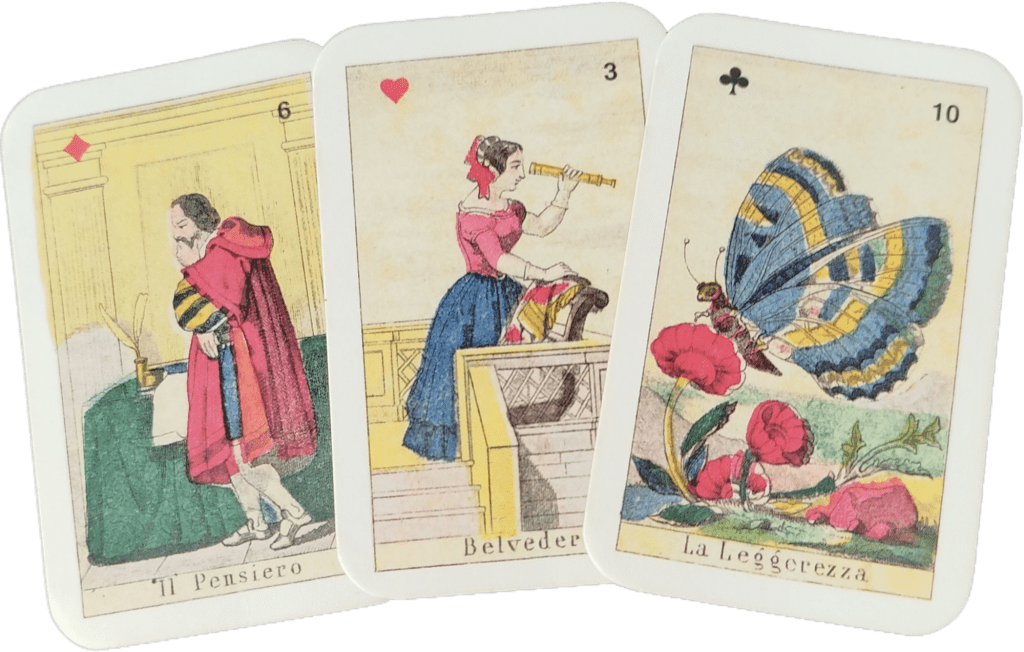
This one’s a quickie. A friend of mine who tends to take things way more seriously than she should asked if the boyfriend had really misplaced the small gift they had bought for her mother or if he had hidden it out of spite (he doesn’t like her mother). Knowing the dude I was quite sure she was overreacting. Still we asked the Sibilla:

Vera Sibilla reading: was that on purpose?

The Thought card is indicative of someone’s inner reality (their thoughts, plans, character, proclivities, etc). Since we asked about the boyfriend’s intention, the thought is his. The Belvedere card is usually associated with the arrival of something. However, it is also the card of sight. Next to the Ten of Clubs, which is a card of carefreeness, this seems to point to an oversight.

It turned out the gift had been left in the car, where it had lodged itself between the the two front seats. As silly as the reason for the reading is, it’s nice to have the cards confirm our suspicion.

MQS

Tarot Encyclopedia – The Nine of Cups

(Note: this is a collection of the meanings attributed to the cards by some occultists in the past centuries. It does not reflect my own study or opinion of the cards. It is only meant as a quick comparative reference as I develop my own take.)

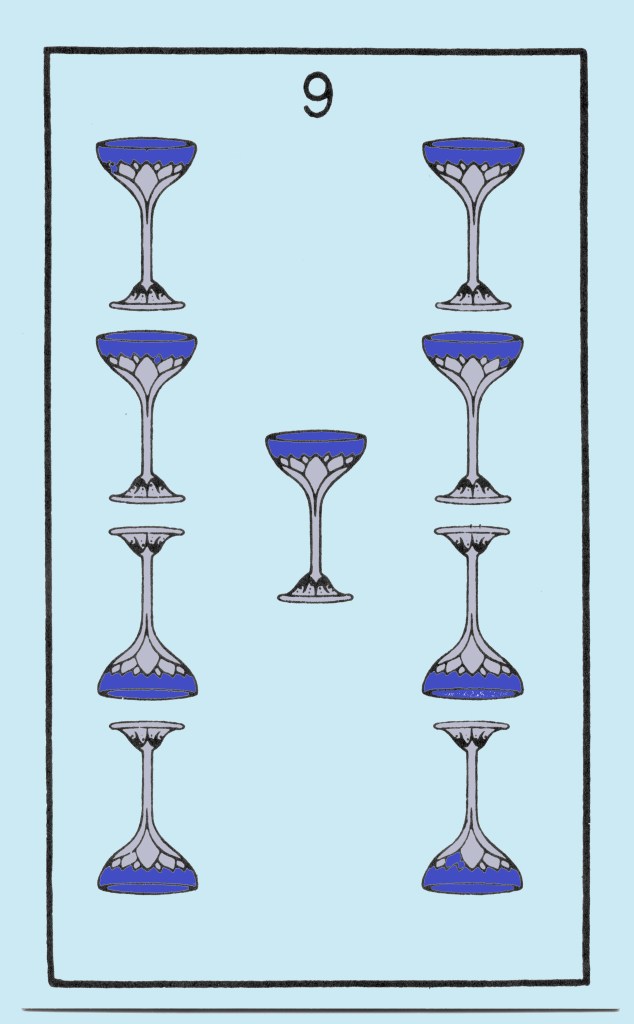
The Nine of Cups from the Builders of the Adytum (BOTA) tarot deck

Paul Foster Case (and Ann Davies)

The time period is the second decanate of Pisces, March 1 to March 10, under the subrulership of the Moon.
Well-Dignified: complete realization of desires; almost perfect pleasure and happiness; wishes fulfilled; physical well-being.
lll-Dignified: vanity, conceit, egotism; foolish generosity or ostentatious expenditure; the
person to whom the card applies is too easily led; one spoilt by
prosperity.
Keyword: Desire fulfilled.
(From the Oracle of Tarot course)

A. E. Waite

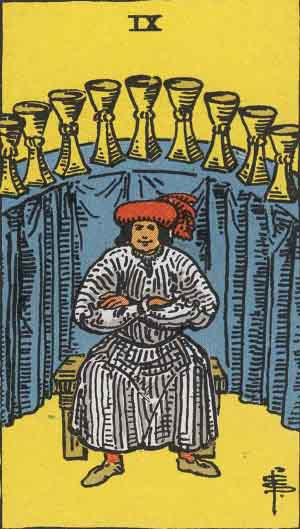
A goodly personage has feasted to his heart’s content, and abundant refreshment of wine is on the arched counter behind him, seeming to indicate that the future is also assured. The picture offers the material side only, but there are other aspects. Divinatory Meanings: Concord, contentment, physical bien-être; also victory, success, advantage; satisfaction for the Querent or person for whom the consultation is made. Reversed: Truth, loyalty, liberty; but the readings vary and include mistakes, imperfections, etc.
(From The Pictorial Key to the Tarot)

The Nine of Cups from the Rider Waite Smith tarot

Aleister Crowley

The Nine of Cups is called Happiness. This is a peculiarly good card, because happiness, as the word implies, is so much a matter of luck: the card is ruled by Jupiter, and Jupiter is Fortune.In all these watery cards, there is a certain element of illusion; they begin by Love, and love is the greatest and most deadly of the illusions. The sign of Pisces is the refinement, the fading away of this instinct, which, begun with dreadful hunger and carried on with passion, has now become “a dream within a dream”.

The card is ruled by Jupiter. Jupiter in Pisces is indeed good fortune, but only in the sense of complete satiety. The fullest satisfaction is merely the matrix of a further putrefaction; there is no such thing as absolute rest. A cottage in the country with the roses all around it? No, there is nothing permanent in this; there is no rest from the Universe. Change guarantees stability. Stability guarantees change.

[…]

The Number Nine, Yesod, in the suit of Water, restores the stability lost by the excursions of Netzach and Hod from the Middle Pillar. It is also the number of the Moon, thus strengthening the idea of Water. In this card is the pageant of the culmination and perfection of the original force of Water.

The Ruler is Jupiter in Pisces. This influence is more than sympathetic; it is a definite benediction, for Jupiter is the planet of Chesed which represents Water in its highest material manifestation, and Pisces brings out the placid qualities of Water. In the symbol are nine cups perfectly arranged in a square; all are filled and overflowing with Water. It is the most complete and most beneficent aspect of the force of Water.

The Geomantic Figure Laetitia is ruled by Jupiter in Pisces. For its meaning consult the “Handbook of Geomancy” (Equinox Vol I, No.2). Laetitia, Joy, gladness, is one of the best and most powerful of the sixteen figures; for the Solar, Lunar, and Mercurial symbols are, at the best, ambiguous and treacherously ambivalent; those of Venus portend rather relief than positive beneficence; Saturn and Mars are seen at their worst; and even the stable-companion of Laetitia, Acquisitio, has its unpleasant aspects, and even its dangers. But the consonance of Laetitia with this card amounts to little less than an identity; the wine is poured by Ganymede himself, unstinted vintage of true nectar of the Gods, brimful and running over, an ordered banquet of delight, True Wisdom self-fulfilled in Perfect Happiness.
(From The Book of Thoth)

The Nine of Cups from the Thoth tarot

Golden Dawn’s Book T

A WHITE Radiant Angelic Hand, issuing from a cloud holding lotus or waterlilies, one flower of which overhangs each cup; from it a white water pours. Cups are arranged in three rows of 3. Jupiter and Pisces above and below.

Complete and perfect realization of pleasure and happiness, almost perfect; selfpraise, vanity, conceit, much talking of self, yet kind and lovable, and may be self-denying therewith. High-minded, not easily satisfied with small and limited ideas. Apt to be maligned through too much self-assumption. A good and generous, but sometimes foolish nature.

Yesod of HB:H (Complete success, pleasure and happiness, wishes fulfilled).

Therein rule the Angels HB:SALYH and HB:a’aRYAL.

Etteilla

Victory
Upright. This card, as far as the medicine of the spirit is concerned, means, in its natural position: Victory, Success, Achievement, Advantage, Gain. – Pump, Triumph, Trophy, Preeminence, Superiority. – Spectacle, Arrangement, Equipment.
Reversed. Sincerity, Truth, Reality, Loyalty, Good faith, Frankness, Naiveté, Candor, Openness of heart, Simplicity. – Freedom, Science, Overconfidence, Familiarity, Boldness, Looseness, Debauchery

MQS

Which House Is Next To Which?

In astrology, the contiguity of the houses is obvious, since the houses are usually arranged either in a square or in a circle, but always forming a loop. Thus, we have that the Ascendant is always squished between the second house and the twelfth; that it always opposes the seventh, and, if we go by whole sign houses, that it has fixed relationships with all the others (inconjunct, sextile, square or trine).

This is not the case in Geomancy, where the relationship between houses is controversial, at least nowadays. First off, it is not pacific that the houses of the Shield represent astrological houses, unless we operate an equivalence with astrology, as was done at least since Geomancy reached Europe.

Those coming to Geomancy through Michael Greer, as I did, are probably used seeing the geomantic houses as equivalent to astrological houses: once the Shield is turned into a square chart, the houses follow the same astrological pattern as in an astrological chart. Those coming to Geomancy through the Golden Dawn, though using a different way of assigning the mothers to the houses (the one popularized by Agrippa), still end up dealing with a 1:1 replica of an astrological chart.

However, the idea that the Shield chart and the astrological chart are separate ways of doing Geomancy seems to be relatively new. In most old books, only the Shield is shown, and even when the astrological format is followed, this is done more to show some of the similarities with astrology.

Secondly, which house is next to which is not always clear, and sometimes varies by author. In some sources it seems that only houses that are in company are considered to be next to each other: first and second, third and fourth (but not second and third), fifth and sixth (but not fourth and fifth) and so on pair by pair. This seems to follow the order in which the Shield chart is generated.

An example shield chart. App used: Simple Geomancy

In the example above, Tristitia in the first is next to Via in the second, and Tristitia in the third is next to Conjunctio in the fourth, but not to Via in the second. This is possibly because the first and second combine to form the ninth and the third and fourth combine to form the tenth, but the second and third never combine. This approach obviously restricts the possibilities of perfecting the chart, since most houses end up losing a possible spot next to them for other figures to move to.

Another approach is the one I found while translating Abano’s work. Here Abano started by saying (or rather, implying) that the twelfth house is not next to the first. Initially, I thought this was because he was following the arrangement for the company of houses I just discussed. Yet he gives other examples where he does not follow it, for instance by implying that the eighth and ninth house are next to each other, which would contradict the company of houses (the eighth is with the seventh, the ninth with the tenth).

Then, in another one of his examples, he implies that a figure in the tenth house is next to a figure in the third. This does not make sense from an astrological standpoint, but from a sheer geomantic standpoint it does: the third house DOES border with the tenth, since it co-generates it with the fourth. This would also explain why he doesn’t consider the twelfth house to be next to the first: not because they are not in company, but because they are not close on the Shield (they are, in fact, on opposite ends of the shield).

This approach of considering the houses close on the Shield as being next to each other is certainly different from anything I’ve seen, especially in contemporary geomancy, and if it weren’t for the fact that enough readings I’ve done confirmed to me that the twelfth house CAN perfect with the first, I would find Abano’s approach extremely appealing. Unfortunately, one of my rules when dealing with divination is that practice trumps theory.

Abano goes even further, implying that the Witnesses (and possibly even the Judge) are to be treated as regular houses. This, in itself, is not unique to him, but what I find unique is that he considers the Witnesses capable of perfecting the reading, for instance if the first figure moves to the tenth and the quesited’s figure moves to the right Witness, where, by Abano’s theory, the two figures touch.

Another consequence of Abano’s approach is that not all houses are created equal: the first house, for instance, only touches with the second and the ninth, while the tenth house must be considered to be next to the ninth, eleventh, third, fourth and to the right Witness.

A possible argument, at this point, could be that this approach makes certain readings too easy (like those involving the tenth house, as I just showed). Still, we should keep in mind 1. that divination reflects reality, so a no is a no, regardless of the system 2. secondly, that Abano doesn’t always consider merely the querent and quesited. Often he considers the whole chart, and sometimes he resolves certain questions by dividing the shield into two sides (the left and the right side) and seeing which side is stronger. This is a method he has from traditional astrology, where questions of contest or war are often decided in such manner.

Ultimately, which approach we choose depends on what works, which means that the only way is to try, record and compare with what actually ends up happening.

MQS

The Home – A Deep Dive Into Cartomancy

Following my deep dive into the symbols of the door knockers and the road in divination by cards, I want to tackle the symbol of the home. This, too, like the road, is a widespread symbol that is almost never absent from any divination system of a practical nature (I am aware of systems for playing card divination based on Rider Waite symbolism, but they have very little practical use).

The popularity of the symbol of the home is simply a consequence of its importance in people’s lives. The home or house card is, in most systems, a ‘topic’ or significator card indicating the querent’s or someone else’s house, and the cards surrounding it show us the atmosphere or happenings of the household. Its practical value, therefore, is immense.

In the earliest recorded system for reading the tarot, which is Pratesi’s guide for the Bolognese tarot, the house card is the Ace of Cups. This meaning is retained in the more modern variants of the method. This is also an almost universal constant in cartomancy, since the Ace of Cups or Hearts is almost always taken as a symbol of the home.

Whether this association originates with the Bolognese tarot I don’t know. It is possible that the symbolism is simply suggested by the shape of the Ace of Cups. In the Visconti tarot, the Ace of Cups is a water spring similar to a baptismal font, but in many old decks it can look similar to a walled structure. If we add to this the fact that the function of the cup is to contain, it may be that this could have suggested the idea of the house to old cartomancers, since a house is a large (the ace is large) containment structure.

Similarly, in almost all card reading systems using Italian regional cards, the Ace of Cups is the home, although I am aware of a couple where the meaning is attributed to the Four of Cups, possibly due to the squarish form suggested by the arrangement of the pips. The Ace of Cups is also the house card in the Sibilla regionale, which is the second-most widespread sibilla deck in Italy.

Why the same idea of home as the Ace was suggested by people using regular playing card suits is unclear, since the Ace of Hearts does not look like anything but a heart. Still, if the system I was taught is anything to go by, the main idea is that hearts deal with one’s emotional life and nourishment, and the home is the origin and source (ace) of our emotional life, the place where our first (ace) needs are met. As a matter of fact, the person who taught me cartomancy with playing cards often insisted that the Ace of Hearts is not just any house (though it can be, in practice) but especially one’s home, where we come from (the ‘spring’ we come from, in the Visconti sense), which is why an extended meaning of the house card is often one’s family.

The same attribution of the Ace of Hearts to the home is found in most systems I am aware of, including German cartomancy and most English and French methods. As far as tarot is concerned, we find that, in some earlier tarot documents, the Tower is simply called ‘casa’ (house), before being called House of God or House of the Devil in some other decks (the title ‘Tower’ is actually a rather late innovation).

Etteilla assigned the house to the Ten of Coins, which Waite retains in his illustration of the Ten of Pentacles, while Paul Case generally matched the house with the Two of Cups, among other things. However, this was more of an accidental consequence of the Golden Dawn attribution of the first cards of the suit of Cups to the zodiac sign of Cancer and, according to the sign/house equivalence theory, to the fourth house, which is the house of the father and therefore of one’s fathers and one’s family/house.

The Sibilla is a partial exception to the rule of the ace as the home, as the House card is given to the Two of Hearts. The meaning of origin (which metaphorically, depending on the reading, can also indicate the origin of a problem) is retained. Still, the Ace of Hearts is also given to the family and to people living together, among other meanings.

The Sibilla, like the Kipper cards, distinguishes between a House card and a Room card. This is probably because both decks seem to have been consolidated from earlier German or Austrian decks which also had similar cards, although the makers of the Sibilla also took playing cards into consideration.

I cannot speak to the Kipper cards (nor to Lenormand, where there is a House card, attributed to the King of Hearts), but in the Sibilla, the Room can represent a small(er) apartment, as well as a place in general, but it doesn’t usually have a connection with the emotional side of life, like the House, although it can represent intimacy, since it is connected with rooms in general, but with the bedroom specifically.

MQS