Tag Archives: Cartomancy

Enneagram Comparisons | Type One and Type Nine

Enneagram Type One and Enneagram Type Nine are different in many respects. Both are Body types, and are therefore concerned with issues of autonomy. Neither of them is as assertive and warrior-like as Type Eight, the other Body type, but both find different strategies to preserve their autonomy. Nines seek to maintain their autonomy by being friendly and avoiding conflict with others. Ones maintain their autonomy by justifying it rationally as a means for them to pursue an ideal of rightness or justice.

While both Nines and Ones can believe that justice is important, for Nines justice is more a matter of harmonious balance with others. They do not quibble about rules and methodologies and are more than happy to accept (or even to sugarcoat) the world’s and other people’s shortcomings. They usually do not go out of their way to convert others to their point of view and prefer to keep peace, something alien to Ones.

Both Nines and Ones have a difficult relationship with anger. Nines are the least choleric of the nine types, and often need to work hard on themselves to learn to express anger and disappointment when it is appropriate. Average Nines may even feel that the notion of anger is completely alien to them. Ones certainly feel their anger simmering inside of them, but they have a difficult time expressing it directly.

harmony

Both types can be passive-aggressive. Nines are so in an attempt to neutralize other people’s agendas that risk disturbing their peaceful flow. In this sense, they are passive saboteurs. Ones are passive-aggressive because they would like everything to be perfect and everyone to accept that they are right about what it means for everything to be perfect, but they generally find it hard to boldly force others to comply. Furthermore, they often project onto others the anger they feel at their own shortcomings.

In general, Nines believe that the world is (or could very easily become) a good place, and usually keep themselves mentally occupied with bucolic platitudes about themselves and the world. Ones are more pessimistic about the world and about human nature, as they tend to see the world as the negative of a perfect picture that requires an inordinate amount of effort to reach. Furthermore, Ones tend to be methodical and spurred on by clear objectives. Nines, on the contrary, are more placid and, while not necessarily inactive, they can content themselves with following their routine without rigid aspirations and methods.

MQS

Using Playing Card Divination on Psychological Questions (Example Reading)

There is a general stigma toward certain forms of divination such as cartomancy with playing cards, namely that they are good at discussing mundane issues, while the Tarot should be used for deeper questions. This presupposes two things: that deeper questions don’t take place in the same world as regular life and that the Tarot is too deep to talk about everyday occurences. Both these beliefs are wrong.

The Tarot is perfectly capable of talking about whatever it wishes, just like playing cards, the Sibilla deck and every other oracle. The first presupposition, though, is more insidious and requires a bit more discussion.

The oldest extant series of tarot meanings has been retrieved in Bologna. The meanings there are what you would expect from a fortune-telling deck: the Ace of Swords is a letter, the Ace of Cups the house, the Hermit an old person etc. Furthermore, some rare examples of tarot fortune-telling in pre-modern Italian literature confirm that the Tarot has probably been used for such aims long before the occult revival started by Court de Gébelin, which slowly removed the Tarot from real life and confined it to the realm of “higher metaphysics”, that is to say, of psychological onanism.

In order to justify this “higher” (I would say emptier) use, several hypotheses on the Tarot’s origins have been put forth, depending on what was considered fashionable and not too easily disproven at the time. First it was the Egyptians, then the Kabbalists, then the Cathars, etc. Instead of being seen for what it obviously is, namely a wonderful product of European Neoplatonic Christian art that anyone before the Enlightenment would have immediately understood and considered familiar, and that only the ignorance of our post-Enlightenment metaphysicians could try to disguise as a distant voice coming from distant secret masters to apply in the understanding of distant matters, rather than an immediately obvious tool to mirror immediately obvious real life situations, which are all instances of an eternal story that constantly tells itself.

So yes, the Tarot can talk about daily experience. In the same way, other, more apparently mundane forms of fortune-telling can talk about problems that some would consider ‘deep’. Just like the Tarot, they can talk about it in immediate terms, immediately understood by anyone with who has some understanding of symbols.

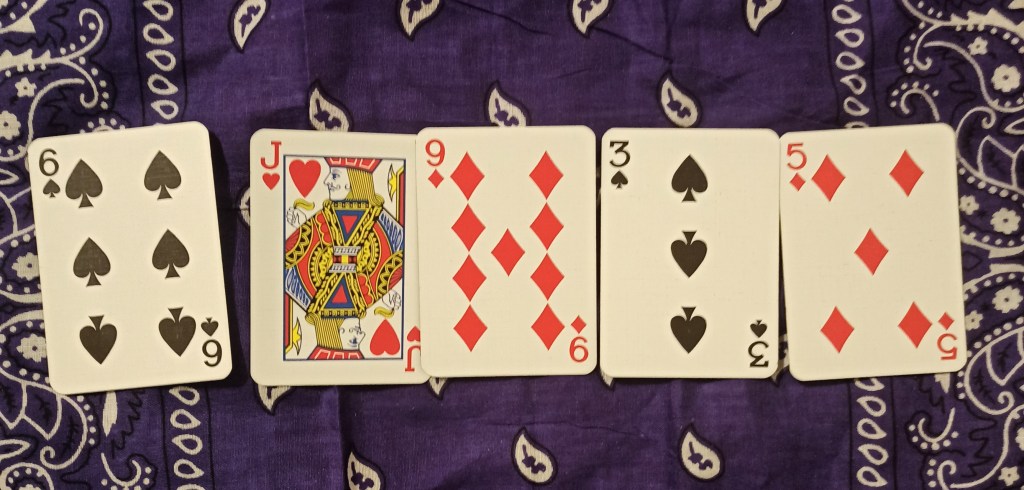
Here’s an example of playing cards used for a ‘deeper’ reading. The querent is a woman I met at an Enneagram convention. She asked what was the reason for her constant bouts of depression. These are the cards:

“Why am I always depressed?”

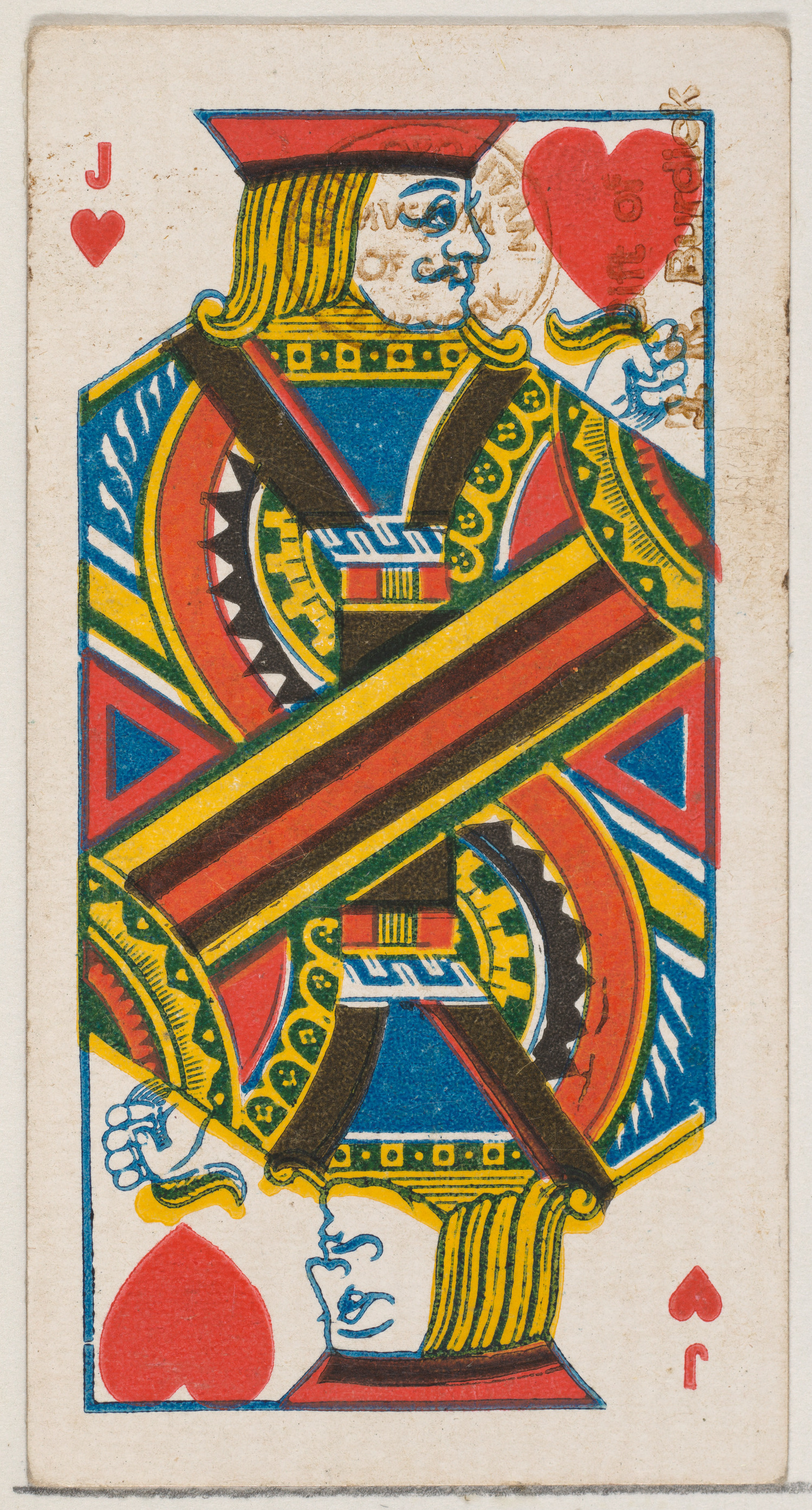
There is a sickness in her life, signaled by the Six of Spades. There are no cards of deep trauma, but something definitely needs healing. This card falling first sets the tone. The Jack of Hearts represents a child, a project, etc. Next we have the Nine of Diamonds, which is a card that represents the realization of ambitions, but more broadly can represent ambition. Then we have the Three of Spades and the Five of Diamonds. These two cards oftne indicate turning away from something. But the Three of Spades also comes directly before the ambition card. So she has turned away from some ambition. Two possible interpretations that came to mind are that she had the ambition of having a child but couldn’t or that she turned away from a childhood ambition.

I asked her, and it was the second possibility. She’d had big dreams for her life when was a child, but some disappointments had led to seeing them as unrealistic and she had let go of them. I told her that she hadn’t really let go of them, otherwise the Six of Spades wouldn’t have shown up: those ambitions still fester inside of her, and the fact that she is not doing anything about them could make her sick if she isn’t careful. These cards clearly show that she needs to go after her dreams, perhaps in her free time. Alternatively, if she doesn’t want to, she needs to truly let go of them and move on.

MQS

People have the Power | Cartomancy with Playing Cards

Court cards are scary, because they don’t seem to have a logical meaning, or at least not a prominent one. Instead, they represent people, and this can be inconvenient, because people exist in the real world and need to be described more or less accurately for the reading to be useful. This can be very difficult.

Queens and Kings are more likely to represent people and less likely to represent concepts, although on occasion they might. The K♣ and Q♣ are the two querent cards, and only in the rarest occasion do they stand for anything other than that.

A general rule of cartomancy (not just with playing cards) is that action happens in the spread. Who is not in the spread does not act. This can take on a variety of meanings, but most commonly what it means is that, for instance, if the querent doesn’t show up, they are relatively passive, and it is going to be harder for them to change the situation.

A natural corollary to this is the fact that if a person does show up in the spread, they influence the situation directly. Example: a female querent once asked me if she would find a job. The cards were:

10♠ – Q♥ – 7♥

The querent is not represented in the spread. This doesn’t mean that she wasn’t actively looking for a job (she was). It just means that her looking for one won’t solve the problem. Instead, out of nowhere (10♠) a woman will provide the solution in an unexpected way. What happened was that an aunt who lived far from home and didn’t even know the niece was looking for a job phoned and she happened to mention that there was an opening in the company she worked at that she needed to fill. Once she discovered the niece was looking for a job she helped her get the job.

Another example. A friend of mine once asked if the relationship that had just ended would resume (he had been left)

K♣ – 5♣ – A♦

An accumulation of Clubs is not good when asking about reconciliations. Here, the querent’s significator is shown acting (Five of Clubs) to start something new (Ace of Diamonds.) A week later he met a new girl and he (successfully) went after her. Here, despite the question, it is clear that the previous girl is completely out of the picture and cannot influence the events, so much so that later on she tried to reconnect with him (obviously, when she noticed that he was taken) but the spread showed that he was the one wielding power within the situation and was committed to the new.

MQS

Cartomancy with Playing Cards | Queen of Hearts and King of Hearts

In cartomancy with playing cards, the Queen of Hearts (Q♥) and King of Hearts (K♥) represent loved ones.

They are slightly positive cards, although their true meaning will be revealed by the surrounding cards. In themselves, they portray a man or a woman in a positive light, because the suit of Hearts is positive in itself. Often, they indicate people whom the querent already knows and have an emotional connection (or a blood one) with him or her. They may show up as parents.

In love readings, it’s important to remember that the official querent is the Q♣ or K♣, and their partner will be the other Club card. However, if the cards want to show, for instance, that the male querent will break up with his partner and will then find a new girlfriend, the Q♥ would show the new one. Same for the woman with the K♥. In gay relationships, though, the Q♥ and K♥ can show the official or perspective partner.

In career readings, usually these are positive figures who have the querent’s best interest at heart and often an emotional connection to him (though not necessarily a romantic one). Keep in mind that it’s a little weird for a boss to show up as a Heart figure, unless they are your parents or you have very close bond of affection with them. Still, if the question is “will he or she help me?” the fact that they show up as a Heart is encouraging.

Usually Queens and Kings are people. Rarely, they can take on allegorical meanings. In that case, the Queen of Hearts indicates acceptance, receptivity, obedience (not necessarily submission), docility and nurturing situations. The King shows positive decisions made by or for the querent, including in a legal setting.

Finally, the Q♥ and K♥ represent all things feminine and all things masculine, respectively.

Spiritually, they can indicate deities (in Catholic Italy, the Queen of Hearts is Mary and the King God).

Combinations:

Q/K♥ + 2♥ + 9♥ = the realization of your wish is dependent on a man or woman who is very close to you and will further you (same if 3♥ instead of 9♥), usually a very close friend or a relative
Q/K♥ + 10♠ + J♠ = a man/woman that appears good but harbors negative feelings
A♦ + J♣ + Q/K♥ = a new positive friendship with a man/woman
4♣ + Q♥ = it can mean a lot of things, but broadly, if the Q is not a woman, it shows that your words are deeply understood by other people, what you say is accepted by others. If K♥, it still means the man is truthful
A♠ + Q♥ + 5♦ + K♥ = transition female to male (if you swap the Q and the K, it’s male to female)

Cartomancy with Playing Cards | Jack of Spades

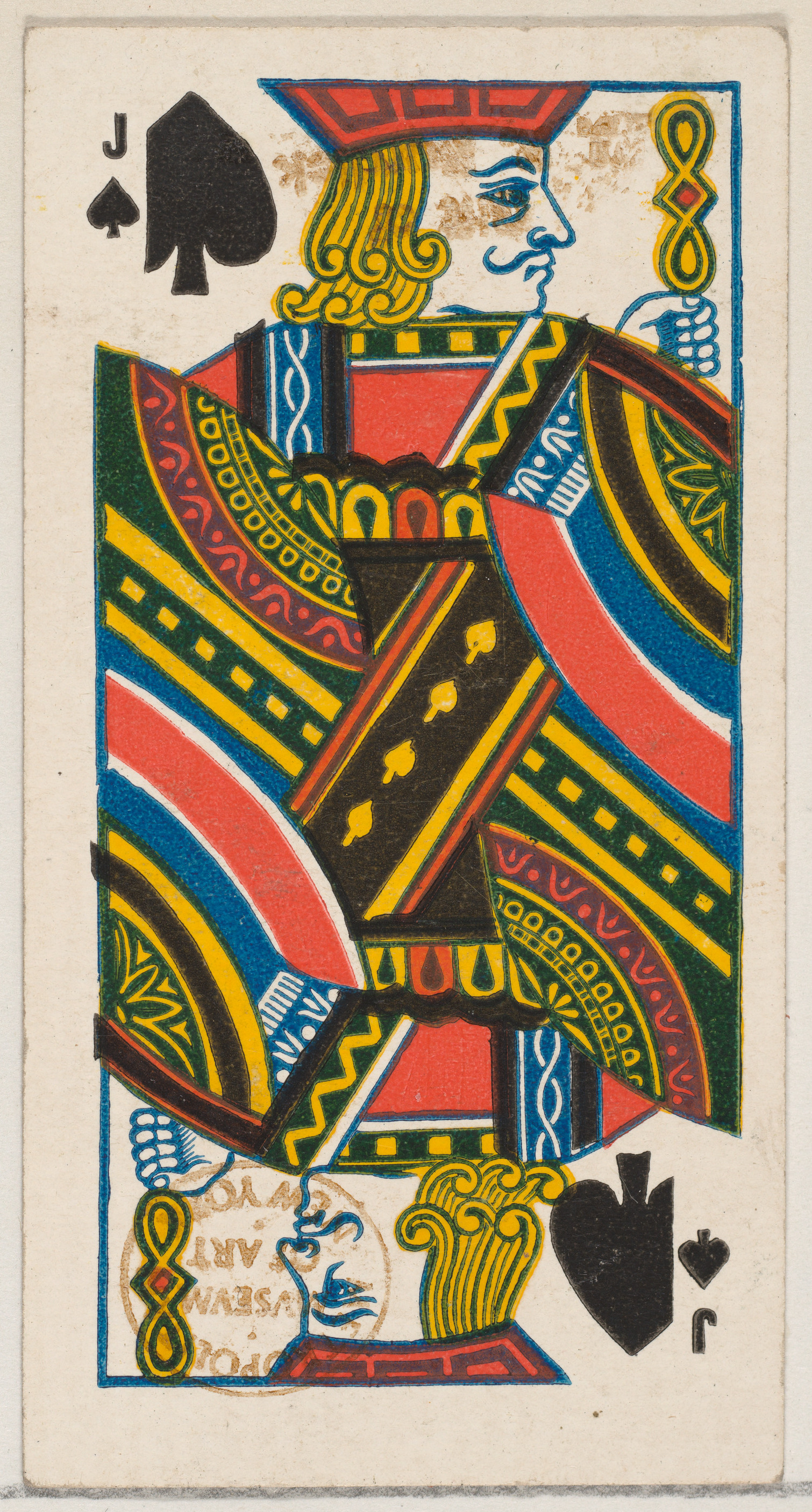
In cartomancy with playing cards, the Jack of Spades (J♠) is the card of enmity.

Like all Jacks, it can represent a child, albeit rarely. When it does, the child is “problematic”, to use an abused word. He or she is either difficult or has a problem (for instance, he could be sick, and this is especially bad in pregnancy readings).

In general, this card represents the opposite of the Jack of Hearts, as it indicates a negative attitude and ill-will. It personifies the desire to hurt or to do something bad or illegal or at least somewhat shady.

In relationship readings, the Jack of Spades indicates poor communication, disharmony and possibily the desire to cheat. Together with a face card indicating another person outside of the couple, it can show a rival. Broadly, it shows underhandedness. It can also mean spying.

It can also signify more mundane things. For instance, after a disagreement, having the Jack of Spades near your partner’s card simply shows they still need time to get over their anger. In this sense, they are still your “enemy”. This can be true for every kind of personal relationship.

In work readings, the Jack of Spades can show the presence of ill will on the workplace, rivals and enemies of all kind. However, this is also the card of the uniform, and it is connected to jobs in the armed forces in a neutral sense.

Psychologically the card shows malice and a poor attitude in general, pettiness, double standards and slyness. Spiritually it’s connected to evil spirits,evil thought forms and being “bad” in general.

Combinations:

J♠ + K♠ = if pertinent, it indicates a policeman or soldier (if also 5♠, arrest)
J♠ + 9♦ + 3♠ = one possible combination of slander (9♦ is the reputation)
A♥ or 2♥ + J♠ = disharmony and enmity at home or close to you
J♠ + 5♦ + J♣ or any positive card, especially a ♥ = enmity turns to friendship
J♠ + 6♠ = it can indicate a morbidly negative attitude, in a health reading it can indicate parasites or viruses

Cartomancy with Playing Cards | Jack of Diamonds

In cartomancy with playing cards, the Jack of Diamonds (J♦) is the card of the messenger.

Like the other Jacks, the Jack of Diamonds can, albeit rarely, indicate an actual person, usually a kid or teen. This kid is smart and energetic, mostly positive. More likely, however, the card is one of communication. It is the archetype of the mercurial bearer of news, and it is neutral. If followed by negative cards, it shows bad news. With cards of blockage, it shows delays in receiving news.

The Jack of Diamonds is also the card of the go-between, not unlike the corresponding Vera Sibilla card. It indicates someone or an agency mediating between two parties. Sometimes it indicates the process of mediation itself.

Finally, the Jack of Diamonds can signify the knowledge of facts and acquiring knowledge of facts as an extended meaning of the idea of message. As such, this is one of the playing cards connected with study and studying.

In love readings, the card often signifies messages, but it can also show the presence of a third party mediating between two lovers, although this was more common in the past. This is especially when the Jack falls next to a face card.

In career readings, the Jack of Diamonds indicates much the same. If it describes a job, it indicates one that requires a certain level of education. It can also be a job dealing with information. Needless to say, it shows students.

Psychologically, the card shows a lively intellect and much nervous energy. Usually a person influenced by this card will find it hard to keep his mind still and often looks for new stimuli. Spiritually it indicates signs and messages from above (or from below, with the appropriate cards, as, unlike the Jack of Hearts, that of Diamonds is too mercurial to be inherently good)

Combination:

J♦ + 2♦ = it can be a literal postman bringing correspondence | a student

6♦ + 9♣ + J♦ = worry about a delay in the arrival of a message or package

J♦ + Face + 4♥ = an agreement reached thanks to a third person

J♦ + 6♠ = in addition to indicating messages about sickness, it indicates mediation efforts gone awry

2♣ + J♦ = it can indicate studying (intellectual steps)

Cartomancy with Playing Cards | Jack of Clubs

In cartomancy with playing cards, the Jack of Clubs (J♣) is the card of friendship and help. Rarely, it can represent an actual person, usually very young, such as a child or teen. When it does, the person is usually helpful, good, constructive.

In love readings, when coupled with Hearts, the Jack of Clubs is a wonderful card of mutual support, indicating that two partners have each other’s back, and that their love finds practical “application” in daily acts of kindness and support for one another. However, if in a more negative context, the Jack of Clubs can show that the situation is more akin to friendship. Note that, if followed by cards that negate its meaning, the Jack of Clubs can indicate lack of help or support, and so it can point to an unsupportive partner.

In work-related questions, the Jack of Clubs is a card of many meanings. When it indicates a type of job, it shows service and help, in whatever context it may be (look at the other cards). Unless assisted by cards of wealth, in itself this card does not promise great realization, as it is more indicative of someone in a helping or secondary position. It is also the card of friends and, by extension, co-workers. Especially with Spades, it can highlight a situation of mobbing, or, failing that, a bad work environment or an underpaid job. Help can also indicate help in health matters, and so with certain cards it can indicate a nurse.

In money issues, the Jack of Clubs does not have a specific meaning, however, with money cards, it can show financial help and support. When quantifying a sum of money, the card tends to restrict it somewhat.

Psychologically, this card indicates a practical, constructive, helpful attitude. Again, look out for negative cards after it, as the meaning may totally opposite. Spiritually, the Jack of Clubs indicates much the same, however in esoteric readings it can indicate a positive familiar spirit or elemental, but not an angel.

Combinations

Face card + J♣ = A friend or colleague (friend can mean someone who will lend a hand)
J♣ + 8♦  + 3♣ = A business partnership (instead of the 3♣, a money card could be present)
J♣ + 5♠ = it can mean helplessness or lack of friends (the 3♠ would indicate loss of support)
4♣ + J♣ = counseling or, more broadly, words that help
Q♣ + 4♠ + K♣ + J♣ = the relationship is stale, it’s turned into more of a friendship

Cartomancy with Playing Cards | Jack of Hearts

In cartomancy with playing cards, the Jack of Hearts (J♥) is generally the Child card.

All the Jacks can represent children, but the Jack of Hearts is the one that is most likely to. When it does, it is a neutral significator card. You will read the child’s characteristics and “fate” from the surrounding cards. Needless to say, this is an important card in issues surrounding pregnancy.

When it does not represent a literal child, the Jack of Hearts takes on the symbolic attributes of children: playfulness, purity, freshness, gullibility, immaturity, inexperience. It is slightly positive, but can easily become negative when in a negative context.

In love readings, the card broadly speaks of something that has begun or will begin, and that therefore is in its initial stages. This is when a relationship is at its most fun and people get to know each other, but it also means that the couple doesn’t have deep roots (yet). It is a fun, flirtatious, adventurous card, and if not spoiled by negative cards it holds the promise of a long and stable future, because children have their whole life in front of them.

When the Jack of Hearts comes up for a couple that has been together a long time (say, at least three or four years), it can mean they have a child or that they still have a fresh and playful attitutude. With negative cards, though, it indicates shallowness and lack of true commitment, and can point to potential cheating. Only potential, though. You need confirmation from other cards. Broadly, the Jack of Hearts indicates flirting.

In a work reading, the Jack of Hearts indicates a new job or a job connected with children. It is also a card of inexperience, so if other cards indicate trouble, this can be due to not knowing what you’re doing. It can also indicate new arrivals and new colleagues. In itself, it shows that the querent is well-liked in a new work environment (or any environment), just like generally people will sympathize with children and pamper them.

In money matters, the card is a bit ambiguous, as, unless it indicates new ventures, it often shows a chronic inability to hold on to your money. However, it can also signify that you are unprejudiced and will pursue new avenues, so it can speak of brilliant financial abilities.

The above also applies to a person’s character. Depending on where it falls, the Jack of Hearts will highlight positive or negative traits. From a spiritual standpoint, the card is among those connected to prayers and positive thoughts in general, as well as to angels.

Combinations

J♥ – J♠ = can be a misbehaving or problematic child
J♥ – 7♦ or 3♦ – 3♠ = financial loss due to carelessness
10♣ – 4♥ – J♥ – A♥ = a trip to your childhood home (and therefore your family home)
5♥ – J♥ – 9♥ or 10♥ = One of the combinations that indicate a pregnancy (a wanted one)
J♥ – 8♦ – 6♣ = a new business that drains a lot of energy (the querent is tired). Implicitly, this means that the venture is not going very well

Cartomancy with Playing Cards | Ten of Spades

In cartomancy with playing cards, the Ten of Spades (10♠) is the card of secrets.

All tens in cartomancy relate to the idea of goal or destination. While the Ten of Hearts represents the querent’s hometown, the Ten of Clubs travel and the Ten of Diamonds another city, the Ten of Spades indicates destinations that are abroad and unknown.

As an extended meaning from this, the card indicates all things that are unknown, unfamiliar or secret. It’s a card of mysteries, lack of clarity and lack of awareness. Another extended meaning is that it represents the night and things taking place at night, while the Ten of Hearts represents the day.

Because tens represent goals, the Ten of Spades is the card of negative goals. It represents all things that are illegal, underhanded and shady. It’s also a card of silence and lack of communication, which can be a meaning if the other cards in the spread are good.

In love, the Ten of Spades can indicate marrying someone from abroad, eloping in secret or, with bad cards that reinforce the meaning, cheating. In work readings the Ten of Spades can simply indicate working the graveyard shift or a night job, but it may also indicate illegal activities.

When near card that indicate failure, the Ten of Spades reinforces the notion and makes it final.

Psychologically, the card is connected to hidden thoughts and to the subconscious mind.

Some Combinations:

K♣ – 3♣ – Q♣ – 10♠ – K♠ = she has a man on the side
4♣ – 10♠ = secret meeting to talk about something | can mean lack of communication
10♠ – J♠ – 3♠ = theft
9♣ – 10♣ – 10♠ = traveling abroad
3♦ – 10♠ = moonlighting

Cartomancy with Playing Cards | Ten of Diamonds

In cartomancy with playing cards, the Ten of Diamonds (10♦) is the card of success.

All tens relate to the idea of goal or destination. The Ten of Diamonds tends to interpret the notion on the material plane, therefore it signifies the concrete ability to reach goals. Just as the other tens, it also connects to physical destinations, but while the Ten of Hearts represents the querent’s hometown and the Ten of Clubs represents travel, the Ten of Diamonds represents another city. Not necessarily a distant one though.

In love readings the Ten of Diamonds indicates the reaching of common goals. It is especially good if the couple has concrete projects to realize together, as it indicates success in these. It is not a card of feelings, but it does show that the people involved (or at least one of them) is serious, as high morals and values and is willing to commit.

In money and career readings, one of the possible meanings is a large sum of money. The other cards will specify what is being done with it. Otherwise, the Ten of Diamonds represents the completion of personal projects and job security. Usually it represents professions where one has other people under them, but not always. It also indicates lots of energy, so the person is certainly taking their job (or passion, hobby, etc. Depending on the question) very seriously.

Psychologically, the card means that the person can be relied upon. They are dependable and have high values, and will generally do what’s honorable. Negative cards can however negate this trait, showing someone who is shallow and unreliable.

Some Combinations:

10♦ – A♥ – A♦ = investing money to buy a new house
10♦ – 4♠ = money problems (psychologically, one not to be relied on)
J♥ – 10♦ – 3♠ = foolishness leading to losses
10♦ – 5♥ – 9♦ = living in luxury
5♣ – 10♦ = a large investment