Traditional cartomancy, like all traditional divination systems, is full of tips on how to handle spiritual topics. The difference with contemporary psychobabble is that in traditional cartomancy we deal with a spirituality that is rooted in the earth and in everyday life rather than in Mind/Body/Spirit section poppycock. As I often remark, in such systems spirituality is seen as the logical next step for someone who is acquainted with real life, not as a consolation prize for someone who is trying to avoid it.
The querent asked if her boyfriend believes in “a superior being”, by which I assume she meant God (“being” is probably a more reassuring term compared to “bearded guy holding a lightning bolt”). She places great importance on the topic, but he seems to avoid talking about it. This is a playing card reading. In the next days I will also post a Vera Sibilla reading done on a similar question by a different person some time ago.
A♥ – 8♣ – 9♣ – K♥ – 7♣
Seeing this, I asked the querent to draw three more cards to open the reading on the Ace of Hearts, which yielded the 2♠, the 2♣ and the 6♣.
The first thing I noticed was the complete absence of Spades (except in opening the spread, but that’s a very weak Spade). This generally bodes well for spirituality. However, there is also a majority of Clubs, which indicate struggles and difficulties. There is no need to interpret the spread card by card. The spread indicates a slow or difficult relation with the divine. Belief is not denied, but it is rendered heavy, problematic.
The first card is the Ace of Hearts, which can indicate “inner” issues, but because the first card in a spread can also represent the cause of a situation described by the following cards, I ventured to interpret it as issues relating to the home causing the querent’s boyfriend to falter in his faith. The three additional cards with which I opened the spread on the Ace of Hearts reinforced my idea that there must have been a difficult atmosphere at home surrounding the topic.
What about the King of Hearts? Is it the dad? Well, no. Traditionally, in spiritual readings the King of Hearts is God himself (just like in the Sibilla): he is the lord (King) of your inner life (Hearts). Surrounded by all those Clubs, the God-side of the boyfriend’s life suffers, is stifled. Yet it is there, since the King of Hearts comes up and is not surrounded by Spades.
I asked the querent to give another three cards to open the spread on the King of Hearts. These were the 10♠, the 4♣ and the 10♥. At night (Ten of Spades) he speaks (Four of Clubs) spiritually/finding consolation (Ten of Hearts). He prays to God at night.
This is intended as a collection of meanings attributed by some sources to the Major Arcana and Minor Arcana of the Tarot. I will add sources as I study them. If you have sources to recommend, hit me up.
If you are interested in a (partial) list of the meanings I attribute to the Major arcana in my reading examples and case studies, click here.
(Note: this is a collection of the meanings attributed to the cards by some occultists in the past centuries. It does not reflect my own study or opinion of the cards. It is only meant as a quick comparative reference as I develop my own take.)
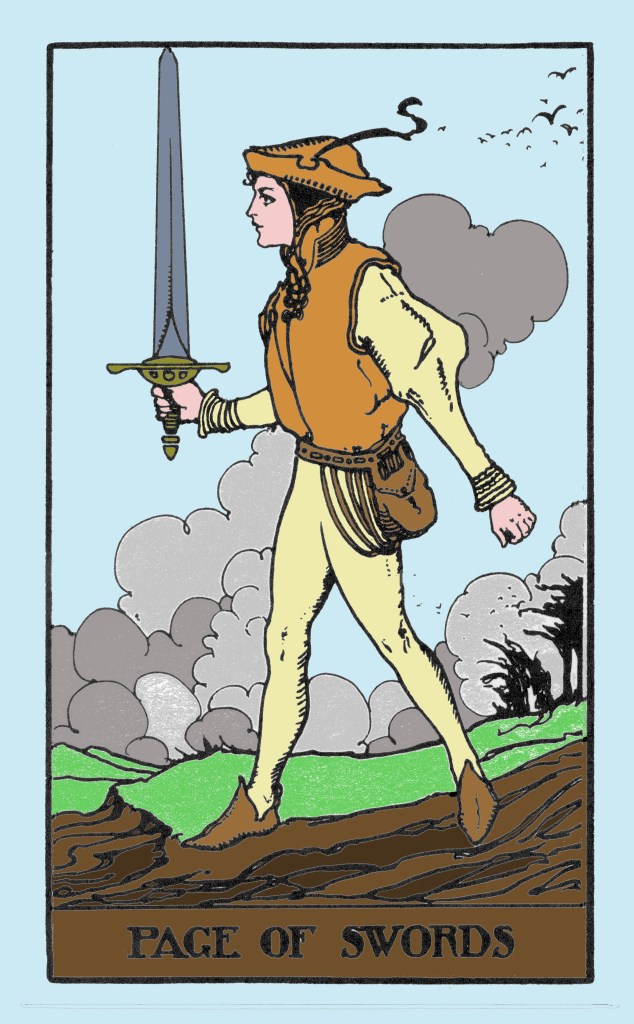
The Page of Swords from the BOTA (Builders of the Adytum) Tarot deck
Paul Foster Case (and Ann Davies)
The time period is from the beginning of Libra to the end of Sagittarius, September 23 to December 21. Meanings: a young person of either sex. Artistic, active, generous. Capable of weighing evidence, somewhat interested in occultism, philosophy or religion. Naturally aspiring, graceful. If Ill-Dignified: frivolous, cunning and prodigal Light brown hair and blue eyes (From the Oracle of Tarot course)
A. E. Waite
A lithe, active figure holds a sword upright in both hands, while in the act of swift walking. He is passing over rugged land, and about his way the clouds are collocated wildly. He is alert and lithe, looking this way and that, as if an expected enemy might appear at any moment. Divinatory Meanings: Authority, overseeing, secret service, vigilance, spying, examination, and the qualities thereto belonging. Reversed: More evil side of these qualities; what is unforeseen, unprepared state; sickness is also intimated. (From The Pictorial Key to the Tarot)
Aleister Crowley
The Princess of Swords represents the earthy part of Air, the fixation of the volatile. She brings about the materialization of Idea. She represents the influence of Heaven upon Earth. She partakes of the characteristics of Minerva and Artemis, and there is some suggestion of the Valkyrie. She represents to some extent the anger of the Gods, and she appears helmed, with serpent-haired Medusa for her crest. She stands in front of a barren altar as if to avenge its profanation, and she stabs downward with her sword. The heaven and the clouds, which are her home, seem angry.
The character of the Princess is stern and revengeful. Her logic is destructive. She is firm and aggressive, with great practical wisdom and subtlety in material things. She shews great cleverness and dexterity in the management of practical affairs, especially where they are of a controversial nature. She is very adroit in the settlement of controversies.
If ill-dignified, all these qualities are dispersed; she becomes incoherent, and all her gifts tend to combine to form a species of low cunning whose object is unworthy of the means.
In the Yi King, the earthy part of Air is represented by the 18th hexagram, Ku. This means “troubles”; it is, for all practical and material matters. The most unhappy symbol in the book. All the fine qualities of Air are weighed down, suppressed, suffocated.
People thus characterized are slow mentally, the prey of constant anxiety, crushed by every kind of responsibility, but especially in family affairs. One of both of the parents will usually be found in the aetiology.
It is hard to understand line 6, which “shows us one who does not serve either king or feudal lord, but in a lofty spirit prefers to follow his own bent”. The explanation is that a Princess as such, being “the throne of Spirit”, may always have the option of throwing everything overboard, “blowing everything sky high”. Such action would account for the characteristics above given for the card when well dignified. Such people are exceedingly rare; and, naturally enough, they appear often as “Children of misfortune”. Nevertheless, they have chosen aright, and in due season gain their reward. (From the Book of Thoth)
Golden Dawn’s Book T
AN AMAZON figure with waving hair, slighter than the Rose of the Palace of Fire. Her attire is similar. The Feet seem springy, giving the idea of swiftness. Weight changing from one foot to another and body swinging around. She is a mixture of Minerva and Diana: her mantle resembles the AEgis of Minerva. She wears as a crest the head of the Medusa with serpent hair. She holds a sword in one hand; and the other rests upon a small silver altar with grey smoke (no fire) ascending from it. Beneath her feet are white clouds. Wisdom, strength, acuteness; subtlety in material things: grace and dexterity. If ill dignified, she is frivolous and cunning. She rules a quadrant of the heavens around Kether. Earth of Air
Etteilla
Observer Upright. This card, as far as the medicine of the spirit is concerned, means, in its natural position: Spy, Curious, Observer, Scrutinizer, Collector, Overseer, Intending. – Examination, Note, Observation, Annotation, Speculation, Account, Calculation, Conjecture. – Scientist, Artist. Reversed. Unexpected, Suddenly, Suddenly, Suddenly. – Stunning, Astonishing, Inopinently. – Improvise, Acting and speaking without preparation, Composing and acting sitting down.
Of the many subjects that have been banished to the realm of shadows in contemporary divination, none have become more unspeakable than death. Under no circumstances should we be reminded of our mortality and finitude, largely because these are all things that fly in the face of the “you can be whatever you want” ideology that many diviners now espouse. Divination proves that no, we can’t be whatever we want. Certain patterns of our life are laid out for us and there is precious little we can do about them except, maybe, work on our ability to accept them.
Obviously, as diviners we wield a certain degree of power over our querents, and as such we ought not to abuse it to terrorize them. I don’t usually talk about death unless the question is specifically about it or unless the context somehow allows for such a discussion. But I am also no moralist lecturing the querent on what they should be asking. In this case I was asked by a woman about her father’s wellbeing after being diagnosed with a serious illness. I told her I would not diagnose anything, but I would merely look at the general flow of his life.
2♥ – Q♥ – Q♠ – K♠ 10♠ – K♣ – 9♠ 8♠ – Q♦ 10♥
I said it largely to comfort her, but the cards have their own language that cannot be overruled by any consideration. The pyramid can largely be summarized in one word: “funeral“. There isn’t much to discuss or interpret. Look at that group of people cards: these are not specific individuals. They are just meant to indicate many people together.
Then we have the Nine of Spades, Eight of Spades and Ten of Speads interspersed. These show great evil, tears, darkness. You get the picture. In the context of this question, many people together for something tear-related is called a funeral. So there is going to be a funeral: the father won’t survive.
Due to the Two of Hearts, I thought this was going to be within two weeks (not the funeral, but the death). It ended up being almost a month (timing is always tricky). In general, I think the cards meant “soon”.
But what about the Ten of Hearts at the end? Shouldn’t it nullify the evil meaning of the other cards? Usually it does, but the Ten of Hearts also represents Heaven or paradise. In the context of readings about this sort of issues it indicates that death comes as a release from the sufferings of life. As such, as weird and unfathomable as this sounds to us in the realm of the living, the spread is positive: it ended well because it ended in death. As a matter of fact, I have been told that the father was serene and peaceful till the end.
Why Predict Death? Philosophical and Practical Implications
I hope I haven’t put off anyone with this post, but the fact is that death is possibly the most salient event in life, so it makes sense that divination should be able to address it. The readings I do about this sort of issues are very rare, and I generally warn the person that I am fallible and have been and will be wrong again.
Other readers may choose to avoid such questions altogether. This is a legitimate choice, as no one should be forced to read about topics they feel uncomfortable about. However, it is also important to recognize that such questions are legitimate and that there is nothing inherently dark about them. It all depends about the context and about the attitude of the diviner (and of the querent, of course).
One may ask what the point is of divining about death and other such topics, since the querent cannot do much about it. In reality, there is plenty of non-morbid reasons to want to know about it: one may wish to set their affairs in order, or simply get a head start in getting closure. In pre-modern Western astrology, as well as in Chinese astrology, the prediction of the native’s death, or at least of whether they had enough life force in them to lead a relatively long life, was one of the first things the astrologer looked for. This is obvious: you can’t predict fame to someone for next year if they’ll be gone tomorrow.
Most importantly, a sober and serviceable approach to such topics has the ability to make us appreciate life from the point of view of the eternal, from the recognition that many things escape our control and we are truly actors in a cosmic play.
I am old enough to remember a time when people did videos of tarot unboxings and would be shocked to discover that their deck had either unillustrated pips or different designs incompatible with the Rider-Waite-Smith tradition (which is not a tradition. I’ll come back to it)
In this regard, the average literacy of tarot enthusiasts has slightly increased in the last fifteen years or so. For whatever reason, people online still rave about the latest RWS clones, but they are also aware that the RWS is not THE tarot deck. It just happens to be a very popular variant.
As a matter of fact, its illustrated pips are probably the single major contributor to its success (it certainly wasn’t for Pamela Colman Smith’s talent or Waite’s approachable writing). Although the Waite deck is not the first to have illustrated minors (the the Sola Busca has this honor, and centuries later also the Tarot of the Master) it was the one which, after a couple of decades of obscurity between World Wars, accompanied the New Age-themed Tarot revival that lasts to this day.
The Waite deck essentially redifined tarot for decades as needing illustrated pips. People have come up with all sorts of fantastic interpretations of the most minute and inconsequential details found in the pips. We also have a relatively consolidated tradition that has nothing to do with Waite’s (or Smith’s) vision, such as for instance the Eight of Pentacles being the apprentice card, the Nine of Pentacles being basically the strong independent woman who don’t need no man card, the Seven of Swords as the thief card and so on.
This, I must confess, I find very amusing, considering Waite’s own attitude toward the minor arcana. Whoever takes the time to wade through Waite’s turgid prose quickly finds out that Waite couldn’t care less about the minor arcana in his deck (so much so that he had them almost completely eliminated from his later deck, the so-called Waite-Trinick)
Waite had been a member of the Golden Dawn, and as such he must have had to draw or color in his own deck at some point or another. He was instructed in the Golden Dawn system, wherein the pips (except the aces) are assigned to the decans of the zodiac (usually the Picatrix version) and given titles. So, for instance, the Two of Wands is the Lord of Dominion (and, lo and behold, the Two of Wands in the Waite deck has a lord observing his own dominion.)
All this is no secret, and has been discussed at length already. However, what is often not discussed enough is how scathing Waite’s attitude was toward both the Golden Dawn system and the minor arcana in general. He clearly believed that the Major Trumps were a separate, mystical device that had been merged with a regular playing deck with no meaning whatever. He certainly was intelligent enough to see that the Golden Dawn system was essentially made up and had no historical authenticity to it (though this is not to say one cannot work with it. Symbols are symbols.)
It is for this reason that he notoriously “spoon-fed” Smith the design of the Major Trumps. Because he deeply cared about them, or at least about his own interpretation of them. As far as the minor arcana are concerned, he generally had Smith follow the Golden Dawn system in illustrating the names of the pips.
This is clear when we read Waite’s interpretation of cards such as the Five of Pentacles, where the meaning of the Golden Dawn card (Lord of Material Trouble) cannot be harmonized with the other sources Waite draws from (such as Etteilla, for whom the Five of Coins is the Lovers card). That is, Waite seeks to find a harmony of the various meanings, but when this is impossible, he goes with the Golden Dawn variant, though not out of true conviction that the system is valid. He also very likely left Smith more creative freedom in decorating a bunch of cards he felt were useless distractions.
So what we have today is people finding meaning into something that never was intended to have much meaning in the first place. Surely it must be one of the great ironies of history that one of the most radical developments in the structure of the tarot, i.e., illustrated pips, came about not because the inventor cared about pip cards, but because he didn’t.
(Note: this is a collection of the meanings attributed to the cards by some occultists in the past centuries. It does not reflect my own study or opinion of the cards. It is only meant as a quick comparative reference as I develop my own take.)
The Page of Pentacles from the BOTA (Builders of the Adytum) tarot deck
Paul Foster Case (and Ann Davies)
The time pe r iod is from Decembe r 21 t o March 21, which encompasses the three signs of the winter quarter, Capricorn, Aquariusand Pisces, ruled by Saturn, Saturn- Uranus and Jupiter- Neptune. Well-Dignified: good command in practical matters; ability to see the principles be hind physical plane situations and phenomena; a young person of either sex, friendly to the Querent. Usually a friendly disposition with some leaning to the occult or a touch of psychic ability in the make-up. Generous, diligent, compassionate. lll-Dignified: more or less in bondage to material matters; inability to see beyond physical plane phenomena . A young person unfriendly, dull, wasteful, thoughtless, self-centered. If interested in the occult, it is usually for the sake of furthering selfish ends. Dark eyes and rich brown hair. (From the Oracle of Tarot course)
A. E. Waite
A youthful figure, looking intently at the pentacle which hovers over his raised hands. He moves slowly, insensible of that which is about him. Divinatory Meanings: Application, study, scholarship, reflection another reading says news, messages and the bringer thereof; also rule, management. Reversed: Prodigality, dissipation, liberality, luxury; unfavourable news. (From The Pictorial Key to the Tarot)
Aleister Crowley
The Princess of Disks, the last of the Court cards, represents the earthy part of Earth. She is consequently on the brink of transfiguration. She is strong and beautiful, with an expression of intense brooding, as if about to become aware of secret wonder.
Her crest is the head of the ram, and her sceptre descends into the earth. There its head becomes a diamond, the precious stone of Kether, thus symbolizing the birth of the highest and purest light in the deepest and darkest of the Elements. She stands within a grove of sacred trees before an altar suggesting a wheatsheaf, for she is a priestess of Demeter. She bears within her body the secret of the future. Her sublimity is further emphasized by the disk which she bears; for in the centre thereof is the Chinese ideogram denoting the twin spiral force of Creation in perfect equilibrium; from this is born the rose of Isis, the great fertile Mother.
The characteristics of an individual signified by this card are too various to enumerate; one must summarize by saying that she is Womanhood in its ultimate projection. She contains all the characteristics of woman, and it would depend entirely upon the influences to which she is subjected whether one or another becomes manifest. But in every case her attributes will be pure in themselves, and not necessarily connected with any other attributes which in the normal way one regards as symbolic. In one sense, then, her general reputation will be of bewildering inconsistency. It is rather like a lottery wheel from which the extraction of any number does not predict or influence the result of any subsequent operation. The fruit of the Philosophy of Thelema is enjoyed, rare, ripe, nourishing and vitalizing at its highest and fullest in this meditation; for to the adept every turn of the wheel is equally probable, and equally a prize; for every Event is “a play of Nuit”.
In the Yi King the earthy part of Earth is represented by the 52nd hexagram, Kan. The meaning is “a mountain”; of how sublime a significance is this Chinese doctrine of Balance, and how closely congruous with that of the Holy Qabalah!
The mountain is the most sacred of all terrestrial symbols, stark, rugged, and immoveable in its aspiration to the Highest, thrust up as it is by the Titan energy of Hidden Fire. It is no less an hieroglyph of the Inmost Godhead than the Phallus itself, even as Capricornus, the sign of the New Year, is exalted in the Zodiac, its deity autochthonous no less than the Most Holy Ancient One himself.
It is essential for the Student to trace this doctrine for himself in every symbol: Air, the elastic and flexible, yet all-pervading and the element of combustion; Water, fluid yet incompressible, the most neutral and composed of all components of living matter, yet destructive even of the hardest rocks by physical assault, and irresistible in its burning power of solution; and Fire, so kin to Spirit that it is not a substance at all, but a phenomenon, yet so integral to Matter that it is the very heart and essence of all things soever.
The characteristic of Kan in the Yi King is rest; each line of the comment describes repose in the parts of the body in turn, and their effects; the toes, the calves, the loins, the spine, and the jaws.
This chapter is a close parallel in this respect, line by line, with the 31st, Hsien, which begins the second section of the Yi.
The Rosicrucian doctrine of Tetragrammaton could hardly be more adequately stated-to every ear that is to heavenly harmony attuned.
“There’s not a planet in the firmament But in his motion like an angel sings, Still quiring to the young-eyed cherubim; But while this muddy vesture of decay Doth wrap us round, our nature cannot hear it.
Let every student of this Essay, and of this book of Tahuti, this living Book that guides man through all Time, and leads him to Eternity at every page, hold fast this simplest, most far-reaching Doctrine in his heart and mind, inflaming the inmost of His Being, that he also, having explored each recess of the Universe, may therein find the Light of Truth, so come to the Knowledge and Conversation of the Holy Guardian Angel, and accomplish the Great Work, attain the Summum Bonum, true Wisdom and perfect Happiness! (From the Book of Thoth)
A medieval looking AI-generated illustration for the Page of Pentacles
Golden Dawn’s Book T
A STRONG and beautiful Amazon figure with rich brown hair, standing on grass or flowers. A grove of trees near her. Her form suggests Hebe, Ceres, and Proserpine. She bears a winged ram’s head as a crest: and wears a mantle of sheepskin. In one hand she carries a sceptre with a circular disk: in the other a Pentacle similar to that of the Ace of Pentacles. She is generous, kind, diligent, benevolent, careful, courageous, persevering, pitiful. If ill dignified she is wasteful and prodigal. She rules over one quadrant of the heavens around the North Pole of the Ecliptic. Earth of Earth
Etteilla
Brown-haired boy Upright. This card, as far as the medicine of the spirit is concerned, means, in its natural position: Brown-haired Boy, Study, Instruction, Application, Meditation, Reflection. – Work, Occupation, Apprenticeship. – Schoolboy, Disciple, Pupil, Apprentice, Amateur, Student, Speculator, Shopkeeper. Reversed. Profession, Superfluity, Width, Luxury, Lavishness, Magnificence, Abundance, Multiplicity. – Liberality, Beneficence, Generosity, Beneficence. – Crowd, Multitude. – Degradation, Dilapidation, Squandering, Dissipation.
Querents are not always paragons of virtue. There are usually two sides to most stories. I generally distrust people whose past is littered with psychos, crazy ex and narcissists. While someone CAN be that unlucky, the general trend seems to me to be more that people who have trouble in every relationship tend to be the cause of the trouble. “My love life is always a mess!” Of course it is, Rhonda, you are always in it!
As I said, there are usually two sides to each story, but as diviners we rarely hear the other one, so what we are stuck with is the querent’s own version, their word that the universe is constantly conspiring against them and a divination system usually saying exactly the opposite. And we are stuck in the middle of the perfect storm, carefully trying to thread the fine line between politeness and truth.
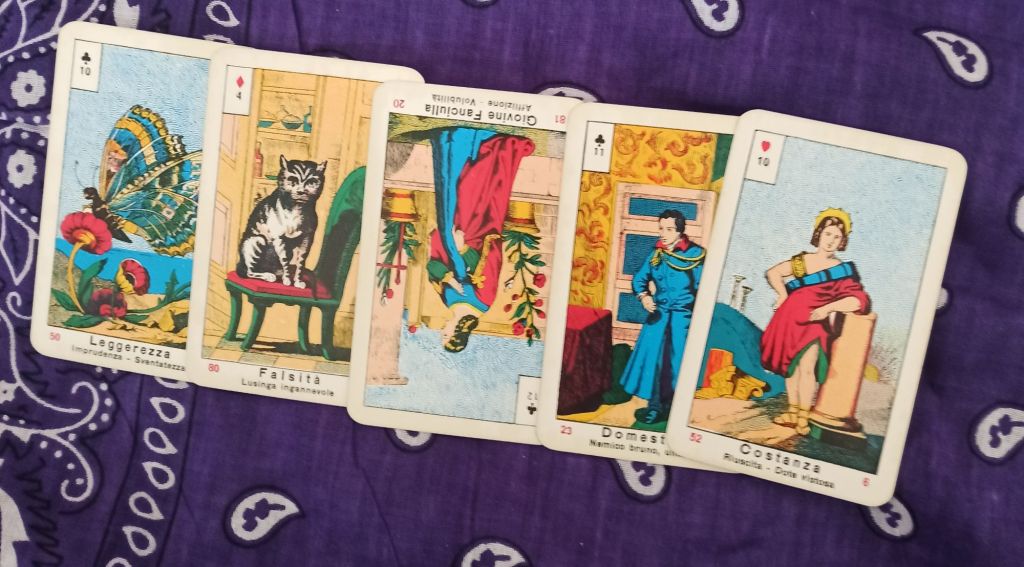
We were at a friend’s house and she had invited over another friend. The latter asked me the question: “I’m always unlucky in love. I’ve started dating this new guy, can I trust him?” Our friend made an odd face I could not decipher as we did the spread. These were the cards:
Is he reliable?
As I already discussed, sometimes the cards describe the development of a situation as if it were a book. At other times, they recreate a scene that can almost be observed with the characters calling attention to what they symbolize. This is one of those situations.
Right off the bat we notice that both querents are present. They are within the age range of the Queen of Clubs and Jack of Clubs. However, the mere fact that they are represented by these cards in a love question shows that this is not the romance of the century and will probably end, sooner or later. The cards, though, tell us something else.
Look at the Queen of Clubs! She is reversed and occupying the center of the spread. Usually, when the Young Maiden (Giovane Fanciulla) is reversed, she is afflicted by something, as opposed to other significators which, when reversed, tend to show problematic behavior.
This is unless the Maiden is reversed and near cards that show problematic behavior. This is exactly the case here. She is together with the Four of Diamonds, the Falsehood card (which, notice, is on her side of the spread, not on the guy’s side) and the Ten of Clubs, the Levity or Carefreeness card.
On the other hand, we have the Ten of Hearts, i.e., the Perseverance card, on the side of the boyfriend. Although the Perseverance card is not one of major feelings, it still shows him to be dependable. She, however, is depicted by the cards as being not only somewhat whiny, but also a little flighty (someone might say a little floozy, especially since she comes up reversed with the Ten of Hearts at the end of the spread)
In this situation, I tried to sugarcoat it to the querent by telling her that he is rather dependable, though this romance was probably not the one that would lead to marriage, and that he also had doubts about her, and that she should make sure not to send mixed signals.
Upon leaving, our friend pulled me aside and she told me that the girl has literally been the “butterfly” of the group, landing from man to man, being unreliable and not learning anything from experience. This is very well described by the reversed Queen of Clubs, who, in a negative context, can show a woman with a princess complex who thinks everyone else is at fault.
Remember those listicles that were much in demand about ten years ago, before people grew tired of the rage-bait? Yea, they still do them, but they have somewhat fallen out of favor, especially since they are so basic even AI can do them better than the poorly paid saps who wrote them back then. Anyway, here’s a short one, hopefully more interesting than the average listicle, on what generally hinders good divination, plus a bonus entry for what helps.
Mechanic Behavior
Divination eschews mechanic repetition. Asking the same question one or two times is fine because there is still enough emotion behind it to put the system into motion. In fact, it is fine to ask the same question many times as long as the querent is truly invested in it, but the more the querent asks the same question with the same emotional drive as the first time, the more you know the querent is cuckoo and is best avoided. In general, it is best to wait a little between divinations.
This point is one that skeptics seem unable to wrap their heads around, because it seems to run against the principle that experiments can be repeated ad libitum, but it is really quite simple: divination is not an experiment, and the more you mechanically ask the same question, the more the real question changes to whatever it was at the beginning to “does divination really work?” and this question cannot be answered by divination itself.
All in all, a balanced relationship to divination as a means of intelligence gathering, together with the understanding that we are attempting something more exceptional than cleaning the cat’s litterbox, is in order.
Shallow Understanding of the System You Work With
If you asked your doctor how he knows his diagnosis is right and he told you it was just his intuition, you’d feel justified in seeking a second opinion. Yet among ‘spiritual seekers’ anything that reeks of effort and study is frowned upon and people go to extraordinary lengths in order to avoid the simple fact that both knowledge and experience are needed to perform satisfactorily in any sector of life. So they come up with anything from intuitive advice (which essentially means “don’t ask me how I know”) to the great angel HRU to fairies to ‘kickass schools of non-duality.’
The reality is that divination is a method for the acquisition of knowledge. If we don’t make the effort of studying the method we don’t get much knowledge. I believe the current distrust of study comes in part from the distrust of intellectual knowledge (see the bonus entry in this list) and in part from the fact that many people who become interested in divination do it to create a little bubble of mystery and mysticism away from the golden cage that is modernity.
Either way, it is a misguided attitude. Divination requires study. Lots of it. In fact, the study will never end. The good news is that we can start practicing much sooner. As for intuition, it does have a place in divination, and I’ll talk about it in the future, but unbridled intuition is just a badly behaved kid.
Bias and Preconceptions
I’ve already talked at length about this, and I will probably still talk about it in the future. It bears repeating: the more we think we know, the less we’re open to discovery.
Aside from ideological forms of bias, which are always bad regardless of the ideology, there are also other forms. One of the most deadly forms of bias is, for instance, the belief that the querent knows what they are talking about. A querent doesn’t need to be malicious in order to confuse us: they can just be confused themselves, or they can have built a whole scenario inside their heads before sitting in front of us.
On the other hand, talking over our querent and treating them like a special needs child won’t do either. There needs to be a balance between our ability to see the truth of the matter in a dispassionate way (thanks to the divination system we are employing) and open-heartedness toward the querent. As a matter of fact, an open heart can go a long way.
Querents can also be biased against us, but we can do nothing about it. People sometimes ask me what happens when someone asks false questions maliciously. What happens is that if I’m lucky, I’ll understand it from the cards, while if I’m not lucky I’ll make a fool of myself. Either way, the person won’t change their mind about divination or about me, so why bother getting worked up about it? Stuff happens.
Your Brain, Your Best Friend
Ever since Madame Blavatsky disgracefully started peddling poorly understood principles of oriental philosophy, the Western esoteric world has become convinced that the “mind is the enemy”. People generally think so (isn’t it ironic? The mind thinking that the mind is the enemy) because they are incapable of using it but want to sound deep in their incompetence.
In reality, if there is such a thing as overthinking, there is also such a thing as underthinking. The idea that everything must come immediately and instinctively to us in a space of pure knowing and that everything resembling logic is the work of the devil is patently wrong.
Aside from the fact that this is philosophically delusional, most people who think only the mind lies never stop to consider how many times their instincts or their heart actually let them down on a day-to-day basis. The reality is that our mind, our body and our heart are ways for us to acquaint ourselves with the world, and all three can lead us astray depending on the context, just as much as they can guide us to profound insight.
Therefore, if it is not correct to let the other two dry up, it is also not correct to become mindless pseudomystics, sacrificing our understanding on the altar of an ill-digested and rather offensive orientalism (“Counterfeit Asian philosophy 101 says the mind is poo poo, therefore it’s true. See how smart I am? I misquote exotic people!”)
The funny thing is that most Eastern forms of divination are not at all intuitive, and in fact verge on the overly technical (see Da Liu Ren, Qi Men Dun Jia, Wen Wang Gua, Vedic Astrology, Purple Emperor Astrology, etc.) They are also incredibly accurate exactly because of how majestically brainy they are, though they may not have the glamour of the latest useless set of empowering witchy cards. Traditional Western divination systems, of course, can be just as accurate, but people usually have the expectation that they need to unplug their brains on the way in. Let’s not do this. Our mind can sometimes lead us astray. It can also help a great deal.
(Note: this is a collection of the meanings attributed to the cards by some occultists in the past centuries. It does not reflect my own study or opinion of the cards. It is only meant as a quick comparative reference as I develop my own take.)
The Page of Wands in the Builders of the Adytum (BOTA) tarot deck
Paul Foster Case (and Ann Davies)
The time p e riod corre la t e d with this Key is the whole first quarter of the zodiac from March 21 to June 21 inclusive, including Aries, Taurus and Gemini. The specific Divinatory meanings involved are: Well Dignified: a young person, youth or girl; brilliant mind, courageous disposition , perhaps given to sudden anger and desirous of power. Capable of great enthusiasm. lll Dignified: Revengeful at the least opposition, headstrong, theatrical, unstable, domineering and decidedly superficial. This Key often stands for a messenger. (From the Oracle of Tarot course)
A. E. Waite
In a scene similar to the former (i.e., of the Knight of Wands), a young man stands in the act of proclamation. He is unknown but faithful, and his tidings are strange. Divinatory Meanings: Dark young man, faithful, a lover, an envoy, a postman. Beside a man, he will bear favourable testimony concerning him. A dangerous rival, if followed by the Page of Cups. Has the chief qualities of his suit. He may signify family intelligence. Reversed: Anecdotes, announcements, evil news. Also indecision and the instability which accompanies it. (From The Pictorial Key to the Tarot)
Aleister Crowley
The Princess of Wands represents the earthy part of Fire; one might say, she is the fuel of Fire. This expression implies the irresistible chemical attraction of the combustible substance. She rules the Heavens for one quadrant of the portion around the North Pole.
The Princess is therefore shewn with the plumes of justice streaming like flames from her brow; and she is unclothed, shewing that chemical action can only take place when the element is perfectly free to combine with its partner. She bears a wand crowned with the disk of the Sun; and she is leaping in a surging flame which re-calls by its shape the letter Yod
This card may be said to represent the dance of the virgin priestess of the Lords of Fire, for she is in attendance upon the golden altar ornamented with rams’ heads) symbolizing the fires of Spring.
The character of the Princess is extremely individual. She is brilliant and daring. She creates her own beauty by her essential vigour and energy. The force of her character imposes the impression of beauty upon the beholder. In anger or love she is sudden, violent, and implacable. She consumes all that comes into her sphere. She is ambitious and aspiring, full of enthusiasm which is often irrational. She never forgets an injury, and the only quality of patience to be found in her is the patience with which she lies in ambush to avenge.
Such a woman, ill-dignified, shews the defects of these qualities. She is superficial and theatrical, completely shallow and false, yet without suspecting that she is anything of the sort, for she believes entirely in herself, even when it is apparent to the most ordinary observer that she is merely in the spasm of mood. She is cruel, unreliable, faithless and domineering.
In the Yi King, the earthy part of Fire is described by the 27th hexagram, i. This shows a person omnivorous in passion of whatever kind, entirely reckless in the means of obtaining gratification, and insatiable. The Yi commentary is packed with alternate warning and encouragement. (From The Book of Thoth)
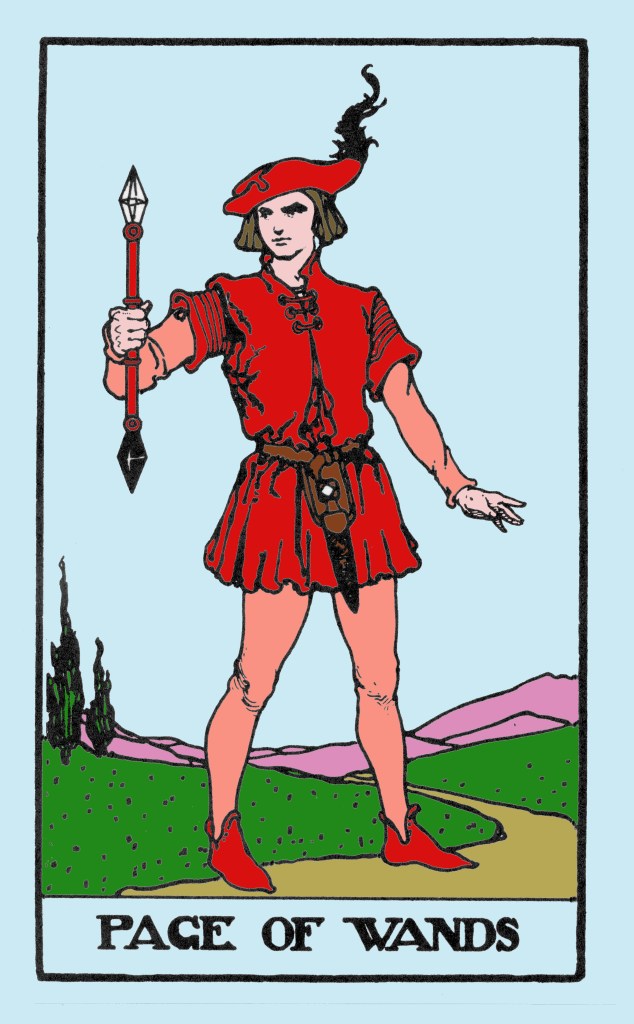
AI generated illustration for the Page of Wands
Golden Dawn’s Book T
A VERY strong and beautiful woman with flowing red-gold hair, attired like an Amazon. Her shoulders, arms, bosom and knees are bare. She wears a short kilt reaching to the knee. Round her waist is a broad belt of scale-mail; narrow at the sides; broader in front and back; and having a winged tiger’s head in front. She wears a Corinthian-shaped helmet and crown with a long plume. It also is surmounted by a tiger’s head, and the same symbol forms the buckle of her scalemail buskins. A mantle lined with tiger’s skin falls back from her shoulders. Her right hand rests on a small golden or brazen altar ornamented with ram’s heads and with Flames of Fire leaping from it. Her left hand leans on a long and heavy club, swelling at the lower end, where the sigil is placed; and it has flames of fire leaping from it the whole way down; but the flames are ascending. This club or torch is much longer than that carried by the King or Queen. Beneath her firmly placed feet are leaping Flames of Fire. Brilliance, courage, beauty, force, sudden in anger or love, desire of power, enthusiasm, revenge. If ill dignified, she is superficial, theatrical, cruel, unstable, domineering. She rules the heavens over one quadrant of the portion around the North Pole. Earth of Fire
Etteilla
Foreigner Upright. This card, as far as the medicine of the spirit is concerned, means, in its natural position: Stranger, Unknown, Extraordinary. – Strange, Unusual, Unheard of, Surprising, Admirable, Wonderful, Prodigy, Miracle. – Episode, Digression, Anonymous. Inverted. Announcement, Instruction, Warning, Admonition, Anecdotes, Chronicle, History, Tales, Fables, Notions, Teaching.
I come from a rather traditionalist school of divination. One of the ways I learned was that my teacher often told me to do a spread on an aspect of her past I knew nothing about to see if I managed to discover what happened. Another way was when she told me to do a spread to see what would be the problem of the next person going to her for a reading. Interestingly, I have met other people, who have taught me other techniques, who used the same method.
As can be expected, there was little room for anything other than the literal interpretation of the cards. This has helped me a lot to remain with my feet on the ground as I forged my path, which is very good, considering how littered with nonsense the esoteric landscape is.
On the other side of the spectrum you have a sizeable chunk of diviners today, though the situation now is slightly more balanced than it was just twenty years ago. These readers simply interpret the cards (or the planets, or whatever) as if they were benevolent tips from the universe about some inner issue that the person needs to work through to progress.
The problem I have with this approach, aside from the fact that it leads to unverifiable predicitions, is that it presupposes a superstitious view of the universe as some kind of benevolent nanny that teaches you how you ought to behave. These people, I should remind you, are the ones who often loathe Christianity as a bundle of silly dogmas and think they are the reasonable ones.
If there is one thing that my study of philosophy as well as my experience as fortune-teller has taught me is that there is no such thing as an ‘ought’. There’s what is and what isn’t, what was and what wasn’t, what will be and what won’t be, as well as what can be, or is more or less likely to be. For instance, there is no way you ‘ought’ to eat. You either eat well or you don’t. Eating well only becomes an ought when your current diet is checked against your desire to minimize health risks. It’s your desires that create oughts, not the universe.
I already discussed how I believe that divination tools are essentially something that gives us a bird-eye view of existence, affording us a glance at a number of considerations about our situation that we might not otherwise have. To use my old analogy, it is like being in a crowded city center and talking to a person on a walkie talkie, this person looking at your position from the top of a skyscraper and therefore seeing things you cannot see.
It goes without saying that I believe divination tools never give advice.* As maps, they simply tell you what is. Advice is contingent on what either someone wants to do or what they believe a superior authority wants them to do. My view of the superior authority is that it is too occupied exploring all its potential through us to pick and choose what’s best for us.
Does it therefore mean that a diviner should not give advice? I actually believe advice is a perfectly fine thing, as long as it is not delusional advice. I think a good divination session should always be of help to the querent in living their own life better. This is done by checking the querent’s wishes (sometimes implied, sometimes stated outright) against the wider situation as portrayed by the oracle, with its potentials, its risks, its possibilities and impossibilities, its certainties and its uncertainties.
In other words, advice must come from the diviner on the backdrop of the oracle, and not be projected onto the oracle, which just pictures reality as it is, not as it should be (because there is no way reality should be, from an objective standpoint). Sure, sometimes I tell my querents “the cards are advising you to do X”, but this is short for “I am advising you to do X based on what the cards are telling me about your situation.”
Sometimes the right bit of advice at the right time can help the querent make a turn for the better in life. These are the readings I love the most. Sometimes it can improve a situation. Sometimes, though, the advice is not enough to change an objectively difficult situation. The more heroic and nietzschean reaction to these slings and arrows that life throws at us is that of amor fati: in knowing what’s coming, one can learn to love it, thus overcoming it, making it part of oneself instead it being an alien destiny. But this is not always possible. Sometimes, all the querent can get from a difficult reading is peace of mind. And peace of mind is a great thing, all too often undervalued until it’s no longer there.
MQS
* In this, divination tools are very different from inspired divinations caused by spirits or deities, since these actually do have their own particular views and preferences.