Tag Archives: Cartomancy

Tarot Encyclopedia – The Two of Swords

(Note: this is a collection of the meanings attributed to the cards by some occultists in the past centuries. It does not reflect my own study or opinion of the cards. It is only meant as a quick comparative reference as I develop my own take.)
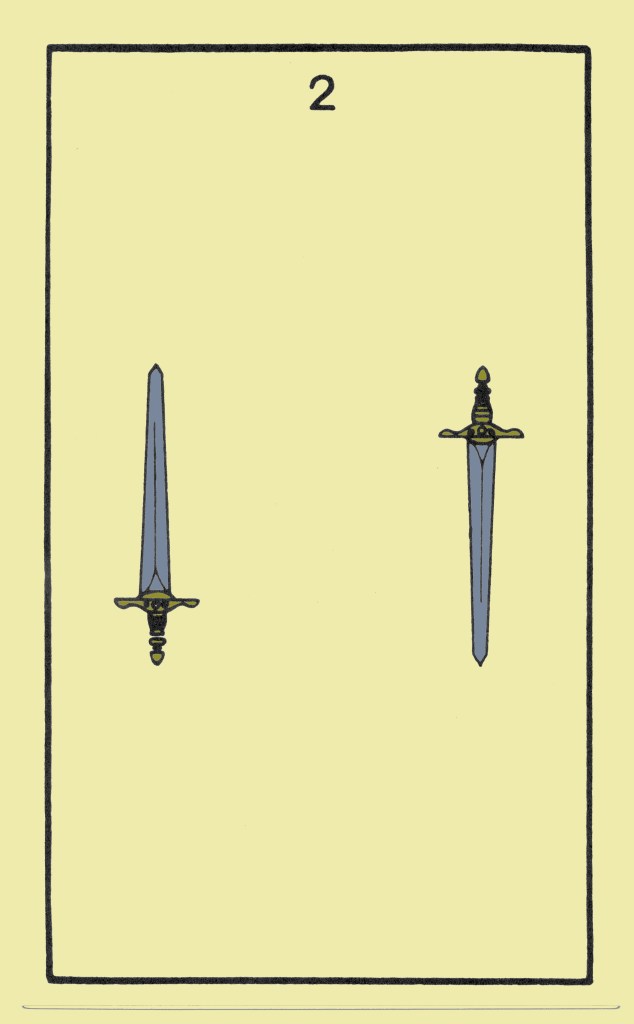
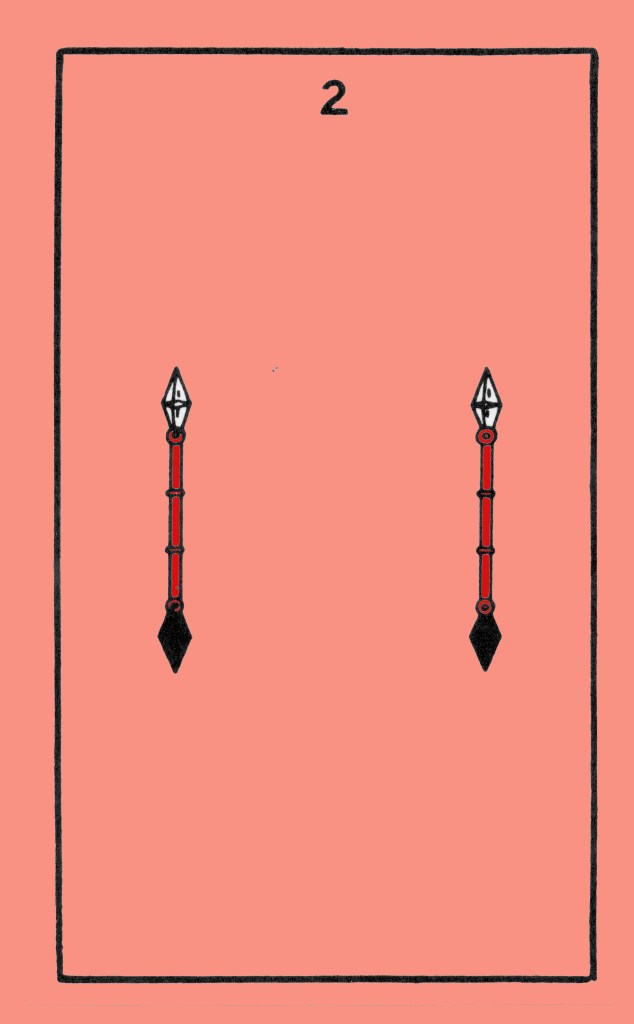
The Two of Swords from the Builders of the Adytum (BOTA) tarot deck

Paul Foster Case (and Ann Davies)

The time period is the first decanate of Libra from September 23 to October 2, under the rulership of Venus.
Well-Dignified: contradictory characteristics in the same nature; strength through suffering; pleasure after pain; delay in the realization of objectives. This card sometimes indicates a period of uncertainty, during which the Querent, though he has a sense of adequate power, does not know just what to do with it. It also indicates justice, unselfishness and the restoration of peace.
Ill-Dignified: falsehood; sorrow; injury from another who really means well to the Querent, or injury by the Querent to another whom he wishes to help; always a symbol of tension, of want of tact, and suggests force held in abeyance, awaiting some announcement or revelation that will make decision possible.
Keyword: Indecision.
(From the Oracle of Tarot course)

A. E. Waite

A hoodwinked female figure balances two swords upon her shoulders. Divinatory Meanings: Conformity and the equipoise which it suggests, courage, friendship, concord in a state of arms; another reading gives tenderness, affection, intimacy. The suggestion of harmony and other favourable readings must be considered in a qualified manner, as Swords generally are not symbolical of beneficent forces in human affairs. Reversed: Imposture, falsehood, duplicity, disloyalty.
(From The Pictorial Key to the Tarot)

Aleister Crowley

The Two of Swords was formerly called the Lord of Peace Restored; but this word “restored” is incorrect, because there has been no disturbance. The Lord of Peace is therefore a better title: but it needs thinking hard to work this out, since the Sword is so intensely active. It may be helpful to study the Essay on Silence (p. 120) for a parallel: the Negative Form of the Positive Idea. See also the Essay on Chastity (Little Essays toward Truth, pp. 70-74) which concludes: Sir Knights, be vigilant: watch by your arms and renew your oath; for that day is of sinister augury and deadly charged with danger which ye fill not to overflowing with gay deeds and bold of masterful, of manful Chastity.

Witness also Catullus: domi maneas paresque nobis Novem continuas futationes. Nor does he misunderstand the gesture of Harpocrates; Silence and Chastity are isomers.
It is all one case of the general proposition that the sum of the infinite Energy of the Universe is Zero.

[…]

This card is ruled by Chokmah in the Element of Air. This suit, governing all intellectual manifestations, is always complicated and disordered. It is subject to change as is no other suit. It represents a general shaking-up, resulting from the conflict of Fire and Water in their marriage; and proceeds, when Earth appears, to crystallization. But the purity and exaltation of Chokmah are such that this card manifests the very best idea possible to the suit. The energy abides above the onslaught of disruption. This comparative calm is emphasized by the celestial attribution: the Moon in Libra.

The Moon is change, but Nature is peaceful; moreover, Libra represents balance; between them, they regulate the energy of the Swords.

In the card appear two swords crossed; they are united by a blue rose with five petals. This rose represents the influence of the Mother, whose harmonizing influence compounds the latent antagonism native to the suit. The Rose emits white rays, producing a geometrical pattern that emphasizes the equilibrium of the symbol.
(From The Book of Thoth)
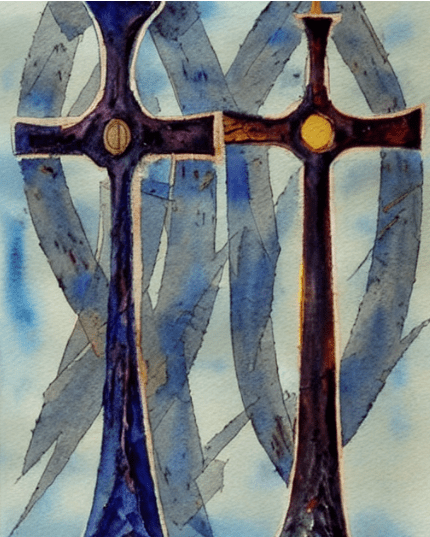
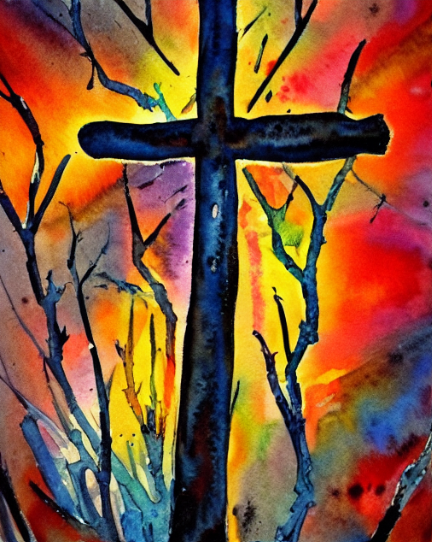
An ominous AI-generated illustration for the Two of Swords

Golden Dawn’s Book T

Two crossed swords, like the air dagger of a Zelator Adeptus Minor, each held by a White Radiant Angelic Hand. Upon the point where the two cross is a rose of five petals, emitting white rays. At the top and bottom of the card are two small daggers, supporting respectively the symbol {Crescent moon with horns upward} thus, and Libra representing the Decanate.
Contradictory characters in the same nature, strength through suffering; pleasure after pain. Sacrifice and trouble, yet strength arising therefrom, symbolized by the position of the rose, as though the pain itself had brought forth beauty. Arrangement, peace restored; truce; truth and untruth; sorrow and sympathy. Aid to the weak; arrangement; justice, unselfishness; also a tendency to repetition of affronts on being pardoned; injury when meaning well; given to petitions; also a want of tact, and asking question of little moment; talkative.
Chokmah of Vau. Quarrel made up, yet still some tension in relations: actions, sometimes selfish, sometimes unselfish.
Herein rule the Great Angels HB:YZLAL and HB:MNHAL.

Etteilla

Friendship
Upright. This card, as far as the medicine of the spirit is concerned, means, in its natural position: Friendship, Attachment, Affection, Tenderness, Benevolence, Relationship, Identity, Intimacy, Convenience, Correspondence, Interest, Conformity, Sympathy, Affinity, Attraction.
Reversed. Falsehood, Falsehood, Lying, Imposture, Duplicity, Bad faith, Overbearingness, Dissimulation, Cunning, Deceit, Superficial, Superficiality, Surface.

MQS

The Ghost That Came Back (Example Reading)

Certain topics are exceedingly rare, and they should remain so, because people otherwise tend to see the supernatural at play everywhere. Traditional divination takes these topics very seriously, which is why it rarely discusses them. In most systems, a vocabulary is given to describe most situations in life, including encounters with ghosts. We are, of course, free to disbelieve, but the cards can still talk about it.

A querent asked me if there was a ghost in her (very old) apartment complex. As I said when talking about curses and hexes, the answer is almost invariably no (although, to be fair, ghosts and other entities are far more common than competent witches). Here’s the spread (it started as a three card spread, I kept adding cards until I was satisfied).

A♠️ – Q♠️ – 2♠️ – K♥️ – 2♣️ – 4♣️ – 9♥️ – 5♠️ – 10♥️

I asked the querent an open question (to avoid influencing her), that is, I asked her to describe the ghost she thought she saw. She said she thought it was the spirit of an ugly, angry woman moving in the hallways of the building. This fits very well with the Queen of Spades and Two of Spades. The Ace of Spades, aside from indicating death, is also a card of great evil.

What about the rest of the spread? Usually the Heart court cards indicate either positive spirits (God, etc.) or religious people. I asked the querent if she was planning on contacting a priest, shaman or other such figure. She said she wasn’t really thinking about it, but another tenant was.

I said that it was a good idea. Look at the King’s action: he is taking steps (Two of Clubs) by uttering words (Four of Clubs) which are positive (Nine and Ten of Hearts). But what about the Five of Spades? My sense is that the presence will not be eradicated or banished for good, since the Five of Spades is a card of imprisonment, but it will be contained in some form (the two Hearts hemming in the Spade).

The interesting thing was that, according to the querent, the other tenant (who had been living in the building for much longer than the querent) told her that many years ago they had had a problem with the same presence and had managed to somehow exorcise it.

My view is that even this time the situation will not be remedied completely, but the situation should improve by calling in someone to perform a religious ritual.

MQS

A Reading Gone Wrong

Getting things wrong hurts, but is part of the human condition. In fact, I would argue that if a reader says they are infallible, that’s a good time to put as much distance between you and them as possible. An infallible reader is either so delusional that they block out all negative feedback from their reality or so dishonest that they’ll constantly be looking for the right bridge to sell you. Either way, they are best kept at a distance.

Still, there’s no denying that getting a reading wrong is disheartening because, as much as we should keep the ego out of the equation, the ego always seeps into it. I think it’s fair to share our failures as well as our triumphs. Here is a reading I got wrong relatively recently.

The querent was asking about her recent pregnancy.

Q♣️ – 7♣️ – J♥️ – 3♠️ – 2♥️

Accepting the question was my first mistake, as such issues are way too delicate. There is no situation where “you will miscarry” is an acceptable thing to say, and if we can’t be honest there is no point in giving a reading. Even if I had interpreted the cards correctly I would never have told the querent.

Thing is, though, that I wanted to give her good news, albeit subconsciously, and so I ended up interpreting a clearly negative spread positively. The querent falls first in the spread, and there is a card of obstacles between her and the child (the Jack of Hearts). The Three of Spades in questions of pregnancy often leads to loss, but I interpreted the Two of Hearts as the solution of the problems, while in fact it was merely saying that the loss would happen soon (it was knocking at the door). In hindsight, I probably should have added some cards.

I told the querent the pregnancy would go fine, though with minor problems which would be solved, but that she should always listen to the doctor. In reality, the cards point to a situation that not even doctors would be able to salvage (the doctors don’t show up in the spread).

Two things can be learned: first, never accept questions you are not really comfortable answering; second, always keep your desire to give a skewed answer in check. It is human nature to want other people to be happy (or sad, if we don’t like them) but this gets in the way of our objectivity.

MQS

Vera Sibilla Cards That Indicate Change

Change is a vague concept. Much of contemporary occultism is predicated on the equation of change and stability, so that essentially everything is change. Still, even if we subscribe to this notion, our everyday life is made up of things that change relatively as opposed to things that remain relatively stable. It may be true that my body is a Swiss cheese of chaotic particles constantly being swapped with new ones, but from the standpoint of our daily experience, my body is a relative constant.

Therefore, divination does deal with what changes and what stays the same. Here I talk about cards that indicate change. As usual, the list is not meant to be exhaustive.

Ace of Hearts Reversed – The Conversation

When upright, the Ace of Hearts, aside from being the card of words, represents a relatively stable situation (as indicated symbolically by the table in the image). When reversed, the Ace of Hearts represents change, transformation, revolution. This may be good or bad, depending on the cards that follow.

Two of Hearts Reversed – The House

Again, when upright this card indicates a house, a very stable thing. When reversed, it shows instability. This time the connotation is quite negative, as it can indicate a couple breaking up, a family falling out, and similar situations depending on the other cards. This is rarely a positive card when reversed.

Five of Hearts – Happiness

As I discussed in the article for this card, the Five of Hearts is the card of commitment to someone or something. Traditionally it is the card of engagement, a transition phase between being single and being married. As such, the Happiness card symbolizes a positive, happy transition (when upright). It often rids us of problems and shows fidelity and the ability to honor commitments.

Ten of Hearts Reversed – Perseverance

When upright, the Ten of Hearts represents things that persevere, go on, stabilize. When reversed it shows situations going legs up, becoming shaky or stormy. It is a wildly negative card of volatile emotions and deep instability.

Three of Clubs Upright or Reversed – The Journey

When upright, the Journey card is indicative of travel, that is, change of place. However, it also indicates physical movement, or even mental movement, such as changing one’s mind. It is a card of transition, seen in a neutral to slightly positive sense (but always take the other cards into account). When reversed, the Journey card becomes intensely positive, representing the interruption of negative trends, freedom from addiction or vicious cycles in general. It represents situations starting to evolve in a positive direction, unless followed by very negative cards.

Five of Clubs Upright or Reversed – Fortune

Representing the power of fate in our life, the Five of Clubs is emblematic of strokes of luck, situations taking a different (usually positive) turn, things getting into motion in a positive way. When reversed, the card is slowed down and weakened, and it acquires the meaning of long-term transformations.

Ten of Clubs Reversed – Levity

Much like the Fortune card, the Ten of Clubs reversed represents strokes of luck shaking up the routine, offering us opportunities and chances. Its power, however, is much smaller.

Five of Diamonds – Melancholy

The Melancholy card is rather static in itself, especially when hemmed in by cards indicating a negative situation. However, it can also show situations which were once positive and are starting to show some cracks or situations that are negative but which won’t be negative forever. Therefore, in spite of its mild negativity, often the card implies future change.

Eight of Diamonds – The Handmaid

A symbol of social and personal ascent thanks to its symbolism of the stairs, the Handmaid indicates positive evolution, transition from one phase to the next, entering new segments of one’s life. This is especially true when it shows between cards indicating different situations, or when it shows up at the beginning of a spread. In general it represents positive change.

Two of Spades – The Old Lady

It may seem strange to find the static Old Lady card on this list. However, when we think about it, the Two of Spades is about things that are old and are reaching their natural conclusion. When followed by cards indicating a different situation, therefore, the Old Lady can act as a card of transition (for instance, showing that a contract is expiring.)

Four of Spades Reversed – Sickness

The Sickness card reversed is usually a card of deep stasis and blockage. There is, however, one exception: when it is preceded by negative cards and followed by positive cards. In this case, it indicates the end of the negative situation (tha situation is blocked in favor of what followed.) Of course, when the situation is reversed, i.e., with positive cards before and negative ones after, it shows a change for the worse.

Five of Spades – Death

The most archetypal card of change, the Death card usually indicates a sharp and often difficult cut in one’s life. The result is not necessarily bad, as the outcome depends on what follows. However, since it is a Spade card, it is always difficult and comes at a great price.

Six of Spades Reversed – Sighs

When upright, the Sighs card signifies sighing for something, pining and waiting. It is very static. When reversed, one of its (many) meanings is of showing the end of sighing. This doesn’t necessarily mean you get what you’ve been sighing for. Often, it shows giving up on something and moving on, letting go of it.

Seven of Spades – Tragedy

In spite of its name, the Seven of Spades can indicate a sharp turn for the better if followed by positive cards (if followed by negative ones then, yes, it can indicate being struck by tragedy). What it does imply is that the situation followed by the other cards strikes us from the outside, without us planning it, and usually in a very sudden way.

Nine of Spades Reversed – The Prison

This card acts in very much the same way as the Sickness card reversed. Attention must be paid to the cards preceding and following it.

MQS

Tarot Encyclopedia – The Two of Cups

(Note: this is a collection of the meanings attributed to the cards by some occultists in the past centuries. It does not reflect my own study or opinion of the cards. It is only meant as a quick comparative reference as I develop my own take.)

The Two of Cups from the Builders of the Adytum (BOTA) tarot deck

Paul Foster Case (and Ann Davies)

The Two of Cups, astrologically, is assigned to the first decanate of Cancer, ruled by the Moon, time period June 22 to July 1.
The specific divinatory ideas associated with this Key are:
Well Dignified: reciprocity, reflection; gain and benefit through parents;
favors from the opposite sex; changes of residence.
Ill Dignified: reverses and losses through parents or the opposite sex; unfortunate changes of residence; fluctuations of mood; unwise decisions.
Keyword: Response to environment.
(From the Oracle of Tarot course)

A. E. Waite

A youth and maiden are pledging one another, and above their cups rises the Caduceus of Hermes, between the great wings of which there appears a lion’s head. It is a variant of a sign which is found in a few old examples of this card. Some curious emblematical meanings are attached to it, but they do not concern us in this place. Divinatory Meanings: Love, passion, friendship, affinity, union, concord, sympathy, the interrelation of the sexes, and–as a suggestion apart from all offices of divination–that desire which is not in Nature, but by which Nature is sanctified.
(From The Pictorial Key to the Tarot)

Aleister Crowley

The Two always represents the Word and the Will. It is the first manifestation. Therefore, in the suit of Water, it must refer to Love, which recovers unity from dividuality by mutual annihilation.

The card also refers to Venus in Cancer. Cancer is, more than any other, the receptive Sign; it is the House of the Moon, and in that Sign Jupiter is exalted. These are, superficially, the three most friendly of the planets.

The hieroglyph of the card represents two cups in the foreground, overflowing upon a calm sea. They are fed with lucent water from a lotus floating upon the sea, from which rises another lotus around whose stem are entwined twin dolphins. The symbolism of the dolphin is very complicated, and must be studied in books of reference; but the general idea is that of the “Royal Art”. The dolphin is peculiarly sacred to Alchemy.

The number Two referring to Will, this card might really be renamed the Lord of Love under Will, for that is its full and true meaning. It shows the harmony of the male and the female: interpreted in the largest sense. It is perfect and placid harmony, radiating an intensity of joy and ecstasy.

Of necessity, the realization of the idea in the Four (as the suit develops) will gradually diminish the purity of its perfection.
(From the Book of Thoth)

A somewhat mundane AI-generated illustration for the Two of Cups

Golden Dawn’s Book T

A WHITE Radiant Hand, issuant from the lower part of the card from a cloud, holds lotuses. A lotus flower rises above water, which occupies the lower part of the card rising above the hand. From this flower rises a stem, terminating near the top of the card in another lotus, from which flows a sparkling white water, as from a fountain. Crossed on the stem just beneath are two dolphins, Argent and Or, on to which the water falls, and from which it pours in full streams, like jets of gold and silver, into two cups; which in their turn overflow, flooding the lower part of the card. Venus and Cancer above and below.

Harmony of masculine and feminine united. Harmony, pleasure, mirth, subtlety:
but if ill dignified — folly, dissipation, waste, silly actions.
Chokmah of HB:H (Marriage, love, pleasure).
Therein rule the Angels HB:AVa’aAL and HB:ChBVYH.

Etteilla

Love
Upright. This card, as far as the medicine of the spirit is concerned, means, in its natural position: Love, Passion, Inclination, Sympathy, Attraction, Propensity, Friendship, Benevolence, Affection, Attachment, Taste, Bonding, Galantry, Attraction, Affinity.
Reversed. Desire, Augury [= Aspiration], Vow, Will, Want, Cupidity, Concupiscence, Jealousy, Passion, Illusion, Appetite.

MQS

Playing Cards That Indicate Loss

After discussing the playing cards that indicate gain, let’s take a look at the ones that represent loss. Keep in mind that loss can be indicated by any card of gain that is poorly placed in the spread, i.e., when surrounded by difficult cards. For instance, the 7♦, normally a card of money, followed by most Spades or even some Clubs, would represent either loss of money or a sum of money being withheld.

Six of Clubs

The Six of Clubs is a card of difficulties, toil and fatigue. It is not inherently a card of monetary loss. However, it represents a stagnand situation which, applied to money, can imply either loss or lack of gain, and especially lack of compensation for one’s toil.

Seven of Clubs

The Seven of Clubs is, again, not directly connected to loss, but it does show problems in all levels, and as such it can indicate loss or lack of gain when together with Diamonds or when summoned for a money reading. Keep in mind, though, that Clubs are not tremendously nefarious, so while they can create unsatisfactory situations, that are unlikely to cause dramatic loss.

Six of Diamonds

The Six of Diamonds is a card of worry and preoccupation, usually over money matters (but not necessarily). In general it shows situations of all kinds that stand on a shaky foundation, living paycheck to paycheck, businesses that don’t take off, etc. Again, it is not a dramatic card, but it can signify money problems or even, in general, not gaining something.

Ace of Spades and Nine of Spades

All Spades can signal loss. However, the way each of them causes loss is different. I will just highlight some of the differences. The Ace of Spades is a seriously bad card, which is often involved of configurations indicating bankruptcy, poverty and failure all around. The Nine of Spades is equally bad, and when they come up together they often prevent success in accumulating money for very long periods of time.

Two of Spades and Three of Spades

Less dramatic than most Spades, the Two of Spades indicates small losses, situations that cause headaches from a financial standpoint. The Three can also indicate small losses, and can also be found in sequences indicating scams.

Four of Spades, Five of Spades and Six of Spades

Much more dramatic, the Four and Five of Spades indicate serious loss, projects going awry and being abandoned. They can often represent difficult circumstances, but with the appropriate cards they can point to the querent being at fault (missteps, etc). The Six of Spades represents financial situations characterized as ‘sick’, that is, unhealthy, structurally unsound and therefore destined to failure.

Seven of Spades and Eight of Spades

These cards, especially the Seven, can indicate accidental loss, that is, loss not due to negligence (however, always remember to take the context into account).

MQS

Tarot Encyclopedia – The Two of Wands

(Note: this is a collection of the meanings attributed to the cards by some occultists in the past centuries. It does not reflect my own study or opinion of the cards. It is only meant as a quick comparative reference as I develop my own take.)

The Two of Wands from the Builders of the Adytum (BOTA) Tarot deck

Paul Foster Case (and Ann Davies)

In Tarot divination the Two of Wands has these key meanings:
Well Dignified: it shows force, enterprise, boldness, resolution, some
combativeness, much originality.
lll Dignified: it signifies restlessness, fierceness, shamelessness, inordinate ambition, turbulence, obstinancy, revenge. A card of enthusiasm, but of strong self-interest.
Keyword: Dominion
(From the Oracle of Tarot course)

A. E. Waite

A tall man looks from a battlemented roof over sea and shore; he holds a globe in his right hand, while a staff in his left rests on the battlement; another is fixed in a ring. The Rose and Cross and Lily should be noticed on the left side. Divinatory Meanings: Between the alternative readings there is no marriage possible; on the one hand, riches, fortune, magnificence; on the other, physical suffering, disease, chagrin, sadness, mortification. The design gives one suggestion; here is a lord overlooking his dominion and alternately contemplating a globe; it looks like the malady, the mortification, the sadness of Alexander amidst the grandeur of this world’s wealth. Reversed: Surprise, wonder, enchantment, emotion, trouble, fear.
(From The Pictorial Key to the Tarot)

Aleister Crowley

The Two of Wands is called the Lord of Dominion, and represents the energy of fire; fire in its best and highest form.

[…]

This card, pertaining to Chokmah in the suit of Fire, represents the Will in its most exalted form. It is an ideal Will, independent of any given object.

“For pure will, unassuaged of purpose, delivered from the lust of result, is every way perfect.” AL. 1. 44.

The background of this card shows the power of the planet Mars in his own sign Aries, the first of the Signs. It there represents Energy initiating a Current of Force.

The pictorial representation is two Dorjes crossed. The Dorje is the Tibetan symbol of the thunderbolt, the emblem of celestial Power, but more in its destructive than its creative form.

More, that is, in its earlier rather than its later form. For destruction may be regarded as the first step in the creative process. The virgin ovum must be broken in order to fertilize it. Fear and repulsion are therefore the primary reaction to the assault. Then, with understanding of the complete plan, willing surrender rejoices to co-operate. Six flames issue from the centre. This indicates the influence of the Sun, who is exalted in Aries. This is the creative Will.

Mars in Aries is the attribution of the Geomantic Figure Puer. The meaning of these figures is to be studied in the Handbook of that science: “The Equinox” Vol. I, No.2. Remember that the Geomantic Intelligences (see Liber 777 Cols. XLIX and CLXXVIII) are all primarily Gnomes.
(From the Book of Thoth)

Weirdly religious AI-generated illustration of the Two of Wands

Golden Dawn’s Book T

A WHITE Radiating Angelic hand, issuing from clouds, and grasping two crossed wands. Flames issue from the point of junction. On two small wands above and below, with flames of five issuing therefrom, are the symbols of Mars and Aries for the Decan.
Strength, domination, harmony of rule and of justice. Boldness, courage,
fierceness, shamelessness, revenge, resolution, generous, proud, sensitive, ambitious, refined, restless, turbulent, sagacious withal, yet unforgiving and obstinate.
Chokmah of HB:Y (Influence over others, authority, power, dominion).
Therein the Angels HB:VHVAL and HB:DNYAL bear rule.

Etteilla

Sadness
Upright. This card, as far as the medicine of the spirit is concerned, signifies, in its natural position: Sadness, Misery, Melancholy, Affliction, Sorrow, Desolation, Mortification, Mood, Discontent, Vapors, Gloomy Ideas. – Bitterness, Anger, Spite.
Reversed. Surprise, Enchantment, Shock, Upset, Unexpected event, Unexpected fact, Excitement, Fear, Fright, Terror. – Consternation, Stunning, Domination, Abduction, Alarm. – Marvel, Phenomenon, Miracle.

MQS

Vera Sibilla Cards That Indicate Positive Feelings

In the Vera Sibilla, every card can indicate some type of feelings. I have singled out some of those that indicate positive feelings. As usual, the list is not meant to be exclusive.

Ace of Hearts (A♥️) – Conversation

This card is broadly connected with words and self-expression. However, when discussing someone’s feelings, they indicate someone who is capable of expressing their feelings to someone else and reaching some kind of communion with them. In general, it shows an attitude of openness toward others.

Two of Hearts (2♥️) – The House

Usually the Two is the card of the house and of places in general. However it is also connected with harmony between two people, and it shows a constructive attitude, especially, though not exclusively, in a love reading.

Four of Hearts (4♥️) – Love

The Love card is, wouldn’t you know, the card of love, but also of strong feelings of affection in all personal relationship. It is connected with the motions of our heart, and as such it shows emotions above and beyond reason. The caveat here is that this card is not stable, and it requires other more grounded cards to promise lasting happiness.

Five of Hearts (5♥️) – Happiness

The Happiness card indicates everything connected with joy and good intentions. Being the card of the bethrodal, it also shows a certain degree of commitment to someone, and is therefore also a symbol of fidelity.

Seven of Hearts (7♥️) – The Scholar

The Scholar is a rational card, one of planning and long term prospects. When not damaged by the presence of difficult cards it shows the desire to create something lasting, as well as a helpful attitude.

Eight of Hearts (8♥️) – Hope

Hope is the positive feeling par exccellence. It represents optimism, honesty, someone who takes the high road, is elevated, spiritual, reliable. The exception is when the Hope card is not supported by stronger cards, as in this case it tends to show flirts, due to its connection with ease and lack of trouble.

Nine of Hearts (9♥️) – Faithfulness

Contrary to popular belief, the Nine of Hearts (not the Four) is the best card when it comes to feelings. Not only does it show love, but unlike the Love card, it also represent a strong bond and commitment that goes beyond those feelings and is pursued systematically. It is the card of the diehard supporter, of the best friend, of the lifelong love commitment.

The Heart Court Cards

Court cards tend to be neutral. However, the Heart court cards, when upright, indicate a person who is in love or who has a positive attitude toward the question or the querent.

Four of Clubs (4♣️) – The Friend

Similar to the Nine of Hearts, the Friend can indicate friendship (when it doesn’t show a literal -female- friend). The difference is that the concept of friendship of the Four of Clubs is not as strong and it is often connected with practical matters. When reversed, the Friend card can indicate a helpful attitude that takes the form of tips, recommendations, etc.

Six of Clubs (6♣️) – The Surprise

The Surprise card is connected broadly with things that come to us easily. As such, it indicates people who are similar, have similar interests and find it easy to grow together and pursue similar activities. Relationships tend to flourish with this card.

Seven of Clubs (7♣️) – The Realization

In general, this card speaks of ambitions in a positive sense, so it can show people having common goals and projects.

Eight of Clubs(8♣️)  – The Reunion

The reconciliation card of the deck, the Eight of Clubs is indicative of a willingness to compromise and to find common ground. Furthermore, it shows someone who is social and moves toward others with positive intents in mind.

Nine of Clubs (9♣️) – Merriment

In keeping with the energy of the suit, the Nine of Clubs indicate positive bonds, though not necessarily deep. It is a card of fun and of playing, drinking and having a good time together.

Ace of Diamonds (A♦️) – The Room

The Room has, among its meanings, that of intimacy. As such it represents someone who seeks closeness and contact. However it is not a card of love, as it is in the suit of Diamonds, not that of Hearts.

Seven of Diamonds (7♦️) – The Child

As the card of children, the Seven of Diamonds shows someone to be open, good-hearted and inoffensive, unless with cards that bring out the worst qualities of children (immaturity, etc.). It represents also someone who wants to start new things and is unprejudiced and innocent.

Eight of Diamonds (8♦️) – The Handmaid

This is the card of someone who is serviceable, dependable and hardworking. It is also a card of politeness and the desire of peace. It can show someone of a noble character who is helpful, friendly and improving himself to be better with others.

Two of Spades (2♠️) – The Old Lady

As pretty much the only card of this suit that is not outright negative, the Old Lady can indicate feelings of affection toward others, though these feelings tend to be tenuous and not very dynamic. It can also indicate someone who uses the wisdom and experience they gained in life to be of service to others in a detached, serene way

MQS

When Mothers Smother (Reading example)

When we read for people and they only give us a broad question, I think it’s important to remain open to the twists of fate the cards are showing us, as well as to have an open dialogue with the querent  Sometimes querents lie, but more often they are either confused or fail to focus on the ‘real’ question. In the following case, the querent’s question wasn’t wrong, but it hid more than it showed. The querent is a woman of around 25. She asked me about her career without specifying anything.

A career reading using the Vera Sibilla

The querent is anagraphically covered by the Queen of Clubs, the young maiden, so we can initially assign this card to her. She is reversed, showing trouble.

The first line of the pyramid indicates the influence of a (probably older) woman. She is surrounded by the House and Love, but on the same line we find the Seven of Spades reversed. This is one of the worst cards in the deck, so whenever we see it we must tread carefully.

I asked the querent if an older female relative, possibly her mother, is involved in the issue, and at this point the querent tells me she works with her parents in the family business.

The Seven of Spades reversed represents tyranny and oppression, so I ask her if her mother is somewhat authoritarian, and she confirms. Note though that the mother is surrounded by two positive cards, hence the ‘somewhat’ in the statement. Furtermore, look at the angles of the spread: Good feelings, oppression, but not too much (Butterfly). I am aware that smothering mothers are how some serial killers get started, but this mother, while not positive, could be worse. She smothers the querent out of (real) love. She is oppressive, but not a sociopath.

Be it as it may, the querent clearly suffers from this situation (she is reversed) and therefore hopes to move away (Hope + Journey), as the Hope card can indicate the hopes of the querent or of the person preceding it, which in this case is again the querent. Probably the querent wants to find her sense of self and freedom. This would be understandable even under normal circumstances, let alone in this case. I asked her if she wanted to leave and again she confirmed.

But, woe and alas, look how the spread ends! Money is tight (Money + Sickness) so whatever job she is looking for is going to probably make her start at the very bottom. Thus we end with the Ten of Clubs, the Butterfly. This card indicates all those things that are fleeting and not rooted in the querent’s destiny. Thus her hopes are just fleeting, at least in the foreseeable future, due to the rotten (Sickness) money situation.

MQS

The Lost Coins (Example Reading)

Readings about lost objects are hard. I am very much less than infallible in finding them. The reason is quite simple: most questions have a limited number of likely answers and an even more limited number of unlikely ones, so it is usually easier to make sense of the cards. “Yes he’ll marry you”, “No, he hates you”, “There doesn’t seem to be much tenderness left in the relationship, but with some effort you can keep it going a while.” There is, of course, some skill for finding nuances involved, and a good reader will add some details, but in general, the possible answers are relatively limited.

But a lost object can be anywhere, and we can either be very right or very wrong, with little space for “yes, but…” and “no, although…” Especially if we’ve never seen the place where the object was lost, it becomes hard to read the symbolism of the cards without reading our own fantasy into them. As far as I am concerned, much depends on how clear the cards decide to be with me. Since I have nothing to prove, I have no problem throwing my hands up and saying “Dunno” if that is my honest answer.

As we are moving all our stuff from the old house into the new one, plenty of things have gone momentarily missing, in the sense that I don’t know which of the dozens of boxes we’ve brought along they are in, and frankly I’m not too eager to start searching.

Except that I started itching to do some I Ching readings, and I couldn’t find my I Ching coins anymore. I did remember putting them somewhere where “I know I will find them”. The problem is that I have done the same with so many of my things in the last couple of months that the trick doesn’t work anymore. So I asked the cards for a pointer:

K♣ – 2♥ – 5♣

In general, what makes this reading relatively easy, compared to other lost item readings, is that it does not describe the place where the coins are, but rather their relationship to me. The King of Clubs is my significator. It is followed by a card, the Two of Hearts, which indicates ‘close to home’, but also ‘close’ in general. I know I cannot have left the coins in the neighborhood, which is naturally signified by the Two of Hearts, so I take it to mean ‘close’.

That Five of Clubs is interesting. In general it represents effort, but it is connected also with the body in general, understood as moving, acting ‘machine’, and also the hands. Close at hand, maybe? Or close to my body?

Either reading would have been correct. I found the coins in an internal pocket of my jacket where I usually don’t keep anything and don’t bother looking.

MQS