Tag Archives: Cartomancy

A Water Spirit (Example Reading)

One cool thing about moving to our new place is that we now live much closer to the countryside. Although there are a couple of major cities around us, our district is basically a cluster of small pictoresque old German villages close to the woods. This is a very good place for a magic practitioner to settle down.

I also discovered that there is a small lake or large pond (depending on who you ask) nearby. It’s been my experience that old water places, just like old caves, tend to be stably inhabited by spirits. In fact, in a subtle way, these spirits *are* the place they inhabit.

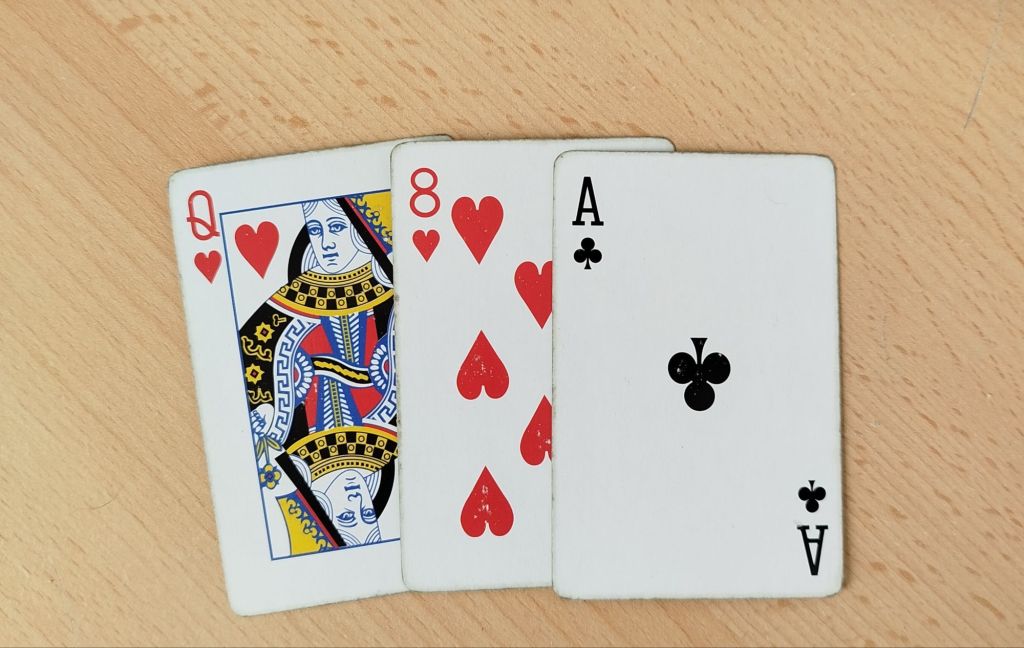
Before visiting the place I drew three cards to investigate, and these cards came up:
A water spirit – Cartomancy with playing cards

Obviously, the first thing to take note of is the presence of the Queen of Hearts, which is a motherly figure or a positive female entity. This is confirmed by the Eight of Hearts which can represent a water place, so in the context of an esoteric / magical reading it would represent a female entity of a broadly positive nature tied to water. The Ace of Clubs represents power, dominion, rulership. It indicates that the spirit has power over the place, so while she is positive, she is not the airy-fairy pushover type.

After doing the reading, I started researching local folklore. If you know of any such place near where you live, it may be wise to research local legends, as they often contain romanticized but accurate hints about the nature of the spirit.

What I discovered is that there is a medieval legend tied to the place, according to which a mother (!!!) once brought a local duke a basket of vegetables, in exchange for having a new irrigation system dug near where she lived. This irrigation system became the pond. There is no narrative reason why she should be characterized as a mother. Her being a mother serves no purpose in the legend, which makes it a very important hint in understanding the spirit: she is essentially motherly.

“But” you may be wondering “this is an artificial pond, how can it be magical?”

We must not draw strict boundaries between the world of humans and that of the great powers of nature. What we know from the legend is that a water spirit wanted to establish herself in this place and convinced the humans around her to cooperate by being motherly and nurturing toward them, and the humans were intelligent enough to accept her offer. There is nothing strange about this: in actuality, humans cooperate with nature all the time.

Note how the reading hints at a spirit that is positive (Queen of Hearts) but not submissive (Ace of Clubs). Had she been a difficult spirit she could have simply flooded the zone. There is altogether too much mischaracterization of water in the spiritual and magical community as something weak, vague and mystical. Water can be devastatingly powerful, so it is a good thing our local water spirit is a positive member of the community.

MQS

The Mystery of the Seven of Swords

Waite the Juggler

The Rider Waite’s minor arcana (which I already talked about here) are based on the Golden Dawn’s correspondences and titles found in Mathers’ and Felkin’s Book T. Yet Waite, who was very fond of showing off his erudition, made it a point to look for as many similarities as possible between the Book T system and other lists of meanings such as Etteilla’s, Christian’s and others.

This is reflected in the accompanying book to his deck, The Pictorial Key to the Tarot, where he tries to find similarities between various sources for each minor card. He never mentions the Golden Dawn material, despite the fact that knowing the GD’s card names would clarify most of the designs.

The 1 to 1 correspondence between GD meanings and Waite’s minor arcana is self-evident, and once it is noted it cannot be unseen. Yet in his book he makes it a point to just rely on non-esoteric sources, or at least on non-GD sources.

Note that the Golden Dawn did something similar, despite the claim that the card titles were revealed to them. Take the Four of Cups, for instance, which technically should be ascribed to the rulership of the Moon in the third decan of Cancer and to the sephira Chesed (mercy). All these things sound very promising. Yet the card is called Blended Pleasure and it is less positive than the previous two, largely (I believe) in an attempt to accomodate Etteilla’s relatively negative interpretation of the Four of Cups as a card of boredom, annoyance, etc.

Similarly, the Golden Dawn retained certain meanings found in traditional fortune-telling, such as ‘travel by water’ for the Six of Swords. This can be seen as part of the GD’s attempt at summarizing the whole of the Western magical tradition in a new synthesis.

Going back to Waite, it is clear that in his book he is also trying to balance various sources, but if in doubt about which one to follow, he will stick (without saying so explicitly) to the GD tradition. An example I already discussed is the Five of Pentacles, which Etteilla calls the card of the lovers, but the Golden Dawn called it ‘Material Trouble’.

Another example is the Two of Wands, which Etteilla calls a card of sorrow, but for the GD it is a card of Dominion, so Waite goes with the GD but tries to stretch the interpretation in his text by saying that it could be the sorrow of a great leader, like Alexander the Great, at the height of his power.

But What About the Seven of Swords?

With that in mind, what the hell is going on with the Seven of Swords? Let me explain: most people who pick up a Rider Waite tarot deck, even today, have no idea about the esoteric stuff behind it, so they base their interpretation on the design (which, incidentally, Waite thought very little of). This is how, for instance, the Two of Pentacles, the Lord of Harmonious Change according to GD, became the card of juggling, or how the Seven of Cups, the Lord of Illusionary Success, became the card of options.

In this new folk approach to the Waite deck, the Seven of Swords became known as the thief card due to the design.

Yet Waite does not even mention thieves in his description. He says:

A man in the act of carrying away five swords rapidly; the two others of the card remain stuck in the ground. A camp is close at hand. Divinatory Meanings: Design, attempt, wish, hope, confidence; also quarrelling, a plan that may fail, annoyance. The design is uncertain in its import, because the significations are widely at variance with each other. Reversed: Good advice, counsel, instruction, slander, babbling.

The meanings he gives are from Etteilla, where the Seven of Swords is one of the few non negative Sword cards. The description of the card, however, is far more consonant with what we find in Book T, which is:

The Lord of Unstable Effort […]Partial success. Yielding when victory is within grasp, as if the last reserves of strength were used up. Inclination to lose when on the point of gaining, through not continuing the effort. Love of abundance, fascinated by display, given to compliments, affronts and insolences, and to spy upon others. Inclined to betray confidences, not always intentionally. Rather vacillatory and unreliable.
Netzach of HB:V (Journey by land: in character untrustworthy)

This thing with the yielding when victory is within grasp is clearly depicted in the card, where the thief takes away most of the enemy’s swords, but not all, as Waite clearly states.

But why did Waite (and, maybe, Smith) decide to depict a thief in the Seven of Swords despite it being so thematically different from Waite’s actual inspiration (Book T) and even his cover-up inspiration (Etteilla)?

The only hints we find in Book T that seem to point in this direction are “to spy upon others” and “in character untrustworthy”. In an attempt to accomodate Etteilla, Waite probably saw the man looking longingly at the swords he left on the ground as a symbol of hope, which is Etteilla’s meaning for the card.

One possible explanation is that Waite and/or Smith probably thought the type of action that is best suited to the Suit of Swords is the kind of sneaky, underhanded action depicted in the final design of the card. Be it as it may, this is one of the cards that always stood out to me when studying the history of this deck, because it takes a very non-obvious approach to its theme.

MQS

It Was Me All Along (Reading Example + Update)

Sometimes it is hard to predict your own future even while interpreting the cards correctly. In the past month, whenever I drew cards for my general future or to answer personal questions, I kept receiving this combination:

A♥ – K♠ – 6♠

The order of the cards changed, but they were always present, and if you’ve had a look at the meanings I use, it is quite clear that they refer to a health-related issue in the home.

This is where making assumptions is deadly: I know that my dad, being old, suffers from quite a vast array of issues, so I assumed the cards were talking about him.

Nope: it was me. Yesterday my wisdom teeth started screaming bloody murder in my mouth, so much so that I haven’t slept a bit. At 8 in the morning I dragged myself to the dentist, where I was given an appointment for tomorrow, likely to get those teeth pulled. This is probably going to be the longest 24 hours of my life.

Interestingly, the cards do not put my significator next to the combination of the doctor, so all I could say was that there would be a health issue at home, and I am, of course, part of my home.

NOTE: it is also fascinating that the teeth started aching exactly on the day before I was going to start a particular ritual work. This is not seldom the case: as soon as one approaches magic the whole of existence plots revenge.

MQS

What Makes Readings Go South

A recent comment by a visitor of this website has inspired me to write an article about what makes divination go south, whether it’s card reading or something else. I have already shared one or two readings I got wrong, but in the future I would like to share more of my hardships as well as my successes, for two reasons: 1. it gives a fairer representation of how divination works and 2. it doesn’t discourage those who are studying the material I provide (I often get messages from people despairing they will ever be good diviners)

The reality is that divination is a human activity, and like all human activities it can go wrong. In a world where lawyers, scientists and doctors can be wrong (and not seldom), it’s unclear why we would expect fortune-tellers to be infallible.

There can be a variety of factors that make a reading go south. Here’s a bunch, in no particular order.

The querent is too emotionally volatile

Usually, the querent’s attitude doesn’t matter that much. However, it has been my experience that when a querent is in a state of utter and extreme desperation or emotional volatility, they will skew the reading in one direction or the other. This is rare, but it does happen on occasion. Once a friend who was looking for a job and was absolutely desperate asked for a reading and he pulled ALL spades. He still got a job around a month later. The cards were just reflecting his emotional turmoil.

Emotional involvement is also usually not good when reading the cards for ourselves. My personal experience is that if I read for myself about a topic I don’t care too much about, the reading will be largely accurate, while if I read about something I care very much about, the cards will show me either what I hope or what I fear.

Note though that there are divination tools that work better when the querent is very emotionally involved. This is the case, for instance, for Horary Astrology, where there are no counters to manipulate and therefore a relatively strong emotional push is required for question and answer to align.

The reader isn’t grounded enough

This is more common. Divination is not an assembly line type of occupation. We are dealing with a world that is, in a very real sense, divine and that eschews the mechanic and repetitive.

The diviner needs to be relatively at peace with themselves before performing a divination. I say ‘relatively’ because we don’t need to always be at our best (otherwise we’d never be able to divine). Certainly we need to be capable of detaching at least momentarily from our deepest worries and hopes. Fits of ecstasy and cheap mysticism are also to be avoided, as the best attitude is one of sober helpfulness toward the other.

There are some partial exceptions for ‘inspired divination’, such as mediumistic spiritism, but I don’t cover these topics on this website as I avoid these practices like the plague (I had a distant relative who was an excellent natural psychic and ruined her life in her attempt at constantly staying in the required state of passive receptivity).

The reader simply doesn’t always interpret the medium right

This is obvious, and I’ve talked about it at length, but it bears repeating. Divination is a language with no native speakers. We must learn it as if it were a foreign language. or, if you are romantic about the universe and think divination is our original language, then we must relearn it, but the end result doesn’t change. Like with all secondary languages, we are bound to make mistakes.

The best we can do about it is strive to correct our mistakes and be upfront with our querents that we are not offering miracles but just help in widening their view of their own life, of where it’s coming and where it’s directed.

Drawing wrong conclusions from right premises

This is another important pitfall, and it is a particular variety of ‘not reading the medium right’. As diviners we must understand that certain things can be changed and certain things can’t. Most divination tools are very upfront about it. If they say the thing you want cannot be achieved, then it cannot be achieved (unless we are interpreting the medium wrong, see above). If it says the thing you want will fall in your lap, then it will fall in your lap. Period. But if the medium says what you want is hard, it doesn’t mean it’s impossible, just as when it says it’s easy it doesn’t mean you’ll achieve it.

As diviners, sometimes, we feel we must give our querents more certainty than we are entitled to give them based on our divination tools. If the querent wants to become a writer and the cards show that writing comes easy to them, it doesn’t mean they will become a writer if they don’t put in the effort. Usually, in such cases, the lack of effort does come up in the cards as a warning, so that the prediction will sound like: you are very talented, but unless you actually spend time honing your craft, you won’t amount to much. This, too, is a valid prediciton.

All in all, we must be careful to distinguish what the medium says from what we want to tell the querent.

MQS

Example Spread: Guess Who’s Coming To Dinner?

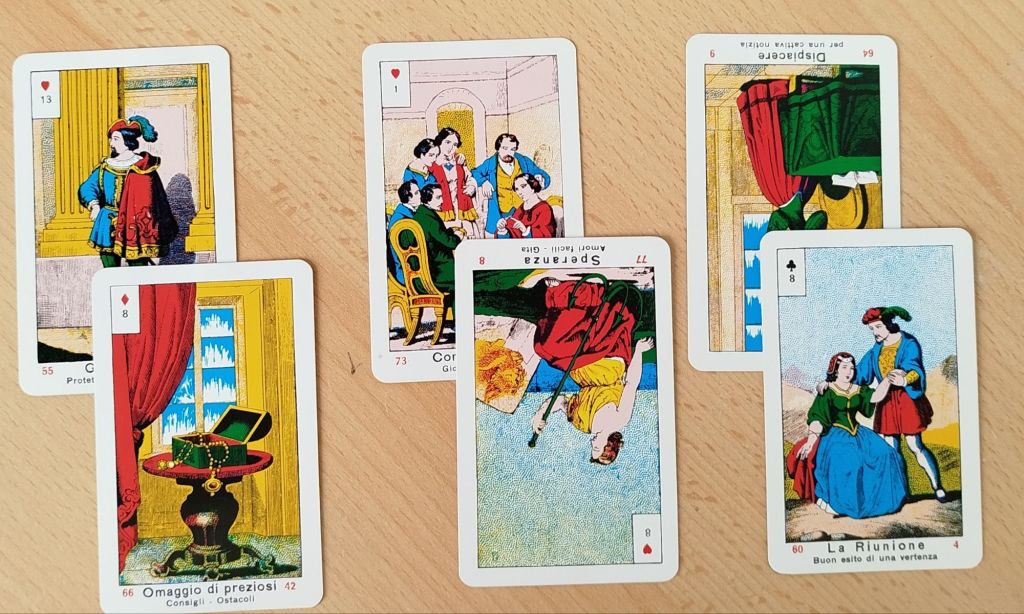
I’ve been having some fun with the answer spread with my playing cards but so far I had never used it with the Sibilla. This is an example of a spread I did two days ago, when hubby invited a colleague over for dinner. My question was simply how the dinner would go. It is a mundane question, useful for trying out a new spread.

Regina Russell’s answer spread, adapted for the Vera Sibilla

The Sibilla is, thankfully, very clear here. The first column, the one that supposedly gives us the background of the question, shows hubby (the King of Hearts) extending an invitation (the Gift, a proposal).

The central column generally gives us the answer to the question. Usually, the Hope card, when reversed, makes things go up in smoke. Together with a card such as the Conversation, which talks about gatherings, clearly the appointment does up in smoke or is at least dalayed.

The final column usually gives us additional information. The reversed Ace of Spades is generally less dangerous or less disappointing than when it is upright, but another meaning it has is that of a repeated occurrance. What repeated occurange? The Reunion, i.e., another gathering card.

What ended up happening was that the colleague had to cancel on us to take care of her ailing mother, but we rescheduled for next week.

An interesting Experiment

According to Regina Russell’s instructions, we only read the cards in the answer spread in columns. However, let us try to read them in the order in which they were pulled, which is:

Gentleman, Conversation, Sorrow rev., Gift, Hope rev., Reunion

In this case, the situation doesn’t change that much. The Gentleman, i.e., my husband, repeatedly gifts an invitation which, with some delay (Hope rev.) ends up happening (Reunion). Though, to be fair, in this case I would have probably pulled an additional card to make sure.

MQS

A World of Odd Coincidences

Yesterday I was cleaning in my office. I took my playing card deck (the one I use for divination) and was about to put it on the windowsill to dust my desktop, when it fell to the floor and the cards went flying in all directions.

So I gathered the cards without thinking anything of it and went on with my day. Later on I realized that one of the cards was the wrong way around: the Six of Spades, the sickness card.

Around an hour later my husband was on the phone with my mother-in-law, when she suddenly started slurring her words and being unable to move one side of her face. Fearing a stroke, we immediately called an ambulance and they were there a few minutes later.

We are still not sure what it was, but it was thankfully gone. She seems to be doing fine now, but the paramedics told her to remain in contact in case the situation presents itself again.

It is a good thing that we were on the phone with her when it happened, and I find the way the cards forewarned me endlessly fascinating, though I didn’t put two and two together until after the fact.

MQS

Regina Russell’s Answer Spread (with Example Reading)

The Answer Spread was popularized by Regina Russell in her Card Reader’s Handbook.1 Here, Russell details a system of fortune-telling by playing cards that is different from mine, but still quite interesting as a reference. She also gives examples of some spread layouts, including a small one to answer specific question.

I have rarely used this spread, but I added it to my repertoire just for variety, and I have found it to be quite reliable. You’ll need to shuffle or have the querent shuffle the deck after formulating a clear question. Then, have the querent take out six cards from the fanned out deck (or pull them yourself, if you’re doing a phone reading). Lay the cards out in this order

123
456
Layout for Regina Russell’s Answer Spread

Russell explains that the cards are read exclusively in columns (1-4, 2-5, 3-6). Each column has a different meaning: the first (1-4) indicates the background of the question or the current situation; the second (2-5) answers the question; the third (3-6) adds information about the answer. The sixth card can on occasion be of special importance and may contain the answer or some information on which everything hinges, but I have generally found this not to be the case.

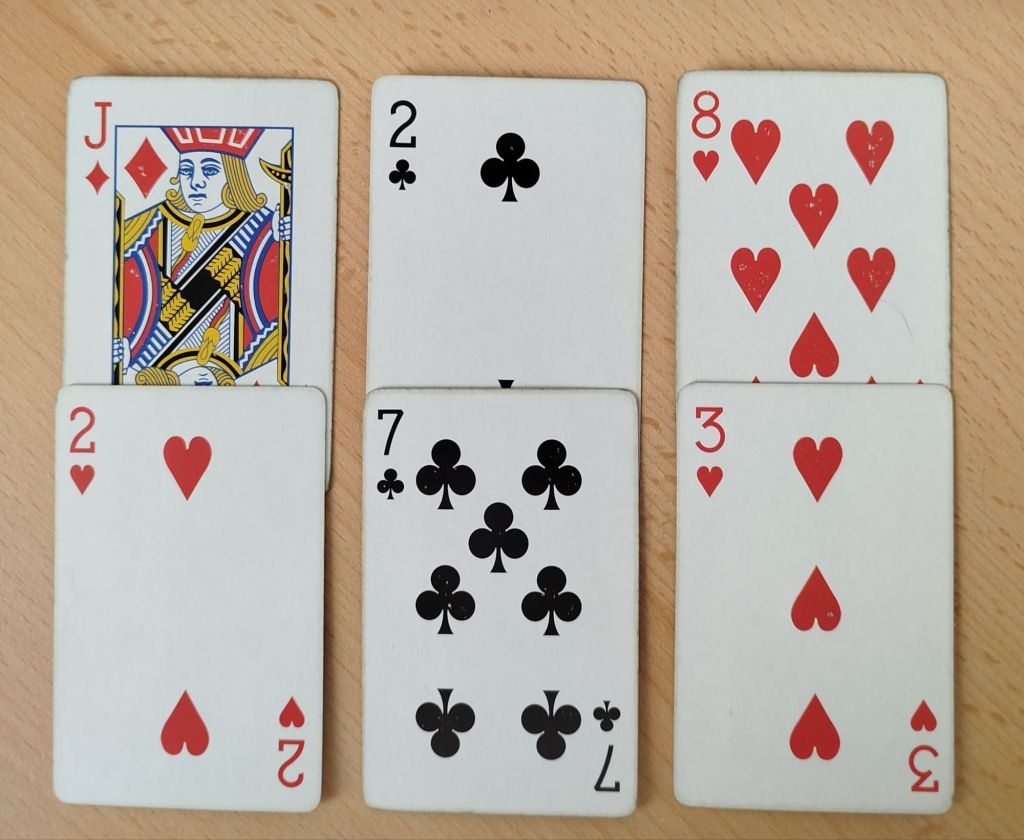
As you may have guessed, this is a very short spread to receive information quickly. Here is an example from the recent past with my husband as a guinea pig: his birthday was approaching and he wanted to know relatives would drop by unannounced to celebrate. These were the cards (note that I am not using Russell’s meanings, but those I am familiar with):

Will there be a surprise visit? Regina Russell’s Answer Spread

Since the question is so specific, you have the right to wonder why he thought they would throw him a surprise party. If we look at the column on the left, the one that talks about background information, we have the Jack of Diamonds and the Two of Hearts, an exciting message or a message from relatives. I didn’t know this at the time of hubby pulling the cards, but in talking to his family on his family chatgroup there had been odd remarks that had made him suspect something was being prepared. So this is the background information we need to understand the spread.

The answer, however, is somewhat disappointing. There are steps (Two of Clubs) being taken, so something is indeed being organized, but the Seven of Clubs causes trouble.

If we look at the right column, where additional information is found, we see a party (Eight of Hearts) and a gift (Three of Hearts). If these two cards had been in the center column, the answer would have been positive. As it stands though, these cards merely explains what steps had were being taken. So the answer is no, they won’t come on the day of his birthday.

It turned out that they did not come, though his brother would have liked to and was making plans for, because his mother was still recovering from a minor operation she’d had: this is the problem (Seven of Clubs). However, looking at this spread, I wouldn’t be surprised if a little celebration did take place next time we get together.

MQS

  1. Which you may buy here if interested. I’m not affiliated with them, I just think the book is a good reference to have. ↩︎

Vera Sibilla Cards Connected With Work

In the Vera Sibilla there are a couple of cards that connect more or less directly to the topic of work. Here we review them quickly to show their similarities and differences. As usual, this isn’t meant to be exclusive.

Six of Hearts – Money

Not directly related to work per se, the Six of Hearts is the money card, and as such it shows where money comes from, where it goes, whether one has it or not, etc. However, in a consultation about work, it can also indicate whether the pay is good or not, whether the business one works for flourishes or not, etc.

Seven of Hearts – The Scholar

This card is always welcome when we want to know whether we’ll get a job, as it can show the signing of a contract. It is also related to talent in one’s field, as well as certain types of job (intellectual or desk jobs).

Ace of Clubs – Marriage

Again a card that can represent the signing of something. Marriage is anything that gives us rights and obligations with respect to someone else, and a job contract is exactly that. It is also an important card for business deals and partnerships

Six of Clubs – The Surprise

This is a small money card, but because it represents money being received, it can symbolize the wages and therefore being employed. For instance, together with the House card it can sometimes represent the place where you gain money, i.e. the workplace.

Seven of Clubs – Realization

The Seven of Clubs is the card of worldly ambition and it can therefore stand for the querent’s career (I’m always reminded that in German the word Beruf, work, comes from the word Ruf, fame, the name you make for yourself in the world).

Eight of Diamonds – The Handmaid

This is another card that is strongly connected with money and where it comes from and where goes toward, but it is also a card of employment (a handmaid works for someone else). When it signifies the querent’s work, it is essentially a synonym of the Merchant card.

King of Diamonds – The Merchant

This is THE work card, the one you usually want to see in a question about work, and four times out of five, when it pops up in a different kind of question it still indicates the influence of the querent’s job on question, though the card also has other less common meanings.

King of Spades – The Priest

Not directly related to the querent’s job, but this card can represent the institution or company the querent works for (especially if it is relatively big). Needless to say it can stand for many other things, such as works related with the law or religion (with specific cards) or even works where one wears a uniform (the Soldier also represents a uniform, but usually it shows less socially important types of employment, such as being a builder).

MQS

Tarot Encyclopedia – The Three of Swords

(Note: this is a collection of the meanings attributed to the cards by some occultists in the past centuries. It does not reflect my own study or opinion of the cards. It is only meant as a quick comparative reference as I develop my own take.)

The Three of Swords from the Builders of the Adytum (BOTA) tarot deck

Paul Foster Case (and Ann Davies)

The time period is the second decanate of Libra, under the combined rulership of Saturn and Uranus, October 3 to October 12. Because Libra is involved, remember that the qualities of the Seventh house are prominent.
Well-Dignified: this is nevertheless a Key depicting sorrow, disappointment and tears, but it can be the beginning of deep understanding as to the basis and cause of our problems; disruption of friendship; interruption of cherished projects; quarrels; occasionally the position in the layout may indicate platonic friendships; in money matters this card is almost always a symbol of loss, but indicates that whatever money matters are under consideration have been fair and honest, so that no blame attaches to anyone for the loss.
Ill-Dignified: slander; selfishness and dissipation; deceit with respect to promises; loss in legal affairs.
Keyword: Sorrow
(From the Oracle of Tarot course)

A. E. Waite

Three swords piercing a heart; cloud and rain behind. Divinatory Meanings: Removal, absence, delay, division, rupture, dispersion, and all that the design signifies naturally, being too simple and obvious to call for specific enumeration. Reversed: Mental alienation, error, loss, distraction, disorder, confusion.
(From The Pictorial Key to the Tarot)

Aleister Crowley

The idea of division, of mutability, the idea of the airy quality of things, manifests itself in the Three of Swords, the Lord of Sorrow. Here one is reminded of the darkness of Binah, of the mourning of Isis; but this is not any vulgar sorrow dependent upon any individual disappointment or discontent. It is Weltschmerz, the universal sorrow; it is the quality of melancholy.

[…]

Binah, the Great Mother, here rules the realm of Air. This fact involves an extremely difficult doctrine which must be studied at length in The Vision and the Voice: Aethyr 14.
Binah is here not the beneficent Mother completing the Trinity with Kether and Chokmah. She represents the darkness of the Great Sea.
This is accentuated by the Celestial Lordship of Saturn in Libra.
This card is dark and heavy; it is, so to speak, the womb of Chaos. There is an intense lurking passion to create, but its children are monsters. This may mean the supreme transcendence of the natural order. Secrecy is here, and Perversion.
The symbol represents the great Sword of the Magician, point uppermost; it cuts the junction of two short curved swords. The impact has destroyed the rose. In the background, storm broods under implacable night.
(From The Book of Thoth)

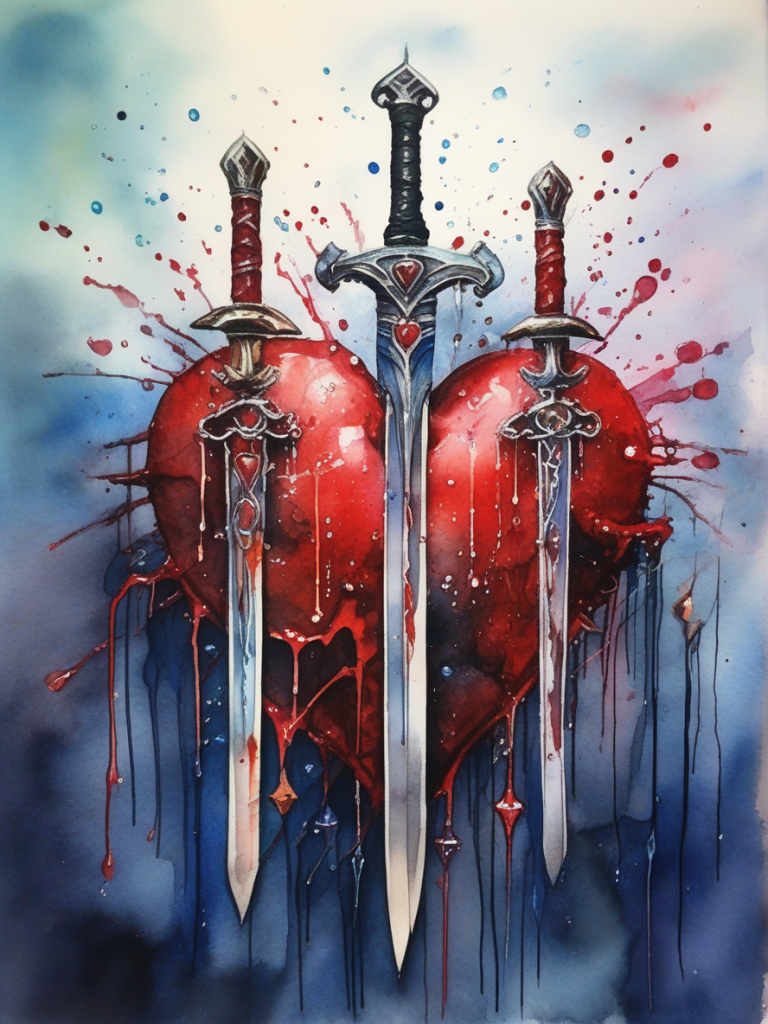
A gruesome AI-generated illustration for the Three of Swords

Golden Dawn’s Book T

THREE White Radiating Angelic Hands, issuing from clouds, and holding three swords upright (as though the central sword had struck apart the two others, which were crossed in the preceding symbol): the central sword cuts asunder the rose of five petals, which in the previous symbol grew at the junction of the swords; its petals are falling, and no white rays issue from it. Above and below the central sword are the symbols of Saturn and Libra.

Disruption, interruption, separation, quarrelling; sowing of discord and strife, mischief-making, sorrow and tears; yet mirth in Platonic pleasures; singing, faithfulness in promises, honesty in money transactions, selfish and dissipated, yet sometimes generous: deceitful in words and repetitions; the whole according to dignity.
Binah of HB:V (Unhappiness, sorrow, and tears).
Herein rule the Great Angels HB:HRYAL and HB:HQMYH as Lords of the Decan.

Etteilla

Removal
Upright. This card, as far as the medicine of the spirit is concerned, means, in its natural position: estrangement, Departure, Absence, Discarding, Dispersion, Remoteness, Delay. – Contempt, Repugnance, Aversion, Hatred, Disgust, Horror. – Incompatibility, Contrariness, Opposition, Unsociability, Misanthropy, Incivility. – Separation, Division, Breaking, Antipathy, Section, Cutting off.
Reversed. Misdirection, Dementia, Vanity, Alienation of spirit, Distraction, Insane conduct. – Error, Miscalculation, Loss, Deviation, Discard, Dispersion.

MQS

Answering Airy-Fairy Questions… Meaningfully (Example Reading)

As someone who advocates a grounded approach to divination, you’d expect me to scoff at questions that deal with more philosophical or spiritual themes. But this is not so. Airy-fairy is in the eye of the beholder, or rather, of the reader. Just like many airy-fairy readers can drown concrete topics in a deluge of commonplace spiritual-but-not-religious buzzwords, so can a grounded reader approach complex, ‘soulful’ topics from a grounded standpoint, while always following what the oracle says.

Someone asked me what was the goal of her current incarnation. Right off the bat we are confronted with a dilemma: firstly, the question presupposes that there is such a thing as reincarnation, which I don’t believe (at least, not in a sense that is compatible with what most people think of as reincarnation);1 secondly, it presupposes that this happens with a goal.

The first problem (reincarnation) we may circumvent by simply asking what’s the goal of the querent’s life. The second question (the goal) is trickier, but as I show in the example, it is not unanswerable.

What is my life’s goal? Playing card divination

Since we have absolutely nothing to go off on, we can start by noting that the querent’s significator shows up (the Queen of Clubs), though not in a very good spot. She comes after the Five of Spades which is the card of sacrifice, imprisonment and the inability to move. So we can already sort of guess that the querent is feeling trapped in some form or another.

The spread ends with the Six of Diamonds, which represents worry, insecurity and the like. Often it shows financial problems, but not necessarily: it can be a card of general nervousness and uncertainty. The spread is now starting to reek of psychological hang-ups.

Usually, the Two of Clubs after a person card indicates the person taking steps. Toward what? Toward the Ten of Spades. This is the card of secrets, of the night and of unknown situations.

At this point I asked the querent if she’s someone who never leaps into unclear, unknown situations. She said that that was one of the things keeping her from enjoying life, since she always prefers to avoid risk or put off taking it until she feels prepared, which is never.

Bingo. This is the answer: she must learn to step into the dark, take risks and be ok with not having everything figured out. She must learn to swim by swimming rather than by reading up on how to swim. If she doesn’t do it, she will spend her whole life by the poolside waiting for every condition to be perfect.

So, have the cards talked about the purpose of the querent’s whole life? You may disagree with me, but I don’t think so. I do not think that this is the purpose of her whole life (I think there is much, much more to anyone’s life), nor do I think that this is the reason she was born or has reincarnated (if you believe in reincarnation at all). And I told the querent as much, in the spirit of transparency.

What I do mean is that, at least at this juncture in her life, this is a recurring pattern that weighs her down and that needs addressing because it influences her general quality of life. That’s already enough to be worth being mentioned by the cards.

Ultimately, almost every airy-fairy woo woo question is the voluntary or involuntary corruption and modernization of some kind of longing that is deeply seated in the human soul. Questions about the purpose of one’s life may be often answered with the usual mix of mind body spirit platitudes, but the human desire for purpose is not to be lightly dismissed, whether the purpose is really there or not. And divination can address this desire in some form or another.

I believe that divination should be able to run the whole gamut of the human experience, from the most concrete questions to the most abstract, because this is the extension of the human soul. The problem arises only when we try to reduce one order of problems (Will I the chicken cross the street?) to another order of problems (What kind of psychospiritual drama do you think caused the chicken to want to cross the street?)

MQS

  1. I will probably discuss it more at length in another section, but my belief is that there is only one, universal soul that is constantly incarnating and reincarnating through everything. ↩︎