Sometimes a spread doesn’t give us enough information and we need to dig deeper. I know that there is a number of way to do it. The way that has been taught to me is called ‘opening the spread‘ and it simply means adding one to three cards in one point to obtain further information. At this point I should say that I try to use this technique only when I find it is strictly necessary. The cards are fickle friends, so they are best kept on a short leash, lest they start confuse us. Here is an example. A querent asked me about his career. This is what came out:
Career reading
He didn’t ask a specific question, but the first two cards, the Six of Diamonds and the Five of Diamonds, represent worry about change. The center of the spread is occupied by the Jack of Diamonds, which indicates messages. Note, also, that the spread is ovverrun with Diamonds.
At this point, I asked him to draw two cards to add to the Jack of Diamonds, and we got the Four of Clubs and the Eight of Diamonds, clearly an interview. Then I asked him to open the spread again on the Eight of Clubs, the job card, and the Ace of Clubs and Seven of Clubs came up, indicating the overcoming of obstacles.
The question I asked him was if he was waiting for a message about some change, possibly to do with a raise or another positive change, where he would need to solve new problems, and he said he had applied for a promotion with came with new tasks, and he was waiting for an answer. I told him he’d get it (Ten of Diamonds and Eight of Clubs). Yesterday he confirmed he got the promotion.
This spread is proof that we always need to have good communication with the querent, because sometimes readings are deceptive.
Sometimes spreads don’t answer the question at hand. This happens in two cases: when something more important is going on (or about to happen) in the querent’s life or when the cards want to give us details about the question that we haven’t asked for. This latter case requires great care, especially if the question is of a delicate nature.
A woman asked me if she will get pregnant. This is the spread (this is a rather old reading):
A pregnancy question answered with playing card divination
You’d probably think (and you’d be right) that my first instinct was to say “no” due to the horrible mesh of Spades following the Jack of Hearts, which is the child card.
However, something didn’t sit right with me about this spread. I wasn’t at all convinced the spread was answering the question directly. The reason is that the cards Ace of Spades, Nine of Spades and Ten of Spades can show bereavement, and bereavement can only happen if there *is* a child.
The King of Spades could be a doctor performing an abortion, but this isn’t confirmed by any other card (e.g. the Six of Spades). In this case, the King of Spades seems to be more like a priest celebrating a funeral.
I asked the querent if she already had a child, and she said that she unfortunately had a miscarriage in the recent past when the pregnancy was already relatively advanced.
So the cards were not saying that she wouldn’t have a child: they were merely reflecting a recent trauma. With that in mind, I interrupted the reading, telling her the cards were telling her to take time for herself. This was an excuse, of course: I could have done another reading, but I didn’t want to risk having to predict another miscarriage.
Fortunately, today the woman is the happy mother of two twins.
I was asked in a private message about the difference between the Ace of Spades and the Five of Diamonds in my way of reading playing cards, since both seem to signify change. This is a nice question, so I thought I’d write an article about it. Maybe I’ll write other comparative articles if I feel inspired to.
First off, let’s start with two obvious facts. The Ace of Spades belongs to the Suit of Spades, which is the most negative in the deck. Spades have very few redeeming qualities. They represent the dark side of existence, pain, grief and sorrow. The Suit of Diamonds, on the other hand, is neutral, with some positive undertones. It is a symbol of energy, change, progress. It is connected to technology and science, to money, wealth, intelligence. Broadly, it shows impulses and new impulses. This fact alone indicates that the Ace of Spades must have more negative connotations than the Five of Diamonds.
Furthermore, the Ace of Spades is, well, an ace. Aces have a powerful impact on any reading, as they can show the manifestation of new currents of destiny, new life phases, etc. They indicate the beginning of something. Even when they don’t, they are still very dominant cards, and we must always pay close attention to them. Fives, on the other hand, are roughly in the middle of the sequence, so the change they indicate is more akin to a transition within the same sequence or current of events.
This is, of course, somewhat vague and needs to be understood within the context of each reading. However, when we combine the suit with the number, we do have a general picture of the Ace of Spades as a very drastic card, whereas the Five of Diamonds, unless supported by drastic cards, tends to show a smoother transition, which is also less all-encompassing.
There is something else to take into account. Calling the Ace of Spades the card of change is somewhat reductive, as if we were trying to neutralize it. The Ace of Spades is, for the most part, a negative card. One of the ways my teacher called it, in addition to ‘the Death card’ was also ‘a thorn in the heart‘ though I don’t remember if I talked about this in the post. Perhaps I, too, have been guilty of playing it down.
A thorn in the heart is something that makes us suffer beyond words. It symbolizes grief, bereavement, sometimes even trauma. Even when followed by positive cards, the Ace of Spades represents painful changes that take a toll on our psyche, changes we are likely to perceive as some kind of great loss. The somewhat sterile concept of ‘change’ pales in comparison to this description.
The Five of Diamonds has, by itself, none of these connotations. It shows transition in the most neutral sense possible. For instance, when found next to the Ace of Hearts, i.e., the house, the Five of Diamonds can show renovations or changing the place of some piece of furniture, depending on the accompanying cards. The Ace of Spades next to the House can show grief in the family or coming from the family, and if it does indicate change, it is more likely to indicate an eviction or an unwanted change of residence.
Again, this is rather vague: we need to understand the cards within the context of a concrete reading, but by and large that’s my experience.
There is a general stigma toward certain forms of divination such as cartomancy with playing cards, namely that they are good at discussing mundane issues, while the Tarot should be used for deeper questions. This presupposes two things: that deeper questions don’t take place in the same world as regular life and that the Tarot is too deep to talk about everyday occurences. Both these beliefs are wrong.
The Tarot is perfectly capable of talking about whatever it wishes, just like playing cards, the Sibilla deck and every other oracle. The first presupposition, though, is more insidious and requires a bit more discussion.
The oldest extant series of tarot meanings has been retrieved in Bologna. The meanings there are what you would expect from a fortune-telling deck: the Ace of Swords is a letter, the Ace of Cups the house, the Hermit an old person etc. Furthermore, some rare examples of tarot fortune-telling in pre-modern Italian literature confirm that the Tarot has probably been used for such aims long before the occult revival started by Court de Gébelin, which slowly removed the Tarot from real life and confined it to the realm of “higher metaphysics”, that is to say, of psychological onanism.
In order to justify this “higher” (I would say emptier) use, several hypotheses on the Tarot’s origins have been put forth, depending on what was considered fashionable and not too easily disproven at the time. First it was the Egyptians, then the Kabbalists, then the Cathars, etc. Instead of being seen for what it obviously is, namely a wonderful product of European Neoplatonic Christian art that anyone before the Enlightenment would have immediately understood and considered familiar, and that only the ignorance of our post-Enlightenment metaphysicians could try to disguise as a distant voice coming from distant secret masters to apply in the understanding of distant matters, rather than an immediately obvious tool to mirror immediately obvious real life situations, which are all instances of an eternal story that constantly tells itself.
So yes, the Tarot can talk about daily experience. In the same way, other, more apparently mundane forms of fortune-telling can talk about problems that some would consider ‘deep’. Just like the Tarot, they can talk about it in immediate terms, immediately understood by anyone with who has some understanding of symbols.
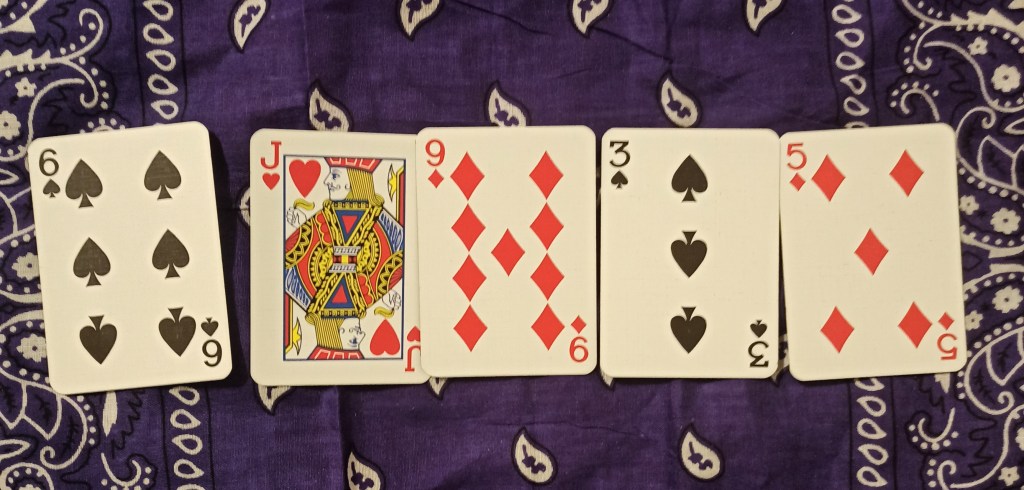
Here’s an example of playing cards used for a ‘deeper’ reading. The querent is a woman I met at an Enneagram convention. She asked what was the reason for her constant bouts of depression. These are the cards:
“Why am I always depressed?”
There is a sickness in her life, signaled by the Six of Spades. There are no cards of deep trauma, but something definitely needs healing. This card falling first sets the tone. The Jack of Hearts represents a child, a project, etc. Next we have the Nine of Diamonds, which is a card that represents the realization of ambitions, but more broadly can represent ambition. Then we have the Three of Spades and the Five of Diamonds. These two cards oftne indicate turning away from something. But the Three of Spades also comes directly before the ambition card. So she has turned away from some ambition. Two possible interpretations that came to mind are that she had the ambition of having a child but couldn’t or that she turned away from a childhood ambition.
I asked her, and it was the second possibility. She’d had big dreams for her life when was a child, but some disappointments had led to seeing them as unrealistic and she had let go of them. I told her that she hadn’t really let go of them, otherwise the Six of Spades wouldn’t have shown up: those ambitions still fester inside of her, and the fact that she is not doing anything about them could make her sick if she isn’t careful. These cards clearly show that she needs to go after her dreams, perhaps in her free time. Alternatively, if she doesn’t want to, she needs to truly let go of them and move on.
I find this short little spread interesting, because it is a good introduction to how playing cards can communicate with us. Often, especially at the beginning, we tend to expect cards to fall into a specific order that represents the whole situation like a movie. And, indeed, sometimes this is what happens (I have a nice Tarot spread coming on this.)
At other times, though, the cards take another approach and use our words ‘against’ us, as it were. Here’s the reading. I have been on a waiting list to receive a certain instruction book on some esoteric doctrines by someone. Yesterday I asked the cards the following question: “Will he do as he says?”
To answer the question, I pulled three cards, which were:
4♣ – K♥ – 10♦
Anyone can see that the spread is broadly positive, but the interesting thing is how the cards respond in the affirmative. The Four of Clubs is the card of words, and represents everything that we do to express what is inside of ourselves. The King of Hearts and the Ten of Diamonds, though, in addition to representing a rich protector, can also be part of larger combinations showing nobility or great wealth.
Therefore, what the cards are saying is “what he says, his words, are the words of a nobleman,” which means that they are truthful. This answers my question “Will he do as he says?” perfectly. The answer is also a broad judgement on the person’s character: he is, generally speaking, a nobleman at heart.