This is a cool reading because it shows that the cards tend to describe a situation and take their time to do so, so that trying to immediately get a yes or no out of them can be problematic and cause mistakes (though making mistakes is part of the human condition, obviously). This is the reason why, talking about the Bolognese tarot, I tend to disregard the yes and no rule of the Death card. It is also the reason why I don’t believe in the yes and no value of playing card colors. To me, that’s just a coin flip, and coin flips don’t work as reliably as actual divination, which is a language.
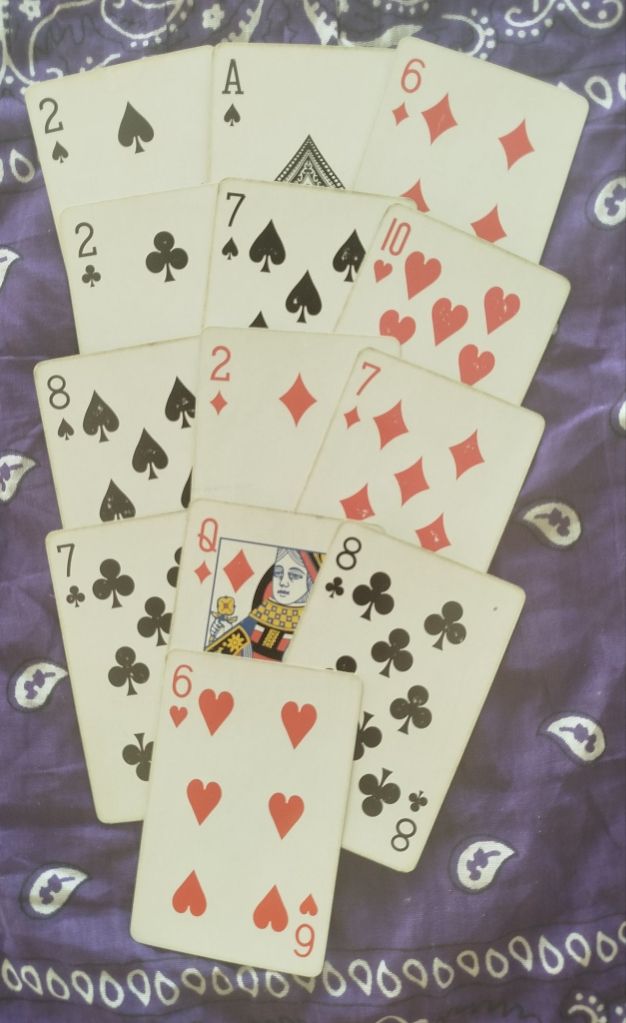
Here the question was if an unemployed man would get a job.
A career spread. Divination with playing cards.
The first thing I noticed is that the reading ends with a very positive combination of Queen of Diamonds, Eight of Clubs (work) and Six of Hearts (reconciliation/solution/adjustment). This bodes well, but the rest of the spread is more disastrous.
The first row shows that the subject is a thorn in the heart of the person (Two of Spades, Ace of Spades and the Six of Diamonds showing worry). Then we see that every step taken (Two of Clubs) to solve the issue has met with misfortune (Seven of Spades), meaning that the person has probably tried to find a job repeatedly but failed. This explains the very emotional cards in the first row, as well as the fact that the Happiness card (Ten of Hearts) is squeezed between Misfortune (Seven of Spades) and Tears (Eight of Spades). This is a whole unfortunate period unfolding in the person’s life.
There are some cards I am not quite sure about: the Two of Diamonds, Seven of Diamonds, Seven of Clubs. 2♦️ + 7♦️ can be a cheque or paper money, or projects about money. I asked the querent a couple of questions and it didn’t really help. I think a more general reading would be that, quite obviously, the lack of a job has impacted negatively (7♣️) his financial situation.
Then finally we have a woman who is either going to help him find a job or give him a job. If I had to bet I would say this is a female boss, since she shows up as a Diamond and not as a Heart. Either way, the period of misfortune is going to thankfully end.
I was asked by a visitor if I take into account the direction court cards look. The idea that the direction faced by court cards gives us important details is ingrained in several strands of card divination. In recent decades it has even been appropriated by certain scam artists (like Jodorowsky and his various imitators) when trying to sell the Tarot of Marseille as a deep metaphysical tool rather than for what it has always been–a cheap gaming deck, which, like all tarot decks, is as good for divination as it is for playing at the local inn.
But directionality does have its place in certain legitimate divination traditions. It just happens not to be part of mine. I do not take into account the way court cards face when reading playing cards, as I have never found it useful or revealing.
To me, each card is a place-holder for a cluster of certain ideas that are called to mind when the card appears: the Ace of Hearts is a place-holder of a cluster of ideas relating to the home or family, and similarly the Queen of Spades is a place-holder for a cluster of ideas relating to problematic women or issues traditionally associated with the negative side of womanhood. In this cluster of ideas there is nothing inherently left-looking or right-looking. That’s just the fantasy of whoever drew the picture.
What matters most to me is not so much where the card looks, but in what relationship it is with respect to the other cards. Suppose we have:
Q♣️ – 3♣️ – K♣️
Here we have a typical sequence of marriage. Even if the two court cards were swapped, it would change nothing. Now let’s take:
3♣️ – K♣️ – Q♣️
This positioning of the cards may or may not be the same as the previous one. In itself it is just another sequence of marriage. But if it makes sense within the context of the spread, it could indicate that he is the one who is more attached to the marriage, because he falls closer to the card that symbolizes union. However, let’s now look at this:
Q♦️ – 3♣️ – K♣️ – Q♣️
Here it is very important that the King of Clubs fell next to the union, because through it he is united to another woman. This sequence shows that the female querent is the lover (it would be even more clear if the 10♠️ fell between the two Club court cards, as it would show that the married man sees the female querent in secret).
In all this, where the court cards face is of no consequence, because what truly matters is their dynamic interplay. That being said, I know of playing card traditions where directionality is taken into account and I have nothing against it. It just happens not to be part of my toolkit.
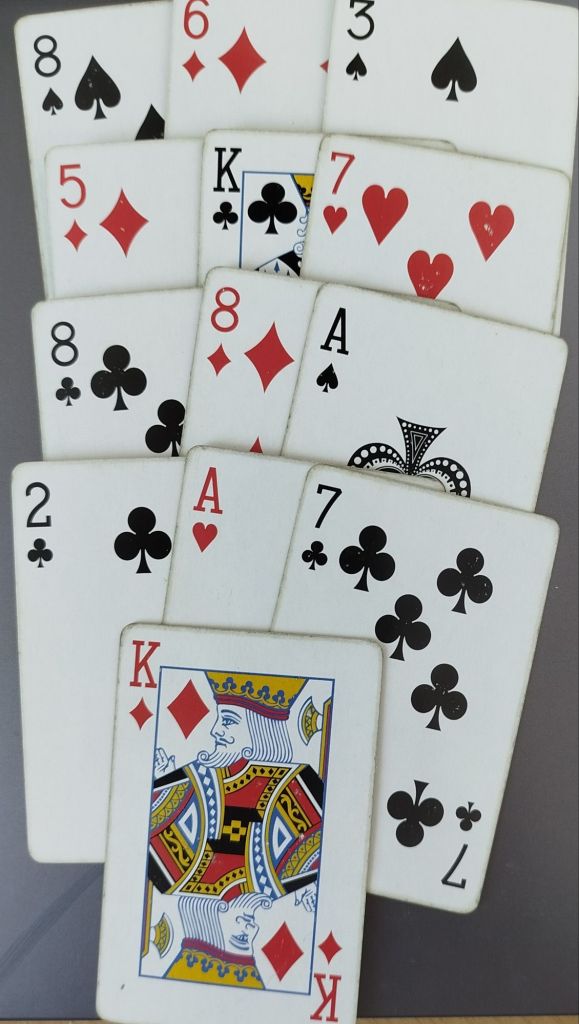
Here the querent is a friend of mine whose live-in boyfriend is acting aloof toward her. She was afraid that he was either having an affair or he was falling out of love with her, or that she had done something to him (he does have a tendency to keep things in until it’s time to explode).
Divination with playing cards: have I done something to him?
My querent doesn’t come up, so we can exclude that she has done something to him or that his love toward her is an issue. There is also a complete absence of mistresses, so we can immediately rule out that he is cheating, especially since there are no cards indicating sneakiness (like the Ten of Spades or the Jack of Spades). There is a Three of Spades, which might indicate intrigue, but clearly this is not what the spread is driving at, and the Three of Spades can also indicate a ‘knotted’, complex situation that doesn’t flow harmoniously.
His significator comes up in the second line, surrounded by cards that show positive development, so the situation is not permanent. However, the first line is a bit concerning, since we have tears, worry and the complex situation. Note that the worry card (the Six of Diamonds) is hemmed in by the spades, so it gives us a picture of the person being somewhat overwhelmed.
Then we have the two Eights and the Ace of Spades. As I wrote sometime ago, the Ace of Spades is often sterilized as a card of change, but at least in my tradition it shows great grief. The grief here is connected to cards of work and business, so this is the problem. The querent said that he doesn’t know if his temp job is going to be renewed. So that’s the problem.
Finally, to complete the picture, there is the house card with problems (Seven of Clubs) next to it. The steps (Two of Clubs) he takes at home (Ace of Hearts) are problematic, as a consequence of the issues shown in the cards above.
We have a final card, the King of Diamonds. We couldn’t identify him, although we suspect it’s either a colleague or a boss. We don’t know from the cards if his influence is positive or negative. It would require another spread, but it doesn’t matter since my friend’s worry was of a different nature.
When we give a reading about extraordinary questions like the occult or the paranormal, it is easy to fall into the trap of wanting to confirm the querent’s bias or subjective experience.
This is why I tend to avoid queries about such things as past lives: for one, I don’t believe in reincarnation, or rather, I believe that the soul of the world constantly reincarnates through every individual that is born, but I don’t believe in the existence of seprate or individual souls that reincarnate karmically; for two, I fail to see the importance of knowing about what one might have been in a previous life; for three, suppose I tell someone that they were an illiterate farmer, when another reader convinced them they were a cool witch who was burned at the stake for her mystical powers, how is the querent going to choose who is right apart from their whim of the moment?
Still, certain topics, such as magic or spirits, are within my tradition and I do believe in them, so I accept readings, but I warn querents that the likelihood of something of the sort happening in their life is very low even if they go looking for it, let alone randomly.
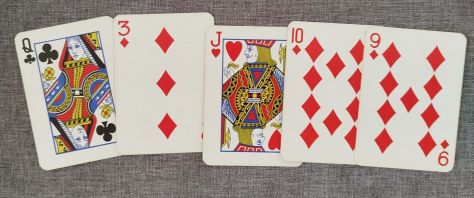
This one querent thought there is a ghost haunting the third floor of the building she moved to. This is the spread that came out:
A card reading about a ghost
As can be seen, even without interpreting the spread, there is no trace of haunting in the cards. The final two cards, the Nine of Diamonds and the Ten of Diamonds, are a lucky combination, they can show success, protection or even simply the fact that the “energy” is clean, not charged with magical or paranormal forces. The querent shows up at the beginning of the spread with the Three of Diamonds, which is a doubtful card in this context. It makes me think more about random things that she, the Queen, misinterpreted.
The Jack of Hearts is even more doubtful. It could show the presence of a child (a living child, that is) or an animal (again, a living one) who does something the querent misinterprets. The querent said that there are both children and animals in the building, so that’s a possibility. Frankly, I should have either added cards or done another spread.
Still, this is enough to make me think that there is a non-paranormal explanation for the querent’s experience, so the spread is enough to answer the question in that regard.
The funny thing is that, after the reading, the querent started talking to me like I am not very competent at reading cards. I am obviously open to being wrong, and I understand that it must be frustrating being told that one’s subjective experience is probably the result of a misinterpretation (it must feel like ‘gaslighting’, to employ an overused word). All I could do was trying to be as understanding as I could in delivering the answer.
After all, for every instance of real haunting or real magic (at least, real according to the oracle) there are thousands of cases of people who spend years burning sage to smoke out a presence that isn’t there, yet the ghost who isn’t there often ends up influencing their life more than those that are there.
If you ever happen to receive a comment from someone whom the cards describe in the following way:
2♠️ – 6♦️ – 2♣️
you can safely flag all their future comments as spam. Their actions (Two of Clubs) presuppose (behind) a volatile and unstable temper (Two of Spades – Six of Diamonds). It is someone who is simply looking for a target to live out their idiosyncrasies depending on the fixation of the moment.
Yesterday we had a nice reunion with some friends. One of them asked the cards if she has a shot with her dance instructor, whom she’s crushing hard on. These were the cards:
The first thing that jumped at me was that nasty Eight of Spades at the end, which literally says “it will end in tears.” If we take the three angles of the pyramid, they are the Six of Clubs, Nine of Spades and Eight of Spades. Bleak.
My querent’s card falls on the first line, together with the Six, the Ten of Hearts and the Nine of Spades. If we were to read this line as a literal sentence, it would be “Coming from a place of fatigue your happiness there’s not“. In other words, my friend is not just single, but lonely, has been for a while and she’s unhappy about it. This is interesting, because it shows that her crush is more like a compensation mechanism.
Then we come to him, the King of Clubs, who is on a journey (Ten of Clubs) with a loved woman (Queen of Hearts) that leads to a house (Ace of Hearts) of union (Three of Clubs). He is engaged. The final Eight of Spades does not say that he is unhappy about the engagement, but that the engagement brings tears to the querent.
One thing that I often receive messages about is how to understand the order in which the cards fall. Whether it’s the Vera Sibilla or playing card, there is one fundamental rule that applies in the majority of cases: later cards modify those that fall before.
Keep in mind that divination with cards is like the reading of a book, so the cards build the equivalent of sentences with their own grammatical structure. This is why I prefer to read the cards together rather than in isolation, as would happen in many contemporary positional spreads, where to each position corresponds one card.
In the tradition I come from, there can be positions, but there are always at least three cards, and sometimes five, covering one position. When we have two or more cards together, it becomes possible to “agglutinate” their meanings.
“Boy” and “run” becomes “the boy is running.” “Boy” and “friend” becomes “the boy is with a friend” or “the boy is a friend.” “Boy” and “Australian” becomes “the boy is Australian.”
Similarly, if we put two playing cards together such as the Three of Clubs (Union, marriage) and the Ten of Hearts (Happiness) they say: the marriage is happy. In the Sibilla, if we put the Ace of Club (Marriage) and the Four of Hearts (Love) together, it becomes “a loving marriage” or “a marriage of love.”
These are the first steps only. There are many more nunaces. However, the basic thing we must ask ourselves when interpreting two or more cards together is whether they add to each other or they contradict each other.
When they add to each other, the sequence in which they fall doesn’t matter that much (though it may add shades of meaning). “A beautiful girl” is roughly the same as “A girl who is beautiful.” But if we have “War” and “Peace”, saying “Peace and then war” is very different from saying “War and then peace”.
In the Sibilla, Fortune + Death is the end of fortune (literally, “the fortune meets its end”), whereas Death + Fortune is an end that brings fortune. Generally speaking, the cards falling after have the power to modify those that fall before.
That being said, divination is an art more than a science: we should never apply our rules so rigidly that we stop thinking about what the cards are saying. In most cases, in the Sibilla, Thief + Marriage has a similar meaning as Marriage + Thief: someone or something is interfering with the marriage.
Ultimately, each spread is a world in itself and the specific key to it must be found by following the clues that the cards leave behind.
As you may have read in another post, I recently lost my dad. My mother has always been the worrier type, and taking care of him in this last period has exacerbated these traits. I’ve seen her not just depressed, which would be normal, but utterly confused. A couple of days ago, when I discovered my dad’s playing cards, I asked how her mental state would evolve, and if it would improve (I used this picture as header pic of that post):
Will her mental state improve?
There are two points in this spread that immediately jumped at me:
The Two of Diamonds (2♦️) followed by the Four of Spades (4♠️). The Two is a card of communications, especially written, but it is also strongly connected with attitudes, mental states etc. Followed by the Four of Spades, it gives a critical point in her inner life.
The Five of Diamonds (5♦️) squished between Spades. The Five of Diamonds indicates change, transformation, the ability to move on from one state to another. This ability is negated by the surrounding spades.
Clearly she has entered a rather dark tunnel. The following cards offer hope: the Two of Hearts with a Heart court card indicates someone close to us. It could be me, it could be my uncle. The fact that two hearts follow the Spades indicates healing. It may indicate that focusing on the family, especially me, is a source of positivity for her. It could show help from me and my uncle or other close male relatives and friends
The final two cards are the Six of Clubs and the Six of Hearts are interesting. If the 6♣️ hadn’t been present, the three consecutive Hearts would have shown full recovery from the problem. Tbe 6♣️ though, is a card of fatigue, tiredness and of things slowing down, and of problems that seemed solved resurfacing.
Therefore, as may be expected, while the 6♥️ promises improvement, the 6♣️ shows relapses and that scars will remain. I expected no less.
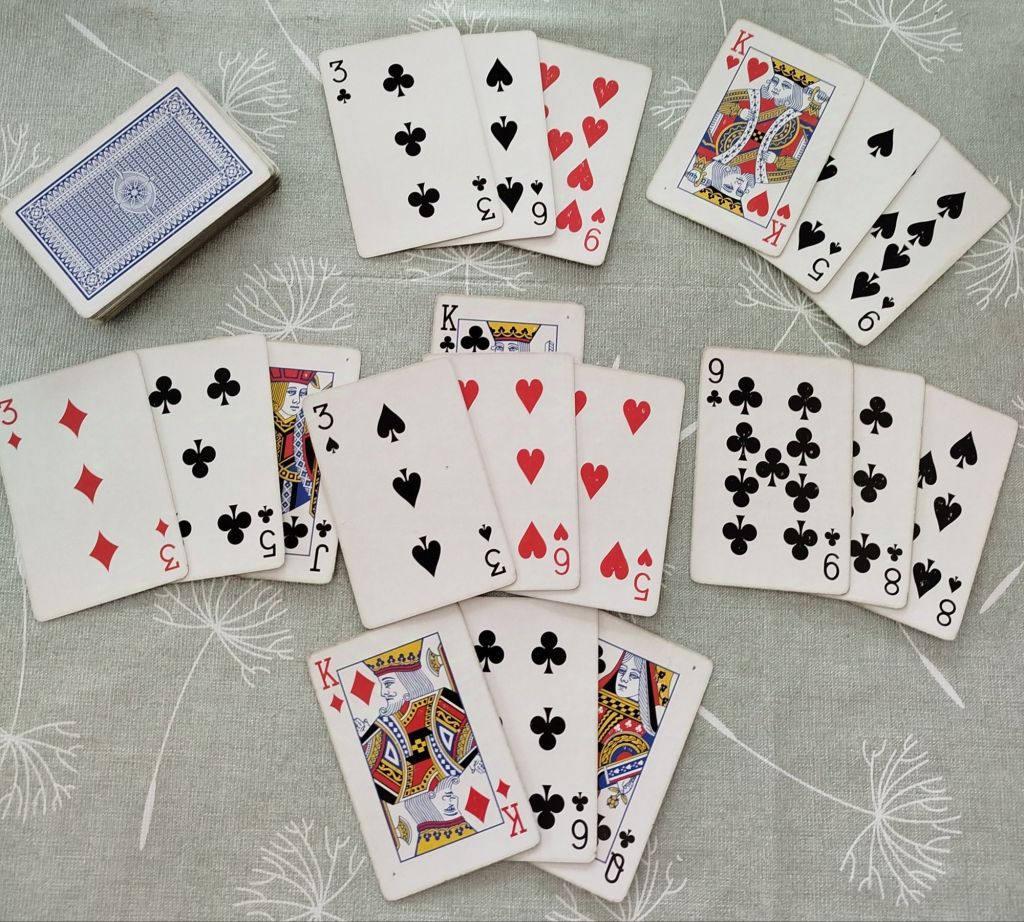
When I was taught to read playing cards, the cross spread was presented to me as a general spread. However, over time I discovered that it can also be used to answer specific questions of a general nature, or simply to explore certain compartments of the querent’s life. Here is a recent spread on a male querent asking about his career:
A career cross spread. Divination with playing cards
To summarise the main meanings of the various fans:
Left: past-present
Center: in the heart, sometimes present
Right: present-future
Above: thoughts, would like
Below: dislikes, problem
To the side: future/answer
The cool thing about larger spreads is that sometimes we can just identify a single spot that answers the question clearly, and everything else gives details that may or may not interest the querent. Here, the clear answer occurs in the right spot: 9♣️ 8♣️ 8♠️, which translates as “for a long time the job will give the querent tears”.
Now that we have identified a clear sentence, let’s fill out the details. Since the sentence is quite negative, let’s look at other negative spots. In his heart, the querent has the 3♠️ which brings difficulties, complications etc. But it is followed by cards that bring hopes of a solution (the two Hearts). Clearly there has been something that caused the querent to start hoping.
Now look at the fan above: he would like a contract (3♣️) that gives him happiness (10♥️). Between these two cards we find the sickness card (6♠️). This could indicate that it is a vain hope or a sick hope, one that is not grounded in reality. On the left we see that he has a small income (3♦️) but works hard (5♣️ J♣️) so it’s not that he doesn’t deserve job security. Below we see a difficult situation with a man that might be his boss or a superior. Clearly he is not the teacher’s pet (the Q♣️ simply shows that the querent’s troubles reflect badly on his love life).
The final fan unfortunately robs the querent of all hope, although it argues that there will be help from a man. To dig deeper I should have done another spread. As it stands, the detail is quite vague.
They are the bane of many a reader: Court Cards are seen as difficult to read, in part because they clearly represent people, and so refuse to be banished into the realm of woolly platitudes inhabited by way too many readers, in part because locating them within the querent’s life can be objectively difficult.
In cartomancy with playing cards, however, the inherent signification of the cards can help us: The Queen and King of Clubs are almost always the main protagonists (the querent and his/her significant other), though there may be exceptions. I know of cartomancy systems where the querents are represented by the Heart suit, but this is just semantics.
Then we have the Heart court cards, of which the Jack is a child, a pet or something fresh and immature and small and the Queen and King represent people close to the querent’s heart. This is actually a modern interpretation: traditionally, they would be people sharing the querent’s bloodline, but modern times require modern solutions. I have found that the Heart courts can simply indicate very dear friends. For gay people, usually the significant other is a Heart card of the same sex, although occasionally the cards simply use the Club cards. We need to stay open. The Jack of Clubs can indicate friendship, help, cooperation.
The Diamond suit represents people usually unrelated to the querent, though they can indicate relatives by marriage. More usually, they show colleagues, acquaintances, bosses, rich people or people who have a more neutral or even cold perspective of the querent compared to the Hearts. The Jack of Diamonds usually represents a message.
Finally, Spades show people who are downright inimical to the querent, or who wield power over the querent’s well-being and enforce an objective set of rules, such as the police, doctors, judges, etc. This is especially the case for the King. The Jack can represent enmity, scheming, etc.
All Jacks can indicate children or very young people, though in practice this is more likely with the Jack of Hearts.
Usually, one court card within a reading is already more than we can tolerate, but sometimes we find that there are ONLY court cards. This is an example of a reading a did yesterday for a man who asked about his relationship:
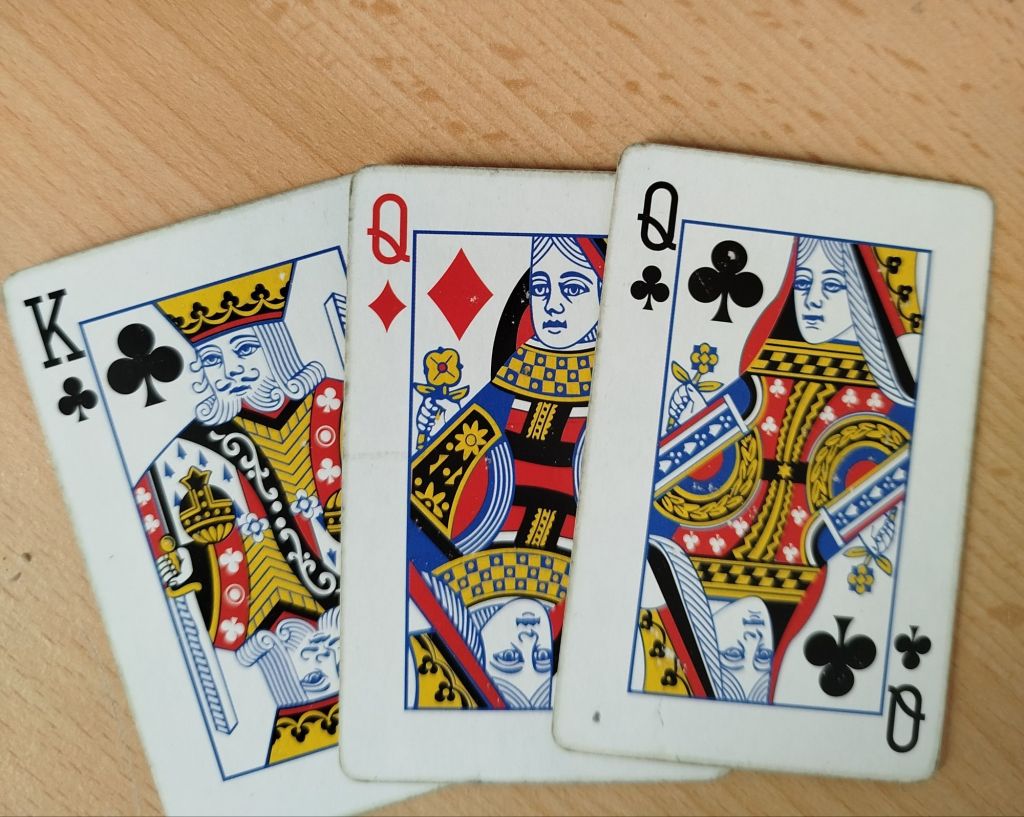
A marriage-related three-card spread
When more than one court card shows up, it is important to look at the cards between them, as they show the nature of their relationship, or what’s between them.
It is easy to jump to conclusions here: there’s a woman between you two! You have a lover! This could very well be the case, actually, but it is always important to keep in mind that, with so few cards on the table, more than one interpretation is possible. Here are some possibilities:
There could actually be a woman between them. He may have a lover (or, more rarely, she may have a female lover)
It might be a threesome
There could be a woman who interferes but who is not a lover: it could be her mother, her friend, any other person.
There might be a person mediating between them in a positive way
He might know her from work or from a business context, since sometimes, two queens or two kings together can represent a single person, merging the qualities of two suits.
So, how do we know which interpretation applies? Well, first off, we ought never to play Nostradamus: in doubt, we ask. This may sound unimpressive, but our aim is not to impress, but to give accurate information. Still, with experience, we may rule out a couple of possibilities as being less likely:
This is a simple three-card spread. If the querent were in some kind of odd polyamorous arrangement, the cards would not lead off with three court cards, but by telling us the querent is weird. This may sound politically incorrect, but the cards are keyed to a rather traditional view of the world. This doesn’t mean they are a compass of morality: it’s just their language. They highlight the strange and untypical in rather clear ways. Three court cards together aren’t strange enough.
This is a simple three-card reading. If the querent had a hidden lover they would tell us the relationship is in danger, or at least they would highlight the lover by assigning her to the Queen of Spades rather than Diamonds (The Queen of Diamonds can be a lover, but it requires more hints from the surrounding cards). Even the Queen of Spades wouldn’t necessarily be a lover, but at least we’d know she’s trouble.
This is a simple three-card spread. If there were a positive influence mediating between them, the cards would have given her to the suit of Hearts, or they would have omitted the information altogether and told us the querent and his significant other are in a positive phase (the mediator isn’t that important, and a three-card spread only has space for what’s important).
With that in mind, I asked the querent if he knew his girlfriend from work or from a business context, and he denied this. I asked him then if there was a woman causing some issues between them. He smirked and said: “A friend of hers doesn’t like me, she’s trying to break us up.”
Obviously, this spread doesn’t tell us how it’s going to end. It just describes the situation rather than how it will evolve, and more cards should be drawn.