Tag Archives: Cartomancy rules

How ‘Topic’ Cards Behave

In every deck there are what we might call topic cards, that is, cards that represent a specific field of life: family, work, money, health, love, the law, etc.

All or most of these cards also have general meanings that apply to various contexts. For instance, the Ace of Cups in the Bolognese Tarot is the home card (just like the Ace of Hearts in playing cards or the Two of Hearts in the Vera Sibilla), so it is the topic card for everything relating to family and house questions. But it can also indicate that someone belongs to the family, e.g., when it comes up next to a court card. It can also indicate the inner side of one’s experience of life, one’s inmost, intimate world, etc. So it can also show that something is close to us and touches us.

We need to distinguish between a card acting as a stand-in for a specific topic and the same card acting out a particular meaning. To keep with the Ace of Cups example, when it comes up in a question about work, it might show that the querent’s work life interferes with their family life or vice versa, or that they work from home, or that their work environment is family-like. In all these cases, the house card qualifies the other cards by adding details of its own.

But when the House card is simply a stand-in for the topic ‘home and family life’, the card says nothing about the topic itself. It doesn’t qualify the reading. It simply tells us, “this is the topic.” It is then the role of the other cards to describe the situation, qualifying it in a positive or negative way.

When we are doing a general reading with no question, or with all the cards down on the table, this is all well and good: we see if the person’s significator is next to any of the topic cards, showing that that topic is important, and then we read the cards surrounding the topic card relating them to the topic.

When the question has been specified, though, extra care must be taken trying to figure out if the topic cards that appear are qualifying the topic of the question or if they are coming up to ignore the question and talk about something else. This is not always easy.

Let’s say you asked about work, but the house card comes up. Why? Is it because the home is involved? Or is it because the cards have decided to bypass your question and discuss something else? Or is it both? (It CAN be both). One way to solve this issue is to see if there are topic cards relating to the question, or if at least the cards seem to be predominantly of a nature that seems more akin to the question asked (e.g., lots of Diamonds and Clubs in a work-related question).

The other way is to see if the cards next to the rogue topic card coalesce with it to form a coherent statement that has nothing to do with work, or if instead the topic card allows itself to be absorbed into the querent’s question.

The third way is simply to work with the querent. This is always a good idea. After all, our aim is to interpret the oracle correctly, not to impress people.

Cards that have the potential to be topic cards are always quite strong in a reading, so it is always good to observe them first. Often they form focal points in the interpretation of the spread. Sometimes some cards in some readings can even be ignored, but topic cards always seem to have something to say. We ignore them at our peril.

MQS

Bolognese Tarot – Connecting the Cards

I’ve recently talked about understanding the order of the cards when using the Vera Sibilla and playing cards. The Bolognese tarot, being a traditional fortune-telling system, follows similar rules, and as such it is important to understand whether the cards add their meanings together or contradict each other. Example:

Page of Coins + Queen of Coins

The Page indicates words, while the Queen represents the truth. Therefore, in this case, we get “true words”, “trustworthy words”, and similar combinations.

Queen of Coins + Moon

The Queen of Coins is the truth, but it is followed by the Moon, which indicates negativity, falseness, secrets. Therefore the combination talks about hidden truths, and thus of potential lies to cover the truth.

Moon + Sun

In the Bolognese tarot, the Moon is the card of negativity, while the Sun is the card of positivity. Traditionally, the Sun and Moon together are called “the two red cards” (due to the color of the two celestial bodies in the card) or the sorrow combination. Since here the Moon comes first and is followed by the Sun, the sorrow is passing, the problem will be solved.

Sun + Moon

In this case, the Moon more decisively blocks the Sun, so the sorrow doesn’t stop, or at least will last longer.

Tower + Justice

The tower can represent a large building one would rather avoid. Justice represents the law. Together, the two cards can represent a courthouse (but they can also indicate that justice or fairness is impeded, if the reading is not about a trial).

Justice + Sun

The Sun affirms the positivity of something. Together with Justice, it shows justice, fairness, equilibrium, etc

Justice + Moon

This is the opposite. The Moon negates justice.

Justice + King of Coins

The King of Coins is an important person, usually one with a degree. With Justice, he becomes an attorney, a notary, someone who is competent in some area of law or bureaucracy.

Love + Hanged Man

The Love card indicates, of course, love. In the Bolognese Tarot, the Hanged Man represents betrayal (being hanged upside down was the punishment for traitors). Together, they can indicate some kind of dishonesty connected to love (with the figure of a third party, it would become a triangle).

Love + Ten of Cups

The Ten of Cups brings feasting and jollity, so this combination would describe a happy-go-lucky love that is blooming, and if we add the Fool, that’s obviously a very fun love with not much commitment.

Love + King of Coins + Justice + Tower

We’ve seen that the King of Coins with Justice indicates a lawyer, and Justice and the Tower indicate a court of law. Connected with Love, this combination could show a divorce.

World + Eight of Wands

The World card means “around the world” or journey. The Eight of Wands indicates a road or path. Clearly, the two cards together strengthen the idea of a literal journey.

World + Page of Cups

The Page of Cups can indicate a younger woman, while the World shows “from afar” or “from around the world”. So this young woman probably isn’t part of the querent’ life: she’s a stranger.

All in all, combining the cards of the Bolognese tarot is a relatively intuitive process, although there are some traditional combinations that we’ll need to talk about in a future post.

MQS

Understanding the Order of the Cards

One thing that I often receive messages about is how to understand the order in which the cards fall. Whether it’s the Vera Sibilla or playing card, there is one fundamental rule that applies in the majority of cases: later cards modify those that fall before.

Keep in mind that divination with cards is like the reading of a book, so the cards build the equivalent of sentences with their own grammatical structure. This is why I prefer to read the cards together rather than in isolation, as would happen in many contemporary positional spreads, where to each position corresponds one card.

In the tradition I come from, there can be positions, but there are always at least three cards, and sometimes five, covering one position. When we have two or more cards together, it becomes possible to “agglutinate” their meanings.

“Boy” and “run” becomes “the boy is running.” “Boy” and “friend” becomes “the boy is with a friend” or “the boy is a friend.” “Boy” and “Australian” becomes “the boy is Australian.”

Similarly, if we put two playing cards together such as the Three of Clubs (Union, marriage) and the Ten of Hearts (Happiness) they say: the marriage is happy. In the Sibilla, if we put the Ace of Club (Marriage) and the Four of Hearts (Love) together, it becomes “a loving marriage” or “a marriage of love.”

These are the first steps only. There are many more nunaces. However, the basic thing we must ask ourselves when interpreting two or more cards together is whether they add to each other or they contradict each other.

When they add to each other, the sequence in which they fall doesn’t matter that much (though it may add shades of meaning). “A beautiful girl” is roughly the same as “A girl who is beautiful.” But if we have “War” and “Peace”, saying “Peace and then war” is very different from saying “War and then peace”.

In the Sibilla, Fortune + Death is the end of fortune (literally, “the fortune meets its end”), whereas Death + Fortune is an end that brings fortune. Generally speaking, the cards falling after have the power to modify those that fall before.

That being said, divination is an art more than a science: we should never apply our rules so rigidly that we stop thinking about what the cards are saying. In most cases, in the Sibilla, Thief + Marriage has a similar meaning as Marriage + Thief: someone or something is interfering with the marriage.

Ultimately, each spread is a world in itself and the specific key to it must be found by following the clues that the cards leave behind.

MQS

Which Card Prevails?

I’m taking inspiration from a question I got asked recently to talk about an important topic in cartomancy. Sometimes (in fact, many times) the cards appear contradictory, with positive and negative cards mixed together. The question I was asked is, which cards prevail in the reading.

Before starting the interpretation, it is usually a good thing to get a general look at the cards to see the ‘tone’. Are they mostly positive? Are there places in the spread that seem difficult? Are there cards that answer the question directly? You don’t need to come up with the interpretation right away, but it’s good to be aware.

However, this general bird-eye view is not enough. Usually, in cartomancy, we read the cards from left to right as if they were a sentence, stringing the meanings together. Therefore, as a general rule, 5♥️ – 4♠️ is worse than 4♠️ – 5♥️. In the former case, the abundance is broken or blocked, while in the latter case the brokenness and blockage are overcome.

In this sense, it is important to pay attention to whether the negative points in the spread come at the beginning, in the middle or at the end, because. Even if there’s two negative cards out of five, if they come up at the end they can obstruct success. If they come at the beginning, it may be a passing problem.

Again, though, let us avoid purely mechanical rules. Suppose a five-card spread is all positive and shows the querent getting what he wants, and then at the end there is one negative card. This card may show not failure, but that the fulfillment of the wish comes with problems. In these cases it is always good to either add cards or do another spread.

Similarly, the cards are entirely negative and show failure, a single positive card at the end doesn’t necessarily show that the querent will get his way. It could be showing that there will be new opportunities. Again, additional cards or a new spread may be warranted.

When we ask a question and a card directly connected to it comes up in the spread, it is always important to look at the cards surrounding it, especially if they are of the same suit, and even more important are the cards following it, because they will show us what will happen to the significator of the question.

For instance, if the question is about a pregnancy, the 5♥️ followed by positive cards is encouraging. If the question is about work, the 8♣️ surrounded by Spades could show serious problems or even unemployment. In a marriage question, the 3♣️ surrounded by Hearts shows a loving union.

These are rules of thumb. Every spread is unique and must be judged on its own merits and in its own structure.

MQS

A Long Long Time (Reading Example)

Sometimes in readings it’s not immediately clear whether the cards start by describing the past, present or future. There are times when they jump immediately into the future, while at other times they only talk about past and present situations and we need to keep adding cards to find out what happens next. More often, though, the cards start with the past/present and then move on to the prediction, or at least this is my experience.

In this case I was asked by a querent if she would find a job. Note that I started with five cards and then added more to get more details, but I here want to concentrate on the first five:

Job Prospects. A Vera Sibilla Reading

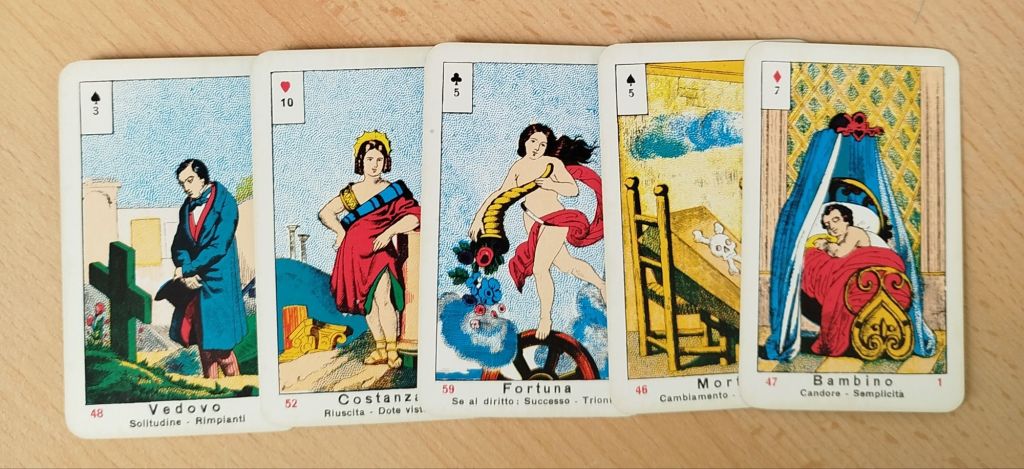
The first four cards (Widower, Perseverance, Fortune and Death) deserve special attention. The Widower is the card of “being without”. It also has some affinity with the past, especially when it falls toward the beginning of the spread. The Perseverance card can sometimes indicate that something goes on for a long time (it perseveres). Usually this happens when the cards surrounding it have the same polarity or talk about the same thing.

In this case, the Fortune card is not the same polarity as the Widower, since the former is positive and the latter negative. However, Fortune is followed by Death, showing misfortune or lost chances. In this case, it’s as if Fortune + Death formed a single (negative) card, which is of the same polarity as the Widower.

Therefore the Perseverance card highlights the fact that the querent is without (work) and has been for quite a while, and has repeatedly lost chances or opportunities, or has had repeated misfortunes connected to her career. She confirmed to me that she hadn’t found a job since giving birth to her daughter a few years ago. Actually, she hadn’t looked that much for a job, but whenever she had she had been passed over in favor of someone else.

The Child card is a card of beginning, and in a way it shows the start of a new phase. This fact is highlighted by the Death card being at the end of a negative sequence, so that while it is a negative card in itself (because it follows the Fortune card) it also ends the negative period thanks to being followed by the Child.

The cards following the first five simply described the work environment and the various ups and downs she will face, but they are less interesting.

MQS

Basics of Card Interpretation – Cartomancy with Playing Cards

As I did for the Sibilla, I shall now write a series of articles on the concrete interpretation of playing cards in divination. Some of what I said for the Sibilla applies here, so make sure to check that article.

Keep in mind that you cannot learn card reading in theory. I am among those who believe that, without some grounding in theory, practice tends to be shallow. I’ve met plenty of “intuitive readers” who basically spend their querents’ time saying “how powerful this reading is” without actually saying anything of consequence except some pseudo-empowering truisms (“It’s time for you to get out of your own way”). There is nothing wrong with empowering the querent, but the advice needs to be taylored to their specific situation, and reading the querent’s specific situation requires some study of the theory.

That being said, there is also such thing as too much theory. If you want to be a card reader, read cards. Do it for friends, acquaintances, relatives. Sooner than you think you are going to amass a wealth of practical insight into the nature of the cards which is going to be more valuable than anything anyone may write.

Playing Cards are usually read one after the other in a linear fashion. If you feel called by positional spreads (“This is his heart, this is his past, this is his wish, etc.”) by all means go ahead. However, playing cards are great at creating broad pictures by combining with one another.

The first thing to remember is that Hearts tend to be positive and Spades negative, with Diamonds and Clubs fluctuating somewhere in between. Unlike in the Sibilla, where red cards tend to be weak and black cards strong and assertive, in playing cards Hearts are just as strong as Spades. This means that much of the interpretation depends on which card falls first and which last.

For instance, let’s say you have the 2♥ followed by the 2♠. In this case, an argument or some kind of vexation is coming up next. The Two of Hearts is a rather broad card in terms of meaning, often just showing that something is about to knock at the door. However, if it were 2♠ followed by 2♥, then whatever negative thing the Two of Spades signifies is likey to be overcome by harmony (the Two of Hearts indicate a distance being bridged).

Diamonds and Clubs are broadly neutral, although Diamonds tend slightly toward the positive and Clubs slightly toward the negative. This means that they are strongly influenced by the Hearts and Spades in the spread. For instance, one of the main associations of Diamonds is with money, but in itself we do not really know if it’s money gained or money lost. This depends on how the card falls in the spread, and whether with Hearts or with Spades. Clubs, on the other hand, indicate effort, so a Heart can make the effort pleasurable or positive, while Spades can make it in vain. In general, accumulations of Clubs indicate difficulties.

Note that although Clubs are neutral and Hearts are positive, which prevails still depends on which card falls first. For instance, 6♥ + 7♣ shows that there are difficulties in overcoming a separation or in healing from sickness. In itself, this combination is slightly positive because the Seven of Clubs is not a Spade, so it leaves the door open, but it is not satisfactory. If we had 7♣ + 6♥, then a problem would be overcome rather easily.

In general, a Spade falling last indicates failure. However, you need to be careful. If you are only pulling three cards, this may very well be so. However, the more cards make up the row of cards you are interpreting, the less a Spade falling last can overcome very positive card, especially if it’s not a hugely negative Spade. Suppose you have five or seven cards in a row that show that the querent will get his wish, but then a Spade falls last. In this case we would interpret the spread as “you will get what you want, but then a problem will arise.” What kind of problem will be shown by the cards themselves. In case, do another spread.

These are just some preliminaries. Playing cards tend to be rather straightforward, so you will soon find yourself understanding the cards in context better than I could ever describe them in an article.