Tag Archives: Card Spreads

A Quirk of the Thirteen-Card Spread

The last thirteen-card spread I posted was interesting for a couple of reasons. One reason I already talked about: the need to be flexible with significators.

Another reason is that it showcases what I suspect to be an interesting quirk of the thirteen-card spread. This is a purely experimental anecdote, so take it with a pinch of salt, but I have found it to be true on more than one occasion.

The quirk is that, in the thirteen-card spread (which I discussed here), the rows seem to be connected not just one after the other, but also alternately, i.e., the first row with the third row and the second row with the fourth row.

I cannot stress this enough: this is NOT a rule, it is simply something I have found to be true on occasion. There are situations where the thirteen-card spread is perfectly smooth from start to finish, reading like a little story with a beginning, a middle and an end. In this sort of situation we don’t need to pair up the rows 1-3 and 2-4.

However, sometimes we can recognize snippets of story mixed together in an odd way. I have found that pairing odd rows together and then even rows together can help sort these snippets out, giving them a more logical order.

In the example of the spread I posted, the second and fourth rows seemed to talk more about material issues, whereas the first and third were more centered on the person’s emotional life. Pairing them odd-with-odd and even-with-even, the spread became more clear.

If the spread is talking about more than one issue at once (which can happen), then this kind of pairing often makes sense. However, sometimes it makes sense even if there is only one topic in play, and this particular case the rows that we pair up talk about subtopics within the same topic.

It may be that this technique simply stems from my limitations as a reader, so that I find ways to circumvent difficulties in the interpretation of the spread. Still, I found this to be accurate enough to bring up, in case anyone wants to experiment with it.

Finally, it may simply be that we need to be very flexible with the rows, and take for granted that they may pair up in unlikely ways. Who knows, maybe I’ll find that the first and fourth row really go well together in some readings. The point is always that the techniques we apply need to shed light on the querent’s life, not simply add flourishes and complications to the interpretation.

MQS

My First YT Video: Cross Spread Tutorial

I finally decided that there was no point in learning the theory of how to make videos. Much better to make crappy ones until something goes right. So yea, here’s the first video on my channel.

Please be patient, I am a very special kid.

MQS

The Great Spreads with the Bologna Tarot – The Staircase

Following up on my previous post about the “bed sheet” spread with the Bologna tarot, I wanted to cover another full-deck spread: la scala, i.e., the staircase spread. You could also call it a pyramid spread, but I’ve never heard it being referred to as ‘pyramid’, possibly because pyramids were quite outside of the daily experience of the old ladies of Bologna. Here is the layout:

The staircase spread (la scala) with the Bologna Tarot

Note that this spread is intended for a 45-card deck. If you use a 50-card deck you’ll have five cards left over that you can put to the side as describing something imminent or something that is outside of the querent’s life (your choice).

The principles for interpreting this spread are the same as with the previous one: we look at the angles, then we locate the significator (Queen of Wands for a woman, King of Wands for a man). Generally speaking, anything above or before the significator shows the past, and anything after or under it shows the future, but we need to be flexible: sometimes we can just read the full column or row of the significator as a single sentence.

Furthermore, while the angles are important, we must not forcefully insert them into the reading: if they seem meaningful we can look at them, if they don’t, we can ignore them. Sometimes their significance becomes clear as the reading progresses.

Finally, we can look at the cards forming the outer diagonal side of the triangle as giving us one or more predictions concerning the future. In this case, the cards are read from the bottom to the top, walking up the stairs as it were.

In this case, let us suppose we are reading for a man. The angles of the spread are formed by Temperance, the Moor and the World. The cards are not especially clear. Let us move on for now. The King of Wands is found in the fourth column and third row. The row is quite negative: Justice is in the dark (Moon) causing suffering (Eight of Swords) at home (Ace of Cups) and confusion (Fool) that requires an expert (King of Coins). This could relate to something legal or bureaucratic.

In his column we find that there are messages and talks (Page of Swords, Page of Coins) with a woman who is close to him (Queen of Cups) and these communications are sad (Seven of Coins) but will be required to clarify some things (Queen of Coins).

Note that not everything we read in this spread must necessarily be connected to everything else, since this spread is supposed to be general. However, in this case we find that the querent’s card is close to the house card and the conversations happen with a family woman, so we can guess that the two things are related. Looking back at the angles, they cound indicate that this situation is requiring unexpected journeys.

Now let us look at the diagonal: the World and the Juggler could indicate a small trip or, considering the Ace of Wands is next to the Juggler, it might refer to hearing about a pregnancy. The Love card would confirm the joyful occasion. If we connect these cards, together with the Queen of Coins and the Strength card, to the issues we’ve seen relating the family, it could show the solution coming after a bit of uncertainty.

Considering the final cards on the stair, namely the King of Coins and the Chariot with the Moor, it could indicate an unexpected need to see a doctor (Chariot = sick bed, King of Coins = important man).

MQS

The Great Spreads With the Bologna Tarot – The Bed Sheet

The Bologna Tarot is typically read in large spreads. This is because each card has very simple meanings, so one cannot spend their time musing on them at length as often happens in contemporary tarot practice. The Bologna Tarot is closer to the Sibilla or to playing cards or Lenormand in this sense (or even to how regular tarot readings used to be).

Many general spreads done to tell a broad fortune use the whole deck. This is the case of the Lezuolata, or bed sheet spread. It is a 5×9 spread similar to the Lenormand or Kipper Grand Tableau (this is for the 45-card deck. If you use the 50-card deck just add a tenth row). Here is an example:

The Bed Sheet spread (Lenzuolata) with the Bologna tarot

This spread is typically used to “locate” the querent’s card (either the King or the Queen of Wands) and see how their general circumstances are. It is typical to start the reading by having a look at the four cards in the angles. In this case we have the Tower, the Hermit, the Ace of Coins and the Page of Cups. This could indicate money trouble relating to a young woman (maybe a daughter). If we interpret the Page figuratively, then it shows that the querent has no (bad cards) monetary (Ace of Coins) satisfaction (Page).

Let us suppose we are reading for a woman. The Queen of Wands is located in the second-to-last row and in the second-to-last column. She looks at the Moon, behind which there is the Ace of Cups (the house) and the Ace of Swords (relationships, or something close). Behind her is the King of Swords, a young man, and underneath her is the Juggler, which is a kid. So possibly she has kids (remember the Page of Cups), and she is worried about her financial situation at home.

Let’s look at the column where she appears. Broadly, this is a positive column, with a King and Queen of Cups possibly indicating figures in the family. Right above the Queen is the Chariot, which in this tradition indicates the sick bed, again reinforcing the idea of suffering (not necessarily physical). But the two figures of the Queen and King bring her the Ten of Cups, flourishing, and some minor good luck thanks to the Wheel.

Above the Wheel we find the Page of Wands, her thoughts, and the Seven of Cups, which also relates to the family, especially protection from the family. Possibly, therefore, the Queen is worried about having money for her kids, but her parents or another couple from her family are helping her.

As can be seen, this spread is not meant to let you talk at length, but it does give you a snapshot of the querent’s life at that moment.

MQS

Will She Learn to Love Herself? (New Spread Example)

The Thirteen Card Tableau Spread

The spread used for this reading is a spread of thirteen cards that I’ve learned from the person who’s teaching me to read the Bologna Tarot, and it is typical of that tradition. It is a small tableau of cards that is generally used to explore a single issue (though nothing forbids you to use it for general readings.)

123
456
789
101112
13

There are several traditions varying from town to town. According to one, the cards are to be read in columns only, with one indicating the past, one the present and another one the future. My teacher however reads them primarily in rows, though sometimes columns can be read too, and usually, the central column holds some importance. More often than not, the last card is especially important because it will either contain a general answer or give you an important detail, or determining factor.

Although this spread is especially linked to the Northern Italian tarot tradition, I’ve seen it used with regional playing cards as well, and I don’t think there is any reason why it wouldn’t work with any deck tradition you practice. I will certainly use it with the Sibilla as well, one of these days.

Will She Learn to Love Herself?

The querent in this case is an acquaintance of mine, but the question was not about her, but rather about her sister. The question was “Will she learn to love herself?” and it came with no further detail. This is fine, as often when a querent feels the need to talk there is a risk that they end up feeding me their perspective. So here are the cards that came out:

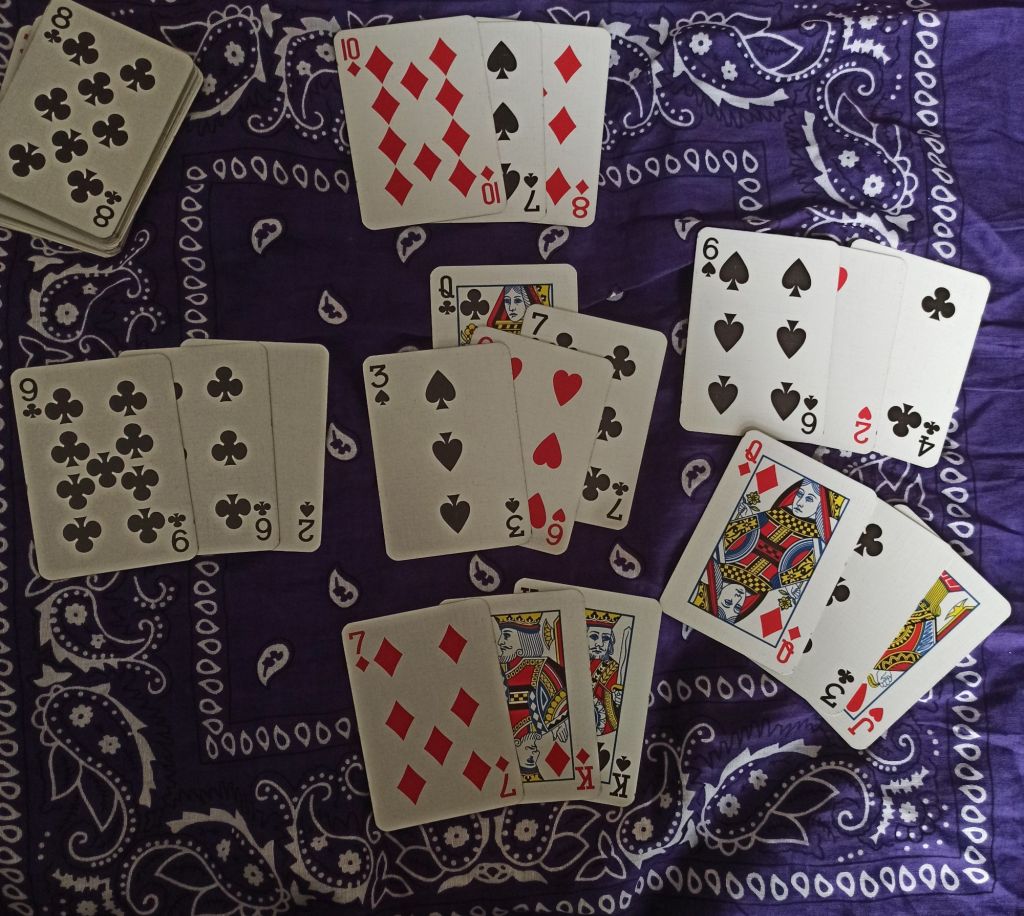
Will she learn to love herself? Divination with playing cards, thirteen-card spread

Right off the bat, we notice that the significator for the querent (the Queen of Clubs) is present, so since this is a tableau we might as well look at the cards surrounding it. She has the Jack of Hearts, the Queen of Spades and the Eight of Spades above her. These cards could mean a number of things, such as problems with a daughter or problems with an immature woman, or problems in the person’s childhood. Let’s file all this away and move on.

Next to the Queen of Clubs we have the Nine of Clubs and the Six of Clubs, which represent long-term toil and struggle. Clearly, whatever this is, it is not something that is going away soon. But the spread ends with the Nine of Hearts which indicates triumph. There is light at the end of the tunnel.

Technically, we already have our answer: the querent’s sister will struggle with self-love a long time, but she will improve. But the cards tell us more. Let’s turn to the first row, where we find the Queen of Hearts hemmed in by Spades. There is some kind of blockage or problem (Four of Spades) that causes the shedding of tears (Eight of Spades) relating to a woman (the Queen of Hearts).

Usually, the Queen of Hearts is either a relative or someone with our best interest at heart. In this case, though, she is strongly afflicted by the Spades. So I asked the querent if the issue relates to the sister’s poor relationship with her mother or another female figure close to her that impacted her self-love negatively. The querent confirmed that their mother was a raging alcoholic who worked overtime to tear them down when they were little. Note how the cards highlight the cause of the sister’s suffering by placing it right on top of the spread!

Right underneath we have the Queen of Spades, the Four of Clubs and the Five of Diamonds. This line was a little cryptic, and I must confess I did rely a little bit on my intuition, but the interpretation was still logical. There is a woman of spades who is saying words (Four of Clubs) that cause change (Five of Diamonds). Who is this woman? Usually the Spade suit is problematic, but it can also indicate certain professional figures (doctors, military figures, judges, etc.) It stood to reason that this figure could be a female therapist that is helping the sister. I asked and the querent confirmed to me that the sister is seeing a female psychologist who “means business but is very competent” (Spades).

The line just above the querent contains the Jack of Hearts, the Six of Hearts and the Three of Spades. This time I felt confident interpreting the Jack of Hearts as the sister’s “inner child” or, to avoid woo woo terminology, it represents the issues accumulated since childhood. The Six of Hearts talks about healing, and the Three of Spades indicates intrigue, but also in the metaphorical sense of a knot, something that needs to be unravelled or clarified. For the time being, therefore, the sister’s issue will persist, but the final Nine of Hearts is promising.

MQS

A Money Spread – With a Mistake

Not even the best card readers are 100% correct, and I’m far from being the best card reader. This is an example from some time ago. The querent was a woman she asked me, generally, about her finances.

Cartomancy with playing cards – a cross spread about money

Looking at the spread as a whole, it is clear that  it’s about money. In the upper position there are money issues highlighted, particularly a sudden (Seven of Spades) expense. The position below, which often needs to be connected to the one above, indicates issues connected with authority, possibly a bank or other financial institution (the King of Spades and King of Diamonds). In the past position we have a situation of slowness and difficulties for a long time, while in the heart position there are difficulties, possibly either obtaining something or getting it back (the Six of Hearts can mean that) or just simply difficulties finding one’s footing.

I ask the querent and she tells me that she’s a small business owner and business has been slow, and she’s been having trouble applying for financial help in the form of loans to renovate her business (note the Six of Hearts) and make it more appealing.

Encouraged by how responsive the spread seems to be, a look at the future positions. This is where I got everything wrong. I tell her that, although there is trouble (Six of Spades) she will get a positive answer (the last fan with the Three of Clubs and the Jack of Hearts). Looking back it is quite obvious the cards were saying something else.

She didn’t get the loan. The fan with the Six of Spades is not positive at all, even though I had decided to interpret it positively: it merely shows she will be quickly (Two of Hearts) refused the loan, possibly because she is not deemed to have her finances in order.

However, she later did end up partnering (Three of Clubs) with another woman (Queen of Diamonds) to start something new (Jack of Hearts).

Cartomancy with the Skat / Piquet Deck of 32 Cards – Spreads

The German Skat / Piquet deck is normally read in a großes Blatt or große Tafel, i.e., a grand tableau. Usually, the composition of the Blatt is 8×4 or, alternatively, 6×5 plus two remaining cards in the last row. Maybe I will cover it in a future post, but as it’s a method I’m still studying and am not familiar with, it may take a while 🙂 there are, however, other methods.

For starters, nothing prevents you from using regular rows of cards for answering simple questions or just to get a general look at the future.  You can also take a look at the spreads I presented for the Sibilla and adapt them.

Another popular method used with Skat cards is that of the star. There are several variations online. The star spread is relatively simple and is normally used for general readings.
You place the significator card for the querent on the table, shuffle (or have the querent shuffle, depending on who you listen to). You then cut three times and read the cut. You restore the cut by placing the central heap on the last and then on the first, and you start dealing the cards.

One goes to the left of the significator, one to the right, one above, one below, one in the upper left corner, one in the lower right corner, one in the upper right corner, one in the lower left corner. You now have the significator completely surrounded by cards, like in a square of 9. But it’s not over. You then place another card to the left, one to the right, one above, one below, upper left, lower right, upper right, lower left. This will get you the shape of a star.

You then go on to interpret the spread, with the cards to the left as the past, those to the right as the future and those in the middle as the present. As I said, there are many variations on this spread, and I haven’t personally used it yet. I will update this post when I do.

Vera Sibilla | Twenty Five Card Spread

A last spread I wanted to cover with you, another one that can be used for general readings, is the twenty five card spread. This is similar to the twenty one card spread, but instead of seven packs of three, you use five packs of five cards.

Pack 1: The Querent
Pack 2: The Home
Pack 3: Work
Pack 4: Love
Pack 5: What you don’t expect

This method also has a short time frame, rarely beyond three months. As usual, lay out the cards and see what your interpretations are before reading mine.

Example with the twenty-five card method

This was a general fortune for a friend, more than two years ago.

Pack 1: 2♥R + 5♦ + 6♦ + 3♠ + 3♣
Pack 2: Q♦R + 4♥ + 4♠ + K♥R + A♣R
Pack 3: 3♥ + 4♣R + 9♥ + 6♣ + 6♥
Pack 4: 9♠ + 10♥ + A♠R + 2♦ + 10♣R
Pack 5: K♠R + Q♠R + 5♥R + 4♦R + 2♣

Pack one tells of a difficult situation at home, which makes the querent sad and makes her want to leave. Since the 3♣ is a card of movement, it is probably going to happen (it did)

Pack two tells of tensions in the family between two married relatives (turned out it was the aunt and uncle who lived on the second floor of the querent’s home). Their love is sick and the situation will likely lead to a divorce (A♣R)

Pack three shows that there is an upcoming recommendation or help. The querent’s interests will be fostered on the job and her finances will improve.

Pack four shows a long period of solitude. The A♠ is reversed, which makes it mildly negative together with the 9♠, as they sandwich the 10♥. However, in reference to the following cards, which are positive, the A♠R shows the end of sorrow. Probably thanks to meeting someone online. This doesn’t tell us about their story, only that she will start dating.

Pack five shows the unmasking of a negative relative, a woman who will give the querent’s family much grief and be unjust. All will be well though in the end. It turned out that a distant cousin was trying to claim the will of a common relative for herself. I don’t know the details, but she was stopped.

Vera Sibilla | Twenty One Card Spread

This spread can be used to tell a general fortune, but it is somewhat vague, meaning you will need to follow up with other spreads. It also tends not to go beyond one or two months.
You simply shuffle and cut the cards and then deal them out into seven packs of three cards each. Each small pack has a correspondence.
Pack 1: the querent (usually, but not invariably, the present moment)
Pack 2: the house
Pack 3: external influences
Pack 4: work and money
Pack 5: love life
Pack 6: potential for trouble
Pack 7: something unexpected

If a pack is not clear, shuffle the remaining cards and add two more

If you look up online, you will see that there are many different variations of this spread. This is how it was taught to me, but feel free to adopt the one that you find resonates better with you. I should also point out this is not a spread I use very often with other people, mostly I do it for myself every month or so to see what’s ahead. There are exceptions, or course.

Remember to lay out the cards as in the example and try to come up with your interpretation before reading mine

Example of 21 card spread
Pack 1: 5♦ + 9♠ + 3♣R
Pack 2: 9♣ + 8♣ + 3♦
Pack 3: J♦ + 8♦R + K♠R
Pack 4: 10♥ + 4♠ + 7♣
Pack 5: 5♥ + A♥ + 2♥
Pack 6: 9♦ + 5♣R + 2♣
Pack 7: 10♣ + 2♦ + 10

This is an old spread from some year backs. The first pack shows that I was coming out of a bout of depression. The 3♣R breaks negative cycles.
Pack 2 shows a family gathering with the exchange of gifts. A couple of weeks later was my nephew’s first birthday.
Pack 3 shows the arrival of negative communications from the authorities, possibly something to be paid or some money not granted. I hadn’t asked for money though. Around a month later I received communication that I needed to pay for the public broadcast network (even though I never watch it. Yay for unwanted public services)
Pack 4 shows that a long spell of unemployment was coming to an end. I did find a job soon after.
Pack 5 shows harmony in the relationship I’m in and talks about consolidating it. It was around the time we had started considering marriage.
Pack 6 shows that althouth there may be difficulties, all will sort itself out, albeit with a delay
Pack 7 shows the loss of correspondence. I actually ended up losing my phone (which can be signified by the Letter, considering that the Gift card was already in play). A tourist found it and I got it back (remember Pack 6)