Tag Archives: Card Reading

Reading the Colors and Suits – Cartomancy with Playing Cards

In playing card divination, a lot of emphasis is given to the two colors and the four suits. The two aspects must not be separated from one another as they give us valuable information. However, since the two colors are a binary distinction without much refinement, they tend to describe general trends that can be easily overruled by other considerations. It’s best to leave them out unless they strike you.

In general, red cards indicate life and movement, but an excess of red can show instability. On the other hand, black cards show inertia and slowness, but when there’s too many of them they create obstruction. A good mix of red and black shows a balanced situation. This is especially true if we are describing a situation rather than predicting an outcome. For instance, I remember once doing a reading for a friend on the beach. She had just met a new guy. The spread was:

2♥ – 7♥ – 8♥ – J♥ – 3♥

Obviously, this spread consists only of Hearts and it is only red. This is consistent with the newness of the relationship, but it also shows us that there is nothing except some infatuation going on. The cards don’t predict a breakup, but they show that the relationship won’t last after the initial excitement has gone. We would need some black cards to anchor the red ones. We don’t even need to interpret the single cards, although we could. This is a fun summertime romance. Let’s leave it at that. Result: they broke up in winter.

Here is another example. A woman was asking if there would be reconciliation with her husband.

3♣ – 2♠ – 4♣ – 6♣ – 5♣

The Three of Clubs is the marriage and the Two of Spades is the argument. My question to the querent was how long ago the breakup had happened. She said it had been less than a week. The cards are obviously predominantly Clubs and all black. Therefore, they show that inertia will prevail. They don’t show reconciliation proper. They simply show that the breakup wasn’t really a break so much as an argument. The situation is unsatisfactory, and there is no love, but the cards show that it will go on.

Now, suppose that the same question had been asked by the same person and that she had gotten the same cards, but this time the breakup had happened three months ago. There is no reconciliation in the cards, and a new status quo has set in, which will tend to preserve itself (black color)

Red and black

Let us now analyze the suits. Suits tend to reinforce their particular meaning: Spades bring sorrow and blockage, Hearts feelings and joy, Clubs work and toil, Diamonds money and energy. In the first example, we only have Hearts, which shows feelings. It would be helpful to get Clubs, because Clubs show effort, and we all know that true love is a full time job. In fact, in a larger spread, it would even be nice to see some Spades in the past position, together with positive cards showing that the couple has gone through a lot and now has reached a point of stability.

In the second example, however, we have mostly Clubs. Here there is no fun left, and the situation goes on simply because it has been going on for a while, but it remains just drudgery.

Another important thing to take notice of is when a card that symbolizes either a person or a significator for a specific question shows up surrounded by cards of the same suit, or at least by cards that give us a coherent picture.

Here’s an example. A man asked about his relationship.

4♠ – Q♣ – 5♠ – 3♣ – K♦

The woman shows up as the Queen of Clubs, surrounded by two Spades. We don’t care about which Spades. The point is that she cannot move. She is impeded in some way. The reason is given by the Three of Clubs and the King of Diamonds: she is married.

Here is another example: a man asked if his new business venture would flourish.

K♣ – J♥ – 5♣ – 8♦ – 6♣

We don’t need to spend much time fiddle-farting with card meanings. The Eight of Diamonds, the card of business, is hemmed in by Clubs. No, the business will not flourish. It won’t go belly up, but at least for a very long time it will be just toil with little rewards. Yes, we could add that that Jack of Hearts shows he’s naive, but let’s not complicate things, for now. Sometimes the prediction is just obvious.

Vera Sibilla | Twenty One Card Spread

This spread can be used to tell a general fortune, but it is somewhat vague, meaning you will need to follow up with other spreads. It also tends not to go beyond one or two months.
You simply shuffle and cut the cards and then deal them out into seven packs of three cards each. Each small pack has a correspondence.
Pack 1: the querent (usually, but not invariably, the present moment)
Pack 2: the house
Pack 3: external influences
Pack 4: work and money
Pack 5: love life
Pack 6: potential for trouble
Pack 7: something unexpected

If a pack is not clear, shuffle the remaining cards and add two more

If you look up online, you will see that there are many different variations of this spread. This is how it was taught to me, but feel free to adopt the one that you find resonates better with you. I should also point out this is not a spread I use very often with other people, mostly I do it for myself every month or so to see what’s ahead. There are exceptions, or course.

Remember to lay out the cards as in the example and try to come up with your interpretation before reading mine

Example of 21 card spread
Pack 1: 5♦ + 9♠ + 3♣R
Pack 2: 9♣ + 8♣ + 3♦
Pack 3: J♦ + 8♦R + K♠R
Pack 4: 10♥ + 4♠ + 7♣
Pack 5: 5♥ + A♥ + 2♥
Pack 6: 9♦ + 5♣R + 2♣
Pack 7: 10♣ + 2♦ + 10

This is an old spread from some year backs. The first pack shows that I was coming out of a bout of depression. The 3♣R breaks negative cycles.
Pack 2 shows a family gathering with the exchange of gifts. A couple of weeks later was my nephew’s first birthday.
Pack 3 shows the arrival of negative communications from the authorities, possibly something to be paid or some money not granted. I hadn’t asked for money though. Around a month later I received communication that I needed to pay for the public broadcast network (even though I never watch it. Yay for unwanted public services)
Pack 4 shows that a long spell of unemployment was coming to an end. I did find a job soon after.
Pack 5 shows harmony in the relationship I’m in and talks about consolidating it. It was around the time we had started considering marriage.
Pack 6 shows that althouth there may be difficulties, all will sort itself out, albeit with a delay
Pack 7 shows the loss of correspondence. I actually ended up losing my phone (which can be signified by the Letter, considering that the Gift card was already in play). A tourist found it and I got it back (remember Pack 6)

Vera Sibilla | Fifteen Card Spread

This method is good for looking at a person in general, either the querent or someone the querent is interested in knowing about. The cards are shuffled and cut, and then dealt into five packs of three cards each, forming a cross.

The first one goes in the center, the second one to the left of it, the third one to the right, the fourth one above and the fifth one below. The center shows what hits the querent (or person) directly. It can signify the present or something that is important to them. Above shows the querent’s thoughts or hopes, or something they are aware of. Below it shows something that the querent doesn’t like or doesn’t know. To the left it shows something the querent leaves behind, to the right something the querent is approaching, usually in the near future (1-2 months).

If you want, you can also reshuffle the remaining cards and deal out another pack of three for the further future.

As usual, lay out the cards and strive to come up with your interpretation before reading mine

Example of the Cross of 15 cards

This was a general fortune for a woman
Center: 4♥ + 7♠ + 2♠R
Left: 9♥ + 10♥ + 6♣
Right: 5♠ + 7♣ + 5♥
Above: Q♠ + 10♦ + A♣R
Below: A♥ + 8♥ + 5♦

The central pack is obvious. It shows a breakup, and a rather ugly one. When the 2♠ comes up reversed there is sometimes the possibility of a third party’s involvement. Looking at the above pack, we find confirmation: the querent knows that a woman destroyed her marriage. To the left we see that the marriage was going well, there was love, stability and common interests. Unfortunately, when the spread is negative, the fact that good cards come up in the past is not a good sign. The involvement of the rival, the Q♠, destroyed a good relationship.
Below we see that communications (A♥) are negative (it comes up below) so there was a final argument without resolution (8♥) and it left a bitter feeling in the querent’s mouth (5♦).
Looking forward to the right, it is clear that the querent will not patch things up with her husband (5♠) but she will find satisfaction in a new story (7♣ + 5♥)

Vera Sibilla | The Pyramid Spread

Another spread that can be used is that of the reversed pyramid. It is rather intuitive and not especially complicated. The base of the pyramid can be any number of cards, usually 4, 5, 6 or 7. I usually limit myself to 4 or 5. You can allot the first row to the past, the second to the present and the subsequent ones to the future, or you can just see what comes up. Usually, this spread is good for exploring topics (“tell me about my love life”) before using a row of cards to answer more specific questions. It can also be used without a question. The tip of the pyramid, i.e., the last three cards, is usually read together, but be flexible.
If you have questions about a particular row of cards, you can still either fan out the deck and choose three cards at random to clarify it, or shuffle the deck and draw three cards from the top. Either way, don’t abuse clarification cards. Sometimes we understand something perfectly well. We are just not willing to accept it. What follows are two examples, one with a 10 card pyramid and one with a 15 card one. Lay out the cards and follow along. Strive to come up with your interpretation before reading mine.

Example of 10 card pyramid


The querent asked if his marriage, which was hitting the rocks, was salvageable. The cards were
A♦R + Q♥R + A♠ + 8♠
7♠ + 3♣ + 2♥R
10♥R + 2♠
7♦

The first row speaks quite obviously of the discovery of some form of negative behavior on the part of the woman, which led to sorrow, strife and jealousy. She was probably cheating on him, which he confirmed.
The second row shows either the immediate past or immediate future, usually. There is an abrupt move away from a house he doesn’t like anymore.
The third row shows that there won’t be a continuation of the marriage and that the situation is waning. The spread ends with the Child, which shows new situations, a new life, a new love story. A few days after the reading, the querent left the house after an argument and they divorced some time later. He is now with a different woman.

Example of a 15 card pyramid

A querent asked a general fortune. Here were the cards:
Q♦ + 2♥R + K♥ + 5♦ + Q♣R
2♦ + K♠ + 8♣ + 4♦
J♥ + 9♥ + 6♣R
A♥ + 10
4♥

The first line clearly speaks of family matters. There’s a married couple in the family, probably her parents, who make life difficult for her. They likely don’t get along together (they are connected by the reversed House card). The mother is probably more at fault than the father. All this creates sadness and melancholy in the querent, showing up as the Q♣ reversed, which emphasizes her sense of helplessness.
The second row speaks of some communication or document concerning a legal or bureaucratic practice that will arrive. The thing will resolve itself (8♣) but it won’t be very satisfactory (4♦). What ended up happening was that quite soon after the reading (the second line shows the present or near future) the querent received her tax return documents, which showed all was in order but she would receive less money in deductions than she expected.
The following line shows that the girl will enter a rough patch with her boyfriend due to growing apart with him and not finding common interests (6♣R). However, the following lines show that they will talk at length (A♥ + 10♥) and will rekindle their relationship.

Note: due to formatting, it looks like the cards are laid out in a right triangle. In reality it is an inverted pyramid. It doesn’t really change anything, but I thought I’d let you know.

Vera Sibilla and Numerology – The Sixes

In the Vera Sibilla, the Sixes represent the natural evolution of the number Five. Whereas Fives dealt with transition, the Sixes represent the flow of time, with all its philosophical annexes: the idea of duration (or lack thereof), the notions of past, present and future, etc.

The four Sixes in the Vera Sibilla: The Six of Hearts (Money), The Six of Clubs (Surprise), The Six of Diamonds (Thought), The Six of Spades (Sighs)

The Six of Hearts is called Money. A better name for it would perhaps be The Safe or The Archive, because while it is true that it does represent money, liquid assets and wealth, this meaning is derived from the idea of accumulation which is a consequence of the traditional meaning of the Six of Hearts in cartomancy in Italy: the past.

And, indeed, the past is one of the main meanings of the Money card, strange as this may sound. Often, when together with a court card, it shows someone whom we already know, or an ex. In general, this card shows that we inherit something from the past, whether it be a situation, a person, an illness (which maybe we haven’t treated properly, or simply one that runs in the family, i.e. a hereditary disease), etc.

Money, the other main meaning of this card, is simply a logical consequence of the notion of time (number six) understood in a positive sense (suit of Hearts), i.e. as a resource and therefore as convertible in resources to be accumulated. Note that, reversed, the Six of Hearts talks about the future, as in future occurrences, unknown places, situations and people. It also heralds money trouble, but it is especially a card of avarice, i.e. unwillingness to let go of what we already have (or of the past).

At the opposite end of the spectrum, the Six of Spades, Sighs, is the card of anxiety and tormented hope. This card, too, can represent something that already happened, but this time it doesn’t show it in a neutral way, but as a source of anguish. More in general, however, rather than to the past, this card is connected with the passage of time as a neutral-to-negative element that comes between us and our desire: the need to wait.

When reversed, one of the meanings of the Six of Spades is that it can represent the idea of letting go of our tormented desires or of our anxiety concerning the past. This is one of the cards that can show, when reversed, opening up to new possibilities rather than clinging to what causes us nothing but grief.

It’s the ability to step outside of ourselves or of our issue and listen to reason, whether it’s in the form of new inspiration or some professional advice. When surrounded by more neutral or negative cards, however, it remains a card of instability, material or psychological even when reversed.

In between Hearts and Spades we find the Six of Clubs, the Surprise, and the Six of Diamonds, Thought. The Six of Clubs is the card of the present time. It represents things happening now, or at least in the very near future. With it are connected the ideas of suddenness and immediacy, and therefore marvel and surprise, of coming across something that was unexpected. Since the suit of Clubs is positive, this unexpected surprise is usually positive.

Taking this idea of “chancing upon” further, we get to the meanings of receiving, getting, acquiring that this card also shows. But this is also the card of things that start flourishing. Note how, in the image, the guy is fishing a bag of money out of a river or lake, which means that, while the result was beyond his expectations, he did have to cast his net. As such, this is the card of minimum effort for great results: small past efforts paying off in the present and possibly heralding a positive future.

Finally, the Six of Diamonds, Thought, also represents the present, but it’s more the a-temporal present that exists in the mind, rather than the physical present of the Six of Clubs. As the card of consciousness, the Six of Diamonds is the point where past, present and future converge and are organized, made sense of and shaped into alternative ideas of reality that we then seek to act out.

As such, this card also shows plans, ideas, etc. Not necessarily true ideas, not necessarily good plans, and not necessarily plans that we are going to be able to act out: this is the card of pure consciousness, the timeless present which fluctuates above the flow of real time.

Vera Sibilla and Numerology – The Eights

The Eights in the Vera Sibilla are a natural continuation of the sevens. They represent the concept of balance and evolution toward balance. If you look at the number 8, you’ll see that it’s made up of two loops, which represent the inside or inner world and the outside or outer world. One of the two loops is represented by the “intention” set forth by the number seven, while the other loop represents whether or not that intention finds actual expression in reality.

The Eights in the Vera Sibilla: The Eight of Hearts (Hope), The Eight of Clubs (Reunion), The Eight of Diamonds (Handmaid) and the Eight of Spades (Jealousy)

The Eight of Hearts, Hope, is connected with the realization of one’s expectations and dreams. At its best, this card shows things going as hoped, at its worst, when it ends a negative sequence, the Eight of Hearts promises us that all will be well anyway and things will evolve in a positive direction.

The two “loops” that make up the number eight are, in this case, in perfect balance: inner and outer are as one. As such, aside from showing the realization of hopes, this is the card that represents clairvoyant abilities, dreams and faith as a whole, as these are manifestations of the concrete reality of our inner world.

The Eight of Spades, Consumed with Jealousy, is by far the most interesting card in the deck. In the Italian title, the word “Disperato” actually means “desperate”, not consumed. Desperation is the opposite of Hope. And, indeed, the two images convey opposite ideas.

Let’s look at the two cards. On one hand, a young woman is gazing confidently in the distance. She is poised and dignified, and there is a sense of peace, of perspective, of having a future in front of us that is clear and peaceful. Her titties out to the wind don’t exactly scream insecurity, if I may add. The connection of this card with the element of water can also be interpreted as things flowing smoothly and calmly, which is itself an extension of the eight-ish idea of balance, understood as our inner wishes flowing out and permeating reality.

On the other hand we have one of the most disturbing images in the history of cartomancy: a guy who has lost all sense of perspective and all hope for the future, whose life has stopped flowing smoothly and who finds himself at a desperate turning point, and he’s about to possibly end his own life. Not someone you’d ask to look after the kids while you are out shopping.

This is the card of crisis, of the world closing in on you, of oppression and lack of positive ways out of this impasse (at least, unless other cards show otherwise). This card behaves as a landmine that our hopes and desires step onto while on the way toward realization. Here, the two loops of the number eight are imbalanced with one another. This imbalance can also be understood not just as unfulfilled hope or crisis, but also as negative hope, hence the card’s connection with envy, slander etc.

In between Spades and Hearts we have the Eight of Clubs, the Reunion and the Eight of Diamonds, the Handmaid, which represent evolution toward balance in two opposite senses. The Eight of Clubs is the card of the positive evolution toward a good conclusion, but it implies either a previous upset or a previous distance.

This is the card that can show winning a court case, which implies the upset of having gone through a trial, it’s the card of the date or meeting, which implies being apart (otherwise we wouldn’t be able to meet), it’s the card of reconciliation, which implies break-up, it’s the card of healing, which implies illness, it’s the card of getting back the money you’ve lent, which implies a previous parting with your money. In general, this card represents an evolution leading us back to a previous balance that has been interrupted, and a positive offsetting of the situation as a whole.

The Eight of Diamonds, The Handmaid, is also a card of evolution, but one that doesn’t necessarily lead us back: it’s an evolution that leads us forward toward a new equilibrium (or lack thereof). It is said that this card, when it falls in the spread without any specific reason, heralds new phases in life, and we must always look where the young woman is going.

The staircase she’s climbing is a symbol for improvement, expansion, growth. As such, this is one of the cards representing nobility, refinement, good manners and climbing up the social ladder. The evolution here is therefore not intended as a re-establishment of a former positive situation as the Reunion (Re-union) often implies, but rather as a building on what is already there to reach a new equilibrium. Note that the handmaid is also the card of offers and money, things and situations being given to us: the new equilibrium or balance may be coming toward us from the outside.

Vera Sibilla and Numerology – The Threes

The threes in the Vera Sibilla are all connected with the concept of movement. Card Reader and Youtuber Etienne Valancourt, who inspired me to study numerological hints in the Vera Sibilla, noted in one of his videos that threes seem to refer to spacial or metaphorcial movement. If the Ace was the single dot and the Two was the extension of the dot into a line, the Three brings in the idea of moving up and down, left and right, since movement implies at least two directions (where you start from and where you finish) that are connected by the movement itself.

The Threes in the Vera Sibilla Oracle: The Three of Hearts (Balcony), The Three of Clubs (Journey), The Three of Diamonds (Gift of Precious Stones), The Three of Spades (Widower)

The Three of Hearts, The Balcony, and the Three of Spades, The Widower, show, as usual, two opposite interpretations of the concept. The Three of Hearts, as the illustration points at, is a card of arrival. The lady is waiting for something or someone that are on their way to her (or, at least, that are supposed to). It’s a positive card, although, like all red cards, relatively easily influenced by the black cards around it.

The Balcony is also connected with sight, the eyes and looking (either literally or figuratively), which are a natural extension of its primary meaning: when something is coming our way, it becomes easier to spot than if it is parting from us. In general, the arrival, i.e. the notion of “getting closer”, may be interpreted as a general remark that new developments are on the way, that the issue under consideration has not reached its conclusion yet, and that the matter is not yet settled. For all its connection to the concept of “getting closer”, this card is also associated with great distances, especially when with cards that reinforce this meaning.

The Three of Hearts is a generally favorable card. The Three of Spades, on the other hand, is extremely negative. In the Widower we find the idea of separation, of getting away. When it’s not a character card depicting an older man, the Widower is always connected with feeling unwell, not necessarily in a health-related sense. He’s not the type of guy you’d want over for a cup of tea, he’s really gonna bring the mood down.

The main ideas connected with it are those of abandonment, loss (things getting away from us), bereavement, deprivation, and something being generally taken from us. If the Balcony points to new things and people coming our way, the Widower is a card of loneliness and isolation, of no news and no people arriving (it can function as a kind of “minus” sign, showing us what we don’t have). This card is pervaded by a general sense of finality, of matters being ready for burial. How fun, right?

In between, we have the Three of Clubs, The Journey, and the Three of Diamonds, The Gift of Precious Stones. The Journey card speaks for itself: it represents journey and movement in general. It can, however, also show change in general. This card is connected with things not remaining the same, of things going through some kind of change. This can be positive or negative, external or internal (e.g. changing point of view). It’s not a difficult card, aside from the fact that it’s one of those in the Vera Sibilla where directional cues need to be taken into account.

The Three of Diamonds is, in most editions of the Sibilla, assigned to the Gift card, but some newer and easily accessible editions have popularized its connection with the card of the Handmaid, The Eight of Diamonds. While I chose to stick with the traditional numerology, I am going to discuss this issue in a separate blog article to show how both attributions make sense. After all, the Gift and the Handmaid have some astounding similarities in their meanings.

In general, The Gift is a card of gifts (duh!) and proposals, of situations moving in our direction to allow us to jump on board. It represents the movement of objects, i.e. packages being sent or received, and, as an extended meaning, this is the card of objects in general, i.e. moveable goods. Another important connection of this card is with opulence and wealth, and therefore with upward mobility and a higher social status. The Handmaid card can also be appropriate as Three, considering that it, too, represents evolution, things that are given to us and a higher position in society. It also has other traits, however, that make her a good Eight as well.

Vera Sibilla and Numerology – The Sevens

The sevens in the Vera Sibilla are mainly connected with the ideas of intentions, mindset, projects and planning. They speak, in other words, of our ability to conjure up visions of reality and of ourselves that may then be planted into the outside world and grown. While the sixes spoke of the passage of time and the flow of events, the sevens represent our ability to see an alternative that may be tapped into to alter that flow. Differently put, they show us how the Self reacts to that flow.

The Sevens in the Vera Sibilla Oracle – The Seven of Hearts (Scholar or Artist), The Seven of Clubs (Gratification), The Seven of Diamonds (Child) and The Seven of Spades (Disaster)

As it should by now be clear, Hearts and Spades are direct opposites of one another. The Seven of Hearts, the Scholar or Artist, represents the power of reason. Notice the difference between the Seven of Hearts and the Six of Diamonds, the Thought card. The latter is about our inner reality, which may or may not be reasonable. A passing look at the amount of psychic crap that comes pouring out whenever we hit a shrink’s couch shows us that the Thought card, i.e. what goes on on the inside, may bear little to no resemblance to reality in its absolute, objective sense.

The Six of Diamonds may show projects, but only in so far as they are inside and not yet outside. The Seven of Hearts, on the other hand, represents the ability to plan. It represents rationality, brain power, the ability to measure and count (when reversed, the idea of measuring and counting becomes the negative notion of ulterior motives, of doing something because you are calculating individual).

It is also the card connected with the skill of coherently putting together a vision of reality that may be used to then mold reality itself. Hence its connection with creativity and art, which are not the opposite of reason, but its extension into the world. As unfashionable as thinking straight is among us new-agey folks, this card is very important. The most important practical meaning of the Scholar, i.e. contracts, comes from the fact that the juridical side of life is founded on the concept of “meeting of minds”, which is what generates contracts: it’s when my mind meets yours midways to create a stable, reasonable intersubjective agreement.

Let’s turn to the Seven of Spades, Disaster, which is notoriously similar to the Tower card in the tarot. This card is, in more than one sense, the direct opposite of the Scholar. In its most general sense, this is the card of immeasurability. It shows all those things that, no matter how “scholarly” we might be, hit us from the outside, without forewarning and without any discernible cause that we might prepare for in advance. It shows shit happening because shit just happens, and that’s kind of it.

As an extended, neutral meaning, this card also represents things happening all of a sudden, and usually very quickly, though not necessarily in a bad sense. A third important meaning of this card is that of negative projects. While the Scholar is the good architect of reality, the Disaster card can show ill-will, the desire to hurt or harm another. It is connected with anger and choler, all forces that blur the line between what’s reasonable and what isn’t.

In between we have the Seven of Clubs, Gratification, and the Seven of Diamonds, the Child. These, too, are starkly different cards in many ways, although with a common tread. The Seven of Diamonds is the card of all things new and novel. It represents new projects, new plans, new things in general coming into our lives. More subtly, this is also the card of new visions, of opening up to new points of view, new stimuli, new perspectives and new ways of understanding ourselves and others.

Its archetype extends to cover ideas such as purity of soul, candor, innocence, but also naivety. The Suit of Diamonds is the suit of seeds, of all those little impulses, positive or negative, that are planted into our lives. Among the other Diamonds cards, the Child is the one that most of all represents a seed: small, ready to grow and full of promise and potential.

The Seven of Clubs, Gratification, is anything except small. It is deeply connected with our sense of self, with what makes us secure in our identity and what supports our narrative of who we are and of how who we are finds its deepest fulfillment in real life. If the Child is the seed, Gratification is the tree ripe with succulent, plump fruits.

This is not a “theoretical” card, but a very material one. In the most general sense, it is connected with our sense of stability in the world: it may have to do with fame, recognition, our good or bad name (depending on the cards around and on whether this one is upright or reversed). Furthermore, the Seven of Clubs has strong ties with the concept of concreteness and concretization: it shows the next logical step in making a situation more stable, concrete and fulfilling, whether it’s marriage (the ring in the picture) a promotion at work (the bag of money) or a positive reception by our fellow humans (the wreath).

As Alessandra Venturi says in her book, this card can be the light at the end of the tunnel, in that after a slew of negative cards it can allow us to regain a sense of balance and a more positive outlook. Whatever the field, this card doesn’t speak of emotions, but it does speak of personal fulfillment in the situation.

Vera Sibilla and Numerology – The Fours

The fours of the vera sibilla. Like and subscribe to support my work

The four Fours in the Vera Sibilla appear to be connected with the notions of environment, context or situation. The famous squareness that almost every system of cartomancy ascribes to the number four is still present, but rather than talking about stability or lack of change, it is focused on describing of the type of 3D world that exists around the querent, depending on the suit. The Ace was like a spark, the Two extended it into a line, the Three provided movement, now we have a full-blown situation.

The four Fours in the Vera Sibilla: The Four of Hearts (Love), The Four of Clubs (Friend), The Four of Diamonds (Falsehood) and the Four of Spades (Sickness)

The Four of Hearts, Love, is perhaps the most famous card in the deck. Every traditional source describes it as a card that represents a live, blind force shaping the situation. This idea movement, aliveness and blindness are a consequence of the irrational nature of love, which is impossible to put in chains or define in a limiting way. I like what I like, I am attracted to what I am attracted to. Period.

Hence, the idea here is one of a context that the querent likes: it may be a house, a partner, a job, whatever. With this card, we are in a context we like. The Love card represents a situation that is alive, that has enough of that vital impetus to keep it going, and the vital impetus is, of course, attraction. The whole of the universe is love, and all that good shit.

Conversely, the Four of Spades, the Sickness card, shows a situation or context that is not hot, but cold, not lively and moving, but rotting, ill and decaying, not free, but stuck, not beneficial but noxious. This card represents sickness and illness in the most general sense, whether it’s an ill body, an ill career, a sick way of living a relationship, etc. Whereas the Four of Hearts is the card of a situation that we love, that we are compatible with, the Four of Spades is a card of wrong paths, situations that developed in the wrong way or that have grown stagnant.

In between, the Four of Clubs, the Friend, is a card of positive, helpful contexts. It may represent partnerships and co-operation, pacts etc., but in general it represents a supportive context or people who support the querent. Some of the undertones of this card are similar to those of the Nine of Hearts, Faithfulness, in that in both cases we have someone (or a general situation) that is loyal, caring and helpful, and will do what’s best for the querent.

Jobs and career in the field of service are often represented by the Friend, as well as all supportive roles (e.g. nurses). All this being said, this card sometimes represents a person, in which case it’s going to be neutral.

The Four of Diamonds, Falsehood or the Cat, is one of the most iconic in the deck. In the most general sense, it is the opposite of the Nine of Hearts and, in a way, of the Four of Clubs. While the Friend represents a positive, supportive context, the Four of Diamonds represents negative contexts in general. Under this card fall all those situations and contexts that are wrong, false or bad for the querent.

While the Dog card shows things being as they seem and seeming as they are, Falsehood is about reality being hidden behind a layer of something else which may be anything, but is not real. In this sense, it also covers illusion and self-deception, in addition to cheating and lies. Interestingly, this is also the card of bad weather, likely because bad weather is a passing illusion covering the eternal blue of the sky.

Vera Sibilla and Numerology – The Fives

A quick discussion of the fives of the vera sibilla. Like and subscribe to support my work

When we hit number Five we discover that here we have one of the most positive cards in the deck, Fortune, and one of the worst, Death. The keyword here is transition, or change, i.e. the end of something and the beginning of something else.

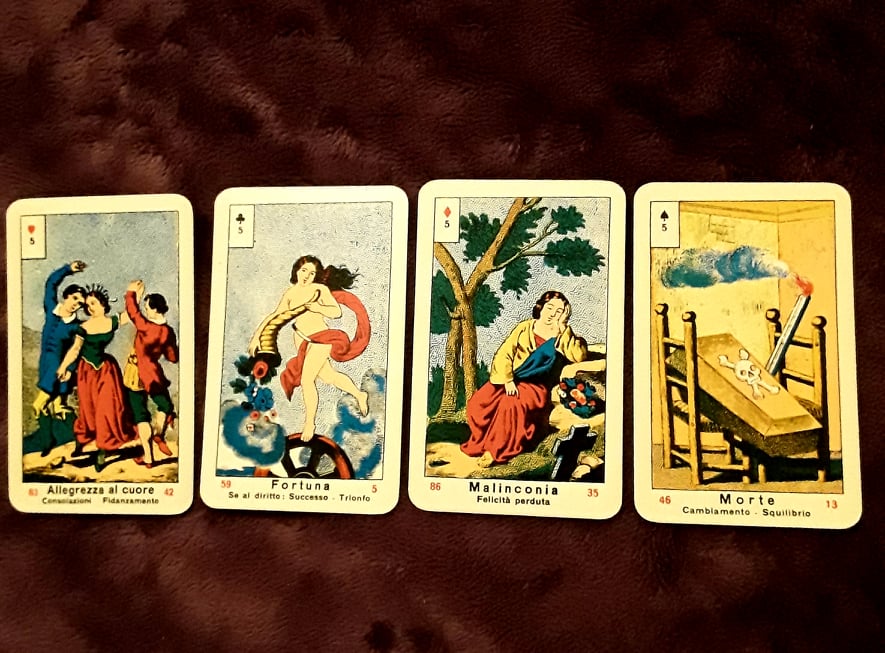
The Fives in the Vera Sibilla: The Five of Hearts (Happiness in the Heart), The Five of Clubs (Fortune), The Five of Diamonds (Melancholy) and the Five of Spades (Death)

The Five of Hearts, Happiness in the Heart, is the card of engagement, which is the transition between being single and being married. In the context of career, this usually means a temporary job or a trial period. More in general, however, this is the card of the “step toward stability”. It shows events put in motion toward a quick and promising resolution. Once this card is activated, unless other negative cards follow, it leads you rather effortlessly to your mark. It is also the card of relatives, which form a sphere of transition between your close family members, i.e. your most private sphere, and an outside world full of unknown people.

At the opposite end of the spectrum, the Five of Spades, Death, obviously shows a different kind of transition. While the Five of Hearts evokes the jollity and mirth of a family gathering, the Death card marches to a much gloomier rhythm. The former shows the quick, flowing motion of the dance of life, the latter shows the same motion coming to an end as its vital force dries up. This is the card of endings. Yes, when something ends, something else begins, but this isn’t saying much: when I die, I stop existing as a live person and begin to exist as a corpse, but that’s hardly reassuring!

In most scenarios, we want this card out of our spreads, unless it’s about inheritance, retiring (i.e. “killing” your career) or conjuring low spiritual energies. However, this card also has an important function when it divides the spread into two halves. In that case, it means that there is going to be a definite and irrevocable transition from one phase of life to the next. Whether this transition is going to be good or bad will be shown by the cards following it.

Between the two polar opposites we have the Five of Clubs, Fortune, and the Five of Diamonds, Melancholy. Fortune is one of the best cards in the deck, though not as good as the Two of Clubs. It marries the keyword associated to the number 5 to the lucky connotations of the suit of Clubs. Hence the classical meaning associated to this card of undeserved success.

Undeserved doesn’t mean that you are nasty and your success is proof that there is no just God holding the world together. It means that, whatever your personal merit might be, the Universe has decided to supplement it with a stroke of luck. You may need to hold your hand out, but it’s not your merit that pennies are raining down from heaven today.

Finally, we need to deal with the most mixed of the Suits in the Vera Sibilla, that of Diamonds. The compromise, here, seems to be that of passing (transitory) disappointment. While it is definitely not a good card, by itself the Five of Diamonds is not catastrophic, and it shows a sense of sadness or dissatisfaction that will eventually end.

By analogy, it represents all those situations that have left us wounded: we have survived them, the wound will heal, but for now it’s there and it itches. While the Five of Hearts is the “step toward stability”, if followed by mixed to negative cards, Melancholy can be the “step toward instability”.