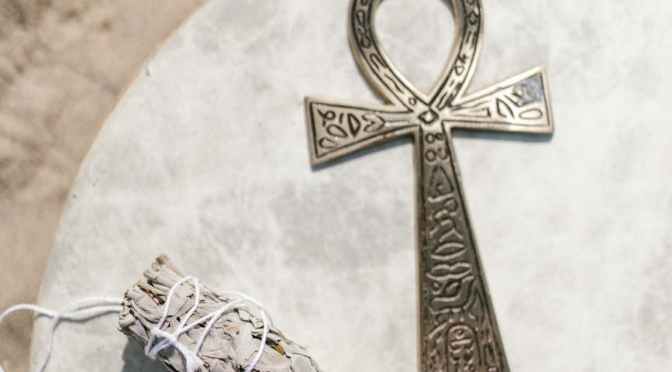
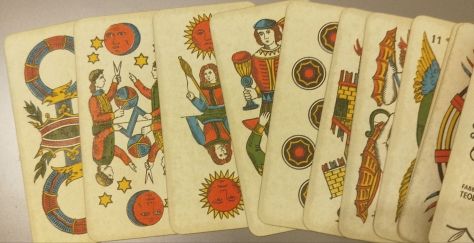
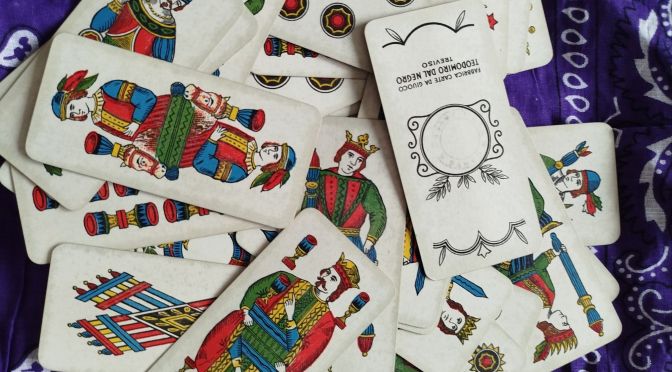
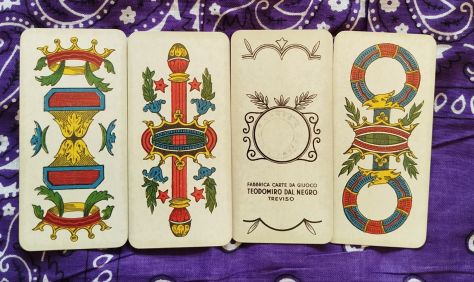
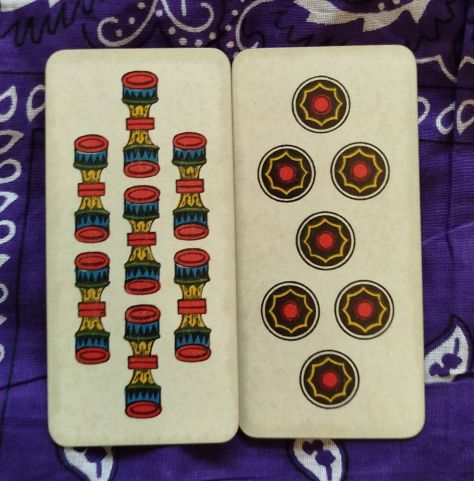
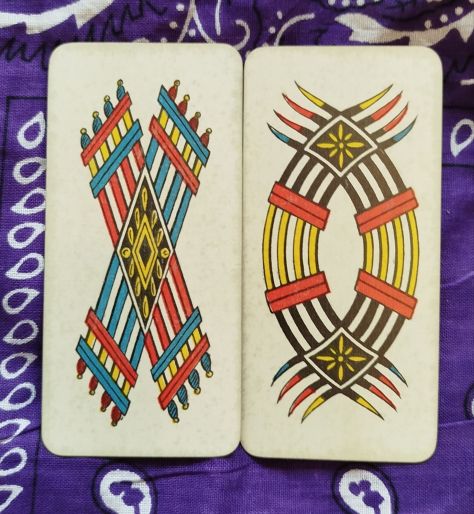
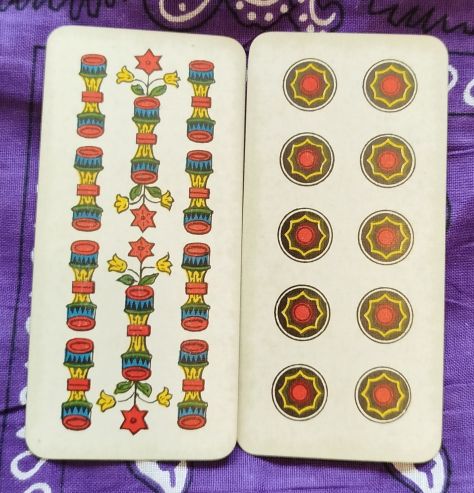
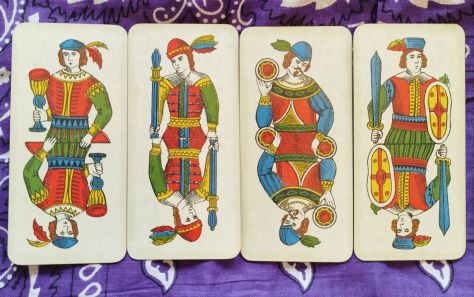
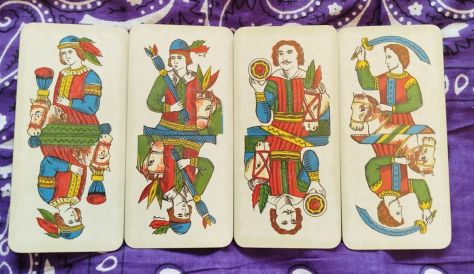
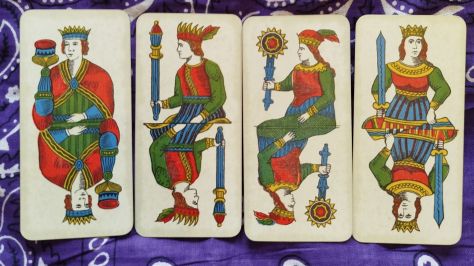
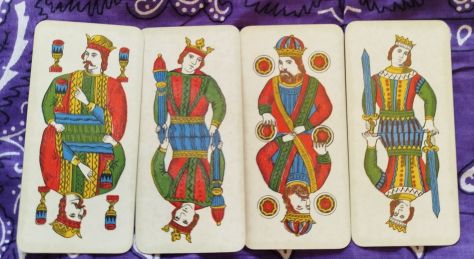
Pretty much every card in the Vera Sibilla has some connection with spirituality and occultism, especially when that’s the topic of the question. However, some cards are more pronounced in the kind of indications they give. The unfortunate thing about this sort of topics is that people tend to use them as a substitute for real life. So, for instance, once someone wrote that the Queen of Clubs can indicate a psychic vampire, and then everyone started reading that card primarily as that for a while (becuase, of course, you are such a wonderful person that everyone wants to leech off of your energy). In reality, unless the question is about spiritual or occult topics, such interpretations are best kept rare, and even then, the surrounding cards need to be kept in mind.
Ace of Hearts – The Conversation (Conversazione)
This is not an especially esoteric or spiritual card, but I’ll talk about it to show how easy it can be to expand a card’s regular meaning to cover those topics. The Conversation card is about words and people meeting or living together. In a spiritual or esoteric reading it can therefore indicate prayers (communion with the divine), exorcisms or spells (the spiritual or esoteric use of words). It can also indicate a group of people operating a ritual or praying together.
Four of Hearts – Love (Amore)
Again, not an especially esoteric card, but it is one of the possible cards indicating the soul (winged, heart-related). It can also indicate that one has the otherworldly tendency to attract certain types of happenings into their life. This has nothing to do with the law of attraction, but merely a statement of the fact that certain people simply tend to end up in specific situations.
Seven of Hearts – The Scholar (Letterato)
The Scholar is connected with the constructive use of the mind. It can therefore indicate plans, including esoteric plans, mostly tending to be good ones. It can also show the divine plan, providence etc.
Eight of Hearts – Hope (Speranza)
The Hope card is the main significator of faith, though not necessarily religious faith. It is heavily indicative of our psychic connection with the divine. It is also involved in those situations where the person has prophetic dreams, psychic powers and all those abilities witches on WitchTok pretend to have but really don’t. Reversed, it can indicate atheism (lack of hope in the divine) or, with very evil cards, it can indicate negative faith systems, such as satanism (we’re talking O9A, not the coastal post-crowleyan, occult-flavored performance art that passes itself off as satansim).
Nine of Hearts – Faithfulness (Fedeltà)
The Faithfulness card is one of great protection and support, whether from worldly friends or from otherworldly ones. As such, it can indicate angels (the Messenger is another possible card for angels, but in a more neutral sense). More commonly, it can indicate devotion to a belief system.
King of Hearts – The Gentleman (Gran Signore)
Obviously, God is the esoteric and spiritual gentleman par excellence, and this is usually what this card can represent. It indicates great protection from the divine (the female counterpart would be the Maiden for the Virgin Mary, or the Girlfriend for a female saint or goddess).
Two of Clubs – The Peacock (Pavone)
The Peacock is one of the cards we look for in sequences about magic and spirituality. When upright, it represents the god-power which unfolds at its own pace, like the peacock’s tail, creating opportunity for marvel and salvation. Esoterically, it shows magic in a neutral to positive sense. It represents oaths and religious vows. Reversed, it is the card of the devil (the one who was doomed by his pride), demons and dark magic.
Three of Clubs Reversed – The Journey (Viaggio)
When reversed, the Journey has a specific connection with white magic in its ability to interrupt any negative trend, harmonizing us with our path in life.
Five of Clubs – Fortune (Fortuna)
In itself the Five of Clubs is the card of destiny, of one’s path through life, whether good or bad. It can represent protection, though not necessarily divine, from magical forces. It can be present when a magical attack is aimed at modifying a person’s natural destiny.
Four of Diamonds – Falsehood (Falsità)
The Falsehood card is the card of negativity in all contexts. Esoterically, it shows negativity in the person’s aura and/or the evil eye, but it usually doesn’t represent heavy black magic.
Six of Diamonds – Thought (Pensiero)
Our thought is where past, present and future coincide and gather in the form of memories, plans and inclinations. It can give us hint as to the person’s inner life, their religious beliefs, their inner and esoteric talent, etc. Reversed, in addition to indicating negative thoughts, it can have a connection with subonsciousness and the powers that are buried within it, or with thought-forms and spirits.
Three of Spades – The Widower (Vedovo)
The Widower is one of the primary culprits we look for when discussing rituals, whether religious or magical. This is especially true when the card is reversed. It is also the card of graveyards and graveyard magic, and it can indicate sects (mostly in a negative sense).
Five of Spades – Death (Morte)
The Death card is always very incisive. It can talk about the person’s aura being out of wack, and it is one of the possible cards representing the summoning of dark forces, especially when reversed.
Eight of Spades – Desperation and Jealousy (Disperato per Gelosia)
The Eight of Spades is strongly connected with magical attacks, whether upright or reversed. It is indicative of demonic presences or dealing with dark forces in a negative sence. Being the card of envy, it can indicate the ill will of the dark magician. Spiritually, it can herald a crisis of faith or beliefs, either leading to loss of faith or to conversion.
Nine of Spades – The Prison (Prigione)
On a positive note, it can indicate the taking of religious vows (which bind us). More commonly it indicates feelings of guilt or feeling limited. Magically it represents the creation of magical bonds.
Ten of Spades – The Soldier (Militare)
Another strongly esoteric card, the Soldier is the card of the night, and therefore of the occult (which means that which is hidden). Because it is the card of attacks, esoterically it can show the tackling of the problem, or more commonly the psychic attack.
King of Spades – The Priest (Sacerdote)
Just like the two Enemies, the Priest can represent a magician. However, it usually signifies the magus in a more neutral and high sense, unless the card is reversed. Spiritually it can indicate spiritual institutions and religions, but also divine justice.
In almost all cartomancy systems, Italian or otherwise, the Ace of Hearts/Cups is the house. Here the Sibilla is an exception, since it relegates the House to the Two of Hearts, although the Ace of Hearts still has connections to the idea of family and people living together. In the second most widespread Sibilla deck in Italy, which is the Sibilla Regionale, which uses the suits of the Neapolitan cards, the Ace of Cups is once again the house.
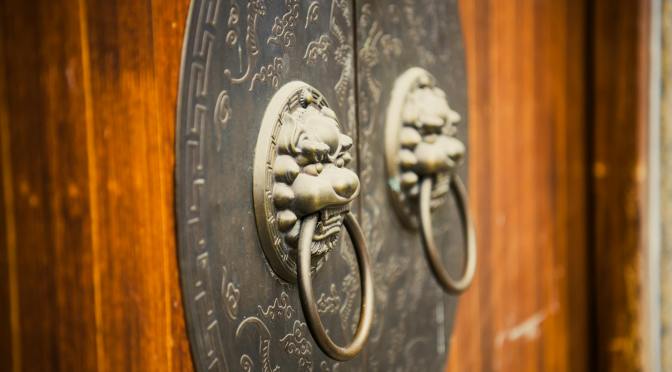
One thing I have so far never found in non-Italian systems, which on the contrary is very widespread in Italy, is the concept of the door knockers, also known as ‘close to home’. This is a meaning that is found in many regional Italian cartomancy systems, and keep in mind that almost everything in Italy is regional, since regions have a much older history as separate states than Italy itself, if we discount the Roman Empire.
When I was taught to read playing cards, my teacher told me that the Two of Hearts is “al martel di porta”, knocking at the door. This refers to the way old house doors are made in many European countries, including Italy, where door knockers were used back when you couldn’t ring at the door. At least in Italy door knockers are still very much en vogue, though mostly as a decorative element.
The idea of the Two of Hearts as “the door knockers” is a reference to the fact that door knockers usually come in twos and to the fact that the Two of Hearts comes right after the Ace, which is the house, so that the Two is quite literally close to the home.
This meaning is also found in many systems for reading Piacentine cards, where the Two of Cups takes on that meaning (in some other systems this meaning is given to the Two of Wands) as well as in the Bolognese Tarot, where it’s the Ace of Swords that depicts it, due to the odd shape of the picture.
In some systems I am aware of, there are two distinct cards: the door knockers and the roof of the house. This is true for some systems employing Piacentine cards, where the Two of Cups is the door knockers and the Four of Wands is the roof.
This distinction is also found in the Bolognese tarot, where the Ace of Swords depicts the door knockers and the Seven of Cups the roof of the house. In the oldest surviving system for reading the Bolognese tarot, which dates back to before the French revolution (I talk about it here), the Knight of Wands indicated the door knockers and the Ten of Cups the roof of the house. Clearly, therefore, this symbolism is deeply ingrained in Italian cartomancy.
According to the person who taught me the 45-card system of Bolognese tarot, the Ace of Swords, the door knockers, tends to show something close to home in a temporal sense (about to happen) whereas the Seven of Cups, the roof, is more connected to everyday life, to our close environment and to the protection of people surrounding us, as well as to the family in a more extended sense. Germana Tartari, who initiated me to the 50-card system, which she was taught by her grandmother and by some of her grandmother’s friends, uses the Nine of Cups as ‘the staircase to the house‘, again mostly in a temporal sense as something about to happen.
On the other hand, in the system for reading playing cards that I was taught, the Two of Hearts covers both possibilities: it indicates something about to knock at the door or it can show family situations, people who are close to us etc.
I have never found this symbolism in other non-Italian systems. If you did, feel free to drop me a line, as it would be very interesting. Manuel Arcuri, an American reader who was taught to read playing cards by his Italian grandmother, says somewhere that his grandmother called the Two of Hearts “l’attesa”, which means waiting or expectation, as of something about to happen. He doesn’t mention door knockers though.
Furthermore, many card reading systems I have read about assign the meaning of “within two weeks” to the Two of Hearts, which once again gives us the idea of something about to knock at the door. Interestingly, Regina Russell‘s playing card system uses the Two of Hearts to indicate excitement for something that is about to happen, expectation and even pregnancy (expecting a child).
(Note: this is a collection of the meanings attributed to the cards by some occultists in the past centuries. It does not reflect my own study or opinion of the cards. It is only meant as a quick comparative reference as I develop my own take.)
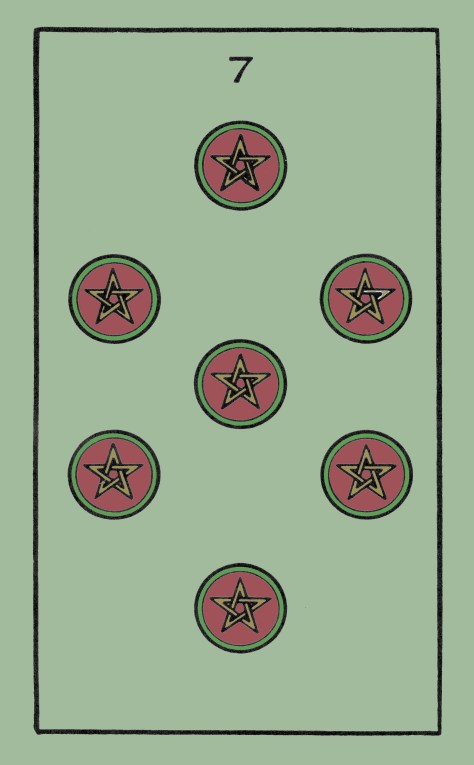
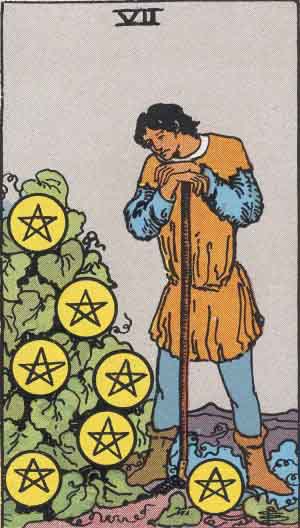
The Seven of Pentacles from the Builders of the Adytum (BOTA) tarot deck
Paul Foster Case (and Ann Davies)
The time period is the third decanate of Taurus, under the rulership of Saturn, May 11 to 20. Meanings: Well-Dignified: slight gains, but of small account; much labor for small returns. Ill-Dignified: something promising turns out badly; loss in speculation and unprofitable employment; financial restriction; unrealized hopes and wishes. Keyword: Loss (From the Oracle of Tarot course)
A. E. Waite
A young man, leaning on his staff, looks intently at seven pentacles attached to a clump of greenery on his right; one would say that these were his treasures and that his heart was there. Divinatory Meanings: These are exceedingly contradictory; in the main, it is a card of money, business, barter; but one reading gives altercation, quarrels–and another innocence, ingenuity, purgation. Reversed: Cause for anxiety regarding money which it may be proposed to lend. (From The Pictorial Key to the Tarot)
The Seven of Pentacles from the Rider Waite Smith tarot
Aleister Crowley
The Seven of Disks is called Failure. This suit gives the extreme of passivity; there is no positive virtue in it below the Abyss. This card is ruled by Saturn. Compare it with the three other Sevens; there is no effort here; not even dream; the stake has been thrown down, and it is lost. That is all. Labour itself is abandoned; every thing is sunk in sloth.
[…]
The number Seven, Netzach, has its customary enfeebling effect, and this is made worse by the influence of Saturn in Taurus. The disks are arranged in the shape of the geomantic figure Rubeus, the most ugly and menacing of the Sixteen. (See Five of Cups.) The atmosphere of the card is that of Blight. On the background, which represents vegetation and cultivation, everything is spoiled. The four colours of Netzach appear, but they are blotched with angry indigo and reddish orange. The disks themselves are the leaden disks of Saturn. They suggest bad money. (From The Book of Thoth)
The Seven of Disks from the Thoth Tarot
Golden Dawn’s Book T
A WHITE Radiating Angelic Hand issuing from a cloud, and holding a white rose branch. Seven Pentacles arranged like the geomantic figure Rubeus. There are only five buds, which overhang, but do not touch the five uppermost Pentacles. Above and below are the Decan symbols, Saturn and Taurus respectively.
Promises of success unfulfilled. (Shewn, as it were, by the fact that the rosebuds do not come to anything.) Loss of apparently promising fortune. Hopes deceived and crushed. Disappointment, misery, slavery, necessity and baseness. A cultivator of land, and yet a loser thereby. Sometimes it denotes slight and isolated gains with no fruits resulting therefrom, and of no further account, though seeming to promise well.
Netzach of HB:H (Unprofitable speculations and employments; little gain for much labour). Therein HB:HRChAL and HB:MTzRAL are ruling Angels.
Etteilla
Money Upright. This card, as far as the medicine of the spirit is concerned, means, in its natural position: Money, Wealth, Sum, Coin. – Silver. – Whiteness, Purity, Candor, Innocence, Naiveté, Moon. – Purgation, Purification. Reversed. Restlessness, Torment of spirit, Impatience, Affliction, Remorse, Concern, Solicitude, Care, Attention, Diligence, Application. – Apprehension, Fear, Distrust, Misgiving, Suspicion.
(Note: this is a collection of the meanings attributed to the cards by some occultists in the past centuries. It does not reflect my own study or opinion of the cards. It is only meant as a quick comparative reference as I develop my own take.)
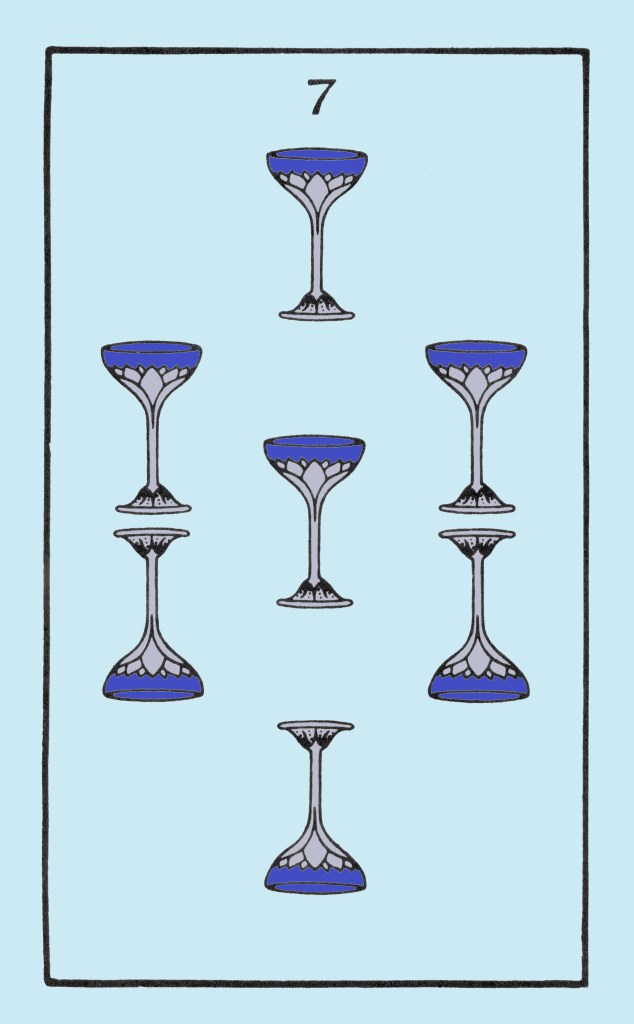
The Seven of Cups from the Builders of the Adytum (BOTA) tarot deck
Paul Foster Case (and Ann Davies)
The time period is the third decanate of Scorpio, November 11 to November 20, under the subrulership of the Moon. Well-Dignified: possible victory, but the person to whom the card applies may be too indolent to take advantage of his opportunities for commanding circumstance. Success may be gained, but not followed up; necessity for choosing only the highest objectives. lll-Dignified: illusionary success; lying and deceit; drunkenness; violence, even lust. Keyword: Illusion (From the Oracle of Tarot course)
A. E. Waite
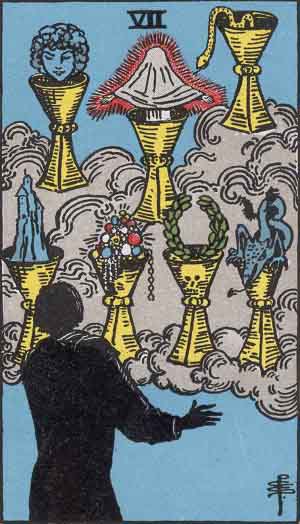
Strange chalices of vision, but the images are more especially those of the fantastic spirit. Divinatory Meanings: Fairy favours, images of reflection, sentiment, imagination, things seen in the glass of contemplation; some attainment in these degrees, but nothing permanent or substantial is suggested. Reversed: Desire, will, determination, project. (From The Pictorial Key to the Tarot)
The Seven of Cups from the Rider Waite Smith Tarot Deck
Aleister Crowley
The Seven of Cups is called Debauch. This is one of the worst ideas that one can have; its mode is poison, its goal madness. It represents the delusion of Delirium Tremens and drug addiction; it represents the sinking into the mire of false pleasure. There is something almost suicidal in this card. It is particularly bad because there is nothing whatever to balance it-no strong planet to hold it up. Venus goes after Venus, and Earth is churned into the scorpion morass.
[…]
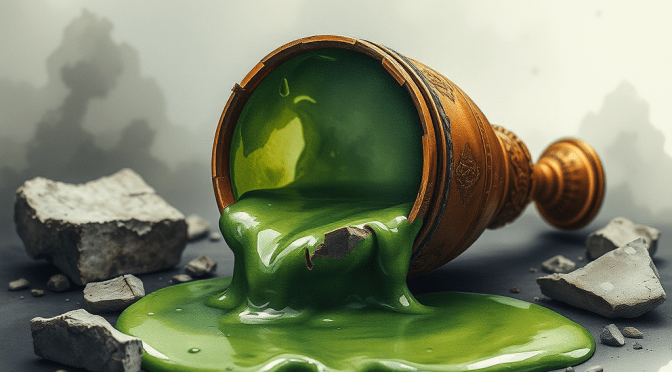
This card refers to the Seven, Netzach, in the suit of Water. Here recurs the invariable weakness arising from lack of balance; also, the card is governed by Venus in Scorpio. Her dignity is not good in this Sign; one is reminded that Venus is the planet of Copper, “external splendour and internal corruption”. The Lotuses have become poisonous, looking like tiger-lilies; and, instead of water, green slime issues from them and overflows, making the Sea a malarious morass. Venus redoubles the influence of the number Seven.
The cups are iridescent, carrying out the same idea. They are arranged as two descending triangles interlaced above the lowest cup, which is very much larger than the rest. This card is almost the “evil and averse” image of the Six; it is a wholesome reminder of the fatal ease with which a Sacrament may be profaned and prostituted.
Lose direct touch with Kether, the Highest; diverge never so little from the delicate balance of the Middle Pillar; at once the holiest mysteries of Nature become the obscene and shameful secrets of a guilty conscience. (From The Book of Thoth)
The Seven of Cups from the Thoth Tarot
Golden Dawn’s Book T
THE seven cups are arranged as two descending triangles above a point: a hand, as usual, holds lotus stems which arise from the central lower cup. The hand is above this cup and below the middle one. With the exception of the central lower cup, each is overhung by a lotus flower, but no water falls from these into any of the cups, which are all quite empty. Above and below are the symbols of the Decanate Venus and Scorpio.
Possible victory, but neutralized by the supineness of the person: illusionary success, deception in the moment of apparent victory. Lying, error, promises unfulfilled. Drunkenness, wrath, vanity. Lust, fornication, violence against women, selfish dissipation, deception in love and friendship. Often success gained, but not followed up. Modified as usual by dignity.
Netzach of HB:H (Lying, promises unfulfilled; illusion, deception, error; slight success at outset, not retained). Herein the Angels HB:MLHAL and HB:ChHVYH rule.
Etteilla
Thought Upright. This card, as far as the medicine of the spirit is concerned, means, in its natural position: Thought, Soul, Spirit, Intelligence, Idea, Memory, Imagination, Understanding, Conception, Meditation, Contemplation, Reflection, Deliberation, Viewpoint, Opinion, Feeling. Reversed. Plan, Design, Intention, Desire, Will, Resolution, Determination, Forethought.
Two of Hearts – The House In most situations, the House card is relatively neutral, as it often indicates the person’s home environment or family, or some other place depending on the combinations. However, in itself the card, when upright, symbolizes a protective environment where the querent feels safe and taken care of. Figuratively, it shows situations that are solid, positive and protective (so you feel at home).
Eight of Hearts – Hope The Hope card’s main meaning is that of representing the hopes and wishes of the querent, and the cards following it will tell us if they come true or not. However, it also indicates the solution of trouble or compensation for it, as the card says “there is hope”. This is especially the case when the Eight of Hearts comes up after a negative sequence of cards. Sometimes the Hope card’s intervention may not be enough to give us what we want, but it will make sure that we come out of a situation still alive and breathing, and with some kind of hope.
King of Hearts – The Gentleman The King of Hearts is, in most situation, a neutral person card, indicating a married man or an older man. However, it does indicate someone who has our interest at heart (unless it is reversed or surrounded by cards of dubious moral quality). He is the archetype of the philanthropist who is out to help others. For this reason, in spiritual readings, it represents God or a saint.
Two of Clubs – The Peacock The best card in the deck, the Two of Clubs represents divine intervention (due to its symbolism of completeness and rebirth). It often shows up to protect us from the worst that could happen, or to increase the quality of something that is already good. It often shows positive undercurrents that do not manifest immediately in all their positive import, but which will save us, protect us or enrich us when they do manifest. For this reason it is known as the talisman card.
Five of Clubs – Fortune While the Two of Clubs indicates divine intervention, the Five of Clubs represents gifts from heaven in the form of good luck. It often indicates positive turns of events, a turn of the wheel that brings us something we want us, or at least something good. Unlike the Two of Clubs, it retains its positivity when reversed, but it becomes delayed or less blatant, maybe a bit less satisying
Seven of Clubs – Gratification The Seven of Clubs is a card of satisfaction, but it also represents our ability to reach our aims and ambitions in the real world. It represents the achievement of goals and reaching of landmarks in one’s life (marriage, promotion, property, recognition, etc.) However, the card can also represent “a light at the end of the tunnel” when it falls after negative cards, indicating, as it were, our ability to pick ourselves up.
Ten of Clubs Reversed – Levity The Butterfly is a symbol of carefreeness, lack of focus and lack of attention. When it is reversed, however, it shows carefulness with one’s finances and, even more importantly, the arrival of good occasions that need to be seized. Although it is not a card of protection per se, it does show us a way out (a new therapy, a new job opportunity, a new meeting, etc.)
Three of Diamonds Reversed – The Gift Again, not a card of protection, but still a welcome sight. It shows situations that somehow sort themselves out, at least in part. It is a relatively weak card, so the presence of very difficult situations may be mitigated only in part, and often it shows some kind of improvement rather than triumph.
Four of Diamonds Reversed – Falsehood When upright, the cat brings falseness and negativity in general. Negativity is to be understood broadly as situations that are negative or bad for us (even when there is no direct lying involved). When it is reversed, the same card brings positivity, relief, solution of trouble.
I don’t often pick three cards for the day, and usually when I do they show very minor situations, for the very good reason that most days are very minor in themselves. The day before yesterday I shuffled the Bolognese Tarot and this came up for the following day:
Three cards for the day
The Sun and Moon, in the Bolognese Tarot tradition, indicate sorrow or tribulation. Usually, when the Moon falls last, the sorrow is serious or lasting, while if the Sun falls last it eventually overcomes the Moon, so the sorrow is shorter or less impactful. Still, what we have here, is sorrow knocking at the door, even though it’s passing. Curious, I decided to deal out some other cards, even though I wasn’t sure the cards would keep talking about the same thing. This came up:
The rest of the deck
Clearly this is not a happy string of cards, and it seems to be dealing with a young woman (the Page of Cups). I wasn’t sure if the young woman had anything to do with me or was experiencing something herself, so I left it at that.
Yesterday, aside from being a mentally taxing day for me, a friend of mine was assaulted by a junkie while walking the dogs, but she managed to make it out of it with nothing more than a big scare and a broken fingernail. She alerted the police, and she asked me what I thought would come of it. This time I whipped out the playing cards.
What will be the consequences of the assault?
The Jack of Spades immediately calls attention to himself, showing a criminal in this case. It is surrounded by two Spades, so trouble or inconvenience for him. The Four is also a card of violence, but I don’t think it has anything to do with it: they are describing what happens to him. Then the spread takes a sharp turn for the better (for the criminal, that is): things change (Five of Diamonds) and he walks (Two of Clubs). I doubted there would be serious consequences. Note also the absence of the law (the King of Spades) or of the prison card (the Five of Spades).
The man was stopped, since he is known around town for being a weirdo, but my friend is probably not going to press charges since she was told there were no witnesses and it would turn into an endless battle of he-says-she-says for what, in the eyes of the law, was a minor scuffle on the streets between two adults. I’ll update the post if anything new happens.
It wouldn’t make sense, at this point, to talk about each single card individually, but I think the cards do warrant a bit more discussion. I am referring to the 45-card system, even though most considerations will apply to the other systems as well.
The Aces
The four Aces in the Bolognese Tarot
Ace of Cups. This is the card of the home environment and of the family, as in many fortune-telling and divination traditions. Its presence usually indicates that the issue somehow relates to the family or the house. However, the card can also occasionally function as a sort of adjective, in that it can indicate a situation or environment is like family. Broadly speaking, the cards surrounding it generally show us whether the family is positive or negative, or is going through a rough patch, etc. I have found that sometimes, when the home or familiar situations simply cannot be part of the interpretation, the Ace of Cups can hint at the intimate life of a person, their inner side, or the intimate relationship between two people.
Ace of Wands. This is a somewhat more complex card. In the main it is a card of sex and sexual interest (or interest in general). However, it represents anything done by two people together, especially marriage (or a strong relationship) or partnership. It portends great vigor, energy, creativity. Another important meaning of this card is that of achievement, personal triumph or personal success, i.e., the ability to reach one’s aims and fulfill one’s aspirations. It is a powerful, active card.
Ace of Coins. In the most ancient set of meanings, this is the card of the table, and it therefore represents sitting together for whatever reason. This meaning has been retained, as well as its metaphorical extensions (conviviality, etc.) It represents daylight. Its most frequent meaning, however, is that of representing finances. Compared to the other money card, i.e., the Ten of Coins, the Ace represents a bigger amount. Whether the amount is coming or going depends on the question and cards surrounding it. Metaphorically it can sometimes portend great satisfaction or a prize.
Ace of Swords. The most common meaning found attached to this card is that of symbolizing the door knockers (see design). The image of the door knockers is widespread in Italian cartomancy and is found in many traditional Italian card reading systems. It symbolizes something about to happen, because it is knocking at the door. However, the card symbolism has also been interpreted as representing two wedding bands being exchanged or a pair of handcuffs. Broadly speaking, therefore, it can show a commitment or a binding situation for better or worse, from marriage to prison, from a contract to an obligation, from an oath to an addiction. The emphasis here is on the binding aspect of it, which limits us, whereas in the Ace of Wands the emphasis is more on doing or achieving something together with someone else.
The Sevens
The two Sevens in the Bolognese Tarot
Seven of Cups. Called the card of the roof or the rooftops. Like all cups, it is strongly connected to the home environment. It is still a card of familiarity and closeness, but in a more extended sense than the Ace of Cups. Therefore, it also symbolizes the city or homeland (depending on the scope of the question). Due to its connection to the roof, it carries a certain connotation of protection with it. It is also another card that can show a quick timeframe.
Seven of Coins. The Seven of Coins is the card of tears. It shows melancholy, sadness, dissatisfaction. In itself it is not a tragic card, but it does indicate loss of heart, feeling down or blue, etc. When it falls together with other difficult cards, though, it compounds their effect, making it worse and showing that it affects the querent emotionally. On rare occasion, when with very positive cards (like the Sun and the Angel) it can show tears or joy, emotional relief in general. This is rare though. Note: some diviners use the Six of Coins instead of the Seven to symbolize tears.
The Eights
The two Eights in the Bolognese Tarot
Eight of Wands. The Eight of Wands is the card of the road or path. The road can be literal, representing a short journey (as opposed to the World), even just going out to meet or visit someone, or it can be metaphorical, indicating something that is moving or requires movement or evolution (e.g., a professional path, a study course, the trajectory of a relationship, etc.) In itself, the card tends to be positive, indicating a situation that is ‘open‘ (like a road) and still developing, but with negative cards it can show the opposite. It can also represent something that is on the way, and therefore, like the Ace of Swords, is about to happen. Note that some diviners use the Six of Wands instead of the Eight.
Eight of Swords. This card is traditionally called ‘passione’, i.e., passion, but more in the sense of the passion of the Christ. It represents torment, suffering and similar fun concepts. It is connected to pain in all its manifestations, whether physical, mental, psychophysical or of different kind. It is also connected with addictions, again literal or metaphorical (as when you make yourself dependent on what your ex thinks or does). Some diviners use the Six of Swords instead of the Eight.
The Tens
The two Tens in the Bolognese Tarot
Ten of Cups. As the image suggests, this is the card of all things that bloom and flourish. It shows rebirth and increase in all fields of life, and situations that metaphorically sprout, bringing mirth. It is the card of fun, of jollity, of parties and of drinking, so with cards showing excess it can indicate alcoholism. It is also the card of blood, so if the other cards seem to point to a stay at the hospital, it doesn’t mean the querent is having the time of his life, only that he is being cut open and blood is coming out.
Ten of Coins. This is again a money card, but its amount is smaller than the Ace. Still, by itself it is a positive card, showing satisfaction and well-being. It represents a positive flow of things, a situation that is calm, tranquil, without major ups and downs (unless the surrounding cards are negative, in which case the calmness is denied, as it were.) With negative cards it can show the querent has little money or little satisfaction.
The Pages
The four Pages in the Bolognese Tarot
Page of Cups. The Page of Cups has the traditional name of ‘coppina‘, i.e., little/young female cup-bearer. It signifies a young, younger or youthful woman, usually belonging to the family or to the querent’s everyday life. With negative cards confirming it, it can represent a rival in love (the fresh young thing snatching hubby from you) or an immature woman. When exploring a woman’s past, it can show “when she was young”. This is one of the hardest cards for me to read, as sometimes it shows up seemingly for no reason, even though there is no young woman involved. I have figured that in these situations she is still a small cup-bearer, cups being joyful, so it can represent the arriving or giving of small joys or satisfactions.
Page of Wands. In the Tarocchino Bolognese, we have not only cards for the male and female querents, but also for their thoughts. The Page of Wands represents the female querent’s thoughts, beliefs, plans, memories, character and inner side.
Page of Coins. This is the card of words, talks, conversations, dialogues. It heralds the arrival of meetings where situations are talked over, agreed on, clarified, etc. Cards surrounding the Page will show either the nature of the words (angry, loving, etc.) their content (work, love, money) or their outcome (agreement, disagreement and so on).
Page of Swords. Traditionally the letter card. Like the Page of Coins, it is a card of communication, but usually written or, nowadays, in the form of messages. It can symbolize documents and things made of paper. It also embodies the broader notion of contacts, developing contacts, coming into contact with others. This is especially relavant when we are not talking about a single specific letter or message.
The Knights
The four Knights in the Bolognese Tarot
Knight of Cups. In Italian, ‘accomodamento’, literally adjustment, compromise, agreement or even repair. This card’s main meaning is simple, but its applications are many: it shows situations that bring conciliation (or reconciliation), healing and the solution of trouble, or at least a way of dealing with it positively. It heralds harmonious interpersonal relationships, smooth sailing ahead, the ironing out of disagreements or difficulties, positive developments.
Knight of Wands. This is the male counterpart to the Page of Wands: the Knight represents the thoughts of the male querent or of a male figure that is involved in the situation. It is the thoughts, beliefs, character, memories and inner side of this male figure. Note, however, that sometimes, when it doesn’t make sense for this (and the Page) to represent thoughts, it can be taken as a secondary significator for the querent: if I show up not as a physical person (King) but as my thoughts (Knight) I am still there, the spread still talks about me.
Knight of Coins. This is the card of the ambassador, as it brings news, developments and similar things connected with the situation we are exploring. It can indicate knowledge of facts from third parties or other sources, but in general it is the card of news. In itself the news is implied to be good news (one of its traditional names is ‘cavallo di buona nuova’, ‘the horse(man) of good news’), because it brings a coin, and coins were considered good in traditionally poor Italian society. However, if the cards surrounding it are bad, the news may be less than positive, or the good news may be blocked or delayed. Sometimes this card can be ‘christened‘ as a young man, if you’ve run out of court cards.
Knight of Swords. The Knight of Swords is the opposite of the Knight of Cups. Where the Knight of Cups adjusts and irons out, the Knight of Swords complicates, twists, brings trouble, difficult situations that are not linear nor smooth (note the curved sword). Where the Knight of Cups conciliates, the Knight of Swords attacks. In interpersonal relationships it brings disagreements, misunderstandings and hurtful words (one of its names is ‘malalingua’, literally evil tongue). If the Knight of Cups brings healing and goodness, the Knight of Swords brings suffering and evil. One of its main symbolic connections is with cuts, either literal (cutting yourself, getting hurt, being cut open by a surgeon, wounds, breaking something) or figurative (cutting words, situations that hurt, etc.)
The Queens
The four Queens in the Bolognese Tarot
Queen of Cups. A mother or a woman in your family, usually. If not in your family, then a friend or someone who acts in your interest. Or should. Always look at the cards surrounding her, as she can be a bad mother or friend if they confirm it, but one who is emotionally invested in you somehow. Mostly, though, it represents the figure of someone who holds you (look how she holds the cup) and has your back. Traditionally she is dark-haired or of dark complexion. Others say she is of medium complexion. Either way, we obviously need to be very careful with descriptions. The Queen of Cups can indicate femininity.
Queen of Wands. If the querent is female, then the Queen of Wands is going to represent her, and the Page of Wands her thoughts. If the querent is male, the Queen can be his partner, or it can be a woman who is somehow important in the situation. Note that when we are talking about triangles, the Queen of Wands is the person who is in the male querent’s heart, regardless of whether she is the official partner.
Queen of Coins. Traditionally ‘the truth‘. This is rarely a physical person. More often than not, it represents truth, reality, authenticity, wisdom, knowledge, education, exactitude, clarity, understanding and the like. It can also say that a situation is as it seems. Or isn’t, if it is surrounded by cards of deceit, indicating the truth is hidden. According to some, it can also sometimes stand for a blonde woman or a wise woman. A traditional phrase attached to this card is ‘di verità conferma’, meaning ‘confirming the truth’ or ‘and that’s the truth’: sometimes this card comes up at the end of a spread or of a group of cards, and acts like a sort of period, as if saying “and that’s exactly it.”
Queen of Swords. Its traditional name is ‘affliction.’ When this card doesn’t represent a woman, it indicates a situation that brings affliction, either physical or psychological. More often than not, though, it does indicate a woman. Tradition says she is gray-haired or a redhead. Others say she is dark. Again, I would advise caution. The Queen of Swords isn’t necessarily evil: she is another woman, usually less accomodating than the Queen of Cups, but not bad. She can be rigid, or she can be a competent but stern professional. With bad cards then she is a rival, the other woman, or a woman who is out to get you.
The Kings
The four Kings in the Bolognese Tarot
King of Cups. The King of Cups is the male counterpart to the Queen of the same suit. He is typically the father or a man in your family. If not in your family, a friend, a wise male influence, someone who has a good word for you, who will help you (like the Queen, he can be a good boss or coworker). It can embody masculinity in general.
King of Wands. As with the Queen so with the King. This is the male querent, or the female querent’s partner, or another man that is important in the question at hand. The Knight of Wands indicates his thoughts. Again, in a triangle this is the man in the querent’s heart, regardless of whether he is the official partner.
King of Coins. It has several titles in the tradition: ‘uomo/vecchio da soldi’ (man/old man bringing money), doctor, important person, a good lord etc. More than a particular person, it represents a role: that of a professional, of someone who has an important job and/or money. Traditionally it shows someone with a degree, from back when degrees were something special. Being called the doctor, it indicates situations that bring healing and care for the querent’s needs. It can indicate a boss or superior. It can also indicate a situation, whether a job or a relationship or something else, which is helpful or nourishing or ‘important’. Traditionally the King is a man for obvious socio-historical reasons, but nowadays it can indicate a woman as well, especially if next to a female court card.
King of Swords. The male counterpart to the Queen, his traditional name is ‘spadino’, i.e., little/young sword-bearer. It can represent a man who is young and/or immature, like the Page of Cups, such as a son or nephew. When exploring a man’s past, it can indicate ‘when he was younger’. It can show a new entry in the querent’s love life, someone who hasn’t yet been promoted to King of Wands. He can be a rival or a problematic man, if with negative cards, or a problematic or immature situation in general. More often than not, it is a literal male figure. Whether positive or negative, it is shown by the other cards. In some traditions it can show a military man, a soldier, a policeman or similar. Look at the other cards for confirmation.
Here I gather all my writings about my explorations with the Tarocco Bolognese or Tarocchino Bolognese (literally Small Bolognese Tarot), a traditional Northern-Italian fortune-telling deck. There are traditionally several ways of using this deck, almost all of which require the reader to create a reduced pack (hence the ‘small tarot’). The most common systems use a reduced pack of 50 or 45 cards, with the 45-card deck being probably older. Although I quickly introduce both systems, I currently focus mainly on the 45-card system.
(Note: this is a collection of the meanings attributed to the cards by some occultists in the past centuries. It does not reflect my own study or opinion of the cards. It is only meant as a quick comparative reference as I develop my own take.)
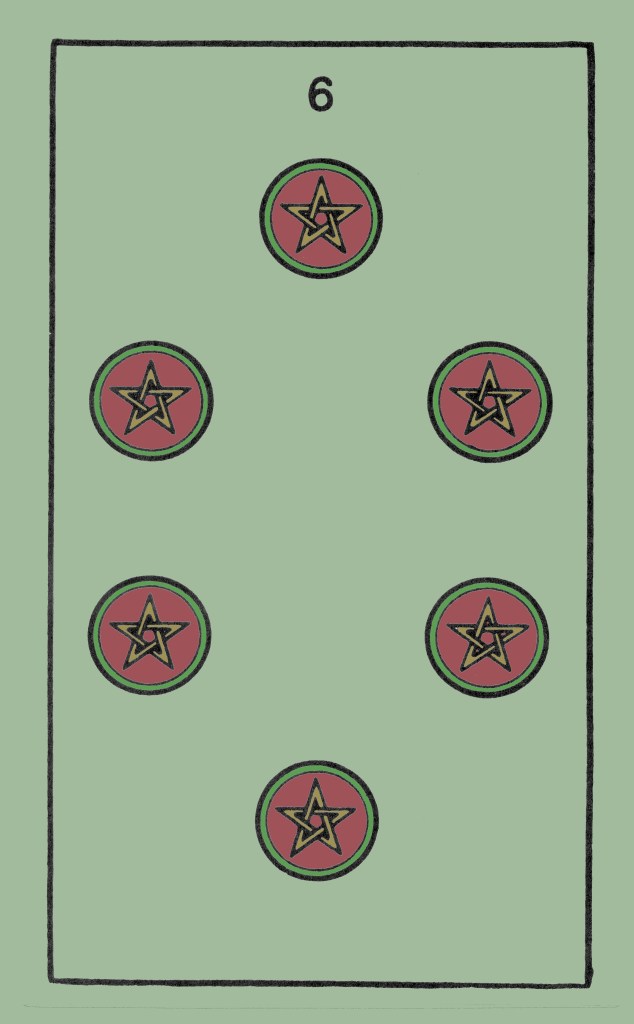
The Six of Pentacles from the Builders of the Adytum (BOTA) tarot deck
Paul Foster Case (and Ann Davies)
The time period is the second decanate of Taurus, under the rulership of Mercury, from April 30 to May 10. Meanings: Well-Dignified: practicality and determination; discretion and diplomacy; gain by letters, writing, travel, speaking, teaching, commissions and through advertising, study, books and all things ruled b Mercury. Ill-Dignified: Loss through the same things. Keyword: Prosperity. (From the Oracle of Tarot course)
A. E. Waite
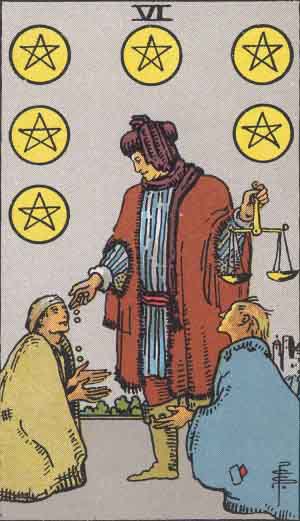
A person in the guise of a merchant weighs money in a pair of scales and distributes it to the needy and distressed. It is a testimony to his own success in life, as well as to his goodness of heart. Divinatory Meanings: Presents, gifts, gratification another account says attention, vigilance now is the accepted time, present prosperity, etc. Reversed: Desire, cupidity, envy, jealousy, illusion. (From The Pictorial Key to the Tarot)
The Six of Pentacles from the Rider Waite Smith Deck
Aleister Crowley
The Six of Disks is called Success; the ruler is the Moon. This is a card of settling down; it is very heavy, wholly lacking in imagination, yet somewhat dreamy. Change is soon coming upon it; the weight of earth will ultimately drag the current down to a mere eventuation of material things. Yet the Moon, being in Taurus, the sign of her exaltation, the best of the Lunar qualities are inherent. Moreover, being a Six, the solar Energy has fertilized her, creating a balanced system for the time being. The card is worthy of the name Success. Remember only that all success is temporary; how brief a halt upon the Path of Labour.
[…]
The Number Six, Tiphareth, as before, represents the full harmonious establishment of the Energy of the Element. The Moon in Taurus rules the card; and this, while increasing the approach to perfection (for the Moon is exalted in Taurus and therefore in her highest form) marks that the condition is transient.
The disks are arranged in the form of the Hexagram, which is shown in skeleton. In the centre blushes and glows the light rose-madder of dawn, and without are three concentric circles, golden yellow, salmon-pink, and amber. These colours show Tiphareth fully realized on Earth; it reaffirms in form what was mathematically set forth in describing the Ace.
The planets are arranged in accordance with their usual attribution; but they are only shown as disks irradiated by the Sun in their centre. This Sun is idolized as the Rose and Cross; the Rose has forty-nine petals, the interplay of the Seven with the Seven. (From The Book of Thoth)
The Six of Disks from the Thoth Tarot deck
Golden Dawn’s Book T
A WHITE Radiant Angelic Hand holding a rose branch with white roses and buds, each of which touches a Pentacle. Pentacles are arranged in two columns of three each:
* * * * * * Above and below are the symbols Taurus and Moon of the Decan. Success and gain in material undertakings. Power, influence, rank, nobility, rule over the people. Fortunate, successful, liberal and just. If ill dignified, may be purse-proud, insolent from excess, or prodigal.
Tiphareth of HB:H (Success in material things, prosperity in business). Herein rule the Angels HB:NMMYH and HB:YYLAL.
Etteilla
The present Upright. This card, as far as the medicine of the spirit is concerned, means, in its natural position: Present, Presently, Now, Immediately, At the instant, At this time, Today, Attending, Witnessing, Contemporary. – Attentive, Careful, Vigilant. Reversed. Desire, Vow, Ardor, Haste, Passion, Searches, Cupidity, Want, Jealousy, Illusion.
(Note: this is a collection of the meanings attributed to the cards by some occultists in the past centuries. It does not reflect my own study or opinion of the cards. It is only meant as a quick comparative reference as I develop my own take.)
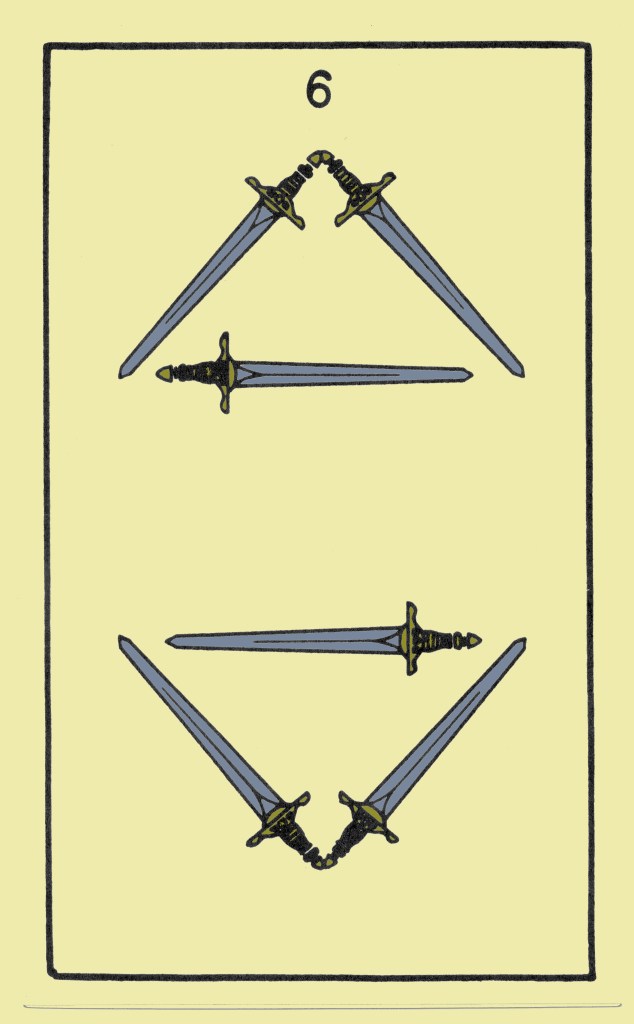
The Six of Swords from the Builders of the Adytum (BOTA) tarot deck
Paul Foster Case (and Ann Davies)
The Six of Swords corresponds to the second decanate of Aquarius under the rulership of Mercury, January 30 to February 8. Well-Dignified: success after a period of trouble or anxiety; difficulties overcome; change of scene, possibly a journey by water; something mysterious effects a change o f circumstances for the better; success earned by the Querent’s laborious efforts. Ill-Dignified: sudden changes; circumstances dominate the Querent; he is in danger of being over-confident or conceited; too much effort expended for small results. Keyword: Patience (From the Oracle of Tarot course)
A.E. Waite
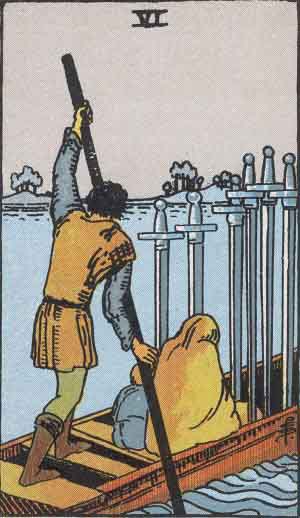
A ferryman carrying passengers in his punt to the further shore. The course is smooth, and seeing that the freight is light, it may be noted that the work is not beyond his strength. Divinatory Meanings: journey by water, route, way, envoy, commissionary, expedient. Reversed: Declaration, confession, publicity; one account says that it is a proposal of love. (From The Pictorial Key to the Tarot)
The Six of Swords from the Rider Waite Smith tarot
Aleister Crowley
The Six of Swords is called Science. Its ruler is Mercury, so that the element of success turns away from the idea of division and quarrel; it is intelligence which has won to the goal.
[…]
Tiphareth shows the full establishment and balance of the idea of the suit. This is particularly the case with this card, as the intellect itself is also referred to the number Six. Mercury, in Aquarius, represents the celestial Energy influencing the Kerub of the Man, thus showing intelligence and humanity.
But there is much more than this in the symbol. The perfect balance of all mental and moral faculties, hardly won, and almost impossible to hold in an ever-changing world, declares the idea of Science in its fullest interpretation.
The hilts of the Swords, which are very ornamental, are in the form of the hexagram. Their points touch the outer petals of a red rose upon a golden cross of six squares, thus showing the Rosy Cross as the central secret of scientific truth. (From The Book of Thoth)
The Six of Swords from the Thoth Tarot deck
Golden Dawn’s Book T
TWO hands, as before, each holding two swords which cross in the centre. Rose re-established thereon. Mercury and Aquarius above and below, supported on the points of two short daggers or swords.
Success after anxiety and trouble; self-esteem, beauty, conceit, but sometimes modesty therewith; dominance, patience, labour, etc.
Tiphareth of HB:V (Labour, work, journey by water). Ruled by the Great Angels HB:RHa’aAL and HB:YYVHL.
Etteilla
Road Upright. This card, as far as the medicine of the spirit is concerned, means, in its natural position: Road, Avenue, Walk, Course, Passage, Path, Way. – Path, Tract, Gait, Origin, Conduct, Means, Manner, Way, Expedient, Run, Career, Walk, Pattern to be followed, Track, Footprint, Sending, Commissary [= Deliveryman]. Reversed. Declaration, Declaratory act, Development, Explanation, Interpretation. – Charter, Constitution, Diploma, Manifest law, Ordinance. – Publication, Proclamation, Ostensibility, Manifesto, Publicity, Authenticity, Notoriety. – Denunciation, Census. – Enumeration. – Knowledge, Discovery, Unveiling, Vision, Revelation, Apparition, Appearance, Admission, Confession, Protest, Approval, Authorization.